Random but System-Wide Unique Unlinkable Parameters
Peter Schartner
System Security Group, Klagenfurt University, Klagenfurt, Austria Email: [email protected]
Received August 23, 2011; revised October 24, 2011; accepted November 4, 2011
ABSTRACT
When initializing cryptographic systems or running cryptographic protocols, the randomness of critical parameters, like keys or key components, is one of the most crucial aspects. But, randomly chosen parameters come with the intrinsic chance of duplicates, which finally may cause cryptographic systems including RSA, ElGamal and Zero-Knowledge proofs to become insecure. When concerning digital identifiers, we need uniqueness in order to correctly identify a spe- cific action or object. Unfortunately we also need randomness here. Without randomness, actions become linkable to each other or to their initiator’s digital identity. So ideally the employed (cryptographic) parameters should fulfill two potentially conflicting requirements simultaneously: randomness and uniqueness. This article proposes an efficient mechanism to provide both attributes at the same time without highly constraining the first one and never violating the second one. After defining five requirements on random number generators and discussing related work, we will de- scribe the core concept of the generation mechanism. Subsequently we will prove the postulated properties (security, randomness, uniqueness, efficiency and privacy protection) and present some application scenarios including system- wide unique parameters, cryptographic keys and components, identifiers and digital pseudonyms.
Keywords: Randomness; System-Wide Uniqueness; Unique Cryptographic Parameters; Cryptographic Keys; Digital
Identifiers; Digital Pseudonyms; UUID; Universally Unique Identifiers; GUID; Globally Unique Identifiers
1. Introduction
Concerning cryptographic parameters, cryptographic keys and digital identifiers, randomness is the foremost re- quirement. With respect to cryptographic applications, the lack of sufficient randomness causes security risks which may result in faster attacks or completely compromised systems. In the field of digital identifiers, the lack of randomness may cause privacy problems, when identify- ers (and hence actions) become linkable to each other or to the identity of a specific instance or person.
Beside the positive effects of randomness mentioned above, random generation processes unavoidably come with the intrinsic risk of duplicates. Unfortunately, these duplicate cryptographic parameters, cryptographic keys and digital identifiers can put the security of safety- or security-critical systems at risk as well.
1.1. The Risks of Pure Randomness
Digital Identifiers: In our everyday electronic life, du-
plicate parameters used as digital identifiers may cause severe problems. Think of object and message identifiers or digital identities in e-business or e-government appli- cations. In the first case, duplicate identifiers may cause inconsistencies in databases or the system’s registry. In the second case, records of different instances or persons
may become inseparably mixed up. Both situations may end up in disaster.
In the context of security systems like RSA encryption and signature schemes, ElGamal signature schemes and zero knowledge proofs, duplicates may cause the fol- lowing problems (for details on the following attacks we refer the reader to [1,2]):
RSA [3]: Assume that two instances accidentally
choose the same prime when generating the RSA key pair. Since this common prime is a factor of both moduli, an attacker can easily determine the second factor of the two affected moduli. Afterwards, he can determine the according private keys. If the key pairs have been used in an encryption scheme, the attacker can now decrypt messages he is not authorized for. In case of a signature scheme, he can sign on the victims’ behalf and hence fake their identities.
ElGamal[4]: If a signing instance signs two different
messages using the same randomizer, the attacker can retrieve the private signing key by solving two linear congruencies. Again, the signature scheme is broken.
Zero Knowledge Proofs[5]: Consider two rounds of
use of the third messages. Again the attacker can now fake the identity of the victim.
1.2. The Problem of Randomness vs Uniqueness
In order to avoid the problems mentioned above, we need random and unique (cryptographic) parameters. Unfor-
tunately, randomness and (system-wide) uniqueness are potentially conflicting requirements. Pure randomness includes the risk of duplicates and hence may violate uniqueness, whereas generation processes which guaran- tee system-wide uniqueness may reduce randomness or cause the generation to be either inefficient or prone to other attack scenarios.
1.3. Our Contribution
In this article we will propose a solution for the problem of randomness vs. uniqueness: a scheme to generate prova- bly system-wide unique, but highly random and unlink- able numbers (called collision-free numbers—CFNs) which can be used as digital identifiers (or pseudonyms) and cryptographic parameters and keys.
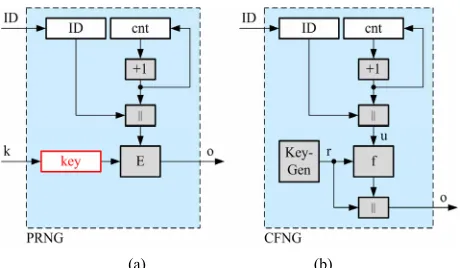
As other approaches, our scheme is based on a unique identifier for the generating process and additional non- invertible (cryptographic) mechanisms to disguise it and hence protect the generator’s privacy. Simply spoken, our approach is a counter-based pseudo-random number generator (PRNG) with a fresh (random) key for each call of the generator (see Figure 6 for a PRNG (left) and our
approach (right)). It is clear, that providing both proper- ties at the same time, will not be achievable without extra costs. Based on a short discussion of related work, we will show that this overhead is quite low compared to the existing methods of generation (see Table 1), which in
contrast to our approach do not provide randomness and uniqueness simultaneously.
The remainder of this article is structured as follows: In order to provide a base for our design and the subse- quent analysis, we will first define five requirements on random number generators and provide the most essen- tial cryptographic preliminaries. Based on the require- ments we will briefly discuss existing approaches. The analysis will show that none of the existing generation methods simultaneously fulfills all requirements. Hence there is need for a new approach. After presenting the design principle of CFNGs we will prove the fulfillment of the stated requirements and close with a discussion of application scenarios for CFNGs.
2. Requirements on Random Number
Generators
In order to avoid the risks of duplicates when generating and using cryptographic parameters or digital identifiers, we postulated two additional requirements on the em-
ployed secure and efficient generators for random num- bers in [2]: Uniqueness and Privacy Protection. We called generators providing the following properties col-lision-free number generators (CFNG) and the outputs of
such generators collision-free numbers (CFNs):
1) Security. 2) Randomness. 3) Efficiency. 4) Uniqueness. 5) Privacy Protection.
We are aware of the fact, that depending on the appli- cation scenario, not all of the above requirements may be necessary or there may be additional requirements. Nev- ertheless, in the scope of generating cryptographic pa- rameters (like keys) and digital identifiers, these re- quirements are necessary to obtain a secure generating process and hence the existing methods of generation and our proposed approach will be analyzed with respect to the five requirements stated above.
2.1. Security
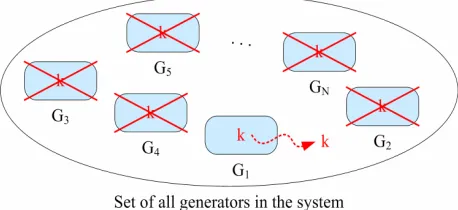
If one CFNG is compromised, all outputs previously gener- ated by this specific generator should remain secure. Ad- ditionally, all other CFNGs in the system must not be affected. This means that there should not be a central- ized CFNG (since compromising this CFNG immedi- ately compromises the whole system) and distributed CFNGs must not use any common secrets like the secret key k used by the compromised generator G1 in Figure 1.
2.2. Randomness
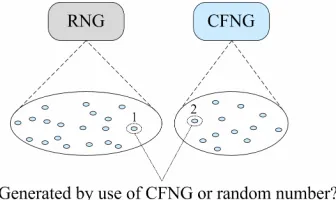
Ideally, the outputs of CFNGs (see value 2 in Figure 2)
are indistinguishable to the outputs of true random num- ber generators (RNG—see value 1 in Figure 2).
[image:2.595.308.537.603.708.2]In fact, the proposed generators will be based on true random numbers, but will be post-processed to fulfill the newly introduced requirement of uniqueness. Neverthe- less, the only way to verify the randomness is to perform statistical tests (like the DIEHARD test suite [6]) on the generated sequences and compare the outputs to the properties of true random sequences.
2.3. Efficiency
Concerning efficiency, minimal communications is the foremost requirement. Ideally, as depicted in Figure 3,
there is no communication during the generation process and only one-time communication during the initialize- tion. Nevertheless, to enable the usage of smart cards and other security token with limited resources, memory and computational demands should also be kept as low as possible.
2.4. Uniqueness
All outputs of all CFNGs within a system have to be unique, i.e., there must not be any duplicates during the
life-time of the system. As depicted in Figure 4, ran-
domly generated values may be system-wide unique (e.g. outputs 1, 2 and 3), locally, but not system-wide unique (e.g. outputs 4 and 5) or not unique at all (e.g. outputs 6 and 7).
Local duplicates may be detected by storing all outputs and comparing the currently generated value against the stored ones. Obviously, this method will need a consid- erable amount of memory over the life-time of the gen- erator. But even worse, global duplicates cannot be de- tected without communication with all the other genera- tors or a centralized instance for checking. Besides a tremendous communication overhead, this again calls for local or centralized storage of all outputs for later com- parison, which is obviously a bad idea with respect to the requirements “security” and “privacy protection”.
2.5. Privacy Protection
Depending on the application scenario, outputs of CFNGs should not be linkable. As Figure 5 shows, with respect
to the protection of the generator’s identity, especially two questions are of interest:
Which CFNG has generated this (a specific) number?
Have these numbers been generated by the same CFNG?
3. Cryptographic Preliminaries
Within this article the reader needs only a basic under- standing of cryptography. So we will provide the most important facts and refer the reader to [7,8] for a detailed discussion of the basic concepts and more sophisticated cryptographic algorithms and protocols.
Symmetric encryption provides confidentiality.
En-cryption E and deEn-cryption D use the same key k: c =
Ek(m), m = Dk(c) with plaintext m and ciphertext c.
Without the knowledge of k, m cannot be efficiently re-
trieved from c. Most commonly, symmetric encryption
algorithms are block-oriented, i.e., they work on input
[image:3.595.339.507.84.184.2]blocks of fixed length. Candidates for symmetric encrypt
[image:3.595.307.541.212.435.2]Figure 2. Outputs of a RNG and a CFNG.
[image:3.595.307.538.457.565.2]Figure 3. Efficiency considerations.
Figure 4. Outputs of RNGs and CFNGs.
Figure 5. Privacy protection.
tion include DES [9] (Data Encryption Standard, 64 bit blocks and 56 bit keys), 3DES [10,11] (64 bit blocks and 112 bit keys), Skipjack [12] (64 bit blocks and 80 bit keys) and AES [13] (Advanced Encryption Standard, 128 bit blocks and 128,192 and 256 bit keys).
Asymmetric encryption also provides confidentiality,
but uses different keys for encryption and decryption: c =
Ee(m), with public key e and m = Dd(c), with private key d. Without knowing d, m cannot be efficiently retrieved
from c, and d cannot be efficiently derived from e
(minimum key length 1024 bit) and ECC [8] (Elliptic Curve Cryptography, minimum key length 160 bit).
Cryptographic Hash-functions H are compressing
one-way-functions, which convert a large, arbitrary sized input m into a small, fixed size hash value h (most
com-monly 128 or 160 bit): h = H(m). Candidates for Hash-
functions include SHA-1 [14] and RIPEMD160 [15], both with 160 bit outputs and the SHA-2 family [16] (224 to 512 bit outputs). Note that both, symmetric and asy- mmetric encryption and decryption functions are bijec-tive for an arbitrary, but fixed key, whereas hashfunc-tions are by definition not injective!
4. Related Work
There exist at least three straight forward solutions for generating random and system-wide unique parameters:
The naive attempt of centralized generation and check obviously avoids duplicates but is quite inefficient
concerning storage (all previously generated parameters have to be stored for later comparison) and communica-tion (each instance which needs a parameter has to wait for the centralized generator to send it). Additionally, the centralized generator has full control over the generating process and knows all parameters. So, compromising this generator compromises the complete system.
With local generation and check, only the generation
itself is done locally, but the comparison against all pre- viously generated parameters has to involve all other generators or a centralized service. Again, efficiency and security are quite questionable.
Local generation based on pseudo-random number generators (PRNG, see [7]) can avoid centralized
stor-age and comparison and is efficient in terms of memory and communications. But in order to avoid duplicates, all PRNGs have to use a common key or common secret parameters. So, if one of them is compromised, all of them become insecure. Additionally, the generated pa- rameters are no longer random, but pseudo-random and
this approach is not suitable for software implementation, because by use of software, the system-wide key (or se- cret parameter) cannot be protected sufficiently.
A more sophisticated approach is the so called loca- tion- and time-based generation which simply uses
location and time provided by a GPS receiver to derive a unique seed for the generation process. The idea behind this concept: two generation processes cannot take place at the same place and the same time. Besides the fact that
the GPS signal will not be available at all locations, the according paper does not specify, how (pseudo-) ran-domness and uniqueness are maintained (see [17] for details).
A widely adopted approach for system-wide unique system parameters are universally unique identifiers
(UUIDs, see [18]) and globally unique identifiers (GUIDs,
see [19]), Microsoft’s implementation of GUIDs. There exist several variants of GUIDs, but these variants either use the MAC address to guarantee uniqueness or they employ hash-functions or purely pseudo-random values. Except the first one, which violates the privacy require-ment, none of them can guarantee uniqueness.
Besides the attempts mentioned above, there exist some national methods for the generation of identifiers
[image:4.595.76.521.582.736.2]used in e-business and e-government processes. Again, these methods employ hash-functions to protect the iden-tity of the generating process and come with the un-avoidable risk of duplicates (e.g. see [20]).
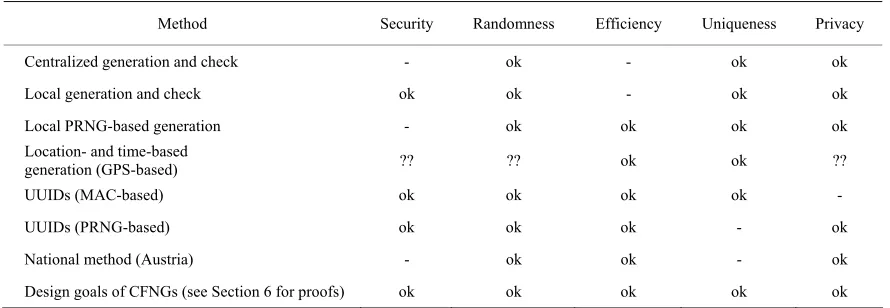
Table 1 shows a summary of the discussed related
work according the requirements stated in Section 2. Here “-” denotes, that the described generation method lacks a certain property, “??” denotes that it is unclear whether a generator provides a specific property (ac- cording to the publicly available specification) and “ok” denotes that the generator provides the property.
Note that none of the existing approaches shows “ok” for all five requirements. The analysis of our approach (see Section 6) will show that CFNGs (collision-free number generators) fulfill all requirements.
Table 1. Related work—a short analysis and comparison.
Method Security Randomness Efficiency Uniqueness Privacy
Centralized generation and check - ok - ok ok
Local generation and check ok ok - ok ok
Local PRNG-based generation - ok ok ok ok
Location- and time-based
generation (GPS-based) ?? ?? ok ok ??
UUIDs (MAC-based) ok ok ok ok -
UUIDs (PRNG-based) ok ok ok - ok
National method (Austria) - ok ok - ok
5. The Concept of Collision-Free Numbers
The core concept of collision-free number generators (CFNG) is closely related to pseudo-random number generators based on the CTR-mode of block-ciphers which uses a random but fixed key k throughout its lifetime (see Figure 6(a)). The crucial difference of CFNGs comparedto a PRNG in CTR-mode is that the key used by the CFNG is freshly chosen at random for each call of the generator (see Figure 6(b)).
Informally, our approach is based on three facts:
Use counters that generate system-wide unique out-puts u. This can easily be achieved by using counters
of the following form: u = ID||cnt, where ID is a
hier-archically structured identifier (e.g. the ICCSN of a
smartcard), unique for each generator, and cnt is a
locally stored value, which is incremented before each call of the generator.
Employ some injective mixing function f u r
, whichhides the value of u by use of a so called randomizer r.
This randomizer is freshly chosen at random for each call of the generator and deleted immediately after usage.
In order to fix the uniqueness, embed the randomizer
r in the output o of the generator by use of an
injec-tive bit permutation (or expansion). For the ease of discussion, we will use the concatenation (||) throughout the remainder of this article.
More formally defined, the output o of a basic—type
1—CFNG (denoted as CFNG1 in the remainder of this article) is of the form
, r
CFNG1 ,
o f u r r f u r
with f being an injective mixing transformation for an
arbitrary but fixed randomizer r and u, r defined as above.
We suggest to either use an injective one-way mix-ing-transformation for fr, according to Shannon [21] (e.g.
symmetric encryption), or an injective probabilistic one- way function, based on an intractable problem (e.g. the discrete logarithm problem [7]).
[image:5.595.57.287.570.704.2](a) (b)
Figure 6. Block-cipher in CTR-mode and the concept of CFNG (type 1).
Note that originally, CFNGs have been called quasi- random number generators (QRNG). Since our genera-tors provide numbers being neither pseudo-random nor random, QRNG—alphabetically and concerning the out- puts being somewhat between PRNGs and true RNGs— would be the perfect name. Unfortunately the abbrevia- tion QRNG collides with generators for quasi random sequences used for statistical testing. Hence to avoid this duplicate, we changed the name to CFNG.
6. Fulfillment of Requirements
6.1. Security
In our approach, all security critical parameters like ran- domizers or keys are nonces (numbers used once) gener- ated on demand, i.e., at each call of the generator. They
are neither stored, nor transferred outside the generator. Hence, compromising one generator cannot affect any other generator in the system.
6.2. Uniqueness
In the following we will first give a proof for the uniqueness of outputs of Type 1 CFNGs. Based on this proof we will analyze Type 2 and Type 3 generators. Note that the lifetime of the system and especially of the generators employed within this system is defined by the time, none of the counters cnt used inside of the CFNGs
has an overflow.
Theorem:Outputs of Type 1 CFNGs are unique dur- ing their lifetime.
Proof: Consider two outputs of two arbitrary type 1
CFNGs: o1 CFNG11
fr1
u1 r1 and
2 CFNG12 2 2 2
o fr u r , with r1, r2 being random and u1ID cnt1 1 and 2 2 2 . With respect to
the randomizers r1 and r2, there are two cases:
u ID cnt
1) r1r2: This directly means that o1≠o2.
2) r1 r2 r: Now, both calls of the generators
em-ploy the same randomizer and fr becomes injective.
Hence fr
u1 and fr
u2 will be different if andonly if u1ID cnt1 1 and u2 ID cnt2 2 differ in at
least one bit. This is always true, because
Different generators use different identifiers
ID1ID2
, and If we call the same generator twice (i.e., ID1ID2), the values cnt1 and cnt2 will differ, because the counter is incremented at each call of the generator.
Hence the outputs o1 and o2 will be different again.
Corollary:Outputs of type 2 and type 3 CFNGs are unique during their lifetime.
Proof: Function g, applied to the unique inputs in type
6.3. Privacy Protection
When analyzing CFNGs which employ a block cipher E for f
oEr
ID cnt r
c r
, it is obvious that theidentity of the generator is not protected sufficiently. Everybody who gets hold of an output o can retrieve the
identifier ID of the according generator by simply de-
crypting c by use of r: ID cnt Dr
c . We will latersee that this may not be a problem in certain application scenarios, but in order to guarantee the protection of the generator’s ID we have either to change our requirements
on f, or we have to slightly change the design of CFNGs.
To provide privacy, f has to be a cryptographic one-
way function. Candidates include injective probabil-istic one-way functions based on an intractable prob-lem like the (ECC) discrete logarithm probprob-lem [7].
In the case that f is a (bijective) symmetric encryption
function, we can employ an additional (injective) one- way-function g to the output or to the randomizer of
the original CFNG, which results in the variants de- picted in Figure 7.
Both variants shown in Figure 7 eliminate the attack
described above. Now the attacker is faced with the problem of inverting function g, which is practically im-
possible. Hence, the output of function f in case of type 2
CFNGs, and the randomizer r in case of type 3 CFNGs,
stays secure and the identity of the generator is safe again.
6.4. Randomness
Remember that in case of type 1 CFNGs, the second half of the output is the randomizer, which is—as the name implies—generated at random. Function f is (with respect
to the random input r) an injective mixing transformation,
like a symmetric or asymmetric encryption function. Hence its output is pseudo-random.
Function g, applied in type 2 and type 3 CFNGs is a
(injective) one-way-function. The randomness of its out- put depends on the randomness of its input, which is ei-ther the pseudo-random output of f (type 2 CFNG), or the
randomizer r (type 3 CFNG).
Concerning the randomness of the outputs, we will briefly analyze the three types of CFNGs separately:
Type 1 CFNGs: The output is a concatenation of
pseudo-random and random bits, and hence should “look random”.
Type 2 CFNGs: The input of function g is, as noted
above, partially pseudo-random and random. So, the randomness of type 2 CFNGs should not be worse than the randomness of type 1 CFNGs.
Type 3 CFNGs: The output is a concatenation of
pseudo-random and random bits, transformed by use of function g. So again, the output should “look random”.
For all three types of generators, the statement “should
look random” has been verified by conducting statistical tests with the DIEHARD test suite [6]. See Table 3 for
exemplary DIEHARD results on 500.000 outputs o of a
type 1 CFNG (i.e., 128.000.000 bit) of the form
AESk
o ID cnt k, where ID is a 96 bit identifier (all
zeros), cnt is a 32 bit counter (which runs from 0 to
499.999) and k is a 128 bit key randomly chosen for each
encryption. Hence the length of one output o is 256 bit.
According to [22] we defined three areas: safe, doubtful, and failure, (see Table 2) where more results in the safe
area indicate that the output is closer to randomness and more results in the failure area indicate that the tested sequence deviates from true randomness.
Analyzing Table 3 with respect to the areas failure,
doubt and safe we get 8, 13 and 26 entries, which is (as expected) quite close to the output of AES encrypted data (see [22]). Note that other test outputs and generators might have different outcomes, but this analysis of out- puts of type 1 CFNGs strongly supports our brief theo- retical analysis given above: the outputs “look random”.
6.5. Efficiency
Our system is very effective with respect to communica- tions. The only time we need to interact with a generator is during initialization, where the unique identifier ID is
loaded into the generator’s memory. After that, especially during the generation of CFNs, there is no need for any communication at all.
[image:6.595.307.540.474.717.2]Concerning the computation of CFNs, the approach is
Table 2. Interpretation of DIEHARD p-values: safe—dou- bt—failure.
Area p-value p
Failure area (f) 0 < p≤ 0.10 or 0.90 ≤p≤ 1
Doubt area (d) 0.10 < p≤ 0.25 or 0.75 ≤p < 0.90
Safe area (s) 0.25 < p < 0.75
Table 3. DIEHARD test on type 1 CFNGs.
Test Name p-value Area Test-Name p-value Area Test-Name p-value Area
0.883838 d 0.31904 s 0.92747 f
0.985774 f 0.63408 s 0.60832 s
0.707886 s 0.14583 d 0.05893 f
0.283701 s 0.74402 s 0.59841 s
0.727969 s 0.95016 f 0.10172 d
0.300982 s 0.45042 s 0.77173 d
0.619710 s 0.99874 f 0.25175 s
0.261471 s 0.39829 s 0.32827 s
Birthday Spacing
0.233554 s 0.69937 s 0.74176 s
0.988664 f
Monkey Test
0.73568 s
Monkey Test
0.32743 s Overlapping Permutations
0.256193 s Minimum Distance 0.576871 s Overlapping Sums 0.219271 d
0.414570 s 3D-Spheres 0.111133 d 0.200393 d
0.338007 s Squeeze 0.215885 d Craps 0.197837 d
Binary Rank
0.758256 d 0.211515 d 0.001859 f
0.552591 s Runs 0.829193 d Runs 0.007574 f
Count the 1s
0.842024 d Parking Lot 0.728020 s
Table 4. Comparison of software- and hardware-based CFNGs.
quite efficient, as well. See Table 4 for a summary of
different variants of type 1 CFNGs and Table 5 for
de-tailed timings of the CFNGs implemented in software on a SmartCafe Expert 2.0 JavaCard (see [23] and [24] for more details on the implementation of CFNGs). In case of Type 2 CFNGs, we used two different approaches to implement function g: elliptic curve scalar multiplication
(SM) and modular exponentiation (ME).
SW Implementation HW implementation
Symmetric
encryption Quite low Very low
Asymmetric
encryption Acceptable Very low
As far as memory is concerned, each generator needs to locally store its ID and the current value of the counter cnt. One may argue that compared to true random
num-bers or pseudo-random numnum-bers, CFNs are quite long. The following comparison—which clarifies that CFNGs are worth consideration—is based on generating 2n numbers
[image:7.595.309.539.438.505.2]of bit-length N by use of RNGs, CFNGs, and PRNGs:
Table 5. Time for generating a CFN.
CFNG f g |r| |output| time
Type 1 DESr(u) - 56 bit 160 bit 1.5 s
Type 1 Skipjackr(u) - 80 bit 160 bit 2.0 s
Type 2 Skipjackr(u) ME 80 bit 160 bit 3.4 s
Type 2 DESr(u) SM 56 bit 160 bit 9.3 s
RNG: Remembering the birthday paradox, you will
have a fair chance (~50%) to get a duplicate after gener-ating approximately 2N/2 values (of bit-length
N). Of
course, keeping slightly below 2N/2 values will signifi-cantly reduce the probability of duplicates, but no matter how many outputs you generate, you cannot completely eliminate the risk of duplicates. In the worst case sce-nario, the second value generated is the first duplicate!
2N/4 generators in our system can generate 2N/4 outputs each, without any collisions. Note that if you need more generators and less outputs per generator, simply shift some bits from cnt to ID (i.e., increase the length of ID
and decrease the length of cnt) and vice versa. As long as
2
ID cnt IDcnt N you will not get any dupli-
cates when generating 2N/2 values.
CFNG: Now think of CFNGs which generate the same
number of CFNs. When employing a block cipher E for f,
E ID cnt ID cnt IDcnt. If ID cnt = N/4,
[image:7.595.308.538.532.638.2]PRNG: Obviously, PRNGs which use a common se-
cret key and hierarchically structured counters can gen- erate 2N unique outputs of size
N without any duplicates.
Nevertheless, since compromising one means compro- mising all, PRNGs are no option here.
Note that employing cryptographic mechanisms like hash-functions or encryption always slows down the gen- eration process. But, when we want to protect the privacy of the generator’s identity, the use of cryptographic primi- tives is mandatory. Modern smartcard microprocessors (like SmartCafe Expert 5.0 JavaCard from Giesecke and Devrient [25]) and modern CPUs (like Intels West-mere-based and Sandy Bridge processors [26]) provide encryption functions (like AES) implemented in hard-ware, but most commonly only provide software-based hash-functions.
Practical test on a SmartCafe Expert 5.0 JavaCards from Giesecke and Devrient [25] showed that hardware- based encryption is two to four times faster than hard- ware based hashing of the same data, and 10 to 15 times faster than hashing by use of software [27]. Hence, com-pared to the existing solutions like UUIDs or GUIDs which use hash-functions, our approach which uses en-cryption is quite competitive.
7. Fields of Application
Originally, CFNGs have been designed to eliminate the attack scenarios, briefly described in the introduction of this article. Besides that, we discovered that the concept of CFNGs could be quite useful in the field of unique identifiers as well. Additionally, by changing from sym- metric to asymmetric algorithms, CFNGs can be used to generate unique pseudonyms, which can directly be used as keys in cryptographic protocols.
7.1. Unique Cryptographic Parameters and Keys
Reconsidering the attacks in Section 1.1 we will first de- scribe how CFNGs will fix the problems with random- ness in cryptographic protocols. Simply spoken, we will replace random parameters by system-wide unique but random parameters, generated by the use of application-
specific CFNGs.
Primes: The security of an RSA scheme (used for en-
cryption or digital signature) is based on the factorization problem, or more precisely, on the problem of factoring the modulus n which is the product of two random
primes: n = pq. If the randomness in the prime generation
process is based on CFNGs, there will be no duplicates and no attacks based on common primes. Note that the attacker knows only n, so we have implicit privacy pro-
tection here. As a consequence we can use a type 1 CFNG with f being a symmetric encryption algorithm. So
the primes will be of the following form:
CFNG1 Ek ,
p pad ID cnt k pad
where pad is a sequence of random padding bits which
ensures the required length (512 bit upwards). Padding the unique header simplifies the prime generation process. In a first step, we set the least significant bit of p to 1, so
that p is an odd number. If p is not prime, we can now
simply add 2 and check again. This will be repeated until
p is prime. As long as this repeated adding 2 does not
interfere with the unique header, our resulting prime will be unique.
ElGamal Randomizers: When using the ElGamal
signature scheme, we need some random parameter r,
called randomizer, to digitally sign a message. As above, this randomizer is protected by an intractable problem, the discrete logarithm problem. So, we can again use a type 1 CFNG to generate our randomizers:
CFNG1 Ek ,
r pad ID cnt k pad
where the padding bit sequence pad can be omitted, if
Ek ID cnt k is of sufficient length.
Nonces:Random numbers used once (nonces) are
es-sential for the security of zero knowledge protocols (ZKP). So again, we employ a CFNG to generate the nonces s.
Unfortunately, many ZKPs include messages that contain the nonce in unprotected form, or messages of a protocol round can be used to extract the nonce. Hence, to provide explicit privacy protection, we have to use a type 2 or type 3 CFNG:
CFNG2 CFNG1 , r
or CFNG3 , .
s g g f u
s f u r g r
r
7.2. Unique Identifiers and Pseudonyms
In specific scenarios, we do not care about the privacy protection of the generators identity. In this case, simply employ a type 1 CFNG based on symmetric encryption and where necessary, (randomly) pad the output to the appropriate length.
However, in the majority of cases, digital identifiers and digital pseudonyms (of the same generator) should be unlinkable to each other. This means that we have to provide privacy protection for the identifier, embedded in the CFNGs. So we can either use a type 1 CFNG with a one-way function f or a type 2 or type 3 CFNG.
To explain the operating principle, we will first discuss an RSA-based type 1 generator of the form:
,
CFNG1 RSAe n
o ID cnt e n
where e is the public exponent of the RSA system and n
is the modulus. Although being quite long (|n| ≥ 1024 bit),
these identifiers contain a public key (e,n) which can be
the key (e,d) with public key eSM DES ,
u r r
, P)and private ECC key d DES ,
u r1) Authenticate the holder of the identifier by
verify-ing his digital signature or to r, can be used as
sketched above. For a detailed discussion of ECC-based pseudonyms we refer the reader to [28].
2) Send encrypted messages to the holder of the iden-tifier, provided that the holder has stored the according
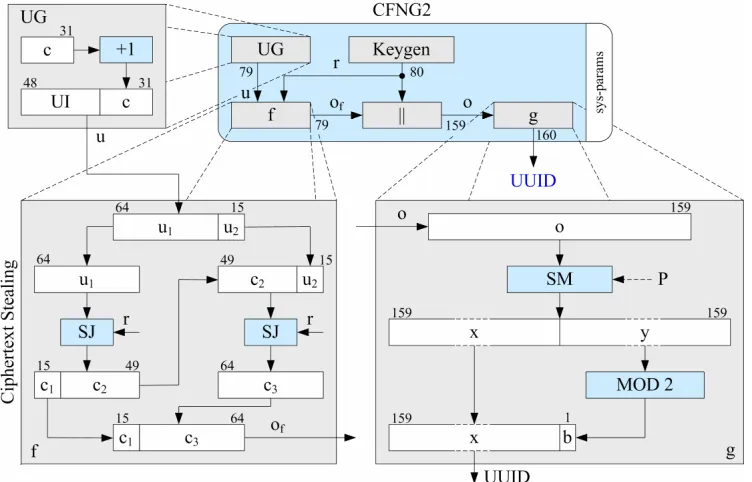
private key. Finally, when replacing DES by Skipjack (SJ) with CBC mode and ciphertext stealing, these ECC-based type 2 CFNGs (see Figure 9 and [29]) are a secure and
efficient replacement for UUIDs which fulfills all re- quirements on UUIDs (universally unique identifiers). In
[image:9.595.315.531.251.444.2]particular, the generated identifiers, which are based on 48 bit user identifiers (UI), are system-wide (or in UUID’s language universally) unique, whereas UUIDs are not!
Figure 8 shows the usage of digital pseudonyms in the
context of an authentication scheme based on digital sig-natures. The prover employs an RSA-based type 1 CFNG to generate his unique digital pseudonym
,
RSAe n
o ID cnt e n. After the generation, P sends o to the verifier. The verifier extracts the public key (e, n)
and sends a challenge r to the prover. The prover signs
the challenge and sends the signature s to the verifier,
who finally verifies the signature with the public key of the prover.
In order to keep the identifiers as short as possible, but also protect the identity of the generator, we suggest to use CFNGs of type 2 or type 3 based on elliptic curve cryptography (ECC), elliptic curve scalar multiplication (SM) and point compression (PC). Generators with the shortest outputs, but still secure and privacy protecting are of the form:
CFNG2 PC SM DES , ,
o u r r P
where P is a so-called generator point of the elliptic
curve (see [8] for details on ECC). By using this type of generator we can achieve outputs with a length form 128 bit upwards. Scenarios which only need short-term secu- rity may use 128 bit outputs, but the long-term security requires 160 bit or more. Since the output of the elliptic
curve scalar multiplication (SM) is an ECC public key, Figure 8. Usage of digital pseudonyms.
[image:9.595.113.489.475.716.2]8. Conclusion
Security critical parameters and identifiers, chosen purely random, come with the intrinsic risk of duplicates. These duplicates may cause severe problems in cryptographic schemes, cryptographic protocols and applications. In this article, we proposed an efficient mechanism which could replace true random number generators in the men- tioned fields of application. In contrast to true random number generators, the so called collision-free number generators (CFNGs) provably do not generate any dupli- cates during their life-time. Nevertheless, the proposed generators are secure (compromising one or more gen- erators does not compromise the whole system), efficient (in terms of computation, communications and memory) and they additionally protect the generator’s identity (i.e.,
outputs are unlinkable to each other and the generator’s identity).
REFERENCES
[1] P. Schartner, “Security Tokens—Basics, Applications, Ma- nagement, and Infrastructures,” IT-Verlag, Sauerlach, 2001. [2] M. Schaffer, P. Schartner and S. Rass, “Universally
Unique Identifiers: How to Ensure Uniqueness While Protecting the Issuer’s Privacy,” Proceedings of Security and Management 2007, CSREA Press, Las Vegas, 2007, pp. 198-204.
[3] R. L. Rivest, A. Shamir and L. Adleman, “A Method for Obtaining Digital Signatures and Public-Key Cryptosys-tems,” Communications of the ACM, Vol. 21, No. 2, 1978, pp. 120-126. doi:10.1145/359340.359342
[4] T. ElGamal, “A Public Key Cryptosystem and a Signature Scheme Based on Discrete Logarithms,” IEEE Transactions of Information Theory, Vol. IT-31, No. 4, 1985, pp. 469- 472. doi:10.1109/TIT.1985.1057074
[5] S. Goldwasser, S. Micali and C. Rackoff, “The Knowl-edge Complexity of Interactive Proof Systems,” SIAM Journal on Computing, Vol. 18, No. 1, 1989, pp. 186- 208. doi:10.1137/0218012
[6] G. Marsaglia, “The DIEHARD Test Suite 2003,” 2003. [7] A. J. Menezes, S. A. Vanstone and P. C. Van Oorschot,
“Handbook of Applied Cryptography,” CRC Press, Lon-don, 1996.
[8] D. Hankerson, A. J. Menezes and S. A. Vanstone, “Guide to Elliptic Curve Cryptography,” Springer-Verlag, Berlin, 2004.
[9] National Institute of Standards and Technology—NIST, “FIPS Publication 46-3: Data Encryption Standard (DES),” NIST, Gaithersburg, 1999.
[10] NIST, “FIPS Special Publication 800-38A: Recommen-dation for Block Cipher Modes of Operation—Methods and Techniques,” NIST, Gaithersburg, 2001.
[11] ISO/IEC, “ISO/IEC 10116: Modes of Operation of an n-bit Block Cipher,” 1991. http://www.iso.org
[12] NIST, “SKIPJACK and KEA Algorithm Specifications,”
NIST, Gaithersburg, ver. 2.29, 1998.
[13] NIST, “FIPS Publication 197: Advanced Encryption Stan-dard (AES),” NIST, Gaithersburg, 2001.
[14] NIST, “FIPS Publication 180-1: Secure Hash Standard (SHA),” NIST, Gaithersburg, 1995.
[15] H. Dobbertin, A. Bosselaers and B. Preneel, “RIPEMD- 160: A Strengthened Version of RIPEMD,” Proceedings of Fast Software Encryption (FSE), LNCS, Springer, Ber-lin, Vol. 1039, 1996, pp. 71-82.
[16] NIST, “FIPS Publication 180-2: Secure Hash Standard,” NIST, Gaithersburg, 2002.
[17] IPCOM, “Method of Generating Unique Quasi-Random Numbers as a Function of Time and Space,” PriorArt-Datbase, IPCOM#000007118D, 2002.
[18] P. Leach, M. Mealling and R. Salz, “RFC 4122: A Uni-versally Unique IDentifier (UUID) URN Name-Space,” 2005. http://www.ietf.org/rfc/rfc4122.txt
[19] Microsoft Developer Network, “Globally Unique Identi-fiers (GUIDs),” 2008.
http://msdn.microsoft.com/en-us/librarycc246025.aspx [20] Republik Österreich, “Bundesgesetz über Regelungen zur
Erleichterung des Elektronischen Verkehrs mit Öffentlichen Stellen (E-Government-Gesetz—E-GovG),” BGBl. I 10/2004, 2010. http://www.ris.bka.gv.at
[21] C. E. Shannon, “Communication Theory of Secrecy Sys-tems,” Bell System Technical Journal, Vol. 28, No. 4, 1949, pp. 656-715.
[22] M. Alani, “Testing Randomness in Ciphertext of Block- Ciphers using DIEHARD,” International Journal of Com-puter Science and Network Security—IJCSNS, Vol. 10, No. 4, 2010, pp. 53-57.
[23] M. Schaffer, P. Schartner and S. Rass, “Efficient Genera-tion of Unique Numbers for Secure ApplicaGenera-tions,” Tech-nical Report TR-Syssec-07-01, Klagenfurt University, Sys-tem Security Group, Klagenfurt, 2007.
[24] P. Schartner and M. Schaffer, “Implementing Collision- Free Number Generators on JavaCards,” Technical Re-port TR-Syssec-07-03, Klagenfurt University, System Security Group Klagenfurt, 2007.
[25] Giesecke and Devrient, “Sm@rtCafe JavaCards,” 2011. http://www.gi-de.com.
[26] Intel, “Intel Processors Supporting AES-NI,” 2011. http://www.intel.com.
[27] P. Schartner, “A Low-Cost Alternative for OAEP,” Pro-ceedings of International Workshop on Security and De-pendability for Resource Constrained Embedded Systems SD4RCES, ICPS Series, ACM Digital Library, in Print, 2011.
[28] P. Schartner and M. Schaffer, “Efficient Privacy-Enhanc- ing Techniques for Medical Databases, BIOSTEC, Com-munications in Computer and Information Science, Springer, Berlin, Vol. 25, 2008, pp. 467-478.