BIODIGESTERS: ALTERNATIVE ENERGY PRODUCTION AND ORGANIC LOADINGREDUCTION
*,1
Suzuki, A. B. P.,
1
Master of Energy in Agriculture
2
Professor of Maters Degree in energy in Agriculture
ARTICLE INFO ABSTRACT
In order to meet the ever increasing demand for energy it is necessary to pursue new alternative sources of energy. This paper aims to verify the production of biogas from mixtures of poultry litter and cassava wastewater, to analyze its effluents
attempt to solve the environmental issue caused by the disposal of these raw materials, producing clean and renewable energy in order to contribute to the Brazilian energy matrix. Batch digester
These digesters enable the verification of the amount and the quality of biogas. Significant productions of biogas of up to 0.39 and 0.30 L d
81.95%.
Copyright©2016, Suzuki et al. This is an open access article distributed under the Creative Commons Att distribution, and reproduction in any medium, provided the original work is properly cited.
INTRODUCTION
Brazil already has a tradition of using alternative sources of energy, with emphasis on the electrical energy from Power plants, which are nowadays responsible for meeting over 80% of all electric energy consumption in the country (Souza 2004). However, there are many other sources of energy that are less explored, such as solar, aeolic and biomass energies. Biomass energy is nothing but the energy that is obtained during the processing of products of animal and plantorigin for the production of heat energy and electricity.
growth demands an increase in food production and tha to an exponential increase of residues generated by the agricultural sector in Brazil. When disposed without previous treatment the residues compromise the quality of the soil and the water by contaminating water springs with microorganisms, intoxicating animals and plants, and depreciating the product, however these events are perceptible only in medium to long term. Thus, it is evident the necessity to develop clean technologies that seek to mitigate the production of such residues and the environ
(Aires, 2009). The environmental issue that has received
*Corresponding author: Suzuki, A. B. P.
Master of Energy in Agriculture–Universidade Estadual do Oeste do Paraná, Cascavel – Brasil.
ISSN: 0975-833X
Article History: Received 21st May, 2016
Received in revised form 30th June, 2016
Accepted 07th July, 2016
Published online 20th August,2016
Key words:
Anaerobic digestion, Biogas, Renewable energy, Alternative energy.
Citation: Suzuki, A. B. P., Vidal, T. C. M. and Feiden, A.
Journal of Current Research, 8, (08), 35645-35651.
RESEARCH ARTICLE
BIODIGESTERS: ALTERNATIVE ENERGY PRODUCTION AND ORGANIC LOADINGREDUCTION
Suzuki, A. B. P.,
1Vidal, T. C. M. and
2Feiden, A.
Master of Energy in Agriculture–Universidade Estadual do Oeste do Paraná, Cascavel
gree in energy in Agriculture–Universidade Estadual do Oes
Cascavel– Brasil
ABSTRACT
In order to meet the ever increasing demand for energy it is necessary to pursue new alternative sources of energy. This paper aims to verify the production of biogas from mixtures of poultry litter
cassava wastewater, to analyze its effluents and to check the reduction of organic load. It is attempt to solve the environmental issue caused by the disposal of these raw materials, producing clean and renewable energy in order to contribute to the Brazilian energy matrix. Batch digesters made of PVC fed with different mixtures from the biomasses were used for the experiment. These digesters enable the verification of the amount and the quality of biogas. Significant productions of biogas of up to 0.39 and 0.30 L d-1 were found. The organ
81.95%.
is an open access article distributed under the Creative Commons Attribution License, which distribution, and reproduction in any medium, provided the original work is properly cited.
Brazil already has a tradition of using alternative sources of electrical energy from Power responsible for meeting over 80% of all electric energy consumption in the country (Souza et al., 2004). However, there are many other sources of energy that
and biomass energies. Biomass energy is nothing but the energy that is obtained during the processing of products of animal and plantorigin for the production of heat energy and electricity. Population growth demands an increase in food production and that leads to an exponential increase of residues generated by the When disposed without previous treatment the residues compromise the quality of the soil and the water by contaminating water springs with cating animals and plants, and depreciating the product, however these events are perceptible only in medium to long term. Thus, it is evident the necessity to develop clean technologies that seek to mitigate the production of such residues and the environmental abuses (Aires, 2009). The environmental issue that has received
Universidade Estadual do Oeste do Paraná,
special attention in recent years is related to
in general, for it generates great amount of residues with high potential of emission of greenhouse gasses resultant of the degradation of these wastes in inappropriate sites. The only way to avoid the emission of these gasses is to capt
burn them so that CH4 and N2O would be transformed in CO and N2 after burn, thus reducing the contribution to global warming. The aim of this paper is to find the ideal mixture of two biomasses, the poultry litter, and the cassava wastewater. These two residues are generated in large amount in Brazil in the process of obtaining biogas and organic loading reduction.
METERIALS AND METHODS
The experiment was conducted at Universidade Estadual do Oeste do Paraná(UNIOESTE) in the city of Cascavel
Brasil, which is located in the third
State, in Western Paraná region, with altitude raging around 785m. The climate is subtropical mesothermic superhumid. The experiment started in May. It was analyzed
ending in September. Although the season did not have any influence on the results once all the treatments were kept in constant temperature of 35°.
International Journal of Current Research Vol. 8, Issue, 08, pp.35645-35651, August, 2016
INTERNATIONAL
Suzuki, A. B. P., Vidal, T. C. M. and Feiden, A. 2016. “Biodigesters: Alternative energy production and organic
BIODIGESTERS: ALTERNATIVE ENERGY PRODUCTION AND ORGANIC LOADINGREDUCTION
te do Paraná, Cascavel – Brasil
Universidade Estadual do Oeste do Paraná,
In order to meet the ever increasing demand for energy it is necessary to pursue new alternative sources of energy. This paper aims to verify the production of biogas from mixtures of poultry litter and to check the reduction of organic load. It is in an attempt to solve the environmental issue caused by the disposal of these raw materials, while producing clean and renewable energy in order to contribute to the Brazilian energy matrix. Batch s made of PVC fed with different mixtures from the biomasses were used for the experiment. These digesters enable the verification of the amount and the quality of biogas. Significant were found. The organic loading reduction reached
ribution License, which permits unrestricted use,
special attention in recent years is related to animal production in general, for it generates great amount of residues with high potential of emission of greenhouse gasses resultant of the degradation of these wastes in inappropriate sites. The only way to avoid the emission of these gasses is to capture and O would be transformed in CO2 after burn, thus reducing the contribution to global warming. The aim of this paper is to find the ideal mixture of two biomasses, the poultry litter, and the cassava wastewater. e two residues are generated in large amount in Brazil in the process of obtaining biogas and organic loading reduction.
AND METHODS
The experiment was conducted at Universidade Estadual do Oeste do Paraná(UNIOESTE) in the city of Cascavel, Paraná, Brasil, which is located in the third plateau of the Paraná State, in Western Paraná region, with altitude raging around 785m. The climate is subtropical mesothermic superhumid. The experiment started in May. It was analyzed for 120 days in September. Although the season did not have any influence on the results once all the treatments were kept in
INTERNATIONAL JOURNAL OF CURRENT RESEARCH
Raw Material
The raw materials used in this study were: (1) residual water from industry of cassava starch; (2) poultry litter from grow-out houses.
Characteristics of the Poultry Litter
Poultry litter is all the material that is disposed on the floor of grow-out housesas a bed for the poultry (Paganini, 2004). It is a mixture of excretes, feathers, ration and materials used on the floor. Many are the materials that are used in poultry litters, such as: sawdust, peanut bark, rice husk, coffee bark, dry grass, chopped corn cob, among several other materials (Grimes, 2004).For a long time poultry litter was used for feeding ruminants, but due to sanitation problems in Europe in 2001, like the bovine spongiform encephalopathy (BSE), the Brazilian Ministry of Agriculture published a rule (Brasil, 2001) that prohibits the commercialization of poultry litter for nourishing ruminants. That occured because of the risks of the contaminations of the littler that have remaining of ration that perhaps might have animal protein in their composition. Due to the difficulty to proceed inspection in all Brazilian territory in order to determine whether the poultry were fed with animal or vegetal protein, the prohibition is for all types of poultry litter, regardless their origin. With this correct prohibition, the destination for poultry litter became restrict, and researches with the objective of studying alternatives for the exploitation of this residue are necessary. An alternative to reduce the environmental impact caused by the accumulation of residues is to reuse the litter. The reuse also favors regions where the base material is scarce and where it is difficult to sell the litter after its use. Other reasons for reusing poultry litter are: cost for purchase of materials; labor to remove the litter from the grow-out house, along with the attempt to reduce the downtime of the facilities; reduction of logging, making scarce the offer of wood shavings; and adaption to the seasons of the year for availability of materials (Paganini, 2004). According to Lien, Conner e Bilgili (1992); Malone (1992) and Brake et al. (1993), the litter can be reused from 1 to 6 times without significant differences regarding mortality, weight gain, feed consumption, feed efficiency and quality of the carcasses. Several factors influence the composition of the poultry litter, such as the composition of the ration, amount of material to cover the floor of the grow-out house, season of the year, density of the grow-out house, type of substrate in litter, ventilation in the grow-out house, level of reuse of the litter and characteristics of the birds excreta. Santos (1997) noted that there was significant decrease in the production of waste in the farm when the litter is reused.
According to the author, the coefficient of residue which has created a lot was of 0.521 kg of dry matter of litter in kg-1 of live weight (MS), and for two batches of 0.439 kg of MS of litter in kg-1 live weight, indicating that a reuse can decrease the coefficient of residue (production of litter) in approximately 16 %. Severino, Lima e Beltrão (2006), while studying eleven organic materials, among these, the peanut bark and chicken litter, found values of macronutrients different from the ones found out by Santos et al. (1997).
Characteristics of the cassava wastewater
Cassava wastewater is a liquid residue of provennematicidal action which is produced in cassava starch industry. The main components of its chemical composition are macro and micronutrients and cyanogen glycosides which are lethal to different forms of life, including the nematodes. Due to such characteristics the cassava wastewater has been successfully used in agriculture as organic fertilizer and as agent of control of nematodes, insects and other microorganisms (Comerlato, 2009). Scholz (1971) describes “cassava wastewater” as the liquid obtained from the pressing of the mass of grated roots after they are peeled off.The yield of starch production per 1kg root is 0.25kg with 12 to 13% of moisture content. The residues in wet weight is of 0.14kg of peeling, 5.67kg of washing water, 1.1kg of vegetable water and 1.88kg of pulp and fiber (bagasse). According to this balance the total sum of the liquid residues obtained from cassava starch industry is of 6.77kg per kg of processed cassava root (Feiden, 2001).
The inoculums used was obtained with a well functioning digester (Indian type) fed with wastes from the swine industry. The poultry litter was sieved in 0.32mm mesh. Right after collected, the cassava wastewater and the inoculums were immediately transported to the laboratory in order to be mixed with the biomass and fill the digester.
Digesters
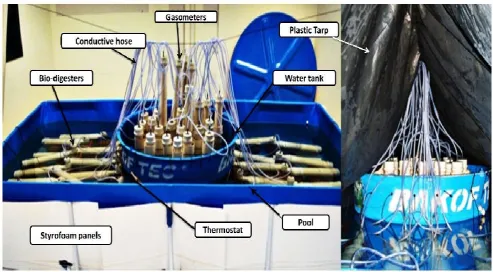
The bio-digester developed for the experiment is a discontinuous hydraulic flow digester, which is characterized by accepting a discontinuous feeding, which means that it is fed only once, in the beginning of the process, not receiving any substrate until the bio-digestion is complete. The anaerobic digesting system was composed of two containers of known volumetric capacity, hoses, and copper pipe. The digester was composed of a container of around 3.5 L made of PVC pipes and covered with a PVC cover with an orifice at the center through which passes a copper pipe linked to the hose from the digester. The gasometer was afloating dome type, which went up according to the production of gas of each digester. The gasometers were immersed in a tank full of whater, where the gas produced in the digester was conducted through the hoses. The gasometer rose up by natural pressure of gas, as shown in Figure 1. In order to know the amount of the gas produced, it was measured the height above the water depth the gasometer was found. The measurement was performed daily and the gasometers were emptied.
Statistical Analysis
Planning is the first step of any research, therefore, an experiment must be well planned, so it can meet the interests of the researcher and the basic hypothesis that are necessary for the validation of the statistical analysis. The experiment was performed in randomized block design with six treatments and four repetitions. The test of significance used in the experiment was the test of comparison of means that testes any contrast between two means of treatments, in this study, the Tukey’s test. The numbers of contrasts that can be tested
consist in the number of combination of the means two by two. Thus, in an experiment with 6 treatments it is possible to test up to 12 contrasts of two means of treatments. The test is accurate when two means of contrast have the same number of repetitions as it is the case of this experiment. The Tukey's test is applied to 5% of probability.
Treatments
[image:3.595.52.271.203.272.2]The treatments are describes below on Table 1:
Table 1. Treatments used in the experiment
Treatments Cassava wastewater (%) Poultry litter (%)
A 0 100
B 20 80
C 40 60
D 60 40
E 80 20
F 100 0
25% of the total volume of the inoculums and water were added in all treatments for dilution.
System
The system was made of a 3000L swimming pool. A water tank of 500L was placed in the center of the pool and the gasometers and the digesters were placed around this tank in which the digesters were submerged. The system had four heaters with thermostats that maintained the heated water in constant temperature of 35°C; in order to keep this temperature, Styrofoam panels were also used around the pool and a black plastic tarp, as shown in Figure 1.
Solid Analysis
The evaluation of total solids content, volatile solids and fixed solids were made by methods described in APHA (1992).The mixture used in the process was composed of solids and water. The total solids (TS) are divided in suspended solids and dissolved solids. In sludge, the most part is represented by suspended solids. Compared with the organic matter, the solids are divide in fixed or inorganic solids (TFS) and volatile or organic solids (TVS). To determine the total solids, a porcelain capsule was left it in a muffle furnace at 550 ± 50°C for 1 hour , followed by cooling in desiccant and weighing with precision of 0.1 mg. Then, it were transferred to the capsule 10 ml of each treatment, measured in a test tube in which was weighed to determine the wet weight (WW) and placed in a greenhouse at a temperature of 103-105° C for about 2 hours until reach a constant weight . After withdrawn of the greenhouse, it were placed in a desiccant to cool and the capsule was weighed again to obtain the dry weight (DW). The content of total solids were determined by equation 1 :
Equation 1: Determination of total solids (TS)
= 100[( − ). 100]
After obtaining the total solid, capsule underwent calcination in muffle furnace at 550 ± 50°C for 1 hour to determine the fixed solids. Then, they were removed from the muffle, cooled in desiccators and weighed in balance with a precision of 0.1mg, thereby obtaining the ash weight (AW). The levels of volatile solids from biomass were calculated by equation 2: Equation 2: Determination of total volatile solids (VS)
[image:3.595.54.548.451.723.2]= [ ( ). 100
The total fixed solids are the amount of total residue that is able to fry or not to fry, which remains after calcination at 550 ± 50°C for 1 hour.
RESULTS AND DISCUSSION
The biogas production started on the 10th day and increased as the hydraulic retention time (HRT) increased. The behavior of the biogas production can be better observed in figure 2.The treatment F was the only one to show insignificant production, thus it was not possible to draw a curve.
Figure 2. Biogas percentage within the treatments composed of different percentages of poutry litter and cassava wastewater. A – 100% poultry
litter; B – 80% poultry litter+ 20% cassava wastewater; C – 60% poultry
litter + 40% cassava wastewater; D – 40% poultry litter + 60% cassava
wastewater; E – 20% poultry litter + 80% cassava wastewater; F – 100% cassava
Van Velsen & Lettinga (1980) alert to the digestibility factor, once the main components in digestible organic matter may not be available to the attack of microorganisms for having structural forms with stable chemical links, as cellulose and hemicelluloses that, when impregnated with lignin, as in woods, become materials of difficult biodegradation in anaerobic environments. Poultry litter is heterogeneous and has its components grouped in substances of rapid degradation, like amid and carbohydrates that are responsible for the rapid release of carbon dioxide and substances of slow degradation, as the lignin, celluloses and hemicelluloses. The fragments of the lignin degradation give origin to different derivatives that are molecules of slow degradation. In the light of these considerations, one can verify that treatment “A” made of 100% of poultry litter reached on the 50th day a peak of production and right after it started to decrease due to the lack of materials that are degradable, behavior alike treatment “A”. Around the 60th day it started to produce once more because the fibrous components, like the cellulose, hemicelluloses and the lignin started to show their degradation peak. The same occurred to treatment “B”, for this treatment was made of 80% of poultry litter and a small dosage of cassava wastewater. The percentage of material that is easily biodegradable when compared to the percentage of the volatile solids in the raw material can indicate its approximate potential of degradation (MOTTA, 1985). Around 70% of the volatiles of the cassava wastewater are made of biodegradable composts. These
[image:4.595.46.269.235.362.2]evaluations are important to determine the amount and the quality of the biogas to be generated, as noted by Chandler (1980). As shown in graph 1, treatments “A” and “B” did not have a rapid initial production but they are constant, with an increasing on the 80th day. Treatment “C” made of 60% of poultry litter and 40% of cassava wastewater reached a peak of production on the 40th day and decreased right after. Treatment "D" had a low production, although it is possible to verify that the same treatment was more constant than the others. It was stable for 30 days until it started to decreased on the 50th day. Treatment “E” was productive for 30 days only going into decline soon after. Treatment “F” did not produce biogas because it acidified due to the high solubility of its substrates, as proven at the end of the experiment. The single stage digesters are not recommended in the treatment of effluents with high soluble organic load, and there must be a separation of it in two environments physically isolated (GOSH; OMBREGT; PIPYN, 1985). Feiden (2001) in an experiment worked with phase separation in pilot scale and verified in the acidogenic reactor values of pH higher than the expected in its initial stage. This probably happened due to the development of a methanogenic population in the acidogenic reactor during the first stage of the process when low organic load were added to the digester. Table 2 shows the results of the Tukey’s test. It is possible to verify that some treatments are different from the others . “B” and “C” show no significant difference, as well as “E” and “F”. The averages show that the higher the percentage of poultry litter in the biomass mixture used in the digester, the higher the production of gas, and the higher the percentage of cassava wastewater the lower the production.
Table 2. Biogas production related to poultry litter percentage in treatments
Treatment Biogas production (L)
Proportion of poultry litter
(%)
Estimate of biogas production related to
poultry litter (L)
A 0.3928 a 100 0.3928
B 0.2487b 80 0.3142
C 0.2120b 60 0.2357
D 0.1416c 40 0.1571
E 0.0508d 20 0.0786
F 0.0010d 0 0
* Grouping information with Tukey’s test at 95% intervals of reliability. Treatments that do not share the same letter significantly different from the others.
Treatment “A” is made of 100% of poultry litter; treatment “B”, 80%; “C”, 60%; “D”, 40%; “E”, 20%, and “F”, 0%. Table 2 shows the averages for each treatment. If only the proportion of poultry litter in the treatments is taken into consideration, the estimate for the production of gas obtained refers only to poultry litter, and from that it is possible to verify if those treatments are been efficient or not in production when cassava wastewater is added. Treatment “A” made of a single biomass (100% poultry litter) was successful in production, it served as a parameter for comparing the other treatments. The only mixture that showed a result higher than the production estimate was treatment “C”. It was the only treatment that had the production of biogas increased with the addition of cassava wastewater. The treatments with higher amount of cassava wastewater, as treatment “F”, did not obtained good results because the digester used in the experiment was not a two phase digester.
[image:4.595.312.556.432.522.2]Analysis of the solids in the mixtures used in the digesters
One can verify all values of TS (total solids), TVS (total volatile solids) and TFS (total fixed solids) of the affluent and effluents for the 24 samples tested in the experiment, as well as the percentage of TS and VS in each of them. Through these data it was possible to determine the amount of TS and VS removed from each treatment. Based on the averages of these data one can verify that the higher the percentage of poultry litter in the sample, the greater the amount of TS. The amount of solids decreases as the percentage of poultry litter in the treatments decreases, the same happens to the VS.
Once all these values are settled for the 24 samples of the experiment, some items that are essential in order to evaluate the results of the experiment can be determined. Table 3 shows the average values of the organicloadings added and removed from total and volatile solids in each treatment. It is clear that the higher the percentage of poultry litter in the mixtures, the greater the value of the organicloadings in them. The removal of the solids was proportional to the addition of the same, and it was greater in treatments with higher concentration of poultry litter and lower in treatments with greater amount of cassava wastewater.
[image:5.595.70.531.365.436.2]The higher amount of total solids removal was obtained in treatment “A”, and that is because its amount of organicloading is greater than in the other treatments once it is made of 100% poultry litter, however it was treatment “C” that had the higher efficiency in the removal of total solids, reaching the value of 75,82%.Treatment “A” showed better results for the removal of volatile solids because its raw material is composed of 100% poultry litter and therefore it has a greater amount of organicloading and, as a consequence, of added volatile solids – 0.87g VSL-1 reaching the value of 0.69g of volatile solids removed and an efficiency of 79,31%. But again, treatment “C” showed better results in efficiency with 81.94% (Table 3). Digestion, fermentation, or even the anaerobic stabilization aim basically the maximum reduction of sanitation risks and pollutantsin the excrements, residues and wastes, and at the same time to obtain as a sub-product in this procedure the biogas that may or may not be used, and the biofertilizer that may be of practicaluse in rural properties (Oliveira, 2002). Motta (1985) used cassava wastewater with organic load loading between 1.70 g VS L-1 r d -1 and 1.96 g VS L-1 r d -1 to feed a bench-scale reactor of complete mixing. He obtained results from 51% to 73% of organic loading reduction. Bouallagui et al. (2005) fed a continuous tubular
Table 3. Added and removed organic loading
Treatments A B C D E F
Organicloading of total solids Added 1,15 0,95 0,91 0,52 0,17 0,05
Removed 0,82 0,61 0,69 0,29 0,08 0,03
Removal efficiency (%) 71,3 64,21 75,82 55,77 47,06 60,00
Organicloading of volatile solids Added 0,87 0,74 0,72 0,42 0,14 0,04
Removed 0,69 0,53 0,59 0,27 0,09 0,03
[image:5.595.100.500.470.624.2]Removal efficiency (%) 79,31 71,62 81,94 64,29 64,29 75,00
Table 4. Averages obtained in the analysis of the solids of affluent and effluents wastes
Treatments
A B C D E F
Affluent Sample Vol. 12,02 10,98 11.09 9,44 9,26 9,34
TS 1,49 1,12 1,09 0,38 0,17 0,04
TFS 0,37 0,25 0,23 0,09 0,04 0,01
TVS 1,12 0,87 0,86 0,29 0,13 0,04
% of TS in the sample 12,35 10,18 9,81 4,04 1,84 0,46
% of VS in the sample 9,29 7,89 7,74 3,1 1,44 0,39
Effluent Sample Vol. 8,92 9,11 8,97 8,72 9,8 8,9
TS 0,31 0,33 0,21 0,16 0,09 0,02
TFS 0,15 0,13 0,08 0,06 0,04 0,01
TVS 0,17 0,20 0,13 0,1 0,05 0,01
% of TS in the sample 3,52 3,62 2,35 1,82 0,92 0,18 % of VS in the sample 1,89 2,22 1,44 1,17 0,49 0,07
Removal TS 0,33 0,34 0,22 0,17 0,09 0,02
VS 0,18 0,21 0,14 0,11 0,05 0,01
Table 5. Averages of yield in the production of biogas for each treatment
Treatments A B C D E F
Biogas yield TS Add. (L biogas g TS added-1) 0,10 0,09 0,08 0,11 0,09 0,01
VS Add. (L biogas g VS added-1) 0,13 0,12 0,10 0,15 0,11 0,01
TS removed (L biogas g TS added-1) 0,14 0,15 0,10 0,20 0,24 0,01
VS removed (L biogas g VS added-1) 0,17 0,17 0,12 0,24 0,17 0,01
CH4yield TS Add. (L CH4 g TS addeds-1) 5,52 5,01 4,48 6,94 4,49 0,00
VS Add. (L CH4 g VS added-1) 7,32 6,50 5,68 9,20 5,68 0,00
TS removed (L CH4 g TS added-1) 7,70 8,23 5,90 12,94 13,05 0,00
VS removed (L CH4 g VS added-1) 9,14 9,33 7,02 15,26 9,16 0,00
Reduction TS (%) 71,77 64,18 75,96 54,35 46,86 62,45
[image:5.595.87.510.661.768.2]reactor with organicloading of volatile solids of 2.8 g L-1r d-1 originated from fruits and vegetables wastes and HRT of 20 days and obtained yields of biogas of 0.45L biogas g-1 of added VS. In an experiment performed by Ribas and Barana (2003), while studying a single phase plug flow reactor model fed with cassava wastewater, results of volatile solids reduction of 60% and 79% were obtained. When compared to the results of the mentioned authors, the results obtained in removal of volatile solids show satisfactory results within the values described between 81.94% and 64.29%. According to Leme (2010), besides producing biogas, the anaerobic treatment of manure causes a reduction of the organic loading between 60% and 90%. Therefore, it is possible to conclude that all treatments achieved a satisfactory efficiency in loading removal. The efficiency of the organic loading removal system was better in treatment “C” with 75.82% and 81.94% of removal of total and volatile solids, respectively (Table 4).
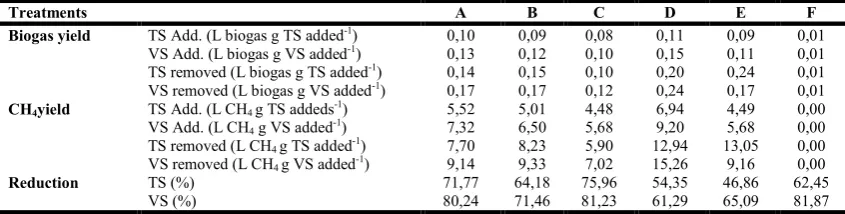
The yield of the process can be evaluated through the data of biogas production on added and removed total and volatile solids and also the yield of CH4 on removed total and volatile solids. These data are shown on table 5.
Biogas production
In order to evaluate biogas yield and production the following technical indicators were used: (this indicators are used in the analysis of solids), daily total and average of biogas production, daily average of specific biogas production (L per L of the reactor), daily total average of production of methane (CH4), daily average of specific production of methane (CH4) (L per L of the reactor); yields of biogas and methane on added total solids; yields of biogas and methane on removed total solids; yields of biogas and methane on added volatile solids, and yields of biogas and methane on removed volatile solids. The results will be discussed lately.
Yields in biogas and methane (CH4) production
Table 9 shows the results of yields of biogas and methane for an amount of added total and volatile solids as well as for the amount of removed solids and its reduction in percentage. These values were obtained from each treatment.
Yields of biogas and methane on added total solids
Values of 0.01 L biogas g-1TS added to 0.01 L biogas g-1 TS added were found. The treatment that showed a greater yield for total solids addition was treatment “D”, followed by treatments “A”, “E”, “B”, “C” and “F”. The values were 0.11 L biogas g-1TS, 0.10 L biogas g-1TS, 0.9 L biogas g-1TS, 0.9 L biogas g-1TS, 0.8 L biogas g-1TS and 0.01 L biogas g -1
TSadded, respectively. Treatment “D” showed the greater yield, yet it is not feasible for gas production because of its low daily and total production. Treatment “A” with 100% poultry litter showed a good yield and a stable biogas production during the 120 days.Once the experiment aimed the production of biogas through the mixtures, treatment “C” is the one that stands out with a biogas yield of 0.9 L biogas-1 TS added and a constant and stable production. Treatment “D” showed the better results for CH4yield with 6.94 L methane g-1TSadded,
but as mentioned above, this treatment did not show a considerable biogas production. The values obtained from treatments “A”, “B”, “E”, “C” and “F” are the following: 5.52; 5.01 L methane g-1TS added, 4.49 L methane g-1TS added, 4.48 L methane g-1TS added and 0.00 L methane g-1TS added, respectively. Treatment “B” obtained the better biogas quality in terms of raw material mixtures, because it has a greater amount of methane and showed a constant production over the 120 days.
Yields of biogas and methane on removed total solids
Biogas yield on removed total solids was greater on treatment “E”, 0.24 L biogas g-1 removed, followed by treatments “D”, “B”, “A”, ”C” and “F”. The amount of methane yield on removed total solids was also quantified. Treatment “E” showed greater yield, 13.05L methane g-1 TS removed. Values of 7.70; 8.23; 5.90; 12.94 and 0.00 were obtained from treatments “A”, ”B”, “C”, “D” and “F”, respectively. Treatment “B” may be considered the one with better performance because it reached a constant and stable production and is compound of biomass mixtures.
Yields of biogas and methane on added volatile solids
Treatment “D” showed greater yields of L biogas g-1 VS added with amounts of 0.15 L biogas g-1 VS added. Treatment “F” did not succeed in its production with a maximum value of 0.01 L biogas g-1 VS added. The values for the other treatments are shown on Table 9. The greater amount was found in Treatment “D”, 9.20 L biogas g-1 VS added.
Yields of biogas and methane on removed volatile solids
Treatment “D” stands out both for L biogas g-1VS removed, and L methane g-1TS removed with valued of 0.24 L biogas g -1
VS removed and 15.26 L methane g-1TS removed. The results can be compared with the ones described on Table 10.The experiment obtained good results for biogas production from added solids.
Specific yield of biogas
Better values for biogas production from added solids were found in treatment “A”, reaching a production of 0.39 L d-1of biogas in its total production, 9% above treatment “B”. “A” also stands out in biogas specific production with an average of 0.11 biogas L r d-1. It also showed better values for the total production of CH4 and for the specific production of CH4 with values of 21.77 L d-1 and 6.22 L biogas L r d-1 (Table 9). In this experiment a specific production of biogas of 0.11 L biogas L r d-1 was obtained in treatment “A”. This was the treatment with greater specific production, reaching 0.39 L d -1
of biogas production. This experiment has no unprecedented, that makes it impossible to compare it with others that use the same biomass. The experiment obtained good results in biogas production from added solids.
Final considerations
According to the results and discussions in this paper, the following can be concluded. The reduction in the organic
loading is concentrated in the diagnosis of the generation, transport and final release, and deployment of systems of primary treatment. By applying the technology of bio-digestersone can promote the reduction of load in up to 75.82 % of TS and 81.94 % of TVS without the need of the construction of a sewage treatment plant. The system of biological anaerobic treatment was efficient to reduce and to stabilize the organic matter of the biomasses. In order to achieve satisfactory results it is necessary to make the aim of the experiment clear, whether the aim is the biogas production or the reduction of organic loading. Treatment “C” meets both objectives once it is efficient both in biogas production and organicloading reduction.
REFERENCES
Aires, A.M.A. 2009. Biodigestão anaeróbia da cama de aviários de corte com ou sem separação das frações sólida e líquida. 134 f. Dissertação (Mestrado em Zootecnia) – Universidade Estadual Paulista, Jaboticabal.
APHA, American Public Health Association. 1992. Standard methods for the examination of water and wastewater. American Water Works Association, Water Environmental Federation. 18th ed. Washington.
Bouallagui, H. et al. 2005. Bioreactor performance in anaerobic digestion of fruit and vegetables waste. Process
Biochem., 40, 989-995.
Brake, J.D. et al. 1993. Evaluations of whole chopped kenaf and kenaf core used as a broiler litter material. Poultry Sci., 72 (11). 2079-2083.
Brasil. 2001. Ministério da Agricultura e do Abastecimento. Instrução normativa nº 15, de 17 de julho 2001. DisponívelAvailable in: http://extranet.agricultura.gov.br/ sislegisconsulta/consultarLegislacao.do>. Access: April, 04th 2011.
Chandler, J.A. et al. 1980. Predictiny methane fermentation biodegradability. Biotechnol Bioen., 93-107.
Comerlato, A.P. 2009.Efeito de manipueira no controlo do nematoide do quisto da soja Heterodera glycinesichinohe. 46 f. Dissertação (Mestrado em Agronomia) - Universidade Estadual do Oeste do Paraná, Marechal Cândido Rondon. Feiden, A. 2001. Tratamento de águas residuárias de indústrias
de fécula de mandioca através de biodigestores anaeróbios com separação de fases em escala piloto. 90 f. Tese (Doutorado em Energia na Agricultura) - Faculdade de Ciências Agronômicas da Universidade Estadual Paulista, Botucatu-SP
Gosh, S. et al. 1985. Methane production from industrial wastes by two-phase anaerobic digestion. Wat. Res., 19.1083-1088.
Grimes, J.L. 2004. Alternatives litter materials for growing poultry. North Carolina Poultry Industry Newsletter. Lien, R.J. et al. 1992. The use of recycled paper chips as litter
material for rearing broiler chickens. Poultry Sci., 71 (1). 81-87.
Leme, E.J.A. 2010.Manual prático de tratamento de águas residuais. São Carlos: Ed. UFSCar.
Malone, G.W. 1992.Nutrient enrichment in integrated broiler production systems. Poultry Sci. 71. 1117-1122.
Motta, L.C. 1985.Utilização de resíduos de indústrias de farinha de mandioca em digestão anaeróbia. 119 p. Dissertação (Mestrado em Agronomia), - Estado Universidade de São Paulo, Botucatu, SP. 1985.
Oliveira, P.A.V. 2002.Curso de Capacitação em práticas ambientais sustentáveis: formação. Embrapa. Suínos e Aves. Concórdia.
Paganini, F.J. 2004. Produção de frangos de corte: manejo de cama. Ed. Mendes, A.A et al. Campinas: FACTA. 356 p. Ribas, M.M.F.& Barana, A.C. 2003. Start-up Adjustment of a
plug-flow digester for cassava wastewater (Manipueira) treatment. Sci Agrícola. 60 (2). 223-229.
Santos, T.M.B. 1997. Caracterização química, microbiológica e potencial de produção de biogás a partir de três tipos de cama, considerando dois ciclos de criação de frangos de corte. 1997. 95 f. Dissertação (Mestrado em Zootecnia) – Faculdade de Ciências Agrárias e Veterinárias, Universidade Estadual Paulista, Jaboticabal.
Severino, L.S. et al. 2006.Chemical composition of eleven organic materials on substrates used for seedlings. EMBRAPA. Technical Communication 278. Campina Grande.
Scholz, H.K.B.W. 1971.Industrial aspects of cassava in the Northeast. Internal ministry / bank of Northeast Brazi /ETENE, 197p.
Souza, S.N.M. et al. 2004.Cost of electricity by hog raising biogas in group engine generator. Acta Sci. Technol., 26. 127-133.
Van Velsen, A.F.M & Lettinga, G. 1980. Effects of feed composition on digester performance. In: Stafford, D.A.
et al. Anaerobic Digestion. London: Applied Science
Publishers, p.113-130.