Proceedings of the Fourth Arabic Natural Language Processing Workshop, pages 108–118 108
Neural Arabic Question Answering
Hussein Mozannar, Karl El Hajal, Elie Maamary, Hazem Hajj Department of Electrical and Computer Engineering
American University of Beirut
{hssein.mzannar,karlhajal,eliemaamary17}@gmail.com; [email protected]
Abstract
This paper tackles the problem of open domain factual Arabic question answering (QA) us-ing Wikipedia as our knowledge source. This constrains the answer of any question to be a span of text in Wikipedia. Open domain QA for Arabic entails three challenges: annotated QA datasets in Arabic, large scale efficient in-formation retrieval and machine reading com-prehension. To deal with the lack of Arabic QA datasets we present the Arabic Reading Comprehension Dataset (ARCD) composed of 1,395 questions posed by crowdworkers on Wikipedia articles, and a machine translation of the Stanford Question Answering Dataset (Arabic-SQuAD). Our system for open do-main question answering in Arabic (SOQAL) is based on two components: (1) a docu-ment retriever using a hierarchical TF-IDF ap-proach and (2) a neural reading comprehen-sion model using the pre-trained bi-directional transformer BERT. Our experiments on ARCD indicate the effectiveness of our approach with our BERT-based reader achieving a 61.3 F1 score, and our open domain system SOQAL achieving a 27.6 F1 score.
1 Introduction
One of the goals in artificial intelligence (AI) is to build automated systems that can perform open-domain question answering (QA) through under-standing natural language and gathering knowl-edge (Kwiatkowski et al., 2019). The driver be-hind progress in English QA has been the release of massive datasets including the Stanford Ques-tion Answering Dataset (SQuAD), WikiQA ( Ra-jpurkar et al.,2016;Yang et al.,2015). The task in these datasets is to find the span of text in a docu-ment that answers a given question. On the other hand, progress in Arabic QA systems has lagged behind their English counterparts. While there has been a good body of work on methods for question
,
YÊJ
® K
B@ I
. ªÊÓ
ú
¯
éJÖÞ QË@ éKAKPAJ.Ó É¿ ÈñK.Q ®KA K ø
XA
K I.ªÊK
. h.Q
®JÓ 54
,074 Pñ mÌ ©
K ø
YË@ ð
½ÊJ
¯ , ÈñK.Q
®JË øXA
JË XðYÊË@ ðYªË@ YJKA KñK Q AÓ ø
XA
K Q.JªK
,
éK
QÊm.
'B
@ ÐY
®Ë@
èQ» ú
¯
HA
¯A JÖÏ@ Ñë
@ áÓ Q.JªK HAêk.@ñÖÏ@
Q AÓ ®k IJk ,H.A
®Ë
CË
A
®J
®m' ù
KXA
K Q»
@ ©Òm.
' IJ
k
.
éËñ¢. 59
ÈñK.Q
®JË
®k AÒ JK. ,62 YJKA KñK
? ÈñK.Q
®JË øXA
K Aê®®k éËñ¢. áÓ Õ»
éËñ¢. 59
? éKAKPAJ.Ó ÈñK.Q
®JË øXA
K I.ªÊK áK
@
[image:1.595.306.525.225.468.2]YÊJ
® K
B@ I
. ªÊÓ
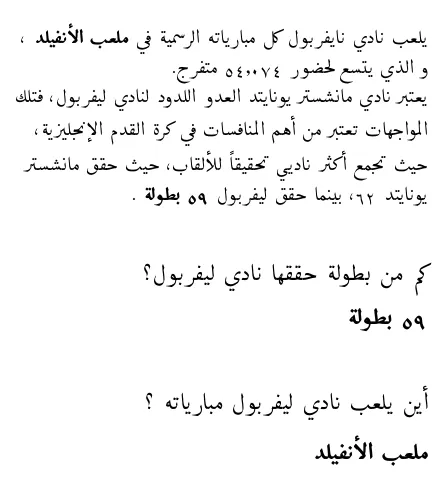
Figure 1: Example data point from ARCD containing a paragraph with two accompanying questions
answering, they mostly have a common limitation of being tested on small amounts of data and rely-ing on classical methods (Shaheen and Ezzeldin,
2014).
In this work, we tackle the problem of answer-ing Arabic open-domain factual questions usanswer-ing Arabic Wikipedia as our knowledge source. The open-domain setting poses many challenges, from efficient large scale information retrieval, to highly accurate answer extraction modules, and this re-quires a sizable amount of data for training and testing.
seg-ments on Arabic Wikipedia as seen in figure1, and (2) Arabic-SQuAD consisting of 48k paragraph-question-answer machine translated tuples from the SQuAD dataset.
Second, modern open-domain QA systems are generally composed of two parts: a retriever that obtains relevant segments of text, and a machine reading comprehension (MRC) model that ex-tracts the answer from the text (Chen et al.,2017). For our retriever, we propose the use of a hierar-chical TF-IDF retriever that is efficiently able to trade off between n-gram features and the number of documents retrieved. We chose raw Wikipedia text as our information source instead of knowl-edge bases (Lehmann et al.,2015) which are com-monly used for open-ended QA as it enables our approach to tackle other domains and settings with little adaptation. Now there has been remarkable progress in designing neural MRC models that read and extract answers from short paragraphs; we selected two of the best performing models on the SQuAD dataset (Rajpurkar et al.,2016) as our document readers. The first is QANet (Yu
et al., 2018), an efficient convolution and
self-attention-based neural network, and the second is BERT (Devlin et al., 2018), a transformer-based pre-trained model. From the document retriever and reader we build an open domain QA system named SOQAL by combining confidence scores from each.
We evaluated our system components on the crowdsoured ARCD dataset: Our hierarchical TF-IDF retriever is competitive with Google Search, and our BERT reader is the current state-of-the-art for reading comprehension. Finally, our open do-main system SOQAL achieves a respectable 27.6 F1 on ARCD.
To summarize, the contributions of the paper are:
• Datasets for Arabic QA. Crowdsourced Arabic Reading Comprehension Dataset (ARCD) of 1,395 questions, and trans-lated Arabic-SQuAD: 48k transtrans-lated ques-tions from (Rajpurkar et al.,2016).
• Neural Reading comprehension in Arabic.
State of the art MRC models for Arabic based on BERT (Devlin et al., 2018) and QANet (Yu et al.,2018).
• Open domain Arabic QA system. End-to-end system for open domain Arabic questions using a hierarchical TF-IDF retriever, BERT
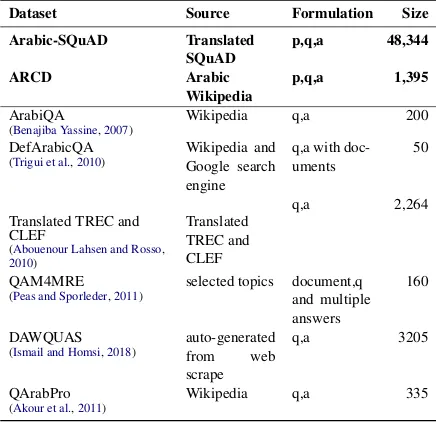
Dataset Source Formulation Size Arabic-SQuAD Translated
SQuAD
p,q,a 48,344
ARCD Arabic
Wikipedia
p,q,a 1,395
ArabiQA
(Benajiba Yassine,2007)
Wikipedia q,a 200
DefArabicQA
(Trigui et al.,2010)
Wikipedia and Google search engine
q,a with doc-uments
50
Translated TREC and CLEF
(Abouenour Lahsen and Rosso,
2010)
Translated TREC and CLEF
q,a 2,264
QAM4MRE
(Peas and Sporleder,2011)
selected topics document,q and multiple answers
160
DAWQUAS
(Ismail and Homsi,2018)
auto-generated from web scrape
q,a 3205
QArabPro
(Akour et al.,2011)
[image:2.595.307.525.63.274.2]Wikipedia q,a 335
Table 1: Available question answering datasets in Ara-bic. p:paragraph, q:question and a:answer
and linear answer ranking.
All the data and system implementation is available at https://github.com/
husseinmozannar/SOQAL.
2 Related Work
Open-domain Arabic question answering. The state of current Arabic QA systems is summarized
in (Shaheen and Ezzeldin, 2014): research has
focused mostly on open-ended QA using classi-cal information retrieval (IR) methods, and there are no common datasets for comparisons. Con-sequently, progress has been slow. Furthermore, the Arabic language presents its own set of dif-ficulties: given the highly intricate nature of the language, proper understanding can be difficult. For instance,
é KñÊ¿
AJ
¯
means “so they will eat it”, which demonstrates the complexity that can be presented by a single word. Moreover, Arabic words require diacritization for their meaning tobe completely understood. For example,
Õ
Î
«
trans-lates into “he taught”, and
ÕÎ
«
means “found out”; modifying one diacritic changes the meaning en-tirely.1000 questions are synthetically generated. Ap-proaches have tackled specific types of questions and are heavily dependent on their nature focus-ing more on document retreival. In (Azmi and
Alshenaifi, 2016), they attempt to answer ”why”
questions using classic IR methods and rhetorical structure theory, and their methods are evaluated on a set of 100 questions. On the other hand, De-fArabicQA (Trigui et al.,2010) focuses on defini-tion quesdefini-tion and uses an answer ranking module based on word frequency. QArabPro (Akour et al.,
2011) employs a rule-based question answering system and obtains an 84% accuracy on 335 ques-tions based on Wikipedia. The SemEval task 3 in 2015, 2016, and 2017 (Nakov et al., 2017) tack-led community question answering. It included a task in Arabic with each data point consisting of a paragraph, a question, and multiple answers, and the goal was to rank them in order of relevance. One of the strategies used to solve the 2015 edi-tion was to train an SVM ranker by embedding the questions and answers using Word2vec (Belinkov et al.,2015). The type of data used is not construc-tive for training answer extraction systems but can be helpful for recognizing relevance.
QA Datasets. As previously mentioned, the driver behind progress in QA has been the release of large datasets in addition to advances in deep learning and language representation models (
De-vlin et al., 2018). The most popular benchmark
for reading comprehension has been the Stanford Question Answering Dataset (Rajpurkar et al.,
2016). Other notable datasets include: WikiQA (Yang et al.,2015), a sentence selection task using Wikipedia passages, and TriviaQA (Joshi et al.,
2017), a dataset of trivia questions with provided evidence.
Reading comprehension and QA. Recently, machine reading comprehension has made signif-icant progress using recurrent models and atten-tion mechanisms to capture long term interacatten-tions (Seo et al., 2016), and this has prompted its use as part of open-domain QA. On the other hand, given that recurrent networks are slow in train-ing and inference, QANet (Yu et al., 2018) pro-poses an approach based only on convolutions and self-attention that is able to achieve very compet-itive results on SQuAD while being 10x faster than recurrent based approaches such as Bidirec-tional Attention Flow (BiDAF) (Seo et al.,2016). For open-domain QA, (Chen et al., 2017)
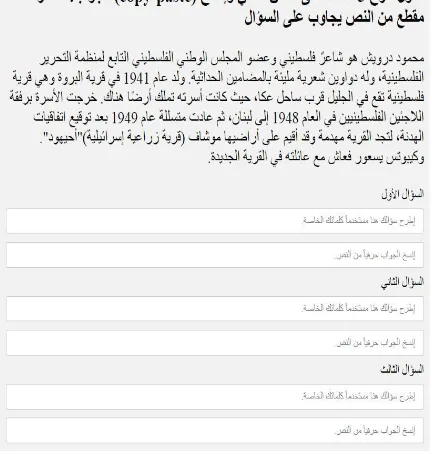
in-Figure 2: Interface for the crowdworkers
vestigates the use of Wikipedia as a knowledge source and implements a two component system based on a TF-IDF retriever and a RNN reader achieving a 29.8% exact- match accuracy on open-SQuAD. Other approaches have attempted to build more sophisticated retrievers by formulating it as a reinforcement learning problem (Wang et al.,
2018b,a), or as a supervised learning problem us-ing distant supervision for data (Das et al.,2018;
Lin et al.,2018).
In the following sections we will first describe the datasets collected, and then our proposed method for Arabic open-domain question answer-ing.
3 Dataset Collection
3.1 Arabic Reading Comprehension Dataset
To properly evaluate our system, we must have questions written by proficient Arabic speakers, and thus we resort to crowdsourcing to develop our dataset.
[image:3.595.309.525.78.305.2]consists of a paragraph along with two text boxes for each of the 3 question-answer pairs. Pasting is disabled in the question fields in order to en-courage workers to use their own words, but it is enforced in the answer fields to guarantee that the answer is taken as-is from the paragraph. Be-fore workers begin the task, they have to answer a reading comprehension question from a test set we created to make sure of their language profi-ciency. Only workers who succeeded in the test were accepted.
Article curation. The articles presented in the tasks were 155 articles randomly sampled from the 1000 most viewed articles on Wikipedia in 2018. We used MediaWiki’s API1 to retrieve the
most viewed articles per month in 2018 for Arabic Wikipedia and aggregated the results. The articles covered a diverse set of topics including religious and historical figures, sports celebrities, countries, and companies. We additionally manually filtered out adult content.
Crowdsourcing. We resorted to Amazon Me-chanical Turk for crowdsourcing. Crowdworkers were required to have a minimum HIT acceptance of 97%, and at least 100 HITs submitted. More-over, our task description highlighted the need for good Arabic skills. Workers were advised to spend 3 to 4 minutes per paragraph and were paid close to 10 USD per hour. They were encouraged to ask difficult questions framed in such a way that they can be answered outside the scope of the para-graph. In total, we collected 1,395 questions based on 465 paragraphs from 155 articles based on the Amazon Turk HITs.
3.2 Arabic-SQuAD
Translating SQuAD.While the crowdsourcing of questions by proficient Arabic writers is essen-tial to properly evaluate our systems, noisy data could well suffice for training. Indeed, backtrans-lation as a means for data augmentation has been effective in improving the performance of neu-ral MRC (Yu et al., 2018), and this gives hope that translated data could be used to train our ma-chine reading comprehension module. We chose to translate SQuAD version 1.1 (Rajpurkar et al.,
2016). It is currently the most popular benchmark for MRC and was collected through crowdsourc-ing based on Wikipedia articles. SQuAD contains
1Availabe at https://en.wikipedia.org/w/
api.php
107,785 paragraph-question-answer tuples on 536 articles, and we translated the first 231 articles of the SQuAD training set using the Google Trans-late neural machine translation (NMT) API (Wu et al.,2016). This resulted in 48,344 questions on 10,364 paragraphs.
4 Our System: SOQAL
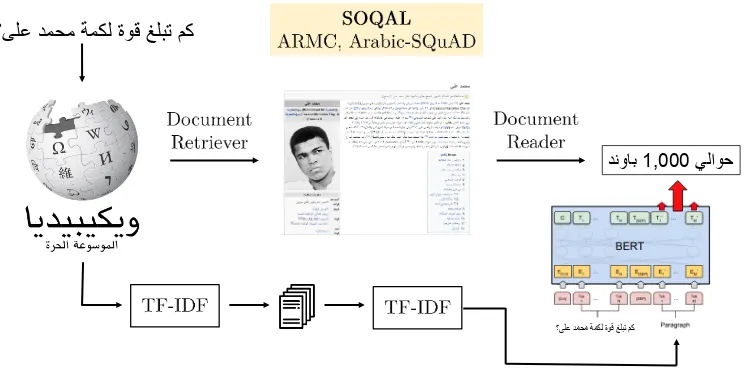
We will now describe the architecture of our sys-tem for open domain question answering for the Arabic language (SOQAL). It is composed of three modules: (1) a document retriever that ob-tains relevant documents to the question, (2) a ma-chine reading comprehension module that extracts answers from the documents retrieved, and an (3) answer ranking module that ranks the answers in order of relevance by taking in scores from both the document retriever and the reader. The inputs to the system are a question consisting of m to-kensq={q1,· · · , qm}, and the entirety of Arabic
Wikipedia, and its output is a small span of text ex-tracted from Wikipedia which should answer the question. The pipeline is illustrated in figure3.
4.1 Hierarchical TF-IDF Document Retriever
The goal of this module is to select the docu-ments that are most relevant to the question, thus reducing the span of search of our reader. Ara-bic Wikipedia is made up of 664,768 indexed ar-ticles with an average of 3.4 paragraphs per arti-cle, totalling 2,683,743 paragraphs with an aver-age of 233 characters per paragraph. We discard imagery, lists, and other structured information so that our approach could translate well to various knowledge sources.
There are two scopes on which we can search: either articles or paragraphs. We denote the set of documents searched over asD = {d1,· · · , dn},
where for 1 ≤ i ≤ n, di is a single document
which can be either an article or a paragraph from an article.
Inspired by classical QA systems (Chen et al.,
2017), we employ a term frequency-inverse doc-ument frequency (TF-IDF) based docdoc-ument re-triever given its efficiency. Each document is first tokenized and stemmed using the NLTK (Bird,
؟ىلع دمحم ةمكل ةوق غلبت مك
يلاوح 1,000 دنواب
[image:5.595.114.488.64.251.2]؟ىلع دمحم ةمكل ةوق غلبت مك
Figure 3: Architecture of our open domain question answering system SOQAL. BERT illustration is adapted from (Devlin et al.,2018)
local word order. As n increases, the retriever becomes more accurate, but the retrieval process becomes slower and more memory prohibitive. Each document’s vector is normalized. Next, the TF-IDF vector weights of the question are com-puted based on the vocabulary of the document set. The score for each document is then computed as the cosine similarity between the question and the document vectors. We use a sparse matrix repre-sentation for the TF-IDF matrix to speed up com-putations. Finally, we return the topkdocuments with the highest similarity wherek ∈ Nis a
hy-perparameter. The higherk is, the more likely it is that the set of retrieved documents contains rel-evant documents, and the slower and more error-prone is the answer extraction process.
To obtain the benefits of using largen-gram fea-tures while keeping ksmall and being computa-tionally efficient, we propose the following hierar-chical TF-IDF retriever approach. The first step is to build a TF-IDF retriever on Arabic Wikipedia with bigram features and a very large k, say ≈
1000, and obtain the set of retrieved documents for a given question, call it D0. Then, for each question, we construct a seperate TF-IDF retriever using as document setD0with4-gram features and a smallk, say≈15. The second retriever does not sacrifice much in terms of the accuracy of the first retrieval step, as4-gram features are highly infor-mative and do not add significant computations.
4.2 BERT Document Reader
Our proposed reader is Bert (Devlin et al.,2018), a pre-trained language model that is currently the state of the art on the SQuAD leaderboard2.
Its core model is a bi-directional Transformer (Vaswani et al.,2017). The input text is first tok-enized using a shared Wordpiece (Wu et al.,2016) vocabulary of 104 languages, and it is then embed-ded; note that Arabic diacritics are removed. Each input point of question and paragraph pairs is rep-resented as a single sentence separated by a special token. We need to learn two new vectors: start and endS, E ∈ RH vectors indicating the position of
the answer;H is the dimension of the last hidden layer outputs. For each token iin the paragraph, we take the final hidden state of the Transformer Ti and let the probability that iis the start or end
of the answer be:
Pstart(i)∝exp(STTi)
Pend(i)∝exp(ETTi)
Note that we take the un-normalized exponential to be able to compare across documents. At in-ference time we predict the span (i, j) such that i≤ j ≤i+ 15that maximizesPstart(i)Pend(j).
The training objective is the sum of the log likeli-hood for each of the start and end positions.
4.3 Answer Ranking
Let us recall the operation of the end-to-end sys-tem. The question is first passed to the retriever
2SQuAD leaderboard https://rajpurkar.
and the topkdocuments are gathered; if a docu-ment unit is an article then we gather all of its para-graphs. Along with the documents’ text, we obtain a score for each document denoted DocScore(i) from the retriever; paragraphs have the same score as their document. For our hierarchical TF-IDF retriever, the scores are the cosine similarities be-tween the document and the question.
The paragraphs obtained from the retriever are each then fed as input to the document reader to obtain candidate answers. We obtain a score for each candidate answeridenoted:
AnsScore(i)∝Pstart(i)·Pend(i)
To make sure the answer and document scores are on the same scale, we normalize both individ-ually by passing each through a softmax function. The final step to obtain the answer of the question is by combining the scores through a linear combi-nation and pick the maximizing answer as follows:
arg max
i∈[k] β·DocScore(i)+(1−β)·AnsScore(i)
Where β ∈ [0,1] is a hyperparameter chosen through a line search using a development set.
As a note, since articles can be very large, one can additionally use a TF-IDF retriever with4−
gram features to obtain a smaller set of paragraphs, thus reducing the load on the reader. While this step was not performed for our experimental eval-uation, it is crucial when deploying the QA system for usage.
5 Dataset Analysis
5.1 ARCD
In this section we analyze the properties of the Arabic Reading Comprehension Dataset. To bet-ter understand the difficulty of answering the ques-tions, we randomly sampled100questions for the following analysis.
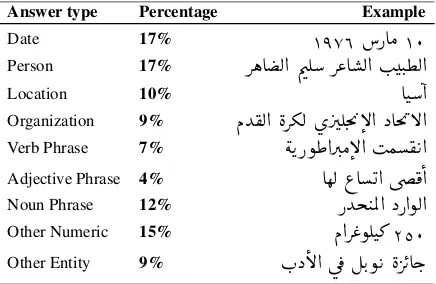
Answer diversity. We, the authors, manually categorized the answers by first separating the nu-merical and non-nunu-merical answers. Nunu-merical answers were either identified as dates by looking at the question, or were otherwise labeled as other numeric. For the non-numerical answers, we iden-tify the type of phrase as either a verb, adjective, or noun phrase. If it is a noun phrase, we check using MADAMIRA (Pasha et al.,2014) for named en-tities, and then manually verify the outcome. The results are shown in table2.
Answer type Percentage Example
Date 17%
1976 PAÓ 10
Person 17%
QëA Ë@ ÕæÊ Q«A
Ë@ I
. J.¢Ë@
Location 10%
AJ
@
Organization 9%
ÐY
®Ë@
èQºË ø
QÊm.
'B
@ XAm
'B@
Verb Phrase 7%
éKPñ£@Q.ÓB@
IÒ
® K@
Adjective Phrase 4%
AêË ¨A
@ úæ
¯
@
Noun Phrase 12%PYj JÖÏ@ XP@ñË@
Other Numeric 15%Ð@Q
«ñÊJ» 250
Other Entity 9%
H.X
B@ ú
[image:6.595.308.526.62.204.2]¯ ÉK.ñ K è QKAg.
Table 2: Answer categories percentages in ARCD ac-cording to the categorization by (Rajpurkar et al.,2016)
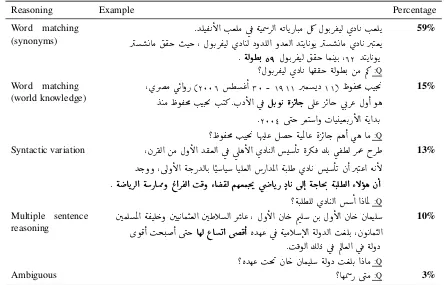
Question Reasoning To better understand the reasoning required to answer the questions, we manually labeled the questions according to the following reasoning categories as in (Trischler et al.,2017;Rajpurkar et al.,2016):
• Word matching (synonyms): question
matches the same word pattern up to syn-onyms in the paragraph; simple pattern matching is required.
• Word matching (world knowledge): question
matches the pattern of the paragraph, how-ever additional inference using world knowl-edge is required to answer.
• Syntactic variation: The question’s syntactic
dependency structure does not match that of the answer sentence.
• Multiple sentence reasoning: The question
draws on knowledge from multiple sen-tences. Only after making necessary links across sentences can it be answered.
• Ambiguous: The question cannot be
an-swered given the information in the para-graph or is unclear.
The results and examples are shown in table3.
5.2 Arabic-SQuAD
We discuss some of the issues resulting from the machine translation of SQuAD and how we han-dled them.
Reasoning Example Percentage
Word matching
(synonyms) . YÊJ
® KB@ I . ªÊÓ ú¯ éJÖÞ QË@ éKAKPAJ.Ó É¿ ÈñK.Q ®JË ø XA K I.ªÊK Q AÓ ®k IJk , ÈñK.Q®JË øXA JË XðYÊË@ ðYªË@ YJKA KñK Q AÓ ø XA K Q.JªK . éËñ¢. 59 ÈñK.Q®JË ®k AÒ JK. ,62 YJKA KñK
? ÈñK.Q®JË øXA K Aê®®k éËñ¢. áÓ Õ» :Q
59%
Word matching
(world knowledge) , øQåÓ ù
K@ðP (2006 ¢ «@ 30 - 1911 Q.ÒX 11) ñ®m× I. Jm. ' Y JÓ ñ®m× I. Jm. ' I. J» .H.XB@ ú
¯ ÉK.ñ K è QKAg. úΫ QKAg úG.Q« Èð @ ñë
.2004 ú æk QÒJ@ð HAJJªK.PB@ éK@YK.
? ñ®m× I. Jm. ' AîDÊ« Ék éJÖÏA« è QKAg. Ñë@ ù ë AÓ :Q
15%
Syntactic variation , àQ®Ë@ áÓ Èð B@ Y®ªË@ ú
¯ úÎë
B@ øXA JË@ AK èQº¯ ½K. ù®¢Ë QÔ« hQ£ Yg.ðð , úÍðB@ ék.PYËAK. AJAJ AJʪË@ P@YÖÏ@ éJ.Ê£ ø XA K AK à@ Q.J«@ é KB . é AKQË@ éPAÜØð ¨@Q®Ë@ I¯ð ZA ®Ë ÑêªÒm.' úæ AKP XA K úÍ@ ék.Am'. éJ.Ê¢Ë@ ZB ñë à@
?éJ.Ê¢ÊË øXA JË@ @ @XAÖÏ :Q
13%
Multiple sentence
reasoning áÒÊÖÏ@ é ®JÊ gð áJ KAÒJªË@ á£CË@ Qå A« , Èð
B@ àA g ÕæÊ áK. ÈðB@ àA g àAÒJÊ øñ¯@ Ij.@ ú æk AêË ¨A@ úæ¯@ èYê« ú
¯
éJÓCB@ éËðYË@ I ªÊK. , àñ KAÒJË@ . I¯ñË@ ½ËX ú
¯ ÕËAªË@ ú¯ éËðX
? èYê« Im' àA g àAÒJÊ éËðX I ªÊK. @XAÓ :Q
10%
[image:7.595.75.519.62.347.2]Ambiguous ? AêÖÞ P ú æÓ :Q 3%
Table 3: Examples of questions with their respective paragraph (trimmed to fit) and answer in bold from ARCD and the reasoning required to answer them.
25,490 answers not found in their respective para-graphs, almost 47.3% of the total questions. We remarked that the type of errors that caused the an-swers to not match in the paragraph mostly arised from two factors: (1) translation was unable to recognize named entities without context and thus transliterated them, and (2) minor typographic like errors from missing or added
KQª
JË@ ÐB
(the) and differing tenses. To fix this issue, we translit-erated all the paragraphs and answers to Arabic and found the span of text of length at most 15 words with the least edit-distance with respect to the answer. To verify the efficacy of this approach, we randomly sampled 100 questions where the an-swer is not found in the paragraph and provided the correct answer. On this test set, the approach managed to exactly find 44% of the answers, and 64% of the proposed answers contained the cor-rect answer and did not exceed more than twice its length.6 System Experiments
We now showcase experiments for every compo-nent in our system and the end-to-end open do-main system.
Datasets. Arabic-SQuAD is split 80-10-10%
into three parts for training, development and test-ing: Arabic-SQuad-Test is composed of 2,966 questions on 24 articles; note that articles are dis-tinct between the parts. Similarly, ARCD is split 50-50 into training and testing with ARCD-Test having 702 questions on 78 articles.
6.1 Retriever
Method k ARCD
Wikipedia API 15 34.8%
Google Search 10 75.6%
TF-IDF Unigram Article 15 41.7% TF-IDF Bigram Article 15 47.7% TF-IDF Bigram Article 350 73.5% Hierarchical TF-IDF 15 65.3% Embedding fastText Paragraph 50 27.0%
Table 4: Comparison of the different retrievers on ARCD.k: number of documents retrieved
Method Arabic-SQuAD Test ARCD
EM F1 SM EM F1 SM
Random Guess 0.23 4.34 23.5 0.07 8.13 51.0
Sliding Win. + Dist.(Richardson et al.,2013) 0.00 5.80 29.2 0.07 14.2 58.4
Embedding fastText 0.04 6.96 43.1 0.36 15.3 73.1
TF-IDF Reader 0.27 2.41 49.2 0.22 5.6 75.3
QANet fastText(Yu et al.,2018) 29.4 44.4 61.7 11.0 38.6 83.2
[image:8.595.104.498.63.173.2]BERT(Devlin et al.,2018) 34.1 48.6 66.8 19.6 51.3 91.4
Table 5: Comparison of the different document reader modules on Arabic-SQuAD test set and all of ARCD. QANet and BERT were trained only on the training set of Arabic-SQuAD.
Baselines. We implement three baselines: the first is using Wikipedia’s Search API 3, and the second is through Google Custom Search en-gine 4 restricted to the Arabic Wikipedia site. Furthermore, we implement an embedding based retriever using fastText embeddings 300 dimen-sional Wikipedia pre-trained word embeddings (Joulin et al.,2016) that computes for each para-graph a representation using the sum of its word embeddings. Other embedding models exist for Arabic but fastText is the most specialized to Wikipedia (Badaro et al., 2018; Al Sallab et al.,
2015)
Results and Analysis Our results are reported in table 4. We find that even the simple TF-IDF unigram retriever is able to beat the Wikipedia API baseline. Google Search with k = 10 is the golden standard with 75.6%, TF-IDF using bi-gram features andk = 350 is able to come close with 73.5%. Using our hierarchical approach of adding a second4-gram TF-IDF retriever to a bi-gram k = 1000 retriever achieves a respectable 65.3% improving on the single bigram by 17.6% and a reduction of 8.2% from the full k = 350 retriever. The embedding retriever using fastText
(Joulin et al., 2016) performed badly in
accor-dance with the results in (Chen et al.,2017). It is important to note that since the questions in ARCD were written with a specific paragraph in mind, they might be ambiguous without their context, hence why it is hard to beat the Google Search baseline.
6.2 Reader
Metrics. We evaluate our different readers based on three metrics. The first is exact match (EM)
3
https://www.mediawiki.org/wiki/API: Search
4We use the official API https://developers.
google.com/custom-search/
Method ARCD-Test
EM F1 SM
Reader:
BERT (SQuAD) 23.8 53.0 90.6
BERT (ARCD) 23.9 50.1 88.0
BERT (SQuAD + ARCD) 34.2 61.3 90.0
Open-Domain:
SOQAL (top-1) 12.8 27.6 29.8 SOQAL (top-3) 17.8 37.9 44.0 SOQAL (top-5) 20.7 42.5 51.7
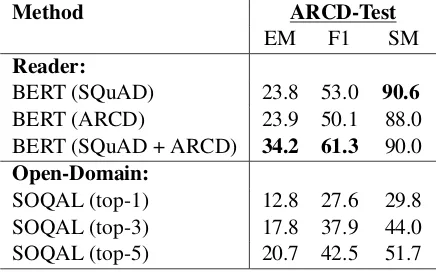
Table 6: Results of BERT as a document reader on ARCD-Test under different data regimes and of our open domain system SOQAL when returning the top k answers
which measures the percentage of predictions that match the ground truth answer exactly, the second
is a(macro-averaged) F1 score(Rajpurkar et al.,
2016) that measures the average overlap between the prediction tokens and the ground truth answer tokens. Finally, we use a sentence match (SM) metric that measures the percentage of predictions that fall in the same sentence in the paragraph as the ground truth answer.
Baselines. We compare against three non-learning baselines. For all three methods, we gen-erate candidate answers by considering every text span of length maximally 10 words in each sen-tence as a candidate. We implement the follow-ing baselines: the slidfollow-ing window distance based algorithm of (Richardson et al., 2013), a TF-IDF reader based on 4-gram features which operates exactly like the retriever withk = 1, and finally an embedding approach where the candidate with the highest cosine similarity with respect to fast-Text embeddings is returned (Joulin et al., 2016;
Belinkov et al., 2015). We also compare against
[image:8.595.307.525.227.363.2]Implementation Details. For Bert, we fol-low the reference implementation for training on SQuAD5. We fine-tune from the BERT-Base un-normalized multilingual model which includes Arabic. The model has 12-layers withH = 768, 12-heads for self attention and inputs are padded to 384 tokens. We train on the training set of Arabic-SQuAD for 2 epochs with a learning rate of3·10−5. Similarly for QANet we modify the implementation of6and use fastText embeddings
and train for a total of 4 epochs.
Results and AnalysisWe report all reader ex-periments in table 5. The non-learning baselines are unable to obtain a significant improvement over a random guess on the EM and F1 metrics. The embedding and TF-IDF readers reach a sen-tence match accuracy of almost 75%; this 75% accuracy in fact corresponds to the percentage of word matching questions as in table 3. On the other hand, BERT and QANet on the test set of Arabic-SQuAD reach 44.4 and 48.6 F1 scores re-spectively; as previously noted half of Arabic-SQuAD answers might be faulty as a result of NMT and this explains the relatively low results compared to the SQuAD leaderboard (Rajpurkar
et al., 2016). Now without having been trained
on ARCD, both neural MRC models are able to perform well transferring knowledge from Arabic-SQuAD with BERT reaching a remarkable 90.08 SM accuracy.
Transfer Learning. To evaluate the effective-ness of using translated data as training data on the ARCD test set we train BERT under the following data regimes: (a) Arabic-SQuAD only, (b) Train only and (c) Arabic-SQuAD and ARCD-Train combined; results are reported in table6. We remark that training under regimes (a) or (b) had very similar results, this gives strong evidence that Arabic-SQuAD could be in fact sufficient for ob-taining powerful MRC models. When combining both datasets, we obtain an improvement of 8.3% on the F1 score with a total score of 61.3; the train-ing on ARCD allowed the model to better adapt to its differing answer distribution.
6.3 Open Domain QA
We test our open domain approach SOQAL on ARCD-Test. For our retriever we combine our hi-erarchical TF-IDF retriever with the Google
Cus-5
https://github.com/google-research/ bert
6https://github.com/NLPLearn/QANet
tom Search Engine to make sure we have a to-tal of 10 retrieved articles. We train BERT on Arabic-SQuAD for two epochs and then fine-tune on ARCD-Train for an epoch.
We report in table 6 the accuracy of our pro-posed system on ARCD-Test achieving a 27.6 F1 and a 29.8 SM. The close F1 and SM scores indi-cate that the system is able to correctly retrieve the answer when it selects the correct paragraph, the issue then lies with it not scoring highly enough the correct paragraph. We also report the accuracy when the system outputs the top 3 and top 5 results (choosing the best answer out of them).
7 Conclusion
To further the state of Arabic natural language un-derstanding we proposed an approach for open do-main Arabic QA and introduced the Arabic Read-ing Comprehension Dataset (ARCD) and Arabic-SQuAD: a machine translation of SQuAD (Devlin
et al., 2018). Our approach consisted of a
doc-ument retriever using hierarchical TF-IDF and a document reader using BERT (Devlin et al.,2018). We achieve a F1 score of 61.3 and a 90.0% sen-tence match on ARCD and a 27.6 F1 score on an open domain version of ARCD. We also showed the effectiveness of using translated data as a train-ing resource for QA. Future work will aim to ex-pand the size of ARCD and improve the end-to-end system by focusing on paragraph selection.
References
Karim Bouzouba Abouenour Lahsen and Paolo Rosso. 2010. An evaluated semantic query expansion and structure-based approach for enhancing arabic ques-tion/answering. In International Journal on Infor-mation and Communication Technologies 3, no. 3, pages 37–51.
Mohammed Akour, Sameer Abufardeh, Kenneth Magel, and Qasemm Al-Radaideh. 2011. Qarabpro: A rule based question answering system for reading comprehension tests in arabic. American Journal of Applied Sciences, 8(6):652.
Ahmad Al Sallab, Hazem Hajj, Gilbert Badaro, Ramy Baly, Wassim El Hajj, and Khaled Bashir Shaban. 2015. Deep learning models for sentiment analysis in arabic. InProceedings of the second workshop on Arabic natural language processing, pages 9–17.
Gilbert Badaro, Obeida El Jundi, Alaa Khaddaj, Alaa Maarouf, Raslan Kain, Hazem Hajj, and Wassim El-Hajj. 2018. Ema at semeval-2018 task 1: Emotion mining for arabic. InProceedings of The 12th Inter-national Workshop on Semantic Evaluation, pages 236–244.
Yonatan Belinkov, Alberto Barr´on-Cede˜no, and Hamdy Mubarak. 2015. Answer selection in arabic community question answering: A feature-rich ap-proach. InProceedings of the Second Workshop on Arabic Natural Language Processing, pages 183– 190.
Abdelouahid Lyhyaoui Benajiba Yassine, Paolo Rosso. 2007. Implementation of the arabiqa question an-swering system’s components. In Proc. Workshop on Arabic Natural Language Processing, 2nd In-formation Communication Technologies Int. Sympo-sium, ICTIS-2007, Fez, Morroco, April, pages 3–5.
Steven Bird. 2006. Nltk: The natural language toolkit. InCOLING ACL 2006, page 69.
Danqi Chen, Adam Fisch, Jason Weston, and Antoine Bordes. 2017. Reading wikipedia to answer open-domain questions. InProceedings of the 55th An-nual Meeting of the Association for Computational Linguistics (Volume 1: Long Papers), volume 1, pages 1870–1879.
Rajarshi Das, Shehzaad Dhuliawala, Manzil Zaheer, and Andrew McCallum. 2018. Multi-step retriever-reader interaction for scalable open-domain question answering.
Jacob Devlin, Ming-Wei Chang, Kenton Lee, and Kristina Toutanova. 2018. Bert: Pre-training of deep bidirectional transformers for language understand-ing. arXiv preprint arXiv:1810.04805.
Walaa Saber Ismail and Masun Nabhan Homsi. 2018. Dawqas: A dataset for arabic why question answer-ing system. In Procedia computer science 142, pages 123–131.
Mandar Joshi, Eunsol Choi, Daniel S Weld, and Luke Zettlemoyer. 2017. Triviaqa: A large scale distantly supervised challenge dataset for reading comprehen-sion.arXiv preprint arXiv:1705.03551.
Armand Joulin, Edouard Grave, Piotr Bojanowski, Matthijs Douze, H´erve J´egou, and Tomas Mikolov. 2016. Fasttext.zip: Compressing text classification models. arXiv preprint arXiv:1612.03651.
Tom Kwiatkowski, Jennimaria Palomaki, Olivia Red-field, Michael Collins, Ankur Parikh, Chris Alberti, Danielle Epstein, Illia Polosukhin, Matthew Kelcey, Jacob Devlin, Kenton Lee, Kristina N. Toutanova, Llion Jones, Ming-Wei Chang, Andrew Dai, Jakob Uszkoreit, Quoc Le, and Slav Petrov. 2019. Natu-ral questions: a benchmark for question answering research. Transactions of the Association of Com-putational Linguistics.
Jens Lehmann, Robert Isele, Max Jakob, Anja Jentzsch, Dimitris Kontokostas, Pablo N Mendes, Sebastian Hellmann, Mohamed Morsey, Patrick Van Kleef, S¨oren Auer, et al. 2015. Dbpedia–a large-scale, multilingual knowledge base extracted from wikipedia. Semantic Web, 6(2):167–195.
Yankai Lin, Haozhe Ji, Zhiyuan Liu, and Maosong Sun. 2018. Denoising distantly supervised open-domain question answering. InProceedings of the 56th Annual Meeting of the Association for Compu-tational Linguistics (Volume 1: Long Papers), vol-ume 1, pages 1736–1745.
Preslav Nakov, Doris Hoogeveen, Llu´ıs M`arquez, Alessandro Moschitti, Hamdy Mubarak, Timothy Baldwin, and Karin Verspoor. 2017. Semeval-2017 task 3: Community question answering. In Proceed-ings of the 11th International Workshop on Semantic Evaluation (SemEval-2017), pages 27–48.
Arfath Pasha, Mohamed Al-Badrashiny, Mona Diab, Ahmed El Kholy, Ramy Eskander, Nizar Habash, Manoj Pooleery, Owen Rambow, and Ryan Roth. 2014. Madamira: A fast, comprehensive tool for morphological analysis and disambiguation of ara-bic. In Proceedings of the Ninth International Conference on Language Resources and Evaluation (LREC-2014).
Eduard H. Hovy Pamela Forner lvaro Rodrigo Richard FE Sutcliffe Corina Forascu Peas, Anselmo and Caroline Sporleder. 2011. Overview of qa4mre at clef 2011: Question answering for machine reading evaluation. In CLEF (Notebook Pa-pers/Labs/Workshop), pages 1–20.
Pranav Rajpurkar, Jian Zhang, Konstantin Lopyrev, and Percy Liang. 2016. Squad: 100,000+ questions for machine comprehension of text. arXiv preprint arXiv:1606.05250.
Matthew Richardson, Christopher JC Burges, and Erin Renshaw. 2013. Mctest: A challenge dataset for the open-domain machine comprehension of text. In Proceedings of the 2013 Conference on Empiri-cal Methods in Natural Language Processing, pages 193–203.
Minjoon Seo, Aniruddha Kembhavi, Ali Farhadi, and Hannaneh Hajishirzi. 2016. Bidirectional attention flow for machine comprehension. arXiv preprint arXiv:1611.01603.
Mohamed Shaheen and Ahmed Magdy Ezzeldin. 2014. Arabic question answering: systems, resources, tools, and future trends. Arabian Journal for Sci-ence and Engineering, 39(6):4541–4564.
Adam Trischler, Tong Wang, Xingdi Yuan, Justin Har-ris, Alessandro Sordoni, Philip Bachman, and Ka-heer Suleman. 2017. Newsqa: A machine compre-hension dataset. ACL 2017, page 191.
Ashish Vaswani, Noam Shazeer, Niki Parmar, Jakob Uszkoreit, Llion Jones, Aidan N Gomez, ukasz Kaiser, and Illia Polosukhin. 2017. Attention is all you need. InAdvances in neural information pro-cessing systems, pages 5998–6008.
Shuohang Wang, Mo Yu, Xiaoxiao Guo, Zhiguo Wang, Tim Klinger, Wei Zhang, Shiyu Chang, Gerry Tesauro, Bowen Zhou, and Jing Jiang. 2018a. R 3: Reinforced ranker-reader for open-domain question answering. In Thirty-Second AAAI Conference on Artificial Intelligence.
Zhen Wang, Jiachen Liu, Xinyan Xiao, Yajuan Lyu, and Tian Wu. 2018b. Joint training of candidate extraction and answer selection for reading compre-hension. arXiv preprint arXiv:1805.06145.
Yonghui Wu, Mike Schuster, Zhifeng Chen, Quoc V Le, Mohammad Norouzi, Wolfgang Macherey, Maxim Krikun, Yuan Cao, Qin Gao, Klaus Macherey, et al. 2016. Google’s neural ma-chine translation system: Bridging the gap between human and machine translation. arXiv preprint arXiv:1609.08144.
Yi Yang, Wen-tau Yih, and Christopher Meek. 2015. Wikiqa: A challenge dataset for open-domain ques-tion answering. In Proceedings of the 2015 Con-ference on Empirical Methods in Natural Language Processing, pages 2013–2018.