© 2016, IRJET | Impact Factor value: 4.45 | ISO 9001:2008 Certified Journal | Page 1388
Solar Passive Architecture Cooling Techniques
C. V. Subramanian
1, M. Divya
21
Associate Professor, Dept. of Architecture, Periyar Maniammai University, Tamilnadu, India
2
Final year student, Dept. of Architecture, Periyar Maniammai University, Tamilnadu, India
---***---Abstract -
In the recent years, the usage of air conditioning
system has been in rapid increase for the purpose of cooling the building which results in high energy consumption. Passive cooling techniques are the method to increase the comfort level without or less usage of mechanical methods. The climate in Tamilnadu region is warm and humid and the temperature ranges from 30˚to 35˚c and 25˚ to 30˚ in summer and winter respectively. Solar Passive Architecture cooling techniques will certainly be an appropriate design solution for this region.
Key Words: Passive cooling techniques, building envelope,
climate design and energy conservation.
1.0 INTRODUCTION
In recent year, there were several energy demand in developing countries and that too in summer season due to cooling requirement of the building [1]. The energy required for the buildings are quite high due to increase in population and to the improved standard of living [2]. For the warm humid climate of Tamilnadu region, Solar Passive Architecture plays a vital role in reducing the cooling load of the building in a natural way. Several Solar Passive Architecture cooling techniques are discussed in this paper. By incorporating such techniques in an appropriate way will certainly can provide comfortable indoor conditions and contributes for the energy conservation to a larger extent.
2.0 PASSIVE COOLING OF BUILDINGS
Passive cooling is a building design approach that is used to control heat gain and promote heat dissipation in a building in order to improve the thermal comfort with low or nil energy consumption [1].
Fig -1: Cooling of the building through ventilation
Passive cooling works either by preventing heat from entering the interior (heat gain prevention) or by removing heat from the building (natural cooling)
It also helps to reduce the usage of air conditioners and the period for which it is highly required. The general passive cooling techniques and the advanced passive cooling techniques suitable for warm humid climate are discussed here.
3.0 GENERAL PASSIVE COOLING TECHNIQUES
The general passive cooling techniques have three levels of approaches during the building construction. Site level building features, Architectural features and Weather skin features are those approaches which have to be dealt at micro level as shown below:
A) SITE LEVEL BUILDING FEATURES
Location Orientation Vegetation Land massing
Microclimate modification
B) ARCHITECTURAL FEATURES
Building exposure Surface/volume ratio Screen
Shade Wing walls Overhangs
C) WEATHER SKIN FEATURES
Insulation Glazing Mass
© 2016, IRJET | Impact Factor value: 4.45 | ISO 9001:2008 Certified Journal | Page 1389
4.0 ADVANCED PASSIVE COOLING TECHNIQUES
Apart from the general passive cooling techniques, few advanced techniques are widely used at various locations alone or in combination with the general techniques on the need basis.
4.1 DESICCANT COOLING
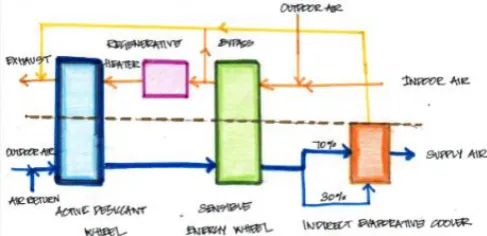
[image:2.595.309.558.265.417.2]It is effective in warm and humid climate. In desiccant cooling method, desiccant salt or dehumidifiers were used to reduce humidity in atmosphere. High affinity materials are used for dehumidification. Chemicals like silica gel, alumina gel and activated alumina or triethylene glycol [11]. The outside air enters into the unit area containing desiccant, which absorbs the moisture and dries the air adiabatically. Solar energy is used to regenerate the desiccants [2].
Fig -2: Desiccant rotary dehumidifier wheel
Fig -3: Process of desiccant cooling
4.2 EARTH COUPLING
In earth coupling, the moderate and consistent temperature of soil acts as heat sink to cool the building through conduction. This principle is most effective in hot climate
and also when earth temperature is cooler than ambient air temperature [10].
4.2.1 Direct Coupling
[image:2.595.36.286.328.480.2]Earth acts as heat sink when the building is in contact with it. When the ambient temperature goes high, the earth has a capacity to retain the coolness and acts as buffer by protecting the building. Worldwide earth sheltered buildings are built to take the advantage of the coolness and buffer provided by it. Thus it reduces the heat gain by limiting solar infiltration [10].
Fig -4: Earth sheltered building
4.2.2 Indirect Coupling
The building is coupled with earth by means of earth ducts. The buried tubes, as earth duct acts as avenue for supply of air to travel below earth before entering the building. The supplied air is cooled by surrounding soil. Soil temperature should be lower than the desired room air temperature for better cool output temperature. If not, the tubes can be buried below water before entering the building.
[image:2.595.36.280.531.649.2] [image:2.595.310.530.578.736.2]© 2016, IRJET | Impact Factor value: 4.45 | ISO 9001:2008 Certified Journal | Page 1390
4.3 EVAPORTIVE COOLING
[image:3.595.36.288.202.337.2]In evaporative cooling, the outdoor air is cooled by evaporative water before it is introduced into the building [1]. For conditioning the indoor space through evaporative cooling technique, water can also be used as another resource apart from air [10].
Fig -6: Courtyard effect and evaporative cooling
A Study based on passive cooling; prove that interior comfort by evaporative cooling can reduce air temperature by 9.6˚c compared to outdoor [10].
In the process of evaporative cooling, ambient hot air is passed over water to evaporate and cool the air. Thus cooled air is passed inside the Interior to cool the space.
There were 2 types of evaporative cooling,
Passive Downdraft Evaporative Cooling (PDEC) Roof Surface Evaporative Cooling (RSEC)
4.3.1 Passive Downdraft Evaporative Cooling
[image:3.595.313.556.229.360.2]In this system, the tower is with wetted cellulose pad at the top of the tower. The water sprayed on the pad gets collected and re-circulated by a pump.
Fig -7: Model of cooling tower with cooling pad
This principle has been successfully implemented in Torrent research centre in Ahmedabad, India.
4.3.2 Roof Surface Evaporative Cooling
Solar radiation incident on the roof results in overheating of rooms below them. The heat on roof surface can be reduced by spraying water on water retentive material and rooftop vegetation [5].
Fig -8: Roof top sprinkler for evaporative cooling
4.4 RADIATIVE COOLING
The Roof top of building acts as both nocturnal radiator and also a heat or cold store. During the night time, the heat is lost from roof by long wave radiation and by convection [10].
The roof can be insulated externally during the day time to minimize the heat gain by solar radiation and outside hot air.
4.4.1 Diode Roof
The heat gain and water loss by evaporation can be reduced by diode as this roof consists of pipe system, consisting of corrugated sheet metal roof on which polyethylene bags coated with titanium oxide containing a layer of pebbles wetted with water are placed. By this method, the roof system can cool up to 4˚ C[3].
4.4.2 Roof Pond
[image:3.595.37.291.611.748.2]© 2016, IRJET | Impact Factor value: 4.45 | ISO 9001:2008 Certified Journal | Page 1391
The ceiling of the building which has thermal storage willradiate uniform low temperature heat in both sunny and cloudy conditions. The solar radiation which is captured by roof pond can store temperature of up to 100˚C [7].
4.5 INSULATION
Insulation is barrier to heat flow, reducing heat loss in winter and reduce heat gain in summer. There are many types of insulation materials available according to the need [8]. They are,
Foam Cellulose Fiberglass Polystyrene
4.6 SHADING DEVICES
[image:4.595.306.561.285.487.2]Heat generated by the direct sun as a single bar radiate over each square meter of surface, but 90% of heat can be located by effective shading, which can reduce summer temperature, improves comfort and save energy [5].
Fig -9: Types of shading devices protecting building exterior
Shading requirements vary according to climate and orientation of buildings as briefed below:
North direction: fixed or adjustable horizontal shading above the window and extending past it each side.
East and West direction: fixed or adjustable vertical louvers or blades, deep verandas or pergolas with ever green trees.
North east and North west: perforated elements like pergola with deciduous trees to allow solar radiations partially or verandas and adjustableshading devices to avoid it fully.
South east and South west: planting evergreen trees in hot climate and providing complete shade [4].
4.6.1 Shading by Overhangs, Louvers, Awnings, etc.
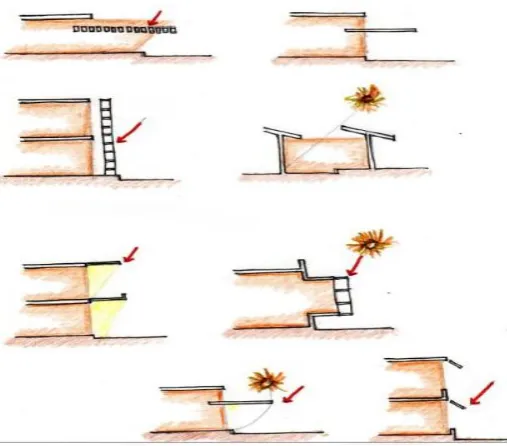
[image:4.595.36.290.405.628.2]Proper design of shading devices like overhangs, louvers, awnings, etc., will reduce the heat gain into the building and reduces the cooling load. It also improves daylighting inside the building. Depending on the orientation and sun angle, the effectiveness of the shading device can be improved [1].
Fig -10: Types of shading devices
4.6.2 Shading of Roof
[image:4.595.304.551.529.751.2]© 2016, IRJET | Impact Factor value: 4.45 | ISO 9001:2008 Certified Journal | Page 1392
Shading the roof is one of the important factors to reduceheat gain as around 40% of the heat entering the building is through the roof. Roof shading can be done by plants, canvas, earthen pots, removable covers, wet gunny bags, etc., [1].
4.7 SHADING BY LANDSCAPE
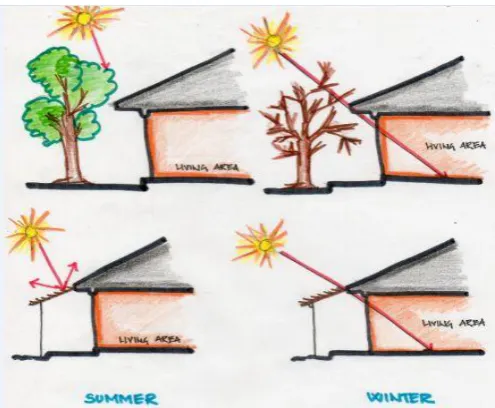
[image:5.595.312.545.190.319.2]One of the most important factors for energy conservation in building is done by landscaping [1]. Landscaping can be used to shade the building exterior, which has the capacity to reduce the indoor temperature up to 2.5˚C [6]. Evergreen trees can be used for shade in both summer and sun in winter. The trees should be planted based on the orientation.
Fig -12: Shading of trees in summer and winter
Fig -13: Shading by trees based on orientation
4.8 SHADES BY TEXTURED AND REFLECTIVE
SURFACE
High textured wall surface helps to reduce heat gain. Color of building also helps to reflect the solar radiation.
[image:5.595.37.285.280.484.2]Light color helps to reflect the sun radiation [8].
Fig -14: Shading in textured vertical surfaces
4.9 INDUCED VENTILATION TECHNIQUES
Induced ventilation is caused, when there is a pressure difference between the outside air and air present inside the building. Hot air rises up due to lower pressure and pulls the fresh air from surrounding creating buoyancy ventilation. This effect is also known as stack ventilation [10].
[image:5.595.312.550.470.665.2]4.9.1 SOLAR CHIMNEY
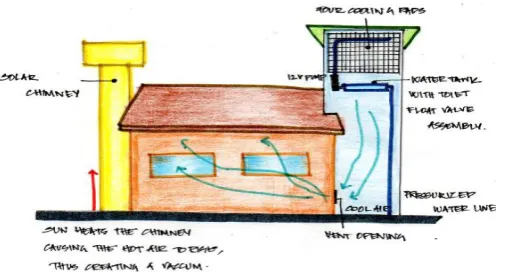
Fig -15: Solar chimney principles
A solar chimney works as natural draft device that makes the solar radiation to move air upward and convert the solar energy into kinetic energy of air [8]. By this method the hot air is moved out quickly from the building interior.
[image:5.595.35.296.538.720.2]© 2016, IRJET | Impact Factor value: 4.45 | ISO 9001:2008 Certified Journal | Page 1393
4.9.2 AIR VENTS
[image:6.595.38.295.214.383.2]Air vents are suitable for the hot and dry climate, warm and humid climate which helps to reduce the dusty winds. In this type the apex of dome or cylindrical roof has an opening with protective cap at the top this opening act as ventilator and makes the collected hot air to escape. This circulation is continuous and makes the living space cool [1].
Fig -16: Stack effect by air vent at roof top
4.10 WIND TOWER
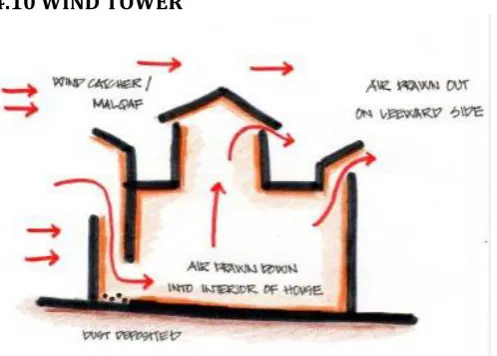
Fig -17: Ventilation by wind tower
Wind catchers or wind towers are installed at top of the building. It has different shape and heights. It is suitable for the hot and arid climate region [9]. The hot air collected in the top of the tower becomes cooled and sinks down into the interior [1]. Whereas, the wind speed is low in wind tower with wetted surface used. This can be used in warm humid regions without the usage of water to cool the buildings.
5.0 SUMMARY AND DESIGN RECOMMENDATIONS
Various types of solar passive architecture principles are reviewed in this paper. A passive cooling technique is one of the energy efficient design principle helping the building to consume less artificial energy. It helps to save energy and reduce the global warming.
The climate zone of Tamilnadu region is warm-humid and some of the passive principles recommended for the design of buildings are as follows:
1. Provide maximum ventilation and free air movement by large openings.
2. Orientation of the building; longer axis can be oriented along north – south axis.
3. Shading in exterior of building can be done by vegetation, shading devices like louvers, sunshade, fins, etc., and passive water features.
4. Provide sunshade spaces like balcony and verandah space while designing the building.
5. Light Color building exterior also plays an important role in cooling.
6. There are various types of insulation material like foam, polystyrene were available and which can be provided in the building interior.
7. According to the building design approach, low rise building should be placed on wind direction to protect the walls from receiving radiation.
8. Buildings having large surface areas should opt for compact form to minimize heat gain.
9. Large overhanging can be used to protect walls. 10. The usage of reflective tiles and materials for wall &
roof and textured surface helps to reduce heat gain. 11. Pitched roof is also recommended for warm-humid
climate to minimize roof exposure.
6.0 CONCLUSION
[image:6.595.40.289.435.613.2]© 2016, IRJET | Impact Factor value: 4.45 | ISO 9001:2008 Certified Journal | Page 1394
REFERENCES
[1] Md. Arif Kamal, An Overview of Passive Cooling Techniques in Buildings: Design Concepts and Architectural Interventions, Acta Technica Napocensis: Civil Engineering & Architecture ,vol (55)1,2012, pp 85-97.
[2] Bhavesh pugaonkar (et.al.,), Study of Solar Passive Techniques suitable for Building in Mumbai Region,
International Research Journal of Engineering and Technology (IRJET), vol 3(4),2016, pp 992-994.
[3] Berger X., Schenider M., Deval J., Kieno F., Awanou C. and Donet I. Thermal comfort in hot dry countries: radiative cooling by a diode roof, Proceedings of the Third Passive and Low-Energy Architecture Conference, Mexico, pp. 960-967, 1984.
[4] www.yourhome.gov.au/passive-design/shading
[5] Gupta V. A Study of Natural Cooling Systems of Jaisalmer, unpublished Ph.D. thesis, Indian Institute of Technology, New Delhi, 1984.
[6] Bansal N. K., Hauser G. and Minke G. Passive Building Design – A Handbook of Natural Climatic Control. Elsevier Science B.V., Amsterdam, 1994.
[7] http:www.landscapingnetwork.com/landscape-design/ sustainable/solar.html
[8]
https://greenpassivesolar.com/passive-solar/building-characteristics/insulation/
[9] A new design of wind tower for passive ventilation in buildings to reduce energy consumption in windy regions,
Renewable and sustainable energy reviews, vol 42, feb 2015, pp 182-195.
[10] http://en.wikipedia.org/wiki/passive_cooling
[11] Nayak J. K. and Prajapati J. A. Handbook on energy conscious buildings, Project Report, IIT Mumbai, 2006.
BIOGRAPHIES
C.V.Subramanian is an Associate Professor in the Department of Architecture, Periyar Maniammai University. He has 19 years of experience in this field. His area of interest is Energy and Buildings.