80
THOMAS: The Hegemonic OSU Morphological Analyzer using Seq2seq
Byung-Doh Oh1∗ Pranav Maneriker2∗ Nanjiang Jiang1∗ 1Department of Linguistics, The Ohio State University
2Department of Computer Science and Engineering, The Ohio State University
{oh.531, maneriker.1, jiang.1879}@osu.edu
Abstract
This paper describes the OSU submission to the SIGMORPHON 2019 shared task, Crosslinguality and Context in Morphology. Our system addresses thecontextual morpho-logical analysis subtask of Task 2, which is to produce the morphosyntactic description (MSD) of each fully inflected word within a given sentence. We frame this as a se-quence generation task and employ a neu-ral encoder-decoder (seq2seq) architecture to generate the sequence of MSD tags given the encoded representation of each token. Follow-up analyses reveal that our system most sig-nificantly improves performance on morpho-logically complex languages whose inflected word forms typically have longer MSD tag se-quences. In addition, our system seems to cap-ture the struccap-tured correlation between MSD tags, such as that between the verbVtag and TAM-related tags.
1 Introduction
For many natural language processing (NLP) ap-plications such as parsing and machine translation, correctly analyzing the part-of-speech and fine-grained morphological information (e.g. tense, mood, and aspect) of a given string of words is crucial for satisfactory performance. This task de-pends on the system’s ability to learn reliable rep-resentations of the sequence on two distinct levels – one at the character-level, which is indicative of the morphosyntactic values of the word, and the other at the word-level, which is informative of subsequent words that are likely to appear in the sequence. In addition, the system needs to have representational flexibility in order to be used in a cross-linguistic setting, as languages with typo-logically distinct morphological systems (e.g. iso-lating, agglutinative, and fusional) have different methods of realizing morphological information.
∗First authors. Ordering determined by dice roll.
Input They buy and sell books .
MSD tags N;NOM;PL | V;SG;1;PRS | CONJ | V;PL;3;PRS | N;PL | PUNCT
Table 1: Example English contextual morphological analysis problem from SIGMORPHON 2019 Shared Task 2 (McCarthy et al.,2019).
Task 2 of the SIGMORPHON 2019 Shared Task,Morphological Analysis and Lemmatization in Context (McCarthy et al., 2019), provides an appropriate setting to examine the applicability of morphological analyzers on typologically dis-tinct languages. As mentioned on the shared task webpage,1 the goal of the contextual morpholog-ical analysis subtask of Task 2 is to produce the morphosyntactic description (MSD) of each word within a given sentence (i.e. “context,” see Table1 for example).2 The system’s performance is eval-uated on a total of 107 treebanks from the Uni-Morph dataset (McCarthy et al.,2018), which cov-ers more than 70 languages. Again, this requires the system to generalize across typologically dif-ferent languages without being biased towards a particular morphological system.
In this paper, we present our approach of treat-ing contextual morphological analysis as the gen-eration of the correct sequence of MSD tag di-mensions. To address the task, we take a sim-ilar approach as the shared task baseline system (Malaviya et al.,2019) in encoding each word in the sequence with a representation learned by a
1https://sigmorphon.github.io/sharedtasks/
2019/task2/
2For the other subtask of contextual lemmatization, the goal of which is to return the correct lemmata of the fully inflected forms, we generated the predictions using the pre-trained shared task baseline lemmatizer (Malaviya et al.,
Figure 1: The encoder based on bidirectional LSTM for the baseline, binary relevance, and seq2seq models.
(a) The decoder of the binary relevance model, which makes independent binary decisions for each possible tag dimension.
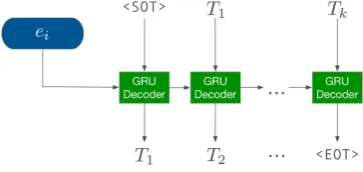
[image:2.595.90.272.430.516.2](b) The GRU decoder of the seq2seq model, which predicts the next tag dimension given the encoder representation and the prediction at the previous timestep.
Figure 2: Overview of the decoder architectures.
character-level recurrent neural network (RNN). With the baseline system that treats each possi-ble combination of MSD tag dimensions sepa-rately and chooses the most likely combination, we first demonstrate that modifying the system to make multiple independent binary decisions over each possible tag dimension results in higher per-formance. Furthermore, we present an encoder-decoder (seq2seq) model that decodes the repre-sentation of each input word into a sequence of MSD tag dimensions. The use of the seq2seq model further improves model performance,
espe-cially in terms of exact match accuracy for tokens that have long sequences of MSD tag dimensions. Our best-performing model outperforms the offi-cial baseline by 14.25 on exact match accuracy and by 4.6 on micro-averaged F1.
2 Model Description
Baseline model The baseline model takes as in-put each sentence in the training data, and uses a bidirectional LSTM (Long Short-Term Memory, Hochreiter and Schmidhuber,1997) to learn a rep-resentation for each word by attending to its in-dividual characters. The learned representation is then subsequently fed into a fully connected lin-ear layer, which maps the representation of the word to the space of every observed combina-tion of MSD tag dimensions. The network is up-dated based on the cross-entropy loss between the model’s prediction and the correct combination of MSD tag dimensions.
Sents Tokens Tags Combinations
en 13297 204857 36 178
es 14144 439925 40 419
hi 13317 281948 43 1508
ru 4024 79989 47 1385
tr 4508 46417 55 1896
zh 3997 98734 21 39
Table 2: Descriptive statistics for the six UniMorph treebanks used for training. Number of tags refers to the number of different MSD tag dimensions, and the number of combinations refers to the number of differ-ent MSD tag combinations presdiffer-ent in each training set.
agglutinative languages, which typically have a clear correspondence between surface string and MSD tag dimension. In order to mitigate this is-sue, we mapped the learned representation of each word to the space of individual MSD tag dimen-sions, where independent binary decisions about the presence of each tag dimension are made.
Encoder-decoder (seq2seq) model3
Nonethe-less, given the fact that particular MSD tag dimen-sions tend to co-occur within a same word (e.g. the “verb” tag dimension frequently co-occurs with tense- or aspect-related tag dimensions), the inde-pendence assumption between individual tag di-mensions made in the binary relevance model may be too strong to capture this inherent structure. To account for the potential dependence between pre-dicted tag dimensions, we feed the encoded repre-sentation of each word as the initial hidden states of a GRU (Gated Recurrent Unit,Cho et al.,2014) decoder, which is then trained to predict one tag dimension at each decoding timestep. The use of such a seq2seq model is also partly motivated by its state-of-the-art performance in various NLP tasks such as machine translation (Bahdanau et al., 2015; Luong et al., 2015), document classifica-tion (Nam et al., 2017; Yang et al., 2018), mor-phological reinflection (Kann and Schütze,2016; Kann et al., 2017), and morphological analysis like the current shared task (Tkachenko and Sirts, 2018). Our seq2seq model resemblesTkachenko and Sirts’s (2018) SEQ model, with the primary difference being the use of a GRU decoder (instead of their unidirectional LSTM) and the sorting of tag dimensions in decreasing order of frequency
3The predictions from this model were submitted to the shared task. The code repository can be found athttps: //github.com/njjiang/THOMAS
Baseline Bin. Rel. Seq2seq
Acc. F1 Acc. F1 Acc. F1
[image:3.595.308.524.64.154.2]en 80.17 90.91 92.53 95.75 93.72 95.41 es 84.35 95.35 96.39 98.42 96.77 98.31 hi 80.60 93.92 87.59 96.37 88.13 95.99 ru 63.37 87.49 81.42 92.92 84.92 92.92 tr 62.94 86.10 84.15 93.87 87.08 93.84 zh 75.97 83.79 89.61 91.18 91.57 91.35
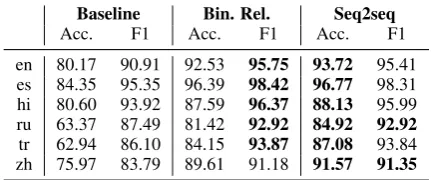
Table 3: Exact match accuracy and micro-averaged F1 scores of the models evaluated on the test portion of each respective UniMorph treebank. For each dataset, the best results under each metric are in bold.
during training. An overview of our model archi-tecture is presented in Figures1and2.
Our seq2seq model strongly outperforms the of-ficial baseline, scoring 14.25 and 4.6 points higher on average across 107 datasets on exact match ac-curacy and micro-averaged F1 scores respectively. For an in-depth analysis of each model, we focus on 6 languages and compare the performance of our two models (binary relevance and seq2seq) to that of the baseline model.
3 Experimental Design
Training data Following the shared task guide-lines, six different treebanks from the UniMorph dataset (McCarthy et al., 2018) provided the data for training and evaluating the model. The six treebanks – English-EWT, Spanish-Ancora, Hindi-HDTB, Russian-GSD, Turkish-IMST, and Chinese-GSD – cover a wide spectrum of morpho-logical typology, thus making it suitable to assess the generalizability of each morphological analy-sis system. The descriptive statistics of each train-ing set are outlined in Table2.
Training and evaluation procedure For the bi-nary relevance model, most of the hyperparam-eters followed the default settings of the base-line system code4; characters were embedded into 128-dimension representations, and the character-level biLSTM was trained to output a 256-dimension representation. Adam (Kingma and Ba, 2015) was used as the optimizer, using the de-fault settings of the PyTorch deep learning library (Paszke et al.,2017). The model was trained for five epochs using batches of size 16, with early stopping.5 The same hyperparameters were used
4https://github.com/sigmorphon/
contextual-analysis-baseline
Figure 3: Exact match accuracy and micro-averaged F1 scores of the models on tokens with different numbers of MSD tag dimensions.
Bin. Rel. Seq2seq
en 459 89
es 559 70
hi 439 199
ru 423 166
tr 124 63
zh 117 0
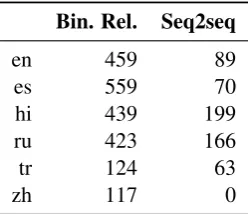
Table 4: Number of instances where two tag dimen-sions that do not co-occur in the test portion of the dataset were predicted together by each model.
to train the encoder portion of the seq2seq model. As for the GRU decoder, the maximum quence length was fixed as the maximum se-quence length seen during training. Following prior work (Yang et al.,2018), the order of the out-put tags was fixed to be in decreasing order of fre-quency of occurrence in the training set. Decoding took place in a greedy manner, and only the high-est scoring hypothesis at the previous timhigh-estep was further pursued. The model was trained without any teacher forcing, as preliminary results showed that a teacher forcing ratio of 0.5 resulted in a de-crease in model performance.
After training was complete, the models’ accu-racy was evaluated on the held-out test portion of the six treebanks that were used to train the mod-els. As per the shared task guidelines, the ex-act match accuracy and micro-averaged F1 scores were calculated for each of the trained models.
that the default settings of the code were used to train them. The only changes to the default settings when training the bi-nary relevance model were in the training epochs (default 10 epochs) and batch size (not implemented, therefore default size 1).
4 Results and Discussion
As can be seen in Table 3, having the model make independent binary decisions for each pos-sible MSD tag dimension (i.e. the binary rele-vance model) significantly increases model perfor-mance. This is most likely the result of having nar-rowed down the output space and thereby allow-ing the model to generalize over instances of the same tag dimension that appear in different com-binations. In addition, using a neural decoder to generate a sequence of tag dimensions further im-proves model performance in terms of exact match accuracy, which is sensitive to predicting the cor-rect number of tag dimensions. This corroborates the results of Tkachenko and Sirts (2018), who found that their sequence generation model out-performed other neural classifiers in terms of ac-curacy on most languages. The increase in perfor-mance is especially salient in Russian and Turk-ish, which typically have more tag dimensions per word than other languages. An analysis of the distribution of predicted tag dimensions (Ta-ble4) shows that the seq2seq model predicts sig-nificantly less “invalid” combinations that are not attested in the gold test set,6 indicating that the seq2seq model is more capable of capturing the structured dependence compared to the binary rel-evance model.
Lengths of tag sequences To further examine where the seq2seq model makes significant im-provement, the exact match accuracy and micro-averaged F1 scores were calculated according to
[image:4.595.119.245.267.374.2]Bin. Rel. Seq2seq en P < G P = G P > G P < G P = G P > G
0 - 3199 14 - 3201 12
1 0 7819 252 0 7872 199
2 386 9296 164 165 9605 76
3 61 1017 44 58 1037 27
4 125 1995 20 150 1986 4
5 3 384 2 1 386 2
6 27 704 6 20 716 1
ru P < G P = G P > G P < G P = G P > G
0 - 1712 1 - 1712 1
1 0 1751 91 0 1770 72
2 11 165 17 3 176 14
3 21 126 11 4 138 16
4 48 341 29 3 381 34
5 448 3906 235 48 4512 29
6 12 89 0 7 90 4
7 19 386 2 14 389 4
8 11 191 4 4 202 0
9 40 97 5 17 124 1
tr P < G P = G P > G P < G P = G P > G
0 - 1034 0 - 1034 0
1 0 1198 87 0 1183 102
4 175 1382 35 63 1484 45
5 143 477 10 81 538 11
6 28 209 6 9 225 9
7 81 470 26 36 506 35
8 53 257 10 29 279 12
[image:5.595.309.525.64.270.2]9 24 27 0 18 33 0
Table 5: Comparison of the number of MSD tag di-mensions predicted by each model and that in the gold annotation, sorted according to the number of tags in the gold annotation. P refers to the number of tags pre-dicted by the model, and G refers to the number of tags that are in the gold annotation.
the number of MSD tag dimensions in the test por-tion of the dataset. In Figure3, the scores are pre-sented for English, Russian, and Turkish.7 Addi-tionally, we compared the number of tag dimen-sions predicted by each model to that of the gold annotation in order to investigate whether there was a tendency for the models to over- or under-predict the correct number of tag dimensions (Ta-ble 5). Although there is no clear pattern as to sequences of what length (i.e. short or long) the seq2seq model helps the most, it is clear from the scores that the seq2seq model has the capability to reproduce longer sequences of tag dimensions in comparison to the binary relevance model. Fur-thermore, while both models predict the correct number of tag dimensions for the vast majority of test examples, the seq2seq model makes more accurate predictions across sequences of nearly
7There was only one token each with two or three tag di-mensions in the test portion of the Turkish dataset (and none in the development portion). As such, the scores for tokens with two or three tag dimensions were omitted in the figure.
Bin. Rel. Seq2seq
Tag Freq. Acc. F1 Acc. F1
COND 18 27.78 86.09 66.67 94.82
FUT 62 72.58 95.85 69.35 93.72 HAB 106 75.47 94.74 77.36 92.67 IMP 32 59.38 77.34 75.0 84.79
IND 1022 81.12 96.08 85.71 96.51
OPT 14 71.43 88.4 85.71 95.24
PFV 944 78.18 94.93 84.43 95.98
POT 56 67.86 96.91 62.5 94.19 PROG 134 88.81 98.98 90.3 99.13
PROSP 3 66.67 95.24 100.0 100.0
PRS 646 75.54 93.29 82.82 94.47
PST 439 84.28 98.11 87.7 98.39
PST+PRF 38 89.47 97.95 97.37 99.26
FUT/PST 3 66.67 95.24 100.0 100.0
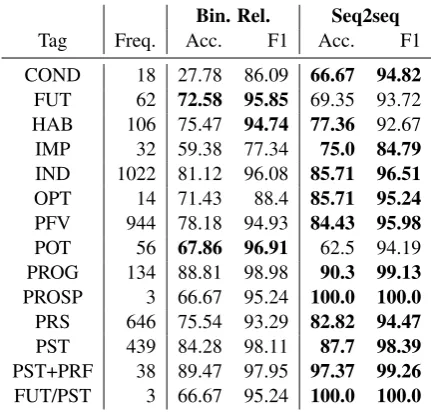
Table 6: Performance of the two models on related tokens in the Turkish test set. For each TAM-related tag dimension, the best results under each met-ric are in bold.
all lengths. There is also a general tendency for the two models to under-predict rather than over-predict distinct tag dimensions, with the exception of the seq2seq model on Russian examples with four tag dimensions or less.
Dependence between tag dimensions We
hy-pothesize that the neural decoder of the seq2seq model helped it correctly predict tag dimensions that are low in frequency but often co-occur with a more frequent tag dimension. Such highly depen-dent examples can be found in the verbal paradigm of a language, where tag dimensions that indi-cate a particular tense, aspect, and mood (TAM; e.g. present, progressive, indicative) always co-occur with the verb (V) tag dimension. We ex-pect that the prediction of the higher-frequencyV
tag dimension during decoding would have helped the model accurately predict these specific TAM-related tag dimensions. As a case study testing this hypothesis, we compared the performance of the two models on TAM-related tokens present in the Turkish test set. The results in Table6reveal that the seq2seq model generally outperforms the bi-nary relevance model, indicating that the seq2seq model captures the dependence between theVtag dimension and TAM-related tag dimensions.
[image:5.595.73.290.71.363.2]Gold Prediction
INAN;GEN;PL;V;IPFV;PRS;V.PTCP;PASS INAN;GEN;PL;ADJ
PL;V;FIN;IND;IPFV;PRS;2 SG;INAN;N;FEM;DAT
PL;V;FIN;IND;IPFV;PRS;2 SG;V;FIN;PFV;2;IMP
PL;V;FIN;IND;IPFV;PRS;MID;2 SG;V;FIN;IND;IPFV;3;PRS
PL;V;FIN;IND;PFV;1;FUT SG;INAN;MASC;N;NOM
PL;V;FIN;IPFV;MID;2;IMP SG;N;NOM;FEM;V
SG;INAN;FEM;V;ESS;IPFV;PRS;V.PTCP;PASS SG;INAN;N;NEUT;ESS
SG;INAN;GEN;FEM;V;PST;PFV;V.PTCP;PASS SG;INAN;GEN;FEM;ADJ
SG;INAN;NOM;V;NEUT;PST;PFV;V.PTCP;PASS SG;INAN;N;NOM;NEUT
SG;MASC;NOM;ANIM;V;PST;PFV;V.PTCP;PASS SG;MASC;N;NOM;ANIM
SG;MASC;V;FIN;IND;PST;PFV SG;MASC;N;NOM;ANIM;PST;PFV;V.PTCP;PASS
[image:6.595.80.525.66.238.2]SG;V;FIN;IND;IPFV;PRS;1 SG;N;NOM;V;FIN
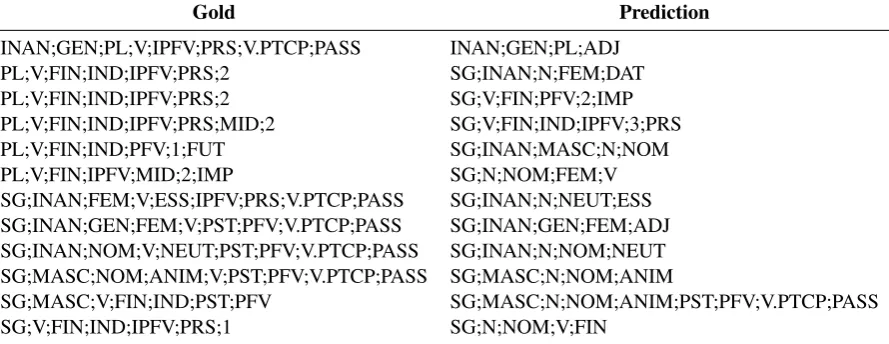
Table 7: Representative errors from the seq2seq model on Russian test examples with seven or more tag dimensions in the gold annotation.
the binary relevance model, the binary relevance model slightly outperforms the seq2seq model in terms of micro-averaged F1 score. We conjec-ture that this is due to the naconjec-ture of the decoder employed in the seq2seq model. Because the de-coder conditions on its prediction at the previous timestep, once the decoder predicts an erroneous tag dimension, it is likely to continue to deviate from the correct sequence. This will result in pre-dictions that do not have many tag dimensions in common with the gold annotation. On the other hand, as the binary relevance model is optimized to predict each individual tag dimension indepen-dently, it is more likely to generate “partially cor-rect” sequences that are penalized less severely by the F1 score. Representative errors from the seq2seq model on the Russian test set presented in Table7demonstrate this tendency; in general, the prediction of an incorrect tag dimension results in predictions that have little overlap with the gold annotation.
In order to alleviate such decoding errors of the seq2seq model, a beam search could be con-ducted to pursue multiple hypotheses simultane-ously. This could help the model recover from an initial erroneous prediction, albeit at the cost of computational efficiency. Furthermore, to explic-itly incorporate the underlying structure between MSD tag dimensions, the binary relevance model could be extended to a multiclass multilabel classi-fier, which selects one tag among those that are in complementary distribution for each morphologi-cal category (e.g. part-of-speech, case, number) as inTkachenko and Sirts(2018). Finally, a more
rig-orous search for the optimal hyperparameters (e.g. hidden state sizes, training epochs, learning rate) of each model could further enhance their perfor-mance. We leave these directions to future work.
5 Conclusion
In this paper, we present our approach to the SIG-MORPHON 2019contextual morphological anal-ysis shared task. Expanding from the baseline model that chooses the most likely combination from all those present in the training data, we demonstrate that having the model make indepen-dent binary decisions over each tag dimension al-leviates data sparsity and improves model perfor-mance. Furthermore, based on the linguistic in-sight that certain tag dimensions often co-occur together, we employed a neural decoder to turn contextual morphological analysis into a sequence generation task and aimed to capture this depen-dence. This again improved model performance in terms of exact match accuracy, especially for mor-phologically rich languages that generally have more MSD tag dimensions for every token. A follow-up case study of Turkish verbal inflections demonstrates that the seq2seq model captures the correlation between the more frequent V tag mension and the less frequent TAM-related tag di-mensions.
Acknowledgement
References
Dzmitry Bahdanau, Kyunghyun Cho, and Yoshua Ben-gio. 2015. Neural machine translation by jointly learning to align and translate. In 3rd Inter-national Conference on Learning Representations, ICLR 2015, San Diego, CA, USA, May 7-9, 2015, Conference Track Proceedings.
Kyunghyun Cho, Bart van Merrienboer, Caglar Gul-cehre, Dzmitry Bahdanau, Fethi Bougares, Holger Schwenk, and Yoshua Bengio. 2014. Learning phrase representations using RNN encoder–decoder for statistical machine translation. InProceedings of the 2014 Conference on Empirical Methods in Nat-ural Language Processing (EMNLP), pages 1724– 1734, Doha, Qatar. Association for Computational Linguistics.
Sepp Hochreiter and Jürgen Schmidhuber. 1997. Long short-term memory. Neural Computation, 9(8):1735–1780.
Katharina Kann, Ryan Cotterell, and Hinrich Schütze. 2017. Neural multi-source morphological reinflec-tion. In Proceedings of the 15th Conference of the European Chapter of the Association for Computa-tional Linguistics: Volume 1, Long Papers, pages 514–524, Valencia, Spain. Association for Compu-tational Linguistics.
Katharina Kann and Hinrich Schütze. 2016. MED: The LMU system for the SIGMORPHON 2016 shared task on morphological reinflection. InProceedings of the 14th SIGMORPHON Workshop on Computa-tional Research in Phonetics, Phonology, and Mor-phology, pages 62–70, Berlin, Germany. Associa-tion for ComputaAssocia-tional Linguistics.
Diederik P. Kingma and Jimmy Ba. 2015. Adam: A method for stochastic optimization. In 3rd Inter-national Conference on Learning Representations, ICLR 2015, San Diego, CA, USA, May 7-9, 2015, Conference Track Proceedings.
Thang Luong, Hieu Pham, and Christopher D. Man-ning. 2015. Effective approaches to attention-based neural machine translation. In Proceedings of the 2015 Conference on Empirical Methods in Natu-ral Language Processing, pages 1412–1421, Lis-bon, Portugal. Association for Computational Lin-guistics.
Chaitanya Malaviya, Shijie Wu, and Ryan Cot-terell. 2019. A simple joint model for improved contextual neural lemmatization. arXiv preprint arXiv:1904.02306v2.
Arya D. McCarthy, Miikka Silfverberg, Ryan Cotterell, Mans Hulden, and David Yarowsky. 2018. Mar-rying Universal Dependencies and Universal Mor-phology. In Proceedings of the Second Workshop on Universal Dependencies (UDW 2018), pages 91– 101, Brussels, Belgium. Association for Computa-tional Linguistics.
Arya D. McCarthy, Ekaterina Vylomova, Shijie Wu, Chaitanya Malaviya, Lawrence Wolf-Sonkin, Gar-rett Nicolai, Christo Kirov, Miikka Silfverberg, Se-bastian Mielke, Jeffrey Heinz, Ryan Cotterell, and Mans Hulden. 2019. The SIGMORPHON 2019 shared task: Crosslinguality and context in morphol-ogy. In Proceedings of the 16th SIGMORPHON Workshop on Computational Research in Phonetics, Phonology, and Morphology, Florence, Italy. Asso-ciation for Computational Linguistics.
Jinseok Nam, Eneldo Loza Mencía, Hyunwoo J Kim, and Johannes Fürnkranz. 2017. Maximizing subset accuracy with recurrent neural networks in multi-label classification. In I. Guyon, U. V. Luxburg, S. Bengio, H. Wallach, R. Fergus, S. Vishwanathan, and R. Garnett, editors, Advances in Neural Infor-mation Processing Systems 30, pages 5413–5423. Curran Associates, Inc.
Adam Paszke, Sam Gross, Soumith Chintala, Gre-gory Chanan, Edward Yang, Zachary DeVito, Zem-ing Lin, Alban Desmaison, Luca Antiga, and Adam Lerer. 2017. Automatic differentiation in PyTorch. InNIPS-W.
Alexander Tkachenko and Kairit Sirts. 2018. Modeling composite labels for neural morphological tagging. InProceedings of the 22nd Conference on Computa-tional Natural Language Learning, pages 368–379, Brussels, Belgium. Association for Computational Linguistics.