Munich Personal RePEc Archive
Forecasting Realized Volatility of Russian
stocks using Google Trends and Implied
Volatility
Bazhenov, Timofey and Fantazzini, Dean
April 2019
Online at
https://mpra.ub.uni-muenchen.de/93544/
Forecasting Realized Volatility of Russian stocks
using Google Trends and Implied Volatility
Timofey Bazhenov
∗Dean Fantazzini
†Abstract
This work proposes to forecast the Realized Volatility (RV) and the Value-at-Risk (VaR) of the most liquid Russian stocks using GARCH, ARFIMA and HAR mod-els, including both the implied volatility computed from options prices and Google Trends data. The in-sample analysis showed that only the implied volatility had a significant effect on the realized volatility across most stocks and estimated
mod-els, whereas Google Trends did not have any significant effect. The out-of-sample
analysis highlighted that models including the implied volatility improved their fore-casting performances, whereas models including internet search activity worsened their performances in several cases. Moreover, simple HAR and ARFIMA models without additional regressors often reported the best forecasts for the daily realized volatility and for the daily Value-at-Risk at the 1% probability level, thus showing that efficiency gains more than compensate any possible model misspecifications and
parameters biases. Our empirical evidence shows that, in the case of Russian stocks, Google Trends does not capture any additional information already included in the implied volatility.
Keywords: Forecasting, Realized Volatility, Value-at-Risk, Implied Volatility, Google Trends, GARCH, ARFIMA, HAR.
JEL classification: C22, C51, C53, G17, G32.
Russian Journal of Industrial Economics
, forthcoming
∗Higher School of Economics, Moscow (Russia)
1
Introduction
Volatility forecasting is of cardinal importance in several applications, from derivatives
pricing to portfolio and risk management, see [1] for a large survey. Recent literature
suggested the idea to consider the investors’ behavior measured by the internet search
volumes as a factor influencing the assets volatility, see for example [2] and references
therein for more details. The investors’ interest was originally quantified using some
proxy measures like news or turnover. However, [3] showed that these proxies do not
im-prove the forecasting of volatility. Instead, recent works by [4] and [5] reported empirical
evidence showing that online search volumes are a good predictor of volatility. This
pa-per aims to estimate the predictive power of online search activity (as proxied by Google
Trends data) and implied volatility (computed from option prices) for forecasting the
re-alized volatility of several Russian stocks. In this regard, the implied volatility measures
the investors’ sentiment about the future performance of an asset, see the survey of [6]
and references therein for more details. These two measures of investors’ attention and
expectations are then used to forecast the realized volatility of Russian stocks by using
three competing models: the Heterogeneous Auto-Regressive (HAR) model by [7], the
AutoRegressive Fractional (ARFIMA) model by [8], and a simple GARCH(1,1) model.
The forecasting performances of these models are compared using the usual forecasting
diagnostics, such as the mean squared error (MSE), and the Model Confidence Set by [9].
The models volatility forecasts are also employed to compute the Value-at-Risk for each
asset to measure their market risk. The first contribution of this paper is an evaluation of
the contribution of both online search intensity and options-based implied volatility to the
modelling of realized volatility for Russian stocks. To our knowledge, this analysis has
not been done elsewhere. The second contribution is an out-of-sample forecasting
Google data and implied volatility. The third contribution of the paper is a backtesting
exercise to measure the accuracy of Value-at-Risk forecasts. The rest of this paper is
or-ganized as follows. Section 2 briefly reviews the literature devoted to Google Trends and
implied volatility, while the methods proposed for forecasting the realized volatility and
the VaR are discussed in Section 3. The empirical results are reported in Section 4, while
Section 5 briefly concludes.
2
Literature review
There is an increasing body of the financial literature which examines how online searches
affect asset pricing and volatility modelling. We review some of these works which are
closely related to our research topic. [5] considered the top-30 stocks (in terms of volume)
traded on the NYSE and used the search volumes involving the name of the company as
a proxy of demand for firm-specific information. They found that such demand for
in-formation contains potentially useful signals because it is strongly related to the stock
trading volumes and the historical volatility. [2] evaluated the marginal predictive power
of Google trends to forecast the Crude Oil Volatility index by using HAR models and
sev-eral macro-finance variables. More specifically, they employed the standard HAR model,
the HAR model including macroeconomic variables, the HAR model with online search
volumes and the HAR model including both search volumes and macroeconomic
vari-ables. They found that the amount of online searches has a positive relationship with the
oil volatility index. Moreover, this association remains significant even when
macroe-conomic variables are included in the model, thus highlighting that Google data capture
some extra information. [9] examined the relationship between investors’ interest and the
foreign exchange market volatility. They showed a strong connection between the changes
variables. [10] evaluated the role of the online search activity for forecasting realized
volatility of financial markets and commodity markets using models that also include
market-based variables. They found that Google search data play a minor role in
pre-dicting the realized volatility once implied volatility is included in the set of regressors.
Therefore, they suggested that there might exist a common component between implied
volatility and Internet search activity: in this regard, they found that most of the predictive
information about realized volatility contained in Google Trends data is also included in
implied volatility, whereas implied volatility has additional predictive content that is not
captured by Google data.
3
Methodology
3.1
Measures of volatility
3.1.1 Realized Variance
Real volatility is not observable, so a proxy is needed for its observation. The realized
variance (RV) is probably the best proxy available: [11] showed that the RV is a consistent
estimator of the actual variance, while [12] compared more than 400 estimators of price
variation and they came to the conclusion that it is difficult to significantly outperform
the 5-minute RV estimator. For this reason, we used this estimator in this work. Suppose
that on the trading dayt, Mprices were observed at times t0,t1,...,tM. Ifptjstands for the
logarithmic price at timetj, then the log-returnrtj for thej-th interval of day tis defined
as,rtj=ptj−ptj-1. The formula for the realized variance is thus given by:
RVt = M X
j=1
Over a time horizon ofk days, the realized variance is computed asRVt:t+k = Pki=1RVt+i
, under the convention that RVt =RVt−1:t. Horizons of 1 (daily), 5 (weekly) and 22
(monthly) days were considered.
3.1.2 Implied volatility
The implied volatility (IV) of an option contract is the value of the volatility of the
un-derlying asset which makes the theoretical value of the option -computed using an option
pricing model like the Black–Scholes model- equal to the current market price of the
op-tion, see [6] and [13] for details. The implied volatility reflects the investors’ expectations
and sentiments and, if the assumptions of the Black-Scholes model hold, it is an efficient
predictor of the actual volatility of the underlying asset. Assuming that all the other
pa-rameters of the Black-Scholes model are available (that is, the stock and strike prices, the
risk-free rate, the time to expiration and the market price of the option), then the IV can
be computed using nonlinear optimization methods, like the Newton-Raphson algorithm,
see [14] and references therein.
3.2
Data
Intraday data sampled every 5 minutes for the most liquid Russian stocks (Sberbank
-SBER, Rosneft -ROSN, Yandex-YNDX, Gazprom- GAZP, where the four-letter
abbrevi-ations are the stocks tickers) were downloaded from the websitefinam.ru. Option prices
from the Moscow exchange were used to compute the implied volatility for each asset.
The dataset covered the period from January 2016 till April 2018.
Google Trends computes how many searches were made for a keyword or a topic on
Google over a specific period of time and a specific region. This amount is then divided
series is divided by its highest value and multiplied by 100, so that all data are normalized
between 0 and 100. The tickers of the Russian stocks described above were used as a
search keyword used by investors to get information for a particular company. All search
volumes were downloaded from the Google Trends website using the R packagegtrendsR.
These data were then merged with the search volumes for the queries in Russian looking
for a specific stock price, for example “Sberbank share price”.
3.3
Models
3.3.1 HAR model
The Heterogeneous Auto-Regressive model for the realized volatility was first proposed
by [7] and it allows to reproduce several stylized facts of assets’ volatility. The HAR
model is specified as follows,
RVt+1=β0 +βDRVt +βWRVt−5:t +βMRVt−22:t +εt+1
whereD,W and M stand for daily, weekly and monthly values of the realized volatility,
respectively. The main novelty of our work is the inclusion of the implied volatility and
Google Trends as additional regressors to forecast the realized volatility of Russian stocks:
RVt+1=β0+βDRVt+βWRVt−5:t+βMRVt−22:t+γGTt+αIVt +εt+1
3.3.2 ARFIMA model
[8] proposed the Auto-Regressive Fractional Integrated Moving Average (ARFIMA) model
to forecast the realized volatility, and it has been one of the best models ever since. The
ARFIMA(p,d,q) model is given by:
Φ(L)(1−L)d(RV
whereLis the lag operator, Φ (L)= 1 − ϕ1L −... − ϕpLp, Θ(L) = 1+ θ 1L+ ... + θ
qLqand (1−L)dis the fractional differencing operator defined by:
(1−L)d =
∞
X
k=0
Γ(k−d)Lk Γ(−d)Γ(k+1)
whereΓ(•) is the gamma function. Similarly to the HAR model, we also considered the
case where the implied volatility and Google Trends are added as (external) regressors, so
the model becomes:
Φ(L)(1−L)d(RVt+1−µ)=γGTt +αIVt+ Θ(L)εt+1
[15] proposed an algorithm for the automatic selection of the optimal ARFIMA model,
which is implemented in the R packagesforecastandrugarch.
3.3.3 GARCH model
The Generalized Auto-Regressive Conditional Heteroscedasticity (GARCH) models are
extensively used in empirical finance, thanks to their good forecasting performances:
for example, [16] compared more than 330 volatility models and they found no
evi-dence that a GARCH(1,1) can be outperformed by more sophisticated models. A general
GARCH(p,q) model for the conditional variance equation can be specified as follows:
σ2t =α0+ q X
i=1
αiε2t−i+ q X
j=1
βjσ2t−j
whereσ2t is the conditional variance at timet. A simple GARCH (1,1) model with
stan-dardized errors following a Student’s t-distribution was employed in this work. Similarly
to the HAR and ARFIMA models, we also considered a GARCH specification including
3.4
Forecast Comparison
3.4.1 Variance forecasts
We divided the data into a training dataset used to estimate the models (the first 67% of
the sample), and a test dataset to evaluate the models’ performances. We computed the
1-day-ahead volatility forecasts of our competing models and we compared them using the
mean square error (MSE). We also employed the Model Confidence Set proposed by [17],
which can select the best performing model(s) at a predefined confidence level. Given a
specific loss function, in our case the squared loss, Lossi,t =
c
RVi,t−RVi,t
2
, where RV
and RVc stand for the observed and forecasted level of the realized volatility, then the
difference between the losses of models i and j at time t can be computed as follows:
di,j,t = Lossi,t −Lossj,t. The hypothesis of equal predictive ability suggested by [17] can
be formulated as:
H0,M : E(di,j,t)=0,for all i,j∈M,
whereMis the set of forecasting models. First, the following t-statistics are calculated
ti j =
¯
di j c
vard¯i j
f or i, j∈M
where ¯di j = T−1PTt=1di j,t andvarc
di j
is a bootstrapped estimate of vard¯i j
. Then, this
test statistic is computed: TR,M = maxi∈M|ti j|. This statistic has a non-standard
distribu-tion, so the distribution under the null hypothesis is computed via bootstrap. If the null
hypothesis is rejected, one model is eliminated from the analysis by using the following
rule:
eRM = argmaxi (
sup
j∈M
¯
di j c
The number of models is diminished by 1 and the testing procedure starts from the
be-ginning. For volatility forecasts, the previous MSE loss was used, whereas the symmetric
quantile loss function proposed by [18] was used for the VaR forecasts (more details in
the next section).
3.4.2 Value-at-Risk forecasts
The Value-at-Risk is the potential market loss of a financial asset over a time horizonh
with probability levelα. The VaR is a widely used measure of market risk in the
finan-cial sector, and we refer to [19] for a large survey of realized volatility models and VaR
methods.
In this work, we consideredh=1 and the probability levelsα=5% andα=1%. In the
case of HAR and ARFIMA models, the 1-day ahead VaR can be computed as follows:
VaRt+1,α =Φ−1α
q c
RVt+1
whereΦ−1
α is the inverse function of a standard normal distribution function at the
prob-ability levelα, whileRVct+1 is the 1-day-ahead forecast for the realized volatility. In the
case of GARCH models with student’s t errors, the 1-day ahead VaR can be computed as
follows:
VaRt+1,α= µˆt+1+t−1α,ν
q
ˆ σ2t+1
where ˆµt+1is the 1-day-ahead forecast of the conditional mean, ˆσ2t+1is the 1-day-ahead
forecast of the conditional variance, whilet−1
α,ν is the inverse function of the Student’s t
distribution withνdegrees of freedom at the probability levelα.
To compare the forecasting performance of the different VaR models, the forecasted
values of the VaR are compared to the actual returns for each day, and the number of
the number of violations are counted): a “perfect VaR model” would deliver a number
of violations which is not predictable and exactly equal to α%. We can test the null
hypothesis that the fraction of actual violationsπfor a forecasting model is significantly
different fromαusing the unconditional coverage test by [20]. The joint null hypothesis
that the VaR violations are independent and the average number of violations is correct can
be tested using the conditional coverage test by [21]: differently from the unconditional
coverage test, the Christoffersen’s test also considers the dependence of violations for
consecutive days. Finally, noting that financial regulators are also concerned with the
magnitude of the VaR violations, we computed the asymmetric quantile loss (QL) function
proposed by [18]:
QLt+1,α =(α−It+1(α))(yt+1−VaRt+1,α)
whereIt+1(α)=1 ifyt+1 <VaRt+1,αand zero otherwise.
3.5
In-sample analysis
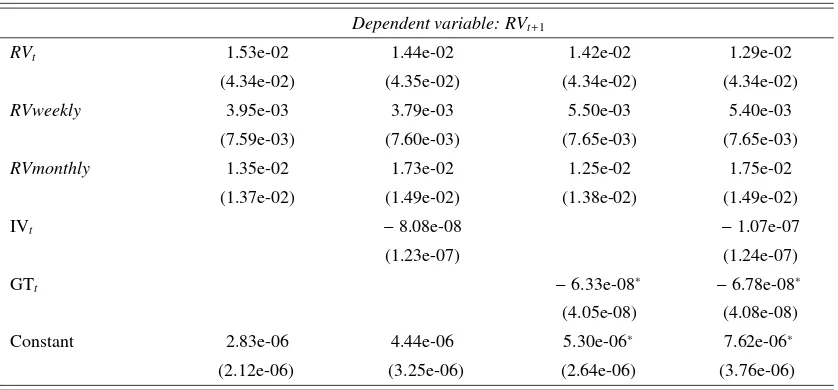
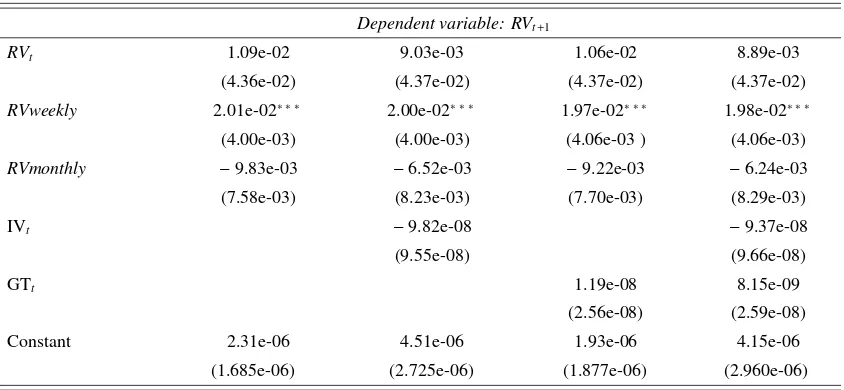
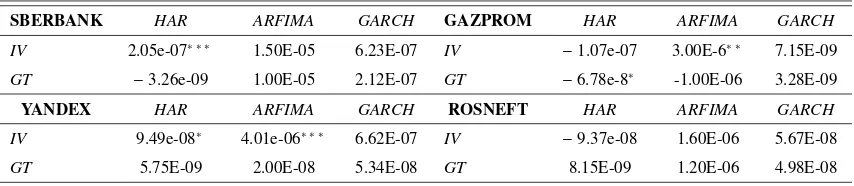
For sake of space and interest, we report in Tables 1-4 the parameters estimates for the
HAR model under different specifications -with and without the implied volatility and
Google Trends-, while Table 5 summarizes the parameters estimates across different
mod-els by showing only the estimated parameters of the implied volatility and Google Trends
Table 1: Summary of HAR models for SBERBANK
Dependent variable: RVt+1
RVt −6.16e-02 −6.57e-02 −6.54e-02 −6.10e-02
(4.43e-02) (4.40e-02) (4.40e-02) (4.43e-02)
RVweekly 5.13e-03∗ ∗ ∗ 5.80e-03∗ ∗ ∗ 5.86e-03∗ ∗ ∗ 5.26e-03∗ ∗ ∗
(1.53e-03) (1.53e-03) (1.54e-03) (1.54e-03)
RVmonthly −2.52e-03 −9.25e-03∗ ∗ −9.45e-03∗ ∗ −3.12e-03
(4.12e-03) (4.66e-03) (4.71e-03) (4.22e-03)
IVt 2.08e-07∗ ∗ ∗ 2.05e-07∗ ∗ ∗
(6.92e-08) (6.98e-08)
GTt −3.26e-09 −6.63e-09
(9.79e-09) (9.80e-09)
Constant 3.10e-06∗ ∗ ∗ −2.19e-06 −1.91e-06 3.52e-06∗ ∗ ∗
(8.783e-07) (1.96e-06) (2.14e-06) (1.08e-06)
Note:∗p<0.1;∗ ∗p<0.05;∗ ∗ ∗p<0.01
Table 2: Summary of HAR models for GAZPROM
Dependent variable: RVt+1
RVt 1.53e-02 1.44e-02 1.42e-02 1.29e-02
(4.34e-02) (4.35e-02) (4.34e-02) (4.34e-02)
RVweekly 3.95e-03 3.79e-03 5.50e-03 5.40e-03
(7.59e-03) (7.60e-03) (7.65e-03) (7.65e-03)
RVmonthly 1.35e-02 1.73e-02 1.25e-02 1.75e-02
(1.37e-02) (1.49e-02) (1.38e-02) (1.49e-02)
IVt −8.08e-08 −1.07e-07
(1.23e-07) (1.24e-07)
GTt −6.33e-08∗ −6.78e-08∗
(4.05e-08) (4.08e-08)
Constant 2.83e-06 4.44e-06 5.30e-06∗ 7.62e-06∗
(2.12e-06) (3.25e-06) (2.64e-06) (3.76e-06)
[image:12.596.90.509.405.600.2]Table 3: Summary of HAR models for YANDEX
Dependent variable: RVt+1
RVt 1.97e-02 1.63e-02 1.97e-02 1.63e-02
(4.33e-02) (4.33e-02) (4.34e-02) (4.34e-02)
RVweekly −8.02e-04 −1.12e-03 −8.72e-04 −1.19e-03
(1.23e-03) (1.24e-03) (1.28e-03) (1.30e-03)
RVmonthly 8.89e-03∗ ∗ ∗ 8.72e-03∗ ∗ ∗ 8.94e-03∗ ∗ ∗ 8.78e-03∗ ∗ ∗
(2.37e-03) (2.37e-03) (2.39e-03) (2.39e-03)
IVt 9.49e-08∗ 9.49e-08∗
(5.73e-08) (5.73e-08)
GTt 5.79e-09 5.75e-09
(2.96e-08) (2.96e-08)
Constant −8.00e-07 −4.30-06∗ −8.47e-07 −4.34e-06∗
(1.20e-06) (2.43e-06) (1.22e-06) (2.44e-06)
Note:∗p<0.1;∗ ∗p<0.05;∗ ∗ ∗p<0.01
Table 4: Summary of HAR models for ROSNEFT
Dependent variable: RVt+1
RVt 1.09e-02 9.03e-03 1.06e-02 8.89e-03
(4.36e-02) (4.37e-02) (4.37e-02) (4.37e-02)
RVweekly 2.01e-02∗ ∗ ∗ 2.00e-02∗ ∗ ∗ 1.97e-02∗ ∗ ∗ 1.98e-02∗ ∗ ∗
(4.00e-03) (4.00e-03) (4.06e-03 ) (4.06e-03)
RVmonthly −9.83e-03 −6.52e-03 −9.22e-03 −6.24e-03
(7.58e-03) (8.23e-03) (7.70e-03) (8.29e-03)
IVt −9.82e-08 −9.37e-08
(9.55e-08) (9.66e-08)
GTt 1.19e-08 8.15e-09
(2.56e-08) (2.59e-08)
Constant 2.31e-06 4.51e-06 1.93e-06 4.15e-06
(1.685e-06) (2.725e-06) (1.877e-06) (2.960e-06)
[image:13.596.89.511.405.600.2]Table 5: Summary of the estimated parameters of the implied volatility and Google Trends across different
models
SBERBANK HAR ARFIMA GARCH GAZPROM HAR ARFIMA GARCH
IV 2.05e-07∗ ∗ ∗
1.50E-05 6.23E-07 IV −1.07e-07 3.00E-6∗ ∗
7.15E-09
GT −3.26e-09 1.00E-05 2.12E-07 GT −6.78e-8∗
-1.00E-06 3.28E-09
YANDEX HAR ARFIMA GARCH ROSNEFT HAR ARFIMA GARCH
IV 9.49e-08∗ 4.01e-06∗ ∗ ∗ 6.62E-07 IV −9.37e-08 1.60E-06 5.67E-08
GT 5.75E-09 2.00E-08 5.34E-08 GT 8.15E-09 1.20E-06 4.98E-08
Note:∗p
<0.1;∗ ∗p
<0.05;∗ ∗ ∗p
<0.01
In general, only the implied volatility has a significant effect on the realized volatility
across most stocks and estimated models. Instead, Google Trends does not seem to have
any appreciable effect on the realized volatility, thus confirming similar evidence reported
by [10].
3.6
Out-of-sample analysis
3.6.1 Variance forecasts
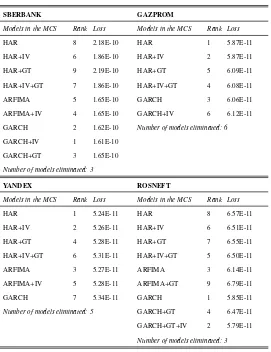
The models included in the Model Confidence Set (MCS) at the 10% confidence level and
Table 6: Models included in the MCS at the 10% confidence level and associated mean squared loss
SBERBANK GAZPROM
Models in the MCS Rank Loss Models in the MCS Rank Loss
HAR 8 2.18E-10 HAR 1 5.87E-11
HAR+IV 6 1.86E-10 HAR+IV 2 5.87E-11
HAR+GT 9 2.19E-10 HAR+GT 5 6.09E-11
HAR+IV+GT 7 1.86E-10 HAR+IV+GT 4 6.08E-11
ARFIMA 5 1.65E-10 GARCH 3 6.06E-11
ARFIMA+IV 4 1.65E-10 GARCH+IV 6 6.12E-11
GARCH 2 1.62E-10 Number of models eliminated: 6
GARCH+IV 1 1.61E-10
GARCH+GT 3 1.65E-10
Number of models eliminated: 3
YANDEX ROSNEFT
Models in the MCS Rank Loss Models in the MCS Rank Loss
HAR 1 5.24E-11 HAR 8 6.57E-11
HAR+IV 2 5.26E-11 HAR+IV 6 6.51E-11
HAR+GT 4 5.28E-11 HAR+GT 7 6.55E-11
HAR+IV+GT 6 5.31E-11 HAR+IV+GT 5 6.50E-11
ARFIMA 3 5.27E-11 ARFIMA 3 6.14E-11
ARFIMA+IV 5 5.28E-11 ARFIMA+GT 9 6.79E-11
GARCH 7 5.34E-11 GARCH 1 5.85E-11
Number of models eliminated: 5 GARCH+GT 4 6.47E-11
GARCH+GT+IV 2 5.79E-11
Number of models eliminated: 3
The models including the implied volatility tend to have smaller MSE compared to
other models, but these differences are not statistically significant and several
compet-ing models are also included into the MCS. Interestcompet-ingly, the simple HAR and GARCH
models without additional regressors have the smallest MSE for 3 stocks out of 4, thus
showing that efficiency gains more than compensate any possible model misspecifications
3.6.2 Value-at-Risk forecasts
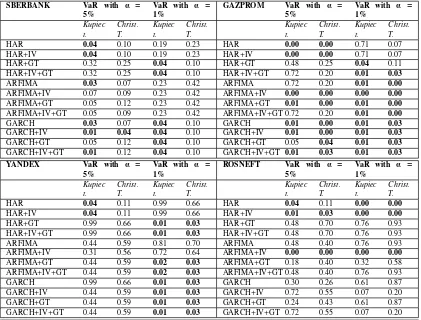
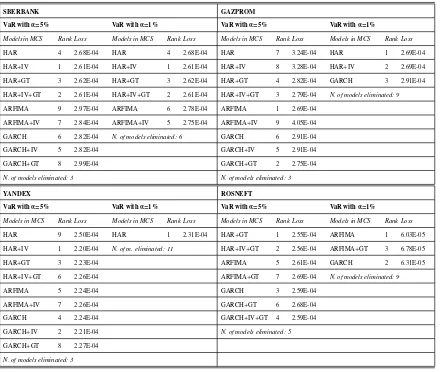
The p-values of the Kupiec and Christoffersen’s tests are reported in Table 7, while the
models included in the Model Confidence Set (MCS) at the 10% confidence level and
[image:16.596.85.506.259.579.2]their associated asymmetric quantile loss are reported in Table 8.
Table 7: Kupiec tests p-values and Christoffersen’s tests p-values. P-values smaller than 0.05 are in bold font.
SBERBANK VaR with α = 5%
VaR with α = 1%
GAZPROM VaR with α = 5%
VaR with α = 1% Kupiec t. Christ. T. Kupiec t. Christ. T. Kupiec t. Christ. T. Kupiec t. Christ. T.
HAR 0.04 0.10 0.19 0.23 HAR 0.00 0.00 0.71 0.07 HAR+IV 0.04 0.10 0.19 0.23 HAR+IV 0.00 0.00 0.71 0.07
HAR+GT 0.32 0.25 0.04 0.10 HAR+GT 0.48 0.25 0.04 0.11
HAR+IV+GT 0.32 0.25 0.04 0.10 HAR+IV+GT 0.72 0.20 0.01 0.03
ARFIMA 0.03 0.07 0.23 0.42 ARFIMA 0.72 0.20 0.01 0.00
ARFIMA+IV 0.07 0.09 0.23 0.42 ARFIMA+IV 0.00 0.00 0.00 0.00
ARFIMA+GT 0.05 0.12 0.23 0.42 ARFIMA+GT 0.01 0.00 0.01 0.00
ARFIMA+IV+GT 0.05 0.09 0.23 0.42 ARFIMA+IV+GT 0.72 0.20 0.01 0.00
GARCH 0.03 0.07 0.04 0.10 GARCH 0.01 0.00 0.01 0.03
GARCH+IV 0.01 0.04 0.04 0.10 GARCH+IV 0.01 0.00 0.01 0.03
GARCH+GT 0.05 0.12 0.04 0.10 GARCH+GT 0.05 0.04 0.01 0.03
GARCH+IV+GT 0.01 0.12 0.04 0.10 GARCH+IV+GT 0.01 0.03 0.01 0.03
YANDEX VaR with α = 5%
VaR with α = 1%
ROSNEFT VaR with α = 5%
VaR with α = 1% Kupiec t. Christ. T. Kupiec t. Christ. T. Kupiec t. Christ. T. Kupiec t. Christ. T.
HAR 0.04 0.11 0.99 0.66 HAR 0.04 0.11 0.00 0.00
HAR+IV 0.04 0.11 0.99 0.66 HAR+IV 0.01 0.03 0.00 0.00
HAR+GT 0.99 0.66 0.01 0.03 HAR+GT 0.48 0.70 0.76 0.93
HAR+IV+GT 0.99 0.66 0.01 0.03 HAR+IV+GT 0.48 0.70 0.76 0.93
ARFIMA 0.44 0.59 0.81 0.70 ARFIMA 0.48 0.40 0.76 0.93 ARFIMA+IV 0.31 0.56 0.72 0.64 ARFIMA+IV 0.00 0.00 0.00 0.00
ARFIMA+GT 0.44 0.59 0.02 0.03 ARFIMA+GT 0.18 0.40 0.32 0.58
ARFIMA+IV+GT 0.44 0.59 0.02 0.03 ARFIMA+IV+GT 0.48 0.40 0.76 0.93
GARCH 0.99 0.66 0.01 0.03 GARCH 0.30 0.26 0.61 0.87 GARCH+IV 0.44 0.59 0.01 0.03 GARCH+IV 0.72 0.55 0.07 0.20
GARCH+GT 0.44 0.59 0.01 0.03 GARCH+GT 0.24 0.43 0.61 0.87
Table 8: Models included in the MCS at the 10% confidence level and associated asymmetric quantile loss.
SBERBANK GAZPROM
VaR withα=5% VaR withα=1% VaR withα=5% VaR withα=1%
Modelsin MCS Rank Loss Models in MCS Rank Loss Models in MCS Rank Loss Models in MCS Rank Loss
HAR 4 2.68E-04 HAR 4 2.68E-04 HAR 7 3.24E-04 HAR 1 2.69E-04
HAR+IV 1 2.61E-04 HAR+IV 1 2.61E-04 HAR+IV 8 3.28E-04 HAR+IV 2 2.69E-04
HAR+GT 3 2.62E-04 HAR+GT 3 2.62E-04 HAR+GT 4 2.82E-04 GARCH 3 2.91E-04
HAR+IV+GT 2 2.61E-04 HAR+IV+GT 2 2.61E-04 HAR+IV+GT 3 2.79E-04 N. of models eliminated: 9
ARFIMA 9 2.97E-04 ARFIMA 6 2.78E-04 ARFIMA 1 2.69E-04
ARFIMA+IV 7 2.84E-04 ARFIMA+IV 5 2.75E-04 ARFIMA+IV 9 4.05E-04
GARCH 6 2.82E-04 N. of models eliminated: 6 GARCH 6 2.91E-04
GARCH+IV 5 2.82E-04 GARCH+IV 5 2.91E-04
GARCH+GT 8 2.99E-04 GARCH+GT 2 2.75E-04
N. of models eliminated: 3 N. of models eliminated: 3
YANDEX ROSNEFT
VaR withα=5% VaR withα=1% VaR withα=5% VaR withα=1%
Models in MCS Rank Loss Models in MCS Rank Loss Models in MCS Rank Loss Models in MCS Rank Loss
HAR 9 2.50E-04 HAR 1 2.31E-04 HAR+GT 1 2.55E-04 ARFIMA 1 6.03E-05
HAR+IV 1 2.20E-04 N. of m. eliminated: 11 HAR+IV+GT 2 2.56E-04 ARFIMA+GT 3 6.78E-05
HAR+GT 3 2.23E-04 ARFIMA 5 2.61E-04 GARCH 2 6.31E-05
HAR+IV+GT 6 2.26E-04 ARFIMA+GT 7 2.69E-04 N. of models eliminated: 9
ARFIMA 5 2.24E-04 GARCH 3 2.59E-04
ARFIMA+IV 7 2.26E-04 GARCH+GT 6 2.68E-04
GARCH 4 2.24E-04 GARCH+IV+GT 4 2.59E-04
GARCH+IV 2 2.21E-04 N. of models eliminated: 5
GARCH+GT 8 2.27E-04
N. of models eliminated: 3
These tables show that ARFIMA and HAR models without additional regressors tend
to be the best compromise for precise VaR forecasts, particularly at the 1% level, which
is the most important quantile for regulatory purposes. The HAR model with the implied
volatility showed in several cases the lowest asymmetric quantile losses, thus confirming
the previous in-sample analysis. However, the differences with the other models were
rather small and not statistically significant. Moreover, for two stocks (Yandex and
Ros-neft) the models with the implied volatility were excluded from the MCS for the VaR
bet-ter choice when out-of-sample forecasting is the main concern, thanks to more efficient
estimates in comparison to more complex specifications.
4
Conclusions
Three volatility forecasting models and several different specifications, including also the
implied volatility computed from option prices and Google Trends data, were used to
model and forecast the realized volatility and the VaR of four Russian stocks.
The in-sample analysis showed that only the implied volatility had a significant
ef-fect on the realized volatility across most stocks and estimated models, whereas Google
Trends did not have any significant effect on the realized volatility. The out-of-sample
analysis highlighted that the models including the implied volatility had smaller MSE
compared to several competing models, but these differences were not statistically
sig-nificant. Moreover, the simple HAR and GARCH models without additional regressors
showed the smallest MSE for three stocks out of four, thus showing that efficiency gains
more than compensate any possible model misspecifications and parameters biases. A
similar result was also found after performing a backtesting analysis with daily VaR
fore-casts, where ARFIMA and HAR models without additional regressors had the best results
in several cases (particularly at the 1% probability level), whereas the HAR model with
implied volatility displayed good results when forecasting the VaR at the 5% probability
level. Therefore, these findings revealed that Google Trends data did not improve the
forecasting performances of the models when a market-based predictor like the implied
volatility was included, thus confirming similar results reported by [10].
How to explain these results? One possible explanation was proposed by [10], who
put forward the idea that the informational content included in the internet search activity
as a surprise, if we consider that implied volatility is a forward-looking measure mainly
based on the expectations of institutional investors and market makers who have access
to premium and insider information, while Google Trends data are mainly based on the
expectations of small investors and un-informed traders. A second simpler explanation
is that Yandex is the main search engine in Russia with a market share close to 56% in
2018 (all platforms), while Google is second with a market share close to 42%, so that
Google Trends may not be the best proxy for Russian investors’ interest and behavior.
More research is definitely needed in this regard, and this issue is left as an avenue of
References
[1] Bauwens, L., Hafner, C. M., and Laurent, S. (2012).Handbook of volatility models and their
appli-cations (Vol. 3). John Wiley and Sons.
[2] Campos, I., Cortazar, G., and Reyes, T. (2017). Modeling and predicting oil VIX: Internet search
volume versus traditional variables.Energy Economics, 66, 194-204.
[3] Donaldson, R. G., and Kamstra, M. J. (2005). Volatility forecasts, trading volume, and the arch versus
option-implied volatility trade-off.Journal of Financial Research, 28(4), 519-538.
[4] Andrei, D., and Hasler, M. (2014). Investor attention and stock market volatility. The Review of
Financial Studies, 28(1), 33-72.
[5] Vlastakis N. and R. N. Markellos. (2012) Information demand and stock market volatility.Journal of
Banking and Finance, 1808–1821.
[6] Mayhew, S. (1995). Implied volatility.Financial Analysts Journal, 51(4), 8-20.
[7] Corsi, F. (2009). A simple approximate long-memory model of realized volatility.Journal of
Finan-cial Econometrics, 174-196.
[8] Andersen, T. G., Bollerslev, T., Diebold, F. X., Labys, P. (2003). Modeling and forecasting realized
volatility.Econometrica, 71(2), 579-625.
[9] Goddard, J., Kita, A., and Wang, Q. (2015). Investor attention and FX market volatility.Journal of
International Financial Markets, Institutions and Money, 38, 79-96.
[10] Basistha, A., Kurov, A., and Wolfe, M. (2018). Volatility Forecasting: The Role of Internet Search
Activity and Implied Volatility, West Virginia University working paper
[11] Barndorff-Nielsen, O. E., and Shephard, N. (2002). Econometric analysis of realized volatility and
its use in estimating stochastic volatility models.Journal of the Royal Statistical Society: Series B
(Statistical Methodology), 64(2), 253-280.
[12] Liu, L. Y., Patton, A. J., and Sheppard, K. (2015). Does anything beat 5-minute RV? A comparison
of realized measures across multiple asset classes.Journal of Econometrics, 187(1), 293-311.
[13] Hull, J. C. (2016).Options, futures and other derivatives. Pearson.
[14] Fengler, M. R. (2006). Semiparametric modeling of implied volatility. Springer Science & Business
[15] Hyndman, R. J., and Khandakar, Y. (2008). Automatic Time Series Forecasting: the forecast Package
for R.Journal of Statistical Software, 27(3).
[16] Hansen, P. R., and Lunde, A. (2005). A forecast comparison of volatility models: does anything beat
a GARCH (1, 1)?.Journal of applied econometrics, 20(7), 873-889.
[17] Hansen, P. R., Lunde, A., & Nason, J. M. (2011). The model confidence set. Econometrica, 79(2),
453-497.
[18] Gonz´alez-Rivera, G., Lee, T. H., and Mishra, S. (2004). Forecasting volatility: A reality check based
on option pricing, utility function, value-at-risk, and predictive likelihood.International Journal of
forecasting, 20(4), 629-645.
[19] Louzis, D. P., Xanthopoulos-Sisinis, S., and Refenes, A. P. (2014). Realized volatility models and
alternative Value-at-Risk prediction strategies.Economic Modelling, 40, 101-116.
[20] Kupiec, P. H. (1995). Techniques for Verifying the Accuracy of Risk Measurement Models. The
Journal of Derivatives, 3(2), 73-84.
[21] Christoffersen, P. F. (1998). Evaluating interval forecasts.International economic review, 39,