http://www.scirp.org/journal/jtst ISSN Online: 2379-1551
ISSN Print: 2379-1543
DOI: 10.4236/jtst.2017.34004 Nov. 30, 2017 45 Journal of Textile Science and Technology
Effect of Machine Setting Parameters on Ring
Slub Carded Yarn Quality and Spinning
Performance
Md. Din Islam, Md. Rokonuzzaman, Joykrisna Saha
*, Abdur Razzaque
Department of Textile Engineering, Mawlana Bhashani Science and Technology University, Santosh, Tangail,Bangladesh
Abstract
At present ring slub carded yarn is very popular to produce value added product for ornamentation purpose in the apparel industry. During spinning different parameters influenced the spinning performance. The main aim of this study was to investigate the effect of spindle speed as well as traveller weight on yarn quality. The Ne 28, Ne 30 and Ne 34 carded slub yarns were produced at the spindle speed of 15,500 rpm, 16,000 rpm, 16,500 rpm, 17,000 rpm and 17,500 rpm on the ring frame with using traveller number 3/0, 4/0, 5/0 and 6/0. The yarn properties like mass variation percentage (CVm%), un-evenness (U%), hairiness, yarn breakage rate, yarn imperfection were investi-gated. It was found that traveller number 5/0 showed lower Um%, CVm% for Ne 28 and Ne 30 carded slub yarn compared to traveller number 3/0 and 4/0. On the other hand traveller number 6/0 showed better Um%, CVm%, thin places (−50%)/km and end breakage% for Ne 34 carded slub yarn compared to traveller number 4/0 and 5/0. It was also observed that increasing end breakage rate as the spindle speed of ring frame was increased.
Keywords
Slub Yarn, End Breakage, Spindle Speed, Traveller
1. Introduction
The fancy yarn like slub carded yarn which creates special appearance in the outside of fabric is widely used for decorative purpose in apparels industry. This special appearance depends on different parameters of slub yarn which are slub length, slub thickness, slub/meter, slub distance. Approximately 100,000 tons fancy yarns are produced per year all over the world [1]. At present slub yarns
How to cite this paper: Islam, Md.D., Rokonuzzaman, Md., Saha, J. and Razza-que, A. (2017) Effect of Machine Setting Parameters on Ring Slub Carded Yarn Quality and Spinning Performance. Journal of Textile Science and Technology, 3, 45-55.
https://doi.org/10.4236/jtst.2017.34004
Received: October 7, 2017 Accepted: November 27, 2017 Published: November 30, 2017
Copyright © 2017 by authors and Scientific Research Publishing Inc. This work is licensed under the Creative Commons Attribution International License (CC BY 4.0).
http://creativecommons.org/licenses/by/4.0/
DOI: 10.4236/jtst.2017.34004 46 Journal of Textile Science and Technology
are becoming more popular than conventional yarns in denim factory [2]. Among the fancy yarns, slub yarn creates good position in textile sector for producing value added product [3]. At present, slub yarn is used in versatile ap-plication like denim, shirting, knitwear, casual wear and ladies dress material. These depend on different thickness and length of slub, giving a wide range of effects [4].
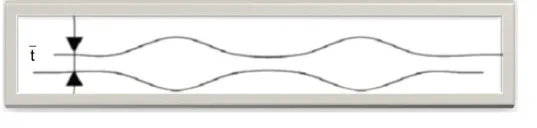
The fancy yarn consists of two parts: the slubs (or flames) and the spacings (Figure 1).
This novelty generates a change in yarn properties compared to the conven-tional yarn. The slub yarn studied is produced on the ring spinning system equipped with the Amsler device [5].
In ring spinning system traveller is the most essential component for spun yarn production. Different weights of travellers are used in ring spining. Travel-ler weight controls the degree of frictional forces between the travelTravel-ler and the ring which influences the winding speed and balloon tension [6]. Weight of the traveller to be selected depends upon the yarn count, yarn strength, spindle speed and raw material. Traveller weight influences yarn quality and production. Experience has shown that, for any given traveller, there is a limit to maximum practical speed; if that is exceeded, the high amount of heat develops due to the friction with the ring. In turn, the traveller is burnt, in a very short time, and fly of the rings. When this happens in a spinning room, the “ends down” or brea-kage rate is increased. Yarn quality parameters can be improved by proper tra-veller weight selection, which results in reducing yarn breakages, mass variation, twist variation and hairiness. In this way, the increased quantity and quality of the yarn along with the low spinning cost can be obtained [7].
[image:2.595.243.512.650.714.2]Normally light weight and heavier weight travellers are used for the produc-tion of fine yarn and coarser yarn spinning correspondingly. In addiproduc-tion, travel-lers life is very short, so traveltravel-lers are replaced frequently to minimize the unne-cessary machine stoppage [8][9]. In staple yarn manufacture, ring spinning sys-tem is still now dominating the spun yarn production area amongst all the spin-ning systems because of special characteristics of these yarns which supply ex-cellent apparel fabric properties [10]. Rotor, friction and air jet systems are un-conventional spinning techniques which produce yarns at a much faster rate than the ring spinning system. But these yarns are not equal with ring yarns in terms of strength, especially as an end product of fabric for apparels [11] [12]. The productivity of ring frame mostly depending on a higher spindle speed has become necessary for higher productivity [13]. High spindle speeds generate
DOI: 10.4236/jtst.2017.34004 47 Journal of Textile Science and Technology
problems during spinning such as high yarn breakage rate, hairiness, strength loss and fly generation [14][15]. The aim in this study is to produce yarn at high speed by using suitable traveler and maintaining yarn quality.
A variety of methods are available for producing slub yarns, like ring-spun slub yarns and rotor-spun slub yarns. In these methods, ring spinning is the ear-liest and also the most common processing technology in slub yarn production at the present time. A well-known method in this process is to modify the ring spinning frame in such a way that the intermittent acceleration of the drafting rollers produces constant varying degrees of draft to be applied [16]. In this re-search four different weights of travellers were selected and their influence on the production and quality of 28/1, 30/1 and 34/1 cotton carded slub yarn were determined at different spindle speed of 15,500, 16,000, 16,500, 17,000, 17,500 rpm. Mass variation percentage (CVm %), Unevenness (U %), Yarn hairiness, End breakage rate, Thick places and thin places were determined as the quality parameters.
2. Materials & Methods
2.1. Materials Properties Which Are Used in Experiment
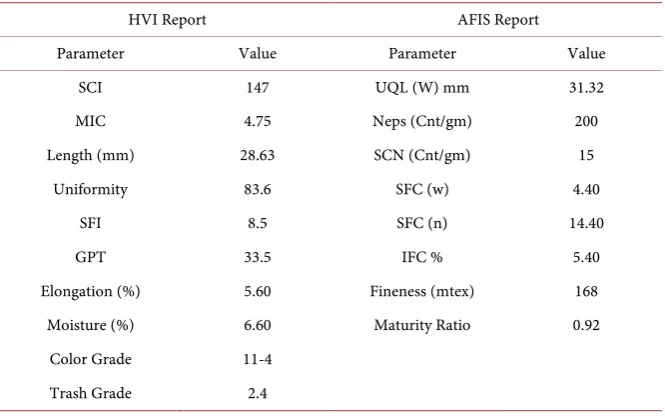
Through this study it has been selected CIS (Uzbekistan) cotton fibers. Proper-ties of cotton fibers are shown below-
28/1, 30/1, and 34 Ne carded slub yarn samples were produced from the above mention raw cotton sample.
2.2. Methods
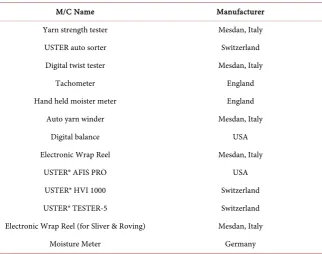
[image:3.595.207.540.515.723.2]At first selected cotton is to be tested by USTER® HVI 1000 and the result of is shown in Table 1. And process materials properties have been tested by process controlled machine of USTER® AFIS PRO and the result is shown in Table 2. In
Table 1. HVI and AFIS report.
HVI Report AFIS Report
Parameter Value Parameter Value
SCI 147 UQL (W) mm 31.32
MIC 4.75 Neps (Cnt/gm) 200
Length (mm) 28.63 SCN (Cnt/gm) 15
Uniformity 83.6 SFC (w) 4.40
SFI 8.5 SFC (n) 14.40
GPT 33.5 IFC % 5.40
Elongation (%) 5.60 Fineness (mtex) 168
Moisture (%) 6.60 Maturity Ratio 0.92
Color Grade 11-4
DOI: 10.4236/jtst.2017.34004 48 Journal of Textile Science and Technology Table 2. Instruments that are used in analysis.
M/C Name Manufacturer
Yarn strength tester Mesdan, Italy
USTER auto sorter Switzerland
Digital twist tester Mesdan, Italy
Tachometer England
Hand held moister meter England
Auto yarn winder Mesdan, Italy
Digital balance USA
Electronic Wrap Reel Mesdan, Italy
USTER® AFIS PRO USA
USTER® HVI 1000 Switzerland
USTER® TESTER-5 Switzerland
Electronic Wrap Reel (for Sliver & Roving) Mesdan, Italy
Moisture Meter Germany
back process, all stage like carding, breaker drawing, finisher drawing & simplex process materials are to be tested by wrap block. First sample of 28/1, 30/1, and 34/1 Ne carded slub yarn is made from ring frame where slub attachment was mounted. Then ring cops of slub yarns are tested by Uster-5 and the result of slub yarns are analyzed and U%, CVm%, Thin (−50%), Thick (+50%), Hairiness, end breakage% slub yarn slub length, slub thickness, slub/meter and pause length measured by Uster-5 and manually measure by scale & balance.
3. Results and Discussion
3.1. Effect of Ring Spindle Speed and Traveller Number on Yarn
Evenness
Yarn evenness can be expressed by two ways: 1) The irregularity U%; 2) The coefficient of mass variation CVm%.
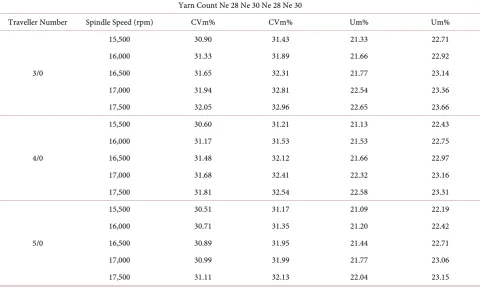
DOI: 10.4236/jtst.2017.34004 49 Journal of Textile Science and Technology Table 3. Effect of spindle speed and traveller number on yarn irregularity (U%) and Co-efficient of mass variation (CVm%) of Ne 28 and Ne 30 carded slub yarn.
Yarn Count Ne 28 Ne 30 Ne 28 Ne 30
Traveller Number Spindle Speed (rpm) CVm% CVm% Um% Um%
3/0
15,500 30.90 31.43 21.33 22.71
16,000 31.33 31.89 21.66 22.92
16,500 31.65 32.31 21.77 23.14
17,000 31.94 32.81 22.54 23.36
17,500 32.05 32.96 22.65 23.66
4/0
15,500 30.60 31.21 21.13 22.43
16,000 31.17 31.53 21.53 22.75
16,500 31.48 32.12 21.66 22.97
17,000 31.68 32.41 22.32 23.16
17,500 31.81 32.54 22.58 23.31
5/0
15,500 30.51 31.17 21.09 22.19
16,000 30.71 31.35 21.20 22.42
16,500 30.89 31.95 21.44 22.71
17,000 30.99 31.99 21.77 23.06
17,500 31.11 32.13 22.04 23.15
yarn count Ne 28. In addition to the yarn count Ne 30 also showed the similar effet. Above discussion it was clear that traveller number 5/0 was given the best result as traveller number 5/0 shown lower CVm% and Um as compared to oth-ers.
From Figure 2 & Figure 3, it was found that when spindle speed increases and lower traveller number used ie; light weight traveller then yarn unevenness and CVm% also increases and vice versa. Traveller number 4/0 was shown worst result. On the other hand traveller number 5/0 and 6/0 were given approximate-ly similar result. So for Ne 34 carded slub yarn traveller number 6/0 is suitable. It is clear that yarn Um% and CVm% decreases with the increase in traveller mass.
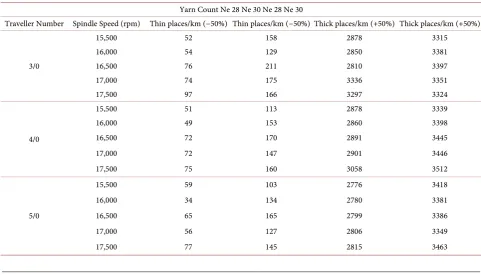
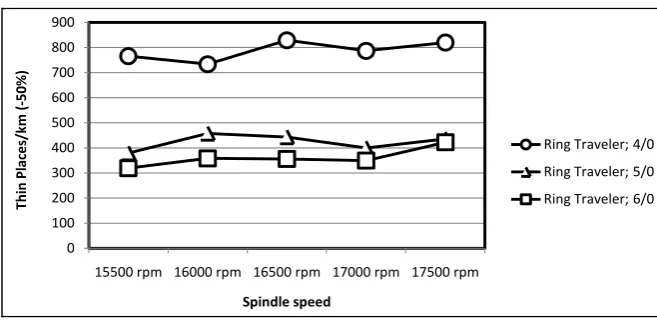
The Table 4 and Figure 4 & Figure 5, it was shown that number of thin plac-es per km for Ne 30 carded slub yarn was two or three timplac-es greater than Ne 28 carded slub yarn. So it can be said that higher yarn count produces more thin places. The number of thin places of yarn count Ne 34 were 820, 436 and 422 with traveler number were 4/0, 5/0 and 6/0 respectively at 17500 rpm. Whereas Ne 28 yarn count produces only 97, 77, and 77 number of thin places per kilo-meter at the same rpm. Traveller number 4/0 was given worst vaule and traveler 6/0 gives best result for Ne 34 carded slub yarn. On the other hand there was no significance variation among the traveler number and different traveler speed for Ne 28 and Ne 30 yarn count.
DOI: 10.4236/jtst.2017.34004 50 Journal of Textile Science and Technology Figure 2. Um% of Ne 34 carded slub yarn with different ring spindle speed and ring tra-veller.
Figure 3. CVm% of Ne 34 carded slub yarn with different ring spindle speed and ring traveller.
Table 4. Effect of ring spindle speed and traveller number on yarn thin places/km (−50%) and thick places/km (+50%). Yarn Count Ne 28 Ne 30 Ne 28 Ne 30
Traveller Number Spindle Speed (rpm) Thin places/km (−50%) Thin places/km (−50%) Thick places/km (+50%) Thick places/km (+50%)
3/0
15,500 52 158 2878 3315
16,000 54 129 2850 3381
16,500 76 211 2810 3397
17,000 74 175 3336 3351
17,500 97 166 3297 3324
4/0
15,500 51 113 2878 3339
16,000 49 153 2860 3398
16,500 72 170 2891 3445
17,000 72 147 2901 3446
17,500 75 160 3058 3512
5/0
15,500 59 103 2776 3418
16,000 34 134 2780 3381
16,500 65 165 2799 3386
17,000 56 127 2806 3349
17,500 77 145 2815 3463
22.523 23.524 24.525 25.526 26.527 27.5
15500 rpm 16000 rpm 16500 rpm 17000 rpm 17500 rpm
Um
%
Spindle speed
Ring Traveler; 4/0 Ring Traveler; 5/0 Ring Traveler; 6/0
32 32.5 33 33.5 34 34.5 35 35.5
15500 rpm 16000 rpm 16500 rpm 17000 rpm 17500 rpm
CVm
%
Spindle speed
Ring Traveler; 4/0 Ring Traveler; 5/0
[image:6.595.56.538.466.741.2]DOI: 10.4236/jtst.2017.34004 51 Journal of Textile Science and Technology Figure 4. Thin places/km (−50%) of Ne 34 Carded slub yarn with different ring spindle speed and ring traveller.
then thick places/km (+50%) also increases but yarn thick places/km (+50%) is requirement because it represents the no. of slub. So for Ne 28 and Ne 30 carded slub yarn traveller number 4/0 is suitable. The number of thick places of Ne 30 is more than Ne 28 carded slub yarn. In addition to the traveller number 5/0 and 6/0 were shown approximately similar result and traveler number 4/0 was given highest thick places per kilometer.
3.2. Effect of Ring Spindle Speed and Traveller Number on Yarn
Hairiness and End Breakage Rate
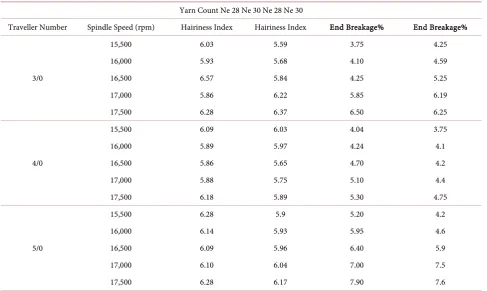
From Table 5, it was observed that when spindle speed increase end breakage% also increase and vice versa. In case of yarn count Ne 28, the end breakage% was shown 6.50, 5.30 and 7.90 with the traveller number of 3/0, 4/0 and 5/0 respec-tively at 17,500 rpm. In addition to the end breakage% was also shown 6.25, 4.75 and 7.6 with the traveller number of 3/0, 4/0 and 5/0 respectively at 17,500 rpm for yarn count Ne 30. Above discussion it was clear that traveller number 4/0 was given the best result as traveller number 4/0 shown lower end breakage rate as compared to others.
Yarn hairiness is defined as the protrusion of fibres from the core of yarn structure [17].
Yarn hairiness influences the fabric appearance, handle, pilling tendency and yarn strength. Broadly spindle speed and traveler mass mostly influenced the yarn hairiness. From the Table 5, it was observed that higher spindle speed re-sponsible for upper level of hairiness index at different traveller weight. This outcome bears the other authors [18]. Traveller number 5/0 shown slightly higher hairiness index than traveller 3/0 and 4/0. Among the traveller, 4/0 num-ber is suitable for Ne 28 and Ne 30 carded slub as it was given lower hairiness index at highest spindle speed 17,000 rpm. It is very clear that hairiness index reduces with the increase in traveller mass 3/0 to 4/0 but slightly increases hairi-ness index for traveller 5/0. This result supported by number of author [19][20]. A number of researcher have found that hairiness reduce with increase traveler
0 100 200 300 400 500 600 700 800 900
15500 rpm 16000 rpm 16500 rpm 17000 rpm 17500 rpm
Th
in
P
la
ce
s/
km
(-50%
)
Spindle speed
DOI: 10.4236/jtst.2017.34004 52 Journal of Textile Science and Technology Figure 5. Comparison of thick places/km (+50%) of Ne 34 Carded slub yarn with differ-ent ring spindle speed and ring traveler.
Table 5. Hairiness and end breakage% of Ne 28 and Ne 30 Carded slub yarn with different ring spindle speed and ring traveller.
Yarn Count Ne 28 Ne 30 Ne 28 Ne 30
Traveller Number Spindle Speed (rpm) Hairiness Index Hairiness Index End Breakage% End Breakage%
3/0
15,500 6.03 5.59 3.75 4.25
16,000 5.93 5.68 4.10 4.59
16,500 6.57 5.84 4.25 5.25
17,000 5.86 6.22 5.85 6.19
17,500 6.28 6.37 6.50 6.25
4/0
15,500 6.09 6.03 4.04 3.75
16,000 5.89 5.97 4.24 4.1
16,500 5.86 5.65 4.70 4.2
17,000 5.88 5.75 5.10 4.4
17,500 6.18 5.89 5.30 4.75
5/0
15,500 6.28 5.9 5.20 4.2
16,000 6.14 5.93 5.95 4.6
16,500 6.09 5.96 6.40 5.9
17,000 6.10 6.04 7.00 7.5
17,500 6.28 6.17 7.90 7.6
mass. But the reduction is thought to be up to a certain traveler mass before it begins to increase again.
From the Figure 6, it was observed that traveller number 4/0 showed lower hairiness index in all cases except 16,500 rpm than traveller number 5/0 and 6/0 for Ne 34 carded slub yarn. The hairiness index was sharply increase at 16,000 rpm and slight goes down at 16,500 rpm but dramatically fall at 17,000 rpm and again rise at 17,500 rpm in case of traveller number 5/0. Again the hairiness in- dex was gradually increase of traveller number 6/0 in all spindle speed except 16500 rpm. It can be conclude that traveller number 4/0 was given best result.
0 500 1000 1500 2000 2500 3000 3500 4000 4500 5000
15500 rpm 16000 rpm 16500 rpm 17000 rpm 17500 rpm
Th
ic
k P
la
ce
s/
km
(+
50%
)
Spindle speed
[image:8.595.56.544.285.576.2]DOI: 10.4236/jtst.2017.34004 53 Journal of Textile Science and Technology Figure 6. Comparison of hairiness of Ne 34 Carded slub yarn with different ring spindle speed and ring traveller.
Figure 7. Comparison of End Breakage% of Ne 34 Carded slub yarn with different ring spindle speed and ring traveller.
In the Figure 7 for Ne 34 carded slub yarn, it was found that the end breakage rate increases with the increase in spindle speed and vice versa. But traveller mass increases; the end breakage rate also decreases. On the other hand lighter weight travellers responsible for more yarn end breakage as a result machine ef-ficiency and production will go down. Furthermore lighter weight travellers in-crease the traveller speed but it disturbs the winding speed. This disturbance happening more yarn breakage and also reduce the yarn quality [3]. The suitable traveller selection is the key to achieve optimum production. Among the travel-ler, traveller number 6/0 is excellent for better production at 17500 rpm of spin-dle speed for 34 carded slub yarn.
4. Conclusion
In this study U%, CVm%, thin places, thick places, hairiness index and end breakage% have been observed by changing spindle speed and traveller number in ring frame. The traveler number 5/0 showed better result in terms of U%, CVm% at maximum spindle speed for Ne 28 and Ne 30 carded slub yarn. There
5.3 5.4 5.5 5.6 5.7 5.8 5.9 6
15500 rpm 16000 rpm 16500 rpm 17000 rpm 17500 rpm
Ha
irin
es
s
Spindle speed
Ring Traveler; 4/0 Ring Traveler; 5/0 Ring Traveler; 6/0
0 1 2 3 4 5 6 7 8 9 10
15500 rpm 16000 rpm 16500 rpm 17000 rpm 17500 rpm
Br
eak
ag
e%
Spindle speed
[image:9.595.207.540.273.429.2]DOI: 10.4236/jtst.2017.34004 54 Journal of Textile Science and Technology
is no significant difference for thin places per kilometer. On the other hand trav-eler number 4/0 is given the highest thick places and the lowest end breakage% and hairiness index. So traveler number 4/0 is suitable for Ne 28 and Ne 30 carded slub yarn production. Again traveller number 6/0 is given the best result in terms of U%, CVm%, thin places/km and end breakage% for Ne 34 carded slub yarn. On the other hand, traveler number 4/0 showed the lowest hairiness index and the highest thick places per kilometer for Ne 34 cared slub yarn. So it can be said that traveler number 4/0 is the best for slub yarn production purpose but 6/0 is suitable for overall spinning performance.
References
[1] Kwasniak, J. (1997) Application of a Pressurized-Air Method of Fancy-Yarn Forma-tion to Industrial Rotor-Spinning Machines. Journal of the Textile Institute, 88, 185-197.https://doi.org/10.1080/00405009708658544
[2] Amsler, B. and Olsson, P. (1991) Economic Benefits in Fancy Yarn. Textile Month, 31-35.
[3] Amsler, B. (2004) Fancy Yarn Opportunities in Spinning Process. International Textile Buletin, 2, 40-42.
[4] Spamth, V.R. (2004) Fancy Yarns in Open End Spinning. Asian Textile Journal, 13, 52-54.
[5] Product Review (2004) Amsler Equipment to Spin Fancy & Elastic Yarn. Indian Textile Journal, 114, 37.
[6] Nemailal, T. (2002) Effect of Speed, Twist, Draft on Ring Spun Yarn. Indian Textile Journal, 11, 10,
[7] Barella, A. and Manich, A. ((2002) Yarn Hairiness: A Further Update. Textile Progress, 31, 1-44.https://doi.org/10.1080/00405160208688953
[8] Usta, I. and Canoglu, S. (2002) Influence of Ring Traveller Weight and Coating on Hairiness of Acrylic Yarns. Fibres and Textiles in Eastern Europe, 20-24.
[9] Merril, G.R.(1999) Manual of Textile. Universal Publication Corporation, Mumbai. [10] Lord, P.R. (2003) Handbook of Production, Technology, Science and Economics.
The Textile Institute, Woodhead Publishing Ltd., Cambridge, 71.
[11] Azzouz, B., Hassan, M.B. and Sakli, F. (2007) Quality Prediction and Optimizing Cotton Blend Using ANN. Indian Textile Journal, 1, 27-34.
[12] Lawal, A.S. (2008) Studies on the Effects of Some Spinning Parameters on Various Blends of Flax/Cotton Yarns Spun Using Ring and Rotor Spinning Techniques. Ph.D. Thesis. Ahmadu Bello University, Zaria.
[13] Grosberg, P. and Iype, C. (1999) Yarn Production, Theoretical Aspect. The Textile Institute, Manchester, 99-113.
[14] Nemailal, T. (2002) Effect of Speed, Twist, Draft on Ring Spun Yarn. Indian Textile Journal, 11, 19-28.
[15] Schlafhorst (1995) Preparation of Linen Fibres and Their Processing in Ring and Rotor Spinning. Manchenglabatch, 33.
[16] Gong, R.H. and Wright, R.M. (2002) Fancy Yarns: Their Manufacture and Applica-tion. Woodhead Publishing Limited, Cambridge, 60-91.
DOI: 10.4236/jtst.2017.34004 55 Journal of Textile Science and Technology
[17] Wang, X. and Chang, L. (2003) Reducing Yarn Hairiness with a Modified Yam Path in Worsted Ring Spinning. Textile Research Journal,73, 327-332.
https://doi.org/10.1177/004051750307300409
[18] Wang, X. and Miao, M. (1997) Reducing Yarn Hairiness with an Air-Jet Attach-ment during Winding. Textile Research Journal,67, 481-485.
https://doi.org/10.1177/004051759706700702
[19] Pillay, K.P.R. (1964) A Study of the Hairiness of Cotton Yarns Part I: Effect of Fiber and Yarn Factors. Textile Research Journal,34, 663-674.
https://doi.org/10.1177/004051756403400802
[20] Tang, Z.-X., Wang, X., Wang, L. and Fraser, W.B. (2006) The Effect of Yarn Hairi-ness on Air Drag in Ring Spinning. Textile Research Journal,76, 559-566.