Selection of Appropriate Ring Traveller Number for
Different Count of Cotton Hosiery Yarn
1
Jamal Hossen,
2Subrata Kumar Saha
Department of Textile Engineering Ahsanullah University of Science and Technology 141-142, Love Road, Tejgaon I/A, Dhaka-1208, BangladeshAbstract-- Traveller has a great impact on yarn quality parameters specially hairiness. Yarn quality varies due to different traveller number. The traveller imparts twist to the yarn and enables winding of the yarn on the cop. However, cooperating assembly, the spindle is required for the winding operation. High contact pressure (up to 35 N/mm2) is generated between the ring and traveller during winding, mainly due to centrifugal force. This research was established according to yarn parameter of hairiness, U%, IPI, i.e. imperfection index and end breakage rate per 1000 spindle-hr. It is very important for the technologist to understand this and act on them to optimize the yarn production. Specific number of traveller should be used for a particular count of yarn.
Index Term-- Traveller number, carded yarn, combed yarn, Uster Tester, hosiery yarn.
I. INTRODUCTION
The ring and traveller combination is effectively a twisting and winding mechanism [3]. Although it is very minute in appearance, it plays an important role in spinning operation [2]. Several investigations have been carried out on the influence of the ring traveller [4]. For a given yarn count, the longer the fibers, the fewer the number per unit length of a given yarn count, and this is reflected in the yarn hairiness. Consequently, there moving of short fibers by combing results in combed yarns being much less hairy than carded yarns of equivalent count [3]. In most cases, the limit to productivity of the ring spinning machine is defined by the traveller in interdependence with the ring, and yarn. The following shapes are in use in the short-staple spinning mills: (i) C-traveller (ii) Flat or oval traveller (iii) Elliptical traveller (iv) N-traveller (v) SU-traveller [1]. Usually, C-traveller is used in short-staple spinning mills. C-traveller and Kanai brand were used in this work.
II. MATERIALS AND METHOD
Formerly in the United Kingdom, the term hosiery was used in the generic sense of all types of knitted fabrics and goods made up there from. Combed, super carded and carded yarns are all used extensively for knitting [6]. In this study 26/1 Ne and 30/1 Ne carded hosiery and 24/1 Ne and 34/1 Ne combed hosiery yarn were made from roving of hank 0.75. For both carded and combed yarns, twist multiplier were 3.6 and 3.5
Comparative chart of traveller weights [5]
Table A
Travel. No.
R+F ISO-Nr.
Bracker
ISO-Nr. Carter ISO-Nr. Kanai
*
ISO-Nr.
Lighter 15/0 14.0 15.0 22.7 16.6
14/0 15.0 16.0 24.3 18.3
13/0 16.0 17.0 26 20.0
12/0 18.0 18.0 27.5 21.6
11/0 19.0 20.0 29 23.4
10/0 20.0 22.4 31 25.0
9/0 22.4 23.6 32 26.8
8/0 23.6 25.0 34 28.5
7/0 26.5 28.0 36 30.2
6/0 30.0 31.5 39 32.2
5/0 31.5 35.5 42 35.1
4/0 35.5 40 45 38.3
3/0 40 45 49 42.2
2/0 45 50 52 48.3
1/0 50 56 58 54.6
1 60 63 65 62.2
2 71 71 71 73.6
3 80 80 78 81.0
4 85 90 84 87.7
5 95 95 91 95.3
6 106 100 104 108.8
7 112 112 117 121.8
8 125 125 130 135.9
9 140 140 149 154.4
10 160 160 168 174.8
11 180 180 194 199.0
12 200 200 214 219.8
13 224 224 233 237.8
14 236 250 253 258.7
Heavier 15 250 265 272 277.1
III. RESULTS AND DISCUSSION
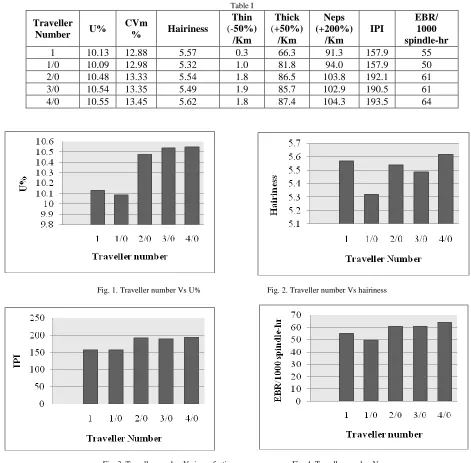
Count and traveller number wise Uster test report and end breakage rate per 1000 spindle-hr for 26/1 Ne carded hosiery yarn
Table I
Traveller Number U%
CVm
% Hairiness
Thin (-50%) /Km
Thick (+50%) /Km
Neps (+200%)
/Km
IPI
EBR/ 1000 spindle-hr
1 10.13 12.88 5.57 0.3 66.3 91.3 157.9 55
1/0 10.09 12.98 5.32 1.0 81.8 94.0 157.9 50
2/0 10.48 13.33 5.54 1.8 86.5 103.8 192.1 61
3/0 10.54 13.35 5.49 1.9 85.7 102.9 190.5 61
4/0 10.55 13.45 5.62 1.8 87.4 104.3 193.5 64
Fig. 1. Traveller number Vs U% Fig. 2. Traveller number Vs hairiness
Fig. 3. Traveller number Vs imperfection Fig. 4. Traveller number Vs index (IPI) EBR/1000 spindle-hr
The figure 1 to 4 show that U%, hairiness, IPI and end breakage rate are the lowest for traveller number 1/0. With respect to above four quality parameters the best result is in this traveller number. So it can be concluded that in case of
26/1 Ne carded hosiery yarn, traveller number 1/0 is appropriate.
Table II
Traveller Number U%
CVm
% Hairiness
Thin (-50%)
/Km
Thick (+50%) /Km
Neps (+200%)
/Km
IPI
EBR/ 1000 spindle-hr
1 11.68 14.85 5.20 4.2 172.3 243.5 420.0 58
1/0 11.65 14.81 5.21 4.0 171.5 241.8 417.3 52
2/0 11.34 14.55 5.08 3.9 172.3 223.0 399.2 48
3/0 11.52 14.65 5.43 4.3 178.0 226.3 408.6 59
4/0 11.58 14.71 5.57 4.7 179.2 229.4 413.3 62
Fig. 5. Traveller number Vs U% Fig. 6. Traveller number Vs hairiness
Fig. 7. Traveller number Vs imperfection Fig. 8. Traveller number Vs Index (IPI) EBR/1000 spindle-hr
The figure 5 to 8 show that U%, hairiness, IPI and end breakage rate are the lowest for traveller number 2/0. With respect to above four quality parameters the best result is in this traveller number. So it can be concluded that in case of 30/1 Ne carded hosiery yarn, traveller number 2/0 is
Table III
Traveller Number U%
CVm
% Hairiness
Thin (-50%)
/Km
Thick (+50%) /Km
Neps (+200%)
/Km
IPI
EBR/ 1000 spindle-hr
2 7.82 9.88 5.07 0.0 8.5 19.0 27.5 54
1 7.65 9.64 5.63 0.0 7.3 17.8 25.1 47
1/0 7.65 9.64 5.02 0.0 6.0 15.8 21.8 43
2/0 7.79 9.71 5.92 0.0 7.8 16.5 24.3 49
3/0 7.77 9.59 5.89 0.0 8.5 17.4 25.9 53
Fig. 9. Traveller number Vs U% Fig. 10. Traveller number Vs hairiness
Fig. 11. Traveller number Vs imperfection Fig. 12. Traveller number Vs Index (IPI) EBR/1000 spindle-hr
The figure 9 to 12 show that U%, hairiness, IPI and end breakage rate are the lowest for traveller number 1/0. With respect to above four quality parameters the best result is in this traveller number. So it can be concluded that in case of 24/1 Ne combed hosiery yarn, traveller number 1/0 is appropriate.
Table IV
Traveller Number U%
CVm
% Hairiness
Thin (-50%)
/Km
Thick (+50%) /Km
Neps (+200%)
/Km
IPI
EBR/ 1000 spindle-hr
1/0 8.99 11.48 4.78 0.0 10.4 33.7 44.1 53
2/0 9.04 11.38 4.65 0.0 10.5 32.3 42.8 52
3/0 8.95 11.27 4.52 0.3 7.0 24.0 25.0 47
4/0 8.95 11.27 4.54 0.3 9.0 25.3 34.6 54
5/0 9.98 11.35 4.54 0.5 9.9 29.6 40.0 55
Fig. 13. Traveller number Vs U% Fig. 14. Traveller number Vs hairiness
Fig. 15. Traveller number Vs imperfection Fig. 16. Traveller number Vs index (IPI) EBR/1000 spindle-hr
The figure 13 to 16 show that U%, hairiness, IPI and end breakage rate are the lowest for traveller number 3/0. With respect to above four quality parameters the best result is in this traveller number. So it can be concluded that in case of 34/1 Ne combed hosiery yarn, traveller number 3/0 is appropriate.
using the different traveller number of specific brand against same count of carded, combed and compact cotton yarn.
REFERENCES
[1] Klein W., “Manual of Textile Technology” The Textile Institute. ISBN 0900739916.
[2] Pattabhiram T. K., “Essential Elements of Practical Cotton Spinning” Somaiya Publications Pvt. Ltd. Mumbai, New Delhi. Fourth Edition 1997.
[3] Lawrence, Carl A. “Fundamentals of Spun Yarn Technology” Library of Congress Cataloging-in-Publication Data. ISBN 1-56676-821-7 (alk. paper).
[4] I. Usta, S. Canoglu, “Influence of Ring Traveller Weight and Coating on Hairiness of Acrylic Yarns” University of Marmara Faculty of Technical Education, Department of Textile Studies, Göztepe, 81040 Istanbul, Turkey.
[5] Technical Manual of “Reiners + Furst, Rings and Travellers” Reiners + Furst GmbH u. Co. KG.