Proceedings of the 57th Annual Meeting of the Association for Computational Linguistics, pages 5427–5436 5427
Conversing by Reading:
Contentful Neural Conversation with On-demand Machine Reading
Lianhui Qin†, Michel Galley‡, Chris Brockett‡, Xiaodong Liu‡, Xiang Gao‡,Bill Dolan‡,Yejin Choi†andJianfeng Gao‡
†University of Washington, Seattle, WA, USA
‡Microsoft Research, Redmond, WA, USA
{lianhuiq,yejin}@cs.washington.edu
{mgalley,Chris.Brockett,xiaodl,xiag,billdol,jfgao}@microsoft.com
Abstract
Although neural conversation models are ef-fective in learninghow to produce fluent re-sponses, their primary challenge lies in know-ingwhatto say to make the conversation con-tentful and non-vacuous. We present a new end-to-end approach to contentful neural con-versation that jointly models response gener-ation and on-demand machine reading. The key idea is to provide the conversation model with relevant long-form text on the fly as a source of external knowledge. The model performs QA-style reading comprehension on this text in response to each conversational turn, thereby allowing for more focused inte-gration of external knowledge than has been possible in prior approaches. To support fur-ther research on knowledge-grounded sation, we introduce a new large-scale conver-sation dataset grounded in external web pages (2.8M turns, 7.4M sentences of grounding). Both human evaluation and automated metrics show that our approach results in more con-tentful responses compared to a variety of pre-vious methods, improving both the informa-tiveness and diversity of generated output.
1 Introduction
While end-to-end neural conversation models (Shang et al., 2015;Sordoni et al.,2015;Vinyals and Le,2015;Serban et al.,2016;Li et al.,2016a;
Gao et al., 2019a, etc.) are effective in learning
how to be fluent, their responses are often
vacu-ous and uninformative. A primary challenge thus
lies in modelingwhatto say to make the
conver-sation contentful. Several recent approaches have attempted to address this difficulty by condition-ing the language decoder on external information
sources, such as knowledge bases (Agarwal et al.,
2018;Liu et al.,2018a), review posts ( Ghazvinine-jad et al.,2018;Moghe et al.,2018), and even
im-ages (Das et al.,2017;Mostafazadeh et al.,2017).
……
……
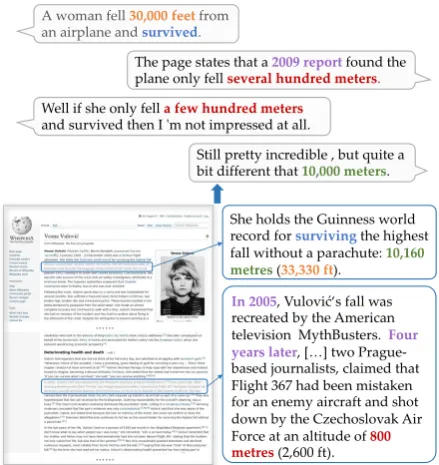
She holds the Guinness world record for survivingthe highest fall without a parachute: 10,160 metres(33,330 ft).
A woman fell 30,000 feet from an airplane and survived.
Well if she only fell a few hundred meters and survived then I 'm not impressed at all.
The page states that a 2009 report found the plane only fell several hundred meters.
Still pretty incredible , but quite a bit different that 10,000 meters.
[image:1.595.307.527.241.474.2]In 2005, Vulović‘s fall was recreated by the American television MythBusters. Four years later, […] two Prague-based journalists, claimed that Flight 367 had been mistaken for an enemy aircraft and shot down by the Czechoslovak Air Force at an altitude of 800 metres(2,600 ft).
Figure 1: Users discussing a topic defined by a Wikipedia article. In this real-world example from our Reddit dataset, information needed to ground responses is distributed throughout the source document.
However, empirical results suggest that condition-ing the decoder on rich and complex contexts, while helpful, does not on its own provide suffi-cient inductive bias for these systems to learn how to achieve deep and accurate integration between external knowledge and response generation.
We posit that this ongoing challenge demands a more effective mechanism to support on-demand knowledge integration. We draw inspiration from how humans converse about a topic, where peo-ple often search and acquire external information as needed to continue a meaningful and
informa-tive conversation. Figure1illustrates an example
com-pose grounded and appropriate responses. Thus, the challenge is to connect the dots across differ-ent pieces of information in much the same way thatmachine reading comprehension (MRC) sys-tems tie together multiple text segments to provide
a unified and factual answer (Seo et al.,2017, etc.).
We introduce a new framework of end-to-end conversation models that jointly learn re-sponse generation together with on-demand
ma-chine reading. We formulate the reading
com-prehension task as document-grounded response generation: given a long document that supple-ments the conversation topic, along with the con-versation history, we aim to produce a response that is both conversationally appropriate and in-formed by the content of the document. The key idea is to project conventional QA-based reading comprehension onto conversation response gener-ation by equating the conversgener-ation prompt with the question, the conversation response with the answer, and external knowledge with the
con-text. The MRC framing allows for integration
of long external documents that present notably richer and more complex information than rela-tively small collections of short, independent re-view posts such as those that have been used in
prior work (Ghazvininejad et al., 2018; Moghe
et al.,2018).
We also introduce a large dataset to facili-tate research on knowledge-grounded conversa-tion (2.8M turns, 7.4M sentences of grounding) that is at least one order of magnitude larger than
existing datasets (Dinan et al.,2019;Moghe et al.,
2018). This dataset consists of real-world
conver-sations extracted from Reddit, linked to web doc-uments discussed in the conversations. Empirical results on our new dataset demonstrate that our full model improves over previous grounded response generation systems and various ungrounded base-lines, suggesting that deep knowledge integration
is an important research direction.1
2 Task
We propose to use factoid- and entity-rich web documents, e.g., news stories and Wikipedia pages, as external knowledge sources for an open-ended conversational system to ground in.
Formally, we are given a conversation history
1Code for reproducing our models and data is made
publicly available at https://github.com/qkaren/ converse_reading_cmr.
of turns X = (x1, . . . ,xM) and a web
docu-mentD= (s1, . . . ,sN)as the knowledge source,
wheresiis theith sentence in the document. With
the pair (X, D), the system needs to generate a
natural language responseythat is both
conversa-tionally appropriate and reflective of the contents of the web document.
3 Approach
Our approach integrates conversation generation with on-demand MRC. Specifically, we use an MRC model to effectively encode the conversation history by treating it as a question in a typical QA
task (e.g., SQuAD (Rajpurkar et al., 2016)), and
encode the web document as the context. We then replace the output component of the MRC model (which is usually an answer classification mod-ule) with an attentional sequence generator that generates a free-form response. We refer to our approach as CMR (Conversation with on-demand Machine Reading). In general, any off-the-shelf MRC model could be applied here for knowledge comprehension. We use Stochastic Answer
Net-works (SAN)2 (Liu et al., 2018b), a performant
machine reading model that until very recently held state-of-the-art performance on the SQuAD benchmark. We also employ a simple but effec-tive data weighting scheme to further encourage response grounding.
3.1 Document and Conversation Reading
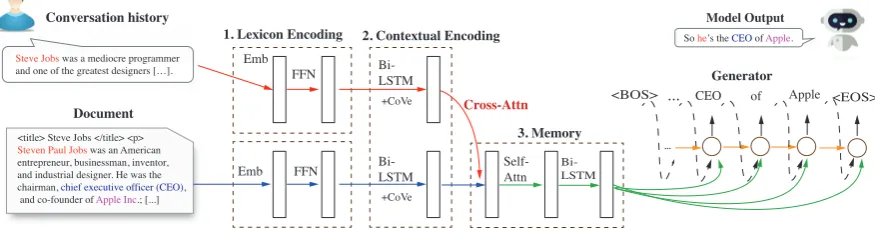
We adapt the SAN model to encode both the in-put document and conversation history and for-ward the digested information to a response
gen-erator. Figure2depicts the overall MRC
architec-ture. Different blocks capture different concepts of representations in both the input conversation his-tory and web document. The leftmost blocks rep-resent the lexicon encoding that extracts
informa-tion fromXandDat the token level. Each token
is first transformed into its corresponding word embedding vector, and then fed into a
position-wise feed-forward network (FFN) (Vaswani et al.,
2017) to obtain the final token-level
representa-tion. Separate FFNs are used for the conversation history and the web document.
The next block is for contextual encoding. The aforementioned token vectors are concate-nated with pre-trained 600-dimensional CoVe
vec-tors (McCann et al.,2017), and then fed to a
EmbeddingFFN Bi-LSTM +CoVe
EmbeddingFFN Bi-LSTM +CoVe
Bi-LSTM Self-Attn
...fellseveralmeters <EOS> ...
Cross-Attn
Document:
[…] claimed that Flight 367 had been mistaken for an enemy aircraft and shot down by the at an altitude of 800 metres (2,600 ft).
Conversation History:
A woman fell 30,000 feet [...]
Generator Lexicon EncodingContextual Encoding
Memory
...
Output:
<BOS> ...
Emb
FFN Bi-LSTM
+CoVe
Emb FFN Bi-LSTM
+CoVe
Bi-LSTM
Self-Attn
... CEO of Apple <EOS>
Cross-Attn 1. Lexicon Encoding 2. Contextual Encoding
3. Memory
<BOS>
...
Lorem ipsum dolor sit amet, con
So he’s the CEO of Apple. Steve Jobs was a mediocre programmer
and one of the greatest designers […].
<title> Steve Jobs </title> <p> Steven Paul Jobs was an American entrepreneur, businessman, inventor, and industrial designer. He was the chairman, chief executive officer (CEO), and co-founder of Apple Inc.; [...]
Generator Conversation history
Document
[image:3.595.81.519.72.187.2]Model Output
Figure 2:Model Architecture for Response Generation with on-demand Machine Reading: The first blocks of the MRC-based encoder serve as a lexicon encoding that maps words to their embeddings and transforms with position-wise FFN, independently for the conversation history and the document. The next block is for contextual encoding, where BiLSTMs are applied to the lexicon embeddings to model the context for both conversation history and document. The last block builds the final encoder memory, by sequentially applying cross-attention in order to integrate the two information sources, conversation history and document, self-attention for salient information retrieval, and a BiLSTM for final information rearrangement. The response generator then attends to the memory and generates a free-form response.
STM that is shared for both conversation history and web document. The step-wise outputs of the BiLSTM carry the information of the tokens as well as their left and right context.
The last block builds the memory that
sum-marizes the salient information from both X and
D. The block first applies cross-attention to
in-tegrate information from the conversation history
Xinto the document representation. Each
contex-tual vector of the documentDis used to compute
attention (similarity) distribution over the
contex-tual vectors ofX, which is concatenated with the
weighted average vector ofXby the resulting
dis-tribution. Second, aself-attention layer is applied
to further ingest and capture the most salient
in-formation. The output memory, M ∈ Rd×n, is
obtained by applying another BiLSTM layer for
final information rearrangement. Note thatdis the
hidden size of the memory andnis the length of
the document.
3.2 Response Generation
Having read and processed both the conversation history and the extra knowledge in the document,
the model then produces a free-form responsey=
(y1, . . . , yT) instead of generating a span or
per-forming answer classification as in MRC tasks. We use an attentional recurrent neural network
decoder (Luong et al.,2015) to generate response
tokens while attending to the memory. At the
be-ginning, the initial hidden stateh0is the weighted
sum of the representation of the history X. For
each decoding step t with a hidden state ht, we
generate a tokenytbased on the distribution:
p(yt) =softmax((W1ht+b)/τ), (1)
whereτ >0is the softmax temperature. The
hid-den statehtis defined as follows:
ht=W2[zt++fattention(zt, M)]. (2)
Here,[·++·]indicates a concatenation of two
vec-tors;fattentionis a dot-product attention (Vaswani
et al., 2017); and zt is a state generated by
GRU(et−1,ht−1)withet−1 being the embedding
of the wordyt−1 generated at the previous (t−1)
step. In practice, we use top-k sample decoding
to drawytfrom the above distributionp(yt).
Sec-tion5provides more details about the
experimen-tal configuration.
3.3 Data Weighting Scheme
We further propose a simple data weighting scheme to encourage the generation of grounded responses. The idea is to bias the model train-ing to fit better to those traintrain-ing instances where the ground-truth response is more closely relevant to the document. More specifically, given a
train-ing instance(X, D,y), we measure the closeness
score c ∈ R between the document D and the
gold responsey(e.g., with the NIST (Doddington,
2002) or BLEU(Papineni et al.,2002) metrics). In
each training data batch, we normalize the close-ness scores of all the instances to have a sum of
1, and weight each of the instances with its
Train Valid Test
# dialogues 28.4k 1.2k 3.1k
# utterances 2.36M 0.12M 0.34M
# documents 28.4k 1.2k 3.1k
# document sentences 15.18M 0.58M 1.68M
Average length (# words):
utterances 18.74 18.84 18.48
[image:4.595.79.284.64.162.2]document sentences 13.72 14.17 14.15
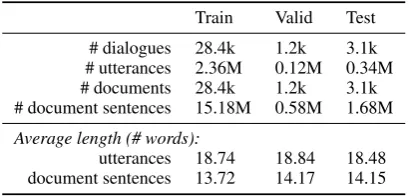
Table 1: Our grounded conversational dataset.
training loss. This training regime promotes in-stances with grounded responses and thus encour-ages the model to better encode and utilize the in-formation in the document.
4 Dataset
To create a grounded conversational dataset, we extract conversation threads from Reddit, a popu-lar and popu-large-scale online platform for news and discussion. In 2015 alone, Reddit hosted more
than 73M conversations.3 On Reddit, user
sub-missions are categorized by topics or “subreddits”, and a submission typically consists of a submis-sion title associated with a URL pointing to a news or background article, which initiates a discus-sion about the contents of the article. This ar-ticle provides framing for the conversation, and this can naturally be seen as a form of ground-ing. Another factor that makes Reddit conversa-tions particularly well-suited for our conversation-as-MRC setting is that a significant proportion of these URLs contain named anchors (i.e., ‘#’ in the URL) that point to the relevant passages in the document. This is conceptually quite similar to
MRC data (Rajpurkar et al.,2016) where typically
only short passages within a larger document are relevant in answering the question.
We reduce spamming and offensive language by manually curating a list of 178 relatively “safe” subreddits and 226 web domains from which the web pages are extracted. To convert the web page of each conversation into a text document, we ex-tracted the text of the page using an html-to-text
converter,4 while retaining important tags such as
<title>,<h1>to<h6>, and<p>. This means the
entire text of the original web page is preserved, but these main tags retain some high-level
struc-3
https://redditblog.com/2015/12/31/ reddit-in-2015/
4https://www.crummy.com/software/
BeautifulSoup
ture of the article. For web URLs with named an-chors, we preserve that information by indicating
the anchor text in the document with tags
<an-chor> and</anchor>. As the whole documents
in the dataset tend to be lengthy, anchors offer im-portant hints to the model about which parts of the documents should likely be focused on in order to produce a good response. We considered it sensi-ble to keep them as they are also availasensi-ble to the human reader.
After filtering short or redacted turns, or which quote earlier turns, we obtained 2.8M conversa-tion instances respectively divided into train,
vali-dation, and test (Table1). We used different date
ranges for these different sets: years 2011-2016 for train, Jan-Mar 2017 for validation, and the rest of 2017 for test. For the test set, we select con-versational turns for which 6 or more responses were available, in order to create a multi-reference test set. Given other filtering criteria such as turn length, this yields a 6-reference test set of size 2208. For each instance, we set aside one of the 6 human responses to assess human performance on this task, and the remaining 5 responses serve
as ground truths for evaluating different systems.5
Table1provides statistics for our dataset, and
Fig-ure 1 presents an example from our dataset that
also demonstrates the need to combine conversa-tion history and background informaconversa-tion from the document to produce an informative response.
To enable reproducibility of our experiments, we crawled web pages using Common Crawl (http://commoncrawl.org), a service that crawls web pages and makes its historical crawls available to the public. We also release the code (URL redacted for anonymity) to recreate our
dataset from both a popular Reddit dump6 and
Common Crawl, and the latter service ensures that anyone reproducing our data extraction exper-iments would retrieve exactly the same web pages. We made a preliminary version of this dataset
available for a shared task (Galley et al., 2019)
at Dialog System Technology Challenges (DSTC) (Yoshino et al.,2019). Back-and-forth with partic-ipants helped us iteratively refine the dataset. The
code to recreate this dataset is included.7
5While this is already large for a grounded dataset, we
could have easily created a much bigger one given how abun-dant Reddit data is. We focused instead on filtering out spam-ming and offensive language, in order to strike a good balance between data quality and size.
5 Experiments
5.1 Systems
We evaluate our systems and several competitive baselines:
SEQ2SEQ(Sutskever et al.,2014) We use a
stan-dard LSTM SEQ2SEQ model that only exploit
the conversation history for response generation, without any grounding. This is a competitive base-line initialized using pretrained embeddings.
MEMNET: We use a Memory Network designed
for grounded response generation (
Ghazvinine-jad et al., 2018). An end-to-end memory
net-work (Sukhbaatar et al.,2015) encodes
conversa-tion history and sentences in the web documents. Responses are generated with a sequence decoder.
CMR-F: To directly measure the effect of
incor-porating web documents, we compare to a base-line which omits the document reading component
of the full model (Figure2). As with the SEQ2SEQ
approach, the resulting model generates responses solely based on conversation history.
CMR: To measure the effect of our data weighting
scheme, we compare to a system that has identical architecture to the full model, but is trained with-out associating weights to training instances.
CMR+W: As described in section 3, the full
model reads and comprehends both the conversa-tion history and document using an MRC compo-nent, and sequentially generates the response. The model is trained with the data weighting scheme to encourage grounded responses.
Human: To get a better sense of the systems’
performance relative to an upper bound, we also evaluate human-written responses using different
metrics. As described in Section4, for each test
instance, we set aside one of the 6 human refer-ences for evaluation, so the ‘human’ is evaluated against the other 5 references for automatic eval-uation. To make these results comparable, all the systems are also automatically evaluated against the same 5 references.
systems do not represent our work and some of these sys-tems have no corresponding publications. Along with the data described here, we provided a standard SEQ2SEQ base-line to the shared task, which we improved for the purpose of this paper (improved BLEU, NISTand METEOR). Our new SEQ2SEQbaseline is described in Section5.
6 Experiment Details
For all the systems, we set word embedding
di-mension to 300 and used the pretrained GloVe8for
initialization. We set hidden dimensions to 512 and dropout rate to 0.4. GRU cells are used for
SEQ2SEQ and MEMNET (we also tested LSTM
cells and obtained similar results). We used the Adam optimizer for model training, with an ini-tial learning rate of 0.0005. Batch size was set to 32. During training, all responses were truncated to have a maximum length of 30, and maximum query length and document length were set to 30, 500, respectively. we used regular teacher-forcing decoding during training. For inference, we found
that top-k random sample decoding (Fan et al.,
2018) provides the best results for all the systems.
That is, at each decoding step, a token was drawn
from thekmost likely candidates according to the
distribution over the vocabulary. Similar to recent
work (Fan et al., 2018;Edunov et al., 2018), we
setk = 20(other common kvalues like 10 gave
similar results). We selected key hyperparameter configurations on the validation set.
6.1 Evaluation Setup
Table 2 shows automatic metrics for quantitative
evaluation over three qualities of generated texts.
We measure the overallrelevanceof the generated
responses given the conversational history by us-ing standard Machine Translation (MT) metrics, comparing generated outputs to ground-truth
re-sponses. These metrics include BLEU-4 (Papineni
et al.,2002), METEOR(Lavie and Agarwal,2007).
and NIST(Doddington,2002). The latter metric is
a variant of BLEU that weights n-gram matches
by their information gain by effectively penalizing
uninformativen-grams (such as “I don’t know”),
which makes it a relevant metric for evaluating systems aiming diverse and informative responses. MT metrics may not be particularly adequate for
our task (Liu et al., 2016), given its focus on the
informativeness of responses, and for that reason we also use two other types of metrics to measure the level of grounding and diversity.
As a diversitymetric, we count alln-grams in the system output for the test set, and measure:
(1) Entropy-nas the entropy of then-gram count
distribution, a metric proposed in (Zhang et al.,
2018b); (2) Distinct-n as the ratio between the
8https://nlp.stanford.edu/projects/
Appropriateness Grounding Diversity
NIST BLEU METEOR Precision Recall F1 Entropy-4 Distinct-1 Distinct-2 Len
Human 2.650 3.13% 8.31% 2.89% 0.45% 0.78% 10.445 0.167 0.670 18.757
SEQ2SEQ 2.223 1.09% 7.34% 1.20% 0.05% 0.10% 9.745 0.023 0.174 15.942
MEMNET 2.185 1.10% 7.31% 1.25% 0.06% 0.12% 9.821 0.035 0.226 15.524
CMR-F 2.260 1.20% 7.37% 1.68% 0.08% 0.15% 9.778 0.035 0.219 15.471
CMR 2.213 1.43% 7.33% 2.44% 0.13% 0.25% 9.818 0.046 0.258 15.048
[image:6.595.308.525.266.346.2]CMR+W 2.238 1.38% 7.46% 3.39% 0.20% 0.38% 9.887 0.052 0.283 15.249
Table 2: Automatic Evaluationresults (higher is better for all metrics). Our best models (CMR+Wand CMR) considerably increase the quantitative measures of Grounding, and also slightly improve Diversity. Automatic measures of Quality (e.g., BLEU-4) give mixed results, but this is reflective of the fact that we did not aim to improve response relevance with respect to the context, but instead its level of grounding. The human evaluation results in Table3indeed suggest that our best system (CMR+W) is better.
number of n-gram types and the total number of
n-grams, a metric introduced in (Li et al.,2016a).
For the grounding metrics, we first compute
‘#match,’ the number of non-stopword tokens in the response that are present in the document but not present in the context of the conversa-tion. Excluding words from the conversation his-tory means that, in order to produce a word of the document, the response generation system is very likely to be effectively influenced by that
document. We then compute both precision as
‘#match’ divided by the total number of non-stop
tokens in the response, andrecallas ‘#match’
di-vided by the total number of non-stop tokens in
the document. We also compute the respectiveF1
score to combine both. Looking only at exact uni-gram matches between the document and response is a major simplifying assumption, but the combi-nation of the three metrics offers a plausible proxy for how greatly the response is grounded in the document. It seems further reasonable to assume that these can serve as a surrogate for less quan-tifiable forms of grounding such as paraphrase –
e.g.,US−→American– when the statistics are
ag-gregated on a large test dataset.
6.2 Automatic Evaluation
Table 2 shows automatic evaluation results for
the different systems. In terms of
appropriate-ness, the different variants of our models
outper-form the SEQ2SEQ and MEMNET baselines, but
differences are relatively small and, in case of
one of the metrics (NIST), the best system does
not use grounding. Our goal, we would note, is not to specifically improve response appropriate-ness, as many responses that completely ignore
the document (e.g., I don’t know) might be
per-Human judges preferred:
Our best system Neutral Comparator
CMR+W *44.17% 26.27% 29.56% SEQ2SEQ
CMR+W *40.93% 25.80% 33.27% MEMNET
CMR+W 37.67% 27.53% 34.80% CMR
CMR+W 30.37% 16.27% *53.37% Human
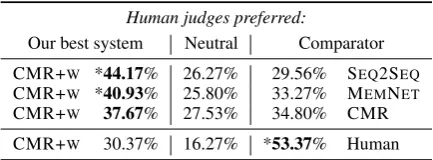
Table 3: Human Evaluationresults, showing prefer-ences (%) for our model (CMR+W) vs. baseline and other comparison systems. Distributions are skewed towards CMR+W. The 5-point Likert scale has been collapsed to a 3-point scale. *Differences in mean pref-erences are statistically significant (p≤0.0001).
fectly appropriate. Our systems fare much better in terms of Grounding and Diversity: our best
sys-tem (CMR+W) achieves an F1 score that is more
than three times (0.38% vs. 0.12%) higher than the
most competitive non-MRC system (MEMNET).
6.3 Human Evaluation
We sampled 1000 conversations from the test set. Filters were applied to remove conversations con-taining ethnic slurs or other offensive content that might confound judgments. Outputs from systems to be compared were presented pairwise to judges from a crowdsourcing service. Four judges were asked to compare each pair of outputs on Rele-vance (the extent to which the content was related to and appropriate to the conversation) and Infor-mativeness (the extent to which the output was in-teresting and informative). Judges were asked to agree or disagree with a statement that one of the pair was better than the other on the above two
parameters, using a 5-point Likert scale.9 Pairs
9The choices presented to the judges were
Strongly Agree,
of system outputs were randomly presented to the judges in random order in the context of short
snippets of the background text. These results
are presented in summary form in Table3, which
shows the overall preferences for the two systems expressed as a percentage of all judgments made. Overall inter-rater agreement measured by Fliess’ Kappa was 0.32 (“fair"). Nevertheless, the differ-ences between the paired model outputs are sta-tistically significant (computed using 10,000 boot-strap replications).
6.4 Qualitative Study
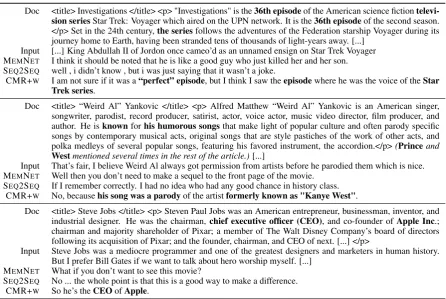
Table4illustrates how our best model (CMR+W)
tends to produce more contentful and informa-tive responses compared to the other systems. In the first example, our system refers to a particu-larepisodementioned in the article, and also uses terminology that is more consistent with the
ar-ticle (e.g., series). In the second example,
hu-morous songseems to positively influence the re-sponse, which is helpful as the input doesn’t
men-tion singing at all. In the third example, the
CMR+W model clearly grounds its response to
the article as it states the fact (Steve Jobs: CEO of Apple) retrieved from the article. The outputs by the other two baseline models are instead not relevant in the context.
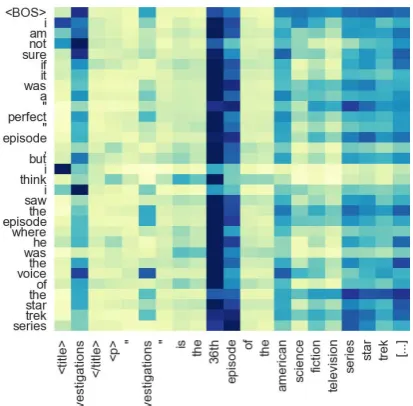
Figure3displays the attention map of the
gen-erated response and (part of) the document from our full model. The model successfully attends to
the key words (e.g., 36th, episode) of the
docu-ment. Note that the attention map is unlike what is typical in machine translation, where target words tend to attend to different portions of the input text. In our task, where alignments are much less one-to-one compared to machine translation, it is com-mon for the generator to retain focus on the key information in the external document to produce semantically relevant responses.
7 Related Work
Dialogue: Traditional dialogue systems (see
(Jurafsky and Martin,2009) for an historical per-spective) are typically grounded, enabling these systems to be reflective of the user’s environment. The lack of grounding has been a stumbling block for the earliest end-to-end dialogue systems, as various researchers have noted that their outputs
tend to be bland (Li et al., 2016a; Gao et al.,
[image:7.595.312.519.62.265.2]2019b), inconsistent (Zhang et al.,2018a;Li et al.,
Figure 3: Attention weights between words of the doc-uments and words of the response. Dark (blue) cells represent probabilities closer to 1.
2016b; Zhang et al., 2019), and lacking in
fac-tual content (Ghazvininejad et al.,2018;Agarwal
et al., 2018). Recently there has been growing interest in exploring different forms of ground-ing, including images, knowledge bases, and plain
texts (Das et al.,2017;Mostafazadeh et al.,2017;
Agarwal et al.,2018;Yang et al.,2019). A recent
survey is included inGao et al.(2019a).
Prior work, e.g, (Ghazvininejad et al., 2018;
Zhang et al., 2018a; Huang et al., 2019), uses grounding in the form of independent snippets of text: Foursquare tips and background information about a given speaker. Our notion of grounding is different, as our inputs are much richer, encom-passing the full text of a web page and its underly-ing structure. Our settunderly-ing also differs significantly
from relatively recent work (Dinan et al., 2019;
Moghe et al.,2018) exploiting crowdsourced con-versations with detailed grounding labels: we use Reddit because of its very large scale and bet-ter characbet-terization of real-world conversations. We also require the system to learn grounding di-rectly from conversation and document pairs, in-stead of relying on additional grounding labels.
Moghe et al. (2018) explored directly using a span-prediction QA model for conversation. Our framework differs in that we combine MRC mod-els with a sequence generator to produce free-form responses.
Machine Reading Comprehension: MRC
Doc <title> Investigations </title> <p> "Investigations" is the36th episodeof the American science fiction televi-sion seriesStar Trek: Voyager which aired on the UPN network. It is the36th episodeof the second season. </p> Set in the 24th century,the seriesfollows the adventures of the Federation starship Voyager during its journey home to Earth, having been stranded tens of thousands of light-years away. [...]
Input [...] King Abdullah II of Jordon once cameo’d as an unnamed ensign on Star Trek Voyager MEMNET I think it should be noted that he is like a good guy who just killed her and her son. SEQ2SEQ well , i didn’t know , but i was just saying that it wasn’t a joke.
CMR+W I am not sure if it was a“perfect” episode, but I think I saw theepisodewhere he was the voice of theStar Trek series.
Doc <title> “Weird Al” Yankovic </title> <p> Alfred Matthew “Weird Al” Yankovic is an American singer, songwriter, parodist, record producer, satirist, actor, voice actor, music video director, film producer, and author. He isknownforhis humorous songsthat make light of popular culture and often parody specific songs by contemporary musical acts, original songs that are style pastiches of the work of other acts, and polka medleys of several popular songs, featuring his favored instrument, the accordion.</p>(Princeand
Westmentioned several times in the rest of the article.)[...]
Input That’s fair, I believe Weird Al always got permission from artists before he parodied them which is nice. MEMNET Well then you don’t need to make a sequel to the front page of the movie.
SEQ2SEQ If I remember correctly. I had no idea who had any good chance in history class. CMR+W No, becausehis song was a parodyof the artistformerly known as "Kanye West".
Doc <title> Steve Jobs </title> <p> Steven Paul Jobs was an American entrepreneur, businessman, inventor, and industrial designer. He was the chairman, chief executive officer (CEO), and co-founder ofApple Inc.; chairman and majority shareholder of Pixar; a member of The Walt Disney Company’s board of directors following its acquisition of Pixar; and the founder, chairman, and CEO of next. [...] </p>
Input Steve Jobs was a mediocre programmer and one of the greatest designers and marketers in human history. But I prefer Bill Gates if we want to talk about hero worship myself. [...]
MEMNET What if you don’t want to see this movie?
[image:8.595.76.523.60.359.2]SEQ2SEQ No ... the whole point is that this is a good way to make a difference. CMR+W So he’s theCEOofApple.
Table 4: Sample output comparing our best system (CMR+W) against Memory Networks and a SEQ2SEQ base-line. The source documents were manually shortened to fit in the table, without significantly affecting meaning.
from a given document for a given question (Seo
et al., 2017; Liu et al., 2018b; Yu et al., 2018). These models differ in how they fuse information
between questions and documents. We chose
SAN (Liu et al.,2018b) because of its
representa-tive architecture and competirepresenta-tive performance on existing MRC tasks. We note that other
off-the-shelf MRC models, such as BERT (Devlin et al.,
2018), can also be plugged in. We leave the study
of different MRC architectures for future work. Questions are treated as entirely independent in these “single-turn” MRC models, so recent
work (e.g., CoQA (Reddy et al.,2019) and QuAC
(Choi et al., 2018)) focuses on multi-turn MRC, modeling sequences of questions and answers in a conversation. While multi-turn MRC aims to answer complex questions, that body of work is restricted to factual questions, whereas our work—like much of the prior work in end-to-end dialogue—models free-form dialogue, which also encompasses chitchat and non-factual responses.
8 Conclusions
We have demonstrated that the machine reading comprehension approach offers a promising step
to generating, on the fly, contentful conversation
exchanges that are grounded in extended text cor-pora. The functional combination of MRC and neural attention mechanisms offers visible gains over several strong baselines. We have also for-mally introduced a large dataset that opens up in-teresting challenges for future research.
The CMR (Conversation with on-demand ma-chine reading) model presented here will help con-nect the many dots across multiple data sources. One obvious future line of investigation will be to explore the effect of other off-the-shelf machine
reading models such as BERT (Devlin et al.,2018)
within the CMR framework.
Acknowledgements
References
Shubham Agarwal, Ondrej Dusek, Ioannis Konstas, and Verena Rieser. 2018. A knowledge-grounded multimodal search-based conversational agent. In
Proceedings of the 2018 EMNLP Workshop SCAI: The 2nd International Workshop on Search-Oriented Conversational AI, pages 59–66, Brussels, Belgium.
Eunsol Choi, He He, Mohit Iyyer, Mark Yatskar, Wen-tau Yih, Yejin Choi, Percy Liang, and Luke Zettle-moyer. 2018. QuAC: Question answering in con-text. InProceedings of the 2018 Conference on Em-pirical Methods in Natural Language Processing, pages 2174–2184.
Abhishek Das, Satwik Kottur, Khushi Gupta, Avi Singh, Deshraj Yadav, José M.F. Moura, Devi Parikh, and Dhruv Batra. 2017. Visual Dialog. In
CVPR.
Jacob Devlin, Ming-Wei Chang, Kenton Lee, and Kristina Toutanova. 2018. BERT: pre-training of deep bidirectional transformers for language under-standing. CoRR, abs/1810.04805.
Emily Dinan, Stephen Roller, Kurt Shuster, Angela Fan, Michael Auli, and Jason Weston. 2019. Wizard of wikipedia: Knowledge-powered conversational agents. InICLR.
George Doddington. 2002. Automatic evaluation of machine translation quality using n-gram co-occurrence statistics. InProc. of HLT.
Sergey Edunov, Myle Ott, Michael Auli, and David Grangier. 2018. Understanding back-translation at scale. InProc. of EMNLP.
Angela Fan, Mike Lewis, and Yann Dauphin. 2018. Hi-erarchical neural story generation. InProc. of ACL.
Michel Galley, Chris Brockett, Xiang Gao, Jianfeng Gao, and Bill Dolan. 2019. Grounded response gen-eration task at DSTC7. In AAAI Dialog System Technology Challenges Workshop.
Jianfeng Gao, Michel Galley, and Lihong Li. 2019a. Neural approaches to conversational ai. Founda-tions and Trends in Information Retrieval, 13(2-3):127–298.
Xiang Gao, Sungjin Lee, Yizhe Zhang, Chris Brockett, Michel Galley, Jianfeng Gao, and Bill Dolan. 2019b. Jointly optimizing diversity and relevance in neural response generation. InNAACL-HLT 2019.
Marjan Ghazvininejad, Chris Brockett, Ming-Wei Chang, Bill Dolan, Jianfeng Gao, Wen-tau Yih, and Michel Galley. 2018. A knowledge-grounded neural conversation model. InProc. of AAAI.
Minlie Huang, Xiaoyan Zhu, and Jianfeng Gao. 2019. Challenges in building intelligent open-domain dia-log systems. arXiv preprint arXiv:1905.05709.
Dan Jurafsky and James H Martin. 2009. Speech & language processing. Prentice Hall.
Alon Lavie and Abhaya Agarwal. 2007. METEOR: An automatic metric for mt evaluation with high levels of correlation with human judgments. In Proc. of the Second Workshop on Statistical Machine Trans-lation, StatMT ’07, pages 228–231.
Jiwei Li, Michel Galley, Chris Brockett, Jianfeng Gao, and Bill Dolan. 2016a. A diversity-promoting ob-jective function for neural conversation models. In
Proc. of NAACL-HLT.
Jiwei Li, Michel Galley, Chris Brockett, Jianfeng Gao, and Bill Dolan. 2016b. A persona-based neural con-versation model. InProc. of ACL.
Chia-Wei Liu, Ryan Lowe, Iulian Serban, Mike Nose-worthy, Laurent Charlin, and Joelle Pineau. 2016. How not to evaluate your dialogue system: An em-pirical study of unsupervised evaluation metrics for dialogue response generation. InProc. of EMNLP.
Shuman Liu, Hongshen Chen, Zhaochun Ren, Yang Feng, Qun Liu, and Dawei Yin. 2018a. Knowledge diffusion for neural dialogue generation. In Pro-ceedings of the 56th Annual Meeting of the Associa-tion for ComputaAssocia-tional Linguistics (Volume 1: Long Papers), volume 1, pages 1489–1498.
Xiaodong Liu, Yelong Shen, Kevin Duh, and Jianfeng Gao. 2018b. Stochastic Answer Networks for ma-chine reading comprehension. InProceedings of the 56th Annual Meeting of the Association for Compu-tational Linguistics (Volume 1: Long Papers), pages 1694–1704, Melbourne, Australia.
Thang Luong, Hieu Pham, and Christopher D. Man-ning. 2015. Effective approaches to attention-based neural machine translation. In Proceedings of the 2015 Conference on Empirical Methods in Natu-ral Language Processing, pages 1412–1421, Lisbon, Portugal.
Bryan McCann, James Bradbury, Caiming Xiong, and Richard Socher. 2017. Learned in translation: Con-textualized word vectors. InAdvances in Neural In-formation Processing Systems, pages 6297–6308.
Nikita Moghe, Siddhartha Arora, Suman Banerjee, and Mitesh M Khapra. 2018. Towards exploiting back-ground knowledge for building conversation sys-tems. InProc. of EMNLP.
Nasrin Mostafazadeh, Chris Brockett, Bill Dolan, Michel Galley, Jianfeng Gao, Georgios Sp-ithourakis, and Lucy Vanderwende. 2017. Image-grounded conversations: Multimodal context for natural question and response generation. InProc. of IJCNLP.
Pranav Rajpurkar, Jian Zhang, Konstantin Lopyrev, and Percy Liang. 2016. SQuAD: 100,000+ questions for machine comprehension of text. InProceedings of the 2016 Conference on Empirical Methods in Natu-ral Language Processing, pages 2383–2392, Austin, Texas.
Siva Reddy, Danqi Chen, and Christopher D Manning. 2019. CoQA: A conversational question answering challenge. Transactions of the Association of Com-putational Linguistics (TACL).
Min Joon Seo, Aniruddha Kembhavi, Ali Farhadi, and Hannaneh Hajishirzi. 2017. Bidirectional attention flow for machine comprehension. InICLR.
Iulian V Serban, Alessandro Sordoni, Yoshua Bengio, Aaron Courville, and Joelle Pineau. 2016. Building end-to-end dialogue systems using generative hier-archical neural network models.AAAI.
Lifeng Shang, Zhengdong Lu, and Hang Li. 2015. Neural responding machine for short-text conversa-tion. InProc. of ACL-IJCNLP.
Alessandro Sordoni, Michel Galley, Michael Auli, Chris Brockett, Yangfeng Ji, Margaret Mitchell, Jian-Yun Nie, Jianfeng Gao, and Bill Dolan. 2015. A neural network approach to context-sensitive gen-eration of conversational responses. In Proc. of NAACL-HLT.
Sainbayar Sukhbaatar, Jason Weston, and Rob Fergus. 2015. End-to-end memory networks. In Proc. of NIPS.
Ilya Sutskever, Oriol Vinyals, and Quoc Le. 2014. Se-quence to seSe-quence learning with neural networks. InProc. of NIPS, pages 3104–3112.
Ashish Vaswani, Noam Shazeer, Niki Parmar, Jakob Uszkoreit, Llion Jones, Aidan N Gomez, Ł ukasz Kaiser, and Illia Polosukhin. 2017. Attention is all you need. InAdvances in Neural Information Pro-cessing Systems 30, pages 5998–6008.
Oriol Vinyals and Quoc Le. 2015. A neural conversa-tional model. InICML Deep Learning Workshop.
Liu Yang, Junjie Hu, Minghui Qiu, Chen Qu, Jian-feng Gao, W Bruce Croft, Xiaodong Liu, Ye-long Shen, and Jingjing Liu. 2019. A hy-brid retrieval-generation neural conversation model.
arXiv preprint arXiv:1904.09068.
Koichiro Yoshino, Chiori Hori, Julien Perez, Luis Fer-nando D’Haro, Lazaros Polymenakos, R. Chulaka Gunasekara, Walter S. Lasecki, Jonathan K. Kum-merfeld, Michel Galley, Chris Brockett, Jianfeng Gao, Bill Dolan, Xiang Gao, Huda AlAmri, Tim K. Marks, Devi Parikh, and Dhruv Batra. 2019. Dia-log system technoDia-logy challenge 7. In In NeurIPS Conversational AI Workshop.
Adams Wei Yu, David Dohan, Minh-Thang Luong, Rui Zhao, Kai Chen, Mohammad Norouzi, and Quoc V Le. 2018. QANet: Combining local convolution with global self-attention for reading comprehen-sion. InICLR.
Saizheng Zhang, Emily Dinan, Jack Urbanek, Arthur Szlam, Douwe Kiela, and Jason Weston. 2018a. Personalizing dialogue agents: I have a dog, do you have pets too? InProceedings of the 56th Annual Meeting of the Association for Computational Lin-guistics (Volume 1: Long Papers).
Yizhe Zhang, Michel Galley, Jianfeng Gao, Zhe Gan, Xiujun Li, Chris Brockett, and Bill Dolan. 2018b. Generating informative and diverse conversational responses via adversarial information maximization. InProc. of NeurIPS.