2160
Zero-Shot Transfer Learning for Event Extraction
Lifu Huang1, Heng Ji1, Kyunghyun Cho2, Ido Dagan3, Sebastian Riedel4, Clare R. Voss5 1 Rensselaer Polytechnic Institute, 2 New York University,
3 Bar-Ilan University, 4 University College London, 5US Army Research Lab
1{huangl7, jih}@rpi.edu,2 [email protected] 3 [email protected], 4 [email protected]
Abstract
Most previous supervised event extraction methods have relied on features derived from manual annotations, and thus can-not be applied to new event types without extra annotation effort. We take a fresh look at event extraction and model it as a generic grounding problem: mapping each event mention to a specific type in a tar-get event ontology. We design a trans-ferable architecture of structural and com-positional neural networks to jointly rep-resent and map event mentions and types into a shared semantic space. Based on this new framework, we can select, for each event mention, the event type which is semantically closest in this space as its type. By leveraging manual annota-tions available for a small set of exist-ing event types, our framework can be applied to new unseen event types with-out additional manual annotations. When tested on 23 unseen event types, this zero-shot framework, without manual annota-tions, achieves performance comparable to a supervised model trained from 3,000 sentences annotated with 500 event men-tions.1
1 Introduction
The goal of event extraction is to identify event triggers and their arguments in unstructured text data, and then to assign an event type to each trig-ger and a semantic role to each argument. An ex-ample is shown in Figure1. Traditional supervised methods have typically modeled this task of event
1The programs are publicly available for research purpose
at: https://github.com/wilburOne/ZeroShotEvent
extraction as a classification problem, by assign-ing event triggers to event types from a pre-defined fixed set. These methods rely heavily on man-ual annotations and features specific to each event type, and thus are not easily adapted to new event types without extra annotation effort. Handling new event types may even entail starting over, without being able to re-use annotations from pre-vious event types.
To make event extraction effective as new real-world scenarios emerge, we take a look at this task from the perspective of zero-shot learning, ZSL (Frome et al., 2013; Norouzi et al., 2013;
Socher et al., 2013a). ZSL, as a type of trans-fer learning, makes use of separate, pre-existing classifiers to build a semantic, cross-concept space that maps between their respective classes. The resulting shared semantic space then allows for building a novel “zero-shot” classifier, i,e,, requir-ing no (zero) additional trainrequir-ing examples, to han-dle unseen cases. We observe that each event mention has a structure consisting of a candidate trigger and arguments, with corresponding pre-defined name labels for the event type and argu-ment roles. We propose to enrich the semantic representations of each event mention and event type with rich structures, and determine the type based on the semantic similarity between an event mention and each event type defined in a target on-tology. Let’s consider two example sentences:
E1. The Government of China has ruled Tibet since 1951 after dispatching troops to the
Himalayanregion in1950.
E2. Iranian state television stated that the con-flict between the Iranian police and the drugsmugglers took place near the town of
mirjaveh.
dis-Figure 1: Event Mention Example: dispatching is the trigger of aTransport-Person event with four arguments: the solid lines show the event annotations for the sentence while the dotted lines show the Abstract Meaning Representation parsing output.
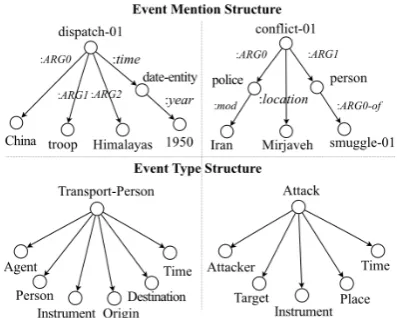
patching is the trigger for the event mention of type Transport Person and in E2, conflict is the trigger for the event mention of typeAttack. We make use of Abstract Meaning Representations (AMR) (Banarescu et al., 2013) to identify the candidate arguments and construct event mention structures as shown in Figure 2 (top). Figure 2
(bottom) also shows event type structures defined in the Automatic Content Extraction (ACE) guide-line.2 We can see that a trigger and its event type name usually have some shared meaning. Further-more, their structures also tend to be similar: a
Transport Person event typically involves a Per-son as its patient role, while an Attack event in-volves aPersonorLocation as anAttacker. This observation matches the theory by Pustejovsky
[image:2.595.88.509.65.141.2](1991): “the semantics of an event structure can be generalized and mapped to event mention struc-tures in a systematic and predictable way”.
Figure 2: Examples of Event Mention Structures and Type Structures from ACE.
Inspired by this theory, for the first time, we model event extraction as a generic grounding problem, by mapping each mention to its semanti-cally closest event type. Given an event ontology,
2https://en.wikipedia.org/wiki/Automatic content extraction
where each event type structure is well-defined, we will refer to the event types for which we have annotated event mentions as seen types, while those without annotations as unseen types. Our goal is to learn a generic mapping function inde-pendent of event types, which can be trained from annotations for a limited number of seen event types and then used for any new unseen event types. We design a transferable neural architec-ture, which jointly learns and maps the structural representations of event mentions and types into a shared semantic space, by minimizing the distance between each event mention and its corresponding type. For event mentions withunseentypes, their structures will be projected into the same seman-tic space using the same framework and assigned types with top-ranked similarity values.
To summarize, to apply our new zero-shot trans-fer learning framework to any new unseen event types, we only need (1) a structured definition of the unseen event type (its type name along with role names for its arguments, from the event on-tology); and (2) some annotations for one or a few seen event types. Without requiring any additional manual annotations for the new unseen types, our ZSL framework achieves performance compara-ble to supervised methods trained from a substan-tial amount of training data for the same types.
2 Approach Overview
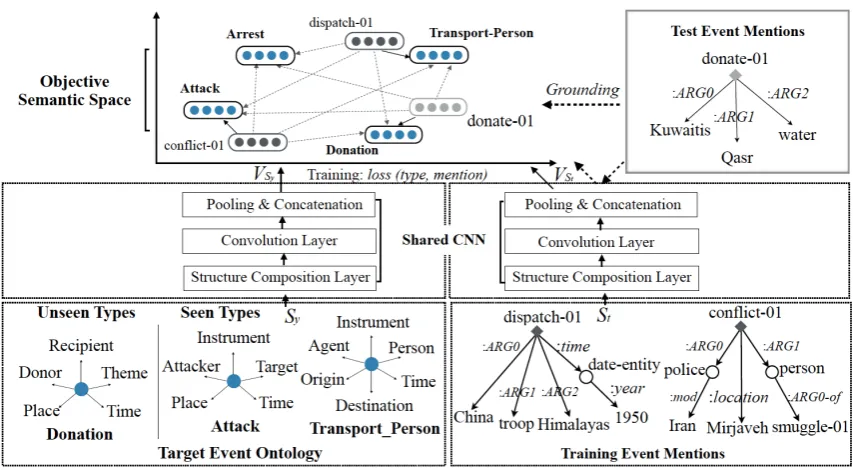
[image:2.595.80.279.483.642.2]Figure 3: Architecture Overview. The blue circles denote event types and event type representations. The dark grey diamonds and circles denote triggers and trigger representations from training set. The light grey diamonds and circles denote triggers and trigger representations from testing set.
After this identification phase, we use our new neural architecture, as depicted in Figure 3, to classify triggers into event types. (The classifi-cation of arguments into roles follows the same pipeline.) For each trigger t, e.g., dispatch-01, we determine its type by comparing its seman-tic representation with that of any event type in the event ontology. In order to incorporate the contexts into the semantic representation oft, we build a structureStusing AMR as shown in
Fig-ure3. Each structure is composed of a set of tu-ples, e.g,hdispatch-01,:ARG0,Chinai. We use a matrix to represent each AMR relation, compos-ing its semantics with two concepts for each tuple (in Section 4), and feed all tuple representations into a CNN to generate a dense vector represen-tationVSt for the event mention structure (in
Sec-tion5.1).
Given a target event ontology, for each type y, e.g.,Transport Person, we construct a type struc-tureSy consisting of its predefined roles, and use
a tensor to denote the implicit relation between any type and argument role. We compose the se-mantics of type and argument role with the ten-sor for each tuple, e.g., hTransport Person, Des-tinationi (in Section 4). Then we generate the event type structure representation VSy using the
same CNN (in Section 5.1). By minimizing the semantic distance betweendispatch-01and
Trans-port Personusing their dense vectors,VStandVSy
respectively, we jointly map the representations of event mention and event types into a shared se-mantic space, where each mention is closest to its annotated type.
After training that completes the construction of the semantic space, the compositional functions and CNNs are then used to project any new event mention (e.g.,donate-01) into the semantic space and find its closest event type (e.g.,Donation) (in Section5.3). In the next sections we will elaborate each step in great detail.
3 Trigger and Argument Identification
Similar toHuang et al.(2016), we identify candi-date triggers and arguments based on AMR Pars-ing (Wang et al.,2015b) and apply the same word sense disambiguation (WSD) tool (Zhong and Ng,
2010) to disambiguate word senses and link each sense to OntoNotes, as shown in Figure1.
Given a sentence, we consider all noun and verb concepts that can be mapped to OntoNotes senses by WSD as candidate event triggers. In addition, the concepts that can be matched with verbs or nominal lexical units in FrameNet (Baker et al.,
rela-tions as candidate arguments 3. We manually se-lect this subset of AMR relations that are useful for capturing generic relations between event triggers and arguments, as shown in Table1.
Categories Relations
Core roles ARG0, ARG1, ARG2, ARG3, ARG4 Non-core roles mod, location, instrument, poss,
manner, topic, medium, prep-X Temporal year, duration, decade, weekday, time
Spatial destination, path, location
Table 1: Event-Related AMR Relations.
4 Trigger and Type Structure Composition
As Figure 3 shows, for each candidate trigger t, we construct its event mention structureStbased
on its candidate arguments and AMR parsing. For each typey in the target event ontology, we con-struct a con-structureSy by including its pre-defined
roles and using its type as the root.
Each St or Sy is composed of a collection of
tuples. For each event mention structure, a tuple consists of two AMR concepts and an AMR rela-tion. For each event type structure, a tuple con-sists of a type name and an argument role name. Next we will describe how to compose semantic representations for event mention and event type respectively based on these structures.
Event Mention Structure For each tuple u =
hw1, λ, w2iin an event mention structure, we use a matrix to represent each AMR relation λ, and compose the semantics ofλbetween two concepts
w1andw2 as:
Vu= [V
0
w1;V
0
w2] =f([Vw1;Vw2]·Mλ)
where Vw1, Vw2 ∈ R
d are the vector
representa-tions of wordsw1andw2.dis the dimension size of each word vector. [ ; ]denotes the concatena-tion of two vectors. Mλ ∈ R2d×2d is the matrix representation for AMR relationλ.Vuis the
com-position representation of tupleu, which consists of two updated vector representationsVw01,Vw02for
w1andw2 by incorporating the semantics ofλ.
Event Type Structure For each tupleu0 =hy, ri
in an event type structure, where y denotes the
3On the whole ACE2005 corpus, using the AMR
parser (Wang et al.,2015b), the coverage for trigger identi-fication is 89.4% and the coverage for argument candidate identification is 66.0%.
event type and r denotes an argument role, fol-lowing Socher et al. (2013b), we assume an im-plicit relation exists between any pair of type and argument, and use a single and powerful tensor to represent the implicit relation:
Vu0 = [V 0
y;V
0
r] =f([Vy;Vr]T ·U[1:2d]·[Vy;Vr])
whereVy andVr are vector representations for y
and r. U[1:2d] ∈ R2d×2d×2d is a 3-order tensor.
Vu0 is the composition representation of tupleu0, which consists of two updated vector representa-tionsVy0, Vr0 fory andr by incorporating the se-mantics of their implicit relationU[1:2d].
5 Trigger and Argument Classification
5.1 Trigger Classification for Seen Types
Both event mention and event type structures are relatively simple and can be represented with a set of tuples. CNNs have been demonstrated effective at capturing sentence level information by aggre-gating compositional n-gram representations. In order to generate structure-level representations, we use CNN to learn to aggregate all edge and tu-ple representations.
Input layer is a sequence of tuples, where the or-der of tuples is from top to bottom in the structure. Each tuple is represented by ad×2dimensional vector, thus each mention structure and each type structure are represented as a feature map of di-mensionality d×2h∗ and d×2p∗ respectively, where h∗ and p∗ are the maximal number of tu-ples for event mention and type structures. We use zero-padding to the right to make the volume of all input structures consistent.
Convolution layer Take St with h∗ tuples:
u1, u2, ..., uh∗as an example. The input matrix of Stis a feature map of dimensionalityd×2h∗. We
makecias the concatenated embeddings ofn
con-tinuous columns from the feature map, wherenis the filter width and0 < i <2h∗+n. A convolu-tion operaconvolu-tion involves a filterW ∈Rnd, which is
applied to each sliding windowci:
c0i= tanh(W ·ci+b)
where c0i is the new feature representation, and
Max-Pooling: All tuple representations c0i are used to generate the representation of the input se-quence by max-pooling.
Learning: For each event mention t, we name the correct type aspositiveand all the other types in the target event ontology asnegative. To train the composition functions and CNN, we first con-sider the following hinge ranking loss:
L1(t, y) = X
j∈Y, j6=y
max{0, m−Ct,y+Ct,j}
Ct,y = cos([Vt;VSt],[Vy;VSy])
wherey is the positive event type fort. Y is the type set of the target event ontology. [Vt;VSt]
de-notes the concatenation of representations oftand
St. jis a negative event type fortfromY.mis a
margin.Ct,ydenotes the cosine similarity between
tandy.
The hinge loss is commonly used in zero-shot visual object classification task. However, it tends to overfit the seen types in our experiments. While clever data augmentation can help alleviate over-fitting, we design two strategies: (1) we add “neg-ative” event mentions into the training process. Here a “negative” event mention means that the mention has no positive event type among all seen types, namely it belongs toOther. (2) we design a new loss function as follows:
Ld1(t, y) =
( max
j∈Y,j6=ymax{0, m−Ct,y+Ct,j}, y6=Other
max
j∈Y0,j6=y0
max{0, m−Ct,y0 +Ct,j}, y=Other
whereY is the type set of the event ontology.Y0is the seen type set.yis the annotated type. y0 is the type which ranks the highest among all event types for event mentiont, whiletbelongs toOther.
By minimizing Ld1, we can learn the optimized model which can compose structure representa-tions and map both event mention and types into a shared semantic space, where the positive type ranks the highest for each mention.
5.2 Argument Classification for Seen Types
For each mention, we map each candidate ar-gument to a specific role based on the seman-tic similarity of the argument path. Take E1 as an example. China is matched to Agent based on the semantic similarity betweendispatch-01→ :ARG0→ChinaandTransport-Person→Agent.
Given a trigger t and a candidate argument a, we first extract a pathSa= (u1, u2, ..., up), which
connects t and aand consists of p tuples. Each predefined roleris also represented as a structure by incorporating the event type,Sr = hy, ri. We
apply the same framework to take the sequence of tuples contained in Sa and Sr into a
weight-sharing CNN to rank all possible roles fora.
Ld2(a, r) =
max
j∈Ry,j6=r
max{0, m−Ca,r+Ca,j} r6=Other
max
j∈R
Y0,j6=r
0max{0, m−Ca,r0+Ca,j} r|y=Other
where Ry andRY0 are the set of argument roles
which are predefined for trigger typeyand all seen typesY0. r is the annotated role andr0 is the ar-gument role which ranks the highest forawhena
oryis annotated asOther.
In our experiments, we sample various size of “negative” training data for trigger and argument labeling respectively. In the following section, we describe how the negative training instances are generated.
5.3 Zero-Shot Classification for Unseen Types
During test, given a new event mention t0, we compute its mention structure representation for
St0 and all event type structure representations for SY = {Sy1, Sy2, ..., Syn} using the same
param-eters trained from seen types. Then we rank all event types based on their similarity scores with mentiont0. The top ranked prediction fort0 from the event type set, denoted asyb(t
0
,1), is given by:
b
y(t0,1) = arg max
y∈Y cos([Vt
0;VS
t0],[Vy;VSy])
Moreover, by(t
0
, k)denotes thekthmost proba-ble event type predicted fort0. We will investigate the event extraction performance based on the
top-kpredicted event types.
After determining the typey0 for mentiont0, for each candidate argument, we adopt the same rank-ing function to find the most appropriate role from the role set defined fory0.
6 Experiments
6.1 Hyper-Parameters
the Continuous Skip-gram model (Mikolov et al.,
2013). Table 2 shows the hyper-parameters we used to train models.
Parameter Name Value Word Sense Embedding Size 200 Initial Learning Rate 0.1 # of Filters in Convolution Layer 500 Maximal # of Tuples for Mention Structure 10 Maximal # of Tuples for Argument Path 5 Maximal # of Tuples for Event Type Structure 5 Maximal # of Tuples for Argument Role Path 1
Table 2: Hyper-parameters.
6.2 ACE Event Classification
Setting N Seen Types for Training/Dev
A 1 Attack
B 3 Attack, Transport, Die C 5 Attack, Transport, Die, Meet, Arrest-Jail D 10 Attack, Transport, Die, Meet, Sentence,
Arrest-Jail, Transfer-Money, Elect, Transfer-Ownership, End-Position
Table 3: Seen Types in Each Experiment Setting.
We first used the ACE event schema 4 as our target event ontology and assumed the boundaries of triggers and arguments as given. Of the 33 ACE event types, we selected the top-N most popular event types from ACE05 data as “seen” types, and used 90% event annotations of these for training and 10% for development. We setN as 1, 3, 5, 10 respectively. We tested the zero-shot classification performance on the annotations for the remaining 23 unseen types. Table3shows the types that we selected for training in each experiment setting.
The negative event mentions and arguments that belong to Other were sampled from the output of the system developed by Huang et al. (2016) based on ACE05 training sentences, which groups all candidate triggers and arguments into clusters based on semantic representations and assigns a type/role name to each cluster. We sampled the negative event mentions from the clusters (e.g.,
Build, Threaten) which do not map to ACE event types. We sampled the negative arguments from the arguments of negative event mentions. Table4
shows the statistics of the training, development and testing data sets.
To show the effectiveness of structural similar-ity in our approach, we designed a baseline,
WSD-4ACE event schema specification is at:
https://www.ldc.upenn.edu/sites/www.ldc.upenn.edu/files/english-events-guidelines-v5.4.3.pdf
Embedding, which directly maps event mentions and arguments to their candidate types and roles using our pre-trained word sense embeddings. Ta-ble5makes the contrast clear: structural similarity (our approach) is much more effective than lexical similarity (baseline) for both trigger and argument classification. Also, as the number of seen types in training increases, the performance of the transfer model improves.
We further evaluated the performance of our transfer approach on similar and distinct unseen types. The 33 subtypes defined in ACE fall within 8 coarse-grained main types, such asLifeand Jus-tice. Each subtype belongs to one main type. Subtypes that belong to the same main type tend to have similar structures. For example, Trial-Hearingand Charge-Indict have the same set of argument roles. For training our transfer model, we selected 4 subtypes of Justice: Arrest-Jail, Convict, Charge-Indict, Execute. For testing, we selected 3 other subtypes ofJustice:Sentence, Appeal, Release-Parole. Additionally, we selected one subtype from each of the other seven main types for comparison. Table 6 shows that, when testing on a new unseen type, the more similar it is to the seen types, the better performance is achieved.
6.3 ACE Event Identification & Classification
The ACE2005 corpus includes the richest event annotations currently available for 33 types. How-ever, in real-world scenarios, there may be thou-sands of event types of interest. To enrich the target event ontology and assess our transferable neural architecture on a large number of unseen types, when trained on limited annotations of seen types, we manually constructed a new event on-tology which combined 33 ACE event types and argument roles, and 1,161 frames from FrameNet, except for the most generic frames such as En-tityandLocale. Some ACE event types were eas-ily aligned to frames, e.g.,Diealigned to Death. Some frames were instead more accurately treated as inheritors of ACE types, such asSuicide-Attack, which inherits fromAttack. We manually mapped the selected frames to ACE types.
We then compared our approach with the fol-lowing state-of-the-artsupervisedmethods:
• LSTM: A long short-term memory neural
network (Hochreiter and Schmidhuber,1997)
Setting Training Development Test # of Types,
Roles
# of Events # of Arguments
# of Events
# of Arguments
# of Types/Roles
# of Events
# of Arguments A 1, 5 953/900 894/1,097 105/105 86/130
23/59 753 879 B 3, 14 1,803/1,500 2,035/1,791 200/200 191/237
[image:7.595.73.532.62.134.2]C 5, 18 2,033/1,300 2,281/1,503 225/225 233/241 D 10, 37 2537/700 2,816/879 281/281 322/365
Table 4: Statistics for Positive/Negative Instances in Training, Dev, and Test Sets for Each Experiment.
Setting Method Hit@k Trigger Classification (%) Hit@k Argument Classification (%)
k=1 k=3 k=5 k=1 k=3 k=5
WSD-Embedding 1.7 13.0 22.8 2.4 2.8 2.8 A
Our Approach
4.0 23.8 32.5 1.3 3.4 3.6
B 7.0 12.5 36.8 3.5 6.0 6.3
C 20.1 34.7 46.5 9.6 14.7 15.7
[image:7.595.73.304.300.422.2]D 33.5 51.4 68.3 14.7 26.5 27.7
Table 5: Comparison between Structural Representation (Our Approach) and Word Sense Embedding based Approaches on Hit@K Accuracy (%) for Trigger and Argument Classification.
Type Subtype Hit@k Trigger Classification
1 3 5
Justice Sentence 68.3 68.3 69.5 Justice Appeal 67.5 97.5 97.5 Justice Release-Parole 73.9 73.9 73.9 Conflict Attack 26.5 44.5 46.7 Transaction Transfer-Money 48.4 68.9 79.5 Business Start-Org 0 33.3 66.7 Movement Transport 2.6 3.7 7.8 Personnel End-Position 9.1 50.4 53.7 Contact Phone-Write 60.8 88.2 90.2 Life Injure 87.6 91.0 91.0
Table 6: Performance on Various Types Using Jus-tice Subtypes for Training
to (Feng et al.,2016).
• Joint: A structured perceptron model based on
symbolic semantic features (Li et al.,2013).
For our approach, we followed the experiment settingDin the previous section, using the same training and development data sets for the 10 seen types, but targeted all 1,194 event types in our new event ontology, instead of just the 33 ACE event types. For evaluation, we sampled 150 sen-tences from the remaining ACE05 data, including 129 annotated event mentions for the 23 unseen types. For both LSTM and Joint approaches, we used the entire ACE05 annotated data for 33 ACE event types for training except for the held-out 150 evaluation sentences.
We first identified the candidate triggers and ar-guments, then mapped each of these to the target event ontology. We evaluated our model on their extracting of event mentions which were classified into 23 testing ACE types. Table7shows the
per-formance.
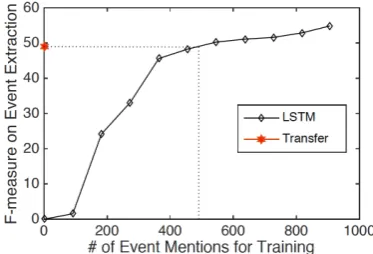
To further demonstrate the effectiveness of zero-shot learning in our framework and its im-pact in saving human annotation effort, we used the supervised LSTM approach for comparison. The training data of LSTM contained 3,464 sen-tences with 905 annotated event mentions for the 23 unseen event types. We divided these event an-notations into 10 subsets and successively added one subset at a time (10% of annotations) into the training data of LSTM. Figure4shows the LSTM learning curve. By contrast, without any anno-tated mentions on the 23 unseen test event types in its training set, our transfer learning approach achieved performance comparable to that of the LSTM, which was trained on 3,000 sentences5 with 500 annotated event mentions.
Figure 4: Comparison between Our Approach and Supervised LSTM model on 23 Unseen Event Types.
5The 3,000 sentences included all the sentences which
[image:7.595.321.508.542.669.2]Method Trigger Identification Trigger Identification + Classification
Arg Identification Arg Identification + Classification
P R F P R F P R F P R F
[image:8.595.73.527.62.125.2]Supervised LSTM 94.7 41.8 58.0 89.4 39.5 54.8 47.8 22.6 30.6 28.9 13.7 18.6 Supervised Joint 55.8 67.4 61.1 50.6 61.2 55.4 36.4 28.1 31.7 33.3 25.7 29.0 Transfer 85.7 41.2 55.6 75.5 36.3 49.1 28.2 27.3 27.8 16.1 15.6 15.8
Table 7: Event Trigger and Argument Extraction Performance (%) on Unseen ACE Types.
6.4 Impact of AMR
Recall that we used AMR parsing output to iden-tify triggers and arguments in constructing event structures. To assess the impact of the AMR parser (Wang et al.,2015a) on event extraction, we chose a subset of the ERE (Entity, Relation, Event) corpus (Song et al.,2015) which has ground-truth AMR annotations. This subset contains 304 doc-uments with 1,022 annotated event mentions of 40 types. We selected the top-6 most popular event types (Arrest-Jail, Execute, Die, Meet, Sen-tence, Charge-Indict) with manual annotations of 548 event mentions as seen types. We sampled 500 negative event mentions from distinct types of clusters generated from the system (Huang et al.,
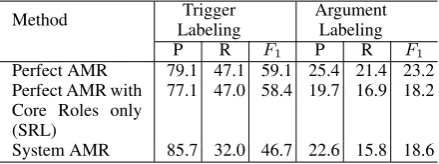
2016) based on ERE training sentences. We com-bined the annotated events for seen types and the negative event mentions, and used 90% for train-ing and 10% for development. For evaluation, we selected 200 sentences from the remaining ERE subset, which contains 128Attackevent mentions and 40Convictevent mentions. Table8shows the event extraction performances based on ground-truth AMR and system AMR respectively.
We also compared AMR analyses with Seman-tic Role Labeling (SRL) output (Palmer et al.,
2010) by keeping only the core roles (e.g.,:ARG0, :ARG1) from AMR annotations. As Table 8
shows, comparing the full AMR (top row) to this SRL proxy (middle row), the fine-grained AMR semantic relations such as :location, :instrument
appear to be more informative for inferring event argument role labeling.
Method Trigger Labeling
Argument Labeling P R F1 P R F1
Perfect AMR 79.1 47.1 59.1 25.4 21.4 23.2 Perfect AMR with
Core Roles only (SRL)
77.1 47.0 58.4 19.7 16.9 18.2
System AMR 85.7 32.0 46.7 22.6 15.8 18.6
Table 8: Impact of AMR and Semantic Roles on Trigger and Argument Extraction (%).
7 Related Work
Most previous event extraction methods have been based on supervised learning, using either sym-bolic features (Ji and Grishman,2008;Miwa et al.,
2009;Liao and Grishman,2010;Liu et al.,2010;
Hong et al.,2011;McClosky et al.,2011;Riedel and McCallum, 2011; Li et al., 2013; Liu et al.,
2016) or distributional features (Chen et al.,2015;
Nguyen and Grishman, 2015; Feng et al., 2016;
Nguyen et al.,2016) derived from a large amount of training data, and treating event types and ar-gument role labels as symbols. These approaches can achieve high quality for known event types, but cannot be applied to new types without addi-tional annotation effort. In contrast, we provide a new angle on event extraction, modeling it as a generic grounding task by taking advantage of rich semantics of event types.
Some other IE paradigms such as Open IE (Etzioni et al., 2005; Banko et al., 2007, 2008;
Etzioni et al., 2011; Ritter et al., 2012), Pre-emptive IE (Shinyama and Sekine, 2006), On-demand IE (Sekine, 2006), Liberal IE (Huang et al., 2016, 2017), and semantic frame-based event discovery (Kim et al., 2013) can discover many events without pre-defined event schema. These paradigms however rely on information re-dundancy, and so they are not effective when the input data only consists of a few sentences. Our work can discover events from any size of input corpus and can also be complementary with these paradigms.
Our event extraction paradigm is similar to the task of entity linking (Ji and Grishman, 2011) in semantic mapping. However, entity linking aims to map entity mentions to the same concept, while our framework maps each event mention to a specific category. In addition, Bronstein et al.
[image:8.595.72.292.629.711.2]pref-erence modeling framework, which can automati-cally predict argument roles without any annotated data, but it relies on manually constructed patterns. Zero-Shot learning has been widely applied in visual object classification (Frome et al., 2013;
Norouzi et al., 2013; Socher et al., 2013a; Chen et al., 2017; Li et al., 2017; Xian et al., 2017;
Changpinyo et al.,2017), fine-grained name tag-ging (Ma et al., 2016; Qu et al., 2016), relation extraction (Verga et al., 2016;Levy et al.,2017), semantic parsing (Bapna et al., 2017) and do-main adaptation (Romera-Paredes and Torr,2015;
Kodirov et al.,2015;Peng et al.,2017). In contrast to these tasks, for our case, the number of seen types in event extraction with manual annotations is quite limited. The most popular event schemas, such as ACE, define 33 event types while most vi-sual object training sets contain more than 1,000 types. Therefore, methods proposed for zero-shot visual-object classification cannot be directly ap-plied to event extraction due to overfitting. In this work, we designed a new loss function by creating “negative” training instances to avoid overfitting.
8 Conclusions and Future Work
In this work, we take a fresh look at the event ex-traction task and model it as a generic ground-ing problem. We propose a transferable neu-ral architecture, which leverages existing human-constructed event schemas and manual annota-tions for a small set of seen types, and transfers the knowledge from the existing types to the ex-traction of unseen types, to improve the scalability of event extraction as well as to save human ef-fort. To the best of our knowledge, this work is the first time that zero-shot learning has been ap-plied to event extraction. Without any annotation, our approach can achieve performance compara-ble to state-of-the-art supervised models trained on a large amount of labeled data. In the future, we will extend this framework to other Informa-tion ExtracInforma-tion problems.
Acknowledgments
This material is based upon work supported by United States Air Force under Contract No. FA8650-17-C-7715 and ARL NS-CTA No. W911NF-09-2-0053. Any opinions, findings and conclusions or recommendations expressed in this material are those of the author(s) and do not nec-essarily reflect the views of the United States Air
Force. or the United States Government. The United States Government is authorized to repro-duce and distribute reprints for Government pur-poses notwithstanding any copyright notation here on.
References
Collin F Baker, Charles J Fillmore, and John B Lowe. 1998. The berkeley framenet project. InProc. COL-ING1998.
L. Banarescu, C. Bonial, S. Cai, M. Georgescu, K. Griffitt, U. Hermjakob, K. Knight, P. Koehn, M. Palmer, and N. Schneider. 2013. Abstract meaning representation for sembanking. In Proc. ACL2013 Workshop on Linguistic Annotation and Interoperability with Discourse.
M. Banko, M. Cafarella, S. Soderland, M. Broadhead, and O. Etzioni. 2007. Open information extraction for the web. InProc. IJCAI2007.
M. Banko, O. Etzioni, and T. Center. 2008. The trade-offs between open and traditional relation extraction. InProc. ACL-HLT2008.
Ankur Bapna, Gokhan Tur, Dilek Hakkani-Tur, and Larry Heck. 2017. Towards zero-shot frame se-mantic parsing for domain scaling. arXiv preprint arXiv:1707.02363.
Ofer Bronstein, Ido Dagan, Qi Li, Heng Ji, and Anette Frank. 2015. Seed-based event trigger labeling: How far can event descriptions get us? In Proc. ACL2015.
Soravit Changpinyo, Wei-Lun Chao, and Fei Sha. 2017. Predicting visual exemplars of unseen classes for zero-shot learning. InProc. ICCV2017.
Long Chen, Hanwang Zhang, Jun Xiao, Wei Liu, and Shih-Fu Chang. 2017. Zero-shot visual recognition using semantics-preserving adversarial embedding network.arXiv preprint arXiv:1712.01928.
Y. Chen, L. Xu, K. Liu, D. Zeng, and J. Zhao. 2015. Event extraction via dynamic multi-pooling convo-lutional neural networks. InProc. ACL2015.
O. Etzioni, M. Cafarella, D. Downey, A. Popescu, T. Shaked, S. Soderland, D. Weld, and A. Yates. 2005. Unsupervised named-entity extraction from the web: An experimental study. Artificial Intelli-gence.
O. Etzioni, A. Fader, J. Christensen, S. Soderland, and M. Mausam. 2011. Open information extraction: The second generation. InProc. IJCAI2011.
A. Frome, G. Corrado, J. Shlens, S. Bengio, J. Dean, and T. Mikolov. 2013. Devise: A deep visual-semantic embedding model. InProc. NIPS2013.
S. Hochreiter and J. Schmidhuber. 1997. Long short-term memory.Neural computation.
Y. Hong, J. Zhang, B. Ma, J. Yao, G. Zhou, and Q. Zhu. 2011. Using cross-entity inference to improve event extraction. InProc. ACL2011.
L. Huang, T. Cassidy, X. Feng, H. Ji, C. Voss, J. Han, and A. Sil. 2016. Liberal event extraction and event schema induction. InProc. ACL2016.
L. Huang, J. May, X. Pan, H. Ji, X. Ren, J. Han, L. Zhao, and J. Hendler. 2017. Liberal entity ex-traction: Rapid construction of fine-grained entity typing systems. Big Data.
H. Ji and R. Grishman. 2008. Refining event extrac-tion through cross-document inference. In Proc. ACL2008.
Heng Ji and Ralph Grishman. 2011. Knowledge base population: Successful approaches and challenges. InProc. ACL-HLT2011.
H. Kim, X. Ren, Y. Sun, C. Wang, and J. Han. 2013. Semantic frame-based document representation for comparable corpora. InProc. ICDM2013.
Elyor Kodirov, Tao Xiang, Zhenyong Fu, and Shao-gang Gong. 2015. Unsupervised domain adaptation for zero-shot learning. InProc. ICCV2015.
Omer Levy, Minjoon Seo, Eunsol Choi, and Luke Zettlemoyer. 2017. Zero-shot relation extrac-tion via reading comprehension. arXiv preprint arXiv:1706.04115.
Q. Li, H. Ji, and L. Huang. 2013. Joint event extrac-tion via structured predicextrac-tion with global features. InProc. ACL2013.
Yanan Li, Donghui Wang, Huanhang Hu, Yuetan Lin, and Yueting Zhuang. 2017. Zero-shot recognition using dual visual-semantic mapping paths. arXiv preprint arXiv:1703.05002.
S. Liao and R. Grishman. 2010. Using document level cross-event inference to improve event extraction. InProc. ACL2010.
B. Liu, L. Qian, H. Wang, and G. Zhou. 2010. Dependency-driven feature-based learning for ex-tracting protein-protein interactions from biomedi-cal text. InProc. COLING2010.
S. Liu, Y. Chen, S. He, K. Liu, and J. Zhao. 2016. Leveraging framenet to improve automatic event de-tection. InProc. ACL2016.
Wei Lu and Dan Roth. 2012. Automatic event extrac-tion with structured preference modeling. InProc. ACL2012.
Y. Ma, E. Cambria, and S. Gao. 2016. Label embed-ding for zero-shot fine-grained named entity typing. InProc. COLING2016.
D. McClosky, M. Surdeanu, and C. D. Manning. 2011. Event extraction as dependency parsing. In Proc. ACL2011.
T. Mikolov, K. Chen, G. Corrado, and J. Dean. 2013. Efficient estimation of word representations in vec-tor space. CoRRabs/1301.3781.
M. Miwa, R. Stre, Y. Miyao, and J. Tsujii. 2009. A rich feature vector for protein-protein interaction extrac-tion from multiple corpora. InProc. EMNLP2009.
T. Nguyen, K. Cho, and R. Grishman. 2016. Joint event extraction via recurrent neural networks. In Proc. NAACL-HLT2016.
T. Nguyen and R. Grishman. 2015. Event detection and domain adaptation with convolutional neural net-works. InProc. ACL2015.
M. Norouzi, T. Mikolov, S. Bengio, Y. Singer, J. Shlens, A. Frome, G. Corrado, and J. Dean. 2013. Zero-shot learning by convex combina-tion of semantic embeddings. arXiv preprint arXiv:1312.5650.
M. Palmer, D. Gildea, and N. Xue. 2010. Semantic role labeling. Synthesis Lectures on Human Language Technologies.
Haoruo Peng, Yangqiu Song, and Dan Roth. 2016. Event detection and co-reference with minimal su-pervision. InProc. EMNLP2016.
Kuan-Chuan Peng, Ziyan Wu, and Jan Ernst. 2017. Zero-shot deep domain adaptation. arXiv preprint arXiv:1707.01922.
J. Pustejovsky. 1991. The syntax of event structure.
Cognition.
L. Qu, G. Ferraro, L. Zhou, W. Hou, and T. Baldwin. 2016. Named entity recognition for novel types by transfer learning. InProc. ACL2016.
S. Riedel and A. McCallum. 2011. Fast and robust joint models for biomedical event extraction. In
Proc. EMNLP2011.
A. Ritter, O. Etzioni, and S. Clark. 2012. Open domain event extraction from twitter. In Proc. SIGKDD2012.
Bernardino Romera-Paredes and Philip Torr. 2015. An embarrassingly simple approach to zero-shot learn-ing. InProc. ICML2015.
S. Sekine. 2006. On-demand information extraction. InProc. COLING-ACL2006.
R. Socher, M. Ganjoo, C. Manning, and A. Ng. 2013a. Zero-shot learning through cross-modal transfer. In
Proc. NIPS2013.
R. Socher, A. Perelygin, J. Wu, J. Chuang, C. Manning, A. Ng, and C. Potts. 2013b. Recursive deep models for semantic compositionality over a sentiment tree-bank. InProc. EMNLP2013.
Zhiyi Song, Ann Bies, Stephanie Strassel, Tom Riese, Justin Mott, Joe Ellis, Jonathan Wright, Seth Kulick, Neville Ryant, and Xiaoyi Ma. 2015. From light to rich ere: Annotation of entities, relations, and events. InProc. NAACL-HLT2015 Workshop on on EVENTS.
P. Verga, D. Belanger, E. Strubell, B. Roth, and A. McCallum. 2016. Multilingual relation
extrac-tion using composiextrac-tional universal schema. InProc. NAACL2016.
C. Wang, N. Xue, and S. Pradhan. 2015a. Boost-ing transition-based amr parsBoost-ing with refined actions and auxiliary analyzers. InProc. ACL2015.
Chuan Wang, Nianwen Xue, Sameer Pradhan, and Sameer Pradhan. 2015b. A transition-based algo-rithm for amr parsing. InHLT-NAACL.
Yongqin Xian, Bernt Schiele, and Zeynep Akata. 2017. Zero-shot learning-the good, the bad and the ugly.
arXiv preprint arXiv:1703.04394.