Proceedings of the 55th Annual Meeting of the Association for Computational Linguistics-Tutorial Abstracts, pages 8–14
Deep Learning for Dialogue Systems
Yun-Nung Chen National Taiwan University
Taipei, Taiwan [email protected]
Asli Celikyilmaz Microsoft Research
Redmond, WA [email protected]
Dilek Hakkani-T¨ur Google Research Mountain View, CA [email protected]
Abstract
In the past decade, goal-oriented spo-ken dialogue systems have been the most prominent component in today’s virtual personal assistants. The classic dialogue systems have rather complex and/or mod-ular pipelines. The advance of deep learn-ing technologies has recently risen the ap-plications of neural models to dialogue modeling. However, how to successfully apply deep learning based approaches to a dialogue system is still challenging. Hence, this tutorial is designed to focus on an overview of the dialogue system devel-opment while describing most recent re-search for building dialogue systems and summarizing the challenges, in order to allow researchers to study the potential improvements of the state-of-the-art dia-logue systems. The tutorial material is available athttp://deepdialogue. miulab.tw.
1 Tutorial Overview
With the rising trend of artificial intelligence, more and more devices have incorporated goal-oriented spoken dialogue systems. Among popular vir-tual personal assistants, Microsoft’s Cortana, Ap-ple’s Siri, Amazon Alexa, Google Assistant, and Facebook’s M, have incorporated dialogue system modules in various devices, which allow users to speak naturally in order to finish tasks more effi-ciently.
The traditional conversational systems have rather complex and/or modular pipelines. The ad-vance of deep learning technologies has recently risen the applications of neural models to dialogue modeling. Nevertheless, applying deep learning technologies for building robust and scalable
di-alogue systems is still a challenging task and an open research area as it requires deeper under-standing of the classic pipelines as well as detailed knowledge on the benchmark of the models of the prior work and the recent state-of-the-art work.
The goal of this tutorial is to provide the au-dience with developing trend of the dialogue sys-tems, and a roadmap to get them started with the related work. In the first section of the tutorial, we motivate the work on conversation-based in-telligent agents, in which the core underlying sys-tem is task-oriented dialogue syssys-tems. The second and third sections describe different approaches using deep learning for each component in the di-alogue system and how it is evaluated. The last two sections focus on discussing the recent trends and current challenges on dialogue system tech-nology and summarize the challenges and conclu-sions. Then the detailed content is described as follows.
2 Outline
1. Introduction & Background [15 min.]
• Brief history of dialogue systems • Summarized challenges of intelligent
assistants
• Task-oriented dialogue system
frame-work
• Neural network basics
• Reinforcement learning (RL) basics
2. Deep Learning Based Dialogue System [75 min.]
• Spoken/Natural language understanding
(SLU/NLU)
– Semantic frame representation – Domain classification
– Slot tagging
– Structural language understanding
• Dialogue management (DM) – Dialogue state tracking (DST)
– Neural belief tracker – Multichannel tracker
• Dialogue management (DM) – Policy
optimization
– Dialogue RL signal
– Deep Q-network for learning policy – Hierarchical RL for learning policy
• Natural language generation (NLG) – Template-based NLG
– Plan-based NLG – Class LM NLG – Phrase-based NLG
– RNN-LM NLG
– Semantic Conditioned LSTM – Structural NLG
– Contextual NLG 3. Evaluation [10 min.]
• Crowdsourcing
• User simulation
4. Recent Trends on Learning Dialogues [45 min.]
• End-to-end neural dialogue systems – Chit-chat seq2seq model – E2E joint NLU and DM
– E2E supervised dialogue system – E2E memory network for dialogues – E2E RL-basedInfoBot
– E2E LSTM-based dialogue control – E2E RL-based task-completion bot
• Dialogue breath – Domain adaptation – Intent expansion
– Policy for domain adaptation
• Dialogue depth
– High-level intent for dialogue plan-ning
– Multimodality in dialogue systems 5. Challenges & Conclusions [5 mins]
3 Dialogue System Basics
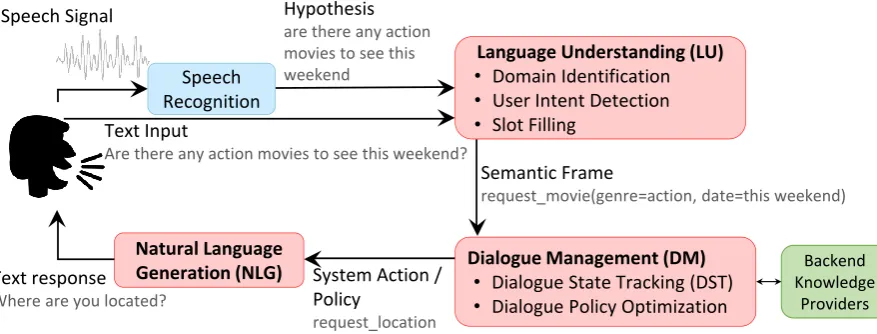
This section will motivate the work on conversation-based intelligent agents, in which the core underlying system is task-oriented spoken dialogue systems.
The section starts with an overview of the stan-dard pipeline framework for dialogue system illus-trated in Figure1 (Tur and De Mori,2011). Ba-sic components of a dialog system are automatic
speech recognition (ASR), language understand-ing (LU), dialogue management (DM), and natu-ral language generation (NLG) (Rudnicky et al.,
1999;Zue et al.,2000;Zue and Glass,2000).. This tutorial will mainly focus on LU, DM, and NLG parts.
Language Understanding Traditionally, do-main identification and intent prediction are framed as utterance classification problems, where several classifiers such as support vector ma-chines and maximum entropy have been em-ployed (Haffner et al.,2003;Chelba et al.,2003;
Chen et al., 2014). Then slot filling is framed as a word sequence tagging task, where the IOB (in-out-begin) format is applied for representing slot tags, and hidden Markov models (HMM) or conditional random fields (CRF) have been em-ployed for slot tagging (Pieraccini et al., 1992;
Wang et al.,2005;Raymond and Riccardi,2007).
Dialogue Management A partially observable Markov decision process (POMDP) has been shown to be beneficial by allowing the dialogue manager to be optimized to plan and act under the uncertainty created by noisy speech recogni-tion and semantic decoding (Williams and Young,
2007; Young et al., 2013). The POMDP pol-icy controlling the actions taken by the system is trained in an episodic reinforcement learning (RL) framework whereby the agent receives a reinforce-ment signal after each dialogue (episode) reflect-ing how well it performed (Sutton and Barto,
1998). In addition, the dialogue states should be tracked in order to measure the belief of the cur-rent situation during the whole interaction (Young et al.,2010;Sun et al.,2014).
Speech Recognition
Language Understanding (LU)
• Domain Identification • User Intent Detection • Slot Filling
Dialogue Management (DM)
• Dialogue State Tracking (DST) • Dialogue Policy Optimization
Natural Language Generation (NLG)
Hypothesis
are there any action movies to see this weekend
Semantic Frame
request_movie(genre=action, date=this weekend)
System Action / Policy
request_location
Text response
Where are you located?
Text Input
Are there any action movies to see this weekend?
Speech Signal
Backend Knowledge
Providers
Figure 1: Pipeline framework of spoken dialog system.
W find action movies this weekend
↓ ↓ ↓ ↓ ↓
S O B-genre O B-date I-date
[image:3.595.80.519.65.232.2]I find movie
Figure 2: An example utterance with annotations of semantic slots in IOB format (S) and intent (I), B-date and I-date denote the date slot.
4 Deep Learning Based Dialogue System
With the power of deep learning, there is in-creasing research work focusing on applying deep learning for each component.
Language Understanding With the advances on deep learning, deep belief networks (DBNs) with deep neural networks (DNNs) have been applied to domain and intent classification tasks (Sarikaya et al., 2011; Tur et al., 2012;
Sarikaya et al.,2014). Recently,Ravuri and Stol-cke(2015) proposed an RNN architecture for in-tent determination. For slot filling, deep learning has been viewed as a feature generator and the neural architecture can be merged with CRFs (Xu and Sarikaya,2013).Yao et al.(2013) andMesnil et al. (2015) later employed RNNs for sequence labeling in order to perform slot filling. Such architectures have later been extended to jointly model intent detection and slot filling in multiple domains (Hakkani-T¨ur et al., 2016;Jaech et al.,
2016). End-to-end memory networks have been shown to provide a good mechanism for integrat-ing longer term knowledge context and shorter term dialogue context into these models (Chen et al., 2016b,c). In addition, the importance of the LU module is investigated inLi et al.(2017a), where different types of errors from LU may de-grade the whole system performance in an
rein-forcement learning setting.
Dialogue Management The state-of-the-art di-alog managers focus on monitoring the didi-alog progress by neural dialog state tracking models. Among the initial models are the RNN based di-alog state tracking approaches (Henderson et al.,
2013) that has shown to outperform Bayesian net-works (Thomson and Young, 2010). More re-cent work on Neural Dialog Managers that provide conjoint representations between the utterances, slot-value pairs as well as knowledge graph repre-sentations (Wen et al.,2016;Mrkˇsi´c et al.,2016) demonstrate that using neural dialog models can overcome current obstacles of deploying dialogue systems in larger dialog domains.
Natural Language Generation The RNN-based models have been applied to language gen-eration for both chit-chat and task-orientated dia-logue systems (Vinyals and Le,2015;Wen et al.,
2015b). The RNN-based NLG can learn from un-aligned data by jointly optimizing sentence plan-ning and surface realization, and language varia-tion can be easily achieved by sampling from out-put candidates (Wen et al.,2015a). Moreover,Wen et al.(2015b) improved the prior work by adding a gating mechanism for controlling the dialogue act during generation in order to avoid semantics repetition, showing promising results.
5 Recent Trends and Challenges on Learning Dialogues
End-to-End Learning for Dialogue System With the power of neural networks, there are more and more attempts for learning dialogue sys-tems in an end-to-end fashion. Different learn-ing frameworks are applied, includlearn-ing supervised learning and reinforcement learning. This part will discuss the work about end-to-end learning for di-alogues (Dhingra et al., 2016; Wen et al., 2016;
Williams and Zweig, 2016; Zhao and Eskenazi,
2016;Li et al.,2017b).
Recent advance of deep learning has inspired many applications of neural models to dialogue systems.Wen et al.(2016) andBordes and Weston
(2016) introduced a network-based end-to-end trainable task-oriented dialogue system, which treated dialogue system learning as the problem of learning a mapping from dialogue histories to system responses, and applied an encoder-decoder model to train the whole system. However, the system is trained in a supervised fashion, thus re-quires a lot of training data, and may not be able to explore the unknown space that does not exist in the training data for an optimal and robust policy.
Zhao and Eskenazi (2016) first presented an end-to-end reinforcement learning (RL) approach to dialogue state tracking and policy learning in the DM. This approach is shown to be promis-ing when applied to a task-oriented system, which is to guess the famous person a user thinks of. In the conversation, the agent asks the user a se-ries of Yes/No questions to find the correct an-swer. Dhingra et al. (2016) proposed an end-to-end differentiable KB-Infobot to improve the flexibility of question types and robustness. Li et al.(2017b) further presented an end-to-end neu-ral dialogue system for completing tasks, which supported flexible question types, allowed user-initiated requests during conversation, and finally achieved better robustness.
Dialogue Breath In order to extend the cover-age of the systems, transfer learning has been ap-plied to different extended systems in order to proceed to a multi-domain scenario. Chen et al.
(2016a) transfered the dialogue acts across differ-ent domains so that the performance of the newly-developed domain can be boosted. Kim et al.
proposed to learn a specific and domain-independent information in order to transfer the shared knowledge more efficiently and effectively. In addition,Gaˇsi´c et al.(2015) presented the pol-icy committee in order to boost the performance
for policy training in a new domain. All above work extended the dialogue coverage using differ-ent directions.
Dialogue Depth Most current systems focus on knowledge-based understanding, but there are hi-erarchical understanding according to the dialogue complexity. For example, an intent about party scheduling may include restaurant reserving and invitation sending. Sun et al. (2016) learned the high-level intentions that span on multiple do-mains in order to achieve common sense under-standing. Moreover, a more complex dialogue such as “I feel sad...” requires empathy in order to generate the suitable response. Fung et al.(2016) first attempted to leverage different modalities for emotion detection and built an emotion-aware di-alogue system.
Given two branches of development, the ulti-mate goal is to build an open-domain dialogue system (coverage) with all levels of understanding (depth).
6 Instructors
Yun-Nung (Vivian) Chen is currently an assis-tant professor at the Department of Computer Sci-ence, National Taiwan University. She earned her Ph.D. degree from Carnegie Mellon Univer-sity, where her research interests focus on spo-ken dialogue system, language understanding, nat-ural language processing, and multi-modal speech applications. She received the Google Faculty Research Awards 2016, two Student Best Paper Awards from IEEE SLT 2010 and IEEE ASRU 2013, a Student Best Paper Nominee from Inter-speech 2012, and the Distinguished Master The-sis Award from ACLCLP. Before joining National Taiwan University, she worked in the Deep Learn-ing Technology Center at Microsoft Research Redmond. More information about her can be found athttp://vivianchen.idv.tw.
has earned her Ph.D. from University of Toronto, Canada in 2008. Asli’s research interests are mainly machine learning and its applications to conversational dialogue systems, mainly natural language understanding and dialogue modeling. In the past she has also focused on research ar-eas including machine intelligence, semantic tag-ging of natural user utterances of human to ma-chine conversations, text analysis, document sum-marization, question answering, co-reference res-olution, to name a few. Currently she is focus-ing on reasonfocus-ing, attention, memory networks as well as multi-task and transfer learning for conver-sational dialogue systems. She has been serving as area chair, co-organizer of numerous NLP and speech conferences, such as ACL, NAACL, Inter-speech, and IEEE Spoken Language Technologies (SLT). She co-organized a NIPS workshop on Ma-chine Learning for Spoken Language Understand-ing and Interactions in 2015.
Dilek Hakkani-T¨ur is a research scientist at Google Research. Prior to joining Google, she was a researcher at Microsoft Research (2010-2016), International Computer Science Institute (ICSI, 2006-2010) and AT&T Labs-Research (2001-2005). She received her BSc degree from Mid-dle East Technical Univ, in 1994, and MSc and PhD degrees from Bilkent Univ., Department of Computer Engineering, in 1996 and 2000, respec-tively. Her research interests include natural lan-guage and speech processing, spoken dialogue systems, and machine learning for language pro-cessing. She has over 50 patents that were granted and co-authored more than 200 papers in natural language and speech processing. She is the recipi-ent of three best paper awards for her work on ac-tive learning for dialogue systems, from IEEE Sig-nal Processing Society, ISCA and EURASIP. She was an associate editor of IEEE Transactions on Audio, Speech and Language Processing (2005-2008), member of the IEEE Speech and Lan-guage Technical Committee (2009-2014), area ed-itor for speech and language processing for Else-vier’s Digital Signal Processing Journal and IEEE Signal Processing Letters (2011-2013), and cur-rently serves on ISCA Advisory Council (2015-2018). She is a fellow of IEEE and ISCA.
References
Antoine Bordes and Jason Weston. 2016. Learn-ing end-to-end goal-oriented dialog. arXiv preprint arXiv:1605.07683.
Ciprian Chelba, Monika Mahajan, and Alex Acero. 2003. Speech utterance classification. In2003 IEEE International Conference on Acoustics, Speech, and Signal Processing, 2003. Proceedings.(ICASSP). IEEE, volume 1, pages I–280.
Yun-Nung Chen, Dilek Hakkani-T, Xiaodong He, et al. 2016a. Zero-shot learning of intent embeddings for expansion by convolutional deep structured seman-tic models. In 2016 IEEE International Confer-ence on Acoustics, Speech and Signal Processing (ICASSP). IEEE, pages 6045–6049.
Yun-Nung Chen, Dilek Hakkani-Tur, and Gokan Tur. 2014. Deriving local relational surface forms from dependency-based entity embeddings for un-supervised spoken language understanding. In 2014 IEEE Spoken Language Technology Workshop (SLT). IEEE, pages 242–247.
Yun-Nung Chen, Dilek Hakkani-Tur, Gokhan Tur, Asli Celikyilmaz, Jianfeng Gao, and Li Deng. 2016b. Knowledge as a teacher: Knowledge-guided structural attention networks. arXiv preprint arXiv:1609.03286.
Yun-Nung Chen, Dilek Hakkani-T¨ur, Gokhan Tur, Jianfeng Gao, and Li Deng. 2016c. End-to-end memory networks with knowledge carryover for multi-turn spoken language understanding. In Pro-ceedings of the Interspeech.
Bhuwan Dhingra, Lihong Li, Xiujun Li, Jianfeng Gao, Yun-Nung Chen, Faisal Ahmed, and Li Deng. 2016. End-to-end reinforcement learning of dia-logue agents for information access. arXiv preprint arXiv:1609.00777.
Pascale Fung, Dario Bertero, Yan Wan, Anik Dey, Ricky Ho Yin Chan, Farhad Bin Siddique, Yang Yang, Chien-Sheng Wu, and Ruixi Lin. 2016. To-wards empathetic human-robot interactions. arXiv preprint arXiv:1605.04072.
M Gaˇsi´c, N Mrkˇsi´c, Pei-hao Su, David Vandyke, Tsung-Hsien Wen, and Steve Young. 2015. Policy committee for adaptation in multi-domain spoken dialogue systems. InAutomatic Speech Recognition and Understanding (ASRU), 2015 IEEE Workshop on. IEEE, pages 806–812.
Dilek Hakkani-T¨ur, Gokhan Tur, Asli Celikyilmaz, Yun-Nung Chen, Jianfeng Gao, Li Deng, and Ye-Yi Wang. 2016. Multi-domain joint semantic frame parsing using bi-directional RNN-LSTM. In Pro-ceedings of the Interspeech. San Francisco, CA.
Matthew Henderson, Blaise Thomson, and Steve Young. 2013. Deep neural network approach for the dialog state tracking challenge. In Proceedings of the SIGDIAL 2013 Conference. pages 467–471.
A. Jaech, L. Heck, and M. Ostendorf. 2016. Domain adaptation of recurrent neural networks for natural language understanding. In Proceedings of the In-terspeech. San Francisco, CA.
Young-Bum Kim, WA Redmond, Karl Stratos, and Ruhi Sarikaya. ???? Frustratingly easy neural do-main adaptation.
Xiujun Li, Yun-Nung Chen, Lihong Li, Jianfeng Gao, and Asli Celikyilmaz. 2017a. Investigation of language understanding impact for reinforcement learning based dialogue systems. arXiv preprint arXiv:1703.07055.
Xuijun Li, Yun-Nung Chen, Lihong Li, and Jianfeng Gao. 2017b. End-to-end task-completion neural di-alogue systems.arXiv preprint arXiv:1703.01008.
Gr´egoire Mesnil, Yann Dauphin, Kaisheng Yao, Yoshua Bengio, Li Deng, Dilek Hakkani-Tur, Xi-aodong He, Larry Heck, Gokhan Tur, Dong Yu, et al. 2015. Using recurrent neural networks for slot fill-ing in spoken language understandfill-ing. IEEE/ACM Transactions on Audio, Speech, and Language Pro-cessing23(3):530–539.
Nikola Mrkˇsi´c, Diarmuid ´O S´eaghdha, Tsung-Hsien Wen, Blaise Thomson, and Steve Young. 2016. Neural belief tracker: Data-driven dialogue state tracking.arXiv preprint arXiv:1606.03777.
Alice H Oh and Alexander I Rudnicky. 2002. Stochas-tic natural language generation for spoken dialog systems. Computer Speech & Language16(3):387– 407.
Roberto Pieraccini, Evelyne Tzoukermann, Zakhar Gorelov, Jean-Luc Gauvain, Esther Levin, Chin-Hui Lee, and Jay G Wilpon. 1992. A speech understand-ing system based on statistical representation of se-mantics. In1992 IEEE International Conference on Acoustics, Speech, and Signal Processing (ICASSP). IEEE, volume 1, pages 193–196.
Suman Ravuri and Andreas Stolcke. 2015. Recurrent neural network and lstm models for lexical utterance classification. InSixteenth Annual Conference of the International Speech Communication Association.
Christian Raymond and Giuseppe Riccardi. 2007. Generative and discriminative algorithms for spoken language understanding. InINTERSPEECH. pages 1605–1608.
Alexander I Rudnicky, Eric H Thayer, Paul C Constan-tinides, Chris Tchou, R Shern, Kevin A Lenzo, Wei Xu, and Alice Oh. 1999. Creating natural dialogs in the carnegie mellon communicator system. In Eu-rospeech.
Ruhi Sarikaya, Geoffrey E Hinton, and Anoop Deo-ras. 2014. Application of deep belief networks for natural language understanding. IEEE/ACM Trans-actions on Audio, Speech, and Language Processing 22(4):778–784.
Ruhi Sarikaya, Geoffrey E Hinton, and Bhuvana Ram-abhadran. 2011. Deep belief nets for natural lan-guage call-routing. In 2011 IEEE International Conference on Acoustics, Speech and Signal Pro-cessing (ICASSP). IEEE, pages 5680–5683.
Kai Sun, Lu Chen, Su Zhu, and Kai Yu. 2014. A gener-alized rule based tracker for dialogue state tracking. In Spoken Language Technology Workshop (SLT), 2014 IEEE. IEEE, pages 330–335.
Ming Sun, Yun-Nung Chen, and Alexander I Rudnicky. 2016. An intelligent assistant for high-level task understanding. In Proceedings of the 21st Inter-national Conference on Intelligent User Interfaces. ACM, pages 169–174.
Richard S Sutton and Andrew G Barto. 1998. Re-inforcement learning: An introduction, volume 1. MIT press Cambridge.
Blaise Thomson and Steve Young. 2010. Bayesian up-date of dialogue state: A pomdp framework for spo-ken dialogue systems. Computer Speech and Lan-guage24(4):562–588.
Gokhan Tur and Renato De Mori. 2011. Spoken lan-guage understanding: Systems for extracting seman-tic information from speech. John Wiley & Sons.
Gokhan Tur, Li Deng, Dilek Hakkani-T¨ur, and Xi-aodong He. 2012. Towards deeper understanding: Deep convex networks for semantic utterance classi-fication. In2012 IEEE International Conference on Acoustics, Speech and Signal Processing (ICASSP). IEEE, pages 5045–5048.
Oriol Vinyals and Quoc Le. 2015. A neural conversa-tional model. arXiv preprint arXiv:1506.05869.
Ye-Yi Wang, Li Deng, and Alex Acero. 2005. Spo-ken language understanding. IEEE Signal Process-ing Magazine22(5):16–31.
Tsung-Hsien Wen, Milica Gasic, Nikola Mrksic, Lina M Rojas-Barahona, Pei-Hao Su, Stefan Ultes, David Vandyke, and Steve Young. 2016. A network-based end-to-end trainable task-oriented dialogue system. arXiv preprint arXiv:1604.04562.
Tsung-Hsien Wen, Milica Gasic, Nikola Mrksic, Pei-Hao Su, David Vandyke, and Steve Young. 2015b. Semantically conditioned lstm-based natural lan-guage generation for spoken dialogue systems. arXiv preprint arXiv:1508.01745.
Jason D Williams and Steve Young. 2007. Partially observable markov decision processes for spoken dialog systems. Computer Speech & Language 21(2):393–422.
Jason D Williams and Geoffrey Zweig. 2016. End-to-end lstm-based dialog control optimized with su-pervised and reinforcement learning. arXiv preprint arXiv:1606.01269.
Puyang Xu and Ruhi Sarikaya. 2013. Convolutional neural network based triangular CRF for joint intent detection and slot filling. In 2013 IEEE Workshop on Automatic Speech Recognition and Understand-ing (ASRU). IEEE, pages 78–83.
Kaisheng Yao, Geoffrey Zweig, Mei-Yuh Hwang, Yangyang Shi, and Dong Yu. 2013. Recurrent neu-ral networks for language understanding. In INTER-SPEECH. pages 2524–2528.
Steve Young, Milica Gaˇsi´c, Simon Keizer, Franc¸ois Mairesse, Jost Schatzmann, Blaise Thomson, and Kai Yu. 2010. The hidden information state model: A practical framework for pomdp-based spoken dia-logue management. Computer Speech & Language 24(2):150–174.
Steve Young, Milica Gaˇsi´c, Blaise Thomson, and Ja-son D Williams. 2013. POMDP-based statistical spoken dialog systems: A review. Proceedings of the IEEE101(5):1160–1179.
Tiancheng Zhao and Maxine Eskenazi. 2016. To-wards end-to-end learning for dialog state tracking and management using deep reinforcement learning. arXiv preprint arXiv:1606.02560.
Victor Zue, Stephanie Seneff, James R Glass, Joseph Polifroni, Christine Pao, Timothy J Hazen, and Lee Hetherington. 2000. JUPITER: a telephone-based conversational interface for weather informa-tion. IEEE Transactions on speech and audio pro-cessing8(1):85–96.