Local Action Groups (LAGs) have become significant actors in rural development. Their position and role have been increasing since the 1990s because they challenge the idea of implementing rural development activities only through the experts endowed with the unmistakable rationality of scientific knowledge and therefore they could not be embedded in the everyday life of the localities of concern. The outlined idea echoes the era of modernity and contradicts late-modern (or post-late-modern) world when the experts are just one of many stakeholders (Stepin 2005). It is the idea of post-modernity which is behind the LEADER approach where the LAGs are the main actor (Ray 2000). Rural development implemented by local people forming the LAGs is manifested together with utilizing the eco-social system existing in the region (Blažek 2004) as the reflection of the recent trends. The LAGs influenced the transition to the new forms of the governance of rural development (Lošťák et al. 2015). The shift is from the support solely targeted to economic activities and other economic and material circumstances of rural life towards the utilization of non-economic aspects and issues, such as the social capital, cooperation, social networks or the coherence of the community (Sutherland and Burton 2011). Such
shift reflects the principles of the local action groups. They are supposed to stimulate the interest of the local people in the place where they live. The goal of the LAGs is to strengthen the civic society through the participation of all actors engaged in the activities in the region (Lowe et al. 1995). It means that the LAGs address the main problem in the countryside – the low capacity of local people to be involved in influenc-ing their conditions of life. The LAGs contribute to strengthening the social capital which is an important factor for the development of the locality (Putnam 1993) and the LEADER with LAGs is an approached built upon social capital (Marquardt et al. 2012).
The research presented in this paper aimed at find-ing out weather the local action groups in the Czech Republic reflect in their activities the shift towards the intangible resources emphasised by the endog-enous type of rural development manifested in the LEADER approach (Osti 2000; Ray 2000; Shucksmith 2000). It means that the goal is to find out if there is a paradigmatic change in rural development in the term of transition from the exogenous to endogenous type of rural development.
Due to the results of the pilot study, we decided not to use the mainstream research methods (e.g.
sur-Tracing shift in Czech rural development paradigm
(Reflections of Local Action Groups in the media)
Katerina BOUKALOVA, Alena KOLAROVA, Michal LOSTAK
Czech University of Life Sciences Prague, Prague, Czech Republic
Abstract: Local Action Groups (LAG) as actors in the EU rural development policy refl ect the endogenous paradigm. Th ey
utilize the cooperation of their members and social networks to achieve the goals defi ned in their strategies developed upon the EU regulations on rural development. Th e paper demonstrates how the printed Czech media refl ect the activities of LAGs. Such research gives a background to answer the question if the references to LAGs in the Czech Republic high-light the paradigmatic shift from the material factors towards the endogenous or hybrid resources embedded in using the intangible factors for development. Th e research consists in the quantitative content analysis of 498 articles about Czech local action groups. Th e analysis indicates that paradigmatic shift is only at the beginning. LAGs activities are still reported to be embedded in using the material factors (exogenous approach) instead of reporting and accounting the endogenous resources composed of both material and non-material factors of rural development.
Keywords: content analysis, endogenous rural development, LEADER approach
veys). The reason was the representatives of the LAGs complained about being “over-surveyed”. Adopting the principle of the “economy of time” in research (Disman 2002), which reflects the demands to the researchers not to burden the investigated people too much, we opted for the content analysis. Although this method primarily allows describing how the local action groups are presented in the Czech mass media (particularly in the printed newspapers in our case), the main aim of using this method was to find out whether the printed media reflect the shift from the tangible and financial capitals towards the intan-gible components of our lives. Being in line with the modified Boudliard’s (1994) post-modern ideas about the images in media constructing hyperreality (the modification is that we do not consider the media as constructing the “media reality” /hyperreality/ which is more real than the reality itself but as reflecting the reality) we used the content analysis to generate the data in order to answer the research question outlined above. It means that the paper investigates whether the Czech LAGs are portrayed in the printed media as the actors with a potential to encourage through cooperation the development of the civic society aim-ing at reducaim-ing the social exclusion which is in line with the aims of the endogenous rural development (Lowe et al. 1995). Such finding will demonstrate the shift contradicting exogenous (and modernist) rural development paradigm emphasising the material and tangible issues resulting in economy of scale being supported from outside (it means not utilising local resources through cooperation and the intangible forms of capital such as social, human or cultural capitals).
Local action group as the actor stimulating intangible factors in rural development
Local action groups are one of the important lo-cal institutions with the aim to help, maintain and develop the non-material aspects of the community life (Stachová 2008). Their importance is documented by the growing support from the EU. “LAG should act so as to benefit the inhabitants and the rural area it represents” (Schiller 2011: 11). Although the LAGs are established in a formally institutionalized form shaped by the rules set up by the actors outside the region (e.g. the ministries, the EU regulations),
they use regularly in their activities the informal social interactions and social networks existing in the region. “Citizens themselves form local action groups and share experiences with the counterparts in neighbouring communities” (Trägardh et al. 2013: 74). This fact corresponds with the principles of an endogenous type of rural development, as well as with the concept of the civic society which is linked to the concept of the social capital (Stachová 2008). The civic society is therefore crucial for the opera-tionalization of variables later in the research. It is because in the current programming period the tool named the “Community Led Local Development (CLLD), which allows municipality to mobilize re-sources, skills and energy of private stakeholders and civil society through local action groups” (European Parliament, 2014: 62) brings the LAGs, civic society and intangible resources (e.g. social capital) together. Social capital as the resource into which the LAGs invest to utilize it in the frames of civic society is understand here as “the form of norms of reciprocity and networks of civic involvement” (Putnam 1993: 167). An important source of social capital are the relations of the people who have voluntarily started to associate in organizations. Their activities resulted in the accumulation of their social and economic strengths, i.e. in the social capital (Stachová 2008). Organizations developing and utilizing social capital have become significant collective actors in the civil society. These associations (e.g. the LAGs) “instill in their members habits of cooperation, solidarity, and public-spiritedness” (Putnam 1993: 89–90).
As van Depoele (2013) suggests, the LEADER1 approach which is activated through the LAGs con-stitutes an innovation when it results in the creation of trust and confidence and makes the people believe in change. Therefore, social capital built on trust is an important element for the development which necessitates the collective action. Cooperation in the collective action is easier in the communities with a greater stock of social capital. Voluntary participation in the local organizations (such as a LAG) supports the creation of a coherent community which is the most visible form of the existence of social capital.
Studies (Furmankiewicz et al. 2010; Lošťák and Hudečková 2010; Ray 2000; Shuck smith 2000; Marquardt et al. 2012) demonstrate that the local action groups are based on social capital. Lopolito et
al. (2011) in their study evaluating the tangible and intangible outputs of the activities of the local ac-tion groups show that the LAG supports rural areas through enhancing the stock of creating and using social capital. The task of the LAG is to involve the local citizens and other economic actors in the net-works of civic participation because this is the way to increase the stock of social capital in the society which is considered to be the key factor of the local development (Casieri 2010).
When the local action groups were established at the beginning of the 1990s, their essential purpose was to activate the local people to participate in the activities and in the decision-making regarding the development of the territory where they live. However, in some countries (namely in the Eastern Europe), the purpose of the LAGs consisting in the involvement of the local people in the public activi-ties was not properly understood and implemented (Maurel 2008). In the post-Soviet countries, the LAGs are perceived as a source of subsidies. The LAGs are considered as a tool to be successful in getting the European Union funding. In the Czech context, it is documented by Binek et al. (2011) con-cluding that today the LAGs represent a tool for the administration of the projects (utilization of the public finances) but not so much a tool to activate (endogenous development) rural territories through partnership (cooperation) in projects resulting in the value added and effectiveness. In many cases, there were projects where the cooperation of the local action groups was only understood as a way to get money without any real cooperation of the actors involved (Čermák and Vobecká et al. 2011). Such approach to the LAGs results from the historically experienced behaviour, or inactivity, where people in the former Soviet type regime countries learned to passively wait for the decisions made at the higher levels (Marquardt et al. 2012; Swain 2013). Local action groups as well as the endogenous develop-ment model suppose active actors searching for the support in the territory where they act.
MATERIAL AND METHODS
The research question forming the background of this paper is: “Do the Czech media capture the paradigmatic shift from the exogenous to endog-enous rural development in the way how they por-trait the LAGs?”This question is further refined
into two research sub-questions: (a) Do the Czech media portrait the LAGs as the bodies facilitating cooperation with the potential to contribute to the development of the civic society, or (b) Do the media portrait the LAGs as the actors re-distributing the finances? These two sub-questions are underlined by the goal of the paper: to show if the Czech media reflect the paradigmatic shift in the approaches to rural development consisting in the transition from supporting the exogenous factors to the use of the endogenous or hybrid resources with a significant component of the non-material factors. If it is true and such shift is documented in the media, then it really exists.
To answer the research questions, a quantitative context analysis was used. This method analyses the documents and texts through quantifying the contents by the means of pre-determined categories (Bryman 2008). The analysed texts are published in the Czech periodicals (Mladá fronta DNES, Právo, Hospodářské noviny, regional journals Deníky, 5+2 dny, Veřejná správa, Moderní obec Zemědělec, Obec & finance
and other regional periodicals). The texts from the mass-media used in the analysis were compiled by the Newton Media company which carries out the mass-media monitoring. The agency was asked to select articles containing the key words “local ac-tion group” and “cooperaac-tion” and the grammatical modifications of these words. The analysis was carried out on a set of texts from the period between 1 May and 31 October 2013. Originally, there were a total of 596 articles in the set. Latter, the set was checked and the texts dealing with other issues than the local action groups and the texts literally repetitive were set aside. After the modification, the analysis was carried out on 498 articles.
RESULTS AND DISCUSSION
Regional differentiation of the articles addressing local action groups
The number of the articles (except for May) was evenly distributed throughout the period of moni-toring between 1 May and 31 October 2013 (most frequently, there were about 81 articles published monthly). The average length of an article was 303 words (Figure 1). However, the length of the articles varies a lot in the regions (the regions are the Czech NUTS 3 regions which have their regional government and are called in Czech “kraj”. The longest articles were from the “Olomoucký kraj” (395 words in aver-age, 32 published articles) and from the “Ústecký kraj”
(394 words in average, 12 articles). The next in terms of the length of articles were “Karlovarský kraj” (390 words in average, 10 articles) and the “Plzeňský kraj”
(362 words in average, 62 articles). It is obvious that there were few articles mentioning the local action groups published in the “Ústecký and Karlovarský kraj”
but they were longer regarding the number of words. Considering the findings described in the previous paragraph and Table 1, we wanted to find out if there is a correlation between the number of the local ac-tion groups active in the particular region and the number of the published articles about the LAGs in this region. We hypothesised that a greater number of local partnerships comes up with more activities in diverse areas, these activities will be reflected in a greater number of articles. However, the analysis showed that the frequency of the articles differs sig-nificantly in the regions and the distribution of the number of articles is not reflecting the number of the LAGs (Table 1). There is no direct correlation in
the sense that a greater number of LAGs in a region means a greater number of the published articles. This uneven distribution of number of articles and LAGs necessitated further analysis.
[image:4.595.305.531.126.390.2]There are two regions – “Plzeňský kraj” with 6.89 articles per 1 LAG, and the “Jihomoravský kraj” with 4.81 articles per 1 LAG – where the LAGs are ad-dressed twice more per one LAG than is the average number of articles per 1 LAG in the whole Czech Republic (2.8 articles per LAG). These regions seems Table 1. Number of articles published about LAG and number of LAGs in the Czech NUTS III regions
Region („kraj“) Number of
articles
Number of LAGs (1/2014)
Jihočeský kraj 40 17
Jihomoravský kraj 77 16
Karlovarský kraj 10 5
Královehradecký kraj 45 15
Liberecký kraj 12 7
Moravskoslezský kraj 22 12
Olomoucký kraj 32 16
Pardubický kraj 23 13
Plzeňský kraj 62 9
Středočeský kraj 43 23
Ústecký kraj 12 8
Vysočina 55 16
Zlínský kraj 19 18
Praha 11
Impossible t o classify
the region 35
Source: Authors’ calculation, National Networks of LAGs in the Czech Republic
Figure 1. The average number of words corresponding to one article according to the regions in the Czech Republic
Source: Authors’ calculation 219
306 390
300 281 270 395
217 362
303 394
296
217 282
50 100 150 200 250 300 350 400 450
Average number of
words
Average number of words = 303 words
Jiho
če
sk
ý
Jihomora
vsk
ý
Kar
lov
arsk
ý
Králove
hrade
ck
ý
Li
b
er
e
ck
ý
Mora
v
sko
slez
sk
ý
Olomouck
ý
Par
dubick
ý
P
lzeňsk
ý
Stře
do
če
sk
ý
Ús
te
ck
ý
V
y
so
čina
Z
línsk
ý
[image:4.595.70.504.574.761.2]to have elaborated the system of sharing and transfer-ring the information. Especially “Plzeňský kraj” is an interesting case because there are only 9 LAGs operat-ing there (this region is among those with the lowest number of LAGs in the Czech Republic). “Zlínský kraj” represents the opposite case. Only 19 articles about LAGs were published over the monitored pe-riod despite the fact that in this region, the number of LAGs is the second highest in the Czech Republic (18). We hypothesize that the difference in the term of the numbers of articles per 1 LAG and number of LAGs in the regions accounts for the activities of LAGs. Media studies (Devereux 2003) suggest the more articles about some issue, the more the issue diverts from “normality”. In the case of the LAGs, “normality” is the experienced way of practicing rural development. Other ways than “normal” might suggest paradigmatic shift. In the other words, we hypothesize that the LAGs in Plzeňský kraj are more active and involved in the “non-trivial” activities compared to those in Zlínský kraj. As such, we assume that the LAGs in Plzeňský kraj (or at least some of its LAGs) reflect in their activities the principles of LAGs and the paradigmatic shift in rural development.
The analysed articles address and reflect the activi-ties of 65.7% of all LAGs in the Czech Republic (out of the total 175 LAGs operating in January 2014). Nearly 90% of the local action groups operating in the Czech NUTS III regions were addressed in Královéhradecký kraj and Plzeňský kraj. Similarly, in Karlovarský kraj
the large number of LAGs operating there is reflected in the media during studied period (80% of LAGs). We could therefore hypothesize that the LAGs located in these regions are more active than those in other
regions because they are more reflected in the printed media. The strongest position seems to be with the LAGs in Plzeňský kraj due to their high number of articles per 1 LAG. However, the number does not say anything about the content of the activities in terms if they echo the endogenous (neo-endogenous) type of rural development or remain in the frames of the exogenous model.
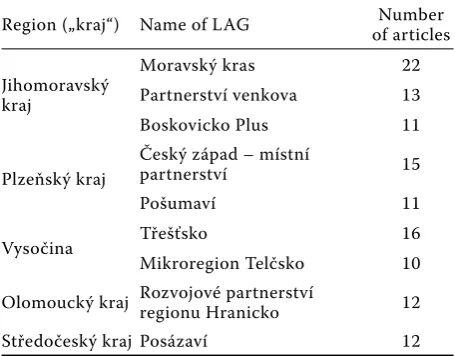
The differences among the regions pointed out in the previous paragraphs suggested the necessity to analyse the regions to answer the question if the most addressed LAGs are those which are the most in line with the LAGs’ principles and reflecting the paradigmatic shift in rural development. Therefore, we firstly assessed the most addressed LAGs in the media. Table 2 shows the LAGs which are addressed in the media in more than 10 articles. Such an ap-proach refines the focus through regions where the concrete LAGs were not analysed in the paper yet. Because Plzeňský kraj indicated in the analysis pre-sented above to be worth of a further investigation, the two LAGs of this region will be further scrutinized as well as other LAGs in Table 2.
[image:5.595.66.387.100.299.2]Table 2 indicates the LAGs which were addressed in the media more than ten times during the moni-tored period between May and October 2013. These LAGs have been functioning for 7.8 years in aver-age. It means their average time of operation is 1.5 years longer that the average time of operation of all Czech LAGs. (7.2 years). Therefore, they are more experienced groups of local partnerships. As such, they already understand the importance of the information and experience transfer reflecting the LEADER approach principles. The transfer of Figure 2. Comparison of the av-erage number of articles per one local action group according to regions
Source: Authors’ calculation
2.35 4.81
2.00 3.00
1.71 1.83 2.00 1.77 6.89 1.87 1.50 3.44 1.06 0.00 1.00 2.00 3.00 4.00 5.00 6.00 7.00 8.00 N umber of Published Artick les per 1 LAG
Average at the Czech Republic level = 2.85 article
per 1 LAG
information and experience of this type supports the social networks. The articles of such case refer to the examples of good practices which are generated in these networks. The analysis also demonstrated a sort of cleavage in the discourse in the media. When the particular LAGs were addressed by more articles (Table 2), there was also an information about new practices. It is because the particular LAG was portrayed as a unique actor in rural devel-opment. Contrary, when the LAGs were addressed as one of the actors in rural development, the texts mostly discussed the negotiations for getting the money from the funds within the EU programme period 2014–2020. This fact confirms our previous findings suggesting there is a difference among the LAGs in terms of observing the new paradigm in rural development. However, the number of the LAGs which are in line with the new paradigm is low. Therefore, also when the LAGs in general are reported, the majority of them dominates in the discourse which echoes the experienced (exogenous) ways of practicing rural development.
Nearly 40% of articles dealing with the issues of LAGs were published in 3 regions only, namely in
“Jihomoravský kraj” (15.5%), “Plzeňský kraj” (12.5%) and Vysočina (11%). Almost 30% of the published articles in the “Plzeňský kraj” and “Jihomoravský kraj”
were discarded from the analysis because these ar-ticles were identical repetitions in the regional media mutations. Nevertheless, the repetition suggests the effort of the LAGs to spread information about the LAGs operating in the region throughout the entire region and not only in the territory where the LAG
is located. Regions located in the North-West of the Czech Republic (“Karlovarský, Ústecký and Liberecký kraj”) have the lowest number of articles published about the local action groups – about 2.0–2.5% out of all analysed articles. In term of these regions (namely
Karlovarský kraj), Stachová (2005) documents that the representatives of the non-profit sector in the Karlovy Vary Region consider the civic engagement of the local actors being very low. In this region, there are quite a few non-profit organizations and people are unwilling to participate in these organizations. Such situation most probably impacted also the LAGs which are not able to engage the local people into rural development and to mainstream the new forms of this development consisting in public involvement and cooperation.
It is interested that the LAGs were addressed also in the media published for Prague (2.21%). They always referred to the local action groups operating in the close vicinity of the capital city, yet belonging to the territory of the Central Bohemia Region (its rural areas). Linking rural activities with the capital city in such case strengthens the rural-urban rela-tions which is in line with the EU policy (European Commission 2012).
Local action groups viewed as rural development actors
[image:6.595.63.291.127.305.2]Activities of the local action groups were the most frequently described by journalists as the authors of the articles (42%). They were also frequently described by the people directly involved in LAG, e.g. a director or a manager (26%), and by a mayor or another local public administration representative (22%). From the point of view of the actors involved within the region (except for the employees in the local action group who are the second in terms of the number of authors following the journalist as authors), the majority of information about the activities of the LAGs comes from the regional public administration represen-tatives. It suggests a tight cooperation of the local action groups and the municipalities. The mayors most frequently noted the financial means acquired by the local action groups for the implementation of projects. These findings show the connection with the studies of Binek et al. (2011) or Varga (2009). They document that the largest volume of finances received by the LAGs aimed at the grants and projects for the municipalities as the applicants. It also shows that the LAGs which re-distributed money to the applicants Table 2. The most frequently mentioned LAGs in the
individual articles
Region („kraj“) Name of LAG Number
of articles
Jihomoravský kraj
Moravský kras 22
Partnerství venkova 13
Boskovicko Plus 11
Plzeňský kraj
Český západ – místní
partnerství 15
Pošumaví 11
Vysočina Třešťsko 16
Mikroregion Telčsko 10
Olomoucký kraj Rozvojové partnerství regionu Hranicko 12
Středočeský kraj Posázaví 12
cooperate with the municipalities in the territory where the LAGs operate, at least during the administrative processes related to the project. However, this evokes a question whether the representatives of the public sector do not perceive the LEADER approach as a mere source of subsidies, rather than a tool enabling and supporting the cooperation throughout the sec-tors (Binek et al. 2011).
Only a minimum of articles (4%) refers to the activi-ties of entrepreneurs in relation to a LAG. It suggests that the media do not highlight the links between the entrepreneurs and LAGs (or more generally between the entrepreneurs and rural development). This situation contradicts the very title (and the nature) of LEADER: Liaison (Liens) Entre Actions de Développement de l’Économie Rurale’, meaning ‘Links between the rural economy and development actions’. A partial explanation of the lower involve-ment of entrepreneurs in the LAG activities (and consequently a lower representation of such activities in media) is in the lower social capital. There is low confidence among the entrepreneurs in terms of their involvement in local partnerships. The entrepreneurs see the discrepancy between their individual busi-ness strategies and the local strategy developed by the LAG. They are afraid that such contradiction will harm their own investment strategies. (Marquardt et al. 2012). The distrust to territorial strategies devel-oped by LAGs indicates a low level of social capital which should be, contrary, supported by the LEADER approach. This finding documents that the LEADER in the Czech Republic still mismatches its goals in many cases. Rural development does not manifest any paradigmatic shift towards the intangible forms of capital in many of the LAGs.
LAGs from the point of view of the contents of the articles
In 31.5% of analysed articles, the LAG was perceived as a sort of agent facilitating the access to finances used to support the implementation of the project. The LAGs were portrayed in public as organizations providing money for the projects without any further value added. Such picture minimizes a chance to use the potential of the local action groups residing in the “soft-issues” such as activating the local population, supporting cooperation and neighbourhood. Being represented as the “channels for money transfers”, the public is not informed that these partnerships are involved in many other important activities, not
only in providing finances for the projects. On the other hand, such portrait suggests what is the main role of the LAGs now and that the role of a financial re-distributor shadows all other roles which creates the image of LAGs as being locked in the paradigm of the exogenous type of rural development
The most frequently projects described in the media (26%) were investments in the community historic buildings (e.g. repairs of the local chapels or resto-rations of sculptures). The second most frequented projects in the media (16.5) were those focusing on the material support of associations (e.g. a reconstruc-tion of the houses for the voluntary fire brigades or purchasing equipment for the activities of the associa-tions). The projects in this second category are mostly “hard-type” (investment) projects, but they signifi-cantly support the development of the community life. Such a latent function is important for building the social capital. We can label these investments as investments in the social capital because they develop the background for networking. Similar findings are documented in Lošťák and Hudečková (2010), who state that although “hard projects” are more supported, “soft projects” are not neglected. On the contrary, many of the “hard” projects in their impacts influence the community life. The third type of articles about the LAGs introduced projects improving the technical infrastructure (e.g. sewage systems, pipelines) and the public space such as the public green areas (15% of analysed articles), The fourth and fifth types (in terms of descending frequency) of articles document the construction of children’s playgrounds and sports grounds (10.8%) and the reconstructions of the vil-lage municipal office or other municipal buildings (10.2%). It is obvious from the analysed texts that the intangible benefits of projects implemented in the LEADER led rural development are not reflected in the media. It confirms our previous finding that the LEADER approach is in the majority of cases (especially if implemented by younger LAGs) still “jailed” in modernization paradigm without indica-tion of the shift towards the post-modern paradigm in rural development which is represented by the very nature of the LEADER (Ray 2000).
was mentioned, it was the most often the coopera-tion among the local accoopera-tion groups (26.4%) or the cooperation between the LAG and the municipalities (24.8%). The other forms of cooperation included the non-profit sector, local associations or citizens. This finding confirms again the assumption that the LAGs most frequently cooperate with the public sector (this fact was supported by the low number of articles about entrepreneurs mentioned above). When cooperation among the LAGs is addressed in the articles, its content concerns the implementation of the cooperation projects (projects financed by the LEADER payment agency – the State Agricultural Intervention Fund). Within the framework of the cooperation between the LAGs and the public sec-tor, the most frequent cooperation speaks about co-organizing events in the territory where the LAGs operate. When the articles highlight cooperation, there is a reference to the intangible factors in the rural development, yet the number of such articles was quite insignificant in the overall number of the analysed texts. The projects of cooperation among the LAGs consisted in the renewals of the cultural heritage, attracting people to the countryside to dwell there, the renewals of old water springs, the develop-ment of trails with regional topics (e.g. introducing the local springs), or opening the local museums. However, the projects of cooperation among the LAGs often represent an institutionalized way of cooperation with the rules defined in writing in a contract for cooperation. It is not a sort of informal cooperation but the cooperation of the partners in the project is mutually concluded in the formal way. Such formalization of the contracts also indicates a low level in trust (Putnam 1993). Cooperation is formal, it is implemented through formal rules origi-nating mostly outside the community. It means that the rules are determined by the power of the actors who have a chance to influence the development of the locality via their decision-making. Such an approach does not contribute to building the social capital and it is not in line with the paradigmatic shift in rural development necessitating the bottom-up approach and local engagement based on informal cooperation rooted in the mutual trust.
LAGs and paradigmatic shift in rural development
We were also interested to conduct some more statistical tests in order to found out more findings
[image:8.595.306.532.696.738.2]highlighting our research questions. When looking at the statistical dependence between the reference to a definite LAG (name of the LAG) and to the topic in which the LAG is referred in terms of activities outside the LAG territory (e.g. negotiating the con-ditions for the new programming period) or inside the LAG territory (e.g. distributing finances, other activities within the LAG territory, strategic plan-ning) there was a statistically significant dependence as pointed out in the Table 3. It means, as suggested above, that the concrete LAGs differ in terms of their activities and it impacts their commitment to the paradigmatic shift in the Czech rural development where still a large number of LAGs is anchored in the exogenous approach rooted in the economy of scale and focusing on the tangible (material) issues instead of supporting the social capital, for example. The findings indicate that if a definite LAG was mentioned, it was most frequently in the connection with different activities it carried out within the ter-ritory and with the provision of finances to the local actors. Namely, it means the re-distribution of the finances (reflecting references to financial capital), the implementation of projects conducted by the local action group, and the organization of cultural, social or sports events (e.g. a tacit reference to supporting social capital). The activities related to the operation (work) of the LAGs and the support or coordination of the regional quality labels within their territories were also mentioned. They are the local quality labels which symbolise new forms of the rural development governance (Lošťák et al. 2015), which gives a hope of a starting transition to the new paradigm in rural development. However, we confirmed that the Czech LAGs are often perceived as the regional subsidy agencies, rather than an animator assisting the co-operation of the local actors. If no particular LAG was mentioned, the articles dealt with the activities not related to a particular locality. The most frequent topic was about the negotiations of the conditions for the programming period 2014–2020. The LAGs were also generally mentioned in connection with the project of the inter-municipal cooperation under
Table 3. The relationship between a particular LAG and the topic with which the LAG is mentioned
Calculated χ2 test
Critical χ2
α = 0.05 Result Cramer’s V
180.419 9.488 Dependence 0.602
the Union of Towns and Municipalities of the Czech Republic, which recommended the involvement of professionals (human capital) from the local ac-tion groups because they are the ones with a good knowledge of the territory and the experience in the development of the locality.
Because the research question addressed the para-digmatic shift in rural development, we were obvi-ously interested if the LAGs bring into the rural development discourse anything new in terms of the topics which are discussed in the analysed texts. The investigation focused on the intangible issues linked to the endogenous rural development and investments or the utilization of intangible capitals such as the social capital, human capital or cultural capital. These issues were operationalized through such categories like the renewal of traditional hab-its, small scale projects for the countryside which impacted the whole territory, engaging people into the active participation in various events.
If the novelties in the rural development were dis-cussed, it was mostly in the articles dealing with the LAGs in the general than in relation to the particular rural activities (e.g. planning the future program-ming period, the LAG as one of the actors in the countryside). The operation of the LAGs in such case was mostly viewed as beneficial because of sup-porting the locality where the people live. It means the LAGs engaged them into events and the people participated in the territorial issues. The LAG was also mentioned as an appropriate association sup-porting cooperation of the actors in the countryside. These findings echo the concept of the civil society. There is another signal of the shift in rural develop-ment paradigm. The media report about people who are interested in the support and utilization of rural values, culture and social relations. Such situation can be achieved via mutual cooperation both inter-nally and with the neighbours (National Network of LAGs 2011). On the other hand, the articles which do not refer to just the described issues regarding the LAGs activities prevailed significantly in the analysed text. This second (and much large category
of articles) continued the focus on the redistribution of money to the project applicants. It means that the paradigmatic shift in rural development in the Czech Republic is only at the beginning. Some LAGs indicate this shift but most of the LAGs continue the development focusing on the exogenous approach.
CONCLUSION
[image:9.595.65.290.697.740.2]Local action groups were foreseen as the precur-sors of the paradigmatic shift in rural development (Ray 2000). Their design should enable to develop the rural territories from the bottom, to engage lo-cal people in the rural activities and to eliminate the social exclusion in this way. Achieving the bottom-up approach and engagement in local issues was sup-posed to be reflected in the development of the civil society. However, the analysis demonstrated that the Czech media often present the LAGs as organizations redistributing the finances (one third of the texts) with no further added value for the territory they operate. It means that the media suggest that the goals of the LEADER approach were not achieved in the Czech Republic yet, despite that there is grow-ing information about the new approaches in rural development. No wonder of such situation, because already in 2000 the papers reflecting the situation in the old EU members states which started with the LEADER in the 1990s documented that the intan-gible outcomes of the LEADER are not visible yet too much (Osti 2000; Ray 2000; Shucksmith 2000). These papers explained this fact through the short programming periods in the EU when 7 years is not enough. However, even without reference to the programming period, it takes a longer time till the new forms of governance (LAGs and the LEADER is one of them) anchor into the everyday practices (Lošťák et al. 2015). It takes up to 10 years to see the first intangible outcomes which would have im-pacts throughout all country. It means that it will be interesting to conduct a similar research in about 2018–2020, when about 10 years from the start of the LAGs will be achieved. Right now the local people have not so many chances to find out more informa-tion about the impacts of the LAGs activities, with the exception that the LAGs act as the provider of money for the implementation of project. This is the reason why the mentioned potential of these lo-cal partnerships cannot be fully used. On the other hand, some LAGs are already portrayed as the actors Table 4. A correlation between addressing a novelty in the
LAG activity and the territory where the LAG operates
Calculated χ2 test
Critical χ2
α = 0.05 Result Cramer’s V
45.304 9.488 Dependence 0.302
influencing the paradigmatic shift. Their number is rather marginal, but they exist.
The outputs of the content analysis show the emerg-ing new paradigm of rural development in terms of the cooperation and social networks in some LAGs in “Jihočeský kraj”, “Plzeňský kraj” and “Vysočina”. The local actors in these regions already recognized the importance of mutual communication about the activities organized by the LAGs. Contrary, the regions situated in the North-West did not refer to the cooperation in connection with the local action groups. In all the monitored texts, the LAGs are the most frequently mentioned by people directly involved in the LAGs or by the public sector repre-sentatives; the entrepreneurs are nearly not men-tioned at all. For this reason, the concept of the LAG as the inter-sectorial rural development actor is lost within the public discourse. It means that the LAGs are so far not meeting all the principles on which the LEADER approach is built. It again suggests that the Czech Republic is now in the starting phase of the paradigmatic transition in rural development.
If 62% of the texts does not mention the coopera-tion at all when referring to the LAGs, it suggests that the paradigmatic shift in rural development was completed only by some of the LAGs. It also means that the rural development in the Czech Republic is conducted in two ways: the exogenous (dominating) and endogenous (emerging), despite the number of LAGs which all should incline to the last way of rural development. If the texts refer to cooperation, it is the most frequently in the projects of cooperation between the LAGs or the cooperation with the public administration. The cooperation is often of a formal nature. Its rules and conditions are determined outside the territory. External actors still have the power to influence the form of cooperation within the terri-tory. References to intangible factors can be found in a small number of the texts on the cooperation of the LAG and the public sphere (such as co-organizing events for the local citizens). This is the first sign of the shift from the exogenous towards the endogenous development model.
REFERENCES
Baudrillard J. (1994): Simulacra and Simulation (translated by Sheila Faria Glaser). The University of Michigan Press. Binek J., Svobodová H., Chabičovská K., Holeček J., Gal-vasová I., Martének J. (2011): Synergie ve venkovském
prostoru. Paradoxy rozvoje venkova. (Synergies within a rural area. Rural development paradoxes.) GaREP, Brno. Blažek B. (2004): Venkovy – anamnéze, diagnóza, terapie.
(The rural areas – history, diagnosis, treatment.) Era, Brno.
Bryman A. (2008): Social Research Methods. Oxford Uni-versity Press, New York.
Casieri A. (2010): Trust building and social capital as devel-opment policy tools in rural areas. An empirical analysis: the case of the LAG CDNISAT. New Medit, 1: 24–30. Čermák D., Vobecká J. et al. (2011): Spolupráce, partnerství
a participace v místní veřejné správě: význam, praxe, příslib. (Cooperation, Partnership and Participation in the Local Public Administration: Meaning, Practice, Promise.) Sociologické nakladatelství (SLON), Praha. Devereux E. (2003): Understanding the Media. SAGE
Pub-lication, London.
Disman M. (2002): Jak se vyrábí sociologická znalost. (How to make a sociological knowledge.) Charles University, Prague.
European Commission (2012): LEADER and Cooperation. European Network for Rural Development, Belgium. European Parliament (2014): Guidance on Community –
Led Local Development for Local Actors. Version 3, European Structural and Investment Funds.
Furmankiewicz M., Thompson N., Zielińska M. (2010): Area-based partnerships in rural Poland: The post-accession experience. Journal of Rural Studies, 26: 52–61. Lopolito A., Nardone G., Sisto R. (2011): Towards a Com-prehensive Evaluation of Local Action Groups in LEAD-ER Programmes. New Medit, 1: 43–49.
Lošťák M., Hudečková H. (2010): Preliminary impacts of the LEADER+ approach in the Czech Republic. Agricultural Economics – Czech, 56: 249–265.
Lošťák M., Karanikolas P., Draganova M., Zagata L. (2015): Local quality and certification schemes as new forms of governance in sustainability transitions. In: Sutherland L-A., Darnhofer I., Wilson G.A., Zagata L. (eds): Transi-tion Pathways towards Sustainability in Agriculture: Case studies from Europe. CABI, Wallingford, UK: 157–169. Lowe P., Murdoch J., Ward N. (1995): Networks in Rural
De-velopment: Beyond Exogenous and Endogenous Models in Beyond Modernization: The Impact of Endogenous Rural Development. Van Gorsum & Comp., Assen. Marquardt D., Möllers J., Buchenrieder G. (2012): Social
Networks and Rural Development: LEADER in Romania. Sociologia Ruralis, 52: 398–431.
Národní síť Místních akčních skupin České republiky (2011): Národní strategický plán LEADER 2014+ (Na-tional Network of Local Action Groups in the Czech Republic: National Strategic Plan LEADER 2014+.) Available at http://nsmascr.cz/content/uploads/2012/07/ N%C3%81RODN%C3%8D-STR ATEGICK%C3%9D-PL%C3%81N-LEADER-2014+-pln%C3%A1-verze.pdf Osti G. (2000): LEADER and partnerships: the case of Italy.
Sociologia Ruralis, 40: 172–180.
Putnam R. (1993): Making Democracy Work. Civic Tradi-tions in Modern Italy. Princeton University Press, New Jersey.
Ray Ch. (2000): The EU LEADER Programme: Rural de-velopment laboratory. Sociologia Ruralis, 40: 163–171. Shucksmith M. (2000): Endogenous development, social capital and social inclusion: Perspectives from LEADER in the UK. Sociologia Ruralis, 40: 208–218.
Schiller H. (2011): Networks of Local Action Groups in Ru-ral Areas – The Example of the EU Initiative Broads and Rivers LEADER+. VDM Verlag Dr. Müller GmbH&Co., Saarbrücken.
Stachová J. (2005): Občanská společnost v regionech České republiky. (Civic society in the regions of the Czech Republic.) Sociologický ústav Akademie věd ČR, Praha. Stachová J. (2008): Občanská společnost v regionech České
republiky. (Civic society in the regions of the Czech Republic.) Sociologický ústav Akademie věd ČR, Praha.
Stepin V. (2005): Theoretical Knowledge. Synthese Library, Vol. 326. Springer, Dordrecht.
Sutherrland L.-A., Burton R.J.F. (2011): Good farmers, good neighbours? The role of cultural capital in social capital development in a Scottish farming community. Sociologia Ruralis, 51: 238–255.
Swain N (2013): Green Barons, Force-of-Circumstance Entrepreneurs, Impotent Mayors: Rural Change in the Early Years of Post-Socialist Capitalist Democracy. Cen-tral European University Press, Budapest.
Trägardh L., Witoszek N., Taylor B. (2013): Civic Society in the Age of Monitory Democracy. Berghanh books, New York.
Van Depoele L. (2013): Local Development Strategy in the EU. The Case of LEADER in Rural Development. Institute for International and European Policy. Catholic University of LEUVEN, Leuven. Available at http://www. eurolocaldevelopment.org/wp-content/uploads/2013/03/ local_development_strategies_in_the_eu-.pdf (accessed August 2014).
Varga E. (2009): Non-profit Organizations in Hungar-ian Rural Development – a LEADER+ Example in the Southern Transdanubian Region. European Countryside, 1: 93–104.
Received: 23th March 2015 Accepted: 16th June 2015
Contact address:
Kateřina Boukalová, Czech University of Life Sciences Prague, Faculty of Economics and Management, Kamýcká 129, 165 21 Prague 6, Czech Republic