Sputtered Al film, AlN film, and incompletely-nitrided Al film (Al–N film) has been investigated from the view point of forming the mesoscopic scaled surface roughness because it can be applied to,e.g., the solar absorption coating, the solar cell and/or the diffusive coloring. The surface structures have been characterized and the growth condition dependence, such as the degree of nitriding which is controlled by changing mixing ratio of N2and Ar sputtering gases, the film thickness (df), and the substrate temperature (Tsub), are systematically investigated.
The following controllable factors about surface structure are confirmed. The characteristic of the form of protuberances on the surface depends on the degree of nitriding. The height and the width of the protuberances can be controlled bydfand/orTsub.
(Received August 5, 2005; Accepted October 25, 2005; Published December 15, 2005)
Keywords: surface roughness, sputtered aluminum film, AlN film, aluminum–nitrogen film, gradient function, thin film
1. Introduction
The optical absorption property and/or the coloring on the material surface depend not only on the intrinsic optical property of the material itself but also on its surface structure. The scale of the surface structure concerned in this paper is the same as the optical wavelength or less than it, i.e., mesoscopic surface structure. In the case of the solar energy thermal conversion coating, e.g., the surface roughness induced by film growth at higher substrate temperature1)
and/or the dense array of metal whisker structure2) were
applied to improve the efficiency. On the other hand, the solar cell performance is also related to the surface roughness.3)
Special surface textures, e.g., the inverted hemisphere structure or the inverted pyramid structure were introduced to improve the efficiency of the solar cell.4,5)
Recently we discovered that the rf sputtered incompletely-nitrided Al film (Al–N film) with submicron scaled surface roughness showed high solar absorptance.6) It has been combined with Al film with low emittance, then a solar selective absorber coating with surface roughness was successfully fabricated.7) On the other hand, the surface roughness is also applied to realize the diffusive structural colour. The Al film with the proper surface roughness showed high white diffuse reflection whose colour was changed by the coating of the transparent AlN film.8)In these examples,
the important technology is to find the experimental condition to realize the proper surface roughness. However, the characterization of these mesoscopic surface roughness and the forming conditions have not been investigated systematically. The aim of this paper is to find the relation between the mesoscopic surface structure formed on the Al and Al–N films and the film growth conditions such as the degree of nitriding, the film thickness (df), and the substrate
temperature (Tsub). Of course, several investigations at
respective formation conditions of Al and/or Al alloy films have been performed.9–13) However, the perspective view
point to control the forming of the mesoscopic submicron scaled surface roughness, which is useful to be gradient function, has been lacked.
2. Experiment
Films were deposited using an rf sputtering apparatus, which was evacuated using a turbo-molecular pump. The base pressure was 4105Pa. A water-cooled Al target
(99.999%, 100 mm diameter) was sputtered at 200 W. The substrate was Corning # 7059 glass. The substrate temper-ature was changed from 303 to 413 K. A pure Ar or a mixture of Ar (99.9995%) and N2 (99.9995%) was used as the
sputtering gas. The total working gas pressure (Ptot) was
1.33 Pa, which is the sum of the partial pressure of N2(PN2)
and the partial pressure of Ar.
The composition of the film was controlled by changing the concentration ofPN2(cN2¼PN2=Ptot100) from 0%N2
to 13%N2. Then the substance of the deposited film was
changed from Al to AlN via incompletely-nitrided Al (Al–N) with increasing cN2. It has been already confirmed by the
X-ray diffraction in our previous study that the Al–N films are composed of Al and AlN.6)
Surface morphology was observed using an atomic force microscope (AFM) (Nanopics, NPX100AFM head, Seiko Instruments Inc.). The silicon AFM-cantilever which has a tip with the radius of curvature of 20 nm was used. The scanning-surface was performed in the atmosphere at room temperature by using the damping-mode.
Film thickness was measured using a surface-texture-measuring instrument (Surfcom 200B, Tokyo Seimitu Ltd.). The deposition rate was evaluated from the smooth film with a thickness of less than 100 nm, because the reproducibility of the measured film thickness with the deposition time could be kept up to only approximately 100 nm for the specimen of
*1Corresponding author, E-mail: [email protected]
*2Present address: Electronics Components Division, The Furukawa
cN2¼0{8%N2. One reason for the non-reproducibility of the
measured film thickness is thought to be the enhanced surface roughness during film growth, as described later. For convenience, we identify films from their estimated thick-nesses based on the deposition rates in this paper hereafter. Maximum film thickness, prepared in this study was 700 nm. If need be, each film was also labeled on the basis of its substance, concentration of PN2 (cN2), deposition thickness
(df), and substrate temperature (Tsub), e.g., Al–N(cN2, df,
Tsub) represents an Al–N film with a thickness ofdfdeposited
atTsub using a gas mixture withcN2.
3. Results and Discussion
As an characterization item, Fourier transformation of the local-height-distribution (FT-LHD) of the surface has been defined as follows: First of all, the two dimensional distribution of height (512512 pixels) within an AFM’s scanning field (10mm10mm) is transformed into the two dimensional distribution of Fourier amplitude. Correspond-ing intensity distribution is calculated by amplitude squared, and is averaged around the circle with equal radius from the origin in reciprocal space. Then the one dimensional quantity appeared to be a profile of the section area of the averaged intensity distribution is defined. Let us call this FT-LHD-profile, which has a meaning correspond to the Fourier transformation of the one dimensional correlation function of height distribution function.
3.1 Change of surface morphology by nitriding
In order to characterize the nitriding effect on the surface morphology, the films are formed in a cN2 range between
0%N2 and 13%N2 at df ¼300nm and Tsub ¼373K.
Figure 1 shows the cN2dependence of the AFM plan view
images and the corresponding respective FT-LHD-profiles. In these images, the change of darkness from darkness toward brightness corresponds to the elevating height. The surface of pure Al film [Fig. 1(a)] looks like connecting protuberances and/or range of protuberances with width about 1mm. The corresponding FT-LHD-profile shows a peak at around 1mm1. Figures 1(b) and (c) show the incompletely-nitrided Al surfaces. They are composed of isolated protuberances with variety of width and height. The corresponding FT-LHD-profiles do not have any characteristic peak like
Fig. 1(a) but rather monotonously reduce with increasing
1=dfrom the origin. The surface of much more nitrided film becomes flat with sparse protuberances [Fig. 1(d)], and then becomes smooth surface [Fig. 1(e)].
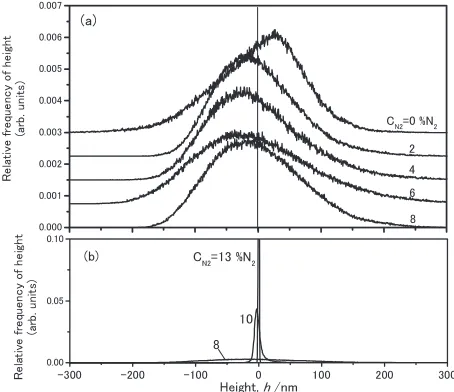
The cN2 dependence of the distribution of relative
frequency of the height (RFH) is shown in Figs. 2(a) and (b) in which the origin of the height axis corresponds to thedf
of 300 nm. It is obvious that the distributions of RFH of the films with cN2 less than or equal to 8%N2 show relatively
broad distribution. However, there is a characteristic differ-ence between pure Al film and Al–N films, i.e., the distribution of RFH of the pure Al film has a maximum position at the positive side of height, on the other hand, the Al–N films have their maximum positions on negative side without exception. This difference is because of the differ-ence between the connecting protuberances and the isolated protuberances with variety of size in the morphology as mentioned in Figs. 1(a) and (b)–(c).
Figure 3 shows the height dependence of material volume fraction (f) of 300-nm-thick specimens deposited at different
cN2. The gradual change in fis realized in the Al–N films due
to the surface roughness, which is composed of
protuber-Fig. 1 N2gas concentration (cN2) dependence of AFM plan view images and corresponding FT-LHD-profiles of 300-nm-thick specimen
deposited atTsub¼373K.cN2: (a) 0%N2, (b) 2%N2, (c) 6%N2, (d) 10%N2, and (e) 13%N2.
Fig. 2 Change of distribution of relative frequency of the height along the surface normal of the 300-nm-thick specimen deposited atTsub¼373K as
[image:2.595.75.526.73.216.2] [image:2.595.312.539.265.461.2]ances with the variety of height and width. This is thought to be a gradient-index optics, which is one of the reasons of the low specular reflectance, low diffuse reflectance, and high absorptance in visible and near infra-red regions6)as shown
in Fig. 4.
3.2 Film thickness dependence of surface morphology of Al and Al–N films
Al(0%N2, df ¼46{500nm, 373 K) films and Al–N
(6%N2, df ¼55{700nm, 373 K) films are deposited.
Re-protuberance in the Al film, the Al–N film growth shows different way. The surface of 55-nm-thick Al–N film [Fig. 6(a)] is also composed of protuberances as small as the 46-nm-thick Al film [Fig. 5(a)]. However, the respective protuberances in the 55-nm-thick Al–N film seem to be isolated. With increasing df [Figs. 6(b)–(e)], the size of the
protuberance increases. However, there is not a tendency that the neighboring protuberances connect each other. Further-more, the difference in the peak height of protuberance is seemed to be enhanced. This fact reflects to the change of FT-LHD-profiles (Fig. 6) with rather monatomic change com-pared with the profiles in Fig. 5.
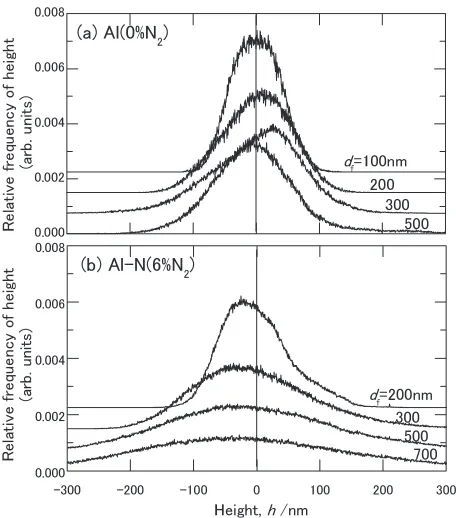
Figures 7(a) and (b) show the comparison of df
depend-ence of RFH between Al (0%N2,df ¼100{500nm, 373 K)
Fig. 4 N2gas concentration (cN2) dependence of optical properties of the 300-nm-thick specimen deposited atTsub¼373K: (a) specular
reflectance, (b) diffuse reflectance, and (c) absorptance. volume fraction (f) of the 300-nm-thick specimen deposited at
films and Al–N (6%N2,df ¼200{700nm, 373 K) films. The
origin of height axis corresponds to the respective df’s. In
both cases, RFH becomes broadened with increasingdf. The
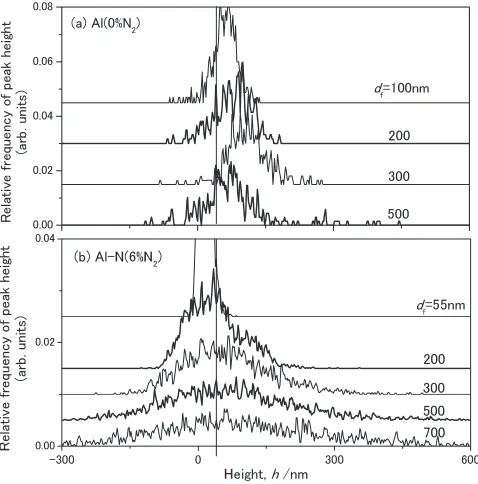
[image:4.595.71.525.72.217.2]width of the distribution of the Al–N film is larger than corresponding width of the Al film. The peaks of distribution of the Al films are located at around the origin and/or positive side of the height axis. On the other hand, the peaks of distribution of the Al–N films are located on negative side of the height axis. This difference corresponds to the concave surface or the convex surface.11)Then the difference of the distribution gives us a hint of controlling the gradient-profile. The local peak heights are also extracted from AFM data, and then the distributions of the relative frequency of local peak height (RF-LPH) are obtained as shown in Figs. 8(a) and (b). In the case of the Al film [Fig. 8(a)], the width of the distribution of RF-LPH is narrower than that of the Al–N films, and the peak positions of the distribution of RF-LPH are clearly located on positive side of the height axis. These facts are reflection of the Al film surface morphology such as the protuberance range. The relatively broad distributions of RF-LPH in Al–N case [Fig. 8(b)] are due to the surface morphology with mixture of large and small protuberances. It is important that each characteristic of the surface morphol-ogy should remain during film growth.
Figure 9 shows the df dependence of the highest and
lowest local peak heights of surface protuberance, and the
Fig. 5 Film thickness (df) dependence of AFM plan view images and corresponding FT-LHD-profiles of pure Al film deposited at
Tsub¼373K.df: (a) 46 nm, (b) 100 nm, (c) 200 nm, (d) 300 nm, and (e) 500 nm.
Fig. 6 Film thickness (df) dependence of AFM plan view images and corresponding FT-LHD-profiles of Al–N film deposited at
cN2¼6%N2,Tsub¼373K.df: (a) 55 nm, (b) 200 nm, (c) 300 nm, (d) 500 nm, and (e) 700 nm.
Fig. 7 Film thickness (df) dependence of distribution of relative frequency
[image:4.595.71.525.281.426.2] [image:4.595.54.282.488.747.2]lowest height of the films. In the case of Al–N films [Fig. 9(b)], all of these quantities increase linearly withdf. In
the case of Al films [Fig. 9(a)], however, the change of corresponding quantities deviates from linear curve at the beginning of film deposition. Among them, the lowest height starts to uprise from about df ¼200nm, i.e., a kind of
incubation thickness. This means that the substance of Al has a tendency of aggregation, which is thought to be one of the reasons for the distinct surface morphology. It is concluded that the scale-up of the surface morphology is possible by increasing the film thickness.
3.3 Substrate temperature dependence of surface mor-phology
Al (0%N2, 300 nm,Tsub¼303{413K) films are deposited.
Tsub dependence of the AFM plan view images and the
FT-LHD-profiles are shown in Fig. 10. The size of the protuberance seems to increase with increasing Tsub.
How-ever, there is a tendency that some protuberances gather together to form cluster [Figs. 10(a)–(c)] or range of protuberances [Figs. 10(d)–(e)]. The amplitude of FT-LHD-profiles of the Al film increases with increasing Tsub.
However, the maximum position of the FT-LHD-profile of the Al film with different Tsub is located at almost similar
position of 0.5mm1 as indicated by arrow. Namely the
typical correlation length does not change withTsub, although
the protuberances grow withTsub. This is contrasted with the
case of the Al film growth at an equalTsubas shown in Fig. 5,
where the peak position of the FT-LHD-profile became small with increasingdf.
Figure 11 shows theTsubdependence of the distribution of
the RFH of Al (0%N2, 300 nm, Tsub ¼303{413K) films.
With increasingTsub, the width of the distribution broadens
and the maximum position moves toward the positive side of the height axis. Similar tendency has been seen more clearly in theTsub dependence of the RF-LPH as shown in Fig. 12.
Fig. 8 Film thickness (df) dependence of distribution of relative frequency
of the peak height along the surface normal of the specimens (a): Al (0%N2) and (b): Al–N (6%N2) deposited atTsub¼373K.
Fig. 9 Film thickness (df) dependence of highest and lowest local peak
[image:5.595.324.526.70.294.2]heights and lowest height of specimens: (a): Al (0%N2, 373 K) and (b): Al–N (6%N2, 373 K).
Fig. 10 Substrate temperature (Tsub) dependence of AFM plan view images and corresponding FT-LHD-profiles of 300-nm-thick pure Al
[image:5.595.49.288.73.315.2] [image:5.595.71.526.375.521.2]These facts correspond to the formation of the range of protuberances.
As mentioned above, the degree of the surface roughness increases with Tsub. However, there is a certain limit.
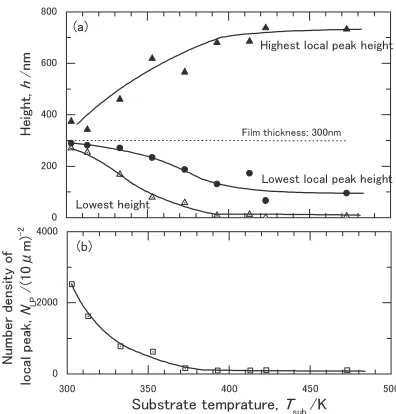
Figure 13(a) shows the Tsub dependence of the highest and
lowest local peak heights and the lowest height of the Al (0%N2, 300 nm) films,i.e., the bottom of the surface valley.
Figure 13(b) also shows the correspond change of the number density of the local peak. All of these quantities change monotonically up to around Tsub ¼400K, then
saturate at the higher Tsub. It is concluded that the size of
the surface profile can be controlled byTsub, however, there is
a certain upper limitedTsubabove that the surface profile does
not change remarkably.
3.4 Other factors of surface morphology and controlla-bility of them
Figure 14 shows thedf dependence of the number density
of local peak (NLP) of Al and Al–N films deposited at
differentTsub’s of 303 and 373 K. Corresponding to Fig. 14,
the dependence of the normalized surface area (SNR) is shown
in Fig. 15. The SNR’s value of 1.0 means a perfect smooth
surface. All of NLP’s decrease with increasing df and are
almost saturated in more than 300 nm. Either specimen, the
NLP decreases with increasing Tsub. The NLP for the Al
(303 K) shows the largest value among them and itsSNR is
almost one. These facts mean that the surface roughness of the Al film is not enhanced at rather lowTsubof 303 K. On the
other hand, whenTsubincreases in only 373 K, theNLPof the
Al film decreases drastically, the SNR increases and then
[image:6.595.326.524.70.277.2]saturates at beginning stage of the film growth,i.e., at around
Fig. 11 Substrate temperature (Tsub) dependence of distribution of relative
frequency of the height along the surface normal of Al (300 nm).
Fig. 12 Substrate temperature (Tsub) dependence of distribution of relative
[image:6.595.55.284.73.211.2]frequency of peak height of Al (300 nm).
Fig. 13 Substrate temperature (Tsub) dependence of (a): highest local peak
[image:6.595.49.288.267.435.2]height, lowest local peak height, and lowest height, (b): number density of local peak of 300-nm-thick Al film.
Fig. 14 Film thickness (df) dependence of number density of local peak of
specimens of (a): Al (0%N2, 303 K), (b): Al (0%N2, 373 K), (c): Al–N (6%N2, 303 K) and (d): Al–N (6%N2, 373 K).
Fig. 15 Film thickness (df) dependence of normalized surface area of
[image:6.595.323.527.339.451.2] [image:6.595.325.526.516.654.2]100–20 nm, although the size of protuberance is enlarged as show in Fig. 5. On the contrary, Tsub dependence of NLP of
the Al–N film is not so strong in comparison with Al film. TheSNRof Al–N films gradually increase withdf. Especially
the growth at higherTsubis profitable to enlarge theSNR.
Finally in order to clarify how we control the surface roughness, cN2 andTsub dependence of the FWHM of RFH
for the 300-nm-thick specimen is illustrated in Fig. 16. The fully nitrided AlN films (cN2>12%N2) show relatively
smooth surface, which is not affected byTsub strongly. The
FWHM of RFH of pure Al increases withTsubmonotonically.
In the intermediate region, i.e., incompletely-nitrided Al–N film, the FWHM of RFH is enhanced at around 6%N2. The
over all feature of the curved surface of the FWHM of RFH seems to be a curved surface that a ridge at cN2¼6%N2
along theTsub axis covers on a slope connected between the
Tsub axis atcN2¼14%N2 and the monotonically increasing
curve at cN2¼0%N2. If we remember the qualitative
difference in form of surface roughness between Al and Al–N films, i.e., concave or convex surface, it can be mentioned that the surface morphology with the variety of
There are, however, proper saturated sizes. It can be concluded that the Al and N binary rf sputtered film system is one of the promising systems to provide the mesoscopic surface morphology, which is useful to realize the variety of the gradient-profile.
Acknowledgment
One of the authors (T.I.) was supported by a Grant-in-Aid for Science Research from the Ministry of Education, Culture, Sports, Science and Technology of Japan.
REFERENCES
1) G. A. Nyberg and R. A. Buhrman: Appl. Phys. Lett.40(1982) 129–131. 2) J. J. Cuomo, J. F. Ziegler and J. M. Woodall: Appl. Phys. Lett.26
(1975) 557–559.
3) H. Taniguchi, H. Sannomiya, K. Kajiwara, K. Nomoto, Y. Yamamoto, K. Hiyoshi, H. Kumada, M. Murakami and T. Tomita: Solar Energy Materials and Solar Cells49(1997) 101–106.
4) J. Zhao, A. Wang, P. Campbell and M. A. Green: IEEE Trans. Electron Devices46(1999) 1978–1983.
5) M. A.Green, J. Zhao, A. Wang and S. R. Wenham: IEEE Trans. Electron Devices46(1999) 1940–1947.
6) T. Ishiguro, M. Nishimura and T. Yamazaki: Jpn. J. Appl. Phys.41
(2002) 292–300.
7) M. Nishimura and T.Ishiguro: Jpn. J. Appl. Phys.43(2004) 757–761. 8) M. Nishimura and T. Ishiguro: Mater. Trans.44(2003) 2417–2419. 9) P. S. McLeod and L. D. Hartsough: J. Vac. Sci. Technol.14(1977)
263–265.
10) R. S. Nowicki: J. Vac. Sci. Technol.17(1980) 384–387.
11) M. Furukawa, Y. Yamamoto, H. Ikakura, N. Tanaka, M. Hashimoto, A. Sano and S. Shingubara: Appl. Opt.35(1996) 701–707.
[image:7.595.55.283.72.262.2]12) K. Kamoshida: J. Vac. Sci. Technol. B18(2000) 2565–2568. 13) C. Eisenmenger-Sittner: J. Appl. Phys.89(2001) 6085–6091. Fig. 16 N2gas partial pressure concentration (cN2) and substrate
temper-ature (Tsub) dependence of FWHM of relative frequency of height of