In vitro
establishment and proliferation of red currant
cultivars
J. Sedlák, F. Paprštein
Research and Breeding Institute of Pomology Holovousy, Ltd., Holovousy, Czech Republic
Abstract
Sedlák J., Paprštein F., 2012. In vitro establishment and proliferation of red currant cultivars. Hort. Sci. (Prague), 39: 21–25.
The goal of this study was to investigate in vitro multiplication protocols for use with red currant cultivars grown in the Czech Republic. Cultivars Detvan, Vitan and Rotte Höllandische were successfully established in vitro using mercuric chloride in a concentration of 0.15% as a sterilization solution. The overall rate of contamination was 25.7%. Two proliferation media Murashige and Skoog medium (MS) and McCown woody plant medium (WPM) containing 1 or 2 mg/l of 6-benzylaminopurine (BAP) were tested. Initial explants produced new plants in the form of rosettes. Rosettes arose from the base of the initial explants in the form of adventitious bud formation. The shoot number was relatively low and varied between 1.0 and 2.1. Generally, the highest number was obtained for cultivar Rotte Holländische that produced 2.1 ± 0.1 new rosettes on MS medium containing lower concentration 1 mg/l BAP. In contrary, Vitan cv. had
significantly lower shoot number ranging from 1.0 to 1.3. WPM medium with a lower concentration of mineral salts proved to be unsuitable for the multiplication of tested cultivars.
Keywords:Ribes; medium; explant; 6-benzylaminopurine; growth regulator
The red currant (Ribes rubrum L.) is a member of the genus Ribes in the gooseberry family Grossu-lariaceae, and is a popular bush fruit grown widely in the Czech Republic, especially in home gardens. Fruits are eaten raw or cooked into syrups, jams and jellies. In recent in vitro studies, red currant was identified as a good dietary source with poten-tial antidiabetes and antihypertension functional-ity (da Silva Pinto et al. 2010). Concerning the current commercial currant growing, there were 1,002 ha of red and white currant and 345 ha of black currant plantations in the Czech Republic in 2009 (Buchtová 2009).
Commercially, it is almost entirely propagated by hardwood cuttings. This method, although
gener-ally successful, is slow and labor intensive. Success with rooting of cuttings also varies with the indi-vidual genotype, age of the stock plant and vege-tation period (Hričovský 1985; Schubert et al. 2001). Micropropagation has the ability to quickly produce large numbers of shoots from a relatively small amount of initial plant material. It is espe-cially effective in the case of new varieties, when clonal material is limited in supply. It also enables the maintenance of plant material in a pathogen-free environment and the development of sophisti-cated in vitro virus elimination techniques (in vitro thermotherapy and chemotherapy).
Data on in vitro currant culture are quite limited in comparison to other fruit woody species. Over the
last three decades, some reports indicated that in vitro culture propagation on various basal media us-ing axillary bud proliferation and adventitious shoot regeneration were achieved with varying success for different species from the Ribes genus (Flegmann, Wainwright 1981; Wainwright, Flegmann 1986; Orlikowska et al. 1991; Arena, Pastur 1995; Benson et al. 1996; Karjalainen et al. 2001; Golis et al. 2002; Ruzic, Lazic 2006). However, reported number of newly formed shoots usually did not exceed 3–4 shoots per original explant. The response of individual genotypes also varied during the whole cycle of micropropagation (Leontiev-Orlov et al. 2004; Ruzic, Lazic 2006).
The work reported here was designed to investi-gate in vitro multiplication protocols for use with commercially important red currant cultivars grown in the Czech Republic as a part of the pro-gram for sanitation of initial plant material from vi-ruses by in vitro thermotherapy and chemotherapy.
MATERIAL AND METHODS
The initial explants were actively growing shoot tips (5–10 mm in length) taken from shoots of red currant cultivars Detvan (154 shoot tips), Vitan (101 shoot tips) and Rotte Höllandische (130 shoot tips) sprouting in laboratory conditions. The donor dormant shoots were obtained in February from mature bushes growing in field collections of Re-search and Breeding Institute of Pomology (RBIP) Holovousy, Ltd., Holovousy, Czech Republic. The apical parts of shoots were prepared for sterilisa-tion procedure by removing all expanded leaves. They were sterilised by a 1-min immersion in a fresh 0.15% HgCl2 solution with several drops of wetting agent added (Tween-20). This was carried out under sterile conditions. All sterile manipulations were in
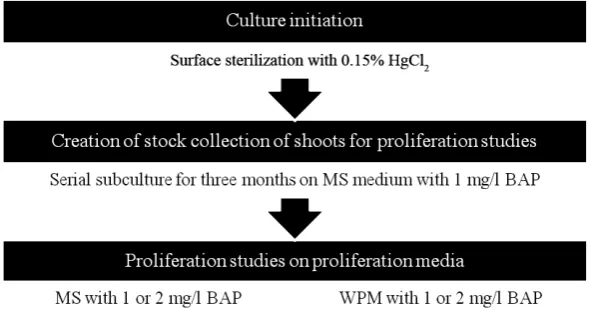
a laminar flow hood. After thorough rinsing in ster-ile deionised and demineralised water, the explants were placed in 200 ml glass culture flasks (five shoots per flask), each with 35 ml of culture medium. The culture medium contained Murashige, Skoog me-dium (MS) salts and vitamins (Murashige, Skoog 1962) supplemented with 100 mg/l inositol, 2 mg/l glycine, 30 g/l sucrose, 1 mg/l 6-benzylaminopurine (BAP) and 7.0 g/l Difco Bacto agar. The medium was adjusted to pH 5.8 with NaOH prior to dispensing and autoclaving at 120°C at 100 kPa for 15 min. All shoot cultures were grown at 22 ± 1°C with a 16-h daily photoperiod. The irradiance was provided by Sylvania F18W (Sylvania, Erlangen, Germany) cool white fluorescent tubes positioned 30 cm above the level of cultures. If any exudation from the initial ex-plants occurred, they were moved to fresh medium. At this time any malformed tissues were discarded. All shoot cultures were serially subcultured for three months on a MS medium supplemented with 1 mg/l 6-benzylaminopurine (BAP). This provided a stock collection of shoots for proliferation studies.
Two proliferation media MS and WPM (Woody Plant Medium) according to Lloyd and McCown (1981) containing 1 or 2 mg/l BAP were tested from the beginning of the culture. Proliferation rate was defined as the number of newly formed shoots (ro-settes > 5 mm) per initial in vitro plant after four
[image:2.595.64.360.86.241.2]weeks of culture. Cultures were transferred to fresh medium once a month. At each subculture the ex-plants were removed and dissected to determine the number of rosettes that had proliferated from the initial single in vitro plant. This sequence was repeated three times and a minimum of four cul-ture flasks per cultivar was recorded on each occa-sion. The rosettes formation was recorded between the first and seventh subculture. Various stages of micropropagation are included in Fig. 1. Treatment means were compared with the standard error
(SE) of the mean. Analysis of variance (ANOVA) and Duncan’s multiple range test were performed to analyze shoot number rates. For the three red currant cultivars, the effect of two agar solidified media (MS, WPM) and BAP growth regulator in two concentrations on proliferation rate, callus for-mation and shoot morphology is shown.
RESULTS AND DISCUSSION
Results of sterilization procedures and develop-ment of shoots from initial explants are stated in Table 1. Selected three genotypes of red currant were successfully established in vitro using mercuric chloride in a concentration of 0.15% as a steriliza-tion solusteriliza-tion. The rate of contaminasteriliza-tion for particu-lar cultivars was 8.4% for Detvan, 31.5% for Rotte Holländische and 44.6% for Vitan. The overall rate of contamination was 25.7%. All contaminated explants were later discarded. In vitro culture was established from remaining actively growing uncontaminated explants. During and after our sterilization proce-dure, we did not observe browning of currant ex-plants or cultivation medium caused by oxidation of phenolic substances from the cut surface of the explant, which is otherwise associated with woody species. Arena and Pastur (1995) obtained for greenhouse-grown Ribes magellanicum 70% sur-vival and only 12% contamination after the disin-festation procedure of initial explants with NaOCl
(1% active Cl). In our study, bacterial and fungal contaminations after sterilization of initial explants were more frequent, probably because the donor shoots were directly exposed to field microflora.
After 4 weeks in culture, ca. 90% initial explants survived and produced new plants in the form of rosettes with circular arrangement of well devel-oped leaves, shortened internodes along a stem and a short, but well developed shoot tip. Rosettes appeared to arise from the base of the initial ex-plants in the form of adventitious bud formation. In our experiments on both media, any physiological disorders or morphological abnormalities such as excessive callus formation or production of abnor-mally narrow leaves were not observed during in vitro shoot proliferation stage. Further dividing and subculturing the basal shoot mass did not cause tis-sue breakdown or exudation.
The number of newly formed shoots for par-ticular cultivars is shown in Table 2. Values of multiplication rate were relatively low and varied between 1.0 and 2.1. Generally, the highest rate was obtained for cultivar Rotte Holländische that produced 2.1 ± 0.1 new rosettes on MS medium
containing lower concentration 1 mg/l BAP. Simi-lar number of newly formed shoots (2.0 ± 0.1) was obtained on the same medium with the same lower BAP concentration for Detvan cv. Across both me-dia and BAP concentrations the rosette multiplica-tion of Rotte Holländische cv. was the best. On the contrary, for cultivar Vitan, none of the two me-Table 1. Surface sterilization with 0.15% HgCl2
Cultivars (number of sterilized initial explants)
Explants contaminated Established explants which developed shoots
number (%) number (%)
Detvan (154) 13 8.4 141 91.6
Rotte Holländische (130) 41 31.5 89 68.5
Vitan (101) 45 44.6 56 55.4
[image:3.595.65.532.515.608.2]Totally (385) 99 25.7 286 74.3
Table 2. Shoot number of red currant cultivars
Cultivar MS medium WPM medium
BAP 1 mg/l BAP 2 mg/l BAP 1 mg/l BAP 2 mg/l
Detvan 2.0 ± 0.1a 1.5 ± 0.1b 1.0 ± 0.0c 1.0 ± 0.1c
Rotte Holländische 2.1 ± 0.1a 2.0 ± 0.1a 1.2 ± 0.1c 1.0 ± 0.0c
Vitan 1.3 ± 0.0bc 1.0 ± 0.0c 1.0 ± 0.0c 1.0 ± 0.0c
[image:3.595.61.534.640.716.2]dia and BAP concentrations promoted markedly in vitro shoot formation and the number of newly formed shoots was thus relatively low from 1.0 to 1.3. General appearance of the shoots was better at lower cytokinin content (1 mg/l).
The cultivars in this study differed in their mul-tiplication and development potential. The ef-fect of the genotype on the various aspects of the performance of tissue-cultured material was also reported in other studies on Ribes species (Wain-wright, Flegmann 1985; Brennan et al. 1989; Orlikowska et al. 1991; Leontiev-Orlov et al. 2004; Ruzic, Lazic 2006). Our experiments con-firmed that multiplication depends not only on the concentration of cytokinins in culture medium, but also on the response of individual genotype. The observed differences in multiplication among red currant cultivars in this study under the influence of an exogenous BAP could result from the genetic control of different auxin and cytokinin metabo-lisms of plant tissue. The studies of Brennan et al. (1990) on the in vitro culture of a range of Ribes cultivars, breeding lines and species showed clear differences in genotypic multiplication rates and cultural behaviour which suggest a link between multiplication rate and genetic composition related to geographical origin.
The lowest shoot number (1.0–1.2) was noted for all selected cultivars on WPM medium. This me-dium with a lower concentration of mineral salts proved to be unsuitable for the multiplication of tested cultivars. Explants of Rotte Holländische and Detvan cvs on WPM medium produced signif-icantly lower shoot numbers at both BAP concen-trations in comparison with MS medium. In vitro plants on WPM medium were of poor quality and developed symptoms of yellowing or chlorosis of leaves in later subcultures.
It was possible to maintain actively growing in vit-ro cultures of all used red currant cultivars on both tested media only for a limited number of subcultures (usually, 7–9 subcultures; total culture period about 9 months), after which they either ceased to prolifer-ate and multiply or eventually turned yellow-brown and subsequently died out. There was no obvious reason for this decline in proliferation and multipli-cation. Similar phenomenon of not sustained rate of proliferation was described by Wainwright and Flegmann (1985) in their multiplication experi-ments with Ribes uva-crispa L. They described that the proliferation rate of two R. uva-crispa cultivars fell since the fourth subculture on MS medium with
1µM/l BAP and they questioned the sustainability of further subculturing beyond 170 days from culture initiation. In contrary Brennan et al. (1989), Tosh-kov (2004) and Ruzic and Lazic (2006) found that a BAP level of 0.5–2 mg/l in modified MS medium proved satisfactory for shoot induction and repro-ducible and sustainable development of a range of diverse Ribes nigrum genotypes.
From our studies, the red currant was the most dif-ficult fruit species to propagate. The procedure was shown possible, but the levels of multiplication were low. It is sufficient for in vitro culture establishment, short-term maintenance and in vitro thermotherapy. But such a low shoot number is not satisfactory for larger in vitro shoot production in a commercial scale.
In near future, the use of micropropagation for Ribes species is unlikely to be widely used in commercial production, as there are already relatively slow but in-expensive and reliable traditional nursery techniques. In vitro propagation, which can be carried during the dormant season, could provide an alternative means to produce disease-free stock material. In vitro propa-gation techniques are also general prerequisites to ex-ploiting somaclonal variation and induced mutations, and for the development of transgenic plants.
CONCLUSSION
The use of mercuric chloride in a concentration of 0.15% as a sterilization solution proved to be an applicable treatment method to disinfect the start-ing plant material of selected red currant cultivars. It was found under the conditions employed that MS medium and BAP level of 1 mg/l is satisfactory for in vitro culture establishment and short-term maintenance of tested red currant cultivars, but not for sustainable development and multiplication in larger scale. More research is needed to develop a protocol suitable for commercial micropropaga-tion. Other methods will be investigated, for ex-ample multiplication system according to Ruzic and Lazic (2006), which uses nodal sections taken from elongating in vitro shoots grown on media supplemented with low concentrations of indole-3-butyric acid (IBA) and giberellic acid (GA3).
References
Arena M.E., Pastur G.J.M., 1995. In vitro propagation of
Benson E.E., Reed B.M., Brennan R.M., Clacher K.A., Ross D.A., 1996. Use of thermal analysis in the evaluation of cryopreservation protocols for Ribes nigrum L. germ-plasm. CryoLetters, 17: 347–62.
Brennan R., Davidson D., Wilshin A., Millam S., 1989. An assessment of the in-vitro multiplication rates of fourteen black currant cultivars. Journal of Horticultural Science, 64: 679–681.
Brennan R.M., Millam S., Davidson D., Wilshin A., 1990. Establishment of an in vitro ribes germplasm col-lection and preliminary investigations into long-term low temperature germplasm storage. Acta Horticulturae 280: 109–112.
Buchtová I., 2009. Situační a výhledová zpráva ovoce (Com-modity Report – Fruit Crop). Ministry of Agriculture of the Czech Republic, Prague: 80.
da Silva Pinto M., Kwon Y.I., Apostolidis E., Lajolo F. M., Genovese M. I., Shetty, K., 2010. Evaluation of red currants (Ribes rubrum L.), black currants (Ribes nigrum
L.), red and green gooseberries (Ribes uva-crispa) for po-tential management of type 2 diabetes and hypertension using in vitro models. Journal of Food Biochemistry, 34: 639–660.
Flegmann A.W., Wainwright H., 1981. Shoot doubling time: a quantitative parameter for characterizing shoot cultures in vitro. Plant Cell Tissue Organ Culture, 1: 85–92. Golis A., Korbin M., Pluta S., 2002. The development of
ribes embryos by interspecific hybridisation. Acta Horti-culturae, 585: 155–158.
Hričovský I., 1985. Rozmnožovanie ríbezlí a egrešov (Propa-gation of currant and gooseberry). In: Ríbezle a Egreše. Bratislava, Príroda: 50–61.
Karjalainen R., Välimäki K., Pacot-hiriart C., Kl-eemola M., Lehto K., 2001. Optimising of the transfor-mation methods of black currant (Ribes nigrum L.) and development of transgenic resistance against black currant reversion virus. Acta Horticulturae, 560: 169–172.
Leontiev-Orlov O.A., Leontieva-Orlova L.A., Mossi A., Cansian R.L., 2004. Study of the influence of major ions and benzylaminopurine on proliferation in vitro of microshoots of apple,plum, trifoliata orange and black currant by a systematic variance method. Acta Horticul-turae, 632: 249–254.
Lloyd G., McCown B., 1981. Commercially-feasible mi-cropropagation of mountain laurel, Kalmia latifolia, by use of shoot tip culture. Combined Proceedings of the International Plant Propagators’ Society, 30: 421–427. Murashige T., Skoog F., 1962. A revised medium for rapid
growth and bioassays with tobacco tissue cultures. Plant Physiology, 15: 473–497.
Orlikowska T., Lisek A., Serwik M., 1991. Micropropaga-tion of 9 genotypes of black currant. Fruit Science Reports,
18: 51–61.
Ruzic D., Lazic T., 2006. Micropropagation as means of rapid multiplication of newly developed blackberry and black currant cultivars. Agriculturae Conspectus Scienti-ficus, 71: 149–153.
Schubert V., Mareček F., Dlouhá J., Sus J., 2001. Ry-bíz (Ribes, Grossulariaceae) In: Mareček F. et al. (eds), Zahradnický Slovník Naučný 5. Ústav zemědělských a potravinářských informací, Prague: 137–139.
Toshkov A., 2004. Clonal micropropagation of black cur-rant (Ribes nigrum). Multiplication and roots formation in vitro of the micropropagated shoots. Rastenievadni Nauki,
42: 147–155.
Wainwright H., Flegmann A.W., 1985. The micropropaga-tion of gooseberry (Ribes uva-crispa L.): I. Establishment
in vitro. Journal of Horticultural Science, 60: 215–221. Wainwright H., Flegmann A.W., 1986. Studies on the
micropropagation of Ribes species. Acta Horticulturae,
183: 315–321.
Received for publication February 25, 2011 Accepted after corrections July 11, 2011
Corresponding author:
Ing. Jiří Sedlák, Ph.D., Research and Breeding Institute of Pomology Holovousy, Ltd., Holovousy 1, 508 01 Hořice v Podkrkonoší, Czech Republic