Selection procedure and multicriterial selection
of small and bigger lorries
V. Drobný
1, M. Kavka
2, V. Tlustý
31
Norske Skog a.s., Štětí, Česká Republika
2
Faculty
of Engineering, Czech University of Life Sciences in Prague, Prague, Czech Republic
3Chamber of Deputies, Parliament of the Czech Republic, Prague, Czech Republic
Abstract: The developed car market makes demands on the potential user in the Czech Republic in view of the se-lection, purchase and operation. More vehicles appear on the market and it is far more complicated to make a good choice. There are plenty of methods and ways to simplify or improve the selection procedure. The article presented solves a multicriterial selection issue based on the results of a survey of small and bigger lorries. The main method of multi-criteria selection was PATTERN (Planning Assistance Trough Technical Evaluation of Relevant Numbers) suitable for the comparison of non-homogeneous criteria targeting a row of significance of each variant.
Keywords: multicriterial evaluation; change trend; weight of significance; selection procedure; index of change; com-parison
The developed car market makes demands on the potential user in the Czech Republic in view of the selection, purchase and operation. More vehicles appear on the market and it is far more complicated to make a good choice (Abrhám et al. 2002). There are plenty of methods and ways (Skoupý 2006) to simplify or improve the selection procedure. In ac-cordance with Zemánek et al. (2004) the decisive criteria are technical, technological and economic. The multivariate data analysis must always be ap-plied (Hair at al. 2005). The article presented here solves a multicriterial selection issue based on the results of a survey of small and bigger lorries.
MeThoDology
The word van is used to describe a vehicle larger than a small lorry. Depending on the variant, it is possible to transport up to 3.5 t of freight or 15 people but in this case such a lorry is understood as a vehicle determined for human transportation, hence a smaller bus.
In all categories of lorries, the vehicles operating and functional parameters which had more or less impact on the selection were compiled. These parameters
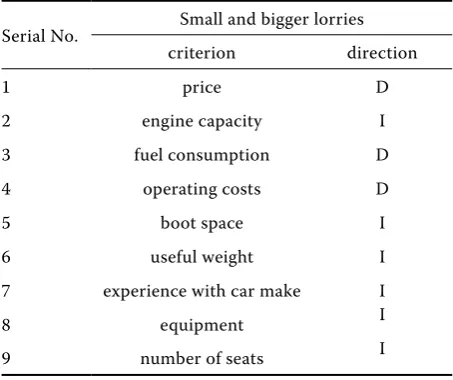
(criteria) were input into a table in which the direction was also stated which the respective criterion should vary so that the selection was more likely.
A questionnaire was put together based on the parameters which did not feature in any car makes surveyed and this was given to the managers and people responsible for the selection and purchase of vehicle fleets in companies operating on the Czech market. Their task was to find the significance of each parameter (criterion) by the method of com-paring the pairs in a triangle.
The data obtained were processed by a suitable method of multicriterial comparison with the con-clusion of which car was the most suitable for the chosen group of companies regardless of the car makes and comparing this with the car selection made according to the car make.
Among the methods which considered more cri-teria at the time of selection (or factors) is a method of multicriterial (multifactor) comparison called PATTERN (Planning Assistance Trough Technical Evaluation of Relevant Numbers), suitable for the comparison of non-homogeneous criteria targeting significant rows of variants (Tomek & Vávrová 1999).
Algorithm of method PATTeRN is as follows:
(1) Selection of the criteria for the vehicle com-parison.
(2) Definition of the trend in the change of the criteria chosen (growing, decreasing).
(3) Setting the weight of significance of each cri-terion.
(4) Calculation of indices of changes of the chosen criteria for the compared vehicles.
(5) Putting the compared vehicles in order. The number of the evaluation criteria should not be too small (1–2) as this would cause a deficiency in the description of the differences between all evaluation factors (vehicles) and at the same time the number of the evaluation criteria should not be too large as this would cause a decrease in the power of selection.
The PATTERN method allows the trend to be dis-tinguished for each variable. In practice this means that it is possible to define under which condition the result is more effective.
[image:2.595.63.290.394.584.2]Criteria used and their effects are stated in Table 1.
The opinions of all evaluators were subsequently processed and the point values of significance and weights of significance for each criterion were set. The point value of significance was set as:
BHVj = PHij (2) p
where:
BHVj – points value of significance of j criterion
PHij – number of votes assigned by i evaluator to j criterion
P – number of evaluators
It is possible to set the weight of significance as:
qj = BHVj
(3)
BHVj
where:
qj – the weight of significance of j criterion
m – number of criteria
It is applicable to objectify the weight of signifi-cance of the chosen criteria using the opinions of more evaluators but it is also necessary to determine the level of agreement of each evaluator in order to use the achieved results. It is possible to use the following relationship:
W =
12 n
ij – p(m + 1)
2
(4)
p2(m3 – m)
m – number of criteria
p – number of evaluators
nij – order of j criterion assigned by i evaluators
W = 1 – complete agreement of opinions (the results can be used unambiguously)
W = 0– complete difference in opinions (the use of results is seriously arguable)
In the case of an expressed disagreement of the evaluators it is necessary to correct the weights of the evaluating criteria as follows:
– By a change of the number of evaluators (usually by increasing their number. The increase of the number of evaluators does not have to lead to an increase in agreement of the opinions!),
– By amending the selection of the evaluating criteria. To calculate the change indices, it was necessary to procede as follows:
If the trend of the requested changes was increas-ing
Table 1. Criteria used and their effects
Serial No. Small and bigger lorries criterion direction
1 price D
2 engine capacity I 3 fuel consumption D 4 operating costs D
5 boot space I
6 useful weight I
7 experience with car make I
8 equipment I
9 number of seats I
D – decreasing trend; I – increasing trend
Method of comparison of pairs in triangle
Criteria 1 to 9 were compared, or more precisely 1 to 11 were arranged in pairs into triangles whereby the necessary numbers of combinations PK were created.
PK = m(m + 1) = 9(9 – 1) = 36 (1) 2 2
where:
m – number of criteria compared
i=1
¦
pj=1
¦
mi=j
¦
p j=1¦
m«¬
ª
¨¨© §
2 ¸¸¹ ·
»¼
º
100
Ijx = Hjx (5)
HjMIN
where:
Hjx – value of j parameter of x factor,
HjMIN – lowest value of j parameter of the studied factor
If the trend of the requested changes was decreas-ing
Ijx = HjMAX (6)
Hjx
where:
Hjx – value of j parameter of x factor,
HjMAX – the highest value of j parameter of the studied factor
Subsequently it is necessary to set the weighted index of change for every factor index as:
Ijkv = Ijx × qi (7)
where:
qj – weight of significance of j parameter
The setting of the order of the factors compared (the factor with the highest value Sx is the most advantageous) could be secured by arranging the sums of the weighted indexes of change of each factor (Eq. (8)).
Sx = Ijx × v (8)
ReSulTS AND DiScuSSioN
Using the chosen criteria for small and bigger lor-ries a questionnaire was given to several managers or people in other management positions. The question-naire was created on the principle of the weight of significance organised in pairs in a triangle schema.
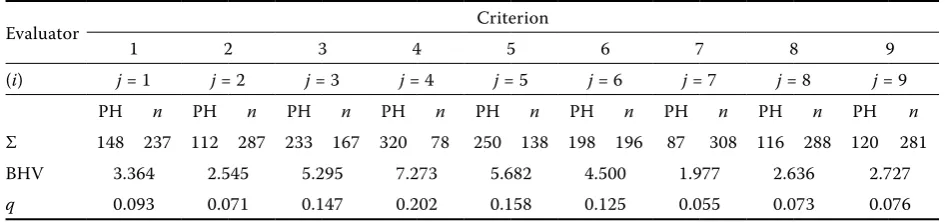
There were 9 criteria set for the small and bigger lorries and these were compared by 44 evaluators in the questionnaire and the outcomes (i.e. the votes assigned to each criterion and the ranking of
these criteria based on the votes) were organised in Table 2.
With the help of Table 2 and Eq. (2) the point value of the significant criteria was calculated and by us-ing Eq. (3) the significance of the chosen criteria q was ascertained.
From the values obtained and by using Eq. (4) the level of agreement of each evaluator W was identified.
Number of criteria: m = 9
Number of evaluators: p = 44
Value W for small and bigger lorries was
in this case: W = 0.44
This means that the agreement between the evalu-ators was 44%. The final order of each criterion is represented in Figure 1.
Probably “The relative importance of criteria in the selection of lorries” would be a better title for this.
Small lorries
In Table 3, the input values of the compared criteria of small lorries are stated. It is a variant of vehicle with a diesel engine with 55 kW output and with two seats and freight capacity of between 600 and 730 kg.
Indices of change were calculated in relation to the trend of changes through Eq. (5) in the case that the trend of criteria was growing and through Eq. (6) in the case of a decreasing trend.
Using Eq. (7), a weighted index of the trend of change was found and through Eq. (8) weighted in-dices and hence the order of the car favourableness were organized.
From the results of this comparison it follows that: – The order of vehicles according to favourableness
is: Volkswagen Caddy, Ford Connect, Renault Kangoo, and Citroën Berlingo,
– The span of results between the compared vehi-cles is maximum 12.37%.
Bigger lorries
[image:3.595.61.537.647.758.2]This was a variant of vehicles (Table 4) with diesel engines with the output between 63 and 77kW and
Table 2. Consideration of the significance of evaluated criteria from 44 evaluators
Evaluator Criterion
1 2 3 4 5 6 7 8 9
(i) j = 1 j = 2 j = 3 j = 4 j = 5 j = 6 j = 7 j = 8 j = 9 PH n PH n PH n PH n PH n PH n PH n PH n PH n
Σ 148 237 112 287 233 167 320 78 250 138 198 196 87 308 116 288 120 281 BHV 3.364 2.545 5.295 7.273 5.682 4.500 1.977 2.636 2.727
q 0.093 0.071 0.147 0.202 0.158 0.125 0.055 0.073 0.076
without a glazed boot space, with a load capacity of around 1100 kg.
From the results it follows that:
– The order of vehicles according to favourable-ness is: Peugeot Boxer, Ford Transit, Volkswagen Transporter, Mercedes-Benz Sprinter,
– The range of results between the compared ve-hicles is maximum 10.05%.
coNcluSioNS
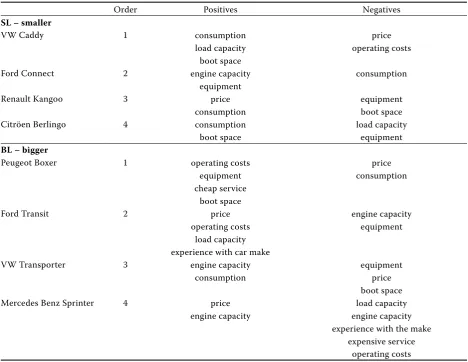
In Table 5 the overall evaluation results of the followed vehicles are recorded. The following con-clusions emerge from the results:
Small lorries as a small van (Sl –smaller). Low
consumption, great experience with the car make, bearing capacity, and boot space were the main
0.093 0.071 0.147 0.202 0.158 0.125
0.055 0.073 0.076
[image:4.595.77.511.63.256.2]0.00 0.05 0.10 0.15 0.20 0.25 C ar ȱp ri ce En gi ne ca pa ci ty Fu el co ns um pt io n Ope rat io nal co st s Bo ot ȱs pa ce Lo ad ca pa ci ty Ex pe ri en ce w ith ȱc ar C ar eq ui pm en t N um be rȱo f se at s W ei gh tȱo fȱs ig ni fic an ce ȱo fȱc ri te ri a
Table 3. The values of the compared criteria of small lorries as a small van
Parameter Compared lorries – small vans
Car make Citröen VW Renault Ford
Type Berlingo Caddy Kangoo Connect
Description Furgon 1.9D skříň 2.0 SDI Express 1.5 dCI 1.8 TDCI
Equipment 600 2KAA32 Generique SWB 200
Car price (CZK) 359900 378687 338100 359900
Engine capacity (kW) 51 51 48 55
Fuel consumption (l/100 km) 5.5 5.3 5.5 6.3 Operational costs (CZK/km) 2.73 2.73 2.29 2.46
Boot space (m3) 3 3.2 2.75 2.8
Load capacity (kg) 600 730 689 638
Experience with the make (points 1–5) 4 5 3 3
Car equipment (points 1–5) 2 4 2 4
Number of seats (pcs) 2 2 2 2
Sum Sx 1.063 1.195 1.090 1.121
Sx (%) 100.0 112.4 102.5 105.5
Sx 0.89 1.00 0.91 0.94
[image:4.595.61.533.312.636.2]Order of compared factors 4 1 3 2
Table 4. The values of the compared criteria of bigger lorries as a van type
Parameter Compared lorries – vans
Car make Mercedes Benz VW Peugeot Ford
Type Sprinter Transporter Boxer Transit
Description 209 CDI / K skříň 1.9 TDI Furgon 3000 VAN 2.2 TDCI
Equipment 7HH172-OWQ L1H1 2.2 HDI MWB 300
Car price (CZK) 548500 604504 589000 559900
Engine capacity (kW) 63 77 74 63
Fuel consumption (l/100 km) 8.9 6.1 7.5 7.4 Operational costs (CZK/km) 4.14 3.36 3.11 3.03
Boot space (m3) 7.5 6.7 8 7.44
Load capacity (kg) 1070 1170 1155 1305
Experience with the make (points 1–5) 3 5 4 5
Car equipment (points 1–5) 5 3 4 3
Number of seats (pcs) 3 2 3 3
Sum Sx 1.101 1.156 1.212 1.208
Sx (%) 100.0 104.9 110.0 109.7
Sx 0.91 0.95 1.00 1.00
Order of compared factors 4 3 1 2
Table 5. Results of the evaluation of small and bigger lorries (SL, BL)
Order Positives Negatives
Sl – smaller
VW Caddy 1 consumption price
load capacity operating costs boot space
Ford Connect 2 engine capacity consumption equipment
Renault Kangoo 3 price equipment
consumption boot space Citröen Berlingo 4 consumption load capacity
boot space equipment
Bl – bigger
Peugeot Boxer 1 operating costs price
equipment consumption cheap service
boot space
Ford Transit 2 price engine capacity
operating costs equipment load capacity
experience with car make
VW Transporter 3 engine capacity equipment
consumption price
boot space Mercedes Benz Sprinter 4 price load capacity
engine capacity engine capacity experience with the make
[image:5.595.63.532.396.758.2]reasons why VW Caddy won in the comparison of small Lorries even though the purchasing price was the highest and the operating costs belonged to the high ones. Contrary to this, Citröen Berlingo was in the last position. Its operating costs were among the highest and neither the load capacity nor the price put this car at the top of its class.
Bigger lorries as a van (Bl – bigger). The
catego-ry of vans was won by Peugeot Boxer, which offered the largest boot space as well as one of the lowest operating costs due to the relatively low service requirements (or costs). At the other end, 10% mea-sures distance was Mercedes Benz Sprinter which, while being offered for the lowest price, was judged as average or low average except for the equipment. Also the operating costs were over those of the other cars in this class due to a high fuel consumption and very expensive service.
From the price and operating costs point of view Ford Tranzit shows good parameters.
It is obvious from the groups of lorries presented that the PATTERN method of multi-criteria com-parison is easy to use and is transparent for the comparison of vehicles at selection and purchase.
The most difficult, time consuming, and most com-plicated part of the PATTERN method is the prepara-tion of the quesprepara-tionnaire, data collecprepara-tion, and its evalu-ation. In the case where the agreement of opinions is very low, it is necessary to increase the number of evaluators or amend the evaluation criteria.
If it is necessary to use other parameters, it is also possible to apply the method to the comparison of other devices than lorries. To achieve better trans-parency and precision of the results, it is better to use fewer criteria for the comparison. For a more gentle comparison of non-specific or subjective parameters such as experience with the car make or prestige of the car make, it is recommended that the evaluation scale be increased e.g. 0–20 or 0–100.
References
Abrhám Z. et al. (2002): Obnova zemědělské techniky – současnost a perspektiva – 1. a 2. část, Agromagazin Praha, 3: 76–77
Hair J.F. et al. (2005): Multivariate Data Analysis. Prentice Hall, Inc., New Parsley.
Skoupý A. (2006): Multikriteriální posouzení volby technologií. In: Sborník prací institucionálního výzkumu. Mendelova zemědělská a lesnická univerzita v Brně, Brno, 65–70. Tomek G., Vávrová V. (1999): Řízení výroby. Grada
Pub-lishing, Praha.
Zemánek P., Abrhám Z., Burg P. (2004): Ekonomická efektivita nasazení mulčovačů. Horticultural Science, 31: 76–80.
Received for publication May 5, 2007 Accepted after corrections July 12, 2007
Abstrakt
Drobný V., Kavka M., Tlustý V. (2007): Výběrové šetření a multikriteriální výběr malých a větších
užitko-vých automobilů. Res. Agr. Eng., 53: 166–171.
Vyspělý trh s automobily v České republice klade na potenciální uživatele vysoké nároky jak při výběru a nákupu, tak při provozu. Na trhu přibývá nových automobilů a je čím dál složitější si mezi nimi dobře vybrat optimální vůz. Existuje celá řada způsobů a metod, jak usnadnit nebo zdokonalit výběr. Článek řeší problematiku multikriteríálního výběru na základě provedeného výběrového šetření malých a větších užitkových automobilů. Hlavní metodou mul-tikriteriálního výběru byla metoda PATTERN (Planning Assistance Trough Technical Evaluation of Relevant Num-bers), vhodná ke vzájemnému porovnání nehomogenních kritérií s cílem sestavit pořadí významnosti jednotlivých variant.
Klíčová slova: multikriteriální hodnocení; tendence změny; váha významnosti; výběrové šetření; index změny; porovnání
Corresponding author:
Prof. Ing. Miroslav Kavka, DrSc., Česká zemědělská univerzita v Praze, Technická fakulta, Kamýcká 129, 165 21 Praha 6-Suchdol, Česká republika