This thesis is made available online and is protected by original copyright. Please scroll down to view the document itself.
by
JOHN G. HALIKIAS
A Thesis submitted in fulfilment of the requirements for the degree of Doctor of Philosophy of the
University of Warwick.
Department of Economics University of Warwick COVENTRY CV4 7AL
List of Tables
List of Figures
Acknowledgements
Declaration
Summary
TABLE OF CONTENTS
CHAPTER I
INTRODUCTION
1. Objectives of the Thesis 2. Structure of the Thesis
CHAPTER II
THE FOREIGN SECTOR OF THE GREEK ECONOMY
1. Trends of the Foreign Sector of Greece in the Period 1954-1976
2. Previous Studies of the Foreign Trade of Greece
2.1. Imports
2.2. Exports
CHAPTER III
GENERAL ISSUES IN MODELS OF FOREIGN TRADE
1. Import Demand Equations 2. Export Demand Equations
Page
7
12
13
14
15
16
19
21
31
31
36
39
CHAPTER IV
MODEL SELECTION PROCEDURES AND FORMULATION OF
GREECE'S IMPORT AND EXPORT DEMAND EQUATIONS 51
1. Model Selection Procedures 52
1.1. Starting from a Static Model 52
1.2. Starting from a General Unrestricted
Dynamic Model 58
1.3. Seasonality 67
1.4. Application of the Model Selection Procedures
to Monthly Data 72
1 .5. Computational Aspects 81
2. Formulation of Greece's Import and Export Demand
Equations
2.1. The Formulated Hypothesis
2.2. The Relevance of Least Squares
CHAPTER V
THE ESTIMATED IMPORT DEMAND EQUATIONS OF GREECE
1. Statistical Data
2. The Estimated Import Demand Equations of Greece
for Major Groups of Commodities
2.1. Import Demand Equations for Food (SITC:
Section 0)
2.2. Import Demand Equations for Crude Materials
(SITC: Section 2)
2.3. Import Demand Equations for Fuels (SITC:
Section 3)
87
87
92
101
106
106
11 3
2.4. Import Demand Equations for Chemicals
(SITC: Section 5)
2.5. Import Demand Equations for Manufactured
Goods (SITC: Section 6)
2.6. Import Demand Equations for Machinery and
Transport Equipment (Without Ships) (SITC:
Section 7)
2.7. Import Demand Equations for All Goods
(SITC: Sections 0-9)
3. Summary of Findings
CHAPTER VI
THE ESTIMATED EXPORT DEMAND EQUATIONS OF GREECE
1. Statistical Data
2. The Estimated Export Demand Equations of Greece
for Major Groups of Con~odities
2.1. Export Demand Equations for Food (SITC:
Section 0)
2.2. Export Demand Equations for Beverages and
Tobacco (SITC: Section 1)
2.3. Export Demand Equations for Raw Materials
(SITC: Section 2)
2.4. Export Demand Equations for Chemicals
(SITC: Section 5)
2.5. Export Demand Equations for Manufactured
Goods (SITC: Section 6)
Page
132
141
148
157
170
174
177
177
185
1 93
200
Page
2.6. Export Demand Equations for Total Merchandise
Exports (SITC: Sections 0-9) 216
3. Summary of Findings 227
CHAPTER VII
CONSIDERATIONS OF A JOINT ESTIMATION OF
THE IMPORT AND EXPORT DEMAND EQUATIONS
1. Residual Cross Correlation Functions of Import Demand Equations
2. Residual Cross Correlation Functions of Export
Demand Equations
CHAPTER VIII
APPLICATIONS OF THE EMPIRICAL FINDINGS
1. Ex-post Predictions for 1977 and 1978
2. Ex-ante Predictions for 1982
CHAPTER IX
CONCLUSIONS
1. Conclusions from the Application of the Model Selection Procedures
2. Implications for Trade Policies
APPENDIX: TIME SERIES
REFERENCES
230
232
244
253
261
272
282
290
LIST OF TABLES
CHAPTER II
1. Ratios Between Exports, Imports and Gross
National Income
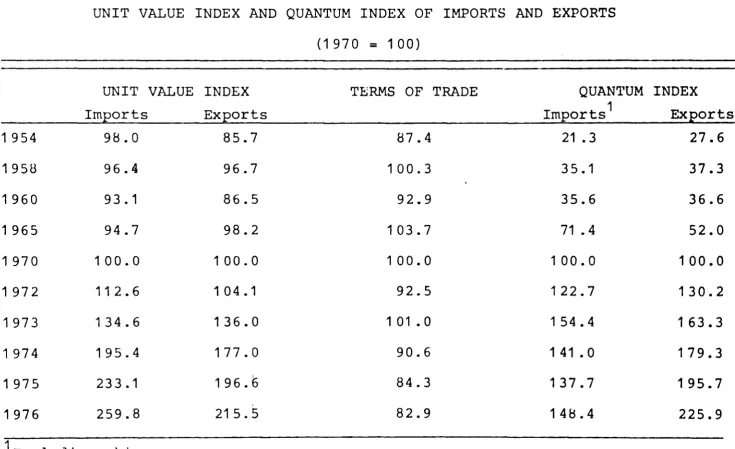
2. Unit Value Index and Quantum Index of
Imports and Exports
3 •
4 •
5.
Percentage Distribution of Imports and
Exports
Balance of Payments
Cover of the Deficit of the Balance of Goods,
Services and Incomes (Percentage Distribution)
6. Level of Aggregation Adopted by Previous
Stu-7 •
1 •
1 .
2.
dies on Greek Import Demand Equations
Level of Aggregation Adopted by Previous
Stu-dies on Greek Export Demand Equations
CHAPTER IV
Process Time Required on the Burroughs 6700
CHAPTER V
Income and Price Elasticities for Six
Catego-ries of Imports and Total Imports
Import Demand Elasticities for Goods (Monthly
Data 1954-1976)
Page
22
24
26
28
30
33
37
85
168
1 •
2.
1 •
CHAPTER VI
Income and Price Elasticities for Five
Cate-gories of Exports and Total Exports
Export Demand Elasticities for Goods (Monthly
Data 1954-1976)
CHAPTER VII
contemporaneous Correlations Between the
Resi-duals of the Import Demand Equations
2. Correlation Coefficients Between Relative
Import Prices
3. Correlation Coefficients Between Relative
Export Prices
1 •
2.
CHAPTER VIII
Post Sample Parameter Stability Tests (1977
Monthly Data)
Actuals and Predicted Values of Greece's Imports
and Exports of Goods for 1977 and 1978
3. Post Sample Parameter Stability Tests (1977
and 1978 Annual Average Data)
4. Greece's Trade Balance in 1982, Assuming
Diffe-rent Combinations of Average Annual Growth Rates
Between 1976 and 1982 for Industrial Production
in Greece and OECD Countries
Page
225
228
242
243
250
254
257
260
5. Trade Balance of Greece in 1982 Under Diffe-rent Rates of Change in Relative Import and Export Prices and for 7% and 3.3% Rates of Growth of Industrial Production in Greece and DECD Countries Respectively
CHAPTER IX
1. Dynamics of the Preferred Specifications from the Application of the Model Selection Proce-dures
A.1 .
A.2.
A.3.
A.4.
A. 5.
A.6.
A. 7 •
APPENDIX
Index of Volume of Imported Food (SITe: Section 0) Index of Volume of Imported Raw Materials
(SITC: Section 2)
Index of Volume of Imported Fuels (SITC: Section 3)
Index of Volume of Imported Chemicals (SITC: Section 5)
Index of Volume of Imported Manufactures (SITC: Section 6)
Index of Volume of Imported Machinery and Transport Equipment (Without Ships) (SITC:
Section 7)
Index of Volume of Total Imports (SITC: Sections 0-9)
Page
269
274
291
292
293
294
295
296
A.8. A.9.
A.1 O.
A .11 •
A .12. A .13.
A .14 •
A.15. A .16.
A .17 •
A .18.
A. 19 .
A.20.
A. 21 •
A.22.
A.23.
A. 24 •
A.25.
A.26.
A. 27 .
Relative Import Prices of Food
Relative Import Prices of Raw Materials
Relative Import Prices of Fuels
Relative Import Prices of Chemicals
Relative Import Prices of Manufactures
Relative Import Prices of Machinery and
Transport Equipment (Without Ships)
Relative Import Prices of Total Imports
Index of Industrial Production of Greece
Index of Chemical Production of Greece
Index of Volume of Exported Food (SITC:
Section 0)
Index of Volume of Exported Beverages and
Tobacco (SITC: Section 1)
Index of Volume of Exported Raw Materials
(SITC: Section 2)
Index of Volume of Exported Chemicals
(SITC: Section 5)
Index of Volume of Exported Manufactures
(SITC: Section 6)
Index of Volume of Total F~ports (SITC:
Sections 0-9)
Relative Export Prices of Food
Relative Export Prices of Beverages and Tobacco
Relative Export Prices of Raw Materials
Relative Export Prices of Chemicals
Relative Export Prices of Manufactures
Page
A.28. Relative Prices of Total Exports 318
A.29. Index of Industrial Production of O.E.C.D. 319
A.30. Index of Industrial Production of Food,
Beverages and Tobacco of O.E.C.D. 320
A.31 . Index of Industrial Production of Chemicals
of O.E.C.D. 321
A.32. Index of Industrial Production of the
LIST OF FIGURES
CHAPTER VII
1 • Residual Cross Correlation Functions of
Import Demand Equations
2. Residual Cross Correlation Functions of
Export Demand Equations
Page
235
ACKNOWLEDGEMENTS
I wish to record my grateful thanks to Professor
Kenneth F. Wallis, under whose supervision this work was
carried out, for his constant encouragement and his
valu-able advice and criticism during its progress and
comple-tion. I am grateful to the General Directorate of
Inter-national Economic Relations, Technical Assistance Division,
of the Ministry of Coordination of Greece for their
finan-cial support. I also wish to thank the members of the
Com-puter Unit staff and in particular Dr. Rachel Countryman
and Mr. Gerry Sheridan for their help.
Finally I wish to thank my wife Mary for her
pati-ence and encouragement during the progress and completion
DECLARATION
The work contained in this thesis was the result of original research conducted by myself under the super-vision of Professor Kenneth F. Wallis and all sources of
information have been specifically acknowledged by means of references.
To my knowledge none of the work contained in this thesis has been previously submitted for examination.
SUMMARY
This study is mainly concerned with the estimation of Greece's dynamic import and export demand equations for goods over the period 1954-1976.
Some recent empirical studies of the foreign trade of va-rious countries are first presented and the approaches that have been pursued are described as a preliminary to the development of our own theoretical framework. Foreign trade elasticities are
then estimated to test various hypotheses in the theory of inter-national trade and, subsequently, to be used in the formulation of economic policy. Some applications of the empirical findings to the trade balance of Greece are attempted. In general the tra-de balance of Greece is found to be sensitive to both relative price changes and the growth rates of Greece and its trading partners.
In the course of the empirical work a number of methodo-logical pOints of importance in applied econometrics arise. In particular we are concerned with the empirical specification of dynamic models and the resulting hypothesis-testing problems. Two model selection procedures for the empirical specification of dynamic models are described and their performance is evalua-ted in the context of our large scale empirical study. The first procedure begins with the simplest (statiC) form of the relation-ship and tests are performed to determine whether i t is necessa-ry to consider more general specifications. An alternative me-thod begins with a general unrestricted dynamic model and then attempts to reduce the number of parameters needed to specify the data generation process. These two procedures are applied to every import and export demand equation we consider and the preferred specification to which each approach leads is reported.
It is found that the possibility of conflict between the two procedures increases as higher-order dynamic models are consi-dered.
CHAPTER I
INTRODUCTION
1. Objectives of the Thesis
International trade has always played a vital role in
a country's economic activity, and among the various branches
of economics is one for which extensive and detailed
statisti-cal information exists. Given also that quantitative
relation-ships between economic variables are invaluable tools in
eco-nomic policy, many investigators have analysed these data to
obtain import and export demand equations either for
descri-bing the responses of imports and exports to changes in prices
and the like, or for forecasting purposes.
The present study is mainly concerned with the
estima-tion of Greece's dynamic import and export demand equaestima-tions
for goods over the period 1954-1976. Foreign trade elasticities
have been estimated to test various hypotheses in the theory
of international trade and, subsequently, to be used in the
formulation of economic policy. This study has been motivated
by the lack of any dynamic model of the foreign trade of Greece,
in particular, and by any recent study of its foreign trade,
in general.
The present study is also concerned with a number of
methodological pOints of importance in applied econometrics ,
and though the particular application chosen is that of
estima-tion of import and export demand funcestima-tions, the pOints have a
empirical specification of dynamic models and the testing of
a series of hypotheses involved.
The lack of detailed information from economic theory
on the dynamic structure of economic relationships has caused
researchers to rely on empirical specification procedures for
model building with economic time series data. The
traditio-nal model selection procedure is to experiment with the
tech-niques suggested by the distributed lag literature and this
approach has been followed so far, at least as far as import
and export demand functions are concerned (see chapter III).
In this study we describe two alternative methods for
the empirical specification of dynamic models, and we try to
evaluate their performance in the context of our large scale
empirical study. In particular, these two procedures have been
applied for every import and export demand equation we consider
and the preferred specification to which each approach leads
is reported.
In the first procedure we start from the static form
of the relationship without assuming anything about dynamics.
Then, testing for serial correlation in the residuals enables
us to specify the dynQmic form of the relationship. This
appro-ach is based principally on the fact that misspecified dynamiCS
may result in a serially correlated disturbance and considers
tests which check this and allow us to discriminate between
stochastic specifications and dynamic specifications.
The above method is a stepwise approach which allows
us to extend the dynamic specification in a systematic way when
estima-ted, at any stage of the procedure, is inadequate. That is we
start with the simplest model and we test if i t is necessary
to consider a more general one. An alternative method is to
begin with a general unrestricted dynamic model and then
at-tempt to reduce the number of parameters needed to specify the
data generation process. Under this alternative we have a
main-tained hypothesis which is a general unrestricted dynamic
mo-del with the maximum number of lags for all variables, and tests
are carried out to ascertain whether restricted versions of i t
are consistent with the data.
The use of monthly data from the period 1954-1976 instea1
of annual or quarterly observations, which have been employed in
previous work on models of foreign trade, constitutes a novelty
of our approach. In the context of monthly data we describe the
application characteristics of the above empirical dynamic
spe-cification procedures.
Applying the above model selection procedures, the
pre-ferred specifications and their numerical estimates of the import
and export demand functions of Greece are obtained, and some
applications of these estimates to the trade balance of Greece
are attempted. Finally, we discuss the experience gained from
the application of the above model selection procedures, and we
deal briefly with the irnplications of the empirical findings for
2.
Structure of the ThesisIn chapter II, the main characteristics of the foreign
sector of the Greek Economy over the period 1954-1976 are
briefly outlined, and we discuss briefly previous research on
Greek imports and exports.
In chapter III, we present some recent empirical studies
of the foreign trade of various countries, describing in general
terms the approaches that have been pursued.
Chapter IV deals with the description of our model
se-lection procedures, their characteristics in relation to monthly
data as well as their computational aspects. Also, the basic
model we adopt for the Greek foreign trade which serves as a
baseline for our subsequent empirical analysis, is presented.
The presentation and discussion of the empirica'l
find-ings are contained in chapters V and VI. In chapter V an attempt
is made to obtain the preferred specifications and their
numeri-cal estimates of the import demand equations, while the
measure-ment of factors determining the foreign demand for Greek exports
is treated in chapter VI.
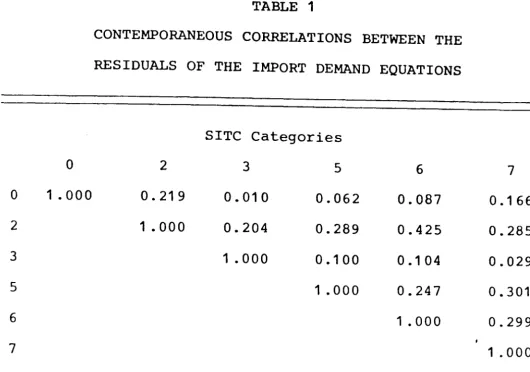
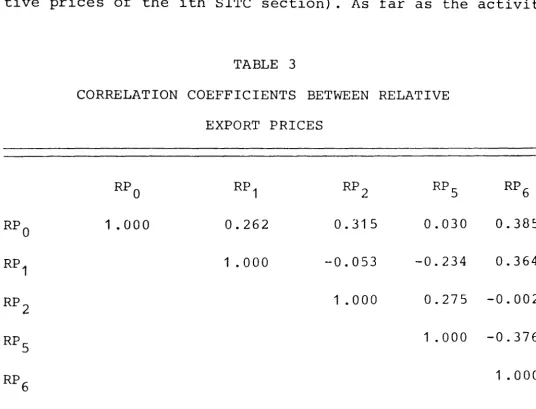
In chapter VII, we examine whether a jOint estimation of
the import and export demand equations could result in more
ef-ficient estimates. In particular, using residual cross
correla-tion funccorrela-tions, we examine if contemporaneous or lagged
corre-lations appear among the residuals of the various import and
export demand equations.
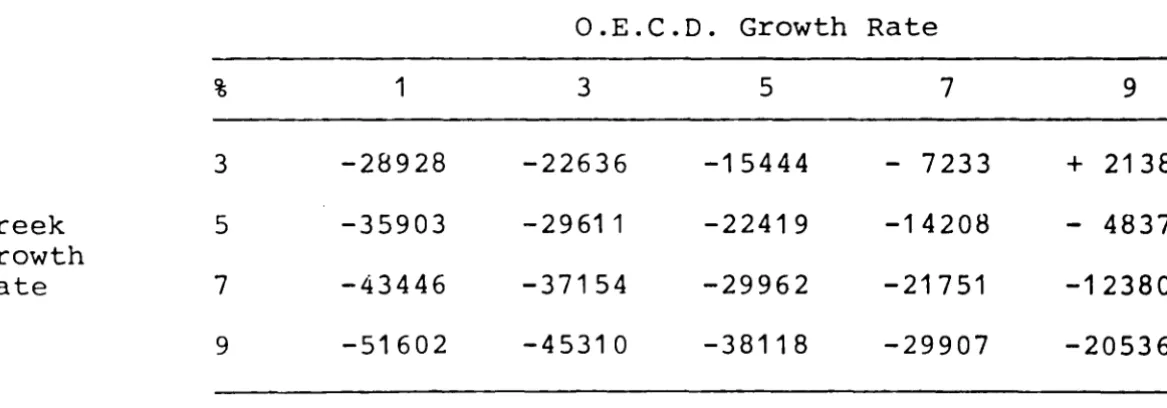
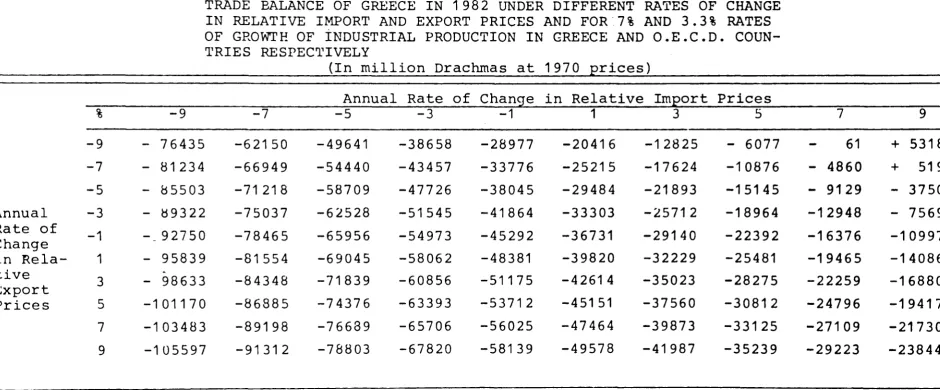
Chapter VIII is concerned with some applications of the
predictions are made for the country's trade balance under
dif-ferent growth rates in Greece and its trading partners, and
different relative price changes, showing at the same time the
sensitivity of the country's balance of trade to these various
assumptions.
Finally, in chapter IX we discuss the experience we
gained from the application of the above model selection
proce-dures, and we deal briefly with the implications of the
CHAPTER II
THE FOREIGN SECTOR OF THE GREEK ECONOMY
In section 1. of this chapter we describe the main characteristics of the foreign sector of the Greek economy over the period 1954 - 1976. In section 2. we discuss briefly previous research on Greek imports and exports.
1. Trends of the Foreign Sector of Greece in the Period 1954 - 1976
Greece, a small country with limited soil and subsoil resources, is highly dependent on international trade. This is mainly due to the country's present stage of development, the small size of the economy, and to the entire lack of fuels and some basic raw materials. The dependence of the country on the foreign trade increased slowly during the period 1954-1972 and more rapidly during the period 1973-1976. Thus, as i t can be seen from table 1, the ratio of the sum of imports and
exports to gross national income, increased from 0.252 in 1954 to 0.284 in 1972. But, during the period 1973-1976 the above ratio increased considerably and i t amounted to 0.425 in 1976. ?able 1 also shows that during the period 1954-1972 the export-income ratio did not vary significantly, while the corresponding import-income ratio increased from 0.172 in 1954 to 0.207 in
Conse-Imports Exports T ra e d B I G a ance ross N t ' a lona 1 Imports+Exports Imports Exports Exports
(c.i.f.) (f.o.b.) Income Income Income Income
1 954 9901 4556 5345 57467 0.252 0.172 0.080
1 958 16946 6953 9993 851 62 0.281 0.1 99 0.082
1 960 21 060 6096 - 14964 95174 0.285 0.221 0.064
1 965 3401 2 9833 - 24179 161 586 0.271 0.21 0 0.061
1 970 58750 1 9276 - 39474 263503 0.296 0.223 0.073
1 972 70373 261 25 - 44248 339554 0.284 0.207 0.077
1 973 1 02979 42ti12 - 601 67 441301 0.330 0.233 0.097
1 974 132181 60890 - 71 291 530081 0.364 0.249 0.11 5
1 975 172041 74441 - 97600 61 2388 0.402 0.281 0.1 21
1 976 221 B21 93~12 -128009 742436 0.425 0.299 0.126
Sources: National Statistical Service of Greece, Monthly Bulletin of External Trade Statistics; National Accounts of Greece, 194~ - 1975 and 1970 - 1976.
Imports 0.460 0.41 0 0.289 0.289 0.328 0.371 0.416 0.461 0.433 0.423
quently, the export-import ratio declined from 0.460 in 1954 to 0.371 in 1972 whereas i t increased to 0.423 in 1976.
With respect to the foreign trade of Greece, the post-war period can be divided in three periods. The first sub-period includes the years 1948-1952, when ummual conditions prevailed in the economy Of Greece. War damages (the civil war lasted until late 1949) and hyperinflation had severely dislo-cated the economic activity of the country, bringing its pro-duction to extremely low levels. At the same time severe import restrictions were imposed by the authorities to control the
large deficits in the balance of payments. In 1953 Greece de-valued its currency (drachma) by 50 percent in order to elimi-nate the fundamental disparities between domestic and interna-tional prices. Simultaneously, the authorities liberalized imports to put foreign trade on a sounder basis conducive to the economic development of the country. Since then, Greece has pursued a liberal import policy to the extend that only a small proportion of imports requires import licences. In view of the above discussion the period 1948-1953 has been excluded from our empirical analysis (see also chapter V, section 1.,
below) .
From 1954 to 1972, we have the second sub-period, during which, the gradual reinstatement of the monetary stability of
UNIT VALUE INDEX TERMS OF TRADE QUANTUM INDEX
1
Imports Exports Import? __ ~~_ ~ _ Exports
1954 9H.O 85.7 H7.4 21 .3 27.6
1958 96.4 96.7 1 00.3 35.1 37.3
1 960 93.1 86.5 92.9 35.6 36.6
1 965 94.7 98.2 1 03. 7 71 .4 52.0
1 970 1 00.0 1 00.0 1 00.0 1 00.0 1 00.0
1 972 11 2.6 1 04.1 92.5 1 22. 7 1 30.2
1 973 1 34.6 1 36.0 1 01 .0 1 54 .4 1 63.3
1 974 195.4 177.0 90.6 1 41 .0 1 79.3
1 975 233.1 1 96. (; 84.3 1 37 .7 1 95.7
1 976 259.8 215.5 82.9 14~.4 225.9
1Excluding ships
Sources: National Statistical Service'of Greece, Annual Volumes of External Trade Statistics
[image:25.1027.150.886.92.541.2]Due to the relatively worldwide monetary stability
during the period 1954-1972, the unit value index of imports
increased at an average annual rate of 1.75 percent and the
unit value index of exports at an average rate of 2.46 percent.
From a quantity pOint of view, imports increased six times and
exports increased almost five times (table 2). In view of the
above events, the trade deficit of the country increased from
5,345 million drachmas in 1954 to 44,248 million drachmas in
1972, namely eight times more, whereas, as already mentioned,
the export-import ratio declined from 0.460 in 1954 to 0.371
in 1972 (table 1).
Over the same period, some noticeable structural changes
of the composition of the external trade of Greece, took place.
As can be seen from table 3, which shows the composition of
imports and exports according to the Standard International
Trade Classification (S.I.T.C.), the share of food and
manu-factures in total imports decreased, whereas the share of
imported machinery and transport equipment was doubled. With
respect to exports, the share of the traditionally exported
agricultural commodities (tobacco, raisins and oil) in total
exports, declined from 65.1% in 1954 to 18.0% in 1972. On the
contrary, the share of more dynamic agricultural products, such
as fresh fruit, vegetables and cotton, in total exports, incr~ed
from 8% in 1954 to 20% in 1972. A noticeable increase has been
also noticed in the participation of exported chemicals and
manufactures, whose shares in total exports increased from 3.4
and 5.8 percent respectively, in 1954 to 7.4 and 32.6 percent
O.
Food 16.8 14.6 12.2 10.9 10.2 9.4 24.9 25.6 22.9 25.0 22.3 22.5 1 . Beverages andtobacco 0.2 0.2 0.1 0.2 42.8 37.1 17.5 16.0 8.2 8.6
2. Raw materials 14.9 12.7 10.6 9.5 9.0 8.5 15.7 25.2 16.9 14.1 8.8 10.0 3. Mineral fuels,
lubricants etc. 14.0 10.2 8.7 10.8 25.4 25.2 1 .0 1.211.0 5.8 4. Animal and
vege-table oils and fats 0.1 0.2 0.8 0.2 0.4 0.3 6.7 2.1 0.8 1 .5 1 .8 0.8 5. Chemicals 9.3 10.6 10.2 10.7 10.0 10.2 3.4 4.1 7.2 7.4 5.8 4.0 6. Manufactures 23.8 24.1 19.7 18.7 15.9 15.3 5.4 4 .1 28.6 26.4 28.7 31.7 7. Machinery and
trans-. t 1
port equlpmen 17.4 24.2 33.9 35.4 26.1 27.7 0.7 0.9 1 .5 2.2 3.9 4.9 8+9. Miscellaneous
ma-nufactureS 3.7 3.4 3.7 3.6 2.9 3.2 0.4 0.9 3.6 6.2 9.5 11.7 (0-9 ) TOTAL 100.0 100.0 1 00.0 1 00.0 1 00.0 1 00.0 1 00.0 100.0 1 00.0 100.0 100.0
1
00.0 1Excluding shipsSources: Elaboration of External Trade Statistics of the National Statistical Service of Greece.
'"
agricultural products whose supply and quality depend on each
time -weather's conditions.
During the last period 1973-1976 the price increases
of the imported and exported commodities were very high (annual
rate of increase 24.5 percent and 16.6 percent respectively
-table 2) as a result of the considerable price increases of
crude oil and raw materials specifically, and more generally
because of the international and domestic inflationary
pressu-res. Moreover, the imported inflation was reinforced because
of the devaluation of the Greek currency (drachma) against the
U.S.A. dollar and the main currencies of Western Europe, which
took place in 1975.
In terms of quantity, imports increased initially in
1973, but then declined in 1974 and 1975 as a result of the
reduced economic activity caused by the Cyprus crisis during
that periodi finally increased again in 1976. On the contrary,
during the same period, exports increased at an average annual
rate of 11.4 percent, and though the trade deficit increased
more, the export-import ratio was slightly improved and i t
increased from 0.416 in 1973 to 0.423 in 1976.
The deficit of the balance of trade was covered for the
most part by the increasing receipts from sales of services
(tourism and shipping). In particular, during the period
1954-1972 the above receipts increased thirteen times, financing
about 27 percent of the merchandise imports in 1972, whereas
in 1954 they covered only 17 percent. These receipts increased
more during the period 1973-1976, but they were affected from
A' CURRENT TRANSACTIONS
1. EXPOrts _ goods (fob)
2. Less: Imports _ goods (cif) 1
I. Balance of trade
3. Sales of non-income services 4. ~Xpenditure of non-residents
Less:
5. Purchases of non-income services
6. Expenditure of residents abroad
II. balance of services
7. Income payments from the rest
of the world
8. Less: Income payments to the rest of the world
III. Net income fror,l the rest
of the world
IV. Balance of goods, services
and incomes (I + II + III)
V. Current transfers from the
rest of the world (net ba-lance)
VI. Balance of current transa-ctions (IV + V)
B' CAPITAL TRANSACTIONS
1. Capital transfers from the rest
of the world (net balance) 2. Net lending
TOTAL (1 + 2)
1
Excluding ships operating overseas
1954 4803 8541 -3738 375 1049 1450 465 - 491 975 102 873 -3356 1406 -1950 1739 211 1950 1
1958 1960
I
19657216 . ' 6242 9960 16092 15840 33113
-8876 -9598 -231$3
850 949 21&2 1914 2408 3980
586 823 1416
676 899 1947
1502 1635 ' 2799
1601 2213 4388
142 264 758
I
1459 1949 3630
-5915 -6014 -16724
2681
-3234
912 2322
3234
3006 6241
-3001l -10483
1459 469 1549 10014
3008 1 0483
1970 1937!! 49262 -29884 3576 7034 2850 2884 4876 7777 2274 5503 -19505 10203 - 9302 54 9248 9302
Source: National Accounts of Greece, 1958 - 1975, and 1970 - 1976
1972 26203 67115 -40912 4876 13221 4452 4156 9489 13027 3450 9577 -21846 17126 - 4720 21 4699 4720 1974 62098 130724 -68626 8580 17187 8358 5613 11796 24744 6876 17868 -38962 20325 -18637 30 18607 18637 1975 74787 149447 -74660 12905 22123 24430 6685 3913 26761 7554 19207 -51540 23342 -28198 431 27767 28198 1976 93948 176869 -82921
1331 b
32275 28612 7553 9428 34906 9964 24942
-48551
27402
-21149
333
20816
had an unfavorable effect on tourism. Also, foreign exchange earnings from transportation were affected from the depression in the international transportation market, which occured
during the years 1975-1976. In view of the above, the receipts from sales of services financed only 19.7 percent of merchandi-se imports in 1974, 23.4 percent in 1975 and 25.8 percent in 1976.
Table 4 shows the balance of payments of Greece, during the period 1954-1976, according to the operating classification of National Accounts. As can be seen from the above table, the deficit of the balance of goods, services and incomes, increased
from 3,356 million drachmas in 1954 to 51,540 million drachmas in 1975, but decreased to 48,551 mil. dr. in 1976. Till 1951, the majority (about 90%) of the above deficit was covered by capital transfers (U.S.A. aid and reparations).
Since 1952 the U.S.A. aid was decreasing gradually and the deficit of the balance of goods, services and incomes was covered by the current transfers from the rest of the world
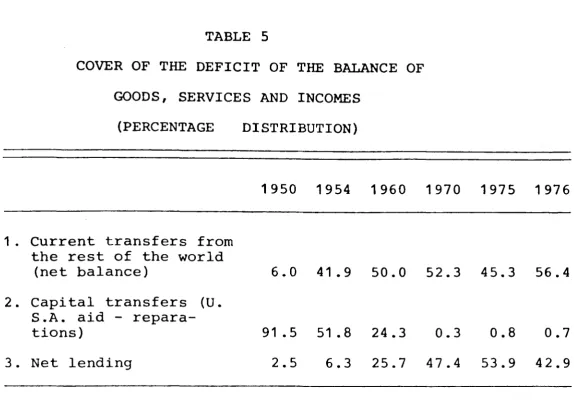
(mainly emigrant remittances and workers' earnings from Europe) and lending. Thus, the percentage of the above deficit which is covered by the current transfers increased from 6 percent in 1950 to 41.9 percent in 1954 and 52.3 percent in 1970. In 1975 i t declined to 44.2% since the increased unemployment in West Europe through its effect on the workers' earnings affected unfavorably the net balance of the current transfers. However,
the above ratio increased again to 56.4 percent in 1976 (table
5) •
TABLE 5
COVER OF THE DEFICIT OF THE BALANCE OF
GOODS, SERVICES AND INCOMES
(PERCENTAGE DISTRIBUTION)
1950 1954 1960 1970 1975 1976
1 . Current transfers from the rest of the world
(net balance) 6.0 41 .9 50.0 52.3 45.3 56.4
2. Capital transfers (U. S.A. aid -
repara-tions) 91 .5 51 .8 24.3 0.3 0.8 0.7
3 . Net lending 2.5 6.3 25.7 47.4 53.9 42.9
Deficit of the balance
of goods and services 100.0 100.0 100.0 100.0 100.0 100.0
Source: National Accounts of Greece
211 million drachmas in 1954 to 20,816 million drachmas in 1976,
covering in average the 47.8 percent of the deficit of the
ba-lance of goods, services and incomes, during the last four
[image:31.690.66.640.97.498.2]2. Previous Studies of the Foreign Trade of Greece
Empirical studies of the foreign sector of the Greek
economy have been carried out by Suits (1965), Adelman and
Chenery (1966), Pavlopoulos (1966), Paraskevopoulos (1970),
Hitiris (1972)1, Sarantides (1973), and Prodromidis (1974).
These studies vary according to the sample period, the
secto-ral breakdown and the explanatory variables used. All of them
deal with the estimation of import demand equations, which we
discuss first, whereas little attention has been paid to exports
(Adelman and Chenery (1966), Paraskevopoulos (1970), Hitiris
(1972) and Prodromidis (1974».
2.1. Imports
Imports are regarded as the difference between two
va-riables, total consumption and domestic production, and the
import function is the difference between the functions
explain-ing these two variables, that -is.demand and suppLy functions.
This implies that the imported and home produced commodities
are identical. But, if an imported con~odity is not produced
at home, or the imported and home produced commodities are not
identical, the import demand coincides with the home demand for
that commodity. Therefore, due to the fact that the majority
of commodities imported into Greece are not produced at home,
all the above investigators formulate import demand equations
which simply express the coun~ry's home demand for such
commo-dities.
The above studies cover the following periods: Suits
(1953-1961), Adelman and Chenery (1950-1961), Pavlopoulos
(1949-1959), Paraskevopoulos (1954-1966), Hitiris (1955-1964),
Saran-tides (1953-1964) and Prodromidis (1961-1969). All the authors
estimate linear regression equations using annual data for the
periods we just mentioned. Paraskevopoulos estimates also double
logarithmic forms using quarterly data, whereas Hitiris (1972)
uses only quarterly data for the estimation of simple linear
form equations.
The level of aggregation at which these empirical
stu-dies have been carried out, varies from author to author, and
there is no sound explanation for that. However, the
availabi-lity of data at the time these studies were carried out
affec-ted the sectoral breakdown followed by each author. The
Natio-nal Statistical Service of Greece started the compilation of
foreign trade indices (quantum and unit value at the one-digit
SITC level of aggregation) at the end of 1956. They cover the
period 1951-1953 with annual data and the period 1954 onwards
with monthly and annual data, the first figures being available
by the end of 1958. Until then only quantities and values, in
current and constant prices, were provided by the National
Sta-tistical Service and the Ministry of Coordination (National
Accounts). This has also affected, as we shall see below, the
explanatory variables included in import demand equations. The
table below gives the major groups of commodities for which
Suits
(1953-l961)a
- Agricultural commodities (i) animal products and fish (ii) luxury agricultural
Adelman and Chenery
(1950-l96l)a
Foods, beverages and animal and vegetable oils
products (sugar, coffee, Crude materials
cocoa etc.) plus mineral fuels
(iii) plant products with domestically produced substitutes (cereal grains and other plant crops)
(tv) edible oils
- Manufacture s
a
(i) private consumer goods (ii) private non-consumer
goods •
Annual data bQuarterly data
and chemicals
- Manufactures
Pavlopoulos
(1949-l959)a
Hitiris - Paraskevopoulos
(1955-64)b (1954-66)a,
b
- Raw materi- - Foods (SITC 0) als
- Crude materials {SITC 2) - Consumption
goods - Fuels (SITC 3)
- Investment - Chemicals (.SITC 5) goods
- Manufactures (.SITC 6)
- Machinery and Transport equipment (SITC 7)
Sarantides
(1953-1964)a
- Foods
- Raw materials, fuel, and
intermediates
- Marufactures
- Construction materials (iron, steel, timber, copper etc.)
Except Suits, all the authors have also estimated
de-mand equations for total imports, whereas Paraskevopoulos has
also estimated import demand equations for individual
commodi-ties as well, such as meat, fish, dairy products, coffee,
co-coa, sugar, passenger cars, textile products without raw wool,
raw wool and services. Prodromidis (1974) examines import
according to the purposes of a sectoral planning model of the
Greek economy which is under preparation at the Athens Center
of Planning and Economic Research. He classifies the importable
cOmP.lodities in accordance with the input-output classification
system of Greece and not according to their use as is usual.
Even in this most recent one work the construction of new
se-ries of data is necessary and the study therefore covers only
the period 1961-19692.
According to the formulation of the Greek import demand
functions by the above investigators, the main explanatory
vari-ables which have been included in their equations are activity
variables and relative prices. As was mentioned before, unit
value indices are listed only for the S.I.T.C. groups of
commo-dities and therefore only Paraskevopoulos and Hitiris include
import prices in their disaggregated import demand equations,
deflated by the indices of domestic prices. In Suits' import
de-mand equations for manufactured consumer goods, animal products
and fish, and luxury agricultural products, the import prices
are implicit deflators obtained as the ratio of the current
lue of imports to value at constant prices. Adelman and Chenery
employ the same relative price of imports in all equations.
This is the price index of total imports divided by the GNP
de-flator. The rest of the authors use only income or activity
variables to explain the behaviour pattern of imports
(Pavlo-poulos (1966), Sarantides (1972».
The explanatory variables used to measure the economic
activity of Greece, differ from author to author depending upon
each investigator's classification. Income, in various forms,
has been included in all the models; i.e. disposable income,
GNP, net national income. In Greece quarterly figures for
inco-me are not listed and in both Paraskevopoulos' (1970) and
Hiti-ris' (1972) works the index of industrial production has been
chosen as an income-proxy. Value added by manufacturing
acti-vity has been employed as explanatory variable in import demand
equations for manufactured non-consumer goods, raw materials,
fuels a~d intermediates (Suits (1965), Pavlopoulos (1966) and
Sarantides (1972». Also, various forms of investment activity
and expenditure (gross fixed capital formation, investment in
housing, building and other construction, machinery, transport
equipment etc.) have been used to explain the imports of
invest-ment goods, construction materials, capital goods, and
machi-nery and transport equipment (Pavlopoulos (1966) and Sarantides
(1972».
Suits (1965) has also included in his import demand
equations for plant products and edible oils, the lagged stock
of cereals and the lagged stock of Oil, respectively, to take
Pavlopoulos (1966) has attempted to include in his equations
one-period lagged imports, but only for the import demand
function for consumption goods he obtained significant
re-sults.
2.2. Exports
Foreign demand functions for Greek exports have been
formulated in a way analogous to that used for the country's
import demand relationships, and have been expressed as functions
of world activity or income variables and the ratio of Greek
export prices to export prices of Greece's competitors.
However, few empirical studies have been carried out
on Greek exports because during the periods covered by the
abo-ve studies, Greek exporting activity was low and the major part
of exports consisted of a few agricultural products (Adelman and
Chenery (1966), Paraskevopoulos (1970), Hitiris (1972), and
Pro-dromidis (1974». The table below shows the groups of
commo-dities for which export demand equations have been estimated
by the above investigators.
In Adelman and Chenery's work each group of commodities
is expressed simply as a linear function of time.
Paraskevopou-los «1970), ch. 6) and Hitiris «1972), ch. 3) estimate linear
(and double logarithmic - Paraskevopoulos) regression equations
with annual data which refer to the periods 1951-1966 and
1954-1966 respectively. Their explanatory variables are, as mentioned
before, relative prices and economic or activity variables of
the areas of destination (volume of food consumption, cigarette
TABLE 7
LEVEL OF AGGREGATION ADOPTED BY PREVIOUS STUDIES ON GREEK
EXPORT DEMAND EQUATIONS
Adelman and Chenery (1966)
-Food, beverages &
tobaca:>, arrl animal & vegetable oils
Paraskevopoulos (1970) -Food
-Dried fruits (currants, raisins arx:1 dried figs) -crude materials, mine- -Tobacro
ral fuels
am
chEmicals-Manufactured goods, arx:1 -cotton
machines arrl transpJrt -Non-a:>tton raw materials equipnent
-Services
-Manufactures arx:1 chani-cals
-Services
Hitiris (1972) -Food arx:1 live
ani-mals (SI'OC 0)
-Beverages arx:1
To-baca:> (srrc 1)
-Inedible crude ma-terials
(srrc
2)-<::hEmicals
(srrc
5)-Manufactures
(SI'OC 6)
GNP and population). They have also estimated export demand equa-tions for the total of Greek exports. Finally, Prodromidis (1974, ch. 5) estimates linear· and- double -logari thmic export ilemand
functions over the period 1961-1969 for groups of commodities according to the input-output classification system of the Greek economy.
pre-vails in the above studies based on the assumption that the de-mand for these commodities has a negligible effect on income or economic activity of Greece. Therefore they presume that the disturbances are independent of the explanatory variables and so least squares estimates are free of simultaneity bias. Over the periods covered by the above studies, the Greek economy was characterized by a rapid rate of growth. The result is a high intercorrelation among the various time series and most of the authors faced the problem of the deterioration of statistical significance of regression parameters when they attempted to include additional explanatory variables (Suits (1965), Pavlo-poulos (1966), Sarantides (1972) and Prodromidis (1974)).
Finally we note that all the estimated import and export demand equations are static in that all variables relate to a
single time period. The use of annual data and the relatively short sample periods may explain the absence of lagged variables and the problem of autocorrelation becomes less serious. Only in Hitiris (1972) and Sarantides (1972) do any equations exhi-bit serial correlation in the disturbances.
CHAPTER III
GENERAL ISSUES IN MODELS OF FOREIGN TRADE
In this chapter we briefly consider the main empiri-cal studies of the foreign sectors of various countries car-ried out during the last decade. Our intention is to discuss
the methodology adopted and the hypotheses selected for testing, elucidating any generalizations about these approaches that
emerge. For convenience we shall refer first to the estimated import demand equations and then to the export demand equa-tions (for a more extended survey see Stern at al (1976».
1. Import Demand Equations
usually in terms of activity variables, relative prices and
other variables reflecting each country's prevailing
condi-tions as we shall see.
However the concept of identical commodities is a
re-lative matter depending upon one's classification. Whether a
commodity is entirely foreign-produced or also the subject of
home production depends on the level of aggregation in the
commodity statistics. The empirical studies to which we refer
have been carried out at a level of aggregation which varies
from author to author. We note that Whitley (1977) classifies
U.K. imports into two major groups of commodities, namely
ma-nufactures and semi-mama-nufactures, whereas Kreinin (1973) works
at a disaggregate level of 56 groups of commodities for
U.s.
imports. In most of these studies a single aggregate import
demand equation is not estimated, but the elasticities of
to-tal imports with respect to income and prices are derived from
the elasticities of the disaggregated functions weighted by
the shares of each import category in total imports. Thus
aggre-gation bias may be reduced: see Barker (1970) for a detailed
analysis of its sources.
Economic theory offers little guidance on the
appro-priate functional form for lllport demand relationships and i t
rests upon each investigator to decide what form is more
con-venient for purposes of estimation. The linear import demand
function implies a constant marginal propensity to import and
declining elasticities with respect to the explanatory
varia-bles as imports increase, and has been adopted by a limited
Dutta (1964), Kwack (1972), Rhomberg and Boissonneault (1965)). On the other hand the majority of investigators adopt the
double-logarithmic form for import demand relationships which yields direct estinlates of the relative price and income ela-sticities and assumes constant elaela-sticities, which seems more _plausible. However, this specification constrains the import
demand elasticity with respect to import prices to be equal
in magnitude but opposite in sign to the elasticity with respect to domestic prices. In a test carried out by Murray and Ginman
(1976) with an aggregate import demand equation for Canada, the above specification was rejected.
The final form of the import demand equation to be estimated is developed in various ways. Most of the studies simply write down the relationship between actual import de-mand and its determinants according to the relevant
hypothe-sis. Import demand functions are also developed from the combi-nation of the relationship between long-run (or desired) de-mand for an imported con~odity and its determinants and a
The majority of the investigators use the traditional
single-equation methods to estimate import demand functions,
by regressing actual imports on explanatory variables, such
as import prices and domestic income. However, attempts have
also been made to develop equations which describe the
beha-viour of import supply and import prices. Turnovsky (1968)
builds a three-equation model determining import quantities
and prices. The first equation regresses import demand on
inco-me, relative prices, net overseas assets and the country's
exports. The second equation determines import supply in terms
of overseas assets, exports and a weighted activity variable
of the country's import-supplying countries (see p. 775), while
the third equation states the equality between import demand
and supply.
Ahluwalia and Hern~ndez-Cat~ (1975) give a system of
two equations in which the first expresses imports as a
func-tion of income and distributed lags of import and domestic
prices, while the second, following a profit-maximization
the-.ory, deter.mines the level of import prices in terms of
distri-buted lags of foreign market prices, exchange rates, domestic
prices and foreign capacity utilization variables. The latter
approach attempts to fill the existing gap in the literature
which traditionally treated import price as exogenous
varia-blesj that more attention should be paid to this had been
pOin-ted out by Prais (1962, p. 577).
Now we turn to discuss the explanatory variables which
have been used as determinants of import demand. Since the
demand equations, as mentioned above, import prices and dome-stic prices, usually in the form of relative prices, and do-mestic income or an activity variable have been included in
all the models. Moreover, some individual attempts have been made to include other variables which are expected to explain ·a sUbstantial part of the variation of imports: for example,
stocks have been included to take account of the dynamic ef-fects of past purchases (Kwack (1972), Rhomberg and Boisson-neault (1965), Whitley (1977), Hibberd (1977), Rees and Lay-ard (1971), and Hibberd and Wren-Lewis (1978».
Khan and Ross (1975) try to separate import demand
into its cyclical and secular components. They include in their import demand function, in addition to other explanatory va-riables, real domestic income and its trend level (defined as potential income) : a series of its values for a number of countries is provided by O.E.C.D. An analogous approach is adopted by Barker (1977) who includes as an explanatory vari-able in his import demand equation the ratio of the total de-mand of the commodity under consideration to the trend
compo-nent of the total demand.
Another explanatory variable which is used by investi-gators dealing with British imports, is a capacity utilization variable, expressed as a function of the proportion of manu-facturers working at full capacity (Barker (1976), W0itley
where a movement in imports cannot be accounted for in terms
of changes in activity or relative prices, but is the result
of changes in tastes, technology and the like (Barker (1976
and 1977), Dutta (1964), Hibb~id (1977), Rees and Layard (1971».
Only a small number of recent investigators adopt
sta-tic relationships in which all variables relate to a single
time period (Ball and Marwah (1962), Kwack (1972), Khan and
Ross (1975), Kreinin (1973». In these cases, where the
hypo-thesis to be tested is that consumers adjust themselves to
changed conditions within this single period, short-run and
long-run elasticities are assumed to be equal. But the
majori-ty of the models include lagged variables since i t is more
realistic to assume that the responses of imports to changes
in the explanatory variables can be delayed as purchasers
ta-ke time to readjust their spending patterns. Whenever
one-pe-riod lagged imports are included in the import demand equation
as predetermined variable, long-run (or equilibrium)
elastici-ties can also be derived_ (Turnovsky (1968), Dutta (1964),
Rhom-berg and Boissonneault (1965), Goldstein and Khan (1976),
Yad-av (1975), Whitley (1977), and Houthaker and Magee (1969».
Relative prices enter Barker's (1970, 1976, and 1977)
estimated import demand equations with a single period lag,
whereas in Price and Thornblade's (1972) model, relative
pri-ces follow a distributed lag pattern over two periods. Also
Almon distributed lags have been adopted to specify the time
shape of the reaction of demand to changes in relative prices
and activity variables (Aurikko (1975), Ahluwalia and
by ordinary least squares. Only Barker (1977) applied non-li-near least squares to take account of first order serial cor-relation in the disturbances; Whitley (1977) estimated his equa-tions by the instrumental variables method, treating the acti-vity variable and lagged imports as endogenous and using as
instruments current and lagged values of exports, public autho-"rities' fixed investment and current expenditure, lagged
rela-tive prices and the level of stocks lagged by two quarters.
2. Export Demand Equations
Exports have also attracted investigators' interest since the export sector plays a central role in a country's economy both in terms of generating employment and by provi-ding the means to pay for imports. The majority of the inve-stigators formulate export demand equations in a way analogous to that used for import demand relationships. Particularly
they develop export demand functions which determine exports in terms of world demand or activity variables, relative pri-ces and other specific variables which are expected to contri-bute to the explanation of each country's exports, as we shall see below. It should be mentioned, however, that the above fomrulation
assumes that there are no supply constraints and therefore what is speci-fied is an export demand equation.
decrea-sing elasticities as exports increase (Turnovsky (1968), Dut-ta (1964), Kwack (1972), Rhomberg and Boissonneault (1965».
Typically, a country's export volume is explained in terms of world demand, the country's competitiveness, the pro-fitability of exporting relative to selling at horne and the . pressure of internal and external demand. However, some
rese-archers follow an indirect way to define the final form of the export demand functions, taking into consideration other factors which may affect the determination of exports. For instance,
Hutton and Minford (1975) employ a mixture of demand and sup-ply functions in the description of export sales. They consider the specification of demand and supply schedules and the beha-viour of deliveries under conditions of disequilibrium between demand and supply. Supply influences enter their model in a constraining manner only when the demand for exportables from home and foreign buyers is greater than or equal to the avail-able capacity. They also argue that the structural parameters of the export demand equation vary according to whether there is world excess demand or supply of exportables and therefore they split their estimation period according to an index of capacity utilization and estimate separate equations for each. Batchelor (1977a) introduces an econometric model of export sales behaviour, the parameters of which vary with the level of internal demand pressure measured by capacity utilization. Also in another paper on U.K. exports (1977b) he develops a model to test whether the estimated elasticities are constant over the whole sample period or whether they have changed with
The competitiveness of a country's exports is a major
determinant and has been taken into consideration by all the
investigators. It is usually measured as the ratio of the
ex-port price to a weighted index of competitors' exex-port prices
(Kwack (1972), Rhomberg and Boissonneault (1965), Aurikko
(1975), Houthaker and Magee (1969), Hutton and Minford (1975),
Batchelor (1977a), Laury and Warburton (1977), Richardson
(1977». Richardson (1977) employs also the ratio of U.K. unit
manufacturing cost to competitors' unit manufacturing cost,
but due to lack of data he is confined only to the unit labour
cost. Also all the investigators have included in their models
a variable which measures the world demand for exports. This
variable is either a measure of world real income (Turnovsky
(1968), Kwack (1972), Houthaker and Magee (1969» or an
acti-vity variable which measures the world's production (Dutta
(1964), Winters (1976 and 1977» or world imports or exports
(Rhomberg and Boissonneault (1965), Aurikko (1975), Hutton and
Minford (1975), Ba~chelor (1977a and 1977b), Laury and
Warbur-ton (1977), Richardson (1977» usually in the form of a
weigh-ted index. Winters (1976 and 1977) uses also as a measure of
demand for the less developed countries their capacity to import
which is based on their availability of foreign exchange.
The profitability of exporting relative to selling at
home has been included in export demand equations only by two
authors, both dealing with U.K. exports (Winters (1976), Laury
and Warburton (1977» and is measured by the ratio of export
prices to domestic wholesale prices. The effect of the internal
investi-gators who analyse British exports, because they believe that
as home demand for a comnlodity rises, export supply is reduced.
Various variables have been used to measure the internal
pres-sure of demand, such as the domestic demand for exportables
(Hutton and Minford (1975}), the index of capacity utilisation
of manufacturing industry (Batchelor (1977a», the pressure on
capacity to produce which is measured by the ratio of production
output to its log-trend (Winters (1976 and 1977)}, the ratio
of home demand to its estimated trend level (Laury and
Warbur-ton (1977» and the index of export weighted capacity
utilisa-tion (Richardson (1977}).
In an analogous way few authors consider the effect of
external demand. In Hutton and Minford's model (1975) the
vari-able included for that reason is the world business cycle. This
is a weighted index of the log-deviations of the industrial
productions of the main industrial countries from their trend
levels. Batchelor (1977a) uses as a variable the proportion of
firms experiencing excess foreign demand, whereas Laury and
Warburton (1977) measure the external demand pressure using
the industrial production of the D.E.C.D. countries.
Finally, some researchers have included a time trend
in their models, since exports often exhibit trends that cannot
be explained by means of the above independent variables (Dutta
(1964), Hutton and Minford (1975), Winters (1976 and 1977».
The majority of the investigators analyse exports
ta-king export prices as exogenous variables. However some attempts
have been made, by authors who deal with U.K. exports, to
(Hutton and Minford (1975), Batchelor (1977a and 1977b),
Winters (1976». Export prices have been explained mainly as
a function of domestic prices and competitors' export prices.
The role of the home price is to measure the opportunity cost
of a unit of produce exported and also to measure the actual
cost of production (see Winters (1976), p. 133). The level of
competitors' export prices is included in the export price
equations for a reason analogous to that mentioned before in
relation with the export demand functions since in most cases
different exporters supply the same market. Also pressure on
productive capacity and home sales have been included in the
equations as a measure of domestic demand pressure to allow
for the effect on prices of economies or diseconomies of scale
(Batchelor (1977a), Wint~rs (1976».
Only a small number of recent investigators adopt
sta-tic relationships is which all variables relate to a single
time period (Dutta (1964), Kwack (1972), Houthaker and Magee
(1969), Winters (1976». Most authors develop dynamic
rela-tionships since i t is more realistic to assume that the
respon-ses of exports to changes in the explanatory variables can be
delayed as purchasers take time to readjust their spending
patterns and also because of the delay between the placing of
an order and delivery. The majority of the dynamic models use
the Almon distributed lag pattern to specify the time shape
of the reaction of the quantities exported to changes of
rela-tive prices, world activity and demand pressure variables
(Au-rikko (1975), Hutton and Minford (1975), Batchelor (1977a and
Most of the studies we refer to have been carried out
at a level of aggregation dealing mainly with the exports of
manufactures. Only Aurikko (1975) and Kwack (1972) work at a
disaggregated level of five groups of commodities for the
Swedish and U.S. exports respectively, whereas Winters (1976
and 1977) examines the export behaviour of sixteen commodity
groups of U.K. exports.
Finally, as in the case of import demand equations,
almost all the authors have estimated their models by ordinary
least squares. An exception is Turnovsky (1968), who employs
constrained least squares in order to incorporate non-linear
constraints on the coefficients of competitors' export prices
CHAPTER IV
MODEL SELECTION PROCEDURES AND FORMu~TION OF GREECE'S IMPORT AND EXPOR'r DEMAND EQUATIONS
As was mentioned in chapter II, Greece's import and ex-port demand functions considered previously were static relation-ships in which all variables relate to a single time period; that is, i t is assumed that consumers adjust to changed conditions wi-thin this single period. But in many cases, adjustment spreads over more than a single period and the demand function becomes a dynamic relationsllip, depending not only on the current level of its influences but on their past levels as well. Moreover, dyna-mic denland functions can be developed by including into the rela-tionship the effects of past purchases of the good unoer conside-ration.
However, we should notice that the neea to consider dyna-mic relationships does not depend only on the possible delay of the explanatory variables' effects, but also on the time aggrega-tion of the data used. For example, if a six-month lag effect is suspected, i t is difficult to detect i t with an annual model. On the contrary, data disaggregated over time may cause dynamic ef-fects, if the period between two successive observations is smal-ler than the time the effect of a variable takes to be demonstra-ted.
To test these hypotheses with observable data we must specify the time shape of the reaction of the quantity demanded, but on this economic theory has little to say and therefore a