139
©IJRASET: All Rights are Reserved
Study on the Application of Nano Additives for
Engineering Properties Enhancement of Bonded
Metal Substrate
Ranvijay Singh1, Rajesh Katiyar2 1
Research Scholar, 2Associate Professor, Chemical Engineering Department, Harcourt Butler Technical University
Abstract: Experimental analysis of lap binder joints with the addition of fumed silica subjected to tension has been done by varying the overlap length. The adherends have been selected as Aluminium and Stainless Steel. Binder material used is single component system phenolic resin. The thickness of the aluminium sheet was 1.63 mm and thickness of SS sheet was 2 mm, which were used as adherends. The adherends were prepared utilizing water jet cutting machine. Fumed silica was used as additive for enhancement of the strength of the joint. The additives formed an intermolecular force of attraction between the binders, and enhanced the strength of the joint. The mechanical properties of shear strength and tensile strength of single lap joint were studied. The adherend surfaces were prepared by mechanical abrasion method, so as to provide better contact area for the binder. The prepared joints were tested on the universal tensile testing machine (Instron 1195). The study is focused on the effect of overlap length on a single lap joint prepared by phenolic resin binder with incorporation of additives. These results were compared with the specimens when no additives were used. Obtained results would be very important for the development of important assembly products looking forward towards reduction in weight as well as cost.
Keywords: Single lap joint, Phenolic resin, Ultimate tensile strength, Lap shear strength, Instron 1195
I. INTRODUCTION
A lot of methods to bring the materials together with the same or different materials is continuously growing up day by day due to various numerous advantages. Single lap joint is one of the promising joining technique over other methods like bolt joint, rivet joint and screw joint. In the past, the binder joint was used to form the everyday objects, like kitchen appliances, household items, etc. But they are now used in the manufacture of aerospace component parts, shipbuilding, civil engineering, mechanical engineering as well as other important areas.
Many methods to reduce energy consumption and to save the environment, for example, consumption of automotive fuel is directly linked with the weight of the vehicle. The use of binder joints instead of bolts, rivet joint, welding reduces the weight of the vehicles. In today automotive industry need of lightweight structure to reduce the fuel consumption is regular demand. Applications were focused on many project in which individual materials are used to develop the lightweight vehicle component parts [1]. Presently in the automotive sector, 27% of joint component parts are based on binder joints.
Lap joints are the most commonly used as adhesive joints between similar and dissimilar adherends in composites, because they are simple to manufacture, are applicable to thin adherends (<1mm, sheet) and most of all, they stress the adhesive in a way that it is stressed in shear. Binder’s joint have numerous advantages over other joining technique such as soldering and welding.
140
[image:2.612.103.520.82.194.2]©IJRASET: All Rights are Reserved
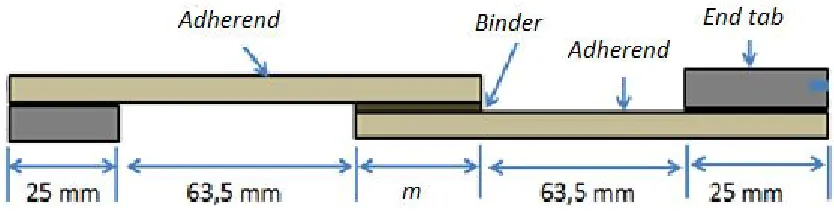
Fig. 1 Single lap joint
II. REVIEWOFTHESTUDY
Mallick, P.K. and Bhambure, S. [1], analysed single lap adhesive joints between magnesium and other structural automotive
materials. In automotive industries 55% joint parts are based on resistance spot welding, 27% are based on adhesive joint and
remaining parts include mechanical joining, laser joining, MIG/MAG welding. They studied the finite element analysis of single
lap joint between magnesium, steel, aluminium and SRIM composites. Authors also studied stress distribution and found out maximum stresses in SLJ between similar or dissimilar material for automotive application. They provided a comparative details about maximum peel, shear and longitudinal stresses. Maximum stresses (peel and shear) occur at the edges of joints for both similar and dissimilar materials.
The longitudinal stresses also occur at one of the lap ends, mid-width and one of the interfaces.
Raos, et al. [2], determined the real mechanical properties of the adhesive joint and studied the effect of overlap length and carried out the numerical analysis of single lap adhesive joint. This study deals with 2D and 3D modeling of single lap bonded joint. Aluminum was used as an adherend in the study. The width of all adherend was 30 mm and the overlap length was kept 15, 20, 30, 40 and 60 mm to find out the optimum overlap length. Increasing the overlap length from 15 mm the joint strength values (Tensile force) increases, because of increasing of bond area. After a certain overlap length i.e., 40 mm joint strength value (Tensile force) get decreased. The authors suggested that the optimal design of single lap joint not only depends upon the overlap length but also the adherend and adhesive material should be considered as important factors. Some other factors (e.g. surface roughness, bond line thickness, holding time and curing conditions) would also affect the bond strength of single lap joint.
III.MATERIALSANDMETHODS
A. Materials
Stainless steel strips were used as adherend and single component system resol type phenolic resin binder was used as a binding material. Phenolic resin is synthesized by condensation of phenol or mixture of phenol with an aldehyde [10]. Today rasching process is used, which is very economical process for the commercial production of the phenolic resin. The additives used in
phenolic binder were fumed silica particle, procured from Sigma Aldrich. The nano-additivesused in this work is fumed silica with
average particle size of around 7 nm. The additives have large surface area and can cause significant change in resulting properties of the final composite bond. Acetone was used to degrease the adherend surface.
B. Surface Preparation
The adherend joint surface was prepared by mechanical abrading method with the help of a flat smooth mechanist cut file. This method provides a better contact area in comparison to other types of surface preparation method. Increase in surface roughness is achieved, which results in maximum contact area and wetting ability. After abrading the surface, it is necessary to wash with distilled water to remove loose particles, subsequently followed by drying.
C. Adhesive Preparation
141
©IJRASET: All Rights are Reserved
D. Joint Preparation And Curing
The single lap joint geometry has been shown in figure 1. Adherend thickness was 1.63 mm for aluminium and 2 mm for the stainless steel strips. ASTM D1002-99 is based on most of the widely used adhesive bond tests for single overlap joint. This standard provides a good concept of determination of the dimension and covers the determination of apparent shear strength of adhesives for bonding the metals when tested on standard single lap joint under the specified condition. The dimension of each strip was same and only the overlap length was varied. The joint surfaces of the adherend were cleaned with the help of acetone to remove the loose particle. After that a fixed quantity of adhesive mix solution was prepared from the Ultrasonicator. This additive incorporated mix is placed on both joint surfaces and kept into the oven at 50-60 ºC for drying purpose. It is necessary to observe
that all the present solvent is removed from the applied layer. After this process, the 2nd coat of solution is applied and again placed
into the oven at the same temperature for 20 min. After this the specimen is aligned very carefully and clamped into pressure plate and again placed into oven for final curing. Final curing was done at 135-150 ºC for 60-70 minutes.
E. Testing
All the prepared specimens were tested at an average displacement rate of jaws with 1.3 mm/min on universal tensile testing machine (Instron 1195), 100 kN which has been shown in fig. 2. To ensure symmetric loading condition two small dimensions of the same thickness were inserted in both jaws as shown in figure. This machine has a minimum load capacity of 5 N and maximum load capacity of 100 kN
Fig.2 Instron 1195
IV.RESULTSANDDISCUSSION
The obtained results from the tensile test is shown in table 1 for the specimens W-13, W-20, W-25, and W-35 prepared by pure phenolic resin at overlap length of 13, 20, 25 and 35 mm respectively. the specimens S-13, S-20, S-25, and S-35 were prepared by phenolic resin with 3 wt% fumed silica particle additive at overlap length 13, 20, 25 and 35 mm respectively.
Table1. Maximum load obtained by specimen
Specimen Maximum load obtained (kN), Fmax
W-13 3.29
W-20 3.83
W-25 4.23
W-35 4.78
S-13 4.23
S-20 5.42
S-25 5.87
142
©IJRASET: All Rights are Reserved
Maximum load obtained in specimen S-35 was 6.95 MPa. The binder’s shear strength (τw) was calculated with equation no.1. the
binder shear strength measures the ability of material that withstands with stress.
τw = ...(1)
Joint tensile strength (σh) was calculated with the help of equation no.2
σh = ……(2)
Graph 1.Maximum load obtained by specimen
10 15 20 25 30 35
7 8 9 10 11 12 13 B i n d e r's s h e a r s tr e n g th ( M P a )
Overlap length (mm)
Phenolic binder with 3 wt% fumed silica
Graph 2. Binder’s shear strength of specimen
10 15 20 25 30 35
80 90 100 110 120 130 140 J o in t T e n s ile S tr e n g th ( M P a )
Overlap length (mm)
Phenolic binder with 3 wt% fumed silica
143
©IJRASET: All Rights are Reserved
V. CONCLUSIONS
The study was done in order to observe the effect of overlap length (13, 20, 25 and 35 mm) on the strength and effect of nano additives on the strength of lap joint bond specimen. The results obtained are summarized below
A. The incorporation of nano-particle increased the average failure load of binder joint, and nano-particles are important parameter
of the lap joint bond strength
B. As overlap length increases the strength of joint increases
C. At 35 mm overlap, joint prepared by phenolic resin with nano-additives is having 30 % more joint tensile strength in
comparison to the joint prepared by phenolic binder without additives
D. At overlap length of 13 mm, the binder shear strength was found to be enhanced by around 40 % with the alliance of
nano-additives (fumed silica)
VI.ACKNOWLEDGMENT
The authors are thankful to the technical personnel of ACMS lab and Imaginary Lab at IIT Kanpur who have provided their support and help in getting the adherends prepared as well as testing of the finally prepared specimens.
REFERENCES
[1] Mallick, P. K. and Bhambure, S. Analysis of Single lap adhesive joint between Magnesium and other structural automotive materials. SAE International Journal Matreial and manufacturing vol.4, 2011 pp 175-180
[2] Raos, P., Kozak, D., and Lucic, M. Stress-Strain analysis of single lap joint tensile loaded adhesive joint. AIP conference proceeding.2007
[3] Znikin, A. E., Bikmullin R. S., and Gorbunova I. A., Characterization of the adhesion interaction of the polymers with the surface of filler nanoparticles. Russian journal of applied chemistry vol 80 (6), 2007 pp 988-993
[4] Katiyar, R., and Kumar, R., Studies on Engineering properties of binder’s loaded with nano fillers for better design composites. International Journal of Engineering research & technology vol. 6, 2017 pp 2319-2321
[5] ASTM D 1002 (1999). Standards test method of apparent shear strength of single-lap-joint-adhesively bonded metal specimens by tension loading (metal-to-metal). ASTM PA 19428-2959
[6] Zhai, L., Ling G., Li, J, Wang, Y. The effect of nanoparticle on the adhesion of epoxy adhesive. International journal of adhesion and adhesive 2007
[7] Admas, R. D. Harris J. A. International journal of Adhesive and Adhesion 15 1996, pp 61-71
[8] Nagalingam, R., Sumdram, S.. Effect of nano particle on tensile, impact and fatigue properties of fiber reinforced plastic. Journal of Indian Academy of Science. 33, 2010, pp 525-528