ORIGINAL RESEARCH
INTERVENTIONAL
Prospective Comparison of Angio-Seal versus Manual
Compression for Hemostasis after Neurointerventional
Procedures under Systemic Heparinization
H.-F. Wong, C.-W. Lee, Y.-L. Chen, Y.-M. Wu, H.-H. Weng, Y.-H. Wang, and H.-M. Liu
ABSTRACT
BACKGROUND AND PURPOSE: The use of arterial closure device in patients with prolonged high ACT values has not been extensively studied. The aim of this study was to compare the safety and efficacy of an arterial closure device, Angio-Seal, with manual compression in patients on anticoagulation following neurointerventional procedures.
MATERIALS AND METHODS: This was a 2-center prospective study approved by our institutional review boards. In total, 153 consecutive patients with 174 arteriotomies (86 men, 67 women; mean age, 56.1⫾16.2 years) following femoral arterial puncture for neurointerventional procedures were enrolled in convenience sampling. All of the patients were systemically heparinized with an ACT between 250 and 500 seconds before removal of the sheath after the procedure. Group 1 consisted of 104 arteriotomies that were closed with an arterial closure device (Angio-Seal), and group 2 consisted of 70 arteriotomies treated with manual compression. The ACT before sheath removal, time to hemostasis, and complications immediately and 24 hours after the procedure were recorded.
RESULTS:The mean ACT before sheath removal was 284.8⫾37.6 seconds (range, 250 – 414 seconds). The mean hemostasis time was significantly shorter in group 1 (2.4⫾11.7 minutes) compared with group 2 (44.7⫾27.4 minutes) (95% CI, 38.16 –51.24 minutes;P⬍.001). Hematoma occurred in 9 patients in group 1 (8.6%) and 18 in group 2 (25.7%). One patient developed an arterial occlusion after hemostasis with the closure device, but this was successfully revascularized.
CONCLUSIONS: Angio-Seal was found to safely and effectively achieve rapid closure of the femoral access site in patients undergoing neuroendovascular procedures under systemic heparinization with an ACT in the range of 250 –500 seconds.
ABBREVIATIONS:ACT⫽activated clotting time; CI⫽confidence interval; OR⫽odds ratio
T
he common femoral artery is the most frequently used site for vascular access in catheter-based neurointerventional proce-dures. Management of the femoral artery access site has become a more important consideration as the frequency of endovascular interventional procedures increases worldwide. Although manual compression has been accepted as the criterion standard for ac-cess-site hemostasis, it is limited by additional operator time, pro-longed patient immobilization following the procedure, andcomplication rates in the range of 1.3%–3.4%.1-3Additionally, hemostasis by manual compression in anticoagulated patients re-ceiving larger access sheaths can be difficult to achieve. The major concern in achieving hemostasis of the arteriotomy after neuro-interventional procedures is the level of anticoagulation, not only during the endovascular treatment but also after the procedure, when it occasionally is sustained to minimize thrombotic events. However, vascular closure device trials have rarely demonstrated lower complication rates compared with manual compression, and occasionally the use of vascular closure devices has resulted in complications primarily involving infection and thrombosis. These complications have become a significant source of litiga-tion in many practices and hospital facilities.
The use of closure devices has been reported extensively in cardiology and, to a lesser extent, in interventional radiology. There are few publications regarding this subject in interventional neuroradiology.4-9During the entire neurointerventional proce-dure, it is important to keep the ACT between 250 and 500 sec-onds or 2 to 2.5 times that of baseline. This makes these patients at
Received March 12, 2012; accepted after revision May 21.
From the Department of Imaging and Intervention, Chang Gung Memorial Hospital at Linkou (H.-F.W., Y.-L.C., Y.-M.W.) and Chiayi (H.-H.W.), College of Medicine and School of Medical Technology, Chang-Gung University, Taiwan; and Department of Medical Imaging (C.-W.L., Y.-H.W., H.-M.L.), National Taiwan University Hospital, Taipei, Taiwan.
This work was supported by the National Central University, Taiwan (NSC 100-2911-I-008-001) Center for Dynamical Biomarkers and Translational Medicine. Please address correspondence to Hon-Man Liu, MD, Department of Medical Im-aging, National Taiwan University Hospital, No. 7, Chung-Shan South Rd, Taipei, Taiwan 10016; e-mail: [email protected]
high risk of bleeding at the access site, especially following invol-untary agitated movement during recovery from general anesthe-sia. Delayed sheath removal and sending the patient back to the intensive care unit have been common practices in interventional neuroradiology. Many serious complications such as a thrombo-embolic event, hematoma formation, retroperitoneal hemor-rhage, or infection can occur when arterial sheaths are left in place after neurointerventional procedures.7,10
The use of a closure device has been shown to be effective in reducing the time to hemostasis and ambulation, subsequent to both transfemoral angiography and intervention.11-16The Angio-Seal VIP 6F/8F device (St. Jude Medical, Minnetonka, Minnesota) is a vascular access closure device that achieves hemostasis by compressing the arteriotomy site between a bioabsorbable intra-vascular foot plate and an external bovine collagen sponge. The anchor is resorbed physically within 30 days and chemically within 90 days. The use of Angio-Seal in patients with prolonged high ACT values has not been extensively studied, to our knowl-edge. In this prospective study, we aimed to compare Angio-Seal with manual compression in patients with prolonged high values of ACT just before arterial sheath removal.
MATERIALS AND METHODS
Following local institutional review board approval and written informed consent from all study subjects, 153 consecutive pa-tients (86 men, 67 women; mean age, 56.1⫾16.2 years) were prospectively divided by convenience sampling into 2 groups. Pa-tients were enrolled into the study at Chang Gung Memorial Hos-pital (Linkou Medical Center) and National Taiwan University Hospital between March 8, 2010, and February 8, 2011. Following an explanation of the risks and benefits of the options, all patients themselves chose either the use of an arterial closure device (An-gio-Seal) or manual compression for hemostasis of the arteriot-omy before entering our study. All vascular access was obtained via the common femoral artery. At the end of the neurointerven-tional procedure, ACT was checked before access-sheath removal. Patients in group 1 received hemostasis by using the arterial clo-sure device (Angio-Seal VIP 6F/8F), and patients in group 2 re-ceived manual compression. A certified interventional neuro-radiologist performed all procedures. All operators had experience of⬎50 successful Angio-Seal deployments. The de-ployment of the device and the application of manual compres-sion were performed by the same operator who performed the neurointerventional procedures. ACT before sheath removal, time to hemostasis, and complications occurring immediately and 24 hours after the procedure were recorded.
The inclusion criteria were as follows: 1) Patients received an endovascular neurointerventional procedure, 2) ACT was within the range of 250 –500 seconds after the procedure and before sheath withdrawal, and 3) puncture was in the common femoral artery (this was confirmed angiographically before sheath with-drawal). The exclusion criteria were the following: 1) patients who were pregnant or lactating, 2) patients younger than 18 years of age, 3) patients with a bleeding disorder, and 4) groin infection.
In group 1, a 6F Angio-Seal was used in those patients with a 5F or 6F access sheath, and an 8F Angio-Seal was used for those with a 7F or 8F access sheath. In both groups, after complete
hemosta-sis had been obtained, patients’ pedal pulses were evaluated to check their blood flow. In both groups, if complete hemostasis could not be obtained after 30 minutes, a hemostasis-enhancing pad, Clo-Sur PAD (Scion Cardio-Vascular, Miami, Florida), was used to provoke hemostasis for ethical reasons.
Patients were monitored for subsequent complications for 20 –24 hours. The hematoma was inspected grossly and measured with a ruler by our assistant operator 24 hours later. Size was determined as the longest dimension measured across the access site. Evaluation after faculty discussion was performed if the op-erator encountered a controversial hematoma of 10 cm. Compli-cations were defined as minor and major. Minor compliCompli-cations included a local hematoma of⬍10 cm in diameter. Major com-plications were those requiring further percutaneous or surgical intervention, as well as a local hematoma of⬎10 cm in diame-ter,17pseudoaneurysm, groin infection, retroperitoneal bleeding, arteriovenous fistula, bleeding at the site requiring transfusion, device embolization, and death. In addition, hemostasis time, the ACT value, and the puncture technique (single- or double-wall puncture) were also recorded.
The stratification of ACT levels was arbitrary, based on every 50-second increase. The patient numbers above 350 seconds were summed. The stratification of the ACT was treated as an exposure variable in the stage of data analysis. We treated 2 arteriotomies in the same patient as separate and independent events. The nu-meric variables were presented as mean⫾SD. We used logistic regression analysis to identify factors linked with outcomes. Mul-tivariate logistic regression was used to estimate the association between Angio-Seal use and the severity of ACT prolongation and the risk of hematoma development. In the analysis, the subjects were categorized into 1 of the 2 categories: manual compression versus Angio-Seal usage. ORs and their 95% CIs were calculated by using the lowest ACT group (250 –300) as the reference group. The association between Angio-Seal usage and hematoma occur-rence was stratified by ACT values. All statistical analyses were performed by using STATA, Version 11.0 statistical software (StataCorp, College Station, Texas). APvalueⱕ.05 indicated a statistically significant difference.
RESULTS
A total of 174 arteriotomies in 153 patients were included in our analysis. The neurointerventional treatment indication included cerebral aneurysms (n⫽48, 31.4%), arteriovenous fistulas (n⫽ 31, 20.3%), vascular malformations (n⫽ 9, 5.8%), intra-/ex-tracranial stenosis (n⫽55, 36.9%), and preoperative tumor em-bolization (n⫽10, 6.5%).
There were 104 arteriotomies in group 1 and 70 arteriotomies in group 2.
initial hemostasis was not complete after 30 minutes. There were 49 patients (51 arteriotomies) who required Clo-Sur PAD exclu-sively in the group with manual compression.
In total, hematoma occurred in 27 arteriotomies/26 patients (15.5%/16.9%): Nine arteriotomies/8 patients in group 1 (8.6%/ 9.2%) and 18 arteriotomies/18 patients in group 2 (25.7%). How-ever a major complication with a hematoma of⬎10 cm occurred 1 of 87 patients in group 1 (1.1%) and in 3 of 70 patients in group 2 (4.3%), with a significant difference in favor of group 1 (OR⫽ 0.3; 95% CI, 0.1– 0.7;P ⫽.003) (Table 1). In group 1, only 1 patient had a hematoma of⬎3 cm. This patient received multiple punctures in a single common femoral artery. Bleeding resulted from the puncture site where the Angio-Seal had not been de-ployed, and it was stopped in 2 hours after application of a Clo-Sur PAD device. This patient developed a right inguinal ecchymo-sis and a 10-cm hematoma. In group 2, eighteen hematomas occurred, 14 of which were⬎3 cm in diameter.
Fourteen hematomas developed in 129 patients with ACT in the range of 250 –300 seconds: One (1/73⫽1.4%) occurred in group 1 and 13 (13/56⫽23.2%) occurred in group 2. Eight he-matomas developed in 28 patients with an ACT in the range of 300 –350 seconds: Five (5/19⫽26.3%) occurred in group 1 and 3 (3/9⫽33.3%) in group 2. Five hematomas developed in 17 pa-tients with ACT in the range of 350 –500 seconds: Three (3/12⫽ 25%) occurred in group 1, and 2 (2/5⫽40%), in group 2 (Table 1). The adjusted ORs (95% CIs) were 4.5 (1.5–13.2) for the pa-tients with ACT values between 300 and 350 and 5.0 (1.4 –18.0) for the patients with ACT values between 350 and 500 compared with those with the lowest ACT values (250 –300) (Table 2). The adjusted OR (95% CI) was 0.2 (0.1– 0.5) for group 1 compared with group 2.
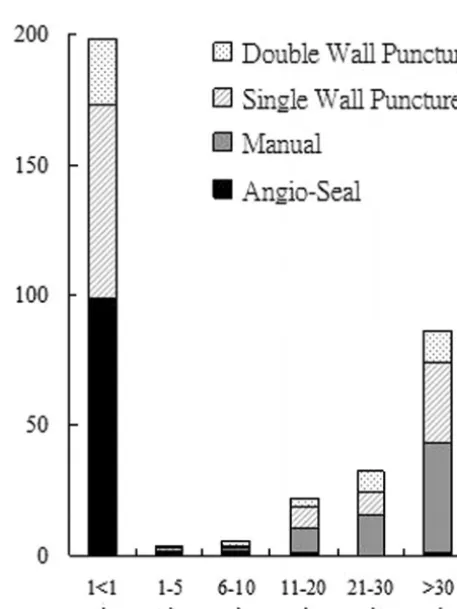
In achieving vascular access, 125 patients underwent single-wall puncture and 49 patients underwent double-single-wall puncture. There were 76 patients with single-wall punctures (60.8%) and 28
with double-wall punctures (57.1%) in group 1 and 49 patients with single-wall punctures (39.2%) and 21 with double-wall punctures (42.9%) in group 2. There was no significant difference between the 2 puncture methods (OR⫽1.2,P⫽.658) (Fig 1).
[image:3.594.52.532.55.127.2]One major complication occurred in group 1. A 75-year-old Table 1: Complication rates and a comparison of hematoma rates between Angio-Seal and manual compression at different ACT levelsa
ACT (sec)
Angio-Seal Manual Compression
Without Hematoma
With Hematoma Total 104
(90)b
Without Hematoma
With Hematoma Total 70
(67)b
<3 cm 3–6 cm >10 cm <3 cm 3–6 cm >10 cm
250–300 72 (61) 1 (1) 73 (62) 43 (43) 4 (4) 6 (6) 3 (2) 56 (55)
300–350 14 (12) 4 (4) 1 (1) 19 (17) 6 (4) 3 (3) 9 (7)
350–500 9 (9) 3 (2)c 12 (11) 3 (3) 2 (2) 5 (5)
a
Complication rate (hematoma⬎10 cm) 0.96 (1.11)% for Angio-Seal and 4.28 (2.98)% for manual compression. Patient numbers and complication rates in parentheses.
b
Four patients with bilateral arteriotomies closed by Angio-Seal and manual compression, respectively.
c
[image:3.594.54.532.177.295.2]One patient with bilateral Angio-Seal and bilateral hematomas simultaneously.
Table 2: Results of uni- and multivariate logistic regression analysis derived from hematoma development and independent predictors
Variable
Univariate Multivariate
OR 95% CIa PValue OR 95% CIa PValue
ACT time (sec)
250–300 1 (baseline) 1 (baseline)
300–350 3.3 1.2–8.8 .019b 4.5 1.5–13.2 .006b
350–500 3.4 1.1–11.2 .041b 5.0 1.4–18.0 .015b
Angio-Seal use 0.3 0.1–0.7 .003b 0.2 0.1–0.5 .001b
Age 1.0 1.00–1.02 .928
Sex 1.4 0.6–3.2 .426
Side 0.99 0.3–3.1 .984
Puncture technique (single- vs double-wall) 1.2 0.6–2.3 .658
a
Confidence interval is adjusted for age, sex, and puncture methods.
b
Significant difference from the control (P⬍.05).
[image:3.594.300.529.319.624.2]man had undergone carotid angioplasty and stent placement for a symptomatic high-grade stenosis of the carotid artery. No obvi-ous local abnormality was shown on the angiogram before de-ployment of the closure device, but the pedal pulse was found to have diminished a few hours later. An angiogram showed an oc-cluded common femoral artery at the puncture site. Flow was restored following balloon angioplasty (Fig 2). Anticoagulation was maintained for 24 hours, and no change in flow was apparent by sonography and during clinical follow-up. Despite the compli-cation, there was no delay in the discharge of this patient.
No new complications or progression of hematoma were found in either group at the 24-hour follow-up.
DISCUSSION
In our study, we found that patients treated with Angio-Seal more rapidly achieved hemostasis than those treated with manual com-pression, with less time needed for hemostasis, less local hema-toma formation, and an acceptably low level of complications in patients with prolonged elevated ACT after endovascular neuro-interventional procedures. The Angio-Seal device is an alternative hemostatic technique that can replace the labor-intensive method of manual compression and may avoid repetitive stress injury.18 In our study, there were no deployment failures and the compli-cation rate was low. Despite 1 adverse event in group 1, there were no delays in patient discharge. In a study of 698 Angio-Seal clo-sures, the minor complication rate in the interventional group was 2.4% and the major complication rate in this group was 1.4%.4This was higher than that in our group. In a study of con-trol of bleeding after transfemoral catheterization, the mean time
to hemostasis with manual compression was 33.5 minutes in a multicenter trial.19 For the manual compression group in our study, the mean time to hemostasis was 44.7 minutes, but we found that it was necessary to use the Clo-Sur PAD in 42 patients (60%), when the time of hemostasis was⬎30 minutes. Therefore the actual hemostasis time in our study would have been longer if only manual compression had been used. Our higher values prob-ably result from the fact that all patients in our cohort were on an anticoagulation regimen during the procedure with definitely prolonged elevated ACT values.
Khaghany et al5reported overall complication rates of 0.6% in their device (Perclose; Abbott Vascular, Santa Clara, California) group and 2.5% in their manual compression group (P⫽.15). McTaggart et al6reported a rate of groin hematomas of 1.4% in their StarClose Vascular Closure System (Abbott Vascular) group and 4.2% in their manual compression group for the patients not suited for StarClose deployment. McTaggart et al reported that the rate of groin hematomas was 4.2% in the manual compression and 1.4% in StarClose vascular closure group.6To the best of our knowledge, there have been no prospective studies that have com-pared Angio-Seal with manual compression in neurointerven-tional patients with reference to ACT values. Our study shows that an increase in ACT results in a greater frequency of hematoma formation. Overall, we found no significant difference in hematoma formation between single-wall and double-wall punc-tures, though there was a slight increase in the manual compres-sion group. In a meta-analysis of 6 studies that compared Angio-Seal with manual compression, the random-effects analysis demonstrated an OR of 0.86 (95% CI, 0.51–1.45;P⫽.78) for hematoma events and an OR of 0.30 (95% CI, 0.04 –2.07;P⫽.93) for pseudoaneurysms. Both marginally favor a trend toward An-gio-Seal having fewer complications than manual compression.20 Our study confirms a similar result in favor of the Angio-Seal device even in patients with prolonged elevated ACT values.
There are limitations in our study. One of the advantages of achieving rapid hemostasis when using a closure device is the potential for early ambulation of the patient. We were unable to evaluate the effect of Angio-Seal on ambulation time because most of our patients had to stay in the intensive care unit for at least 1 night. In addition, many, if not most, of the Angio-Seal– related complications may have occurred after 24 hours, so we would not have found them. Most of our ACT values were within the range of 250 –300 seconds. A larger scale randomized con-trolled trial in interventional neuroradiology is warranted to eval-uate the safety and efficacy of Angio-Seal use in patients with prolonged higher ACT values.
CONCLUSIONS
Groin hematomas appear to be less frequent when Angio-Seal is used compared with manual compression, particularly in cases when the ACT value is prolonged at an elevated level. Angio-Seal is rapid, safe, and effective in achieving closure of the femoral access site in patients undergoing neuroendovascular procedures under systemic heparinization with their postprocedure ACT ranging from 250 to 500 seconds.
[image:4.594.54.286.47.334.2]REFERENCES
1. Bogart DB, Bogart MA, Miller JT, et al.Femoral artery catheteriza-tion complicacatheteriza-tions: a study of 503 consecutive patients.Cathet Car-diovasc Diagn1995;34:8 –13
2. Heintzen MP, Strauer BE.Peripheral arterial complications after heart catheterization[in German].Herz1998;23:4 –20
3. Pracyk JB, Wall TC, Longabaugh JP, et al.A randomized trial of vascular hemostasis techniques to reduce femoral vascular compli-cations after coronary intervention.Am J Cardiol1998;81:970 –76 4. Geyik S, Yavuz K, Akgoz A, et al.The safety and efficacy of the
Angio-Seal closure device in diagnostic and interventional neuroangiog-raphy setting: a single-center experience with 1,443 closures. Neu-roradiology2007;49:739 – 46
5. Khaghany K, Al-Ali F, Spigelmoyer T, et al.Efficacy and safety of the Perclose Closer S device after neurointerventional procedures: pro-spective study and literature review. AJNR Am J Neuroradiol 2005;26:1420 –24
6. McTaggart RA, Raghavan D, Haas RA, et al.StarClose vascular clo-sure device: safety and efficacy of deployment and reaccess in a neu-rointerventional radiology service. AJNR Am J Neuroradiol 2010;31:1148 –50
7. Morris PP, Braden G.Neurointerventional experience with an arte-riotomy suture device.AJNR Am J Neuroradiol1999;20:1706 – 09 8. Park Y, Roh HG, Choo SW, et al.Prospective comparison of collagen
plug (Angio-Seal) and suture-mediated (the Closer S) closure de-vices at femoral access sites.Korean J Radiol2005;6:248 –55 9. Pierot L, Herbreteau D, Bracard S, et al.An evaluation of immediate
sheath removal and use of the Angio-Seal vascular closure device in neuroradiological interventions.Neuroradiology2006;48:45– 49 10. Koenigsberg RA, Wysoki M, Weiss J, et al.Risk of clot formation in
femoral arterial sheaths maintained overnight for neuroangio-graphic procedures.AJNR Am J Neuroradiol1999;20:297–99 11. Cremonesi A, Castriota F, Tarantino F, et al.Femoral arterial
hemo-stasis using the Angio-Sealasystem after coronary and vascular
per-cutaneous angioplasty and stenting. J Invasive Cardiol 1998;10: 464 – 69
12. Kapadia SR, Raymond R, Knopf W, et al.The 6Fr Angio-Seal arterial closure device: results from a multimember prospective registry.
Am J Cardiol2001;87:789 –91, A8
13. Kussmaul WG 3rd, Buchbinder M, Whitlow PL, et al.Rapid arterial hemostasis and decreased access site complications after cardiac catheterization and angioplasty: results of a randomized trial of a novel hemostatic device.J Am Coll Cardiol1995;25:1685–92 14. Sanborn TA, Gibbs HH, Brinker JA, et al.A multicenter randomized
trial comparing a percutaneous collagen hemostasis device with conventional manual compression after diagnostic angiography and angioplasty.J Invasive Cardiol1999;11(suppl B):6B–13B 15. Schrader R, Steinbacher S, Burger W, et al.Collagen application for
sealing of arterial puncture sites in comparison to pressure dressing: a randomized trial. J Invasive Cardiol 1999;11(suppl B):14B–18B
16. Silber S, Bjorvik A, Muhling H, et al.Usefulness of collagen plugging with VasoSeal after PTCA as compared to manual compression with identical sheath dwell times. Cathet Cardiovasc Diagn 1998;43:421–27
17. Tavris DR, Gallauresi BA, Dey S, et al.Risk of local adverse events by gender following cardiac catheterization.Pharmacoepidemiol Drug Saf2007;16:125–31
18. Walker SB, Cleary S, Higgins M.Comparison of the FemoStop de-vice and manual pressure in reducing groin puncture site compli-cations following coronary angioplasty and coronary stent place-ment.Int J Nurs Pract2001;7:366 –75
19. Semler HJ.Transfemoral catheterization: mechanical versus man-ual control of bleeding.Radiology1985;154:234 –35