WITH EMPHASIS ON THE MAN/MACHINE INTERFACE
A THESIS PRESENTED FOR THE DEGREE OF DOCTOR OF PHILOSOPHY IN CHEMICAL ENGINEERING
AT THE
UNIVERSITY OF CANTERBURY CHRISTCHURCH; NEW LAND
BY
Page 2-3
3-10
4-3
6-10 7-5
8-24 8-29
8-32
9-3
Line
7
6 up
10
1 up
13 up
5 6 8 5
careful should read carefully represent should read represents insert it before is
transmission should read transmissions insert no after is of
II it is a tale
Told by an idiot, full of sound and fury,
Signifying nothing. II
The research examined distributed computer based process control systems.
A functional analysis was done to identify the subunits that make up such a system. They are:
i) a communication system
ii) a distributed database
iii) a presentation system for a) the process
b) the process engineer c) the process operator
Each of these subunits is discussed in detail in chapters 3-7.
An economic analysis was also carried out to determine the optimum distribution of the control task. It was concluded that. on present costs, each controller should contain eight control loops. The controllers and man machine interfaces should be distributed along a multidrop communications line.
ACKNOWLEDGEMENTS
I wish, first of all, to thank Gordon Grey. Without him the
touch pad and keyboard would have come to nought.
To my supervisor, Dr R.M. Allen, the staff and postgraduate
students of the Chemical Engineering Department, and my family and friends,
I offer my thanks for the numerous ideas and the encouragement.
This work was carried out with financial assistance from the
TABLE OF CONTENTS
Page
Chapter 1 INTRODUCTI ON 1-1
2 SYSTEMS ANALYSIS 2-1
3 PROCESS INTERFACE 3-1
4 ENGINEER'S INTERFACE 4-1
5 OPERATOR'S INTERFACE 5-1
6 COMMUNICATION SYSTEM 6-1
7 DATABASE 7-1
8 IMPLEMENTATION 8-1
9 CONCLUSIONS 9-1
Appendix A Touch Pad Design A-l
B Keyboard Des i gn B-1
C Process Interface Software C-1
D Engi neerl
s Interface Software D-1
CHAPTER 1 INTRODUCTION
1.1 What;s process control?
1.2 Justification for process control
1.3 Development of process control
1.4 Present systems
1.5 Objectives of this research
Figures
1.1 Simplified control system
1.2 Impac operator interface
1.3 Vupac operator interface
1.1 What is Process Control?
The ultimate aim of a process control system is to maintain the
process to which it is connected at its optimum operating state. This
optimum state is determined by economic considerations combined with
safety, raw material and plant constraints. Maintaining the process
at its optimum, is effected by comparing the present state with the
desired state and, by use of human operators, analog controllers or
digital computers to remove any discrepancy. The transition path
depends upon which of these methods is used. The human operators use
experience based primarily on trial and error. Typically they are the
least efficient. Analog controllers use variations of the PID
(propor-tional, integral, derivative) algorithm. A digital computer can
implement either of the above strategies and, -in addition, methods based
on optimal control theory and process models.
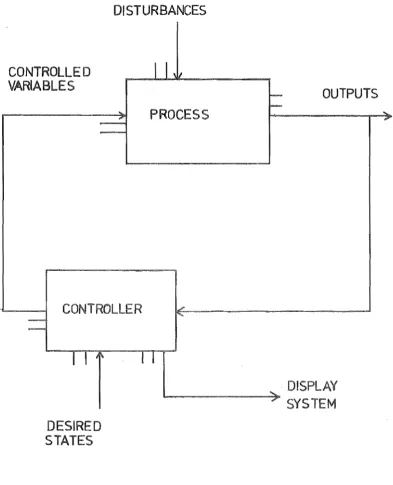
Put simply. a process can be considered as a black box (Fig. 1.1).
The process has two classes of inputs; non-controllable, which are
called disturbances, and controllable, some or all of which are used by
the control system to counteract the deleterious effects of the
di sturbances. Some of the outputs from the process wi 11 be exami ned by
the control system to determine the state of the process. These are
compared with, or the computed resultant state is compared with, the
optimum 'set by other controller inputs. Any difference causes the
control system to alter the controllable process inputs so as to move the
process closer to the optimum.
The control system has another function concomitant with maintaining
the process at its optimum and that is information presentation. The
process engineer and the process operator must be kept informed about the
current state of the process. This may be achieved by displays on
DI5T URBANCES
CONTROLLED
I
11VVARlABLES
_ .... PROCESS
.--::..
-CONTROLLER J
I '
=
I I
I ~DESIRED STATES
I I
to-- OUTPUTS
F-" DISPLAY , SYSTEM
FIG 1.1 SIMPLIFlED
CONTROL
SYS TEM
[image:9.595.114.508.145.631.2]chart recorders and panels on the front of controllers or, with modern
technology, through VDU's (visual display units) and line printers
connected to a computer.
1.2 Justification for Process Control
The equipment required to effect process control, the sensors,
controllers, final control elements and such peripheral services as these
use cost from 6% to 30% of the processing plant (1-5). As with any other
expenditure this must be justified. Qualitative justification has been (1-5)
- a reduction in labour
- increased production
- improved and more uniform product quality
- reduced consumption of raw and process materials
- less plant maintenance under less severe operating conditions
- reduced utilities and energy consumption
capital savings through
- elimination of intermediate storage
- reduced inventory
- less excess capacity
- increased yields, minimum waste
faster readjustment of the process to variations in raw materials
or operating schedules
- increased plant and personnel safety
It is possible to directly quantify some of these factors, for
example, reduced labour and plant requirements, savings on raw materials,
utilities and energy and increased yields. It is also possible to place
a value on those factors not so directly quantifiable, A plant
be Pl and with control this could be reduced to P2. The saving is there-fore $x(P1 - P2). This statistical argument can also be applied to increased product uniformity (1-5). These savings are then offset
against the cost of the control system to decide if its use is economically
justified.
1.3 Development of Process Control
Initially, process control consisted of sensors and their accompanying
indicators or recorders geographically distributed around the plant. Large
numbers of operators were required to monitor these and make the necessary
adjustments to the control elements. Automatic controllers were developed
because of the large variability in results between operators and in fact
for the same operator depending on work load, time of day, mood etc.
These controllers, P, PI or PIO were still spread around the plant and
during fault conditions an operator could still oversee only a small
number of them.
To improve the efficiency of the operator, the next step was the
I
design of centralised control rooms. The readings from sensors
distributed around the process were fed to controllers housed in these
control rooms and the resulting control action returned to the actuating
element. The control rooms, typically, had the controllers spread along
one wall, and while the operators now had their information close at
hand, the volume presented resulted in important changes being missed.
The use of human factors engineering, or ergonomics, to optimise the
presentation of this information improved the situation. By logically
grouping the information, using consistent displays and removing
non-useful detail the workload on the operator was reduced. However, under
high stress conditions information could not be assimilated quickly
Human factors engineering, or the design of work situations to
human capability constraints, was able to make further improvement
when digital computers became cheap enough to allow their use in control
rooms. This permitted the adoption of the "management by exception"
pr"inciple to reduce operator overload. Parallel information presentation
overwhelmed the operator by constantly displaying all available information
about the process. Management by exception meant that the operator was
only presented with information he needed at that particular time. This.
combined with an alarm panel. significantly reduced the operator's load
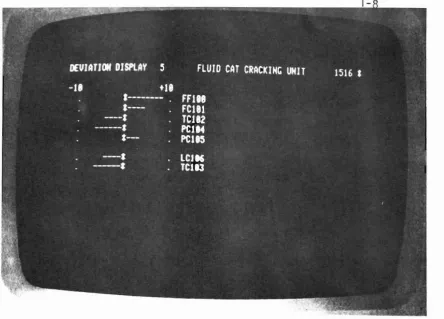
without reducing his efficiency. Figure 1.2 shows a typical operator
display panel from Foxboro's IMPAC system (1-6). Figure 1.3 shows the
same for a later model Honeywell VUPAC (1-7).
Because of their still high cost, the computer could not be justified
solely in terms of man-process interface improvements. The machine was
also time-shared around the control loops for either supervisory or direct
digital control and data logging. This situation was far from satisfactory
however. because computer failure meant loss of all loops. To reduce the
catastrophic effect of this, the most critical loops had conventional
analog controller backup. System reliability could be "improved by using
several computers, either reducing the area of responsibility of each or
using the extra intelligence in a back-up mode. Here again, cost becomes
a dominating factor and typically these types of computer control systems
were and still are used only in highly critical areas, e.g. nuclear
reactor control.
A solution through cheaper computer power became available with
the advent of the microprocessor. Now it was poss"ible to have many small
computers, each responsible for as few as eight. or in rarer cases one.
control loops. By distributing the microcomputers around the plant,
L'J
-Ul
Q
•
0-..IJ
o
-~
!
::
c:.L!J
-0
•
Ul
i:! ~w
rn
0
G
1-7w
u
0
LE
•
0:::w
Ul
Ul
0::: I... W~
a..
" N .:.D
~i ~..
"
...-m
transmission, such as noise were easily solved. Inter-computer
communi-cation was achieved over a twisted pair or coaxial cable, in one of three
basic configurations (Fig. 1.4) i} a star
ii} a multidrop line
iii) a ring
The commercially available systems use variations or combinations of all
three types.
1.4 Present Systems
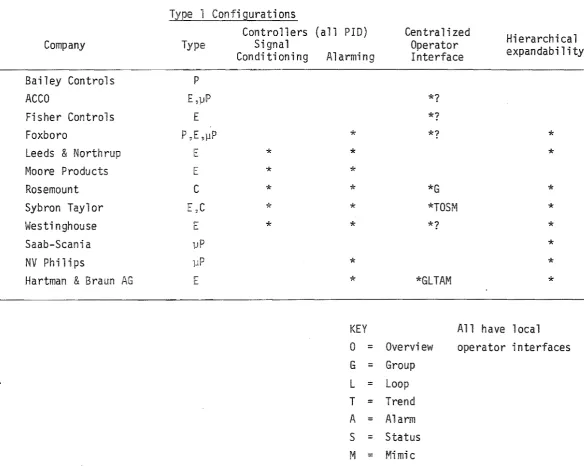
Table 1.1 shows a list of the offer"ings commercially available at
the time of writing. The table "includes information about the controllers,
the operator interfaces and, where appropriate, comrnunications rnethods.
These systems have been sorted into three categories based on their
operational configurations (1-8).
Type 1 systems are the conventional centralized control room layouts.
Sensor readings are brought into the control room and the output from the
controller fed back to the actuator.
The multidrop line and the hierarchical star configurations make
up Type 2 systems. The advantage here is that level sensor signals
have less distance to travel to the controller and thereby suffer less
from the effects of noise. There is also greater use of the operator
interface using the Imanagement by exception ' principle (see section 1.3).
The last configuration, the ring, is the least used. There is only
one control system, the System 1100 by Xomox, that uses it. Data
transmission is uni-directional around the ring and hence reliability
1 Configurations
Controllers (all PID) Centra 1 i zed
Hierarchical
System Company Type Signal Operator expandability
Conditioning Alarminq Interface
7000 Bailey Controls P
Bristol UCS3000 ACCO E,lJ P *?
ac2~ dc2 sher Controls E *7
Spec 200 Foxboro P ,lJP * *? *
Centry Leeds & North rup E * * *
Synchro 350 Moore Products E * *
Diogenes Rosemount C * * *G *
III Sybron Taylor E,C * * *TOSM *
Veritrak Westinghouse E * * *? *
NAF-Unic Saab-Scania *
PCS 700 NV Philips llP * *
Protronic Hartman & Braun E * *GLTAM *
KEY All have local
p = Pneumatic 0 = Overvi ew operator interfaces
E = Electronic G = Group
= M, croprocessor L
=
LoopC = Computer T
=
TrendA = Alarm
S
=
Status [image:16.841.203.788.64.532.2](baud)
OGL
*
Current loop ? ? StarAGL ? Multidrop
ROGLA
*
Coaxial 1.5M 5000 ft Multi dropTGO
*
Current loop Star?
*
? ?OGL Coaxial or 600 ft ?
twisted pair
AOLMR Twisted pair 500k ?
TG
*
? ?AGLT
*
Coaxial 10 km MultidropOGLTM
*
30 core cable Star?R ? 250k ?
OGLA
*
? 1000 ft Multi drop & Star?GR
*
? 15k ft MultidropOGR
*
Coaxial 1M MultidropOGLTR
*
RS232 300-l9,2k StarMTLA 10 rnA 1200-9600 3-.6 mil es Star
?G
*
Coaxial 1 ~1 3-4,5 km Multidrop1M 1 .5 M 4 km Multidrop
OGLAM
*
Twisted pair 500 k 1500 m l'1u1 ti drop? Coaxial 500 k ?
Twisted pair 250 k 2 km Multidrop
See Centum RS232 10 km Multi drop
TTY Ring
Key (Di s plays)
0
=
OverviewG = Group
L = Loop
T = Trend
A
=
AlarmS = Status
STAR
MULTIDROP LINE
RING
1.5 Objectives of this Research
In view of the decreasing cost of computing power, the idea of
distributing intelligence around the plant and providing a communications
highway would become more prevalent in available control systems. This
research aimed at outlining the requirements of these systems with
special attention given to the problem of the man/machine "interface.
In the following chapters the computer based distributed control
system ;s first analysed to show the subsystems that are a part thereof,
and then each subsystem ;s examined in greater detail. The final two
chapters discuss a system that the author constructed based on the above
information and the areas that could be improved with the availability
REFERENCES
1-1 Handbook of Industrial Control Computers
T.J. Harrison, Wily-Interscience, 1972.
1-2 Man and Computer in Process Control
E. Edwards, F.P. Lees, I.Chem.E., 1972.
1-3 IIComputerized Process Control in the Steel Industry"
Review 224, International Metals Reviews, 1977, pp.355.
1-4 "Control Equipment Developments Lead to a Future of Distributed Controll!
E.J. KompQss, Control Engineering, December 1977, pp.35.
1-5 "The Justification of Expenditure for Process Control Equipment"
R.M. Allen, ACIS 8th National Conference, Auckland N.Z., 1977.
1 Fox 2 Process Computer Systems, Impac Software, System Product
Specification SP-53000AX-A
The Foxboro Company, December 31. 1971, pp.IS35, IS37.
1-7 Vupak Systems Manual
Honeywell Inc., 1974.
1-8 liThe Configurations of Process Control: 1979"
Control Engineering, March 1979, pp.43.
1-9 "Internati ona 1 Manufacturers Offer Many Choi ces in Process Control
Systems"
Kenneth Pluher, Control Engineering, January 1980, pp.54.
1-10 "Distributed System is ExpGndable from Eight Loop"
Henry H. Morris, Control Engineering, June 1980, pp.78.
1-11 II Introducing Four More New Integrated Di stri buted Control Systems II
Kenneth P1uher, Control Engineering, August 1980, pp.41-.
1-12 "Foreign Distributed Control Systems Keep Pace with Industry's Needsll
2.1
2.2
CHAPTER 2
SYSTEM ANALYSIS
Functional analysis
Economic analysis
2.2. 1 Hardware cost
2.2.2 Software cost
2.2.3 Wiring cost
2.2.4 Failure cost
2.2.5 Concll,lsions
Fi gures
2. 1 Multidrop hardware layout
2.2 Hardware cost
2.3 Software cost
2.4 Wi ring cost
2.1 Functional Analysis
A functional analysis of any system involves answering the question,
"What does the system do?" A distributed computer based process control
system is designed to maintain a process at its optimum operating condition.
"Maintain" implies the system must have a high reliability and 1I0pt"imumli
includes consideration of economic, safety and legal factors. Having
broadly stated what the system does, the next question to be answered is,
IIHow does it do this?".
To fully answer the second question, and thereby the first, we must
break down the complex control system into its sub-units. These sub-units
are then divided further until we are reduced to parts small enough to be
explained in complete detail.
The type of distr"ibuted control system being studied has three
separate interfaces with the world
i) the process interface
ii) the engineer's interface
iii) the operator's interface
In systems with extensive report generating features. a fourth, the
management interface, can also be defined.
The control strategy is implemented through the process interface.
Sensors feed data to the control stations enabling the current state of
the process to be determined. This state is then compared with a model
stored in the microcomputer and any difference is used to calculate the
action required to return to optimum. This action is then sent to the
final control elements; valves, motors or heaters. In addition, checks
on the approach of variables to safety and other constraints can be made
The engineer, in designing the control strategy, enters information
into the computer through his interface, enabling the computer to
determ"ine the state of the process and to calculate any action required.
A constant check on the state of both the process and the control
system, and entry of data to fine tune both parts, is achieved through
the operator's interface. Because of its critical function, the control
system's success or failure as a whole depends on the careful considered
design of this interface.
These three interfaces, or windows to the world, make up the
presentation sub-unit. The second sub-unit that can be identified is
the database or storage unit. The engineer's information, the control
parameters, and the data collected from the process are stored in a
data-base. The input from the operator's interface involves making adjustments
to variables in this database. Its design affects the engineer's
inter-face and thus the useability of the whole system and also its effectiveness
as a control unit. The more efficient the database, the faster the system
can respond to process changes. As a result, the database is viewed from
two levels, the process interfaces with the physical storage of information
and the engineer with logical storage of the same information.
In operation, data transfers of three types will be occurring
-i) storage-storage
ii) storage-presentation
iii) presentation-storage
These are made through the communication subsystem. Use of the communication
channel for storage-storage transfers is necessary because of the
distributed nature of the system. To fulful the reliability criterion, the
control intelligence is not concentrated in one machine but distributed
among several microcomputers. Consequently the database will also be
The communication subsystem is designed so as to minimize the cost
of the overall scheme. Depending on the price of computing power, the
resulting configuration will be a star, a ring or a multidrop line (see
Fig. 1.4). If an economic analysis shows a small number of loops per
processor to be optimal, the ring or multidrop line is preferred, while
a large loop to processor ratio favours the star format. This is because
of traffic density on the data highway. In the communications subsystem,
consideration must be given to the physical unit, i.e. a twisted pair, a
coaxial cable or an optic fibre, and the logical unit, i.e. the message
format, error correction-detection scheme and the handshaking convention.
So we can now say that a distributed computer based process system
is made up of the following subunits
1) the communication system
ii} the distributed database
iii} the presentation system to the a) process b) engineer
c) operator
It is also possible to consider the hardware subunits. These are
the control station, the engineer's interface, the operator's interface,
and the database and communication controller. Figure 2.1 gives a
typical layout for the multidrop configuration.
2.2 Economic Analysis
Having completed a functional analysis, an economic analysis is
necessary to answer the question, "How distributed should the system be?",
and then decide which of the three poss"ible configurations is more appropriate.
To do this we need to find the most economic number of control loops for
each microcomputer, or minimize a cost function with respect to the number
ENGINEERS
INTERFAct;
OPERATORS
INTERFACE
CONTROL STATIONS
The cost of a system includes
i) design
ii) computer hardware and software
iii) wiring
i v) install ati on
v) failure
This analysis only considers the analog control system as for any
particular situation the digital control system, best implemented through
modern PLe·s (programmable logic controllers), can be considered as a
fixed cost. The logic control system will be required regardless of the
number of loops that will be implemented in each microcomputer. If we
assume a system with
N microcomputer based control stations
n inputs
and m outputs
where m is fixed at n/2, the same as that used for the Honeywell TDC2000
design, then for a fixed value of n, and therefore m, we vary N to
minimise the cost. It is only necessary, therefore, to consider those
factors that vary with N as a 11 others wi 11 effect; ve ly be only a fi xed
additional cost. From our original list, then, we may ignore design and
installation costs which leaves four sections
-; ) hardware
ii) software
i; i) wiring
2.2.1 Hardware costs
Hardware cost
=
CPU + memory + input/output +power supply + box, cabling, etc.
Let H
=
CPU + power supply + box, etc.Now memory comprises program and data memory, i.e. ROM + RAM.
The program memory will be of fixed size, but the data memory will have a
fixed requirement plus extra for control loop data storage. If we allow
5k bytes of memory for the storage of program and set data, and allow .5k
bytes for each control loop, the ,memory requirement becomes
(5 + .5n/N)k bytes
The input/output subsystem includes the communication system, process input
and process output. If we now let
HI = H + communication system
then the hardware cost per microcomputer
=
H" + (10 + R)*Cm +[~J*CDA
+~
* Cowhere H" the cost of HI
Cm = the cost of .5k bytes of memory
C
OA = the cost of an eight channel data acquisition module
CD = the cost of a D/A converter
R
=
the number of inputs per microcomputer=
n/Nand [J = the ceiling function.
Therefore, the system hardware cost
C
H = (H" + 10*C )*N m +
[~J
* C * N OA + R * Cm * N +R
2 * C * 0=
(W + lO*C )""'N m + [-'!] "'" 8 CDA + n * Cm +2-
* CoI~
2.2.2 Software costs
In every microcomputer there will be a set of standard
routines that are used to effect the control" These will be the same
for each control station and so will not affect the cost function. The
software costs that should be considered are those of a load sharing
routine, to even out the number of inputs scanned each interval, if the
number of inputs per microcomputer becomes too large, and if only one
large machine is used, a comprehensive multitasking executive. If we
assume the basic routines cost S, the load sharing routine for greater
than 16 inputs per microcomputer is SL' and the multitasking executive
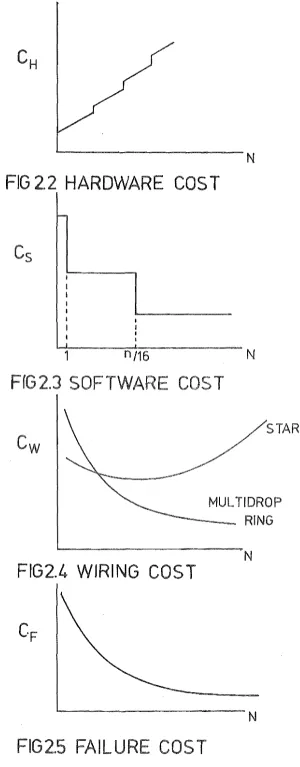
for N = 1 is SE' the result is shown in Figure 2.3.
2.2:3 Wiring costs
Let us assume that the microcomputer based control stations
lie on a circle of radius D. The inputs to each station will be connected
in a star configuration and can be approximated to lie on a circle of
radius r about that station. Then the length of cable needed to join
the control stations is ND for the star
1
2nD(1 -
w)
for the multidrop lineand 2nD for the ring,
and the length of wire needed to join the inputs to their respective
station is nJ. As the number of stations gets larger each input will be
1
closer so raN' say
nr * N
N
r
=
*.
Therefore the wire for all input iskn
= 11
If the wire for joining the control stations costs x per unit length
and for the inputs y per unit length, the total wiring cost is
Cw = ND + ~ star
x N
2nD( 1 1 ~ multi drop 1 i ne
= - W)x +
N
= 2nDx + kny ring
c.f. Y - . aN + N b star
::: a + b multidrop line or ring
N
(see Fi g. 2.4).
2.2.4 Failure costs
Let the cost of failure of a single control loop be c per
hour. If the number of loops for control station is
N'
then the costof microcomputer failure is ~c per hour. Assuming a negative exponential
failure distribution (2-1) and defining
F ::: mean time to failure
R ::: mean time to repair
T ::: operating life in hours (» F),
the downtime of a microcomputer is
RT
R + F hrs.
Therefore the cost of failure is
nc
*
RTN
R + FNow ncT is the cost of failure of all loops for the operating life of
the control system. This is equivalent to having no control at all, and
under these circumstances the plant will cease to be profitable. Therefore
ncT equals the profit of the plant, say P. The cost of failure then
becomes
.!:
;Ie RN R + F
and for all control stations
::: P
*
R R + Fwhich is independent of N.
However, as the number of control stations decreases, the
number of components used to construct each station will increase and
a and b are constant and x is the number of additional components required.
Then the cost of failure
R CF
=
P*
R + (a - bx)c.f. y
(see Fi g. 2.5).
2.2.5 Conclusions
To determine the optimum number of inputs per control station
(or the optimum number of stations for the system), the total system cost
must be minimised. As stated in section 2.2, this total cost, considering
only the parts that vary with the number of control stations N, is
Total cost
=
hardware + software + wiring + failure.The equations were programmed on a computer using the following
data:-Hardware costs based on current N.Z. retail prices
Hit $1,000
C :::: $50
m C
OA = $150
Co ::: $10
ii) Software costs
The loading sharing routine is approximately 500
statements long (as designed by the author) and the executive
(based on the POPll RT-ll system) ;s 2000 statements. At a
cost of $6 per statement (2-2), the costs are
SE
=
$12,000\ ::: $3,000
iii) Wiring costs
FIG 2. HARDWARE
COS T
FrG
I I
1
I
I
I
I I
OF WAR
T
N
N
STAR
MULTIDROP
- - " RING
N
FIG2.4 WIRING CO
T
N
[image:31.597.122.423.50.819.2]of diameter of the order of one kilometre, as D ::: 1000.
Coaxial cable, for inter-station connection is $1 per
metre on current costs and for input connection, cheaper
wire of 30¢ per metre is adequate. For the sake of
simplicity the constant k is set equal to D.
iv) Failure costs
The profit of a plant can be considered as the return
on an investment equal to the capital cost of that plant, so
where n = plant life in years, 15
r
=
effective rate of return, 15%A
=
capital cost, $lOSTherefore P ::: $S.14 x lOS.
The mean time to repair a modern computer board is of the order
of one hour so R ::: 1. The mean time to fa"j 1 ure of the same
;s 1000 hours, and considering the extra complexity each
additional chip will reduce this by 5 hours. Strictly speak"ing
this time is not constant and will exponentially decrease but
for the range considered in the program it was assumed linear.
The results are shown in Table 2.1.
The first important conclusion ;s that the star
configura-tion is never the most economic. The difference between the
multidrop line and ring format is not significant and these
have been included in the one column. The ring suffers from
reliability (see Chapter 6) without the addition of intelligent
Inputs Optimum Inputs/pC Total Cost Star Mul drop ne Star
40 4 3 9.19 x 10 5
80 5 4 9.44 x 10⁵
120 6 5 9.65 x 10⁵
160 7 6 9.83 x 10⁵
200 8 7 9.98 x 10⁵
240 8 8 1.01 x 10⁶
280 8 8 1.03 x 10⁶
320 8 8 1.04 x 10⁶
360 8 8 1.06 x 10⁶
400 8 8 1.08 x 10⁶
Multidrop Llne
9. 14 x 105 9.34 x 10⁵ 9.50 x 10⁵ 9.65 x 10⁵ 9.78 x 10⁵ 9.90 x 10⁵ 1.00 x 10⁵ 1.02 x 10⁵ 1.02 x 10⁵ 1.04 x 10⁵
N
I
...
The range of inputs considered was a minimum of 40 to a
maximum of 400 per system. The optimum always lay between
2 and 16 inputs per microcomputer and so neither extra
soft-ware routines affected the cost. The most significant cost
was the failure cost, contributing as much as 90% of the total
cost in some cases. The wiring and hardware costs were of a
similar order and for the largest system were only 40% of the
overall total. Ignoring the failure cost completely moved the
optimum to more inputs per station. stopping at 16 because
REFERENCES
2-1 System Reliability Engineering
G.H. Sadler, Prentice Hall, 1963.
2-2 'Focus on Software'
3.1 Function
3.2 Hardware
3.3 Software
Fi gures
3.1 Process interface
CHAPTER 3
PROCESS INTERFACE
3.1 Function
The process interface has two identifiable functions. The first is
to effect the control strategy as defined by the engineer. The second is
to collect and process data for use by the process operator in his role as
supervisor, or by the engineer, in reports or higher level control
calculations. The interface must therefore be able to capture this data,
convert it to a form suitable for use by the microcomputer, process the
result using the available software routines or computer language, and
finally output the desired control action and convert it to a signal
capable of driving the control actuating device (Fig. 3.1). The hardware
components, including the microcomputer, are discussed in section 3.2 and
the software requirements in section 3.3.
3.2 Hardware
What must the hardware section of the process interface accomplish?
It must measure the physical variables of interest, convert these to an
electrical and/or digital analogy which can be used by a microcomputer
based controller. On the output side it must do the reverse. The nun~rical
value from the ~C is changed to a signal suitable for actuating the final
control element.
The input can be considered as having four separate stages (Fig. 3.l):
i} the transducer
ii) pre-multiplexor conditioning
iii} the multiplexor
iv} sample and hold/analog digital converter
Table 3.1 lists the more common process variables and means of measurement.
It should be noted that not all are real time methods and some do not give
TRAN SDUCER AMPLIFIER I MUX
FILTER SAMPLEI
HOLD
AI
ACTUATING ELEMENT
3.1
P 0 ESS I T R
I I
I FILTER
I I
I
I OUTPUT
I
PROCESS
I
I
L!NEARISING
.. .- &
SCALING
ALARMING
CONTROLLER
W
The particular choice of transducer depends on three factors;
i) economy
ii) safety
iii) accuracy, relative and absolute
Economic constraints are important but are not the overriding criterion.
Safety aspects may preclude the use of certain transducers. For example,
it may be necessary to convert a level measurement to a pneumatic signal
first because the presence of an electrical signal may constitute an
explosion hazard. Transducer accuracy is affected by its two basic parts.
To measure a variable, the transducer compares the incoming signal with
some previously determined standard. The quality of this reference affects
the absolute accuracy of the measurement and the comparison affects the
relative accuracy. So it is possible for the device to be consistent
(precise or relatively accurate) but to give a poor indication of the state
of the physical variable (inaccurate or poor absolute accuracy). The
resolution of the comparing mechanism will also affect accuracy. Low
resolution means the available scale is divided into very few stages giving
a coarse measurement.
Having eventually converted the process variable into its electrical
analog, the signal must be prepared for computer use. If the computer ;s
any distance from the measurement point, the signal must be transferred.
This transfer gives rise to a large number of errors. To reduce the effect
of noise on the signal it should be amplified as soon as possible. This
amplification must take into account such problems as common mode error
sources, normal mode error sources and the major causes of these. Common
mode errors are, typically, voltages that are in parallel with the desired
signal. These can arise due to ground loops or induction between the Signal
carrying wires and nearby power sources or users. Normal mode voltages are
Table 3 Process Variables and Measurement Systems Temperature
Thermocouples
Resistance thermometers Filled system thermometers Liquid-in-glass thermometers Bi-metallic strips
Optical pyrometers Pressure
Flow
Liquid column
Elastic element methods Bou rdon tube
Bellows Diaphragms Electrical methods
Strain gauges Piezoresistance Piezoelectricity
Variable head meters Variable area meters
Positive displacement meters Turb i ne meters
Mass flowmeters Sound reflection Light reflection Wei rs
Flumes
Level
Visual gauges Float actuated Oi sp 1 acer Head
Electrical methods Resistance Capacitance Sound reflection Nuclear radiation Light reflection Thermal conductivity Physical Properties
Density and Specific Gravity Li qui d col umn
Displacement
Di rect mass
Radiation absorption Viscous drag
Viscosity
Viscous drag Refractive index
Transmission Reflectance
Thermal conductivity Boiling point
Table 3.1 contd.
Chemical Composition
Chromatographic analyzers
Infrared analyzers
UV and visible analyzers
Turbidimetry
Paramagnetism
Moisture
Dew point
Electrolysis
Capacitance
Heat of sorption
Piezoelectricity
Psychrometry
Conductance
Karl Fischer method
Electroanalyticity
Conductance
Capacitance
Potential
pH
Specific ion probes
may arise due to resistive drops in signal wires, thermocouple effects
when dissimilar wires are joined and, again, ground loops. Common mode
problems can be solved, or eased, by using instrumentation or isolation
amplifiers, (3-3), or early digitizing, but correction of normal mode
errors can only be effectively done by careful design to remove their
sources. The amplified signal will still have some noise and this can
be reduced by filtering. In addition, the use of a filter can prevent
aliasing or errors due to freque~cy folding. Aliasing is caused by high
frequency components of the signal. A slow sampling rate can cause the
computer to react to harmonies of these higher frequencies, instead of
the signal of interest. Frequency folding is an effect caused by the
reflection of the higher frequencies about a point equal to half the
sampling frequency. If the highest frequency in the signal is fh and
the sampling rate if f
s' then if (fs - fh) is less than fs/2. there will
be a resultant frequency folding (3-11), Typically, a low pass filter
with a cutoff frequency as low as possible, commensurate with the
band-width of the signal of interest. is used, but specialized filters such as
notch filters, synchronous filters or derivative controlled filters may
be required in some situations. For example, where specific noise spikes
occur (notch or synchronous filters). or where there may be a speed of
response requirement (derivative controlled filters) (3-3).
Primarily for economic reasons, the now amplified and filtered signal
is fed to a multiplexor (MUX). The use of a MUX means that only one analog
to digital converter (A/D) is needed for many incoming measurements. The
MUX is a set of switches that can be selectively turned on to connect only
one measurement line to the A/D. The switches can be mechanical, as in
relays, or semiconductor, as in FET switches. The problems in using a
i) leakage, due to off resistance being less than infinite;
ii) crosstalk, the off channel affects the selected channel
giving common mode problems;
iii) switching time, affecting the possible sampling rate.
The last step before the computer is
AID
conversion. The choiceof converter is critical to the whole measurement. Its resolution,
accuracy and speed affect the final result.
There are two basic types used in process control, an integrating
AID
and a successive approximation type. The integrating converterintegrates the incoming signal for a set time linterval and then measures
the time required to ramp the result back to zero at a fixed rate.
Typically they are only used in low speed applications. The successive
approximation variety compares the signal to an internal voltage created
by successively turning on bits in the resulting word and leaving them on
or switching them off after comparing the two values. They are much
faster and have the capacity for high resolution. However the
AID
istypically not fast enough to convert the signal without it having changed
appreciably during the conversion. For example. a 12 bit
AID
that hada conversion time of 24 ~secs could only handle a signal of 1.6 Hz. To
overcome this problem a sample and hold unit is used before the
AID
tosample the signal and hold the result for the
AID
to convert. If it isnecessa~ to sample a large number of channels simultaneously, the sample
and hold unit may be placed before the MUX. Accuracy in an
AID
isdependent on its linearity, as zero and full scale offset voltages can
be trimmed with a resistance. A typical specification will quote a total
non-linearity of plus or minus a fraction of the least significant bit
and at any stage the output should be in error by no more than this. The
process variable has now been measured and converted to a computer useable
voltage to frequency converter may be preferable with the result being
measured by a pulse counter. This can reduce, in some situations, the
effects of some of the errors we have discussed.
After the software has processed the input, its digital result must
be delivered back to the \~Jactuating device. The necessary conversion is
done by the output hardware. The first step is to convert the digital
result into form acceptable to the actuator of the final control element.
This may mean conversion to an electrical value via a digital to analog
(D/A) converter, or to a form of modulated pulse output.
The two main types of digital to analog converters are the weighted
current source and the R-2R ladder network. The weighted current source
D/A has a series of transistors whose collector currents are set by
resistors with values of R, 2R. 4·R etc. The transistors are switched on
or off according to the appropriate bit in the output word. This method
is fast and simple but the large range of resistance values required for
high resolution results in significant temperature effects. The R-2R
network has a series of resistances that are either in series with the
output of values R or shunt across the output with values 2R. The shunts
are connected to earth or a voltage source depending on the bit value of
the output and the division of current as it flows down the ladder results
in the required output. This method requires twice as many resistors as
the weighted current source but all are of value R or 2R and so are better
matched. Other advantages are that the output amplifier always sees a
constant input resistance and the resistance values can be kept low to
ensure low power consumption and high speed.
The pulse output systems can be modulated in one of four ways:
i) ampl i tude
i i ) frequency
iii ) durati on
For computer output that represent the absolute value of the control
element, amplitude modulation tends to be the most common as it is the
least complicated to implement. For change in position output»any of
the four methods can be used.
This conditioned output is then transmitted to the actuating element
of the controller hardware. Table 3.2 lists common actuating methods and
final control elements {3-2}. As with the input)the use of pneumatics or
hydraulics is typically for safety reasons although with some output .1
situations) they may also effect a large amount of power amplification.
The remaining hardware unit in the process interface is the control
station, or microcomputer, itself. Its primary design consideration is
reliability. Less important criteria are performance, cost and modularity.
The three functions it must perform are control, communication and the
provision of a local man-machine interface. To some extent these are
independent and it is therefore possible to allocate each to a separate CPU,
fulfilling all but the cost restriction. However it is cheaper to use
only a dual CPU system with little or no loss in performance, modularity
and reliability. Figure 3.2 shows the result.
Reliability, and reconfiguration should a fault be detected, are both
accounted for. The control interface CPU is capable of stand-alone
operation and the unit as such could be used as a multi loop controller.
Therefore communication system failure should not affect control
Should the control CPU develop a fault, the communication CPU, through the
duplicated process inputs, can send the measurements to a standby CPU with
the results being sent back for output. This reconfiguration should take
place in less than ten sample intervals and if the communication channel
is fast enough "in less than a second. The layout is therefore dynamically
reconfigurable giving a very high reliability for small cost (redundancy
COMMUNICATION HIGHWAY
PROTOCOL CHIP
DMA
LOCAL
RAMIROM
COMM CPU
COMMUNICATION BUS
-
COMMON
RAM
PROCESS INTERFAC
I
-PROCESS
CONTROL BUS
CONTROL
1 - - - 1 CPU
LOCAL
1 - - - 1 RAM/ROM
LOCAL ,;
_l-...j INTFACE
standby controllers).
The other criteria are also satisfied with this design. Cost is small, as explained above, the only extra requirement being fast access memory so the CPUls can interleave their read/write cycles. Performance is enhanced by using dedicated intelligence for each function and the modularity constraint is complied with as explained above.
3.3 Software
The software requirement for the control station can be divided into three categories:
i) real-time executive
ii) control based applications software iii) communications software
The communications software will be discussed in Chapter 6 and the local interface section of the applications programs will be covered in Chapter 5.
The basic functions for a real time executive for the ~C control station are:
i) task initialisation and scheduling or rescheduling ii) intertask communication and synchronization
iii) timing
iv) interrupt handling v) input/output handling
In this context I/O handling tends to be very situation specific and covers both process I/O and human I/O. Process I/O includes control of the
receipt of an interrupt, polls each possible device in turn to determine
the interrupt source. The timing function must be external to the CPU
to ensure some absolute measure of real time. Task initialization is
usually based on the timer input as the tasks in question are typically
the control routines. Task scheduling or rescheduling may be necessary
to alleviate uneven CPU loading. The final function is intertask
communication. This may occur within a CPU or if external to (or across)
CPU's may make use of the communication system. Because in the process
control situation the number of tasks is limited (see Chapter 2),8 inputs
per CPU, the executive in a control station is uncomplicated and
conse-quently reliable~ fast and compact.
The applications software is composed of a series of routines which
are used to effect the software processing between input and output
(Fig. 3.1), The engineer will specify the routines to be used for each
input and the list produced, be it a program written in some process
control language or literally a list of routine calls, constitutes one
task under the executive. A basic collection of programs would cover:
;) a software filter
ii) linearizing and scaling routines
iii) alarm checking
iv) control routines
v) output checking and formatting.
The hardware filter will have removed most higher frequency noise
from the signal, but the data may still need to be smoothed. The most
common technique is the exponential filter, a simple first order lag.
where Y
t n = present output
Y
t = previous output
n-l
x
= inputa· = filter constant = Ts
TF
TS = sampling interval
TF
=
fi lter time constantWith a set to one, the output equals the input. As a gets less, so less
of the new input and more of the previous output is used, the system
becomes more sluggish, until at a value of zero the input is not used
at all, The recommended range for a is 0.7 to O,g, There are other
possible filters that introduce less phase lag but the computational
requi rement becomes too great (3-9),
Linearizing routines cover just about every mathematical possibility.
For example, a pH signal may need an inverse sinh function, a flow meter
based on pressure drop uses a square root function, and thermocouples
may require a high degree polynomial (or large look up tables). Once
linearized, the signal is then converted to engineering units by a
simple scaling:
Y ::: AX + B
where Y output
X ::: input
A = scale factor
B = offset
Alarm checking covers absolute alarms, with and without a deadband,
offset alarms (relative to some setpoint) or deviation alarms to check
rate of change. The deadband is used to ensure noise does not cause
multiple alarms when the process variable is hovering on an absolute limit.
Control routines include PID algorithms that output absolute values
that have variable gain or may have remote setpoint facility for cascade
operation. Refinements include bumpless transfer when changing from
manual to automatic operation and back)set point tracking for cascade
controllers, and the ability to incorporate interlocks and overrides in
the control scheme. Other control routines w'j 11 be needed for deadtime
compensation, feedforward control and derived variable control.
The output checking facility is used to limit the range of the
control variable. It is also used to keep the rate of change to a level
acceptable for the control element actuator. A side benefit of the rate
of change limit is that a CPU malfunction cannot affect the process too
quickly, hopefully not before the error has been corrected.
The range and complexity of the software processing options can
cause confusion for the process engineer. His method, of implementation
of these routines has a direct bearing on how they are written for the
Table 3.2. Final Control Elements
Linear Position Actuators
Pneumatic
Electropneumatic
Hydraulic
Electrohydraulic
Electric
Mechanical
Variable Speed Drives
Variable Electric Power Actuators
REFERENCES
3-1 Chemical Engineers Handbook, 5th Edition, pp22-33.
R.H. Perry, C.H. Chilton, McGraw-Hill, Kogakusha, 1973.
3-2 Ibid. pp.22-87.
3-3 Transducer Interfacing Handbook
D.H. Shingold, Analog Devices, 1980.
3-4 Analog/Digital Conversion
D.H. Shingold, Analog Devices, 1972.
3-5 "Consider Every Error Source for Data Acquisition Design"
D. Chase, Control Engineering, June 1980, pp65.
3-6 "System Archi tecture Affects Data Acqui s i ti on Accuracy and Flexi bil ity"
D. Chase, Control Engineering, July 1980, pp83.
'3-7 IIData Acquisition Can Falter Unless Components are Well Understood"
D. Santucci, Electronics, November 13, 1975, pp.114.
3-8 "Manouvering for Top Speed and High Accuracy in Data Acquisition"
D. Santucci, Electronics, November 27,1975, pp.115.
3-9 Smoothing, Forecasting and Prediction of Discreet Line Series.
R.G. Brown, Prentice Hall, 1963, Section III.
3-10 "Designing and Programming Control Algorithms for DOC Systems"
E.H. Bristol, Control Engineering, January 1977, pp.24.
3-11 Electronic Design's Gold Book, Vol. 3
4.1 Function
4.2 Software
4.3 Hardware
Fi gures
CHAPTER 4 ENGINEER'S INTERFACE
4.1 Function
The engineer's interface is his means of communicating with the
control system. It differs, in this respect, from the operator's interface
which provides a view of the process rather than the control system. The
engineer has two primary tasks that he must accomplish through his interface:
i) configuring the control strategy
ii) initializing the parameters in the system.
Modification of the configuration or the control parameters is a secondary
requirement but still important.
For the engineer to make optimal use of the control system, the major
design consideration should be flexibility. It must be capable of
imple-ment-ing any and all of the engineer's control schemes. The most flexible
system available at present is to allow him to program his strategy in a
real time computer language. These range from extensions of Fortran and
Basic, to specifically designed languages such as RTL and Coral 66 (4-4).
The advantage of this flexibility is the use that can be made of process
knowledge. Full utilization can be made of feedforward control, derived
variable control and signal linearization to improve the quality of control.
However, the requirement that the engineer be a capable programmer is the
biggest disadvantage with this approach, although modern graduates'
experience with computing is fast removing this constraint. An improvement
in the situation can be made by providing, as part of the language, a
range of standard routines that the engineer would normally require in a
control scheme. This would include alarm checking. filtering, PID
controller algorithms, and others as mentioned in Chapter 3.
The other end of the spectrum in interface designs is to provide a
complete set of standard routines that, in effect, mirror the analog
components the engineer would have used. These are then joined using
but the tradeoff has been at the cost of flexibility. It becomes difficult
to provide those blocks that direct programming can account for, without
increasing the number of available blocks to the detriment of simplicity.
A system that uses the block approach is ABACUS (4-3).
To choose between these two extremes, we must examine the engineer's
approach to control system design. Typically, a control strategy is first
committed to paper as an instrumentation diagram, a graphical layout. The
problem arises when an analysis is done of the requirement of each
component in this diagram. If a block approach was adopted. what choice of
standard blocks should be made available to ensure adequate flexibility,
without over-complicating the interface. Harris and Bell (4-1) suggest
that the 22 signal processing functions of the SAMA RC 22-11-66 standaid
would be suitable. Perhaps the best criteria concept for deciding is that
of information chunking (4-5). Briefly, the more information contained
in each symbol~ the fewer symbols are needed to express an idea. For
example, using the decimal number system where each symbol represents a
choice of one of ten. the number 197 requires three symbols. In the
binary number system it needs eight, 11000101, and in hexadecimal only
two, C5. So while the 22 SAMA functions may be adequate, to improve
flexibility, it may be necessary to provide several refinements of one
function. Leeds and Northrup do this in the MAXl system by offering six
variations of the basic PIO algorithm (4-2). For the engineer to be
totally familiar with the possibilities of such a system. and thereby
be able to design any control strategy he wishes, is becoming not much
simpler than direct programming.
Another problem is providing, within the block algebra structure,
the capability of modifying any parameter, based on another input or the
output of some other block. Again, this is easily accomplished with a
To reduce the mental jump from the graphical layout to the computer
implementation, therefore, a combination of the two approaches would seem
best. Give the engineer the facility to represent the control scheme as
a series of functional blocks, but give him the flexibility to implement
a function of his own choosing within each block. if a suitable one does
not already exist.
The initialisation process can be completed at the same time as the
configuration ;s done, or it may be left so as to take advantage of a
data file that may be stored within the computer.
4.2 Softwa re
The information input by the engineer represents a set of files, one
per process input, that each contain a set ofrecord~. one per block. The
total is, in fact, a data base in the classical commercial sense. The
engineer's interface, therefore, represents one part of a data base
management system (DBMS). The design of a DBMS will then provide a
guide-line for the software required in the interface. The DBMS is more fully
covered in Chapter 7 but the relevant concepts will be stated here.
Typically there are two parts to DBMS interface software:
i) a data definition language
and ;i) a data manipulation language.
The data definition language is used to construct the logical storage
structure of the data (as opposed to the phys i ca 1) " Thi s has a 1 ready been
set by the method chosen for configuration, one file per input that
contains a header record and one record per block. The data manipulation
language is specifically what the engineer's interface software represents.
The language must do three things; create, modify and delete files. In
is best done graphically. Using a touch sensitive graphics screen, a
light pen or suitably interactive system, the engineer could select a
block, represented graphically by its standard symbol, and place it
within the structure as per the instrumentation diagram. Connections,
parameters, and functions if required, could be filled in as this was
done. The display could be as in Figure 4.1. Modifications and
deletions could be similarly handled. With only an alphanumeric VDU
the configuration and initialisation could be done in an on-line
conver-sational manner, using menu driven systems as per modern commercial DBMS
practise, with preformatted displays.
4.3 Hardware
From the previous discussion, the hardware requirement is:
i} a display unit
ii) an input system
iii} a back-up storage medium.
The display unit could be either a graphics terminal (high resolution
is not essential) or an alphanumeric VDU. With the graphics unit, some
sort of interactive input system is desirable, for example a touch sensitive
screen, and both display media require a standard keyboard for parameter
initialisation.
The back-up storage medium is needed to obviate constant data re-entry.
After a control station failure, the required information could be taken
off the back-up rather than re-entered by hand. Its possibilities range
from the expensive Winchester disc system. through bubble memory cassettes
GRAPHICAL LAYOUT AREA GRAPHICAL MENU
rD""
{jb
WORKSPACE &
PARAMETER INI TIALISATION
AREA
..
IG 4.1
NGtNEER
fNTERFA CE
REFERENCES
4-1 If Symbolic Function-Oriented Programming for Process Control Has
Simple Rulesll
L. Harris, 1. Bill, Control Eng-ineering February 1979, pp.91.
4-2 MAXl Controller Functional Description
Leeds
&
Northrup, 1980.4-3 "Programming by Block Diagrams - a computer language to suit the
process engineerll
C.A.J. Payne, Canadian Control & Instrumentation, Dec. 1974, pp25.
4-4 Proceedings of the Conference on Software in Process Control
5.1 Introducti on
5.2 Function
5.3 Ergonomics
5.4 Functional Design
Figures
5.1 Subgroup symbol
5.2 Loop symbol
5.3 Loop trend graph