ISSN Online: 2158-2750 ISSN Print: 2158-2742
DOI: 10.4236/ajps.2018.92014 Jan. 24, 2018 163 American Journal of Plant Sciences
Influence of Modifier in Supercritical CO
2
on
Qualitative and Quantitative Extraction
Results of
Eucalyptus
Ecential Oil
Wenyang Dai, Soulisith Keokurngsamay, Yuan Chen, Xiao Zhu, Lili Gu
*, Yi Han, Zhijun Li
Faculty of Chemical Engineering, Kunming University of Science and Technology, Kunming, China
Abstract
A supercritical CO2 extraction behavior of Eucalyptus oil was investigated under different conditions of pressure, temperature and time with or without cosolvent. The pressure range was from 8 to 25 MPa, temperature from 35 to 55˚C and CO2 flow rate from 10 to 26 g/min. For 1,8-cineole the appropriate extracting pressure was 15 MPa and temperature was 45˚C. When CO2 flow rate was 18 g/min, it was benefit to extract the other three substances (li-monene, p-cymene and γ-terpinene, respectively) except 1,8-cineole. Pro-longing extraction time could not obviously increase the extract concentra-tion, but the extract yield would increase. The results also indicated that ethanol as a modifier could improve extraction velocity and extraction con-centration.
Keywords
Supercritical CO2 Extraction Behavior, Eucalyptus Oil, 1,8-Cineole, Modifier
1. Introduction
Eucalyptus oil, which is widely acknowledged as an important species resource,
consists of essential oil, amaroid, tannin, resin and other components [1] [2]. Most of them are terpenes. The main component is 1,8-cineole, which is widely used in food and medicine industries [3][4][5] [6]. Crude Eucalyptus oil was mainly extracted from Eucalyptus leaves by steam distillation. There are many methods to purify Eucalyptus oil, including distillation [7], crystallization [8] [9], molecular distillation [10], chemical reaction [11], silica gel column chro-matography [12] and so on. Supercritical fluid extraction (SFE), which has re-ceived much attention to industrial applications, has not been used in purifying How to cite this paper: Dai, W.Y.,
Keo-kurngsamay, S., Chen, Y., Zhu, X., Gu, L.L., Han, Y. and Li, Z.J. (2018) Influence of Modifier in Supercritical CO2 on Qualita-tive and QuantitaQualita-tive Extraction Results of Eucalyptus Ecential Oil. American Journal of Plant Sciences, 9, 163-171.
https://doi.org/10.4236/ajps.2018.92014
Received: November 22, 2017 Accepted: January 21, 2018 Published: January 24, 2018
Copyright © 2018 by authors and Scientific Research Publishing Inc. This work is licensed under the Creative Commons Attribution International License (CC BY 4.0).
http://creativecommons.org/licenses/by/4.0/
DOI: 10.4236/ajps.2018.92014 164 American Journal of Plant Sciences
Eucalyptus oil. Here CO2 is a nontoxic, inexpensive, nonflammable, and
non-polluting solvent for the extraction of natural products [13][14]. Because of the low temperature and not high pressure of supercritical CO2 fluid, CO2-SFE process might be operated under mild conditions that could protect natural products from thermal decomposition [15]. CO2-SFE technology has been used to extract essential oil from leaf, seed or fruit of natural plants, such as palm oil from its fruit, limonene from caraway seed and rosemary, fennel and anise es-sential oils from their leaves and seeds [16][17][18], but scarcely used to purify crude essential oil. Thus, in this work, the extraction behavior of eucalyptus oil with supercritical CO2 was investigated under certain conditions of pressure, temperature, CO2 flow rate, time and with or without entrainer to obtain some basic data for commercial application.
2. Materials and Methods
2.1. Materials
The raw material liquid was a crystallization mother liquor and its components were listed in Table 1, which had been distillated and frozen for extracting 1,8-cineole, and was supplied by Yunnan Emerald Essence Co. Ltd. at Kunming China. The species of eucalyptus used was Eucalyptus globulus. Ethanol (at a purity of 99.80%) selected as cosolvent was provided by Shandian Medicine Co. Ltd. at Yunnan China. CO2 at a purity of 99.50% was obtained from Kunming Hongfa Gas Co. Ltd. at Kunming China.
2.2. Supercritical Fluid Extraction Apparatus
[image:2.595.190.539.501.742.2]The supercritical fluid extraction experiments were carried out on the SFE-500 extraction system manufactured by Thar Process Inc. USA and supplied by Te-
Table 1. Results of GC-FID analysis on crude Eucalyptus oil.
Number Compound name Molecular formula Boiling point at 101 kPa/˚C Molecular weight Mass fraction/%
1 ɑ-pinene C10H16 157 136.23 1.36
2 β-pinene C10H16 165 136.23 0.31
3 β-myrcene C10H16 167 136.23 0.75
4 ɑ-phellandrene C10H16 167 136.23 1.10
5 Limonene C10H16 178 136.23 21.78
6 1,8-cineole C10H18O 177 154.24 56.00
7 γ-terpinene C10H16 182 136.23 5.94
8 p-cymene C10H14 177 134.22 11.51
9 L-linalool C10H18O 200 154.24 0.08
10
11 4-terpinenol ɑ-terpineol others
C10H18O
C10H18O 212 213 154.24 154.24
DOI: 10.4236/ajps.2018.92014 165 American Journal of Plant Sciences gent Scientific Ltd. at China. The maximum pressure and CO2 flow rate of the extraction system can reach 60 MPa and 50 g/min, respectively. The operation temperature is in the range of 0˚C - 150˚C. The interface area between oil and CO2 in the extraction tank was about 15 cm2. In each test, ten grams of
eucalyp-tus oil was used to investigate the interface extraction behavior.
2.3. Gas Chromatography
The composition of the extracts was analyzed by gas chromatograph (GC-2014, Shimadzu from Japan, PEG-20 M (60 m × 0.25 mm i.d., 0.5 μm of film thickness from GL Sciences Inc. Japan). The split ratio was 1:850 and the sample size was 1 μL. The carrier gas was Nitrogen (99.999%) at a flow rate of 0.67 mL/min. The temperature program was determined as follows: 70˚C for 1 min, and 8˚C/min to 120˚C, then 15˚C/min to 200˚C, followed by isothermal period for 2 to 10 min. The temperature of injector and transfer chamber were 240˚C and 280˚C, respectively. The contents were measured by hydrogen FID (flame ionization detector) and quantified by the normalization method of peak area.
3. Results and Discussion
3.1. Analysis for Crude
Eucalyptus
Oil
The components of crude eucalyptus oil were determined by GC-FID. As shown
in Table 1, the main components were 1,8-cineole (56.00%), limonene (21.78%),
p-cymene (11.51%) and γ-terpinene (5.94%), respectively. Its GC chromatogram was showed in Figure 1. Taking extraction efficiency as the aim, extraction ex-periments were performed at low temperature of 35˚C - 50˚C and pressures of 8 - 25 MPa. And the effects of CO2 mass flow and extraction time on the extrac-tion process were also investigated.
3.2. Effect of Entrainer
As the solubility of most terpenes in supercritical CO2 fluid was too low to ob-tain the target product effectively, ethanol as an entrainer was introduced to im-prove the extraction efficiency.
As shown in Figure 2(a), the extraction yield of four main components (1,8-cineole, limonene, p-cymene and γ-terpinene) were close to zero if no en-trainer was added. However, for the case of ethanol introduced, four main com-ponents were significantly detected in the extract. It had been found that ethanol could form chemical association [19][20] with 1,8-cineole, limonene, p-cymene and γ-terpinene, respectively. The polar solvent ethanol could significantly in-crease the solubility of polar solute, and the extraction yield of four main com-ponents were improved obviously, especially for 1,8-cineole. It showed that in
Figure 2(b), ethanol had almost no effect on the extraction contents. Compared
DOI: 10.4236/ajps.2018.92014 166 American Journal of Plant Sciences
Figure 1. The GC chromatogram of crude Eucalyptus oil.
(a) (b)
Figure 2. Effect of ethanol on extraction behavior (P = 15 MPa, T = 45˚C, q = 18 g/min, t
= 1 hr).
3.3. Effect of Pressure
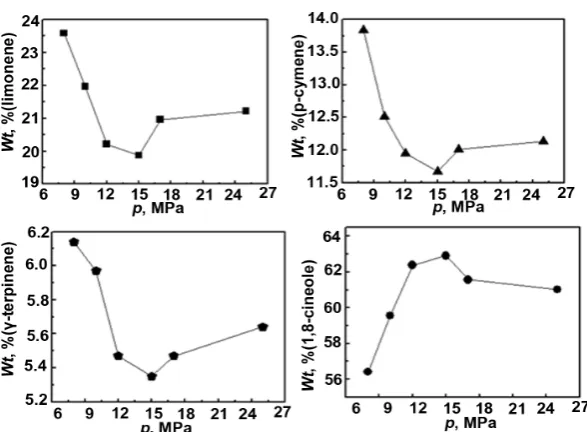
The effects of extraction pressure (P) on the main components of eucalyptus oil were shown in Figure 3. It showed that the extraction content of 1,8-cineole sig-nificantly increased with pressure going up, while the contents of limonene,
[image:4.595.210.535.296.472.2]DOI: 10.4236/ajps.2018.92014 167 American Journal of Plant Sciences
Figure 3. Pressure influence on extraction behavior (T = 45˚C, q = 15 g/min, t =
1 hr, with 3% ethanol).
tent of 1,8-cineole decreased a little, while the content of limonene, p-cymene and γ-terpinene showed slightly increasing trend. Therefore, 15 MPa was opti-mum for the extraction of 1, 8-cineole.
3.4. Effect of Temperature
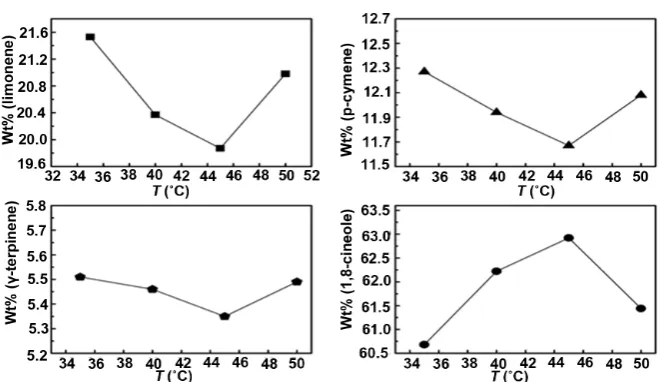
Temperature (T) was an important parameter for supercritical CO2 extraction process. On the one hand, with temperature increasing, the fluidity of the solute sped up in supercritical CO2 fluid, the diffusion coefficient and the solvent vapor pressure increased. At the same time, both the volatility and solubility of the so-lute in CO2 also increased, which was similar to liquid solubility [21][22]. On the other hand, temperature increasing could also reduce the fluid density, which would decrease solvent effect and the solubility of supercritical CO2 in oil
[23]. So, the extraction temperature held a dominant role in the extraction process [24].
DOI: 10.4236/ajps.2018.92014 168 American Journal of Plant Sciences
Figure 4. Temperature effect on extraction behavior (P = 15 MPa, q = 15 g/min, t = 1 hr ,
with 3% ethanol).
The spherical molecular structure of 1,8-cineole would make it flee from super-critical CO2 fluid easily. Additionally, high temperature will also increase opera-tion cost. So 45˚C was chosen as the optimum extracopera-tion temperature for 1,8- cineole.
3.5. Effect of Flow Rate of CO2
As shown in Figure 5, when CO2 flow rate increased from 10 to 18 g/min, the contents of limonene, p-cymene and γ-terpinene increased except 1,8-cineole. However, when CO2 flow rate exceeded over 18 g/min, content variation trends of the four substances were reverse.
3.6. Effect of Extraction Time
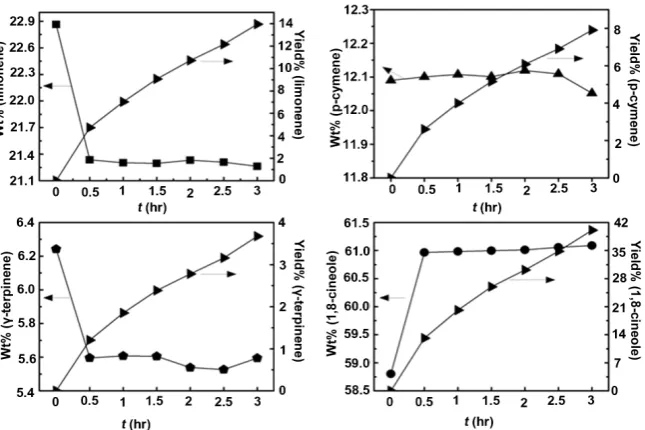
Figure 6 showed the effect of time on the extraction behavior of eucalyptus oil. It could be found that in the initial time range of 0 - 0.5 hr, the content of 1,8-cineole increased, while both the contents of limonene and γ-terpinene de-creased. With extraction time increasing, the percentage of the extracted materi-al changed slightly. So prolonging extraction time could not raise the extract concentration distinctly.
With the rise of CO2 flow rate, both the mass transfer rate and concentration difference increased, and the extraction time was shortened correspondingly
[26]. The experiments under different extraction time were operated at CO2 flow rate of 18 g/min. Different from the literature [27] the process could be divided into two stages: initial phase extraction and relatively stable extraction stage. In the first 0.5 hr the content and yield changed in a large variation. After 0.5 hr the extract contents almost had no changes and the extract yield raised gradually.
4. Conclusions
DOI: 10.4236/ajps.2018.92014 169 American Journal of Plant Sciences
Figure 5. CO2 flow rate effect on extraction behavior (P = 15 MPa, T = 45˚C, t = 1 hr,
with 3% ethanol).
Figure 6. Time effect on extraction behavior (P = 15 MPa, T = 45˚C, CO2 flow rate of 18
g/min, with 3% ethanol).
tion behavior of eucalyptus oil, and the results were summarized as follows: Extraction pressure, temperature, CO2 flow rate and time were the main fac-tors for the extraction process of eucalyptus oil with supercritical CO2. The ef-fects of the above factors on 1,8-cineole, limonene, p-cymene and γ-terpinene were quite different.
[image:7.595.213.536.318.533.2]DOI: 10.4236/ajps.2018.92014 170 American Journal of Plant Sciences gradually.
Fund
It was supported by Natural Science Foundation of China (20966004).
References
[1] Southwell, I.A. and Russell, M.F. (2002) Volatile Oil Comparison of Cotyledon Leaves of Chemotypes of Melaleuca alternifolia. Phytochemistry, 59, 391-393.
https://doi.org/10.1016/S0031-9422(01)00405-8
[2] Shatalov, A.A., Evtuguin, D.V. and Neto, C.P. (1999) (2-O-α-d-Galactopyranosyl- 4-O-methyl-α-d-glucurono)-d-xylan from Eucalyptus globulus Labill. Carbohydrate Research, 320, 93-99. https://doi.org/10.1016/S0008-6215(99)00136-6
[3] Papachristos, D.P. and Stamopoulos, D.C. (2002) Repellent, Toxic and Reproduc-tion Inhibitory Effects of Essential Oil Vapours on Acanthoscelides obtectus (Say) (Coleoptera: Bruchidae). Journal of Stored Products Research, 38, 117-128.
https://doi.org/10.1016/S0022-474X(01)00007-8
[4] Sara, B. (2004) Essential Oils: Their Antibacterial Properties and Potential Applica-tions in Foods—A Review. International Journal of Food Microbiology, 94, 223- 253. https://doi.org/10.1016/j.ijfoodmicro.2004.03.022
[5] Grassmann, J., Hippeli, S., Dornisch, K., et al. (2002) Antioxidant Properties of Es-sential Oils. Possible Explanations for Their Anti-Inflammatory Effects. Arzneimit-tel-Forschung, 50, 135-139.
[6] Cimanga, K., Kambu, K., Tona, L., et al. (2002) Correlation between Chemical Composition and Antibacterial Activity of Essential Oils of Some Aromatic Medi-cinal Plants Growing in the Democratic Republic of Congo. Journal of Ethnophar-macology, 79, 213-220.
[7] Ying, A.G., Xu, S.L. and Xu, S.M. (2005) Purification of 1,8-Cineol by Vacuum Batch Distillation. China Forest Products Industry, 32, 29-31.
[8] Kazuo, N., Kohei, M. and Ryota, M. (2014) High-Speed Growth of Si Single Bulk Crystals by Expanding Low-Temperature Region in Si Melt Using Noncontact Crucible Method. Journal of Crystal Growth, 405, 44-51.
https://doi.org/10.1016/j.jcrysgro.2014.07.024
[9] Liu, W.T., Gu, L.L., Wan, H.Y. and Lv, X.G. (2016) Technique of Low Temperature Control Crystallization for Separating and Purifying 1,8-Cineole. Chemical Industry and Engineering Progress, 35, 270-574.
[10] Lu, X.H., She, H.Y. and Zhang, G.Q. (2008) Study on Purifying Techniques of Mo-lecular Distillation for 1, 8-Cineole. Modern Chemical Industry, 28, 108-110. [11] Davis, C.B. (1975) Extraction and Recovery of Cineole. Unit States 3923837. [12] Matos, H.A., Azevedo, E.D., Simoes, P.C., et al. (1989) Phase Equilibria of Natural
Flavours and Supercritical Solvents. Fluid Phase Equilibria, 52, 357-364.
https://doi.org/10.1016/0378-3812(89)80341-3
[13] Wang, L., Hao, X.S., Zheng, L., et al. (2009) Phase Equilibrium of Isobutanol in Su-percritical CO2. Chinese Journal of Chemical Engineering, 17, 642-647.
https://doi.org/10.1016/S1004-9541(08)60257-8
DOI: 10.4236/ajps.2018.92014 171 American Journal of Plant Sciences
[15] Ma, F. and Zhao, H.J. (2013) Supercritical Fluid Extraction of a Novel Template from Mesoporous Zirconia and the Effect on Porous Structure. Chinese Journal of Chemical Engineering, 21, 698-700. https://doi.org/10.1016/S1004-9541(13)60493-2
[16] Birtigh, A., Johannsen, M., Brunner, G., et al. (1995) Supercritical-Fluid Extraction of Oil-Palm Components. Journal of Supercritical Fluids, 8, 46-50.
https://doi.org/10.1016/0896-8446(95)90049-7
[17] Baysal, T. and Starmans, D.A.J. (1999) Supercritical Carbon Dioxide Extraction of Carvone and Limonene from Caraway Seed. Journal of Supercritical Fluids, 14, 225-234.https://doi.org/10.1016/S0896-8446(98)00099-0
[18] Pereira, C.G. and Meireles, M.A.A. (2007) Economic Analysis of Rosemary, Fennel and Anise Essential Oils Obtained by Supercritical Fluid Extraction. Flavour and Fragrance Journal, 22, 407-413.https://doi.org/10.1002/ffj.1813
[19] Li, X., Xu, G., Wang, Y., et al. (2009) Density, Viscosity, and Excess Properties for Binary Mixture of Diethylene Glycol Monoethyl Ether + Water from 293.15 to 333.15 K at Atmospheric Pressure. Chinese Journal of Chemical Engineering, 17, 1009-1013.https://doi.org/10.1016/S1004-9541(08)60309-2
[20] Mohsen-Nia, M., Amiri, H. and Jazi, B. (2010) Dielectric Constants of Water, Me-thanol, EMe-thanol, Butanol and Acetone: Measurement and Computational Study.
Journal of Solution Chemistry, 39, 701-708. https://doi.org/10.1007/s10953-010-9538-5
[21] Kunmoro, A.C., Singh, H. and Hasan, M. (2009) Solubility of Piperine in Supercrit-ical and Near CritSupercrit-ical Carbon Dioxide. Chinese Journal of Chemical Engineering, 17, 1014-1020.https://doi.org/10.1016/S1004-9541(08)60310-9
[22] Dobbs, J.M. and Johnston, K.P. (1987) Selectivities in Pure and Mixed Supercritical Fluid Solvents. Industrial & Engineering Chemistry Research, 26, 1476-1482. https://doi.org/10.1021/ie00067a035
[23] Marr, R. and Gamse, T. (2000) Use of Supercritical Fluids for Different Processes including New Developments—A Review. Chemical Engineering and Processing, 39, 19-28.https://doi.org/10.1016/S0255-2701(99)00070-7
[24] Cheung, P.C.K. (1999) Temperature and Pressure Effects on Supercritical Carbon Dioxide Extraction of n-3 Fatty Acids from Red Seaweed. Food Chemistry, 65, 399-403.https://doi.org/10.1016/S0308-8146(98)00210-6
[25] Gimeno, B., Torcal, M., Mainar, A.M., et al. (2011) Total Vapour Pressure and Excess Gibbs Energy of Ethanol with 1,8-Cineole at Temperatures between 278.15 K and 323.15 K. Fluid Phase Equilib, 309, 83-88.
https://doi.org/10.1016/j.fluid.2011.07.002
[26] Spanos, G.A., Chen, H. and Schwartz, S.J. (1993) Supercritical CO2 Extraction of
β-Carotene from Sweet Potatoes. Journal of Food Science, 58, 817-820. https://doi.org/10.1111/j.1365-2621.1993.tb09366.x
[27] Chao, R.R., Mulvaney, S.G., Sanson, D.R., et al. (1991) Supercritical CO2 Extraction
of Annatto (Bixaorellana) Pigments and Some Characteristics of the Color Extracts.
Journal of Food Science, 56, 80-83.