Solving Data Sparsity for Aspect based Sentiment Analysis using
Cross-linguality and Multi-linguality
Md Shad Akhtar∗, Palaash Sawant+, Sukanta Sen∗, Asif Ekbal∗and Pushpak Bhattacharyya∗
∗Department of Computer Science & Engineering
Indian Institute of Technology Patna, India
{shad.pcs15,sukanta.pcs15,asif,pb}@iitp.ac.in
+Goa University,[email protected]
Abstract
Efficient word representations play an impor-tant role in solving various problems related to Natural Language Processing (NLP), data min-ing, text mining etc. The issue of data spar-sity poses a great challenge in creating effi-cient word representation model for solving the underlying problem. The problem is more intensified in resource-poor scenario due to the absence of sufficient amount of corpus. In this work, we propose to minimize the effect of data sparsity by leveraging bilingual word embeddings learned through a parallel corpus. We train and evaluate Long Short Term Mem-ory (LSTM) based architecture for aspect level sentiment classification. The neural network architecture is further assisted by the hand-crafted features for the prediction. We show the efficacy of the proposed model against state-of-the-art methods in two experimental setups i.e. multi-lingual and cross-lingual.
1 Introduction
Sentiment analysis (Pang and Lee,2005) tries to automatically extract the subjective information from a user written textual content and classifies it into one of the predefined set of classes, e.g. posi-tive,negative,neutralorconflict. Sentiment anal-ysis performed on coarser level (i.e. document or sentence level) does not provide enough informa-tion for a user who is critical of finer details such as battery life of a laptop or service of a restau-rant etc. Aspect level sentiment analysis (ABSA) (Pontiki et al.,2014) serves such a purpose, which first identifies the features (or aspects) mentioned in the text and then classifies it into one of the tar-get classes. For example, the following review is for a restaurant where the writer shares her/his ex-perience. Though s/he likes thefood but certainly not happy with theservice.
One of the bestfoodwe had in a while but the
servicewas very disappointing.
Analyzing such reviews on sentence level will re-flect only an overall sentiment (i.e.conflict) of the sentence ignoring critical information such asfood
and service qualities. However, ABSA will first identify all the aspects in the text (i.e.foodand ser-vice) and then associatepositivewithfoodand neg-ative with service. Identification of aspect terms is also known as aspect term extraction or opin-ion target extractopin-ion. In this work, we focus on the second problem i.e. aspect level sentiment classi-fication.
Literature survey suggests a wide range of re-search on sentiment analysis (at the document or sentence level) is being carried out in recent years (Turney, 2002;Kim and Hovy, 2004;Jagtap and Pawar,2013;Poria et al.,2016;Kaljahi and Foster, 2016;Gupta et al.,2015). However, most of these researches are focused on resource-rich language like English. Like many other Natural Language Processing (NLP) problems, research on sentiment analysis involving Indian languages (e.g. Hindi, Bengali etc.) are very limited (Joshi et al., 2010; Bakliwal et al.,2012;Kumar et al.,2015; Balamu-rali et al.,2012;Singhal and Bhattacharyya,2016). Due to the scarcity of various qualitative resources and/or tools in such languages, the problems have become more challenging and non-trivial to solve. The research on ABSA involving Indian languages has started only very recently, for e.g. (Akhtar et al.,2016a,b).
2 Motivation and Problem Definition
Indian languages are resource-constrained in na-ture as there is a lack of ready availability of dif-ferent qualitative lexical resources and tools. In a supervised machine learning framework, good amount of training data always have a great impact on the overall system performance. Low-resource languages (such as the Indian [Hindi etc.])
ally suffer due to the non-availability of sufficient training data instances. In order to solve the data and resource scarcity problem in one language, re-searchers often utilize cross-lingual setup to lever-age the resource-richness of other langulever-ages by projecting the task into a common problem space (Zhou et al.,2016;Balamurali et al., 2012; Sing-hal and Bhattacharyya,2016;Barnes et al.,2016). The projection is often performed with the help of machine translation or bilingual dictionaries.
In recent times, deep learning (DL) techniques have shown success in solving several NLP prob-lems. A good word representation is the essence of any deep learning approach. In the absence of qualitative word embeddings, it turns out to be a non-trivial task for any DL framework to effec-tively learn hidden features (e.g. lexical, syntactic, semantics etc.), which may effect the performance. The quality of word embeddings can be preserved by employing state-of-the-art distributed word rep-resentation models such as Word2Vec (Mikolov et al.,2013) or GloVe (Pennington et al.,2014) pro-vided a huge corpus to train on. Due to this limi-tation, quality of word embeddings in Indian lan-guages usually are not at par with that of resource-rich languages like English.
Data sparsity in word representation (i.e. ab-sence of representation of any word) is another problem that often has to be dealt with. In order to solve any NLP task, out-of-vocabulary (OOV) words in a word embedding model pose a serious challenge to the underlying learning algorithm. For a missing word representation, the literature sug-gests two possible solutions: a) zero vector ( Bah-danau et al.,2017) or b) random vector (Dhingra et al.,2017). However, in both the cases the resul-tant vector could be completely out of context and often does not fit well with others. Further, word embedding of a word in a source language has ab-solutely no correlation with the word embedding of the same word (translated) in the target language, hence, it cannot be directly used for training and/or testing in a cross-lingual setup. The prime motiva-tion of the work is to minimize the effect ofdata sparsity and thereby, enabling any deep learning framework to effectively learn its hidden features.
In this paper, we propose to solve the data sparsity problem in a resource-scarce language scenario (here, primarily Hindi and also French embeddings) by leveraging the information of resource-rich languages (here, English
embed-dings)1. We hypothesize that addressing data spar-sity in an intelligent manner would yield increased performance. We utilize bi-lingual word embed-ding (Luong et al.,2015) trained on English-Hindi and English-French parallel corpus to bridge the language divergence in the vector space. The pro-posed method is based on a deep learning (DL) architecture named Long Short Term Memory (LSTM) (Hochreiter and Schmidhuber,1997). We try to establish our hypothesis through experiments on aspect based sentiment classification task in both the setups i.e. multi-lingual and cross-lingual for English-Hindi and English-French language pairs. Aspect based sentiment classification deals with assigning the sentiment polarity (i.e.positive,
negative, neutral orconflict) to the aspect terms. For evaluation, we use the datasets provided in (Akhtar et al., 2016a) for Hindi, SemEval-2014 shared task on ABSA (Pontiki et al., 2014) for English and SemEval-2016 shared task on ABSA (Pontiki et al.,2016) dataset for French.
2.1 Contributions
Major contributions of our current work are as fol-lows: a) we train and use bilingual embeddings on Amazon product review corpus consisting of parallel sentences of Hindi and English-French, which serve as a bridge between the two languages;b)we propose to solve the problem of
data sparsityin low-resource language word em-bedding by utilizing the word emem-bedding created on resource-rich language; and c) to further im-prove the system’s prediction we extract and use various English side semantic features of the ma-chine translated words.
As we already mentioned, the research on ABSA involving Indian languages are limited. Some of the recent works include the one re-ported in (Akhtar et al.,2016a,b). The authors in (Barnes et al.,2016) employed bilingual word em-beddings for sentiment classification in a cross-lingual setup. To the best of our knowledge, our current attempt is the very first of its kind to employ bilingual word embeddings for a multi-lingual scenario. Our proposed system differs with the existing systems in the following ways.
1. Setup: System (Barnes et al.,2016) defines a
cross-lingual setup while (Singhal and
Bhat-1We use French to show how generic our proposed
tacharyya,2016) is multi-lingual in nature. In contrast, our proposed system is applied to both multi-lingual and cross-lingual setups.
2. Approach: System (Akhtar et al.,2016a)
de-fines classical feature driven approach while the system (Barnes et al., 2016) utilized bi-lingual word embeddings as feature values to train a Support Vector Machine (SVM) classi-fier. Rest of the systems (Akhtar et al.,2016b; Singhal and Bhattacharyya,2016) (including the proposed one) are based on deep neu-ral network architecture. However, the tech-niques employed are very much different. Akhtar et al. (2016b) is a CNN-SVM based system with the assistance of multi-objective optimized features, while Singhal and Bhat-tacharyya(2016) is a CNN based system that translate the source language texts into target language text (English) for training and eval-uation. In comparison, our proposed method employ LSTM to solve the data sparsity prob-lem in both multi-lingual as well as cross-lingual setups.
3. Problem addressed: Authors in (Singhal
and Bhattacharyya, 2016) focused on sen-tence level sentiment classification while our present work focuses on fine-grained senti-ment classification at the aspect level.
4. Word Embeddings: The proposed system
employs shared vector-space bilingual word embeddings for training and testing while (Singhal and Bhattacharyya,2016) projected the source language train & test data into tar-get language using machine translation and utilizes target side pre-computed word vec-tors for training the system. Whereas, the sys-tem reported in (Akhtar et al., 2016b) em-ployed mono-lingual word embeddings for training and evaluation.
5. Data Sparsity:The system of (Akhtar et al.,
2016b) does not address the problem of data sparsity, while our proposed system tries to minimize the effect of data sparsity. Our pro-posed system tackles the data sparsity prob-lem by replacing the OOV word with its translated form which usually happens to be its closest neighbor in the shared vector space, hence, the semantic closeness is pre-served to an extent. Whereas, system (
Sing-hal and Bhattacharyya, 2016) addressed the data sparsity by translating every word of the source language into target language which may introduce loss of sentiment in the target language as a side-effect (Mohammad et al., 2016).
6. Hand-crafted Features:The proposed
sys-tem employs much richer set of lexicon based features than that of (Singhal and Bhat-tacharyya, 2016). Also, we do not augment polar words in the training instances as done in (Singhal and Bhattacharyya,2016), rather we use sentiment scores of these lexicons as features themselves in the training and test-ing instances. Whereas, the authors in (Akhtar et al., 2016b) obtained an optimized fea-ture vector through the application of multi-objective genetic algorithm.
3 Proposed Methodology
We propose to use a Long Short Term Memory (LSTM) architecture on top of bilingual word em-beddings for the prediction. LSTM is a special kind of recurrent neural network (RNN) which ef-ficiently captures long term dependencies. Bidi-rectional LSTM is an extended version of LSTM which takes both forward and backward sequences into account. Our model consists of two bidi-rectional LSTM layers followed by two fully-connected layers and an output layer.
3.1 Bilingual Word Embedding
We employ bilingual word embeddings (Luong et al., 2015) trained on a parallel English-Hindi
(and English-French) corpus. We generate a parallel corpus for Amazon product re-view datasets2 (consisting of approx. 7.2M sentences) using an in-house product review domain basedEnglish→Hindi(English→French) Statistical Machine Translation (SMT) sys-tem (English→Hindi: 39.5 BLEU score and
English→French: 37.9 BLEU score). We employ widely used and standard machine translation tool
Moses (Koehn et al., 2007) to train the phrase-based SMT system. The alignment information are obtained from themosesdecoder(Koehn et al., 2007) during translation of the reviews.
The parallel corpus along with the alignment in-formation are used to train two (English and Hindi)
Skip-Gram word2vec (Mikolov et al.,2013) mod-els which share the common vector space. If a wordWS is aligned to wordWT, then the context
informationCT of target wordWT is also used as
context of the source wordWSalong with its own
context CS for computing word vectors. By
uti-lizing the context information of both source and target side, resultant word embeddings ofWS and WT are semantically closer to each other in the
vector space.
Bilingual skip-gram model creates two sepa-rate word embeddings, i.e. one each for source (Hindi) and target language (English). First, we extract word representations for all the words in a sentence from the Hindi bilingual word embed-dings. Subsequently at the second step we trans-late all the OOV words (words whose representa-tions are missing in Hindi bilingual embeddings) into English and then perform another lookup in English embeddings. For instance, if embedding of a word ‘अ छा|achcha’ is unknown we translate it in English as ‘good’, and use its word embed-dings in place of the source word ‘अ छा|achcha’. Thus the missing representation of OOV word is replaced by its translated target side representa-tion. Since, both English and Hindi word embed-dings share a common vector space, this replace-ment strategy proves to be an effective technique. In our case, we observe a reduction of approxi-mately 65% and 37% OOV words, respectively for Hindi and French by our proposed replace-ment strategy. Consequently, an increase in accu-racy value is observed during evaluation.
Hindi is a morphologically rich language. Many inflected words in Hindi share a common trans-lated word in English. For example, based on the gender of the subject Hindi has two forms for word ‘goes’: ‘जाता है | jAtA hai’ (male) or ‘जाती है | jAtI hai’ (female). Therefore, if representation of one word (जाता है | jAtA hai) is missing in Hindi embedding we can still find its representa-tion in English through its translarepresenta-tion i.e. ‘goes’. Bilingual embedding also helps in addressing the spelling variation cases. For e.g. two differently spelled words in Hindi such as ‘कि बनेशन| kambi-neshana’ and ‘कंबीनेशन| kaMbIneshana’ translate to an English word ‘combination’.
We repeat the above process forEnglish-French
language pair to obtain two (English and French) word2vec models. We also released computed bi-lingual word embeddings for the research
commu-nity3.
3.2 Features
We employ various hand-crafted features to assist the network. We try to leverage the effectiveness of English side resources by translating a word into English and then extracting its feature repre-sentation. We use following set of features in our task. It should be noted that we do not include any lexical or syntactic features during training as dis-tributed word embedding models are good at cap-turing such features. So, during the training phase, network adapts its weights to learn the relevant set of these features from the word embeddings itself.
1. Bing Liu (Ding et al., 2008) & MPQA
(Wiebe and Mihalcea, 2006) lexicons: We define a feature that marks the positiv-ity/negativity scores of the words in a sen-tence. We assign a score of +1 & -1, respec-tively to each positive and negative word in the sentence. For unseen words, we use score as 0. We extract one such feature from each lexicon.
2. SentiWordNet (Baccianella et al., 2010):
Three features are extracted for every word denoting its positivity (posScore), negativity (negScore) and objectivity (1 - [posScore + negScore]) scores, respectively.
3. Semantic Orientation (SO) (
Hatzivas-siloglou and McKeown, 1997): Semantic orientation defines the association of a word
w.r.t. its positivity and negativity. Semantic orientation (SO) of a word is the difference of point-wise mutual information of a wordwin positive and negative reviews. We calculate the SO score of each word in the context window of size±5 and take the cumulative SO score as the feature value.
3.3 Cross-lingual and Multi-lingual Setups
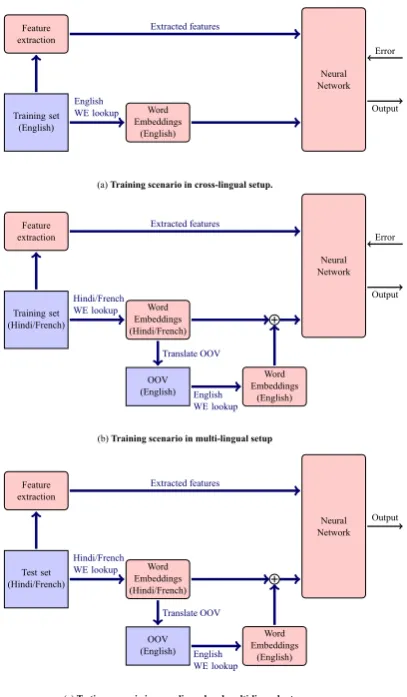
We evaluate our proposed approach for two se-tups i.e. multi-lingual and cross-lingual sese-tups. In multi-lingual setup, the proposed model is trained and evaluated on datasets of the same language i.e. Hindi or French. We pre-process our datasets to reduce the effect of data sparsity by utilizing the resource-rich language i.e. English. In contrast, the
cross-lingual setup employs dataset of resource-rich language (i.e. English) for training and during evaluation Hindi or French dataset is used. Simi-lar to the multi-lingual setup, we pre-process the test dataset to reduce the effect of data sparsity in cross-lingual setup as well.
An overall schema of the proposed methodol-ogy is depicted in Figure1for both multi-lingual and cross-lingual setups. Figures1a and1b show the training architectures for the cross-lingual and multi-lingual scenarios, respectively. Since our test datasets for both the variants are in Hindi (or French), testing scenario for cross-lingual and multi-lingual setups are also the same as repre-sented in Figure1c.
Training set (English)
Feature extraction
Word Embeddings
(English)
Neural Network Extracted features
English WE lookup
Error
Output
Training set (Hindi/French)
Feature extraction
Word Embeddings (Hindi/French)
Neural Network
OOV (English)
Word Embeddings
(English) Extracted features
Hindi/French WE lookup
Translate OOV
English WE lookup
Error
Output
Test set (Hindi/French)
Feature extraction
Word Embeddings (Hindi/French)
Neural Network
OOV (English)
Word Embeddings
(English) Extracted features
Hindi/French WE lookup
Translate OOV
English WE lookup
Output (a)Training scenario in cross-lingual setup.
(b)Training scenario in multi-lingual setup
[image:5.595.315.519.61.247.2](c)Testing scenario in cross-lingual and multi-lingual setup.
Figure 1: Proposed schema for English-Hindi and English-Frenchlanguage pairs.
3.4 Neural Network Architecture
For the successful marriage of word embeddings and extracted features, we try three different archi-tectures as depicted in Figure2. In the first archi-tecture (A1, Figure2a), we concatenate extracted features of each word of an instance with the
corre-LSTM 2 Hidden layers
Output layer Word
Embeddings + Features
Predictions
LSTM
Merge layer
2 Hidden layers
Output layer Word
Embeddings
Features
Predictions
LSTM
LSTM Merge
layer
2 Hidden layers
Output layer Word
Embeddings
Features
Predictions (a) ArchitectureA1
(b) ArchitectureA2
[image:5.595.79.283.273.622.2](c) ArchitectureA3
Figure 2: Neural Network Architectures.
sponding word representations and pass it through a LSTM network followed by dense and output layers. In the second architecture (A2, Figure2b), we do not combine features and word representa-tions together. Rather, we learn sentence embed-dings through a LSTM network and then concate-nate it with the extracted features before feeding to the dense layer. Finally, in the third architec-ture (A3, Figure 2c), we train separate LSTMs for the extracted features and word embeddings. Subsequently, we merge their representations at the dense layer. The choice of separate LSTMs for the hand-crafted features in architectureA3is driven by the fact that the dimension of a word embedding is usually very high as compared to its corresponding hand-crafted features. If trained to-gether, as in architectureA1, extracted features of low dimension usually get overshadowed by the high-dimensional word embeddings. Thus making it non-trivial for the network to learn from the ex-tracted features. Further, to exploit the sequence information of words in a sentence we pass hand-crafted features of each word through a separate LSTM layer. For example, in the following review sentence, there are two positive words (‘liking’ and‘recommending’) and only one negative word (‘far’). In a model that takes into account only the simple polar word score, the sentence would have high relevance towards the positive senti-ment. However, the sequence information of the phrase “far from liking and recommending” dic-tates the negative sentiment of the sentence.
In contrast toA3, architectureA2does not rely on the sequence information of the extracted features and let the network to learn on its own.
We use 300 dimension word embeddings for the experiments. Each LSTM layer contains 100 neu-rons while two dense layers contain 100 and 50 neurons respectively.
4 Experimental Results
In this section, we describe the datasets, experi-mental setup, results and provide necessary anal-ysis.
4.1 Datasets
We use Hindi ABSA dataset released by (Akhtar et al., 2016a) for our evaluation purpose. A to-tal of 5,417 review sentences are present along with 4,509 aspect terms. Each aspect term belongs to one of the four sentiment classes: ‘positive’, ‘negative’, ‘neutral’ and ‘conflict’. We split the dataset into 70%, 10% and 20% as training, de-velopment and test, respectively for the experi-ment. For French case, we use the SemEval-2016 shared task on ABSA (Pontiki et al.,2016) restau-rant dataset. It consists of 2,429 review sentences and 3,482 aspect terms. In cross-lingual setup, we utilize English dataset of SemEval-2014 shared task on ABSA (Pontiki et al., 2014) for training and Hindi ABSA dataset for testing. The English dataset comprises of product reviews in two do-mains i.e. restaurant and laptop. However, we only employ laptop domain dataset as most of the re-views in Hindi ABSA datasets belong to the elec-tronics domain. For training in cross-lingual setup, we combine the training and gold test dataset to-gether. In total, there are 3,845 review sentences comprising of 3,012 aspect terms. For English-French case, we use English restaurant dataset of SemEval-2016 shared task on ABSA (Pontiki et al., 2016) for the training and French ABSA dataset (Pontiki et al., 2016) for evaluation. The SemEval-2016 English restaurant dataset contains 3,365 aspect terms across 2,676 review sentences.
4.2 Experiments
We use Python based neural network library, Keras4for implementation. For English-Hindi, all the four classes (namely positive, negative, neu-tral and conflict) were considered, whereas for English-French three classes (all except conflict
4http://keras.io
class) were used for classification. Since there is no false class, we use accuracy value as metric to mea-sure the performance of the system. Also, we uti-lize accuracy value for the direct comparison with the existing state-of-the-art systems. LSTM net-work is trained with early stopping criteria on (i.e. preserving best learned parameter at each epoch). We set the number of epochs and patience value as 100 & 20 respectively. In other words, we run the experiments for maximum 100 epochs and if validation loss does not reduce for consecutive 20 epochs training stops and reports the best epoch attained so far. As activation function, we utilize
‘tanh’at the intermediate layers, while for classi-fication, we use‘softmax’ at the output layer. To prevent the network from over-fitting, we incor-porate an efficient regularization technique called
‘Dropout’(Srivastava et al.,2014). At each layer of training, dropout skips few hidden neurons ran-domly. We fix dropout rate to be 45% during train-ing while for optimization we use ‘adam’ opti-mizer (Kingma and Ba,2014).
Experimental results for aspect sentiment clas-sification in multi-lingual and cross-lingual setups are reported in Figure3for both the language pairs. In total, we evaluate our model for four cases i.e.a.
En-Hi multi-lingual,b.En-Hi cross-lingual,c. En-Fr multi-lingual and d. En-Fr cross-lingual sce-narios. The non-root four-boxed nodes report per-formance of the respective methods for the four cases. The left subtree represents LSTM based baseline system that utilizes monolingual word embedding (WE) (i.e. word2vec model trained only on 7.2M Hindi and French sentences re-spectively). Whereas the right subtree represents usage of bilingual word embeddings in all the cases. Comparison between monolingual WE and bilingual WE shows competing results. Mono-lingual WE (aM: 63.64%) in multi-lingual
sce-nario performs better than the bilingual WE (aB:
62.51%) for English-Hindi case, while bilingual WE (cB: 70.89%) reports better performance as
compared with monolingual WE (aM: 66.29%) for
observ-a:Multi-lingual -En-Hiscenario
b:Cross-lingual -En-Hiscenario
c:Multi-lingual -En-Frscenario
d:Cross-lingual -En-Frscenario
Baseline (Monolingual WE)
Features (En)
A1
aM F3:69.74
bM F1:50.12
cM F1:70.63
dM F1:55.23
A2
aM F3:71.25
bM F2:52.91
cM F2:72.28
dM F2:55.84
A3
aM F3:71.98
bM F3:56.49
cM F3:69.91
dM F3:61.14 aM:63.64
bM:16.29
cM:66.29
dM:50.69
Bilingual WE
Embeddings (OOV)
Features (En)
A1
aBOF1:71.32
bBOF1:56.68
cBOF1: 72.42
dBOF1:68.24
A2
aBOF2:73.50
bBOF2:56.90
cBOF2:72.14
dBOF2:68.66
A3
aBOF3: 76.29
bBOF3: 60.39
cBOF3:71.72
dBOF3: 69.49 aBO:64.83
bBO:50.79
cBO: 72.42
dBO:65.32 aB:62.51
bB:48.94
cB:70.89
[image:7.595.75.519.61.350.2]dB:63.64
Figure 3: Aspect classification in Multi-lingual and Cross-lingual setups for Hindi and English-French scenarios:Left subtreerepresents various baselines and their corresponding results.Right subtree rep-resents the proposed approach at different levels. Four-box rectangles at non-root levels show accuracy values fora.multi-lingual (En-Hi),b.cross-lingual (En-Hi),c.multi-lingual (En-Fr)&d.cross-lingual (En-Fr) scenar-ios respectively.OOV:Out-of-vocabulary words.A1:Word embeddings and extracted features are combined and fed into single LSTM network.A2:Extracted features are directly merged with LSTM output of word embedding.
A3:One LSTM network each for word embeddings and extracted features. SubscriptsM:monolingual WE;B: bilingual WE;O:Embeddings(OOV);F:Features;1,2,3:Architecture A1, A2 & A3respectively.
ing a performance increase of more than 2 points. For English-French case, we also observe the im-provement with embeddings of OOVs. This sug-gests that the richness of target language (English) word embeddings helps the system to efficiently solve the problem encountered in resource-poor source language. Since the resources are limited for resource-poor language we try to leverage the high-quality lexicon features of English in our sys-tem. Consequently, we introduce the extracted fea-tures of Section 3.2 to the network. For English-Hindi multi-lingual scenario, the performance in-crements from A1 to A2 to A3 indicate that the resource-richness of English language plays a cru-cial role in classification. While we incorporate English side lexicon features for English-French multi-lingual scenario, we observe no performance improvement like the others. For this case, our sys-tem reports an accuracy of 72.42% with (cBOF1) and without (cBO) the use of extra features.
Results of cross-lingual setup for English-Hindi
case, where we train the network utilizing English dataset and evaluate the model on Hindi dataset, are reported in row 2 of the four-boxed nodes in Figure3. The baseline model for cross-lingual se-tups (left subtree of Figure 3) employs monolin-gual word embeddings of English and Hindi for training and testing respectively. Since the vector spaces of two different languages are completely unrelated, it is no surprise that the baseline sys-tem achieves merely 16.29% (bM) accuracy.
Us-ing only the bilUs-ingual word embeddUs-ings the sys-tem achieves 48.94% (bB) accuracy. By
increas-ing the coverage of input word embeddincreas-ings us-ing machine translation the proposed system ob-tains an increased accuracy of 50.79% (bBO). This
archi-tectures (bBOF1, bBOF2& bBOF3).
Results of English-French cross-lingual sce-nario are reported in row 4 of the four-boxed nodes in Figure 3. We observe similar phenomenon in cross-lingual setup with the English-French case as well. The baseline system, where we utilize sep-arate monolingual WE for training and testing in English and French respectively, reports an accu-racy of 50.69% (dM), while employing bilingual
embeddings the system obtains a sharp jump of ap-prox. 13 points with an accuracy value of 63.64% (dB). Further, with the inclusion of OOV words
and lexicon features performance of the system im-proves to 65.32% (dBO) and 69.49% (dBOF3), re-spectively.
We observe four phenomena from these results: i) use of lexicon-based features is the driving force in predicting the sentiment; ii) qualitative lexicons of the resource-rich language can assist in solv-ing the problems of resource-poor languages; iii) embeddings of the OOV words improves the per-formance of the system with or without assistance of extra features; and iv) use of separate LSTMs (one for word embeddings and the other for fea-tures) helps the network to efficiently extract rel-evant features for prediction without interfering each other (except for the multi-lingual English-French scenario).
4.3 Comparative Analysis
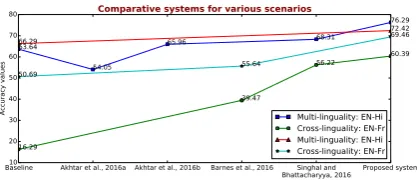
Comparative results reported in Figure4show that our proposed system clearly outperforms the base-line model in both the setups and for both the lan-guage pairs. In multi-lingual setup, we compare the proposed model against three state-of-the-art systems (Akhtar et al.,2016a;Singhal and Bhat-tacharyya,2016;Akhtar et al.,2016b) for English-Hindi case. An accuracy of 65.96% was reported by the system (Akhtar et al.,2016b), while the sys-tem (Singhal and Bhattacharyya, 2016) obtained an accuracy of 68.31%. However, our proposed system reports an accuracy of 76.29%, which is ap-prox. 10% & 8% higher compared to the systems of (Akhtar et al., 2016b) and (Singhal and Bhat-tacharyya, 2016) respectively. In English-French case, our proposed system reports an improvement of approx. 6 points over the baseline. For cross-lingual setup in English-Hindi case, we compare our proposed method with the state-of-the-art sys-tem proposed in (Barnes et al.,2016;Singhal and Bhattacharyya, 2016). On the same dataset their systems reported to have achieved an accuracies
Baseline Akhtar et al., 2016a Akhtar et al., 2016b Barnes et al., 2016 Singhal and
Bhattacharyya, 2016 Proposed system 10
20 30 40 50 60 70 80
Accuracy values
63.64
54.05
65.96 68.31
76.29
16.29
39.47
56.22 60.39
66.29
72.42
50.69 55.64
69.46
Comparative systems for various scenarios
[image:8.595.312.521.65.155.2]Multi-linguality: EN-Hi Cross-linguality: EN-Fr Multi-linguality: EN-Hi Cross-linguality: EN-Fr
Figure 4: Comparison with the baseline and state-of-the-art methods.
of 39.47% & 56.22% as compared to 60.39% of our proposed system. In English-French case, the system proposed in (Barnes et al., 2016) obtains accuracy value of 55.64% against 69.49% in our proposed architecture. Statistical significance tests (t-test) confirm that performance increments in the proposed model are significant w.r.t. state-of-the-art methods with p-value=0.03 andp-value=0.01 respectively in multi-lingual and cross-lingual se-tups.
4.4 Discussions
The prime motivation of our current work is to minimize the effect of data sparsitywhile learn-ing through deep neural network architecture. For this, we propose to use bilingual embeddings com-puted from a parallel corpus, which is created uti-lizing a MT system. Similarly, absence of a large aligned corpus in resource-poor language can be addressed through the application of a MT system. Since, the MT system is not fully accurate, there must be some errors introduced while translating. This, in turn, affects the bilingual word embed-ding. Another limitation of our work is that 7.2M sentences is not a big number in terms of word embedding computation. However, the underlying method performs considerably better compared to the state-of-the-art systems, even with all these constraints.
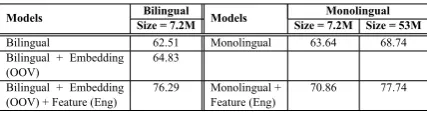
monolin-gual embeddings created from a very large cor-pus of 53M (77.74%). However, the monolingual WE computed using the same amount of corpus (i.e. 7.2M sentences) produces an accuracy of only 63.64%. Further with the help of lexicon based fea-tures accuracy of this system increases to 70.86% (compared to 76.29% of our proposed model). It is also to be observed that performance of the sys-tem is improved by just including representations of the OOV words. Performance of the proposed system would have been much better if we would not have above mentioned limitations.
Models Bilingual Models Monolingual Size = 7.2M Size = 7.2M Size = 53M
Bilingual 62.51 Monolingual 63.64 68.74 Bilingual + Embedding
(OOV)
64.83
Bilingual + Embedding (OOV) + Feature (Eng)
76.29 Monolingual + Feature (Eng)
[image:9.595.74.288.233.290.2]70.86 77.74
Table 1: Comparative analysis of monolingual embed-dings and bilingual embedembed-dings in multi-lingual setup.
4.5 Error Analysis
We perform error analysis on the obtained results. Quantitatively, ‘neutral’ is the most problematic class in both multi-lingual and cross-lingual se-tups. It mainly confuses with ‘positive’ class. Ap-proximately, 20% & 40% of ‘neutral’ instances are tagged as ‘positive’ in multi-lingual and cross-lingual setups, respectively. Our system does not predict ‘conflict’ class at all, possibly due to the in-sufficient number of instances for training. Quali-tatively, following are the few cases where our sys-tem performs below par.
• Lack of polar information inside context:
Our system finds it challenging to classify sentiment of the aspect terms whose polar in-formation lie outside the context window. In the following sentence aspect term is ‘वज़न |weight’ and the actual sentiment towards it is positive. The polar information ‘तुलना म
लगभग आधा |about half as compared’ and
‘ह का|lighter’ are far from the aspect term, hence, not captured within the context win-dow.
Devanagari: इसका वज़न नए आईपैड क
तुलना म लगभग आधा है और यह अ य उपल ध 7-इंच टेबले स से भी ह का है।
Transliteration:isakA vaZana nae AIpaiDa
kI tulanA meM lagabhaga AdhA hai aura yaha anya upalabdha 7-iMcha TebaleTsa se bhI halkA hai.
Translation:Its weight is about half as
com-pared to the new iPad and it is lighter than other available 7-inch tablets.
• Implicit sentiment:Presence of implicit
sen-timent is not correctly classified by the pro-posed system. Following review contains ‘बनावट|built’ as an aspect term and its neg-ative sentiment is derived from the phrase
‘ ािःटक फ ल|plastic feel’.
Devanagari: इस टेबलेट क बनावट काफ
ािःटक फ ल देता है।
Transliteration: isa TebaleTa kI banAvaTa
kAphI plAsTika phIla detA hai.
Translation:The built of this tablet gives a
fairly plastic feel.
5 Conclusion
In this paper, we present a deep learning based LSTM architecture built on top of bilingual word embeddings for aspect level sentiment classifi-cation. Bilingual word embeddings try to bridge the language barrier between a resource-rich and resource-poor languages in a shared vector space. We propose to reduce the effect of data sparsity in a resource-poor language word embeddings by pro-jecting OOV words into target side and utilize the target side word embeddings. In addition, we also exploit various resources of English for assisting the proposed model. We show the effectiveness of the proposed method in two different setups, i.e. multi-lingual and cross-lingual. Experimental re-sults show that the proposed system outperforms various state-of-the-art systems in both the setups. In future, we would like to explore the application of proposed method in another aspect level senti-ment analysis task known as aspect term extraction or opinion target extraction.
6 Acknowldgements
Asif Ekbal acknowledges Young Faculty Research Fellowship (YFRF), supported by Visvesvaraya PhD scheme for Electronics and IT, Ministry of Electronics and Information Technology (MeitY), Government of India, being implemented by Dig-ital India Corporation (formerly Media Lab Asia).
References
In Proceedings of the Tenth International Confer-ence on Language Resources and Evaluation (LREC 2016), May 23-28, 2016. European Language Re-sources Association (ELRA), Portorož, Slovenia, pages 2703–2709.
Md Shad Akhtar, Ayush Kumar, Asif Ekbal, and Push-pak Bhattacharyya. 2016b. A Hybrid Deep Learning Architecture for Sentiment Analysis. In Proceed-ings of the 26th International Conference on Compu-tational Linguistics (COLING 2016): Technical Pa-pers, December 11-16, 2016. Osaka, Japan, pages 482–493.
Stefano Baccianella, Andrea Esuli, and Fabrizio Se-bastiani. 2010. SentiWordNet 3.0: An Enhanced Lexical Resource for Sentiment Analysis and Opin-ion Mining. InProceedings of the Seventh Interna-tional Conference on Language Resources and Eval-uation (LREC 2010), May 17-23, 2010. European Language Resources Association (ELRA), Valletta, Malta, pages 2200–2204.
Dzmitry Bahdanau, Tom Bosc, Stanislaw Jastrzebski, Edward Grefenstette, Pascal Vincent, and Yoshua Bengio. 2017. Learning to Compute Word
Embed-dings On the Fly. CoRRabs/1706.00286. http:
//arxiv.org/abs/1706.00286.
Akshat Bakliwal, Piyush Arora, and Vasudeva Varma. 2012. Hindi Subjective Lexicon: A Lexical Re-source For Hindi Polarity Classification. In Pro-ceedings of the Eight International Conference on Language Resources and Evaluation (LREC 2012), May 21-27, 2012. Istanbul, Turkey, pages 1189– 1196.
A. R. Balamurali, Aditya Joshi, and Pushpak Bhat-tacharyya. 2012. Cross-Lingual Sentiment Analysis for Indian Languages using Linked WordNets. In Proceedings of the 24th International Conference on Computational Linguistics (COLING): Posters, 8-15 December 2012. Mumbai, India, pages 73–82.
Jeremy Barnes, Patrik Lambert, and Toni Badia. 2016. Exploring Distributional Representations and Ma-chine Translation for Aspect-based Cross-lingual Sentiment Classification. InProceedings of the 26th International Conference on Computational Lin-guistics (COLING 2016): Technical Papers, Decem-ber 11-16, 2016. Osaka, Japan, pages 1613–1623.
Bhuwan Dhingra, Hanxiao Liu, Ruslan Salakhutdinov, and William W. Cohen. 2017. A Comparative Study
of Word Embeddings for Reading Comprehension.
CoRRabs/1703.00993. http://arxiv.org/abs/ 1703.00993.
Xiaowen Ding, Bing Liu, and Philip S. Yu. 2008. A Holistic Lexicon-based Approach to Opinion Min-ing. InProceedings of the 2008 International Con-ference on Web Search and Data Mining. ACM, New York, NY, USA, WSDM ’08, pages 231–240.
Deepak Kumar Gupta, Kandula Srikanth Reddy, Asif Ekbal, et al. 2015. PSO-ASent: Feature Selec-tion Using Particle Swarm OptimizaSelec-tion for Aspect Based Sentiment Analysis. In Natural Language Processing and Information Systems (NLDB 2015), June 17-19 2015. Springer, Passau, Germany, pages 220–233.
Vasileios Hatzivassiloglou and Kathleen R. McKeown. 1997. Predicting the Semantic Orientation of
Ad-jectives. InProceedings of the 35th Annual
Meet-ing of the Association for Computational LMeet-inguistics. Association for Computational Linguistics, Madrid, Spain, pages 174–181. https://doi.org/10. 3115/976909.979640.
Sepp Hochreiter and Jürgen Schmidhuber. 1997. Long short-term memory.Neural computation9(8):1735– 1780.
VS Jagtap and Karishma Pawar. 2013. Analysis of Dif-ferent Approaches to Sentence-level Sentiment Clas-sification. International Journal of Scientific Engi-neering and Technology (ISSN: 2277-1581) Volume 2:164–170.
Aditya Joshi, AR Balamurali, and Pushpak Bhat-tacharyya. 2010. A Fall-back Strategy for Sentiment Analysis in Hindi: a Case Study. In Proceedings of the 8th International Conference on Natural Lan-guage Processing (ICON 2010). Kharagpur, India.
Rasoul Kaljahi and Jennifer Foster. 2016. Detecting Opinion Polarities using Kernel Methods. In Pro-ceedings of the Workshop on Computational Mod-elling of People’s Opinions, Personality, and Emo-tions in Social Media. Osaka, Japan, pages 60–69.
Soo-Min Kim and Eduard Hovy. 2004. Determin-ing the sentiment of opinions. In Proceedings of the 20th international conference on Computational Linguistics. Association for Computational Linguis-tics, page 1367.
Diederik P. Kingma and Jimmy Ba. 2014. Adam:
A Method for Stochastic Optimization. CoRR
abs/1412.6980. http://arxiv.org/abs/1412. 6980.
Philipp Koehn, Hieu Hoang, Alexandra Birch, Chris Callison-Burch, Marcello Federico, Nicola Bertoldi, Brooke Cowan, Wade Shen, Christine Moran, Richard Zens, et al. 2007. Moses: Open source toolkit for statistical machine translation. In Pro-ceedings of the 45th annual meeting of the ACL on interactive poster and demonstration sessions. As-sociation for Computational Linguistics, pages 177– 180.
Minh-Thang Luong, Hieu Pham, and Christopher D. Manning. 2015. Bilingual Word Representations with Monolingual Quality in Mind. In NAACL Workshop on Vector Space Modeling for NLP. Den-ver, United States, pages 151–159.
Tomas Mikolov, Kai Chen, Greg Corrado, and Jef-frey Dean. 2013. Efficient Estimation of Word Representations in Vector Space. arXiv preprint arXiv:1301.3781.
Saif M. Mohammad, Mohammad Salameh, and Svet-lana Kiritchenko. 2016. How Translation Al-ters Sentiment. Journal of Artificial Intelligence Research 55(1):95–130. http://dl.acm.org/ citation.cfm?id=3013558.3013562.
Bo Pang and Lillian Lee. 2005. Seeing Stars: Ex-ploiting Class Relationships for Sentiment
Catego-rization with Respect to Rating Scales. In
Pro-ceedings of the 43rd Annual Meeting on Associa-tion for ComputaAssocia-tional Linguistics. Association for Computational Linguistics, Stroudsburg, PA, USA, ACL ’05, pages 115–124. https://doi.org/10. 3115/1219840.1219855.
Jeffrey Pennington, Richard Socher, and Christopher D. Manning. 2014. Glove: Global vectors for word
representation. In Proceedings of the 2014
Con-ference on Empirical Methods in Natural Language Processing (EMNLP). Doha, Qatar, pages 1532– 1543. http://www.aclweb.org/anthology/ D14-1162.
Maria Pontiki, Dimitris Galanis, Haris Papageorgiou, Ion Androutsopoulos, Suresh Manandhar, Moham-mad AL-SMoham-madi, Mahmoud Al-Ayyoub, Yanyan Zhao, Bing Qin, Orphee De Clercq, Veronique Hoste, Marianna Apidianaki, Xavier Tannier, Na-talia Loukachevitch, Evgeniy Kotelnikov, Núria Bel, Salud María Jiménez-Zafra, and Gülşen Eryiğit. 2016. SemEval-2016 Task 5: Aspect Based Senti-ment Analysis. InProceedings of the 10th Interna-tional Workshop on Semantic Evaluation (SemEval-2016). Association for Computational Linguistics, San Diego, California, pages 19–30. http://www. aclweb.org/anthology/S16-1002.
Maria Pontiki, Dimitris Galanis, John Pavlopoulos, Harris Papageorgiou, Ion Androutsopoulos, and Suresh Manandhar. 2014. SemEval-2014 Task 4: Aspect Based Sentiment Analysis. InProceedings of the 8th International Workshop on Semantic Eval-uation (SemEval 2014). Dublin, Ireland, pages 27– 35.
Soujanya Poria, Erik Cambria, and Alexander Gelbukh. 2016. Aspect Extraction for Opinion Mining with a Deep Convolutional Neural Network. Knowledge-Based Systems108:42–49.
Prerana Singhal and Pushpak Bhattacharyya. 2016. Borrow a Little from your Rich Cousin: Using Em-beddings and Polarities of English Words for Mul-tilingual Sentiment Classification. In Proceedings
of the 26th International Conference on Computa-tional Linguistics (COLING 2016): Technical Pa-pers, December 11-16, 2016. Osaka, Japan, pages 3053–3062.
Nitish Srivastava, Geoffrey Hinton, Alex Krizhevsky, Ilya Sutskever, and Ruslan Salakhutdinov. 2014.
Dropout: A Simple Way to Prevent Neural
Net-works from Overfitting.Journal of Machine
Learn-ing Research 15:1929–1958. http://jmlr.org/ papers/v15/srivastava14a.html.
P. D. Turney. 2002. Thumbs up or thumbs down?: Se-mantic orientation applied to unsupervised classifi-cation of reviews. InProceedings of the 40th Associ-ation for ComputAssoci-ational Linguistics (ACL). Philadel-phia, USA, pages 417–424.
Janyce Wiebe and Rada Mihalcea. 2006. Word Sense and Subjectivity. InProceedings of the 21st Inter-national Conference on Computational Linguistics (COLING) and the 44th Annual Meeting of the Asso-ciation for Computational Linguistics (ACL). Asso-ciation for Computational Linguistics, Stroudsburg, PA, USA, ACL-44, pages 1065–1072. https:// doi.org/10.3115/1220175.1220309.