Original citation:
LHCb Collaboration (Including: Back, J. J., Dossett, D., Gershon, T. J., Harrison, P. F., Kreps, Michal, Latham, Thomas, Pilar, T., Poluektov, Anton, Reid, M. M., Silva Coutinho, R., Whitehead, M. and Williams, M. P.). (2012) First observation of the decays
B¯¯¯0(s)→D+sK−π+π− and B¯¯¯0s→Ds1(2536)+π−. Physical Review D (Particles, Fields, Gravitation and Cosmology), Volume 86 . Article Number 112005 .
Permanent WRAP url:
http://wrap.warwick.ac.uk/59550
Copyright and reuse:
The Warwick Research Archive Portal (WRAP) makes this work of researchers of the University of Warwick available open access under the following conditions.
This article is made available under the Creative Commons Attribution- 3.0 Unported (CC BY 3.0) license and may be reused according to the conditions of the license. For more details seehttp://creativecommons.org/licenses/by/3.0/
A note on versions:
The version presented in WRAP is the published version, or, version of record, and may be cited as it appears here.
First observation of the decays
B
0ðsÞ!
D
þsK
þand
B
0s!
D
s1ð2536Þ
þR. Aaij,38,aC. Abellan Beteta,33,pA. Adametz,11B. Adeva,34M. Adinolfi,43C. Adrover,6A. Affolder,49Z. Ajaltouni,5 J. Albrecht,35F. Alessio,35M. Alexander,48S. Ali,38G. Alkhazov,27P. Alvarez Cartelle,34A. A. Alves, Jr.,22S. Amato,2
Y. Amhis,36L. Anderlini,17,gJ. Anderson,37R. B. Appleby,51O. Aquines Gutierrez,10F. Archilli,18,35A. Artamonov,32 M. Artuso,53E. Aslanides,6G. Auriemma,22,nS. Bachmann,11J. J. Back,45C. Baesso,54W. Baldini,16R. J. Barlow,51
C. Barschel,35S. Barsuk,7W. Barter,44A. Bates,48Th. Bauer,38A. Bay,36J. Beddow,48I. Bediaga,1S. Belogurov,28 K. Belous,32I. Belyaev,28E. Ben-Haim,8M. Benayoun,8G. Bencivenni,18S. Benson,47J. Benton,43A. Berezhnoy,29
R. Bernet,37M.-O. Bettler,44M. van Beuzekom,38A. Bien,11S. Bifani,12T. Bird,51A. Bizzeti,17,iP. M. Bjørnstad,51 T. Blake,35F. Blanc,36C. Blanks,50J. Blouw,11S. Blusk,53A. Bobrov,31V. Bocci,22A. Bondar,31N. Bondar,27 W. Bonivento,15S. Borghi,48,51A. Borgia,53T. J. V. Bowcock,49C. Bozzi,16T. Brambach,9J. van den Brand,39 J. Bressieux,36D. Brett,51M. Britsch,10T. Britton,53N. H. Brook,43H. Brown,49A. Bu¨chler-Germann,37I. Burducea,26 A. Bursche,37J. Buytaert,35S. Cadeddu,15O. Callot,7M. Calvi,20,kM. Calvo Gomez,33,oA. Camboni,33P. Campana,18,35 A. Carbone,14,dG. Carboni,21,lR. Cardinale,19,jA. Cardini,15H. Carranza-Mejia,47L. Carson,50K. Carvalho Akiba,2 G. Casse,49M. Cattaneo,35Ch. Cauet,9M. Charles,52Ph. Charpentier,35P. Chen,3,36N. Chiapolini,37M. Chrzaszcz,23
K. Ciba,35X. Cid Vidal,34G. Ciezarek,50P. E. L. Clarke,47M. Clemencic,35H. V. Cliff,44J. Closier,35C. Coca,26 V. Coco,38J. Cogan,6E. Cogneras,5P. Collins,35A. Comerma-Montells,33A. Contu,52,15A. Cook,43M. Coombes,43
G. Corti,35B. Couturier,35G. A. Cowan,36D. Craik,45S. Cunliffe,50R. Currie,47C. D’Ambrosio,35P. David,8 P. N. Y. David,38I. De Bonis,4K. De Bruyn,38S. De Capua,51M. De Cian,37J. M. De Miranda,1L. De Paula,2 P. De Simone,18D. Decamp,4M. Deckenhoff,9H. Degaudenzi,36,35L. Del Buono,8C. Deplano,15D. Derkach,14
O. Deschamps,5F. Dettori,39A. Di Canto,11J. Dickens,44H. Dijkstra,35P. Diniz Batista,1M. Dogaru,26 F. Domingo Bonal,33,oS. Donleavy,49F. Dordei,11A. Dosil Sua´rez,34D. Dossett,45A. Dovbnya,40F. Dupertuis,36 R. Dzhelyadin,32A. Dziurda,23A. Dzyuba,27S. Easo,46,35U. Egede,50V. Egorychev,28S. Eidelman,31D. van Eijk,38 S. Eisenhardt,47R. Ekelhof,9L. Eklund,48I. El Rifai,5Ch. Elsasser,37D. Elsby,42A. Falabella,14,fC. Fa¨rber,11G. Fardell,47
C. Farinelli,38S. Farry,12V. Fave,36V. Fernandez Albor,34F. Ferreira Rodrigues,1M. Ferro-Luzzi,35S. Filippov,30 C. Fitzpatrick,35M. Fontana,10F. Fontanelli,19,jR. Forty,35O. Francisco,2M. Frank,35C. Frei,35M. Frosini,17,g S. Furcas,20A. Gallas Torreira,34D. Galli,14,dM. Gandelman,2P. Gandini,52Y. Gao,3J-C. Garnier,35J. Garofoli,53 P. Garosi,51J. Garra Tico,44L. Garrido,33C. Gaspar,35R. Gauld,52E. Gersabeck,11M. Gersabeck,35T. Gershon,45,35
Ph. Ghez,4V. Gibson,44V. V. Gligorov,35C. Go¨bel,54D. Golubkov,28A. Golutvin,50,28,35A. Gomes,2H. Gordon,52 M. Grabalosa Ga´ndara,33R. Graciani Diaz,33L. A. Granado Cardoso,35E. Grauge´s,33G. Graziani,17A. Grecu,26
E. Greening,52S. Gregson,44O. Gru¨nberg,55B. Gui,53E. Gushchin,30Yu. Guz,32T. Gys,35C. Hadjivasiliou,53 G. Haefeli,36C. Haen,35S. C. Haines,44S. Hall,50T. Hampson,43S. Hansmann-Menzemer,11N. Harnew,52S. T. Harnew,43 J. Harrison,51P. F. Harrison,45T. Hartmann,55J. He,7V. Heijne,38K. Hennessy,49P. Henrard,5J. A. Hernando Morata,34 E. van Herwijnen,35E. Hicks,49D. Hill,52M. Hoballah,5P. Hopchev,4W. Hulsbergen,38P. Hunt,52T. Huse,49N. Hussain,52 D. Hutchcroft,49D. Hynds,48V. Iakovenko,41P. Ilten,12J. Imong,43R. Jacobsson,35A. Jaeger,11M. Jahjah Hussein,5 E. Jans,38F. Jansen,38P. Jaton,36B. Jean-Marie,7F. Jing,3M. John,52D. Johnson,52C. R. Jones,44B. Jost,35M. Kaballo,9
S. Kandybei,40M. Karacson,35T. M. Karbach,35I. R. Kenyon,42U. Kerzel,35T. Ketel,39A. Keune,36B. Khanji,20 Y. M. Kim,47O. Kochebina,7V. Komarov,36,29R. F. Koopman,39P. Koppenburg,38M. Korolev,29A. Kozlinskiy,38 L. Kravchuk,30K. Kreplin,11M. Kreps,45G. Krocker,11P. Krokovny,31F. Kruse,9M. Kucharczyk,20,23,kV. Kudryavtsev,31
T. Kvaratskheliya,28,35V. N. La Thi,36D. Lacarrere,35G. Lafferty,51A. Lai,15D. Lambert,47R. W. Lambert,39 E. Lanciotti,35G. Lanfranchi,18,35C. Langenbruch,35T. Latham,45C. Lazzeroni,42R. Le Gac,6J. van Leerdam,38 J.-P. Lees,4R. Lefe`vre,5A. Leflat,29,35J. Lefranc¸ois,7O. Leroy,6T. Lesiak,23Y. Li,3L. Li Gioi,5M. Liles,49R. Lindner,35 C. Linn,11B. Liu,3G. Liu,35J. von Loeben,20J. H. Lopes,2E. Lopez Asamar,33N. Lopez-March,36H. Lu,3J. Luisier,36 H. Luo,47A. Mac Raighne,48F. Machefert,7I. V. Machikhiliyan,4,28F. Maciuc,26O. Maev,27,35J. Magnin,1M. Maino,20
S. Malde,52G. Manca,15,eG. Mancinelli,6N. Mangiafave,44U. Marconi,14R. Ma¨rki,36J. Marks,11G. Martellotti,22 A. Martens,8L. Martin,52A. Martı´n Sa´nchez,7M. Martinelli,38D. Martinez Santos,35D. Martins Tostes,2A. Massafferri,1 R. Matev,35Z. Mathe,35C. Matteuzzi,20M. Matveev,27E. Maurice,6A. Mazurov,16,30,35,fJ. McCarthy,42G. McGregor,51 R. McNulty,12M. Meissner,11M. Merk,38J. Merkel,9D. A. Milanes,13M.-N. Minard,4J. Molina Rodriguez,54S. Monteil,5 D. Moran,51P. Morawski,23R. Mountain,53I. Mous,38F. Muheim,47K. Mu¨ller,37R. Muresan,26B. Muryn,24B. Muster,36 J. Mylroie-Smith,49P. Naik,43T. Nakada,36R. Nandakumar,46I. Nasteva,1M. Needham,47N. Neufeld,35A. D. Nguyen,36
T. D. Nguyen,36C. Nguyen-Mau,36,pM. Nicol,7V. Niess,5N. Nikitin,29T. Nikodem,11A. Nomerotski,52,35
A. Novoselov,32A. Oblakowska-Mucha,24V. Obraztsov,32S. Oggero,38S. Ogilvy,48O. Okhrimenko,41R. Oldeman,15,35,e M. Orlandea,26J. M. Otalora Goicochea,2P. Owen,50B. K. Pal,53A. Palano,13,cM. Palutan,18J. Panman,35A. Papanestis,46 M. Pappagallo,48C. Parkes,51C. J. Parkinson,50G. Passaleva,17G. D. Patel,49M. Patel,50G. N. Patrick,46C. Patrignani,19,j
C. Pavel-Nicorescu,26A. Pazos Alvarez,34A. Pellegrino,38G. Penso,22,mM. Pepe Altarelli,35S. Perazzini,14,d D. L. Perego,20,kE. Perez Trigo,34A. Pe´rez-Calero Yzquierdo,33P. Perret,5M. Perrin-Terrin,6G. Pessina,20K. Petridis,50
A. Petrolini,19,jA. Phan,53E. Picatoste Olloqui,33B. Pie Valls,33B. Pietrzyk,4T. Pilarˇ,45D. Pinci,22S. Playfer,47 M. Plo Casasus,34F. Polci,8G. Polok,23A. Poluektov,45,31E. Polycarpo,2D. Popov,10B. Popovici,26C. Potterat,33 A. Powell,52J. Prisciandaro,36V. Pugatch,41A. Puig Navarro,36W. Qian,4J. H. Rademacker,43B. Rakotomiaramanana,36
M. S. Rangel,2I. Raniuk,40N. Rauschmayr,35G. Raven,39S. Redford,52M. M. Reid,45A. C. dos Reis,1S. Ricciardi,46 A. Richards,50K. Rinnert,49V. Rives Molina,33D. A. Roa Romero,5P. Robbe,7E. Rodrigues,48,51P. Rodriguez Perez,34
G. J. Rogers,44S. Roiser,35V. Romanovsky,32A. Romero Vidal,34J. Rouvinet,36T. Ruf,35H. Ruiz,33G. Sabatino,22,l J. J. Saborido Silva,34N. Sagidova,27P. Sail,48B. Saitta,15,eC. Salzmann,37B. Sanmartin Sedes,34M. Sannino,19,j R. Santacesaria,22C. Santamarina Rios,34R. Santinelli,35E. Santovetti,21,lM. Sapunov,6A. Sarti,18,mC. Satriano,22,n
A. Satta,21M. Savrie,16,fP. Schaack,50M. Schiller,39H. Schindler,35S. Schleich,9M. Schlupp,9M. Schmelling,10 B. Schmidt,35O. Schneider,36A. Schopper,35M.-H. Schune,7R. Schwemmer,35B. Sciascia,18A. Sciubba,18,mM. Seco,34
A. Semennikov,28K. Senderowska,24I. Sepp,50N. Serra,37J. Serrano,6P. Seyfert,11M. Shapkin,32I. Shapoval,40,35 P. Shatalov,28Y. Shcheglov,27T. Shears,49,35L. Shekhtman,31O. Shevchenko,40V. Shevchenko,28A. Shires,50
R. Silva Coutinho,45T. Skwarnicki,53N. A. Smith,49E. Smith,52,46M. Smith,51K. Sobczak,5F. J. P. Soler,48 F. Soomro,18,35D. Souza,43B. Souza De Paula,2B. Spaan,9A. Sparkes,47P. Spradlin,48F. Stagni,35S. Stahl,11 O. Steinkamp,37S. Stoica,26S. Stone,53B. Storaci,38M. Straticiuc,26U. Straumann,37V. K. Subbiah,35S. Swientek,9
M. Szczekowski,25P. Szczypka,36,35T. Szumlak,24S. T’Jampens,4M. Teklishyn,7E. Teodorescu,26F. Teubert,35 C. Thomas,52E. Thomas,35J. van Tilburg,11V. Tisserand,4M. Tobin,37S. Tolk,39D. Tonelli,35S. Topp-Joergensen,52
N. Torr,52E. Tournefier,4,50S. Tourneur,36M. T. Tran,36A. Tsaregorodtsev,6P. Tsopelas,38N. Tuning,38 M. Ubeda Garcia,35A. Ukleja,25D. Urner,51U. Uwer,11V. Vagnoni,14G. Valenti,14R. Vazquez Gomez,33 P. Vazquez Regueiro,34S. Vecchi,16J. J. Velthuis,43M. Veltri,17,hG. Veneziano,36M. Vesterinen,35B. Viaud,7I. Videau,7
D. Vieira,2X. Vilasis-Cardona,33,oJ. Visniakov,34A. Vollhardt,37D. Volyanskyy,10D. Voong,43A. Vorobyev,27 V. Vorobyev,31C. Voß,55H. Voss,10R. Waldi,55R. Wallace,12S. Wandernoth,11J. Wang,53D. R. Ward,44N. K. Watson,42
A. D. Webber,51D. Websdale,50M. Whitehead,45J. Wicht,35D. Wiedner,11L. Wiggers,38G. Wilkinson,52 M. P. Williams,45,46M. Williams,50,qF. F. Wilson,46J. Wishahi,9M. Witek,23W. Witzeling,35S. A. Wotton,44S. Wright,44 S. Wu,3K. Wyllie,35Y. Xie,47,35F. Xing,52Z. Xing,53Z. Yang,3R. Young,47X. Yuan,3O. Yushchenko,32M. Zangoli,14
M. Zavertyaev,10,bF. Zhang,3L. Zhang,53W. C. Zhang,12Y. Zhang,3A. Zhelezov,11L. Zhong,3and A. Zvyagin35
(The LHCb collaboration)
1
Centro Brasileiro de Pesquisas Fı´sicas (CBPF), Rio de Janeiro, Brazil
2Universidade Federal do Rio de Janeiro (UFRJ), Rio de Janeiro, Brazil 3Center for High Energy Physics, Tsinghua University, Beijing, China
4LAPP, Universite´ de Savoie, CNRS/IN2P3, Annecy-Le-Vieux, France
5Clermont Universite´, Universite´ Blaise Pascal, CNRS/IN2P3, LPC, Clermont-Ferrand, France 6CPPM, Aix-Marseille Universite´, CNRS/IN2P3, Marseille, France
7LAL, Universite´ Paris-Sud, CNRS/IN2P3, Orsay, France 8
LPNHE, Universite´ Pierre et Marie Curie, Universite´ Paris Diderot, CNRS/IN2P3, Paris, France
9Fakulta¨t Physik, Technische Universita¨t Dortmund, Dortmund, Germany 10Max-Planck-Institut fu¨r Kernphysik (MPIK), Heidelberg, Germany
11Physikalisches Institut, Ruprecht-Karls-Universita¨t Heidelberg, Heidelberg, Germany 12School of Physics, University College Dublin, Dublin, Ireland
13Sezione INFN di Bari, Bari, Italy 14Sezione INFN di Bologna, Bologna, Italy 15Sezione INFN di Cagliari, Cagliari, Italy 16Sezione INFN di Ferrara, Ferrara, Italy
17Sezione INFN di Firenze, Firenze, Italy
18Laboratori Nazionali dell’INFN di Frascati, Frascati, Italy 19Sezione INFN di Genova, Genova, Italy
21Sezione INFN di Roma Tor Vergata, Roma, Italy 22Sezione INFN di Roma La Sapienza, Roma, Italy
23Henryk Niewodniczanski Institute of Nuclear Physics Polish Academy of Sciences, Krako´w, Poland 24AGH University of Science and Technology, Krako´w, Poland
25National Center for Nuclear Research (NCBJ), Warsaw, Poland
26Horia Hulubei National Institute of Physics and Nuclear Engineering, Bucharest-Magurele, Romania 27Petersburg Nuclear Physics Institute (PNPI), Gatchina, Russia
28Institute of Theoretical and Experimental Physics (ITEP), Moscow, Russia 29
Institute of Nuclear Physics, Moscow State University (SINP MSU), Moscow, Russia
30Institute for Nuclear Research of the Russian Academy of Sciences (INR RAN), Moscow, Russia 31Budker Institute of Nuclear Physics (SB RAS) and Novosibirsk State University, Novosibirsk, Russia
32Institute for High Energy Physics (IHEP), Protvino, Russia 33Universitat de Barcelona, Barcelona, Spain
34Universidad de Santiago de Compostela, Santiago de Compostela, Spain 35European Organization for Nuclear Research (CERN), Geneva, Switzerland
36Ecole Polytechnique Fe´de´rale de Lausanne (EPFL), Lausanne, Switzerland 37Physik-Institut, Universita¨t Zu¨rich, Zu¨rich, Switzerland
38Nikhef National Institute for Subatomic Physics, Amsterdam, The Netherlands
39Nikhef National Institute for Subatomic Physics and VU University Amsterdam, Amsterdam, The Netherlands 40NSC Kharkiv Institute of Physics and Technology (NSC KIPT), Kharkiv, Ukraine
41Institute for Nuclear Research of the National Academy of Sciences (KINR), Kyiv, Ukraine 42University of Birmingham, Birmingham, United Kingdom
43H.H. Wills Physics Laboratory, University of Bristol, Bristol, United Kingdom 44Cavendish Laboratory, University of Cambridge, Cambridge, United Kingdom
45
Department of Physics, University of Warwick, Coventry, United Kingdom
46STFC Rutherford Appleton Laboratory, Didcot, United Kingdom
47School of Physics and Astronomy, University of Edinburgh, Edinburgh, United Kingdom 48School of Physics and Astronomy, University of Glasgow, Glasgow, United Kingdom
49Oliver Lodge Laboratory, University of Liverpool, Liverpool, United Kingdom 50Imperial College London, London, United Kingdom
51School of Physics and Astronomy, University of Manchester, Manchester, United Kingdom 52Department of Physics, University of Oxford, Oxford, United Kingdom
53Syracuse University, Syracuse, New York, USA
54Pontifı´cia Universidade Cato´lica do Rio de Janeiro (PUC-Rio), Rio de Janeiro, Brazil,
associated to Universidade Federal do Rio de Janeiro (UFRJ), Rio de Janeiro, Brazil
55Institut fu¨r Physik, Universita¨t Rostock, Rostock, Germany, associated to Physikalisches Institut,
Ruprecht-Karls-Universita¨t Heidelberg, Heidelberg, Germany (Received 7 November 2012; published 20 December 2012)
The first observation of the decaysB0
s !DþsKþ andB0!DþsKþare reported using an integrated luminosity of1:0 fb1recorded by the LHCb experiment. The branching fractions, normalized
with respect to B0
s!Dþsþ and B0s !DþsKþ, respectively, are measured to be
BðB0
s!DþsKþÞ
BðB0
s!DþsþÞ¼ ð5:20:50:3Þ 10
2 andBðB0!Dþ sKþÞ
BðB0
s!DþsKþÞ¼0:540:070:07, where the first
aFull author list given at end of the article.
bP.N. Lebedev Physical Institute, Russian Academy of Science (LPI RAS), Moscow, Russia. cUniversita` di Bari, Bari, Italy.
dUniversita` di Bologna, Bologna, Italy. eUniversita` di Cagliari, Cagliari, Italy. fUniversita` di Ferrara, Ferrara, Italy. gUniversita` di Firenze, Firenze, Italy. hUniversita` di Urbino, Urbino, Italy.
iUniversita` di Modena e Reggio Emilia, Modena, Italy. jUniversita` di Genova, Genova, Italy.
kUniversita` di Milano Bicocca, Milano, Italy. lUniversita` di Roma Tor Vergata, Roma, Italy. mUniversita` di Roma La Sapienza, Roma, Italy.
nUniversita` della Basilicata, Potenza, Italy.
oLIFAELS, La Salle, Universitat Ramon Llull, Barcelona, Spain. pHanoi University of Science, Hanoi, Viet Nam.
qMassachusetts Institute of Technology, Cambridge, Massachusetts, USA.
uncertainty is statistical and the second is systematic. TheB0
s !DþsKþ decay is of particular interest as it can be used to measure the weak phase. First observation of theB0
s!Ds1ð2536Þþ,
Dþs1!Dþsþ decay is also presented, and its branching fraction relative toB0s !Dþsþ is found to beBðB0s!Ds1ð2536Þþ;Dþs1!DþsþÞ
BðB0
s!DþsþÞ ¼ ð4:01:00:4Þ 10
3.
DOI:10.1103/PhysRevD.86.112005 PACS numbers: 13.25.Hw, 13.20.He
I. INTRODUCTION
In the Standard Model (SM), the amplitudes associated with flavor-changing processes depend on four Cabibbo-Kobayashi-Maskawa (CKM) [1,2] matrix parameters. Contributions from physics beyond the Standard Model (BSM) add coherently to these amplitudes, leading to potential deviations in rates andCP-violating asymmetries when compared to the SM contributions alone. Since the SM does not predict the CKM parameters, it is important to make precise measurements of their values in processes that are expected to be insensitive to BSM contributions. Their values then provide a benchmark to which BSM-sensitive measurements can be compared.
The least well-determined of the CKM parameters is the weak phaseargðVubVud
VcbVcdÞ, which, through direct mea-surements, is known to a precision of10o–12o [3,4]. It may be probed using time-independent rates of decays such as B!DK [5–7] or by analyzing the time-dependent decay rates of processes such asB0s !DsK
[8–11]. Sensitivity to the weak phase results from the interference between b!c and b!u transitions, as indicated in Figs. 1(a)–1(c). Such measurements may be extended to multibody decay modes, such as B ! DKþ [12] for a time-independent measurement, or
B0
s !DþsKþ in the case of a time-dependent
analysis.
The B0!Dþ
sKþ decay, while having the same
final state as B0
s !DþsKþ, receives contributions
not only from theW-exchange process [Fig.1(d)], but also fromb!ctransitions in association with the production of an extrasspair [Figs.1(e)and1(f )]. The decay may also proceed through mixing followed by ab!u,W-exchange process (not shown). However, this amplitude is Cabibbo-, helicity- and color-suppressed and is therefore negligible compared to theb!camplitude.
This paper reports the first observation of B0
s !
DþsKþ andB0 !DþsKþ and measurements
of their branching fractions relative toB0
s !Dþsþ
andB0
s !DþsKþ, respectively. The data sample is
based on an integrated luminosity of1:0 fb1 ofpp colli-sions atpffiffiffis¼7 TeV, collected by the LHCb experiment.
The same data sample is also used to observe the
B0
s!Ds1ð2536Þþ, Dþs1!Dþsþ decay for the
first time and measure its branching fraction relative to
B0
s!Dþsþ. The inclusion of charge-conjugated
modes is implied throughout this paper.
II. DETECTOR AND SIMULATION
The LHCb detector [13] is a single-arm forward spec-trometer covering the pseudorapidity range 2< <5, designed for the study of particles containingborcquarks. The detector includes a high precision tracking system consisting of a silicon-strip vertex detector surrounding theppinteraction region, a large-area silicon-strip detector located upstream of a dipole magnet with a bending power of about 4 Tm, and three stations of silicon-strip detectors and straw drift-tubes placed downstream. The combined tracking system has a momentum resolution (p=p) that varies from 0.4% at5 GeV=cto 0.6% at100 GeV=c, and an impact parameter (IP) resolution of 20m for tracks with high transverse momentum (pT). Charged hadrons are identified using two ring-imaging Cherenkov detectors. Photon, electron and hadron candidates are identified by a calorimeter system consisting of scintillating-pad and pre-shower detectors, an electromagnetic calorimeter and a hadronic calorimeter. Muons are identified by a system
b s c s cb V s u 0 s
B D+s
) -π + π ( -K (a) b s u s ub V c s 0 s B + s D ) -π + π ( -K (b) b s + W c u g s s s + D ) -π + π ( -K s 0 B cb V us V (c) b d + W c u g s s s + D ) -π + π ( -K 0 B cb V ud V (d) b d c d s s s + D -π *0 K 0 B cb V ud V d u g (e) b d c d s s s + D -K 0 ρ 0 B u d g cb V ud V (f)
FIG. 1 (color online). Diagrams contributing to theB0
s,B0s ! DþsKþ (a–c) and B0s !DþsKþ (d–f ) decays, as described in the text. In (a)–(d), the additional (þ) indicates that the Kþ may be produced either through an excited strange kaon resonance decay, or through fragmentation. Published by the American Physical Society under the terms of
[image:5.612.317.559.475.654.2]composed of alternating layers of iron and multiwire proportional chambers.
The trigger consists of a hardware stage, based on information from the calorimeter and muon systems, followed by a software stage, which applies a full event reconstruction. The software trigger requires a two-, three-or four-track secondary vertex with a highpT sum of the tracks and a significant displacement from the primarypp interaction vertices (PVs). At least one track should have pT>1:7 GeV=c, an IP2 greater than 16 with respect to all PVs, and a track fit 2=ndf<2, where ndf is the number of degrees of freedom. The IP 2 is defined as the difference between the 2 of the PV reconstructed with and without the considered particle. A multivariate algorithm is used for the identification of secondary vertices [14].
For the simulation, pp collisions are generated using
PYTHIA6.4 [15] with a specific LHCb configuration [16]. Decays of hadronic particles are described byEVTGEN[17] in which final state radiation is generated using PHOTOS
[18]. The interaction of the generated particles with the detector and its response are implemented using the
GEANT4toolkit [19] as described in Ref. [20].
III. SIGNAL SELECTION
Signal B0ðsÞ decay candidates are formed by pairing a Dþs !KþKþ candidate with either a þ
(hereafter referred to as Xd) or a Kþ combination
(hereafter referred to asXs). Tracks used to form theDþs and
Xd;sare required to be identified as either a pion or a kaon
using information from the ring-imaging Cherenkov detec-tors, havepT in excess of100 MeV=cand be significantly detached from any reconstructed PV in the event.
SignalDþs candidates are required to have good vertex
fit quality, be significantly displaced from the nearest PV and have invariant mass, MðKþKþÞ, within
20 MeV=c2of theDþ
s mass [21]. To suppress
combinato-rial and charmless backgrounds, only thoseDþs candidates
that are consistent with decaying through either the (MðKþKÞ<1040 MeV=c2) or K0 (jMðKþÞ mK0j<75 MeV=c2) resonances are used (here, mK0 is theK0 mass [21]). The remaining charmless background yields are determined using the Dþs mass sidebands. For
about 20% of candidates, when theKþis assumed to be a þ, the correspondingKþþinvariant mass is consis-tent with the Dþ mass. To suppress cross feed from
B0 !DþX decays, a tighter particle identification (PID) requirement is applied to theKþ in the Dþs !KþKþ
candidates when jMðKþþÞ mDþj<20 MeV=c2
(mDþ is the Dþ mass [21]). Similarly, if the invariant
mass of the particles forming the Dþs candidate, after
replacing theKþ mass with the proton mass, falls within
15 MeV=c2 of the þ
c mass, tighter PID selection is
applied. The sizes of these mass windows are about
2.5 times the invariant mass resolution and are sufficient to render these cross-feed backgrounds negligible.
Candidates Xd and Xs are formed from þ or
Kþ combinations, where all invariant mass values up to 3 GeV=c2 are accepted. To reduce the level of combinatorial background, we demand that theXd;svertex
is displaced from the nearest PV by more than100min the direction transverse to the beam axis and that at least two of the daughter tracks have pT>300 MeV=c. Backgrounds to the B0ðsÞ!DþsKþ search from
B0
s!DðÞþs þ or B0s !DþsKKþ decays are
suppressed by applying more stringent PID requirements to the K andþ in Xs. The PID requirements have an
efficiency of about 65% for selecting Xs, while rejecting
about 97% of the favored three-pion background. To sup-press peaking backgrounds from B0
s!DþsDs decays,
where Dþs !þþ, Kþþ, it is required that
MðXd;sÞis more than20 MeV=c2away from theDþs mass.
SignalBmeson candidates are then formed by combin-ing a Dþs with either an Xd or Xs. The reconstructed B
candidate is required to be well separated from the nearest PV with a decay time larger than 0.2 ps and to have a good quality vertex fit. To suppress remaining charmless back-grounds, which appear primarily in B0 !Dþ
sKþ,
the vertex separation 2 between the Dþ
s and B decay
vertices is required to be greater than 9. Candidates passing all selection requirements are refit with bothDþs mass and
vertex constraints to improve the mass resolution [22]. To further suppress combinatorial background, a boosted decision tree (BDT) selection [23] with the AdaBoost algorithm[24] is employed. The BDT is trained using simulatedB0s !DþsKþ decays for the signal
distributions, and the high B mass sideband in data are used to model the backgrounds. The following 13 variables are used:
(i) B candidate: IP2, vertex separation2, vertex fit 2, andpT;
(ii) Dþs candidate: Flight distance significance fromB
vertex;
(iii) Xd;scandidate: IP2, maximum of the distances of
closest approach between any pair of tracks in the decay;
(iv) Xd;s daughters: minðIP2Þ, maxðIP2Þ, minðpTÞ;
and
(v) Dþs daughters:minðIP2Þ,maxðIP2Þ,minðpTÞ,
where min and max denote the minimum and maximum of the indicated values amongst the daughter particles. The flight distance significance is the separation between the Dþs and B vertices, normalized by the uncertainty.
The training produces a single variable, x, that provides discrimination between signal decays and background contributions. The cut value is chosen by optimizing SðxcutÞ=pffiffiffiffiffiffiffiffiffiffiffiffiffiffiffiffiffiffiffiffiffiffiffiffiffiffiffiffiffiffiffiffiffiffiSðxcutÞ þBðxcutÞ, where SðxcutÞ and BðxcutÞ are the expected signal and background yields, respectively,
after requiring x > xcut. At the optimal point, a signal efficiency of 90% is expected while rejecting about 85% of the combinatorial background (after the previously discussed selections are applied). After all selections, about 3% of events have more than one signal candidate in both data and simulation. All candidates are kept for further analysis.
IV. FITS TO DATA
The B0
s !Dþsþ and B0ðsÞ!DþsKþ
invariant mass spectra are each modeled by the sum of a signal and several background components. The signal shapes are obtained from simulation and are each described by the sum of a crystal ball (CB) [25] shape and a Gaussian function. The CB shape parameter that describes the tail toward low mass is fixed based on simu-lated decays. A common, freely varying scale factor multi-plies the width parameters in the CB and Gaussian functions to account for slightly larger resolution in data than in simulation. For theB0
ðsÞ!DþsKþ mass fit,
the difference between the meanB0
sandB0masses is fixed
to87:35 MeV=c2 [21].
Several nonsignalb-hadron decays produce broad peak-ing structures in the Dþsþ and DþsKþ
invariant mass spectra. For B0
s!Dþsþ, the
only significant source of peaking background is from
B0
s !Dþs þ, where the photon or 0 from the
Dþs decay is not included in the reconstructed decay.
Since the full decay amplitude forB0s!Dþs þis
not known, the simulation may not adequately model the decay. Simulation is therefore used to provide an estimate for the shape, but the parameters are allowed to vary within one standard deviation about the fitted values.
For B0ðsÞ!DþsKþ, backgrounds from B0ðsÞ!
Dþs Kþ and from misidentifiedB0s!Dþsþ
and B0s !Dþs þ decays are considered. The
B0ðsÞ!Dþs Kþ shape is fixed to be the same as
that obtained for the B0
s!Dþs þ component in
the B0
s !Dþsþ mass fit. This same shape is
assumed for bothB0 andB0
s, where for the former, a shift
by the B0B0
s mass difference is included. For the
B0
s !Dþsþ and B0s !Dþs þ cross feed,
simulated decays and kaon misidentification rates taken fromDþcalibration data are used to obtain their expected yields and invariant mass shapes. The cross-feed contribu-tion is about 3% of the B0s!Dþsþ and B0s !
Dþs þ yields; the corresponding cross-feed yields
are fixed in the B0ðsÞ!DþsKþ fit. The shape is
obtained by parametrizing the invariant mass spectrum obtained from the simulation after replacing the appropri-atemass inXdwith the kaon mass. The combinatorial
background is described by an exponential function whose slope is allowed to vary independently for both mass fits.
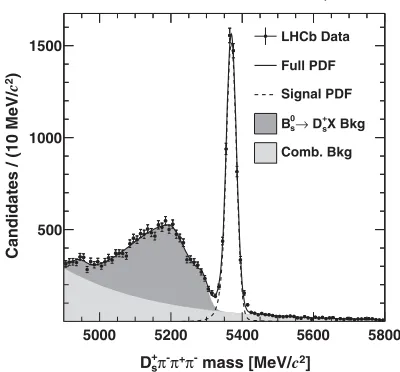
Figure 2 shows the invariant mass distribution for
B0s!Dþsþ candidates passing all selection
crite-ria. The fitted number ofB0
s !Dþsþsignal events
is 568383. While it is expected that most of the low mass background emanates from B0
s !Dþs þ
decays, contributions from other sources such as
B0
s!Dþsþ0 are also possibly absorbed into
this background component. Figure3shows the invariant mass distribution forB0
ðsÞ!DþsKþcandidates. The
fitted signal yields are 40233 B0 !Dþ
sKþ and
21621 B0
s!DþsKþ events.
] 2 c mass [MeV/ -π + π -π + s D
5000 5200 5400 5600 5800
)
2c
Candidates / (10 MeV/
500 1000
1500 LHCb Data
[image:7.612.336.536.42.228.2]Full PDF Signal PDF X Bkg + s D → 0 s B Comb. Bkg
FIG. 2. Invariant mass distribution for B0
s !Dþsþ candidates. The fitted signal probability distribution function (PDF) is indicated by the dashed line and the background shapes are shown as shaded regions, as described in the text.
] 2 c mass [MeV/ -π + π -K + s D
5000 5200 5400 5600 5800
)
2
c
[image:7.612.318.553.446.663.2]Candidates / (10 MeV/ 50 100 150 LHCb Data Full PDF Signal PDFs X Bkg + s D → 0 B X Bkg + s D → 0 s B Bkg πππ (*) s D → 0 s B Comb. Bkg
FIG. 3. Invariant mass distribution for B0
ðsÞ!DþsKþ
The Dþs mass sidebands, defined to be from 35 to
55 MeV=c2 on either side of the nominal Dþ
s mass, are
used to estimate the residual charmless background that may contribute to the observed signals. The numbers ofB0
s
decays in theDþs sidebands are6116,0þ50, and95for the B0s !Dþsþ, B0s !DþsKþ and B0 !
DþsKþ decays, respectively; they are subtracted
from the observed signal yields to obtain the corrected
number of signal decays. The yields in the signal and sideband regions are summarized in TableI.
V. MASS DISTRIBUTIONS OF
Xd;s AND TWO-BODY MASSES
In order to investigate the properties of theseB0
ðsÞdecays,
sWeights [26] obtained from the mass fits are used to determine the underlying Xd;s invariant mass spectra as
well as the two-body invariant masses amongst the three daughter particles. Figure4shows (a) theþmass, (b) the smaller þ mass and (c) the larger þ mass in B0s !Dþsþ data and simulated decays.
A prominent peak, consistent with the a1ð1260Þ!
þ, is observed, along with structures consistent with the 0 in the two-body masses. There appears to be an offset in the peak position of the a1ð1260Þ between data and simulation. Since the mean and width of the a1ð1260Þresonance are not well known, and their values may even be process dependent, this level of agreement is reasonable. A number of other spectra have been compared between data and simulation, such as thepTspectra of the
] 2 c Mass [MeV/ -π + π -π
1000 2000 3000
)
2
c
Candidates / (200 MeV/
0 500 1000 1500 (a) LHCb Data Signal MC ] 2 c Mass [MeV/ + π -π Smaller
0 1000 2000 3000
)
2
c
Candidates / (100 MeV/
0 500 1000 1500 (b) ] 2 c Mass [MeV/ + π -π Larger
0 1000 2000 3000
)
2
c
Candidates / (100 MeV/
0 500 1000 1500
(c)
FIG. 4 (color online). Invariant mass distributions for (a)Xd, (b) smallerþmass inXd and (c) the largerþmass inXd, fromB0
[image:8.612.51.299.120.190.2]s !Dþsþdecays usingsWeights. The points are the data and the solid line is the simulation. The simulated distribution is normalized to have the same yield as the data.
TABLE I. Summary of event yields from data in theDþs signal and sidebands regions and the background corrected yield. The signal and sideband regions require Dþs candidates to have invariant mass jMðKþKþÞ mDþsj<20 MeV=c
2 and
35<jMðKþKþÞ mDþsj<55 MeV=c
2, respectively, where
mDþs is theD
þ
s mass [21].
Decay
Signal Region
Sideband
Region Corrected Yield
B0
s !Dþsþ 568383 6116 562285
B0
s !DþsKþ 21621 0þ50 21622
B0!Dþ
sKþ 40233 95 39333
] 2 c Mass [MeV/ -π + π -K
1000 2000 3000
)
2
c
Candidates / (200 MeV/
0 50 100 (a) LHCb Data Signal MC ] 2 c Mass [MeV/ + π -π
0 1000 2000 3000
)
2
c
Candidates / (100 MeV/
0 20 40 60 (b) ] 2 c Mass [MeV/ + π -K
0 1000 2000 3000
)
2
c
Candidates / (100 MeV/
0 50
100 (c)
FIG. 5 (color online). Invariant mass distributions for (a)Xs, (b)þinXsand (c) theKþinXs, fromB0s !DþsKþdata usingsWeights. The points are data and the solid line is the simulation. The simulated distribution is normalized to have the same yield as the data.
[image:8.612.73.539.339.478.2] [image:8.612.81.534.538.675.2]Dþs,Xdand the daughter particles, and excellent agreement
is found.
Figure5 shows the corresponding distributions for the
B0
s !DþsKþ decay. A peaked structure at low
Kþ mass, consistent with contributions from the lower-lying excited strange mesons, such as the K1ð1270ÞandK1ð1400Þ, is observed. As many of these states decay throughK0 and0 mesons, significant con-tributions from these resonances are observed in theKþ andþinvariant mass spectra, respectively. The simu-lation provides a reasonable description of the distributions in the data.
Figure 6 shows the same distributions for B0 ! DþsKþ. The Kþ invariant mass is quite
broad, with little indication of any narrow structures. There are indications of K0 and 0 contributions in the Kþandþinvariant mass spectra, respectively, but the contribution from resonances such as theK1ð1270Þor K1ð1400Þ appear to be small or absent. In the Kþ invariant mass spectrum, there may be an indication of a
K0ð1430Þ0 contribution. The simulation, which models the Kþ final state as 10% K1ð1270Þ, 10% K1ð1400Þ, 40% K0 and 40% K0, provides a reasonable description of the data, which suggests that processes such as those in Figs.1(e)and1(f )constitute a large portion of the total width for this decay.
VI. FIRST OBSERVATION
OFB0s !Ds1ð2536Þþ
A search for excited Dþs states, such as DþsJ !
Dþsþ, contributing to the Bs0!Dþsþ final
state is performed. Signal candidates within40 MeV=c2 of the nominalB0
s mass are selected, and from them the
invariant mass difference,M¼MðDþsþÞ MðDþsÞ
is formed, where bothþ combinations are included. The M distribution for candidates in the B0
s signal
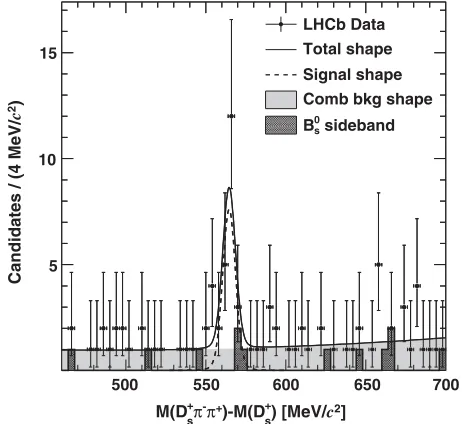
window is shown in Fig. 7. A peak corresponding to theDs1ð2536Þþ is observed, whereas no significant struc-tures are observed in the upper B0s mass sideband
(5450–5590 MeV=c2). The distribution is fitted to the sum of a signal Breit-Wigner shape convolved with a Gaussian resolution function, and a second order polyno-mial to describe the background contribution. The Breit-Wigner width is set to0:92 MeV=c2[21], and the Gaussian resolution is fixed to 3:8 MeV=c2 based on simulation. A signal yield of 20:05:1 signal events is observed at a mass difference of 565:11:0 MeV=c2, which is con-sistent with the knownDs1ð2536ÞþDþs mass difference
of 566:630:35 MeV=c2 [21]. The significance of the signal is 5.9, obtained by fitting the invariant mass distribution with the mean mass difference fixed to
566:63 MeV=c2 [21], and computing ffiffiffiffiffiffiffiffiffiffiffiffiffiffiffiffiffiffiffiffiffiffiffiffiffiffiffiffiffiffiffiffiffi2 lnðL0=Lmax
p
Þ. Here, Lmax andL0 are the fit likelihoods with the signal yields left free and fixed to zero, respectively. Several
] 2
c
Mass [MeV/
-π
+
π
-K
1000 2000 3000
)
2
c
Candidates / (200 MeV/
0 50
100 LHCb Data(a)
Signal MC
] 2
c
Mass [MeV/ +
π
-π
0 1000 2000 3000
)
2
c
Candidates / (100 MeV/
0 20 40 60 80
(b)
] 2
c
Mass [MeV/ +
π
-K
0 1000 2000 3000
)
2
c
Candidates / (100 MeV/
0 50 100
(c)
FIG. 6 (color online). Invariant mass distributions for (a)Xs, (b)þinXsand (c) theKþinXs, fromB0!DþsKþdata usingsWeights. The points are data and the solid line is the simulation. The simulated distribution is normalized to have the same yield as the data.
LHCb Data Total shape
Signal shape
Comb bkg shape
sideband
0 s
B
)
2c
Candidates / (4 MeV/ 5
10 15
]
2
c
) [MeV/
+ s
)-M(D
+
π
-π
+ s
M(D
500 550 600 650 700
FIG. 7. Distribution of the difference in invariant mass, MðDþsþÞ MðDþsÞ, using B0s !Dþsþ candidates within 40 MeV=c2 of the known B0
s mass (points) and in the upper B0
[image:9.612.71.535.43.180.2] [image:9.612.321.552.440.652.2]variations in the background shape were investigated, and in all cases the signal significance exceeded 5.5. This decay is therefore observed for the first time. To obtain the yield in the normalization mode (B0
s !Dþsþ),
the signal function is integrated from 40 MeV=c2 below to 40 MeV=c2 above the nominal B0
s mass. A yield of
550585events is found in this restricted mass interval.
VII. SELECTION EFFICIENCIES
The ratios of branching fractions can be written as
BðB0
s !DþsKþÞ
BðB0
s !DþsþÞ
¼YðB0s !DþsKþÞ
YðB0
s !DþsþÞ
s
rel
(1)
and
BðB0 !Dþ
sKþÞ
BðB0
s !DþsKþÞ
¼YðB0!DþsKþÞ
YðB0
s!DþsKþÞ
d
relfs=fd; (2)
where Y are the measured yields, s
rel¼ðB0s !
DþsþÞ=ðB0s !DsþKþÞanddrel¼ðB0s !
DþsKþÞÞ=ðB0!DþsKþÞ are the relative
selection efficiencies (including trigger), and fs=fd ¼
0:2670:021[27] is theB0
s fragmentation fraction
rela-tive toB0. The ratios of selection efficiencies are obtained from simulation, except for the PID requirements, which are obtained from a dedicated Dþ calibration sample, weighted to match the momentum spectrum of the particles that form Xd and Xs. The selection efficiencies for
each decay are given in Table II. The efficiency of the
B0s !Dþsþ decay is about 35% larger than
the values obtained in either the B0s!DþsKþ or
B0 !DþsKþ decay; the efficiencies of the latter
two are consistent with each other. The lower efficiency is due almost entirely to the tighter PID requirements on the K andþ in Xs. Two additional multiplicative
cor-rection factors, also shown in TableII, are applied to the measured ratio of branching fractions in Eqs. (1) and (2). The first is a correction for theDþs mass veto onMðXd;sÞ,
and the second is due to the requirement that MðXs;dÞ<
3 GeV=c2. The former, which represents a small correc-tion, is estimated from the sWeight-ed distributions of MðXd;sÞ shown previously. For the latter, the fraction of
events withMðXd;sÞ>3 GeV=c2 is obtained from
simu-lation and scaled by the ratio of yields in data relative to simulation for the mass region 2:6< MðXs;dÞ<
3:0 GeV=c2. A 50% uncertainty is assigned to the esti-mated correction. Based on the qualitative agreement between data and simulation in theMðXd;sÞdistributions
(see Sec.V) and the fact that the phase space approaches zero as MðXd;sÞ !3:5 GeV=c2, this uncertainty is
conservative. The relative efficiency between B0
s!
Ds1ð2536Þþ,Dþs1!Dþsþ and B0s!Dþsþ
is estimated from simulation and is found to be
0:900:05.
VIII. SYSTEMATIC UNCERTAINTIES
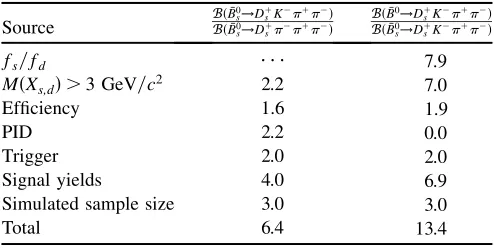
Several uncertainties contribute to the ratio of branching fractions. The sources and their values are listed in Table III. The largest uncertainty, which applies only to the ratio BðB0!DþsKþÞ
BðB0
s!DþsKþÞ, is from the b hadronization
fraction, fs=fd¼0:2670:021 [27], which is 7.9%.
Another large uncertainty results from the required correc-tion factor to account for the signal with MðXs;dÞ>
3 GeV=c2. Those corrections are described in Sec.VII. The selection efficiency depends slightly on the model-ing of theXd;sdecay. The momentum spectra of theB,Dþs,
Xd;sand theXd;sdaughters have been compared to
simu-lation, and excellent agreement is found. The selection efficiency is consistent with being flat as a function of MðXd;sÞat the level of two standard deviations or less. To
assess a potential systematic uncertainty due to a possible MðXd;sÞ-dependent efficiency, the relative differences
between the nominal selection efficiencies and the ones obtained by reweighting the measured efficiencies by the Xd;s mass spectra in data are computed. The relative
deviations of 0.5%, 1.1%, and 1.2% forB0s!DþsKþ,
Bs0!Dþsþ and B0!DþsKþ, respectively,
are the assigned uncertainties. The systematic uncertainty on the BDT efficiency is determined by fitting the B0s!
Dþsþ mass distribution in data with and without
[image:10.612.123.490.658.716.2]the BDT requirement. The efficiency is found to agree with simulation to better than the 1% uncertainty assigned to this source. In total, the simulated efficiencies have uncertainties of 1.6 and 1.9% in the two ratios of branch-ing fractions. The PID efficiency uncertainty is dominated by the usage of the Dþcalibration sample to determine
TABLE II. Selection efficiencies and correction factors for decay modes under study. The uncertainties on the selection efficiencies are statistical only, whereas the correction factors show the total uncertainty.
Quantity B0
s !Dþsþ B0s !DþsKþ B0!DþsKþ Total(104) 4:970:08 3:670:10 3:590:10
Dþs veto corrected 1:0130:003 1:0130:003 1:0170:005 M >3 GeV=c2corrected 1:020:01 1:040:02 1:140:07
the efficiencies of a given PID requirement [28]. This uncertainty is assessed by comparing the PID efficiencies obtained directly from simulated signal decays with the values obtained using a simulated Dþ calibration sample that is re-weighted to match the kinematics of the signal decay particles. Using this technique, an un-certainty of 2% each on the B0s !DþsKþ and
B0 !Dþ
sKþ PID efficiencies is obtained, which
is 100% correlated, and a 1% uncertainty for B0
s !
Dþsþ. The trigger is fully simulated, and given
the identical number of tracks and the well-modeledpT spectra, the associated uncertainty cancels to first order. Based on previous studies [12], a 2% uncertainty is assigned.
The uncertainties in the signal yield determinations have contributions from both the background and signal model-ing. The signal shape uncertainty was estimated by varying all the fixed signal shape parameters one at a time by one standard deviation, and adding the changes in yield in quadrature (0.5%). A double Gaussian signal shape model was also tried, and the difference was negligible. For the combinatorial background, the shape was modified from a single exponential to either the sum of two exponentials, or a linear function. ForB0
s!Dþsþ, the difference in
yield was 0.4%. For B0
s !DþsKþ, the maximum
change was 4%, and for B0 !DþsKþ, the
maxi-mum shift was 1%. In theB0ðsÞ!DþsKþ mass fit,
theB0
ðsÞ!Dþs Kþcontribution was modeled using
the shape from the B0s!Dþsþ mass fit. To
esti-mate an uncertainty from this assumption, the data were fitted with the shape obtained from B0
s !Dþs Kþ
simulation. A deviation of 5.5% in the fitted B0 ! DþsKþ yield is found, with almost no change in
the B0s !DþsKþ yield. The larger sensitivity on
the B0 yield than theB0s yield arises because these
back-ground contributions have a rising edge in the vicinity of theB0 mass peak, which is far enough below theB0
smass
peak to have negligible impact. These yield uncertainties are added in quadrature to obtain the values shown in Table III. The uncertainties due to the finite simulation sample sizes are 3.0%.
The major source of systematic uncertainty on the branch-ing fraction forB0
s!Ds1ð2536Þþ,Dþs1 !Dþsþ, is
from the relative efficiency (5%), and on the fraction of events with M >3 GeV=c2 (10%). This 10% uncer-tainty is conservatively estimated by assuming a flat distribution in MðXdÞ up to 3 GeV=c2 and then a linear
decrease to zero at the phase space limit of
3:5 GeV=c2. Other systematic uncertainties related to the fit model are negligible. Thus in total, a systematic uncertainty of 11% is assigned to the ratio BðB0
s!
Ds1ð2536Þþ;Dþs1!DþsþÞ=BðB0s!DþsþÞ.
IX. RESULTS AND SUMMARY
This paper reports the first observation of the
B0s!DþsKþ, B0 !DþsKþ and B0s!
Ds1ð2536Þþ, Dþs1!Dþsþ decays. The ratios of
branching fractions are measured to be
BðB0
s !DþsKþÞ
BðB0
s !DþsþÞ
¼ ð5:20:50:3Þ 102
BðB0 !Dþ
sKþÞ
BðB0
s !DþsKþÞ
¼0:540:070:07
and
BðB0
s!Ds1ð2536Þþ; Dþs1 !DþsþÞ
BðB0
s!DþsþÞ
¼ ð4:01:00:4Þ 103;
where the uncertainties are statistical and systematic, respectively. The B0
s !DþsKþ branching fraction
is consistent with expectations from Cabibbo suppression. This decay is particularly interesting because it can be used in a time-dependent analysis to measure the CKM phase. Additional studies indicate that this decay mode, with selections optimized for only B0
s!DþsKþ, can
contribute about an additional 35% more signal events relative to the signal yield inB0
s!DsK alone.
TheB0!Dþ
sKþbranching fraction is about 50%
of that for B0s !DþsKþ. Compared to the B0!
DþsKdecay that proceeds only via aW-exchange diagram,
where BðB0 !DsþKÞ=BðB0s!DþsKÞ 0:1 [21], the
ratio BðB0 !DsþKþÞ=BðB0s !DsþKþÞ is
about five times larger. A consistent explanation of this larger B0 !Dþ
sKþ branching fraction is that
only about1=5of the rate is from theW-exchange process [Fig. 1(d)] and about4=5comes from the diagrams shown in Figs. 1(e) and 1(f). The observed MðXsÞ, MðKþÞ
and MðþÞ distributions in Fig. 6 also support this explanation, as evidenced by the qualitative agreement with the simulation.
ACKNOWLEDGMENTS
[image:11.612.51.298.73.197.2]We express our gratitude to our colleagues in the CERN accelerator departments for the excellent performance of
TABLE III. Summary of systematic uncertainties (in %) on the measurements of the ratios of branching fractions.
Source Bð
B0
s!DþsKþÞ
BðB0
s!DþsþÞ
BðB0!
DþsKþÞ
BðB0
s!DþsKþÞ
fs=fd 7.9
MðXs;dÞ>3 GeV=c2 2.2 7.0
Efficiency 1.6 1.9
PID 2.2 0.0
Trigger 2.0 2.0
Signal yields 4.0 6.9
Simulated sample size 3.0 3.0
[image:11.612.314.537.267.395.2]the LHC. We thank the technical and administrative staff at the LHCb institutes. We acknowledge support from CERN and from the following national agencies: CAPES, CNPq, FAPERJ and FINEP (Brazil); NSFC (China); CNRS/ IN2P3 and Region Auvergne (France); BMBF, DFG, HGF and MPG (Germany); SFI (Ireland); INFN (Italy); FOM and NWO (The Netherlands); SCSR (Poland); ANCS/IFA (Romania); MinES, Rosatom, RFBR and NRC ‘‘Kurchatov Institute’’ (Russia); MinECo, XuntaGal and GENCAT (Spain); SNSF and SER (Switzerland); NAS
Ukraine (Ukraine); STFC (United Kingdom); and the NSF (USA). We also acknowledge the support received from the ERC under FP7. The Tier1 computing centers are supported by IN2P3 (France), KIT and BMBF (Germany), INFN (Italy), NWO and SURF (The Netherlands), CIEMAT, IFAE and UAB (Spain), GridPP (United Kingdom). We are thankful for the computing resources put at our disposal by Yandex LLC (Russia), as well as to the communities behind the multiple open source software packages that we depend on.
[1] N. Cabibbo,Phys. Rev. Lett.10, 531 (1963).
[2] M. Kobayashi and T. Maskawa,Prog. Theor. Phys.49, 652 (1973).
[3] M. Bonaet al.(UTfit Collaboration) (Nucl. Phys. B, Proc. Suppl., to be published). Additional information available athttp://www.utfit.org/UTfit/.
[4] S. Descotes-Genon et al. (CKMFitter Collaboration) (Nucl. Phys. B, Proc. Suppl., to be published). Updated results and plots available athttp://ckmfitter.in2p3.fr. [5] I. Dunietz,Phys. Lett. B270, 75 (1991);Z. Phys. C56,
129 (1992); D. Atwood, G. Eilam, M. Gronau, and A. Soni, Phys. Lett. B 341, 372 (1995); D. Atwood, I. Dunietz, and A. Soni, Phys. Rev. Lett. 78, 3257 (1997).
[6] M. Gronau and D. London,Phys. Lett. B253, 483 (1991); M. Gronau and D. Wyler, Phys. Lett. B 265, 172 (1991).
[7] A. Giri, Y. Grossman, A. Soffer, and J. Zupan,Phys. Rev. D68, 054018 (2003).
[8] I. Dunietz and R. G. Sachs,Phys. Rev. D37, 3186 (1988); 39, 3515 (1989).
[9] R. Aleksan, I. Dunietz, and B. Kayser,Z. Phys. C54, 653 (1992).
[10] I. Dunietz,Phys. Rev. D52, 3048 (1995). [11] R. Fleischer,Nucl. Phys.B671, 459 (2003).
[12] R. Aaij et al. (LHCb collaboration), Phys. Rev. D 84, 092001 (2011).
[13] A. A. Alves Jr. et al. (LHCb collaboration), JINST 3, S08005 (2008).
[14] V. V. Gligorov, C. Thomas, and M. Williams, Report No. LHCb-PUB-2011-016.
[15] T. Sjo¨strand, S. Mrenna, and P. Skands, J. High Energy Phys. 05 (2006) 026.
[16] I. Belyaev et al., in Nuclear Science Symposium Conference Record (NSS/MIC)(IEEE, New York, 2010), p. 1155.
[17] D. J. Lange,Nucl. Instrum. Methods Phys. Res., Sect. A 462, 152 (2001).
[18] P. Golonka and Z. Was,Eur. Phys. J. C45, 97 (2006). [19] J. Allisonet al. (GEANT4 Collaboration), IEEE Trans.
Nucl. Sci.53, 270 (2006); S. Agostinelliet al.(GEANT4 Collaboration),Nucl. Instrum. Methods Phys. Res., Sect. A506, 250 (2003).
[20] M. Clemencic, G. Corti, S. Easo, C. R. Jones, S. Miglioranzi, M. Pappagallo, and P. Robbe, J. Phys. Conf. Ser.331, 032023 (2011).
[21] J. Beringeret al.(Particle Data Group),Phys. Rev. D86, 010001 (2012).
[22] W. D. Hulsbergen, Nucl. Instrum. Methods Phys. Res., Sect. A552, 566 (2005).
[23] L. Breiman, J. H. Friedman, R. A. Olshen, and C. J. Stone, Classification and Regression Trees (Wadsworth International Group, Belmont, CA, 1984); B. P. Roe, H.-J. Yang, J. Zhu, Y. Liu, I. Stancu, and G. McGregor,Nucl. Instrum. Methods Phys. Res., Sect. A543, 577 (2005). [24] R. E. Schapire and Y. Freund,J. Comput. Syst. Sci.55, 119
(1997).
[25] T. Skwarnicki, Ph. D. thesis, Institute of Nuclear Physics (Report No. DESY-F31-86-02, 1986).
[26] M. Pivk and F. R. Le Diberder, Nucl. Instrum. Methods Phys. Res., Sect. A555, 356 (2005).
[27] R. Aaij et al. (LHCb collaboration), Phys. Rev. D 85, 032008 (2012).
[28] A. Powell et al., in Proceedings of 35th International Conference on High Energy Physics, Paris, 2010 (Report No. LHCb-PROC-2011-008).

![TABLE I.Summary of event yields from data in the35 Dþs signaland sidebands regions and the background corrected yield.The signal and sideband regions require Dþscandidates tohave invariant mass jMðKþK��þÞ � mDsþ j < 20 MeV=c2 and < jMðKþK��þÞ � mDsþ j < 55 MeV=c2, respectively, wheremDþs is the Dþs mass [21].](https://thumb-us.123doks.com/thumbv2/123dok_us/9618166.464456/8.612.81.534.538.675/signaland-sidebands-background-corrected-dthscandidates-invariant-respectively-wheremdths.webp)