LASIGE: using Conditional Random Fields and ChEBI ontology
Tiago Grego Dep. de Inform´atica Faculdade de Ciˆencias Universidade de Lisboa
Portugal
Francisco Pinto
Dep. de Qu´ımica e Bioqu´ımica Faculdade de Ciˆencias Universidade de Lisboa
Portugal
Francisco M. Couto Dep. de Inform´atica Faculdade de Ciˆencias Universidade de Lisboa
Portugal
Abstract
For participating in the SemEval 2013 chal-lenge of recognition and classification of drug names, we adapted our chemical en-tity recognition approach consisting in Condi-tional Random Fields for recognizing chemi-cal terms and lexichemi-cal similarity for entity res-olution to the ChEBI ontology. We obtained promising results, with a best F-measure of 0.81 for the partial matching task when us-ing post-processus-ing. Usus-ing only Conditional Random Fields the results are slightly lower, achieving still a good result in terms of F-measure. Using the ChEBI ontology allowed a significant improvement in precision (best precision of 0.93 in partial matching task), which indicates that taking advantage of an ontology can be extremely useful for enhanc-ing chemical entity recognition.
1 Introduction
Most chemical named entity recognition systems can be classified in two approaches: dictionary based and machine learning based approaches. Dic-tionary based approaches are usually easier to im-plement and maintain, but require a reference chem-ical term dictionary and are dependent on its com-pleteness and quality. The availability of public chemical databases has been an issue until recently, when several publicly available databases such as PubChem (Wang et al., 2009), DrugBank (Wishart et al., 2006) and ChEBI (Degtyarenko et al., 2007) were released. An example of a popular system that uses this approach is Whatizit (Rebholz-Schuhmann et al., 2008). Machine learning based approaches
are not limited to a terminology and are thus better suited for finding novel chemical terms that are yet to be inserted in reference databases. However this approach requires training data for a classifier to be able to successfully learn and perform the chemi-cal entity recognition task. Some methods combine both approaches and thus are hybrid systems that aim to take the best out of both approaches (Jessop et al., 2011; Rockt¨aschel et al., 2012).
An annotated corpus of patent documents was re-leased by ChEBI, and using such corpus as train-ing data we developed an chemical entity recogni-tion system (Grego et al., 2009) that uses a ma-chine learning approach based on Conditional Ran-dom Fields (CRF) (Lafferty et al., 2001). We fur-thermore expanded our method to allow resolution of recognized entities to the ChEBI ontology (Grego et al., 2012).
This paper describes how our system (Grego et al., 2012) was adapted to perform the task of recog-nition and classification of drug names, and presents the results obtained in the task 9.1 of the 7th Interna-tional Workshop on Semantic Evaluation (SemEval 2013).
2 Task and Dataset
The Task 9 of SemEval 2013 involved two sub-tasks: (9.1) recognition and classification of drug names, and (9.2) extraction of drug-drug interactions from Biomedical Texts (SemEval, 2013). The recognition and classification of drug names (Task 9.1) com-prises two steps. First is chemical named entity recognition, that consists in finding in a sentence the offsets for the start and end of a chemical entity.
An exact match is achieved by correctly identifying both the start and end offset, as curators manually provided them. If there is a mismatch in the offsets but there is some overlap with a manual annotation, then it is considered a partial match, otherwise it is a recognition error.
The second step consists in classifying each rec-ognized entity in one of four possible entity types: i) Drug is any pharmaceutical product approved for human use; ii) Brand is a drug that was first devel-oped by a pharmaceutical company; iii) Group refers to a class or group of drugs; iv) Drug n is an ac-tive substance that has not been approved for human use. Thus, the evaluation takes into account not only entity recognition, but also the assigned type. Type matching assessment considers the entity type evalu-ation from partial matching entity recognition, while strict matching considers the entity type evaluation from exact matching.
For training, the DDI corpus dataset was provided (Segura-Bedmar et al., 2006). This dataset contains two sub-datasets. One that consists of MedLine ab-stracts, and other that contains DrugBank abstracts. An unannotated test dataset was provided for testing and evaluating the systems.
3 CRF entity recognition
Our method uses CRFs for building probabilis-tic models based on training datasets. We used the MALLET (McCallum, 2002) implementation of CRFs. MALLET is a Java-based package for sta-tistical natural language processing, document clas-sification, clustering, topic modeling, information extraction, and other machine learning applications to text, which includes an implementation of linear chain CRFs.
A required first step in our method in the tok-enization of the input text. For this task we have used a specifically adapted tokenizer for chemical text adapted from an open source project (Corbett et al., 2007).
Each token is then represented as a set of features. We kept using a set of features derived in our previ-ous work (Grego et al., 2009), which includes for each token:
Stem: The stem of the token.
Prefix: The first three characters of the token.
Suffix: The last three characters of the token.
Number: Boolean that indicates if the token con-tains digits.
In addition to the set of features, each token is also given a label in accordance to the training data:
NO: A non-chemical token.
NE: A chemical entity represented by a single to-ken.
S-NE: The first token of a multi-token chemical en-tity.
M-NE: A middle token of a multi-token chemi-cal entity (only exists for entities composed by three or more tokens).
E-NE: The last token of a multi-token chemical en-tity.
The task of entity recognition will be the assign-ment of such labels to new, unannotated text, based on a model. The assigned label allows for named entities to be recognized and offsets provided.
For creating a model, it is required as input a set of annotated documents. Our method was initially developed using an annotated patent document cor-pus released to the public by the ChEBI team. This corpus can be found at1, and we decided to keep
us-ing it as trainus-ing data for a model. Together with this corpus, the DDI corpus training dataset provided for the task was used. The model produced by using this combination of training data, that we called All model, will be suited for general purpose chemical entity recognition.
We then prepared four datasets based on the DDI corpus dataset but containing only one type of anno-tated entities each. With that training data we pre-pared four more models, each trained only with one kind on entity type. Thus we have in total prepared five models:
All: A model trained with all entity types of the DDI corpus dataset, and the ChEBI released patent dataset.
1
Drug: A model trained only with the entities of type drug in the DDI corpus dataset.
Brand: A model trained only with the entities of type brand in the DDI corpus dataset.
Group: A model trained only with the entities of type group in the DDI corpus dataset.
Drug n: A model trained only with the entities of type drug n in the DDI corpus dataset.
Using the type specific models it is possible to annotate text with only one entity type. Thus our method now has the capability of entity type classifi-cation in addition to named entity recognition, using these type specific models.
4 ChEBI resolution
After having recognized the named chemical enti-ties, our method tries to perform their resolution to the ChEBI ontology. ChEBI (Chemical Entities of Biological Interest) is a freely available dictionary of small molecular entities. In addition to molecular entities, ChEBI contains groups (parts of molecular entities) and classes of entities, allowing for an onto-logical classification that specifies the relationships between molecular entities or classes of entities and their parents and/or children. The ontology structure provides an integrated overview of the relationships between chemical entities, both structural and func-tional.
The resolution method takes as input the string identified as being a chemical compound name and returns the most relevant ChEBI identifier along with a confidence score.
To perform the search for the most likely ChEBI term for a given entity an adaptation of FiGO, a lexical similarity method (Couto et al., 2005). Our adaptation compares the constituent words in the in-put string with the constituent words of each ChEBI term, to which different weights have been assigned according to its frequency in the ontology vocabu-lary (Grego et al., 2012). A resolution score between 0 and 1 is provided with the mapping, which corre-sponds to a maximum value in the case of a ChEBI term that has the exact name as the input string, and is lower otherwise.
5 Post-processing
To further improve the quality of the annotations provided by our method, some na¨ıve rules were cre-ated and external resources used.
One of the rules implemented is derived from the resolution process, and corresponds in classifying an entity as type Group if its ChEBI name is plu-ral. This is because ChEBI follows the convention of naming its terms always as a singular name, ex-cept for terms that represent classes of entities where a plural name can be used.
We have also used other resources in the post-processing besides ChEBI, namely a list of brand names extracted from DrugBank. This list of brand names was used to check if a given entity was part of that list, and if it was the entity should be of the type Brand.
A common English words list was also used as ex-ternal resource in post-processing. If a recognized chemical entity was part of this list then it was a recognition error and should be filtered out and not be considered a chemical entity.
Some simple rules were also implemented in an effort to improve the quality of the annotations. For instance, if the recognized entity was found to be composed entirely by digits, then it should be fil-tered out because it is most certainly an annotation error. Also, if an entity starts or ends with a char-acter such as “*”, “-”, “.”, “,” or “’”, then those characters should be removed from the entity and the offsets corrected accordingly.
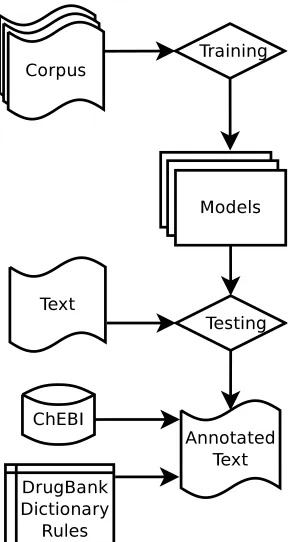
With such na¨ıve but efficient rules it was expected that the performance of entity recognition would im-prove. An overview of the system architecture is provided in Figure 1.
6 Testing runs
Using different combinations of the described meth-ods, three runs were submitted for evaluation and are now described.
Figure 1: Overview of the system architecture. Based on annotated corpus, CRF models are created and used to annotate new documents.
was recognized using the Brand model, then type is Brand, else if it was recognized using the Group model, then type is Group, else and finally it is assigned the type Drug. Resolution to ChEBI is performed and all of the described post-processing rules applied.
Run 2: In this run only the classifiers are used. This means that the entity recognition is performed using all models, and the type classification is performed by using the type specific models as described in Run 1. However no extra process-ing is performed and the results are submitted as obtained directly from the classifiers.
Run 3: This run performs entity recognition in a similar way described in run 1, and per-forms entity recognition to the ChEBI ontol-ogy. However, only the entities successfully mapped to ChEBI, with a resolution score of at least 0.8, are considered. All the other en-tities are discarded in this phase. After reso-lution and the filtering of entities according to
the resolution to ChEBI, all the described post-processing rules are applied in a similar way to Run 1.
7 Results and Discussion
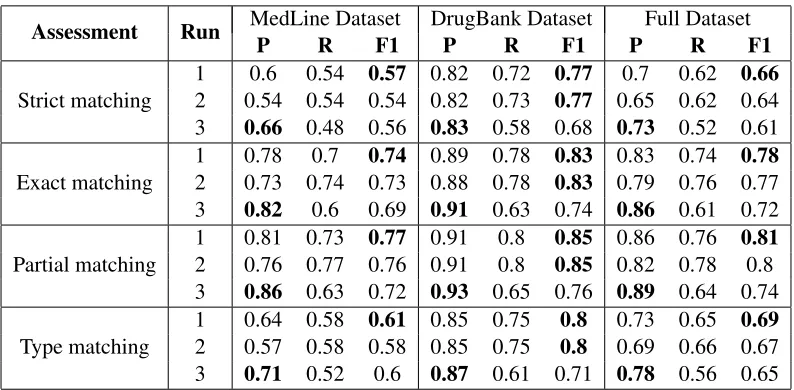
The official evaluation results are presented in Ta-ble 1. We can observe that the obtained results are better for the DrugBank dataset than for the Med-Line dataset. This may have happened because the DrugBank dataset is four times larger than the Med-Line dataset, but also because while the DrugBank abstracts are quite focused in drug descriptions and use mostly systematic names, the MedLine ones are usually more generic and make more extensive use of trivial drug names. We obtained for the Run 1 a top F-measure of 0.81 in the full dataset for a par-tial matching assessment, and that value decreased to 0.78 when an exact matching assessment is con-sidered. The values are very close, which means that our method is being able to efficiently find the cor-rect offsets of the entities. However the F-measure decreases to 0.69 for partial matching and 0.66 for exact matching when the assignment of the entity type is considered. This means that there is room to improve in the task of classifying the chemical enti-ties to the correct entity type.
Run 2 obtained results very similar to Run 1, only slightly less F-measure. The difference between those two runs was that Run 2 used only the classi-fiers, while Run 1 used rules and external resources in an effort to improve the results. We can thus con-clude that the classifiers alone produce already good results and more sophisticated post-processing is re-quired to obtain significant performance gains. Our post-processing was very simple as explained ear-lier, and can only slightly improve the results ob-tained with the CRF classifiers alone.
chem-Assessment Run MedLine Dataset DrugBank Dataset Full Dataset
P R F1 P R F1 P R F1
Strict matching
1 0.6 0.54 0.57 0.82 0.72 0.77 0.7 0.62 0.66
2 0.54 0.54 0.54 0.82 0.73 0.77 0.65 0.62 0.64 3 0.66 0.48 0.56 0.83 0.58 0.68 0.73 0.52 0.61
Exact matching
1 0.78 0.7 0.74 0.89 0.78 0.83 0.83 0.74 0.78
2 0.73 0.74 0.73 0.88 0.78 0.83 0.79 0.76 0.77 3 0.82 0.6 0.69 0.91 0.63 0.74 0.86 0.61 0.72
Partial matching
1 0.81 0.73 0.77 0.91 0.8 0.85 0.86 0.76 0.81
2 0.76 0.77 0.76 0.91 0.8 0.85 0.82 0.78 0.8 3 0.86 0.63 0.72 0.93 0.65 0.76 0.89 0.64 0.74
Type matching
1 0.64 0.58 0.61 0.85 0.75 0.8 0.73 0.65 0.69
[image:5.612.108.505.64.259.2]2 0.57 0.58 0.58 0.85 0.75 0.8 0.69 0.66 0.67 3 0.71 0.52 0.6 0.87 0.61 0.71 0.78 0.56 0.65
Table 1: Results obtained in Task 9.1 for the different assessments. Exact and Partial matching do not consider the entity type, while Strict and Type matching consider the entity type for Exact and Partial matching entity recognition respectively.
Entity Type Run MedLine Dataset DrugBank Dataset Full Dataset
P R F1 P R F1 P R F1
Drug
1 0.58 0.82 0.68 0.85 0.78 0.82 0.69 0.8 0.74 2 0.51 0.82 0.63 0.83 0.81 0.82 0.64 0.82 0.72 3 0.66 0.74 0.7 0.88 0.67 0.76 0.75 0.7 0.73
Brand
1 1 0.5 0.67 0.77 0.45 0.57 0.79 0.46 0.58 2 0.67 0.33 0.44 0.91 0.4 0.55 0.88 0.39 0.54 3 1 0.5 0.67 0.65 0.21 0.31 0.7 0.24 0.35
Group
1 0.7 0.54 0.61 0.82 0.85 0.83 0.76 0.67 0.71 2 0.64 0.56 0.6 0.82 0.83 0.82 0.72 0.67 0.7 3 0.7 0.47 0.56 0.83 0.69 0.76 0.76 0.56 0.65
Drug n
1 0.48 0.11 0.18 0 0 0 0.42 0.11 0.17
2 0.5 0.12 0.2 0 0 0 0.42 0.12 0.18
3 0.48 0.1 0.17 0 0 0 0.41 0.1 0.16
Table 2: Results obtained in Task 9.1 for each entity type. In this evaluation only the entities of a specific type are considered at a time.
Run MedLine Dataset DrugBank Dataset Full Dataset
P R F1 P R F1 P R F1
[image:5.612.150.464.597.667.2]1 0.69 0.50 0.58 0.61 0.52 0.56 0.67 0.51 0.58 2 0.58 0.46 0.51 0.64 0.51 0.57 0.67 0.50 0.57 3 0.71 0.45 0.55 0.59 0.39 0.47 0.66 0.4 0.5
ical entities, which is still a low amount of entities when compared with other chemical databases (for example, PubChem contains more than 10 times that amount). However ChEBI is growing at a steady pace and we believe its coverage will keep increas-ing while maintainincreas-ing the high quality that allows for an excellent precision. Thus, as ChEBI evolves, our approach will mantain the high levels of preci-sion but with a lower reduction in recall.
ChEBI is not only a chemical dictionary, but an ontology. This allows for a comparison recog-nized entities through semantic similarity measures that can be used to further enhance chemical en-tity recognition (Ferreira and Couto , 2010; Couto and Silva , 2011). This comparison can also be ex-tremely useful in other task such as drug-drug inter-action extrinter-action. Moreover, even if with a relatively small ChEBI, it can be possible to increase coverage by integrating other available resources using Ontol-ogy Matching techniques (Faria et al., 2012).
In Table 2 we have the official results obtained for each entity type, and we can observe that our method is efficient in correctly classifying the Drug and Group types, where it achieves an F-measure of 0.74 and 0.71 correspondingly. However our method has some difficulties in correctly classify-ing entities of the Brand type, where an F-measure of 0.58 was obtained. The Drug n entity type has proven to be a very challenging type to be correctly classified, and our system failed the correct classi-fication of this type in most situations. This is pos-sibly because the percentage of entities of this type is very limited, and also because the difference be-tween this type and the Drug type is the fact that the later has been approved for human use, while the former has not. The feature set used cannot ef-ficiently discriminate this information and external information about drug approval for human usage must be used for efficient detection of this type.
Overall, Run 1 has obtained the best results. How-ever, the results from Run 2 have been very similar, which shows that the classifiers have been success-ful and the post-processing of Run 1 has been mini-mal. Run 3 was designed for high precision, because only the entities successfully mapped to the ChEBI ontology were considered. It does improve the ob-tained precision, but suffers a drop in recall. Table 3 presents the macro-average measures obtained for
each run.
8 Conclusions
This paper presents our participation in the 7th In-ternational Workshop on Semantic Evaluation (Se-mEval 2013) using a CRF-based chemical entity recognition method and a lexical similarity based resolution method. We prepared type-specific CRF models to allow both recognition and type classifi-cation of the chemical entities. Mapping of the en-tities to the ChEBI ontology was performed using a lexical similarity based method, and several post-processing rules using external resources where im-plemented.
We submitted different runs on annotated test data using different combination of such methods, and obtained a best precision of 0.89 and a best F-measure of 0.81 in the entity recognition task. For the task of entity recognitions and classification we have obtained a best precision of 0.78 and a best F-measure of 0.69. We concluded that the classifiers provide already good results by their own, that can be slightly improved by using some na¨ıve external resources and rules.
However, using ChEBI allows for a significant in-crease of precision, which is encouraging. We be-lieve this result is a good indication that as ChEBI matures, the methods that take advantage of its on-tology structure for entity recognition and classifica-tion will benefit more from its usage, increasing the F-measure obtained in the task.
9 Acknowledgments
The authors want to thank the Portuguese Fundac¸˜ao para a Ciˆencia e Tecnologia through the financial support of the SPNet project (PTDC/EBB-EBI/113824/2009), the SOMER project (PTDC/EIA-EIA/119119/2010) and the PhD grant SFRH/BD/36015/2007 and through the LASIGE multi-annual support. The authors also wish to thank the European Commission for the financial support of the EPIWORK project under the Seventh Framework Programme (Grant #231807).
References
Work-shop on BioNLP 2007: Biological, Translational, and
Clinical Language Processing, 57–64.
F. M. Couto and M. J. Silva. 2011. Disjunctive shared information between ontology concepts: application to Gene Ontology. Journal of Biomedical Semantics, 2(5).
F. M. Couto, P. M. Coutinho and M. J. Silva. 2005. Finding genomic ontology terms in text using evidence content.BMC Bioinformatics, 6 (Suppl 1), S21. K. Degtyarenko, P. Matos, M. Ennis, J. Hastings, M.
Zbinden, A. McNaught, R. Alcantara, M. Darsow, M. Guedj and M. Ashburner. 2007. ChEBI: a database and ontology for chemical entities of biological inter-est. Nucleic Acids Research, 36, D344.
D. Faria, C. Pesquita, E. Santos, F. M. Couto, C. Stroe and I. F. Cruz 2012. Testing the AgreementMaker System in the Anatomy Task of OAEI 2012. CoRR, abs/1212.1625,arXiv:1212.1625.
J. D. Ferreira and F. M. Couto 2010. Semantic similarity for automatic classification of chemical compounds.
PLoS Computational Biology, 6(9).
T. Grego, C. Pesquita, H. P. Bastos and F. M. Couto. 2012. Chemical Entity Recognition and Resolution to ChEBI. ISRN Bioinformatics, Article ID 619427. T. Grego, P. Pezik, F. M. Couto and D.
Rebholz-Schuhmann. 2009. Identification of Chemical Enti-ties in Patent Documents. Distributed Computing, Ar-tificial Intelligence, Bioinformatics, Soft Computing,
and Ambient Assisted Living, volume 5518 ofLecture
Notes in Computer Science, 934–941.
T. Grego, F. Pinto and F. M. Couto. 2012. Identifying Chemical Entities based on ChEBI. Software Demon-stration at the International Conference on Biomedical Ontologies (ICBO).
D. M. Jessop, S. E. Adams, E. L. Willighagen, L. Hawizy and P. Murray-Rust 2011. OSCAR4: a flexible archi-tecture for chemical text-mining. Journal of Chemin-formatics, 3(41).
J. Lafferty, A. McCallum and F. Pereira. 2001. Con-ditional random fields: Probabilistic models for seg-menting and labeling sequence data. Proceedings of the 18th International Conference on Machine Learn-ing, 282–289.
A. K. McCallum. 2002. Mallet: A machine learning for language toolkit. http://mallet.cs.umass. edu.
D. Rebholz-Schuhmann, M. Arregui, S. Gaudan, H. Kirsch and A. Jimeno. 2008. Text processing through Web services: calling Whatizit. Bioinformat-ics, 24(2):296–298.
T. Rockt¨aschel, M. Weidlich and U. Leser. 2012. ChemSpot: A Hybrid System for Chemical Named Entity Recognition. Bioinformatics, 28(12): 1633-1640.
I. Segura-Bedmar, P. Mart´ınez and C. de Pablo-S´anchez 2006. Using a shallow linguistic kernel for drug-drug interaction extraction. Journal of Biomedical Infor-matics, 44(5): 789–804.
Y. Wang, J. Xiao, T. O. Suzek, J. Zhang, J. Wang and S. H. Bryant. 2009. PubChem: a public information system for analyzing bioactivities of small molecules.
Nucleic Acids Research, 37, W623.
D. S. Wishart, C. Knox, A. C. Guo, S. Shrivastava, M. Hassanali, P. Stothard, Z. Chang and J. Woolsey. 2006. DrugBank: a comprehensive resource for in silico drug discovery and exploration. Nucleic Acids Research, 34, D668.