Action Languages and Question Answering
Yuliya Lierler
University of Nebraska Omaha
Daniela Inclezan Miami University
Michael Gelfond Texas Tech University
Abstract
This paper describes a methodology for designing Question Answering systems that utilize an action language ALM to allow inferences based on complex interactions of events described in texts. This methodology assumes the extension of the VERBNETlexicon with interpretable semantic annotations inALMand specifies the use of several other NLP resources to produceALMsystem descriptions for input discourses.
1
Introduction
In this paper, we propose a methodology for designing Question Answering (QA) systems that uses state-of-the-art techniques from the field of Natural Language Processing (NLP) complementing them with the latest advances from the field of Knowledge Representation and Reasoning (KRR).
The applicability of KRR for the design and implementation of QA systems was explored by Baral et al. (2004) who demonstrated the suitability of the KRR language Answer Set Prolog (ASP) (Gel-fond and Lifschitz, 1991) for this purpose. Balduccini et al. (2008) continued this line of research and described a QA system with an intended wide coverage, based on KRR techniques and NLP tools. Todorova and Gelfond (2011; 2012) addressed the problem from a different angle. They focused on texts restricted to acontrollednatural language tailored tomotionverbs and concentrated on answering difficult questions requiring counting. Their knowledge base was written in a higher-level KRR language than ASP, a so-calledaction languagecalledALM(Inclezan and Gelfond, 2016).
The system by Todorova and Gelfond processed multiple-sentence texts exemplified by
Ann went to the room. (1)
Michael left the room. (2)
and derived inferences based on information in these sentences to answer questions such as
Is Michael inside the room (at the end of the story)? (3) Is Ann inside the room (at the end of the story)? (4) Is the room empty (at the end of the story)? (5)
In the sequel, we refer to the text composed of sentences (1) and (2) as theMAdiscourse.
Our goal is to build upon the methodology outlined by Todorova and Gelfond by putting more empha-sis on the organization of KRR libraries and the NLP stages of QA. We remove some of the constraints assumed by their system: we do not limit ourselves to the motion verbs and we avoid a commitment to a controlled language. Our long term goal is to have a methodology that encompasses texts con-taining a large collection of action verbs (go, give, put exemplify the class of action verbs). In this paper, we test the feasibility of such a proposal by allowing change of possession verbs such as grab, grasp, yankin addition to motion verbs. Consider a discourse that contains the sentence
uttered between sentences (1) and (2). We name it the MAS discourse. We illustrate that a system developed according to our methodology is able to infer that at the time whenMichaelwas graspingthe suitcase, its location wasthe room— the location ofMichael, and thatthe suitcaseis no longer in the roomat the end of the described scenario.
The main feature of our approach is the use ofALMas a language for encoding the meaning of action verbs (i.e., the effects and constraints for the execution of the actions they denote). In addition, we propose to extend an NLP resource about verbs, VERBNET(Kipper-Schuler, 2005; Palmer, 2006), with ALMbased semantic annotations. Other logic formalisms have been used for other NLP tasks (e.g., Recognizing Textual Entailment (NIST, 2008)), but unlikeALM they cannot perform temporal reasoning (MacCartney and Manning, 2007; Harmeling, 2009) or reasoning by cases (Bos and Markert, 2005). This makes them less suitable for answering questions about discourses describing sequences of events.
The paper is structured as follows. Section 2 starts by introducing the KRR action languageALM
by illustrating how a knowledge engineer can utilize this language to formalize the scenarios described by theMAandMASdiscourses and query the respective formalization. In the process, generic modules that capture the knowledge about such actions/verbs as move, go, and grasp are developed. Sec-tion 3 focuses on the methods that will allow us to automatically produceALMdescriptions that cap-ture information present in discourses of interest by utilizing the arsenal of modern NLP lexicons and tools including VERBNET, PROPBANK (Palmer et al., 2005; Palmer, 2005), SEMLINK (Bonial et al., 2013b,a), Ontonotes Sense Groupings (CLEAR, 2008), LTH (Johansson and Nugues, 2007b,a), and CORENLP (Manning et al., 2014). We end with conclusions and future work.
2
The
MA
and
MAS
discourses formalized in
ALM
Action language ALM is a recent representative of KRR languages for modeling knowledge about domains in which changes are caused by the occurrence of actions. An important feature ofALMis its ability to capture the commonality of actionsgoandleaveby defining them as instances of the same action class that we refer to asMOVE, and thus encode the relation that exists between the corresponding verbs.
We start by usingALMto formalize the domain behind theMAdiscourse. First, we use this ex-ample to illustrate the syntax and semantics of the language. Second, we demonstrate how the ALM
framework can be used to perform inferences required to answer questions (3-5). The section concludes with theALMformalization of theMASdiscourse.
MAdiscourse viaALM: There are severalinformative piecesin theMAdiscourse:
1. the discourse refers to actions of class MOVE through the use of verbsgoandleave. This action class immediately brings about a set of axioms associated with it. For example, we are aware that it is impossible to move an object from a point if this object is not at this point.
2. three objects (entities, or instances) are introduced, to which we refer asann,michael, androom; and twoevents(instances of actions):annmoves intoroomandmichaelmoves out ofroom. 3. a sequence of event occurrences is given, i.e.,firstannmoves intoroom, andnext,michaelmoves
out ofroom.
Informative piece 1 or ALM module basic motionfor modeling the MOVE action class: In Figure 1 (LHS), we show theALMmodule calledbasic motion. This module is a general purpose description of knowledge/axioms about the MOVEaction class. It describes how the location of objects is affected by occurrences of events of typeMOVE.
(LHS)
module basic_motion sort declarations
things, points :: universe agents :: things
move :: actions attributes
actor : agents
origin, dest : points function declarations
fluents basic
loc_in : things * points -> booleans axioms
occurs(X) causes loc_in(A,D) if instance(X,move),
actor(X)=A, dest(X)=D.
occurs(X) causes -loc_in(A,O) if instance(X,move),
actor(X)=A, origin(X)=O.
impossible occurs(X) if instance(X,move), actor(X)=A, origin(X)=O, -loc_in(A,O). impossible occurs(X) if instance(X,move),
actor(X)=A, dest(X)=D, loc_in(A,D). (RHS) module basic_motion_verbnet sort declarations
concrete :: universe
escape :: actions attributes
theme : concrete
initial_location, destination : concrete function declarations
fluents basic
loc_in : concrete * concrete -> booleans axioms
occurs(X) causes loc_in(A,D) if instance(X,escape),
theme(X)=A, destination(X)=D.
occurs(X) causes -loc_in(A, O) if instance(X,escape),
theme(X)=A,
initial_location(X)=O.
impossible occurs(X) if instance(X, escape), theme(X)=A,
initial_location(X)=O, -loc_in(A,O).
impossible occurs(X) if instance(X,escape), theme(X)=A,
destination(X)=D, loc_in(A,D).
Figure 1: LHS:ALMmodulebasic motioncapturing knowledge about action class MOVE; RHS: the same module restated using the VERBNETlexicon terminology.
question. In modulebasic motion, action classmoveis declared as a special case of the pre-defined sort actionswith three attributes (i.e., intrinsic properties): attribute actor ranging over the sort agents, and attributesoriginanddest(destination) ranging overpoints.
Next, properties (fluents and statics) related to the domain are declared. Fluentsare properties that may be changed by actions; they are divided in ALMinto basicanddefined. Basic fluents normally maintain their previous values, unless the occurrence of an event causes their value to change. Defined fluents allow one to specify properties in terms of other properties. Properties are modeled via functions inALMusing syntax similar to the mathematical notation for functions. In thebasic motion mod-ule, the property of interest is the locationloc inof things, which may be affected by the occurrence of actions of typemoveand is thus declared as a basic fluent. Per its specification, it is a function that maps pairs ofthingsandpointsinto the pre-defined sortbooleans.
ALMmodules conclude with axioms about described action classes and properties. The first two rules in the basic motionmodule capture the direct effects of actions of sortmove. In particular, the first axiom states that after an occurrence of an instance of move its actor will be located at the destination. The second axiom states that after an occurrence of amoveevent the actor will no longer be at the origin. We note that symbol ”-” is used to denote the classical negation symbol¬. The last two statements describe when the action cannot be executed. In particular, the third and fourth axioms state thatmovecannot occur when the actor is not located at the specified origin, and when the actor is already at the destination, respectively.
Informative piece 2 or ALMsystem description for theMA discourse: InALM, we describe a given domain via asystem descriptionthat consists of atheory— modules organized into a hierarchy, and astructure— definitions of instances. A system description captures atransition diagramthat char-acterizes the behavior of the given domain. Trajectoriesin a transition diagram correspond to possible evolutions or scenarios in the domain. We illustrate these concepts by means of the discourse ma system description presented in Figure 2 (LHS), which corresponds to theMAdiscourse.
(LHS)
system description discourse_ma theory discourse_ma
import module basic_motion
structure discourse_ma instances
ann in agents michael in agents room in points e1 in move
actor = ann dest = room e2 in move
actor = michael origin = room
(RHS)
system description discourse_ma_verbnet theory discourse_ma_verbnet
import module basic_motion_verbnet module drs_michael_and_ann
ann, michael, room :: universe structure discourse_ma_verbnet
instances
r1 in ann, concrete r2 in room, concrete r3 in michael, concrete e1 in escape
theme = r1 destination = r2 e2 in escape
theme = r3
[image:4.595.164.431.275.354.2]initial_location = r2
Figure 2: LHS: ALM system description capturing parts of the MA discourse using module basic motion; RHS: the same system description restated usingbasic motion verbnet.
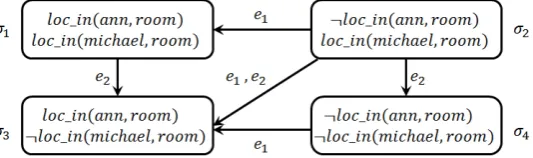
Figure 3: Transition diagram captured by the system descriptiondiscourse ma.
interpreted as a macro to denote that theALMcode describing “module basic motion” has to be inserted in this place. The structure ofdiscourse madeclares instancesann, michael, androom so that the former two are of sortagents, whereas the latter is of sortpoints. The two events described in theMAdiscourse are represented as instancese1ande2of sortmove. Theactorofe1is instance annand itsdestisroom, while theactorofe2ismichaeland itsoriginisroom.
The system description discourse ma defines the transition diagram T presented in Figure 3. It consists of four states labeledσ1· · ·σ4, and five transitions labeled by actionse1, e2 that may take the dynamic system from one state to another. For example, the arce1 between statesσ2 andσ1 says that the occurrence of e1 may take the system from the former state to the latter. Note how action e1 cannot occur in stateσ1(due to the last axiom inbasic motion) and thus there is no arc inT going out of σ1 and labeled e1. The initial state of a system is associated with time step 0. Each arc in the transition diagram suggests an increment of a time step by one. A sequence τ1 = hσ2, e1, σ1, e2, σ3i constitutes a sample trajectory. This trajectory captures the following scenario: initially (time step 0), annis not inroom, whereasmichaelis inroom; at time step 0,annmoves to (enters)room; at time step 1,michaelmoves from (leaves)room. A sequenceτ2 =hσ2, e2, σ4, e1, σ3iexemplifies another trajectory of transition diagramT, whereas a sequencehσ1, e1, σ2, e2, σ4iis not a trajectory.
Informative Piece 3 orALMhistories: A particular domain scenario defines what we call ahistory (Gelfond and Khal, 2014) — a set of observations about fluents that hold in some states and events that happen at some states. Certain trajectories in the transition diagram encoded by a system description are compatible with a particular history, while others are not. We call the compatible trajectoriesmodelsof a history. TheMAdiscourse provides the following history: actione1happens first (at time 0), thene2 happens (at time 1), which we abbreviate below
{hpd(e1,0), hpd(e2,1)}. (7)
Given system description discourse ma, trajectory τ1 is the only model of this history. Thus the initial state of the story conveyed by theMAdiscourse must beσ2and the final one must beσ3.
(a)
module grasping depends on basic_motion sort declarations
carriables :: things grasp :: actions
attributes
grasper : agents
grasped_thing : carriables function declarations
fluents basic
holding : agents * carriables -> booleans defined
can_reach : agents * things -> booleans axioms
occurs(X) causes holding(A,C) if instance(X,grasp), grasper(X)=A, grasped_thing(X)=C. can_reach(A,C) if loc_in(A)=P, loc_in(C)=P.
impossible occurs(X) if instance(X,grasp), grasper(X)=A, grasped_thing(X)=C, holding(A,C). impossible occurs(X) if instance(X,grasp),
grasper(X)=A, grasped_thing(X)=C, -can_reach(A,C). loc_in(X,P) if loc_in(C,P), holding(X,C). loc_in(C,P) if loc_in(X,P), holding(X,C). -loc_in(X,P) if -loc_in(C,P), holding(X,C). -loc_in(C,P) if -loc_in(X,P), holding(X,C).
(b)
system description discourse_mas theory discourse_mas
import module grasping structure discourse_mas
instances ann in agents michael in agents suitcase in carriables room in points
e1 in move actor = ann dest = room ea in grasp
grasper = michael grasped_thing = suitcase e2 in move
actor = michael origin = room
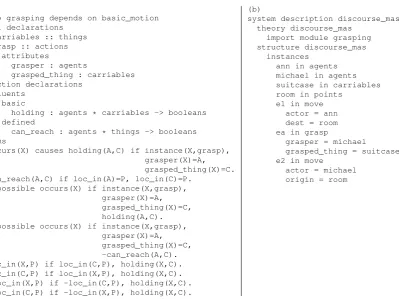
Figure 4: (a)ALMmodule defining actiongrasp; (b) System description for theMASdiscourse.
state σ3 of the trajectory τ1 contains literal -loc in(michael, room), which translates into the answernoto question (3). Stateσ3 containsloc in(ann, room)that translates into answeryesto question (4). Presence ofloc in(ann, room)in stateσ3 translates into answernoto question (5).
Similarly, we can answer other questions:Is Michael inside the room at the beginning of the story? Is Ann inside the room at the beginning of the story? Were Ann and Michael in the room together at some point? How many people were in the room when Ann walked in? The initial stateσ2 of modelτ1 supports the answersyesandnoto the first and the second questions, respectively. The positive answer to the third question is endorsed by the intermediate stateσ1ofτ1. Initial stateσ2 encodes the situation precedingAnn walking into the room. It supports the answerat least oneto the last question.
Automatically computing models of a history: Given theALMsystem description and the history that correspond to a discourse in question, the task of computing models of this history relative to the system description can be automated. First, the system description is translated into a logic program under answer set semantics using the transformation defined by Inclezan and Gelfond (2016). Second, the history and a predefined module for temporal projection (Gelfond and Khal, 2014) are added to the produced logic program. Answer sets of the resulting program can be computed using an off-the-shelf ASP{f}solverCLINGO{F}available athttp://www.mbal.tk/clingof/. Each answer set corresponds to a model of the given history. A prototype translator fromALMsystem descriptions and histories to logic programs is available athttp://tinyurl.com/z6n9fmx.
[image:5.595.104.504.65.364.2]ALM system description for the MASdiscourse: The system description for theMAS discourse, discourse mas, is presented in Figure 4 (b). Its theory starts with an import statement for module grasping. Given thatgraspingdepends on modulebasic motion, the meaning of thisALM
statement is that contents of both modules are copied into the theory ofdiscourse mas. Hence, within this system description we can instantiate events that are of typegraspormove. The fact that action classesgraspandmoveare interconnected in the definition of modulegraspingallows a knowledge engineer to model nontrivial interdependencies between actions. For example, an instance of action graspcauses its agent to hold a grasped object. Modulegraspingalso encodes the knowledge that if an agent holds an object then the locations of the agent and object must be the same. These restrictions allow one to deduce that, when an instance of an actionmoveoccurs while the agent holds some object, then this object changes its location just as the agent does. The structure of thediscourse massystem description is defined similarly to that ofdiscourse ma.
History{hpd(e1,0), hpd(ea,1), hpd(e2,2)}records the events described in discourseMAS. In all models of this history relative to discourse mas(i) the location of entity suitcaseis the same as that of entity michael (namely, entity room) before action instance e2 occurs; (ii) after event ea occurs michael is holding suitcasein all subsequent states; and (iii) after event e2 occurs michaelis holdingsuitcase, and bothmichaelandsuitcaseare not inroom. All of these observations correspond to our expectations given theMASdiscourse. Indeed, we infer thatthe suitcase is no longer inthe roomat the end of the story. Similarly, whenMichaelgraspedthe suitcase, its location was the same as the location ofMichael, i.e.,the room.
3
Automatic construction of
ALM
system descriptions from discourses
In the previous section we illustrated how a knowledge engineer may encode the information carried within theMAandMASdiscourses inALM. We then discussed how theseALMformalizations can be used to automatically reason about these discourses. In this section, we present a proposal for automating the process of creating an ALM system description for an English discourse by relying on modern NLP tools such asLTH,CORENLP and existing lexical resources including Ontonotes Sense Groupings, VERBNET, PROPBANK, and SEMLINK. We stress the steps that have to be performed and how NLP tools and resources are to be used in those steps. TheMAdiscourse is a running example in this section.
Stage 1 or Entity and relation extraction: The goal of this stage is to take an English discourse as an input and produce a so-called discourse representation structure (DRS) — a basic building block of Discourse Representation Theory (Kamp and Reyle, 1993). Figure 5 presents a DRS for the MA discourse. The top part of this DRS enumerates all of the entities, called discourse referents, that take part in the captured discourse (namely, r1, r2, and r3) as well as referents denoting events that the discourse describes (namely,e1ande2). The bottom part of the DRS captures conditions on the entities and events that follow from the discourse. The events are encoded in Neo-Davidsonian style.
r1 r2 r3 e1 e2 entity(r1) entity(r2) entity(r3)
property(r1,ann) property(r2,room) property(r3,michael) event(e1) event(e2)
[image:6.595.106.488.597.673.2]eventType(e1,go.01) eventTime(e1,0) eventArgument(e1,a1,r1) eventArgument(e1,a4,r2) eventType(e2,leave.01) eventTime(e2,1) eventArgumet(e2,a0,r3) eventArgument(e2,a1,r2)
Figure 5: Discourse representation structure for theMAdiscourse
To produce a DRS as exemplified, the first proposed step is to process discourse sentences using the LTHsemantic role labeler. For sentences (1) and (2) of theMAdiscourse,LTHproduces the output:
The examples above are annotated using the rolesets/labels of the predicates go.01 andleave.01 as defined in frame schemas of PROPBANK(version 1.7), where the suffix01indicates that Ontonotes Sense Groupings associates these predicates with senses 1 of verbsgoandleave:
go.01: motion
A1: entity in motion/goer A2: extend A3: start point A4: end point AM-LOC: medium AM-DIR: direction (usually up or down)
leave.01: move away from
A0: entity leaving A1: place left A3: attribute/secondary predication
In the second step, we propose to process a given discourse using the StanfordCORENLP system. Among other NLP tasks, theCORENLP system can perform mention detection and coreference resolu-tion. Given the MAdiscourse it is able to detect that there are three entities in the discourse: Michael, Ann, andthe room, and that expressionsthe roomin sentences (1) and (2) refer to the same entity.
In the third step, the output of systemsLTH andCORENLP is combined to produce a DRS for the given input. Based on the output of CORENLP, entitiesr1, r2, and r3that have a property of being ann, room, andmichael, respectively, are added to the DRS. Similarly, eventse1ande2 are known to be of typego.01andleave.01, respectively, based on the output ofLTH. RelationeventArgumentis populated by using the role labels assigned byLTH. The time step for the events (encoded byeventTime) is provided based on chronological order of events mentioned in the discourse, which coincides with default readings of sentences (we disregard for now markers such asbefore,after).
Related NLP systems: SystemBOXER(Bos, 2008) is an open-domain NLP tool that, given a discourse constructs a respective DRS. However, the discourse representation structures constructed by BOXER omit ordering of events in the discourse (i.e., contain no counterpart to ”eventTime” in Figure 5), as well as details on the roles played by event arguments. Also, named entity recognition and coreference resolution components ofCORENLP perform better thanBOXER.
Stage 2 or From discourse to an ALM system description or via PROPBANK to VERBNET to
ALM: The next question that we tackle is how to map entities, properties, and history present in a given DRS into the vocabulary ofALMmodules that capture axioms about the actions denoted by verbs occurring in this DRS? For theMAdiscourse, this question translates intohow do we transition from the DRS in Figure 5 to anALMscenario composed of a system description in Figure 2 and history(7)?
In order to produce a system description and a history from a DRS, first we have to link two dis-tinct PROPBANK predicatesgo.01 andleave.01to the same ALMaction class MOVE. Second, we ought to map the semantic roles prescribed by PROPBANKfor these predicates to the arguments of action class MOVE as prescribed by thebasic motionmodule. Third, we have to link the entities mentioned in the given DRS in Figure 5 with the instances that compose the structure of the system description capturing this discourse. We will illustrate how these steps result in an ALMsystem de-scriptiondiscourse ma verbnetpresented in Figure 2 (RHS). It is easy to see that to a large extent the new system description is a syntactic modification of thediscourse masystem description in Fig-ure 2 (LHS) that has been designed earlier to process theMAdiscourse. Thediscourse ma verbnet system description can be used in the same manner to answer questions about this discourse. Next, we present details on components required to automate the construction of this system description.
Four (thematic) roles are identified with the classesESCAPE-51.1 and 51.1-1: theme,initial location, destination, andtrajectory. Conditionconcreterepresents (selectional)restrictionthat the arguments of the verbs of this class should satisfy to form semantically coherent sentences. Intuitively, in sentence (1) an entity corresponding toAnnserves the roletheme, while an entity corresponding tothe roomserves the roledestination. Both of these entities are ofconcrete kind/sort. Kipper-Schuler, Section 3.1.4 (2005) describes semantic annotations provided within VERBNETfor each class. However, unlikeALM de-scriptions, these do not have formal semantics and are not computer interpretable in prescribed manner.
TheALM declaration of action classMOVE in Figure 1 (LHS) echoes the information present in VERBNET. We see how attribute actor of MOVE is declared of sortagents, whereasorigin and destare declared of sortpoints. Intuitively, attribute names such asactor,origin, anddestserve the role of thematic rolestheme,initial location, anddestination, respectively. Sortsagentsandpoints echo selectional restrictions and are designated to be ofconcrete kind by VERBNET. Figure 1 (RHS) presents the restatement of thebasic motionmodule in (LHS) of the same figure using VERBNET terminology and namedbasic motion verbnet. It differs from (LHS) by different name choices. The only non-syntactic change appears in sort declarations, where the (RHS) module defines a less specific sort hierarchy. We envision anextended VERBNETthat is augmented withALMmodules (such asbasic motion verbnet), which provideALM-based semantic annotations for its verb classes. Then, theVERBNETlexicon can serve as a lookup table for finding relevant action classes andALM
modules while processing discourses. We believe that the creation of an extended VERBNETwill be an important contribution to both the NLP and KRR communities.
TheSEMLINKProject: The last step to address is how to translate information about entities and events in a DRS into theALMsystem description capturing a given discourse. Here, the missing piece of the puzzle is theSEMLINKproject (Bonial et al., 2013b) that links together PROPBANKand VERBNET.
For instance, SEMLINK contains an entry suggesting that (i) the predicate leave.01 is part of verb class 51.1-1 (a child of the class ESCAPE-15.1) (ii) the argument A0 of predicate leave.01is mapped to rolethemeof verb class 51.1-1, and (iii) the argument A1 of predicateleave.01is mapped to role initial location of class 51.1-1. These mappings are sufficient for devising a translation from information in the DRS in Figure 5 about evente2into the respective part of the structure of theALM
system description present in Figure 2 (RHS). Thus an event of type leave.01 can be seen as an event of typeESCAPE-51.1 and in turn as an instance of actionMOVE, which is captured byescape in the basic motion verbnet module presented in Figure 1 (RHS). Note that this also implies that modulebasic motion verbnetshould be imported into the theory of this constructed system description. Similarly,SEMLINKcontains a mapping for predicatego.01of PROPBANKto a respective class in VERBNET. Yet, argument A4 ofgo.01and role destinationin VERBNET is missing in this mapping. Thus, SEMLINK has to be augmented to accommodate the mapping from A4 todestination. Nevertheless,SEMLINKprovides a solid foundation for the PROPBANK-VERBNETconnection.
4
Conclusions and Future Work
References
Balduccini, M., C. Baral, and Y. Lierler (2008). Knowledge Representation and Question Answering. In F. van Harmelen, V. Lifschitz, and B. Porter (Eds.),Handbook of Knowledge Representation, pp. 779–820. Elsevier.
Baral, C., M. Gelfond, and R. Scherl (2004). Using Answer Set Programming to Answer Complex Queries. InWorkshop on Pragmatics of Question Answering at HLT-NAAC2004.
Bonial, C., K. Stowe, and M. Palmer (2013a). SemLink. https://verbs.colorado.edu/ semlink/[Accessed: 2017].
Bonial, C., K. Stowe, and M. Palmer (2013b). Renewing and revising semlink. InProceedings of The GenLex Workshop on Linked Data in Linguistics.
Bos, J. (2008). Wide-coverage semantic analysis with boxer. In Proceedings of the 2008 Conference on Semantics in Text Processing, STEP ’08, Stroudsburg, PA, USA, pp. 277–286. Association for Computational Linguistics.
Bos, J. and K. Markert (2005). Recognising textual entailment with logical inference. In Proceedings of the Conference on Human Language Technology and Empirical Methods in Natural Language Processing, HLT ’05, Stroudsburg, PA, USA, pp. 628–635. Association for Computational Linguistics.
CLEAR (2008). Ontonotes Sense Groups. http://clear.colorado.edu/compsem/index. php?page=lexicalresources&sub=ontonotes[Accessed: 2017].
Facebook Research (2016). bAbI. https://research.fb.com/downloads/babi/ [Ac-cessed: 2017].
Gelfond, M. and Y. Khal (2014). Knowledge Representation, Reasoning, and the Design of Intelligent Agents: The Answer-Set Programming Approach. Cambridge University Press.
Gelfond, M. and V. Lifschitz (1991). Classical Negation in Logic Programs and Disjunctive Databases. New Generation Computing 9(3/4), 365–386.
Harmeling, S. (2009, October). Inferring textual entailment with a probabilistically sound calculus*. Nat. Lang. Eng. 15(4), 459–477.
Inclezan, D. and M. Gelfond (2016). Modular action language. TPLP 16(2), 189–235.
Johansson, R. and P. Nugues (2007a). Language Technology at LTH. http://nlp.cs.lth.se/ [Accessed: 2017].
Johansson, R. and P. Nugues (2007b, June). Lth: Semantic structure extraction using nonprojective dependency trees. In Proceedings of the Fourth International Workshop on Semantic Evaluations (SemEval-2007), Prague, Czech Republic, pp. 227–230. Association for Computational Linguistics.
Kamp, H. and U. Reyle (1993). From discourse to logic, Volume 1,2. Kluwer.
Kipper-Schuler, K. (2005). VerbNet: A Broad-Coverage, Comprehensive Verb Lexicon. Ph. D. thesis, University of Pennsylvania.
Levin, B. (1993). English verb classes and alternations : a preliminary investigation. University Of Chicago Press.
Manning, C. D., M. Surdeanu, J. Bauer, J. Finkel, S. J. Bethard, and D. McClosky (2014). Stanford CoreNLP a suite of core NLP tools . http://stanfordnlp.github.io/CoreNLP/ [Ac-cessed: 2017].
NIST (2008). Past RTE data. https://tac.nist.gov/data/RTE/index.html[Accessed: 2017].
Palmer, M. (2005).Proposition Bank.http://verbs.colorado.edu/˜mpalmer/projects/ ace.html[Accessed: 2017].
Palmer, M. (2006). VerbNet. https://verbs.colorado.edu/˜mpalmer/projects/ verbnet.html[Accessed: 2017].
Palmer, M., D. Gildea, and P. Kingsbury (2005, March). The proposition bank: An annotated corpus of semantic roles. Computational Linguistics 31(1), 71–106.
Todorova, Y. (2011). Answering questions about dynamic domains from natural language using ASP. Ph. D. thesis, Texas Tech University.
Todorova, Y. and M. Gelfond (2012). Toward Question Answering in Travel Domains. In Correct Reasoning, pp. 311–326.