Projection of Argumentative Corpora from Source to Target Languages
Ahmet Aker
University of Duisburg-Essen
Huangpan ZHANG
University of Duisburg-Essen
Abstract
Argumentative corpora are costly to cre-ate and are available in only few languages with English dominating the area. In this paper we release the first publicly avail-able Mandarin argumentative corpus. The corpus is created by exploiting the idea of comparable corpora from Statistical Ma-chine Translation. We use existing cor-pora in English and manually map the claims and premises to comparable cor-pora in Mandarin. We also implement a simple solution to automate this approach with the view of creating argumentative corpora in other less-resourced languages. In this way we introduce a new task of multi-lingual argument mapping that can be evaluated using our English-Mandarin argumentative corpus. The preliminary results of our automatic argument map-per mirror the simplicity of our approach, but provide a baseline for further improve-ments.
1 Introduction
Identifying argument, i.e. claims and their asso-ciated pieces of evidence (premises) in large vol-umes of textual data has the potential to revolu-tionarise our access to information. Argument based search for information would for example facilitate individual and organisational decision-making, make learning more efficient, enable quicker reporting on present and past events, to name just a few broad applications. Even more important is argument mining in the multi-lingual context, by which argument based search would be available to people in the language of their prefer-ence.
Argument mining is a new, but rapidly grow-ing area of research within Computational Lin-guistic that has gained a great popularity in the last five years. For instance, since 2014 the meet-ing of the Association for Computational Lmeet-inguis- Linguis-tics (ACL) is hosting a workshop specifically dedi-cated to Argument Mining.1Current studies report
methods for argument mining in legal documents (Reed et al., 2008), persuasive essays (Nguyen and Litman, 2015), Wikipedia articles (Levy et al., 2014; Rinott et al., 2015), discussion fora (Swan-son et al., 2015), political debates (Lippi and Tor-roni, 2016) and news (Sardianos et al., 2015; Al-Khatib et al., 2016). In terms of methodology, su-pervised machine learning is a central technique used in all these studies. This assumes the avail-ability of data sets – argumentative texts – to train and test the argument mining models. Such data sets are readily available in English and – al-though in comparably smaller quantities – in very few European languages such as German or Ital-ian. Languages other than these are currently ne-glected. We are only aware of the study conducted by Chow (2016) who manually annotated Chinese news editorial paragraphs about whether they con-tain an argument or not. However, the boundaries of the arguments and their claims and premises were not annotated. Due to this lack of data the research and development of argumentation min-ing outside English and few European languages is very limited, rendering multi-lingual argument mining and language independent argument based search impossible.
In this research we aim to fill this gap. We aim to map existing argument annotations from a source language to a target language. For this purpose an ideal situation would be if there ex-isted parallel documents where the source
docu-1http://argmining2016.arg.tech/
ments are annotated for arguments and where ev-ery sentence in the source document had a transla-tion in the target document. In this case one could easily map any argumentative annotation from the source language to the target one. However, paral-lel data are sparse. In particular there exist no an-notated argumentative corpora with parallel doc-uments in any other language, expect the one de-scribed by Peldszus and Stede (2015) who report argumentative microtexts corpora in German that is also translated into English. Instead, inspired by the statistical machine translation (SMT) meth-ods, we explore the idea of comparable corpora to obtain argumentative data sets. A compara-ble corpus contains pairs of documents written in two different languages. The document pairs usu-ally share the same topic but the documents in a pair are not necessarily entirely translations of each other. However, they may share few sen-tences that are translation of each other. Related work has shown the usefulness of such corpora for training SMT system for under-resourced lan-guages, cross-lingual information retrieval and as-sisted machine translation (Marton et al., 2009; Aker et al., 2013; Hashemi and Shakery, 2014; Ku-mano et al., 2007; Sharoff et al., 2006; Aker et al., 2012; Skadin¸a et al., 2012; Munteanu and Marcu, 2005, 2002; Rapp, 1999). Given the difficulty and the cost of creating an argumentative corpus, ex-tracting arguments from comparable corpora by automatically mapping arguments from the source language corpus to their translations in the target language seems an attractive avenue. In this work, we take a preliminary step to evaluating the viabil-ity of such an approach.
This paper reports on the first Mandarin argu-mentative corpus that is obtained using compara-ble corpora. We make use of the existing corpora, in which English documents are annotated for ar-guments, i.e. where sentences within the docu-ments are marked as claims and premises. We manually map these English sentences to the tar-get documents, by determining sentences in Man-darin that are translations of the English argumen-tative sentences. In addition, we report the results of our attempt to automatise this manual process of cross-lingual argument mapping. This data set will be publicly available for the research commu-nity.
Overall the paper contributes the following:
• We make available a first freely available
ar-gumentative corpus of Mandarin, also con-taining projected argumentative sentences from English to Mandarin comparable arti-cles.
• We introduce a new task of creating multilin-gual argumentative corpora based on the idea of mapping argumentative sentences between articles that are comparable. Our manually generated data can be used to evaluate per-formance of automatic approaches.
• We establish and evaluate the possibility of obtaining argumentative corpora in any lan-guage with lower cost. To this end we pro-pose a first baseline system for mapping En-glish argumentative sentences into Mandarin.
2 Data
We work with the argumentative data published by Aharoni et al. (2014). The data contains the annotation of English Wikipedia articles for topic specific claims called Context Dependent Claims (CDCs) and premises referred as Context Depen-dent Evidence (CDE). A topic is a short phrase and frames the discussion within the article (Levy et al., 2014). A CDC is a general, concise state-ment that directly supports or contests the given topic (Levy et al., 2014). A CDE is a text segment that directly supports a claim in the context of the topic (Rinott et al., 2015). The data released in 2014 contains 1392 labeled claims for 33 different topics, and 1291 labeled premises for 350 distinct claims in 12 different topics (Aharoni et al., 2014). The average number of premises for each claim is 3.69.
To create the comparable corpora we used the inter-language links provided by Wikipedia to link the English articles to the articles in the target lan-guage Mandarin. The original data has 315 En-glish articles of which have 160 corresponding Mandarin articles. These 160 pairs of English-Mandarin articles build the basis for mapping ar-guments from the English to Mandarin.
3 Manual mapping
Language CDC CDE
Only English 1392 1291
[image:3.595.76.289.60.96.2]English-Mandarin 79 27
Table 1: Statistics about the CDCs and CDEs.
CDEs.2 Next, we manually marked sentences that
convey the same meaning as the English argumen-tative sentences. This process was performed by an annotator who is a native speaker of Mandarin and fluent in English.3
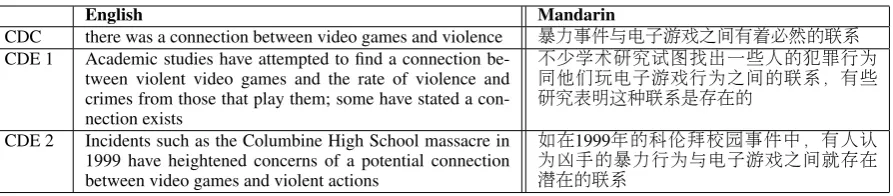
Table 1 summarizes the results of this pro-cess. In total 79 CDCs out of 1392 (5.7%) were mapped. These mappings were found in 34 English-Mandarin article pairs. The remaining 126 article pairs did not share any argumentative sentences. For the 79 CDCs we also analysed their premises (CDEs) and repeated the mapping pro-cess to determine corresponding Mandarin CDEs. In total we found 27 CDEs belonging to 18 CDCs. Table 2 shows an example CDC along with its CDEs in both languages.
Compared to the English the number of CDCs and CDEs mapped into Mandarin is substantially smaller. We have noted three major reasons for this data reduction:
• No article to match an English one:In this case there is no Mandarin article to match an English one. In most cases this is due to the topic of the article being very specific, so there are only limited language versions available. This is the reason why only 160 Mandarin articles could be identified for 315 English articles.
• Dissimilar contents: In this case there is a matched Mandarin article for the En-glish one, but the contents of the arti-cle are not similar. This happens in ar-ticles which talk about topics whose con-tent is country specific. Like Google China (https://en.wikipedia.org/ wiki/Google_China) that talks about country specific events or government con-trol wheres the corresponding English ver-sion does not contain any of Mandarin topics.
2In the data of (Aharoni et al., 2014) few CDCs and CDEs
go over sentence boundaries. We ignore such cases and focus only on those that are bordered by a single sentence.
3Note that the annotation or mapping does not contain
ex-act boundary information of the ex-actual argument but only that the Mandarin sentence conveys similar meaning as its English counterpart.
• Missing sections:The matched Mandarin ar-ticle has missing sections. When the English claims are in those missing parts then there is no corresponding Mandarin mapping.
In a final step it was important to verify that the matched argument pairs are indeed compara-ble. This assessment was performed by three na-tive Mandarin speakers fluent in English educated to post-graduate level. Their task was to indi-cate whether the sentences containing claims and premises in English translate into Mandarin claims and premises identified by our annotator. These assessors worked independently of each other. Only one argument was judged as not being an identified translation. The assessors agreed on all identified translation with our annotator and with each other, leading to the inter-annotator agree-ment ofkappa= 1based on Cohen’s kappa.
4 Automatic mapping
As our manual effort indicates, there is a substan-tial reduction in data set, when comparable cor-pora are used to identify arguments that match in source and target languages. For this reason, an automatic approach to argument matching is mandatory in order to achieve larger data set sizes for multi-lingual argument mining approaches. In addition, successfull automatation of matching would open up the possibiity of creation argumen-tative corpora from any less-resourced language for which comparable corpora are available.
To evaluate the viability of an automatic ap-proach and create a first benchmark we also performed a simple automatic mapping of En-glish CDCs and CDEs into Mandarin. Our ap-proach relies on automatic machine translation using MOSES (Koehn et al., 2007) and Google translate4.
We trained MOSES using the publicly avail-able parallel corpora from the HIT IR-lab5. For
each English article we first translate all CDCs and CDEs into Mandarin. Next, we compare each of those translated argumentative pieces of text with every sentence from the corresponding Mandarin article. Our comparison is based on cosine simi-larity without stop-word removal. To perform to-kenisation we used THULAC6 an efficient
Chi-4https://translate.google.com/
5http://ir.hit.edu.cn/demo/ltp/
Sharing_Plan.htm
English Mandarin
CDC there was a connection between video games and violence 暴力事件与电子游戏之间有着必然的联系 CDE 1 Academic studies have attempted to find a connection
be-tween violent video games and the rate of violence and crimes from those that play them; some have stated a con-nection exists
不少学术研究试图找出一些人的犯罪行为 同他们玩电子游戏行为之间的联系,有些 研究表明这种联系是存在的
CDE 2 Incidents such as the Columbine High School massacre in 1999 have heightened concerns of a potential connection between video games and violent actions
[image:4.595.78.525.60.158.2]如在1999年的科伦拜校园事件中,有人认 为凶手的暴力行为与电子游戏之间就存在 潜在的联系
Table 2: Example CDCs and CDEs.
nese lexical analyser.
We evaluate the performance using accuracy of our automatic mapping solution in retrieving cor-rect pairs. For each CDC and CDE we check whether the most similar Mandarin sentence (ac-cording to cosine similarity) is also the correct pair. If yes, this is regarded as correct mapping, otherwise it is marked as wrong. Our evaluation results give us an accuracy of 24% for MOSES based translation and 49% for Google based trans-lation. The Google based results are substantially better than those obtained through MOSES trans-lation. This is because the MOSES decoder fails to translate many cases correctly.
5 Discussion
Our simple approach to tackling the automatic mapping of CDCs and CDEs achieves very low accuracy scores. Although the accuracy of the ar-gument mapper based on the Google translation is substantially higher than the one achieved through MOSES translation, 49% of correct matches are still not satisfactory. This indicates that the task of argument matching in comparable corpora re-quires more sophisticated methods. One venue for improvement could be to extract richer fea-tures capturing sequential translations. Another direction for improvement could be towards a two phases approach. In the first phase one could re-duce the Mandarin sentences by using an argu-mentative cue filter. In the second phase rich fea-tures could be extracted from the remaining candi-dates to perform the final pairing.
In terms of size the closest corpus to the one pre-sented in this work is the one reported by Boltuˇzi´c and ˇSnajder (2014) with 300 sentences. However, despite its small size at present, our corpus has im-portant potential applications. Apart from train-ing initial Mandarin argument mintrain-ing solutions it can serve as a benchmark data for the task of mapping argumentative sentences from English to
Mandarin. Systems performing with high preci-sion on this data can be used to extend the given corpus by (1) determining annotated documents in the source language, (2) finding comparable docu-ments in Mandarin and (3) using the mapping tool to map the source annotations to Mandarin.
6 Conclusion
In this paper we release the first Mandarin ar-gumentative corpus containing Context Depen-dent Claims (CDCs) and Context DepenDepen-dent Evi-dence (CDE). We obtained the corpus by manually mapping existing CDCs and CDEs from English Wikipedia articles to corresponding Mandarin ar-ticles. With this corpus we provide the basis for developing first argumentation mining solutions for Mandarin. The data can be downloaded from git-hub.7
By tackling the need for multi-lingual argu-ments in this paper we also introduced a new task: mapping argumentative sentences from one lan-guage to another. With this task we open up pos-sibilities for obtaining argumentative resources in less-resourced languages with substantially lower cost than the manual effort.
Finally, we introduced a simple automatic tool for performing the argument mapping between English and Mandarin. The modest accuracy re-sults achieved by this simple approach indicate that more sophisticated methods are necessary for argument mapping. We plan to improve the per-formance of our tool by investigating richer fea-tures and also the idea of filtering out sentences in the Mandarin languages that bare no argumenta-tion. Our method reported in this work is a base-line system for argument mapping, and its scores can serve as a benchmark for further more sophis-ticated methods.
7https://github.com/ahmetaker/
Acknowledgements
This work was supported by the Deutsche Forschungsgemeinschaft (DFG) under grant No. GRK 2167, Research Training Group “User-Centred Social Media”.
References
Ehud Aharoni, Anatoly Polnarov, Tamar Lavee, Daniel Hershcovich, Ran Levy, Ruty Rinott, Dan Gutfre-und, and Noam Slonim. 2014. A benchmark dataset for automatic detection of claims and evidence in the context of controversial topics. In Proceedings of the First Workshop on Argumentation Mining. pages 64–68.
Ahmet Aker, Evangelos Kanoulas, and Robert J Gaizauskas. 2012. A light way to collect compara-ble corpora from the web. InLREC. Citeseer, pages 15–20.
Ahmet Aker, Monica Lestari Paramita, and Robert J Gaizauskas. 2013. Extracting bilingual terminolo-gies from comparable corpora. In ACL (1). pages 402–411.
Khalid Al-Khatib, Henning Wachsmuth, Johannes Kiesel, Matthias Hagen, and Benno Stein. 2016. A news editorial corpus for mining argumentation strategies. InProceedings of the 26th International Conference on Computational Linguistics.
Filip Boltuˇzi´c and Jan ˇSnajder. 2014. Back up your stance: Recognizing arguments in online discus-sions. InProceedings of the First Workshop on Ar-gumentation Mining. Citeseer, pages 49–58. Marisa Chow. 2016. Argument identification in
chi-nese editorials. In Proceedings of NAACL-HLT. pages 16–21.
Homa B Hashemi and Azadeh Shakery. 2014. Min-ing a persian–english comparable corpus for cross-language information retrieval. Information Pro-cessing & Management50(2):384–398.
Philipp Koehn, Hieu Hoang, Alexandra Birch, Chris Callison-Burch, Marcello Federico, Nicola Bertoldi, Brooke Cowan, Wade Shen, Christine Moran, Richard Zens, et al. 2007. Moses: Open source toolkit for statistical machine translation. In Pro-ceedings of the 45th annual meeting of the ACL on interactive poster and demonstration sessions. As-sociation for Computational Linguistics, pages 177– 180.
Tadashi Kumano, Hideki Tanaka, and Takenobu Toku-naga. 2007. Extracting phrasal alignments from comparable corpora by using joint probability smt model. Proceedings of TMI.
Ran Levy, Yonatan Bilu, Daniel Hershcovich, Ehud Aharoni, and Noam Slonim. 2014. Context depen-dent claim detection .
Marco Lippi and Paolo Torroni. 2016. Argument min-ing from speech: Detectmin-ing claims in political de-bates. InAAAI. pages 2979–2985.
Yuval Marton, Chris Callison-Burch, and Philip Resnik. 2009. Improved statistical machine trans-lation using monolingually-derived paraphrases. In Proceedings of the 2009 Conference on Empirical Methods in Natural Language Processing: Volume 1-Volume 1. Association for Computational Linguis-tics, pages 381–390.
Dragos Stefan Munteanu and Daniel Marcu. 2002. Processing comparable corpora with bilingual suffix trees. InProceedings of the ACL-02 conference on Empirical methods in natural language processing-Volume 10. Association for Computational Linguis-tics, pages 289–295.
Dragos Stefan Munteanu and Daniel Marcu. 2005. Im-proving machine translation performance by exploit-ing non-parallel corpora. Computational Linguistics 31(4):477–504.
Huy V Nguyen and Diane J Litman. 2015. Extract-ing argument and domain words for identifyExtract-ing ar-gument components in texts. InProceedings of the 2nd Workshop on Argumentation Mining. pages 22– 28.
Andreas Peldszus and Manfred Stede. 2015. An an-notated corpus of argumentative microtexts. In Pro-ceedings of the First Conference on Argumentation, Lisbon, Portugal, June. to appear.
Reinhard Rapp. 1999. Automatic identification of word translations from unrelated english and german corpora. InProceedings of the 37th annual meeting of the Association for Computational Linguistics on Computational Linguistics. Association for Compu-tational Linguistics, pages 519–526.
Chris Reed, Raquel Mochales Palau, Glenn Rowe, and Marie-Francine Moens. 2008. Language resources for studying argument. In Proceedings of the 6th conference on language resources and evaluation-LREC 2008. ELRA, pages 91–100.
Ruty Rinott, Lena Dankin, Carlos Alzate Perez, Mitesh M Khapra, Ehud Aharoni, and Noam Slonim. 2015. Show me your evidence-an automatic method for context dependent evidence detection. In EMNLP. pages 440–450.
Christos Sardianos, Ioannis Manousos Katakis, Geor-gios Petasis, and Vangelis Karkaletsis. 2015. Ar-gument extraction from news. NAACL HLT 2015 page 56.
Inguna Skadin¸a, Ahmet Aker, Nikos Mastropavlos, Fangzhong Su, Dan Tufis, Mateja Verlic, Andrejs Vasil¸jevs, Bogdan Babych, Paul Clough, Robert Gaizauskas, et al. 2012. Collecting and using com-parable corpora for statistical machine translation. In Proceedings of the 8th International Conference on Language Resources and Evaluation (LREC), Is-tanbul, Turkey.