Sentence-Internal Prosody Does not Help Parsing the Way Punctuation Does
Michelle L Gregory Brown University [email protected]
Mark Johnson Brown University Mark [email protected]
Eugene Charniak Brown University
Abstract
This paper investigates the usefulness of sentence-internal prosodic cues in syntac-tic parsing of transcribed speech. Intu-itively, prosodic cues would seem to pro-vide much the same information in speech as punctuation does in text, so we tried to incorporate them into our parser in much the same way as punctuation is. We com-pared the accuracy of a statistical parser on the LDC Switchboard treebank corpus of transcribed sentence-segmented speech using various combinations of punctua-tion and sentence-internal prosodic infor-mation (duration, pausing, and f0 cues). With no prosodic or punctuation informa-tion the parser’s accuracy (as measured by F-score) is 86.9%, and adding punctuation increases its F-score to 88.2%. However, all of the ways we have tried of adding prosodic information decrease the parser’s F-score to between 84.8% to 86.8%, de-pending on exactly which prosodic infor-mation is added. This suggests that for sentence-internal prosodic information to improve speech transcript parsing, either different prosodic cues will have to used or they will have be exploited in the parser in a way different to that used currently.
1 Introduction
Acoustic cues, generally duration, pausing, and f0, have been demonstrated to be useful for
auto-S
INTJ
UH
Oh ,
, NP
PRP
I
VP
VBD
loved NP
PRP
it .
[image:1.595.352.503.252.363.2].
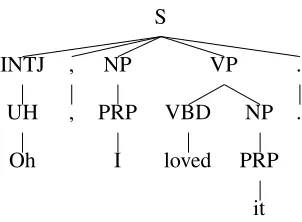
Figure 1: A treebank style tree in which punctuation is coded with terminal and preterminal nodes.
This paper evaluates the accuracy of a statistical parser whose input includes prosodic cues. The pur-pose of this study to determine if prosodic cues im-prove parsing accuracy in the same way that punc-tuation does. Puncpunc-tuation is represented in the vari-ous Penn treebank corpora as independent word-like tokens, with corresponding terminal and pretermi-nal nodes, as shown in Figure 1 (Bies et al., 1995). Even though this seems linguistically highly un-natural (e.g., punctuation might indicate supraseg-mental prosodic properties), statistical parsers gen-erally perform significantly better when their train-ing and test data contains punctuation represented in this way than if the punctuation is stripped out of the training and test data (Charniak, 2000; En-gel et al., 2002; Johnson, 1998). On the Switch-board treebank data set using the experimental setup described below we obtained an F-score of 0.882 when using punctuation and 0.869 when punctua-tion was stripped out, replicating previous experi-ments demonstrating the importance of punctuation. (F-score is a standard measure of parse accuracy, see e.g., Manning and Sch¨utze (1999) for details).
This paper investigates how prosodic cues, when encoded in the parser’s input in a manner similar to the way the Penn treebanks encode punctuation, af-fect parser accuracy. Our starting point is the ob-servation that the Penn treebank annotation of punc-tuation does significantly improve parsing accuracy. Coupled with the assumption that punctuation and prosody are encoding similar information, this led us to try to encode prosodic information in a man-ner that was as similar as possible to the way that punctuation is encoded in the Penn treebanks.
For example, commas in text and pauses in speech seem to convey similar information. In fact, when transcribing speech, commas are often used to de-note a pause. Thus, given the correlation between the two, and the fact that sentence-internal punctu-ation tends to be commas, we expected that pause duration, coded in a way similar to punctuation, would improve parsing accuracy in the same way that punctuation does.
While it may be the case that the encoding of prosodic information used in the experiments be-low is perhaps not optimal and the parser has not been tuned to use this information, note that exactly the same objections could be made to the way that
punctuation is encoded and used in modern statis-tical parsers, and punctuation does in fact dramati-cally improve parsing accuracy.
We focus in this paper on parsing accuracy in a modern statistical parsing framework, but it is im-portant to remember that prosodic cues might help parsing in other ways as well, even if they do not im-prove parsing accuracy. N¨oth et al. (2000) point out that prosodic cues reduce parsing time and increase recognition accuracy when parsing speech lattices with the hand-crafted Verbmobil grammar. Page 266 of Kompe (1997) discusses the effect that incorpo-rating prosodic information has on parse quality in the Verbmobil system using the TUG unification grammar parser: out of the 54 parses affected by the addition of prosodic information, 33 were judged “better with prosody”, 14 were judged “better with-out prosody” and 7 were judged “unclear”. Our experiments below differ from the experiments of N¨oth and Kompe in many ways. First, we used speech transcripts rather than speech recognizer lat-tices. Second, we used a general-purpose broad-coverage statistical parser rather than a unification grammar parser with a hand-constructed grammar.
2 Method
The data used for this study is the transcribed ver-sion of the Switchboard Corpus as released by the Linguistic Data Consortium. The Switchboard Corpus is a corpus of telephone conversations be-tween adult speakers of varying dialects. The cor-pus was split into training and test data as de-scribed in Charniak and Johnson (2001). The train-ing data consisted of all files in sections 2 and 3 of the Switchboard treebank. The testing corpus con-sists of files sw4004.mrg to sw4153.mrg, while files sw4519.mrg to sw4936.mrg were used as develop-ment corpus.
2.1 Prosodic variables
items. In cases of differences, we kept the lexical item from the LDC version. Ferrer et al. (2002) provided very rich prosodic information including duration, pausing, f0 information, and individual speaker statistics for each word in the corpus. The information obtained from this corpus was aligned to the LDC corpus.
It is not known exactly which prosodic vari-ables convey the information about syntactic bound-aries that is most useful to a modern syntactic parser, so we investigated many different com-binations of these variables. We looked for changes in pitch and duration that we expected would correspond to syntactic boundaries. While we tested many combinations of variables, they were mainly based on the variables PAU DUR N, NORM LAST RHYME DUR, FOK WRD DIFF MNMN N, FOK LR MEAN KBASELNandSLOPE MEAN DIFF Nin the data provided by Ferrer et al. (2002).
While Ferrer (2002) should be consulted for full details, PAU DUR Nis pause duration normalized by the speaker’s mean sentence-internal pause dura-tion,NORM LAST RHYME DURis the duration of the phone minus the mean phone duration normalized by the standard deviation of the phone duration for each phone in the rhyme,FOK WRD DIFF MNMN NG is the log of the mean f0 of the current word, divided by the log mean f0 of the following word, normalized by the speakers mean range, FOK LR MEAN KBASELN is the log of the mean f0 of the word normalized by speaker’s baseline, and SLOPE MEAN DIFF Nis the difference in the f0 slope normalized by the speaker’s mean f0 slope.
These variables all range over continuous values. Modern statistical parsing technology has been de-veloped assuming that all of the input variables are categorical, and currently our parser can only use categorical inputs. Given the complexity of the dy-namic programming algorithms used by the parser, it would be a major research undertaking to develop a statistical parser of the same quality as the one used here that is capable of using both categorical and continuous variables as input.
In the experiments below we binned the contin-uous prosodic variables to produce the actual cate-gorical values used in our experiments. Binning in-volves a trade-off, as fewer bins involve a loss of information, whereas a large number of bins splits
the data so finely that the statistical models used in the parser fail to generalize. We binned by first con-structing a histogram of each feature’s values, and divided these values into bins in such a way that each bin contained the same number of samples. In runs in which a single feature is the sole prosodic feature we divided that feature’s values into 10 bins, while runs in which two or more prosodic features were conjoined we divided each feature into 5 bins.
While not reported here, we experimented with a wide variety of different binning strategies, includ-ing usinclud-ing the bins proposed by Ferrer et al. (2002). In fact the number of bins used does not affect the results markedly; we obtained virtually the same re-sults with only two bins.
We generated and inserted “pseudo-punctuation” symbols based on these binned values that were in-serted into the parse input as described below. In general, a pseudo-punctuation symbol is the con-junction of the binned values of all of the prosodic features used in a particular run. When map-ping from binned prosodic variables to pseudo-punctuation symbols, some of the binned values can be represented by the absence of a pseudo-punctuation symbol.
Because we intend these pseudo-punctuation symbols to be as similar as possible to normal punc-tuation, we generated pseudo-punctuation symbols only when the corresponding prosodic variable falls outside of its typical values. The ranges are given below, and were chosen so that they align with bin boundaries and result in each type of pseudo-punctuation symbol occuring on 40% of words. Thus when a prosodic feature is used alone only 4 of its 10 bins are represented by a pseudo-punctuation symbol.
However, when two or more types of the prosodic pseudo-punctuation symbols are used at once there is a larger number of different pseudo-punctuation symbols and a greater number of words appear-ing with a followappear-ing pseudo-punctuation symbol. For example, when P, R and S prosodic annota-tions are used together there are 89 distinct types of prosodic pseudo-punctuation symbols in our cor-pus, and 54% of words are followed by a prosodic pseudo-punctuation symbol.
or concatenated in combination. See Figure 2 for an example tree with pseudo-punctuation symbols inserted.
Pb This is based on the bin b of the binned PAU DUR Nvalue, and is only generated when thePAU DUR Nvalue is greater than 0.285.
Rb This is based on the bin b of the binned NORM LAST RHYME DUR value, and is only generated that value is greater than -0.061.
Wb This is based on the bin b of the binned FOK WRD DIFF MNMN Nvalue, and is only gen-erated when that value is less than -0.071 or greater than 0.0814.
Lb This is based on the bin b of the FOK LR MEAN KBASELN value, and is only generated when that value is less than 0.157 or greater than 0.391.
Sb This is based on the bin b of the SLOPE MEAN DIFF N value, and is only generated whenever that value is non-zero.
In addition, we also created a binary version of thePfeature in order to evaluate the effect of bina-rization.
NP This is based on the PAU DUR N value, and is only generated when that value is greater than 0.285.
We actually experimented with a much wider range of binned variables, but they all produced re-sults similar to those described below.
2.2 Parse corpus construction
We tried to incorporate the binned prosodic informa-tion described in the previous subsecinforma-tion in a manner that corresponds as closely as possible to the way that punctuation is represented in this corpus, be-cause previous experiments have shown that punc-tuation improves parser performance (Charniak and Johnson, 2001; Engel et al., 2002). We deleted dis-fluency tags andEDITEDsubtrees from our training and test corpora.
We investigated several combinations of prosodic pseudo-punctuation symbols. For each of these we
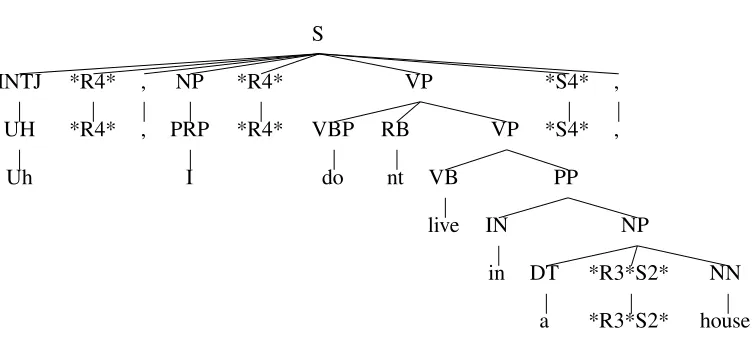
generated a training and test corpus. The pseudo-punctuation symbols are dominated by a new preter-minal PROSODY to produce a well-formed tree. These prosodic local trees are introduced into the tree following the word they described, and are at-tached as high as possible in the tree, just as punc-tuation is in the Penn treebank. Figure 2 depicts a typical tree that contains P R S prosodic pseudo-punctuation symbols inserted following the word they describe.
We experimented with several other ways of in-corporating prosody into parse trees, none of which greatly affected the results. For example, we also ex-perimented with a “raised” representation in which the prosodic pseudo-punctuation symbol also serves as the preterminal label. The corresponding “raised” version of the example tree is depicted in Figure 3.
The motivation for raising is as follows. The sta-tistical parser used for this research generates the siblings of a head in a sequential fashion, first pre-dicting the category label of a sibling and later con-ditioning on that label to predict the remaining sib-lings. “Raising” should permit the generative model to condition not just on the presence of a prosodic pseudo-punctuation symbol but also on its actual identity. If some but not all of the prosodic pseudo-punctuation symbols were especially indicative of some aspect of phrase structure, then the “raising” structures should permit the parsing model to detect this and condition on just those symbols. Note that in the Penn treebank annotation scheme, different types of punctuation are given different preterminal categories, so punctuation is encoded in the treebank using a “raised” representation.
The resulting corpora contain both prosodic and punctuation information. We prepared our actual training and testing corpora by selectively remov-ing subtrees from these corpora. By removremov-ing all punctuation subtrees we obtain corpora that contain prosodic information but no punctuation, by remov-ing all prosodic information we obtain the original treebank data, and by removing both prosodic and punctuation subtrees we obtain corpora that contain neither type of information.
2.3 Evaluation
S
INTJ
UH
Uh
PROSODY
*R4* ,
, NP
PRP
I
PROSODY
*R4*
VP
VBP
do RB
nt
VP
VB
live
PP
IN
in
NP
DT
a
PROSODY
*R3*S2*
NN
house PROSODY
*S4* ,
[image:5.595.94.523.128.289.2],
Figure 2: A tree withP R Sprosodic pseudo-punctuation symbols inserted following the words they corre-spond to. (NoPprosodic features occured in this utterance).
S
INTJ
UH
Uh
*R4*
*R4* ,
, NP
PRP
I
*R4*
*R4*
VP
VBP
do RB
nt
VP
VB
live
PP
IN
in
NP
DT
a
*R3*S2*
*R3*S2*
NN
house *S4*
*S4* ,
,
[image:5.595.119.496.448.618.2]Annotation unraised raised punctuation 88.212
none 86.891
L 85.632 85.361
NP 86.633 86.633
P 86.754 86.594
R 86.407 86.288
S 86.424 85.75
W 86.031 85.681
[image:6.595.111.262.72.247.2]P R 86.405 86.282 P W 86.175 85.713 P S 86.328 85.922 P R S 85.64 84.832
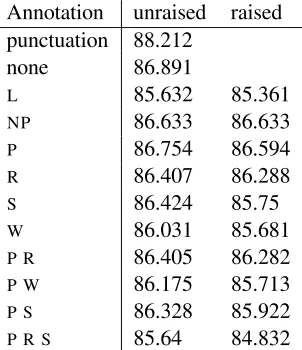
Table 1: The F-score of the parser’s output when trained and tested on corpora with varying prosodic pseudo-punctuation symbols. The entry “punc-tuation” gives the parser’s performance on input with standard punctuation, while “none” gives the parser’s performance on input without any punctua-tion or prosodic pseudo-punctuapunctua-tion whatsoever.
(We always tested on the type of corpora that corre-sponded to the training data). We evaluated parser performance using the methodology described in Engel et al. (2002), which is a simple adaptation of the well-knownPARSEVALmeasures in which
punc-tuation and prosody preterminals are ignored. This evaluation yields precision, recall and F-score values for each type of training and test corpora.
3 Results
Table 1 presents the results of our experiments. The
RAISEDprosody entry corresponds to the raised
ver-sion of theCOMBINEDcorpora, as described above.
We replicated previous results and showed that punctuation information does help parsing. How-ever, none of the experiments with prosodic infor-mation resulted in improved parsing performance; indeed, adding prosodic information reduced perfor-mance by 2 percentage points in some cases. This is a very large amount by the standards of modern sta-tistical parsers. Notice that the general trend is that performance decreases as the amount and complex-ity of the prosodic annotation increased.
4 Discussion and Conclusion
Simple statistical tests show that there is in fact a significant correlation between the location of opening and closing phrase boundaries and all of the prosodic pseudo-punctuation symbols described above, so there is no doubt that these do con-vey information about syntactic structure. How-ever, adding the prosodic pseudo-punctuation sym-bols uniformly decreased parsing accuracy relative to input with no prosodic information. There are a number of reasons why this might be the case.
While we investigated a wide range of prosodic features, it is possible that different prosodic features might improve parsing performance, and it would be interesting to see if improved prosodic feature ex-traction would improve parsing accuracy.
We suspect that the decrease in accuracy is due to the fact that the addition of prosodic pseudo-punctuation symbols effectively excluded other sources of information from the parser’s statisti-cal models. For example, as mentioned earlier the parser uses a mixture of n-gram models to predict the sequence of categories on the right-hand side of syntactic rules, backing off ultimately to a dis-tribution that includes just the head and the preced-ing siblpreced-ing’s category. Consider the effect of insert-ing a prosodic pseudo-punctuation symbol on such a model. The prosodic pseudo-punctuation symbol would replace the true preceding sibling’s category in the model, thus possibly resulting in poorer over-all performance (note however that the parser also includes a higher-order backoff distribution in which the next category is predicted using the preceding two sibling’s categories, so the true sibling’s cate-gory would still have some predictive value).
The basic point is that inserting additional in-formation into the parse tree effectively splits the conditioning contexts, exacerbating the sparse data problems that are arguably the bane of all statisti-cal parsers. Additional information only improves parsing accuracy if the information it conveys is suf-ficient to overcome the loss in accuracy incurred by the increase in data sparseness. It seems that punctu-ation carries sufficient informpunctu-ation to overcome this loss, but that the prosodic categories we introduced do not.
are parsing speech transcripts in which the words (and hence their parts of speech) are very reliably identified, whereas our prosodic features were auto-matically extracted directly from the speech signal and hence might be noisier. If the explanation pro-posed above is correct, it is perhaps not surprising that an accurate part of speech label would prove more useful in a conditioning context used by the parser than a noisy prosodic feature. Note that this would not be the case when parsing from speech rec-ognizer output (since word identity would itself be uncertain), and it is possible that in such applications prosodic information would be more useful.
Of course, there are many other ways prosodic in-formation might be exploited in a parser, and one of those may yield improved parser performance. We chose to incorporate prosodic information into our parser in a way that was similar to the way that punctuation is annotated in the Penn treebanks because we assumed that punctuation carries infor-mation similar to prosody, and it had already been demonstrated that punctuation annotated in the Penn treebank fashion does systematically improve pars-ing accuracy.
But the assumption that prosody conveys infor-mation about syntactic structure in the same way that punctuation does could be false. It could also be that even though prosody encodes information about syntactic structure, this information is encoded in a manner that is too complicated for our parser to utilize. For example, even though commas are of-ten used to indicate pauses, pauses have many other functions in fluent speech. Pauses of greater than 200 ms are often associated with planning problems, which might be correlated with syntactic structure in ways too complex for the parser to exploit. While not reported here, we tried various techniques to iso-late different functions of pauses, such as exclud-ing pauses of greater than 200 ms. However, all of these experiments produced results similar to those reported here.
Finally, there is another possible reason why our assumption that prosody and punctuation are similar in their information content could be wrong. Our prosodic information was automatically extracted from the speech stream, while punctuation was pro-duced by human annotators who presumably com-prehended the utterances being annotated. Given
this, it is perhaps no surprise that our automatically extracted prosodic annotations proved less useful than human-produced punctuation.
References
Bengt Altenberg. 1987. Prosodic patterns in spoken En-glish: studies in the correlation between prosody and grammar. Lund University Press, Lund.
Don Baron, Elizabeth Shriberg, and Andreas Stolcke. 2002. Automatic punctuation and disfluency detec-tion in multi-party meetings using prosodic and lex-ical cues. In Proc. Intl. Conf. on Spoken Language Processing, volume 2, pages 949–952, Denver. Ann Bies, Mark Ferguson, Karen Katz, and Robert
Mac-Intyre, 1995. Bracketting Guideliness for Treebank II style Penn Treebank Project. Linguistic Data Consor-tium.
Eugene Charniak and Mark Johnson. 2001. Edit detec-tion and parsing for transcribed speech. In Proceed-ings of the 2nd Meeting of the North American Chap-ter of the Association for Computational Linguistics, pages 118–126.
Eugene Charniak. 2000. A maximum-entropy-inspired parser. In The Proceedings of the North American Chapter of the Association for Computational Linguis-tics, pages 132–139.
William Croft. 1995. Intonation units and grammatical structure.Linguistics, 33:839–882.
Donald Engel, Eugene Charniak, and Mark Johnson. 2002. Parsing and disfluency placement. In Proceed-ings of the 2002 Conference on Empirical Methods in Natural Language Processing, pages 49–54.
Luciana Ferrer, Elizabeth Shriberg, and Andreas Stol-cke. 2002. Is the speaker done yet? faster and more accurate end-of-utterance detection using prosody in human-computer dialog. InProc. Intl. Conf. on Spo-ken Language Processing, volume 3, pages 2061– 2064, Denver.
Luciana Ferrer. 2002. Prosodic features for the switch-board database. Technical report, SRI International, Menlo Park.
Jon Hamaker, Dan Harkins, and Joe Picone. 2003. Man-ually corrected switchboard word alignments.
Julia Hirschberg and Christine Nakatani. 1998. Acoustic indicators of topic segmentation. InProc. Intl. Conf. on Spoken Language Processing, volume 4, pages 1255–1258, Philadelphia.
Mark Johnson. 1998. PCFG models of linguis-tic tree representations. Computational Linguistics, 24(4):613–632.
Ralf Kompe. 1997. Prosody in speech understanding systems. Springer, Berlin.
Chris Manning and Hinrich Sch¨utze. 1999. Foundations of Statistical Natural Language Processing. The MIT Press, Cambridge, Massachusetts.
Heinrich Neiman, Elmar Noth, Anton Batliner, Jan Buckow, Florian Gallwitz, Richard Huber, and Volkar Warnke. 1998. Using prosodic cues in spoken dialog systems. In Proceedings of the International Work-shop on Speech and Computer, pages 17–28, St. Pe-tersburg.
Elmar N¨oth, Anton Batliner, Andreas Kießling, Ralf Kompe, and Heinrich Niemann. 2000. Verbmobil: The use of prosody in the linguistic components of a speech understanding system. IEEE Transactions on Speech and Auditory Processing, 8(5):519–532. Astrid Schepman and Paul Rodway. 2000. Prosody
and on-line parsing in coordination structures. The Quarterly Journal of Experimental Psychology: A, 53(2):377–396.