Minimum Bayes-Risk Decoding for Statistical Machine Translation
Shankar Kumar and William Byrne
Center for Language and Speech Processing, Johns Hopkins University,
3400 North Charles Street, Baltimore, MD, 21218, USA
skumar,byrne
@jhu.edu
Abstract
We present Minimum Bayes-Risk (MBR) de-coding for statistical machine translation. This statistical approach aims to minimize expected loss of translation errors under loss functions that measure translation performance. We de-scribe a hierarchy of loss functions that incor-porate different levels of linguistic information from word strings, word-to-word alignments from an MT system, and syntactic structure from parse-trees of source and target language sentences. We report the performance of the MBR decoders on a Chinese-to-English trans-lation task. Our results show that MBR decod-ing can be used to tune statistical MT perfor-mance for specific loss functions.
1
Introduction
Statistical Machine Translation systems have achieved considerable progress in recent years as seen from their performance on international competitions in standard evaluation tasks (NIST, 2003). This rapid progress has been greatly facilitated by the development of automatic translation evaluation metrics such as BLEU score (Pa-pineni et al., 2001), NIST score (Doddington, 2002) and Position Independent Word Error Rate (PER) (Och, 2002). However, given the many factors that influence translation quality, it is unlikely that we will find a single translation metric that will be able to judge all these fac-tors. For example, the BLEU, NIST and the PER metrics,
This work was supported by the National Science Foun-dation under Grant No. 0121285 and an ONR MURI Grant N00014-01-1-0685. Any opinions, findings, and conclusions or recommendations expressed in this material are those of the au-thors and do not necessarily reflect the views of the National Science Foundation or the Office of Naval Research.
though effective, do not take into account explicit syntac-tic information when measuring translation quality.
Given that different Machine Translation (MT) eval-uation metrics are useful for capturing different aspects of translation quality, it becomes desirable to create MT systems tuned with respect to each individual criterion. In contrast, the maximum likelihood techniques that under-lie the decision processes of most current MT systems do not take into account these application specific goals. We apply the Minimum Bayes-Risk (MBR) techniques devel-oped for automatic speech recognition (Goel and Byrne, 2000) and bitext word alignment for statistical MT (Ku-mar and Byrne, 2002), to the problem of building au-tomatic MT systems tuned for specific metrics. This is a framework that can be used with statistical models of speech and language to develop decision processes opti-mized for specific loss functions.
We will show that MBR decoding can be applied to machine translation in two scenarios. Given an automatic MT metric, we design a loss function based on the met-ric and use MBR decoding to tune MT performance un-der the metric. We also show how MBR decoding can be used to incorporate syntactic structure into a statistical MT system by building specialized loss functions. These loss functions can use information from word strings, word-to-word alignments and parse-trees of the source sentence and its translation. In particular we describe the design of a Bilingual Tree Loss Function that can ex-plicitly use syntactic structure for measuring translation quality. MBR decoding under this loss function allows us to integrate syntactic knowledge into a statistical MT system without building detailed models of linguistic fea-tures, and retraining the system from scratch.
then present the MBR framework for statistical machine translation under the various translation loss functions. We finally report the performance of MBR decoders op-timized for each loss function.
2
Translation Loss Functions
We now introduce translation loss functions to measure the quality of automatically generated translations.
Sup-pose we have a sentence in a source language for
which we have generated an automatic translation
with word-to-word alignment relative to . The
word-to-word alignment specifies the words in the source
sentence that are aligned to each word in the
transla-tion . We wish to compare this automatic translation
with a reference translation with word-to-word
align-ment relative to .
We will now present a three-tier hierarchy of trans-lation loss functions of the form
that measure against . These loss
func-tions will make use of different levels of information from word strings, MT alignments and syntactic structure from parse-trees of both the source and target strings as illus-trated in the following table.
Loss Function Functional Form
Lexical
Target Language Parse-Tree Bilingual Parse-Tree !"#! $%&'
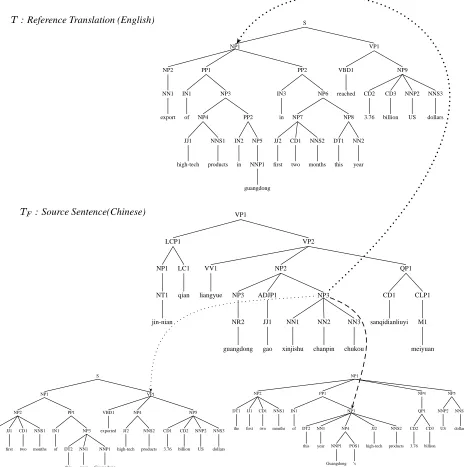
We start with an example of two competing English translations for a Chinese sentence (in Pinyin without tones), with their word-to-word alignments in Figure 1. The reference translation for the Chinese sentence with its word-to-word alignment is shown in Figure 2. In this section, we will show the computation of different loss functions for this example.
2.1 Lexical Loss Functions
The first class of loss functions uses no informa-tion about word alignments or parse-trees, so that
% can be reduced to(. We
consider three loss functions in this category: The BLEU score (Papineni et al., 2001), word-error rate, and the position-independent word-error rate (Och, 2002). An-other example of a loss function in this class is the MT-eval metric introduced in Melamed et al. (2003). A loss function of this type depends only on information from word strings.
BLEU score (Papineni et al., 2001) computes the
geometric mean of the precision of ) -grams of
vari-ous lengths ()+*-,/.10(0243 ) between a hypothesis and
a reference translation, and includes a brevity penalty (56879. ) if the hypothesis is shorter than the
refer-ence. We use2;:=< .
>
?@A
':CBDFE GIH
J
KMLONQPR#S
E
K
%
2 TVU 56
whereE
K
% is the precision of) -grams in the
hy-pothesis. The BLEU score is zero if any of the n-gram
precisionsE
K
is zero for that sentence pair. We
note that WX7
>
?@A 47Y. . We derive a loss
function from BLEU score as
BLEU(Z:X."[
>
Z@%.
Word Error Rate (WER) is the ratio of the string-edit distance between the reference and the hypothesis word strings to the number of words in the reference. String-edit distance is measured as the minimum number of String-edit operations needed to transform a word string to the other word string.
Position-independent Word Error Rate (PER)
mea-sures the minimum number of edit operations needed to transform a word string to any permutation of the other word string. The PER score (Och, 2002) is then computed as a ratio of this distance to the number of words in the reference word string.
2.2 Target Language Parse-Tree Loss Functions
The second class of translation loss functions uses infor-mation only from the parse-trees of the two translations,
so that %\:] . This loss
function has no access to any information from the source sentence or the word alignments.
Examples of such loss functions are tree-edit distances between parse-trees, string-edit distances between event representation of parse-trees (Tang et al., 2002), and tree-kernels (Collins and Duffy, 2002). The computation of tree-edit distance involves an unconstrained alignment of the two English parse-trees. We can simplify this prob-lem once we have a third parse tree (for the Chinese sen-tence) with node-to-node alignment relative to the two English trees. We will introduce such a loss function in the next section. We did not perform experiments involv-ing this class of loss functions, but mention them for com-pleteness in the hierarchy of loss functions.
2.3 Bilingual Parse-Tree Loss Functions
The third class of loss functions uses information from word strings, alignments and parse-trees in both lan-guages, and can be described by
^Z:_ `a`Ob &'.
E 2 2 A
1 A
the first two months of this year guangdong ’s high−tech products 3.76 billion US dollars
jin−nian qian liangyue guangdong gao xinjishu chanpin chukou sanqidianliuyi meiyuan
the first two months of this year guangdong exported high−tech products 3.76 billion US dollars
[image:3.612.114.505.24.102.2]F 1 E
Figure 1: Two competing English translations for a Chinese sentence with their word-to-word alignments.
A
E export of high−tech products in guangdong in first two months this year reached 3.76 billion US dollars
jin−nian qian liangyue guangdong gao xinjishu chanpin chukou sanqidianliuyi meiyuan
F
Figure 2: The reference translation for the Chinese sentence from Figure 1 with its word-to-word alignments. Words in the Chinese (English) sentence shown as unaligned are aligned to the NULL word in the English (Chinese) sentence.
We first assume that a node) in the source tree & can
be mapped to a node in (and a node in) using
word alignment (and respectively). We denote the
subtree of rooted at node by
and the subtree of
rooted at node by
. We will now describe a
simple procedure that makes use of the word alignment
to construct node-to-node alignment between nodes in
the source tree& and the target tree .
2.3.1 Alignment of Parse-Trees
For each node) in the source tree & we consider the
subtree
K rooted at
) . We first read off the source word
sequence corresponding to the leaves of
K . We next
con-sider the subset of words in the target sentence that are aligned to any word in this source word sequence, and select the leftmost and rightmost words from this sub-set. We locate the leaf nodes corresponding to these two
words in the target parse tree , and obtain their closest
common ancestor node * . This procedure gives us
a mapping from a node) * & to a node;* and this
mapping associates one subtree
K
* & to one subtree
* .
2.3.2 Loss Computation between Aligned
Parse-Trees
Given the subtree alignment between& and , and
& and , we first identify the subset of nodes in & for
which we can identify a corresponding node in both
and.
2& : ,#) * & : : 3/0
The Bilingual Parse-Tree (BiTree) Loss Function can then be computed as
BiTreeLoss
!"#$$%'& (*),+
-/.10 234"2"3
(1)
where 5
% is a distance measure between sub-trees
and
. Specific Bi-tree loss functions are determined
through particular choices of5 . In our experiments, we
used a 0/1 loss function between sub-trees
and
.
5
':76
.
:
W otherwise0
(2)
We note that other tree-to-tree distance measures can
also be used to compute 5 , e.g. the distance function
could compare if the subtrees
and
have the same
headword/non-terminal tag.
The Bitree loss function measures the distance be-tween two trees in terms of distances bebe-tween their cor-responding subtrees. In this way, we replace the
string-to-string (Levenshtein) alignments (for WER) or) -gram
matches (for BLEU/PER) with subtree-to-subtree align-ments.
The Bitree Error Rate (in %) is computed as a ratio of the Bi-tree Loss function to the number of nodes in the set
2& .
[image:3.612.103.506.130.201.2]: Reference Translation (English) S
NP1
NP2
NN1
export
PP1
IN1
of
NP3
NP4
JJ1
high-tech NNS1
products PP2
IN2
in NP5
NNP1
guangdong
PP2
IN3
in
NP6
NP7
JJ2
first CD1
two NNS2
months NP8
DT1
this NN2
year VP1
VBD1
reached
NP9
CD2
3.76 CD3
billion NNP2
US NNS3
dollars
`& : Source Sentence(Chinese) VP1
LCP1
NP1
NT1
jin-nian LC1
qian
VP2
VV1
liangyue
NP2
NP3
NR2
guangdong ADJP1
JJ1
gao
NP3
NN1
xinjishu NN2
chanpin NN3
chukou
QP1
CD1
sanqidianliuyi CLP1
M1
meiyuan
S
NP1
NP2
DT1
the JJ1
first CD1
two NNS1
months PP1
IN1
of NP3
DT2
this NN1
year NNP1
Guangdong
VP1
VBD1
exported NP4
JJ2
high-tech NNS2
products
NP5
CD1
3.76 CD2
billion NNP2
US NNS3
dollars
N : Hypothesis Translation 1 (English)
NP1
NP2
DT1
the JJ1
first CD1
two NNS1
months
PP1
IN1
of
NP3
DT2
this NN1
year NP4
NNP1
Guangdong POS1
’s JJ2
high-tech NNS2
products NP4
QP1
CD2
3.76 CD3
billion NP5
NNP2
US NNS3
dollars
[image:4.612.78.542.35.502.2]: Hypothesis Translation 2 (English)
Node # Node Node 23 "23 Node ,2"3 "2 3
VP1 S S 1 NP1 1
LCP NP6 NP1 1 NP1 1
NP1 NP8 NP3 1 NP3 1
NT1 NP8 NP3 1 NP3 1
jin-nian NP8 NP3 1 NP3 1
LC1 first NP1 1 NP2 1
qian first NP1 1 NP2 1
VP2 S S 1 NP1 1
VV NP7 NP2 1 NP2 1
liangyue NP7 NP2 1 NP2 1
NP2 S S 1 NP1 1
NP3 Guangdong Guangdong 0 NP4 1
NR2 Guangdong Guangdong 0 NP4 1
guangdong Guangdong Guangdong 0 NP4 1
ADJP1 reached high-tech 1 high-tech 1
JJ1 reached high-tech 1 high-tech 1
gao reached high-tech 1 high-tech 1
NP3 NP1 VP1 1 NP3 1
NN2 products products 0 products 0
chanpin products products 0 products 0
NN3 export exported 1 products 1
chukou export exported 1 products 1
QP1 NP9 NP5 0 NP1 1
CLP1 NP9 NP5 0 NP1 1
M1 NP9 NP5 0 NP1 1
meiyuan NP9 NP5 0 NP1 1
BiTree Loss Loss 17 Loss 24
[image:5.612.105.510.21.314.2]BiTree Error Rate (%) 17/26 = 65.4 24/26 = 92.3
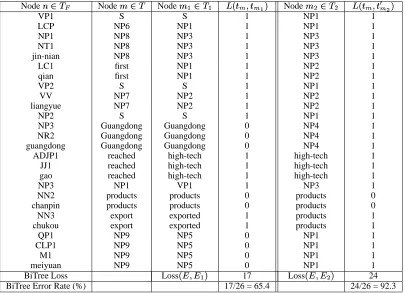
Table 1: Bi-Tree Loss Computation for the parse-trees shown in Figure 3. Each row shows a mapping between a node in the parse-tree of the Chinese sentence and the nodes in parse-trees of its reference translation, hypothesis translation 1 and hypothesis translation 2.
2.4 Comparison of Loss Functions
In Table 2 we compare various translation loss functions for the example from Figure 1. The two hypothesis trans-lations are very similar at the word level and therefore the BLEU score, PER and the WER are identical. However we observe that the sentences differ substantially in their syntactic structure (as seen from Parse-Trees in Figure 3), and to a lesser extent in their word-to-word alignments (Figure 1) to the source sentence. The first hypothesis
translation is parsed as a sentence 2 while
the second translation is parsed as a noun phrase. The Bi-tree loss function which depends both on the parse-Bi-trees and the word-to-word alignments, is therefore very differ-ent for the two translations (Table 2). While string based metrics such as BLEU, WER and PER are insensitive to the syntactic structure of the translations, BiTree Loss is able to measure this aspect of translation quality, and as-signs different scores to the two translations.
We provide this example to show how a loss function which makes use of syntactic structure from source and target parse trees, can capture properties of translations that string based loss functions are unable to measure.
Loss Functions
N
BLEU (%) 26.4 26.4
WER (%) 70.6 70.6
PER (%) 23.5 23.5
[image:5.612.314.520.375.439.2]BiTree Error Rate (%) 65.4 92.3
Table 2: Comparison of the different loss functions for hypothesis and reference translations from Figures 1, 2.
3
Minimum Bayes-Risk Decoding
Statistical Machine Translation (Brown et al., 1990) can
be formulated as a mapping of a word sequence in a
source language to word sequence in the target
lan-guage that has a word-to-word alignment relative to .
Given the source sentence , the MT decoder
pro-duces a target word string with word-to-word
align-ment. Relative to a reference translation with word
alignment , the decoder performance is measured as
. Our goal is to find the decoder that has
the best performance over all translations. This is mea-sured through Bayes-Risk :
?:="!$# $%&'%&)(+*
The expectation is taken under the true distribution
^ that describes translations of human quality.
Given a loss function and a distribution, it is well known that the decision rule that minimizes the Bayes-Risk is given by (Bickel and Doksum, 1977; Goel and Byrne, 2000):
Z:
%&
J
$%&
^
0
(3) We shall refer to the decoder given by this equation as the Minimum Bayes-Risk (MBR) decoder. The MBR decoder can be thought of as selecting a consensus
trans-lation: For each sentence , Equation 3 selects the
lation that is closest on an average to all the likely trans-lations and alignments. The closeness is measured under the loss function of interest.
This optimal decoder has the difficulties of search (minimization) and computing the expectation under the true distribution. In practice, we will consider the space
of translations to be an2 -best list of translation
alterna-tives generated under a baseline translation model. Of course, we do not have access to the true distribution over translations. We therefore use statistical transla-tion models (Och, 2002) to approximate the distributransla-tion
^.
Decoder Implementation: The MBR decoder
(Equa-tion 3) on the2 -best List is implemented as
%
) !"""
-$#
-&
%!&
%
%
('
%
%)*
and+*
*
% -,
.,
. This is a rescoring procedure that
searches for consensus under a given loss function. The
posterior probability of each hypothesis in the2 -best list
is derived from the joint probability assigned by the base-line translation model.
0//./#1':
0//./1
2
H3
LON
3
3
0 (4)
The conventional Maximum A Posteriori (MAP) coder can be derived as a special case of the MBR de-coder by considering a loss function that assigns a equal cost (say 1) to all misclassifications. Under the 0/1 loss function,
#
Z: 6
W ifX:C54 C:_
. otherwise,
(5) the decoder of Equation 3 reduces to the MAP decoder
MAPZ:6!578
#
%&
(
0 (6)
This illustrates why we are interested in MBR decoders based on other loss functions: the MAP decoder is opti-mal with respect to a loss function that is very harsh. It
does not distinguish between different types of translation errors and good translations receive the same penalty as poor translations.
4
Performance of MBR Decoders
We performed our experiments on the Large-Data Track of the NIST Chinese-to-English MT task (NIST, 2003). The goal of this task is the translation of news stories from Chinese to English. The test set has a total of 1791 sentences, consisting of 993 sentences from the NIST 2001 MT-eval set and 878 sentences from the NIST 2002 MT-eval set. Each Chinese sentence in this set has four reference translations.
4.1 Evaluation Metrics
The performance of the baseline and the MBR decoders under the different loss functions was measured with re-spect to the four reference translations provided for the
test set. Four evaluation metrics were used. These
were multi-reference Word Error Rate (mWER) (Och, 2002), multi-reference Position-independent word Error Rate (mPER) (Och, 2002) , BLEU and multi-reference BiTree Error Rate.
Among these evaluation metrics, the BLEU score directly takes into account multiple reference transla-tions (Papineni et al., 2001). In case of the other metrics, we consider multiple references in the following way. For each sentence, we compute the error rate of the hypothe-sis translation with respect to the most similar reference translation under the corresponding loss function.
4.2 Decoder Performance
In our experiments, a baseline translation model (JHU, 2003), trained on a Chinese-English parallel
cor-pus (NIST, 2003) (.:9MW5; English words and.<59;
Chi-nese words), was used to generate 1000-best translation hypotheses for each Chinese sentence in the test set. The 1000-best lists were then rescored using the different translation loss functions described in Section 2.
The English sentences in the2 -best lists were parsed
using the Collins parser (Collins, 1999), and the Chinese sentences were parsed using a Chinese parser provided to us by D. Bikel (Bikel and Chiang, 2000). The English parser was trained on the Penn Treebank and the Chinese parser on the Penn Chinese treebank.
does meet the customary criteria for minimum signifi-cance intervals of 68.3% (Press et al., 2002).
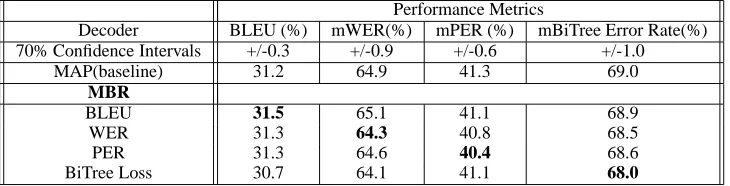
We observe in most cases that the MBR decoder under a loss function performs the best under the correspond-ing error metric i.e. matched conditions perform the best. The gains from MBR decoding under matched conditions are statistically significant in most cases. We note that the MAP decoder is not optimal in any of the cases. In partic-ular, the translation performance under the BLEU metric can be improved by using MBR relative to MAP decod-ing. This shows the value of finding decoding procedure matched to the performance criterion of interest.
We also notice some affinity among the loss functions. The MBR decoding under the Bitree Loss function per-forms better under the WER relative to the MAP decoder, but perform poorly under the BLEU metric. The MBR decoder under WER and PER perform better than the MAP decoder under all error metrics. The MBR decoder under BLEU loss function obtains a similar (or worse) performance relative to MAP decoder on all metrics other than BLEU.
5
Discussion
We have described the formulation of Minimum Bayes-Risk decoders for machine translation. This is a general framework that allows us to build special purpose de-coders from general purpose models. The procedure aims at direct minimization of the expected risk of translation errors under a given loss function. In this paper we have focused on two situations where this framework could be applied.
Given an MT evaluation metric of interest such as BLEU, PER or WER, we can use this metric as a loss function within the MBR framework to design decoders optimized for the evaluation criterion. In particular, the MBR decoding under the BLEU loss function can yield further improvements on top of MAP decoding.
Suppose we are interested in improving syntactic struc-ture of automatic translations and would like to use an existing statistical MT system that is trained without any linguistic features. We have shown in such a situation how MBR decoding can be applied to the MT system. This can be done by the design of translation loss func-tions from varied linguistic analyzes. We have shown the construction of a Bitree loss function to compare parse-trees of any two translations using alignments with re-spect to a parse-tree for the source sentence. The loss function therefore avoids the problem of unconstrained tree-to-tree alignment. Using an example, we have shown that this loss function can measure qualities of transla-tion that string (and ngram) based metrics cannot cap-ture. The MBR decoder under this loss function gives improvements under an evaluation metric based on the loss function.
We present results under the Bitree loss function as an example of incorporating linguistic information into a loss function; we have not yet measured its correla-tion with human assessments of translacorrela-tion quality. This loss function allows us to integrate syntactic structure into the statistical MT framework without building detailed models of syntactic features and retraining models from scratch. However, we emphasize that the MBR tech-niques do not preclude the construction of complex mod-els of syntactic structure. Translation modmod-els that have been trained with linguistic features could still benefit by the application of MBR decoding procedures.
That machine translation evaluation continues to be an active area of research is evident from recent work-shops (AMTA, 2003). We expect new automatic MT evaluation metrics to emerge frequently in the future. Given any translation metric, the MBR decoding frame-work will allow us to optimize existing MT systems for the new criterion. This is intended to compensate for any mismatch between decoding strategy of MT systems and their evaluation criteria. While we have focused on de-veloping MBR procedures for loss functions that mea-sure various aspects of translation quality, this frame-work can also be used with loss functions which measure application-specific error criteria.
We now describe related training and search proce-dures for NLP that explicitly take into consideration
task-specific performance metrics. Och (2003) developed a
training procedure that incorporates various MT evalua-tion criteria in the training procedure of log-linear MT models. Foster et al. (2002) developed a text-prediction system for translators that maximizes expected benefit to the translator under a statistical user model. In parsing, Goodman (1996) developed parsing algorithms that are appropriate for specific parsing metrics. There has also been recent work that combines 1-best hypotheses from multiple translation systems (Bangalore et al., 2002); this approach uses string-edit distance to align the hypotheses and rescores the resulting lattice with a language model.
In future work we plan to extend the search space of MBR decoders to translation lattices produced by the baseline system. Translation lattices (Ueffing et al., 2002; Kumar and Byrne, 2003) are a compact representation of a large set of most likely translations generated by an MT
system. While an2 -best list contains only a limited
re-ordering of hypotheses, a translation lattice will contain hypotheses with a vastly greater number of re-orderings. We are developing efficient lattice search procedures for MBR decoders. By extending the search space of the
de-coder to a much larger space than the2 -best list, we
ex-pect further performance improvements.
Performance Metrics
Decoder BLEU (%) mWER(%) mPER (%) mBiTree Error Rate(%) 70% Confidence Intervals +/-0.3 +/-0.9 +/-0.6 +/-1.0
MAP(baseline) 31.2 64.9 41.3 69.0
MBR
BLEU 31.5 65.1 41.1 68.9
WER 31.3 64.3 40.8 68.5
PER 31.3 64.6 40.4 68.6
[image:8.612.124.489.22.115.2]BiTree Loss 30.7 64.1 41.1 68.0
Table 3: Translation performance of the MBR decoder under various loss functions on the NIST 2001+2002 Test set. For each metric, the performance under a matched condition is shown in bold. Note that better results correspond to higher BLEU scores and to lower error rates.
by tuning them for particular criteria. These criteria could come from evaluation metrics or from other desiderata (such as syntactic well-formedness) that we wish to see in automatic translations.
Acknowledgments
This work was performed as part of the 2003 Johns Hop-kins Summer Workshop research group on Syntax for
Statistical Machine Translation. We would like to thank
all the group members for providing various resources and tools and contributing to useful discussions during the course of the workshop.
References
AMTA. 2003. Workshop on Machine
Translation Evaluation, MT Summit IX.
www.issco.unige.ch/projects/isle/MTE-at-MTS9.html.
S. Bangalore, V. Murdock, and G. Riccardi. 2002. Boot-strapping bilingual data using consensus translation for a multilingual instant messaging system. In
Proceed-ings of COLING, Taipei, Taiwan.
P. J. Bickel and K. A. Doksum. 1977. Mathematical
Statistics: Basic Ideas and Selected topics.
Holden-Day Inc., Oakland, CA, USA.
D. Bikel and D. Chiang. 2000. Two statistical pars-ing models applied to the chinese treebank. In
Pro-ceedings of the Second Chinese Language Processing Workshop, pages 1–6, Hong Kong.
P. F. Brown, J. Cocke, S. A. Della Pietra, V. J. Della Pietra, F. Jelinek, J. D. Lafferty, R. L. Mercer, and P. S. Roossin. 1990. A statistical approach to machine translation. Computational Linguistics, 16(2):79–85.
M. Collins and N. Duffy. 2002. New ranking algorithms for parsing and tagging: Kernels over discrete struc-tures, and the weighted perceptron. In Proceedings of
EMNLP, Philadelphia, PA, USA.
M. J. Collins. 1999. Head-driven Statistical Models for
Natural Language Parsing. Ph.D. thesis, University of
Pennsylvania, Philadelphia.
G. Doddington. 2002. Automatic evaluation of machine translation quality using n-gram co-occurrence statis-tics. In Proc. of HLT 2002, San Diego, CA. USA.
G. Foster, P. Langlais, and G. Lapalme. 2002.
User-friendly text prediction for translators. In Proc. of
EMNLP, Philadelphia, PA, USA.
V. Goel and W. Byrne. 2000. Minimum Bayes-risk auto-matic speech recognition. Computer Speech and
Lan-guage, 14(2):115–135.
J. Goodman. 1996. Parsing algorithms and metrics. In
Proc. of ACL-1996, pages 177–183, Santa Cruz, CA,
USA.
JHU. 2003. Syntax for statistical machine
translation, Final report, JHU summer workshop.
http://www.clsp.jhu.edu/ws2003/groups/translate/.
S. Kumar and W. Byrne. 2002. Minimum Bayes-Risk
alignment of bilingual texts. In Proc. of EMNLP,
Philadelphia, PA, USA.
S. Kumar and W. Byrne. 2003. A weighted finite state transducer implementation of the alignment template model for statistical machine translation. In
Proceed-ings of HLT-NAACL, Edmonton, Canada.
I. D. Melamed, R. Green, and J. P. Turian. 2003. Preci-sion and recall of machine translation. In Proceedings
of the HLT-NAACL, Edmonton, Canada.
NIST. 2003. The NIST Machine Translation Evalua-tions.http://www.nist.gov/speech/tests/mt/.
F. Och. 2002. Statistical Machine Translation: From
Single Word Models to Alignment Templates. Ph.D.
thesis, RWTH Aachen, Germany.
F. Och. 2003. Minimum error rate training in statistical machine translation. In Proc. of ACL, Sapporo, Japan.
K. Papineni, S. Roukos, T. Ward, and W. Zhu. 2001. Bleu: a method for automatic evaluation of machine translation. Technical Report RC22176 (W0109-022), IBM Research Division.
W. H. Press, S. A. Teukolsky, W. T. Vetterling, and B. P. Flannery. 2002. Numerical Recipes in C++. Cam-bridge University Press, CamCam-bridge, UK.
M. Tang, X. Luo, and S. Roukos. 2002. Active learning for statistical natural language parsing. In Proceedings
of ACL 2002, Philadelphia, PA, USA.
N. Ueffing, F. Och, and H. Ney. 2002. Generation of word graphs in statistical machine translation. In Proc.