feedback experience
NORTCLIFFE, Anne <http://orcid.org/0000-0001-6972-6051>
Available from Sheffield Hallam University Research Archive (SHURA) at: http://shura.shu.ac.uk/14431/
This document is the author deposited version. You are advised to consult the publisher's version if you wish to cite from it.
Published version
NORTCLIFFE, Anne (2015). Students and academic reflections of iPhone audio feedback experience. Student Engagement and Experience Journal, 4 (1).
Copyright and re-use policy
Case Study
Students and Academic reflections of iPhone Audio Feedback
Experience
Anne Nortcliffe1 (Sheffield Hallam University)
Copyright © 2015 Anne Nortcliffe. This is an open access journal article distributed under the Creative Commons Attribution License, which permits the unrestricted use, distribution, and reproduction in any medium, provided the original work is properly cited.
Abstract
Audio feedback for Engineering and Computing students has been produced for the last five academic years using an iPhone. The feedback has been applied to support their learning about the professional experience and employability. The benefits of audio feedback have been widely reported by the author and other academic practitioners, however its distribution can be problematic. This case study highlights how iPhone audio feedback production and distribution can be simplified to provide improved and effective high quality feedback to benefit both students and their tutors. iPhone audio feedback was provided to 130+ students in the 2010-211, and 200+ in 2011-2012. This study draws upon the reflections of the two student cohorts between 2010 and 2012 and considers the potential of the approach for feeding forward into the ongoing learning of students.
1 Corresponding author email address: [email protected]
Nortcliffe, A. (2015). Students and Academic reflections of iPhone Audio Feedback Experience. Student Engagement and Experience Journal, 4 (1): http://dx.doi.org/10.7190/seej.v4i1.116
Introduction
Rotheram (2010) argued that audio feedback is an effective way to provide high quality
feedback to students quickly as 500 words of feedback can take 30 minutes to write, but
only 5 minutes to audio record. Ice et al. (2007) found that students perceive audio
feedback to be more personal, that it enhances the student and academic relationship,
and improves student engagement with their feedback. However, distributing audio files
from an MP3 recorder can be tedious and time consuming (Nortcliffe & Middleton,
2009). For a large cohort of 200+ students, distributing this amount of files through the
institutional virtual learning environment (VLE), Blackboard, during the height of the
semester can take more than 10 hours. This study reports how using an audio recorder
app with integrated email functionality on the academic's iPhone reduces this to less
than 1 ¾ hours to distribute. Using this method 215 personal audio feedback files were
distributed directly to student email accounts, thereby removing the need for them to
login into another application to access and download the file. Increasingly students can
access and play the feedback file on their personal smart devices, enabling them to
listen to it anytime and anywhere, providing the device has been configured to access
their university email account through the mail app.
The personal nature of the feedback and its rapid turnaround remain as key benefits of
audio feedback. In this case study, however, students reported that the audio feedback
was more accessible to them and improved their initial understanding of it, which was
multiplied by its long term availability and their subsequent reuse of it.
Audio feedback innovative method
The Aims
This study evaluated the innovative practice of using the academic's personal
technology, an Apple iPhone, to enhance the experience of making, distributing and
using audio feedback given by an academic in response to student assignments. The aim
of this feedback method was to:
Make sure that high quality feedback for the large cohorts could be turned around in a timely fashion, responding to the guidance of Gibbs and Simpson (2004) that timeliness is a key component in supporting student learning;
Enable the academic to generate high quality individual feedback so that it can be distributed to students without creating a burden for either the academic or the student recipients;
Provide feedback that is accessible and personal enabling the student to extend their interaction with the feedback to inform their ongoing personal development;
Support the authentic learning experience designed into the assessment intended to develop student communication;
Develop digital smart device 'literacy' for both staff and students by harnessing smart technology;
Provide feedback to students in an accessible format that gives them control of their learning and allows them to apply the feedback to enhance their engagement and attainment.
The role and management of feedback on the student assignment
The assessment is a mock employability application. The assignment is first marked by
student peers using an established peer assessment method (Orsmond, 2011), to provide
immediate self-reflective feedback and moderated by the module tutor over a 7-9 day
period. The tutor essentially finalises the summative feedback and the grade of the
work. The short turnaround is required due to the students’ need to apply their feedback
on their employability assignment to the completion of their current and real placement
applications, therefore the students are utilising the feedback formatively. The module
leader has the greater number of tutorial groups to support, amounting to 150 students in
2010-2011, and 215 in 2011-2012. The other tutors have only one or two tutorial groups
each, providing feedback back to approximately 40 students in each case. As the
number of scripts per tutor is smaller, these tutors are able to provide written feedback
within the short feedback time framework. This turnaround time was not possible for
the module leader and a solution involving the use of learning technology was needed to
achieve the same time scales in order to provide high quality feedback.
In the past the module tutor has used a method involving MP3 audio recording devices
(Nortcliffe & Middleton, 2009), however the process of distributing 200 audio files
from a MP3 recorder into Blackboard is time-consuming and a painful process for
distributing the audio feedback files via the VLE has simplified the process, it still takes
1.5 minutes on the University network or 2.5 minutes on a home network to locate and
upload each audio file. To distribute 215 audio files would therefore take ~10hrs on a
home network; time that could be spent on giving feedback.
Using the method outlined below, producing iPhone audio feedback takes 10 minutes
for each student submission including reading the submission, recording feedback on it
and sending the feedback directly to the student. The average duration of the feedback
was four minutes and the distribution of the feedback took half a minute per student. In
all, it took a total of 1 3/4 hrs to distribute all 215 audio files.
The feedback is output as an electronic feedback file that can be stored easily. It is
designed to be used by the students, not just for their placement applications, but also
for their final year graduate applications and beyond in the future.
Audio feedback approach
The iPhone audio feedback approach adopted a Bring Your Own Device (BYOD)
philosophy and made use of my personal iPhone and with the Recorder Pro app
(Perception System website). The app has been identified as the most suitable audio
recording app for giving audio feedback in previous work (Nortcliffe et al., 2011). Its
advantage is that it can be linked to the tutor's university email account allowing each
audio file to be directly emailed to each student as It is recorded.
A standard message was pasted into each email explaining how to access and use the
attached audio feedback file. With the aid of the timetable class list for each tutorial
group available via the timetable system, which supplies the student name and the
student number, it is possible to easily construct each student's email address from their
student number. For example, if the student number is 26005471, the student email
address is [email protected].
Evaluation Method
The audio feedback approach was evaluated by surveying the students who had
received either the tutor moderated written feedback or the tutor moderated audio
year during 2010-2011 three months after receiving their feedback. 198 students
responded to the survey of which 106 were recipients of the audio feedback.
The survey was used again in 2011-2012, but this time was distributed electronically
and deployed to all level 5, placement and level 6 students, ~1176 in total, via the VLE.
The second survey aimed to find out if the feedback continued to be useful beyond the
initial purpose of supporting the students' placement applications. Only 97 students
responded, of which 43 had received audio feedback. Each survey was followed up with
semi-structured interviews (Cohen et al., 2000) involving the voluntary co-operation of
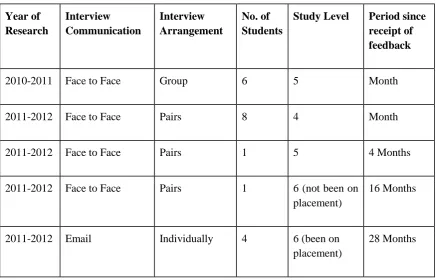
participants (Hague, 1993). The interview arrangements and types of interviews,
volunteers study details and the length of time since they had received the employability
[image:6.595.80.517.345.625.2]audio feedback at the point of the interview is shown in Table 1.
Table 1: Interview details
Year of Research
Interview Communication
Interview Arrangement
No. of Students
Study Level Period since receipt of feedback
2010-2011 Face to Face Group 6 5 Month
2011-2012 Face to Face Pairs 8 4 Month
2011-2012 Face to Face Pairs 1 5 4 Months
2011-2012 Face to Face Pairs 1 6 (not been on placement)
16 Months
2011-2012 Email Individually 4 6 (been on placement)
28 Months
Results
Academic Perspective
From the tutor perspective, the iPhone audio feedback approach enabled the provision
of constructive, qualitative, and timely feedback in a 9 day turnaround to a large number
minutes and a maximum 8.5 minutes. By using the auto-pause function on the Recorder
Pro app which responds to silence, it typically took 10 minutes to read the student
submission and give feedback on it.
The distribution of feedback was speeded up considerably, reducing the time it had
taken to give written feedback from 9 hours to less than 2 hours using the audio method.
By significantly reducing the time it takes to produce the feedback the academic was
able to stay attentive and engaged in the task of producing personal feedback for longer.
Only one or two students did not receive their feedback due to their email accounts
being full or temporarily withdrawn by the University.
Student Perspective
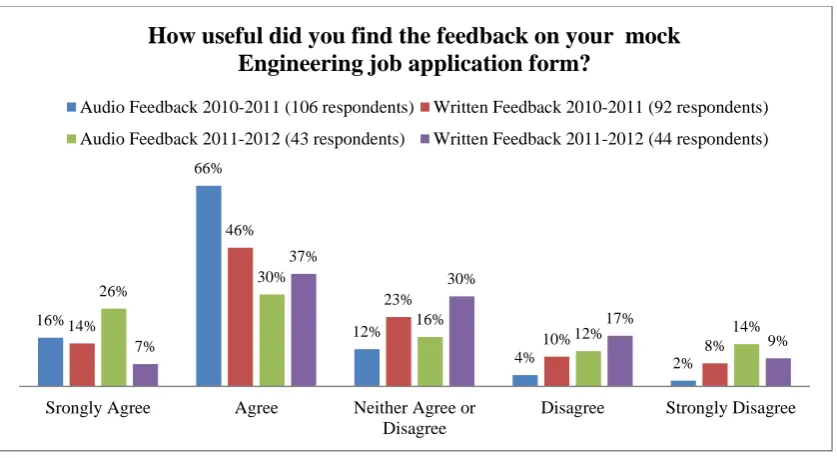
Analysis of the student survey responses on the usefulness of the moderated feedback
(Figure 1) revealed that the recipients of the audio feedback found it was more useful
than the written feedback. The further analysis and codification of the student survey
responses to the open questions on the clarification of the usefulness of personal audio
and written feedback (Figure 2) indicated that student's perception of written feedback
is much narrower than audio feedback. Audio feedback is perceived to be more useful
in terms of content, accessibility and applicability, as well as being more personal,
whereas the written feedback was perceived to only be useful in terms of content and
Figure 1: Student response to how useful they found the feedback they received
Figure 2: Categorisation of student open responses to how useful the students perceive the feedback was to them
The student data also revealed that the students who received audio feedback re-used
the feedback more than those who received written feedback (Table 2).
16%
66%
12%
4% 2%
14%
46%
23%
10% 8%
26% 30%
16%
12% 14%
7%
37%
30%
17%
9%
Srongly Agree Agree Neither Agree or
Disagree
Disagree Strongly Disagree
How useful did you find the feedback on your mock Engineering job application form?
Audio Feedback 2010-2011 (106 respondents) Written Feedback 2010-2011 (92 respondents)
Audio Feedback 2011-2012 (43 respondents) Written Feedback 2011-2012 (44 respondents)
0 5 10 15 20 25 30 35 40 45 50
Students' open responses to the usefulness of the feedback
2010-2011 Audio Feedback N=76 out of 106 open question respondents
2010-2011 Written Feedback N=55 out of 92 open question respondents
2011-2012 Audio Feedback N=17 out of 22 open questions respondents
[image:8.595.83.512.378.623.2]Table 2: Number of times students accessed the moderated personal tutor feedback
Feedback Type No. Times Accessed
2010-2011 2011-2012
Audio Feedback 2.7 3.5
Written Feedback 1.8 2.3
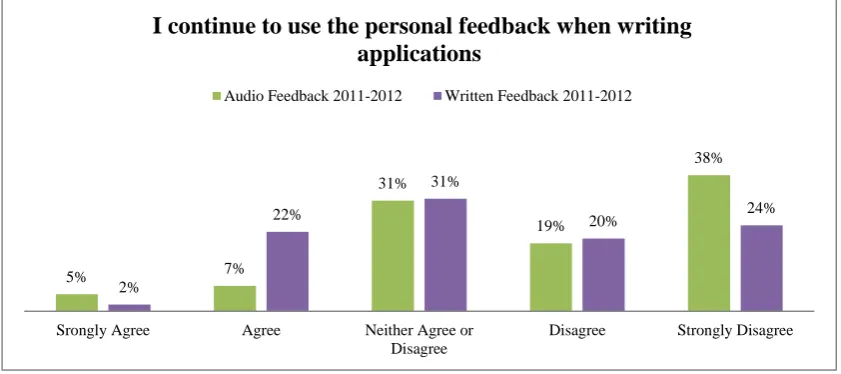
However, the 2011-2012 survey results indicate that neither type of feedback is
accessed again to any significant extent after its initial use to support placement
preparation (Figure 3).
Figure 3: Re-access the feedback post placement preparation assessment
Analysis of semi-structured interviews in 2010-2011 revealed that the students accessed
the audio feedback more often than written feedback and stated that audio feedback was
more useful and understandable in terms of content, as it felt more personal, easier to
access, use, and store. For example:
“I found it more useful than written feedback ...read through what you've written down without... crazy red markings... from some tutors” Student A
"It's there and it's clear. And you know exactly what is trying to be said." Student B
5% 7%
31%
19%
38%
2%
22%
31%
20% 24%
Srongly Agree Agree Neither Agree or
Disagree
Disagree Strongly Disagree I continue to use the personal feedback when writing
applications
[image:9.595.120.541.375.562.2]“...when [my tutor] is speaking it out loud they're communicating it a lot clearer.” Student C
"It's readily available as well... [When] you're doing application forms and you become stuck or something you can click it on in the background instead.” Student D
“It's easier to save audio feedback in a file, whereas a bit of paper - you might file it away and not ...find it again." Student E
The student interviews from 2011-2012 contradicted the survey results. The respondents
indicated that the audio feedback was useful beyond its initial purpose of supporting
placement preparation.
“It sinks in more if it is said to you... can’t skim through it you have to listen to it.” Student F
“I thought it was good getting audio feedback because if it is wrote down people just scan it, then you don’t read through it.” Student G
“I bore it mind [audio feedback] when I changed my covering letters.” Student H
“I listened to it a couple of times to improve my CV for the Bentley placement application.” Student I
“It was nice to have the [audio] feedback. The peer feedback was quite harsh…constructively it pointed out the flaws… the audio feedback did talk you through a little bit what you did wrong and how you could improve it.” Student J.
However, the 2011-2012 level 6 student email reflections indicate how their reuse of the
feedback over time was mixed with many students having forgot that they could revisit
feedback from earlier years.
"I did use it recently as it helped with a recent application form.’ Student K
"No, I haven't used the audio feedback from the mock application. I'm afraid that I had simply forgotten about it.” Student L.
Some practical issues were evident in comments:
"[I] prefer written feedback over audio as it's just easier and saves getting out headphones etc. whilst at university" Student M.
approach.
Conclusion
In conclusion, students value the audio feedback in terms of its content. They also find
it easier to access and more personal which is consistent with previous audio feedback
research (Blackburn et al., 2013). In this application of the audio feedback it not only
supported the student learning, but also their current personal development needs. The
iPhone method of audio feedback generation and distribution, incorporating the
integrated to the email application, sped up the process considerably. It reduced the time
needed from 9 hours to less than 2 hours which freed up more time to give the higher
quality feedback associated with using audio (Rotheram, 2010).
Audio feedback is more efficient in comparison to other methods, for example; written
feedback (Lunt and Curran (2010) and the smartphone audio feedback approach has
further simplified the production and distribution of audio feedback to students
(Nortcliffe & Middleton, 2011). In the case described in this study the method has
enabled the academic the return high quality assessment feedback quickly and
efficiently to large number of students.
However, iPhone audio feedback is not for all academics and not valued by all students.
The approach has potential for promoting long term access, but reuse of the audio
feedback by the students in the long term, as with any feedback, is dependent on the
students remembering they have the feedback and where they have filed it.
Future Developments
The method will be improved in the future by reminding students to create logical filing
systems for storing their e-feedback so that feedback can be found easily in the future.
Final year students need to be reminded about the relevant feedback they have received
in earlier years to support their employability and should be encouraged to re-use it by
applying it to their graduate applications.
Currently the tutor, a module leader, is working with those immediate colleagues who
possess a smart device or have been provided with an iPad Mini to adopt and apply and
have smart devices to store and access their recordings on their devices and to access
the recordings again later to support their development. The potential of the approach is
confirmed by the following unsolicited message from a Level 6 student:
“I still have [the audio feedback] on my computer and my iPhone. I listen to it now again... last week when I was preparing for an interview I actually played it...[at the interview].” Student N.
The audio feedback supplied to the student during the previous academic year and
stored on his phone enabled him to prepare for the interview, demonstrating the
ubiquitous and pervasive nature of the iPhone audio feedback approach.
Recommendations
Recommendations for others who may be considering a similar approach:
Ensure that when students submit their work they provide their email address for
its return;
Find a working space where you will not be disturbed when producing the audio
feedback;
State at the beginning of the recording who the feedback is intended for;
Provide constructive feedback by referring to evidence in their submission to
highlight how they can improve as well as noting what they got right;
Summarise your final thoughts, ideally keeping within five minutes per recording;
Provide guidance to students on how they can use the feedback they receive to
improve future work;
Provide guidance on which software applications on a PC will play the audio file
format (e.g. aifc format will typically play in QuickTime, latest RealPlayer,
iTunes, iPhones, and some Android phones);
If emailing the feedback use a standard message to indicate that there is an
attachment and the name of the assessment to which the feedback relates;
Grades still need to be communicated via the VLE so that they can be found
References
Blackburn, M., Stroud J., & Taylor, C. (2013). Designing audio feedback for students
with different and defined educational backgrounds and experiences. Journal
Advances in Higher Education. 5(1) pp.143-157.
Cohen, L., Manion, L., & Morrison, K. (2000). Research methods in education, 5th
edition. Routledge and Falmer, London and New York.
Hague, P. (1993). Interviewing. Kogan Page, London.
Gibbs, G. & Simpson, C. (2004). Conditions under which assessment supports students’
learning, Learning and Teaching in Higher Education, 1, 2004-05, pp. 3–31.
Available online at:
http://www2.derby.ac.uk/lta-new/images/Documents/Assessment_for_learning/lathe_article_2004.pdf
(accessed 18 May 2015).
Ice, P., Curtis, R., Phillips, P. & Wells, J. (2007). Using asynchronous audio feedback
to enhance teaching presence and students' sense of community. Journal of
Asynchronous Learning Networks, 11(2): pp. 3-25.
Lunt, T., & Curran, J. (2010). 'Are you listening please?' The advantages of electronic audio feedback compared to written feedback. Assessment & Evaluation in Higher Education, 35(7), pp. 759-769.
Nortcliffe, A. L. & Middleton, A. (2009). Understanding effective models of audio
feedback. In: Rajarshi Roy (ed.) Engineering education perspectives, issues and
concerns. Shipra Publications, India.
Nortcliffe, A., & Middleton, A. (2011). Smartphone feedback: Using an iPhone to improve the distribution of audio feedback. International Journal of Electrical Engineering Education, 48(3), pp. 280-293.
Orsmond, P. (2011). Self- and peer-assessment: guidance in practice in the Biosciences.
UK Centre for Bioscience, Leeds: The Higher Education Academy.
Perception System website (2015).
Available online at http://www.recorderpro.perceptionsystem.com/ (accessed 02
June 2015).
Rotheram, B. (2010). "Sounds good: Quicker, better assessment using audio feedback?"
Presented at Assessment SIG: Working with students to enhance feedback, The