Study 2
Learning together: student and staff
experience of interprofessional
groups
Interprofessional Learning Research Programme:
Pre-qualifying curriculum evaluation
Centre for Learning and Workforce Research
in Health and Social Care
Acknowledgements
This research would not have been possible without the support of colleagues
throughout the Faculty. We are particularly grateful to the students and facilitators from
the study groups who allowed colleagues to observe their interprofessional module
sessions and gave up their time to be interviewed. In addition, colleagues took on the
role of researcher (see page 5) and contributed to collecting the data analysed here.
The module leaders, Gill Barrett and Rosemary Greenwood, were unfailingly
supportive of the research, and drew on research data alongside student and module
team experiences to make changes to improve the quality of learning experiences in
the modules.
We would also like to thank administrative colleagues for their support with the
research and with data transcription. Colleagues from the research office and from
schools offices have helped at various times. We are particularly grateful to Deb Joy
and Caroline Lapthorn for the quality and range of their support.
The evaluation of the interprofessional curriculum is supported by a steering group.
The quality of discussion at steering group meetings has significantly enhanced the
quality of the research. Our thanks to Professor David James, Professor Steve Onyett,
Julie Thomas, Professor Robin Means, Professor Kath Ross and Dr Kevin Foreman
for their interest and support.
Note on developments in interprofessional modules
Note on further planned research reports
The authors are preparing a further report on student learning about interprofessional
learning and working, based on an analysis of student assignments and student
interview data. In addition they are analysing data related to student learning in
interprofessional groups on line.
Dr Margaret Miers
Dr Brenda Clarke
Kathy Pollard
Judith Thomas
February 2005
Contents
Executive Summary
6
Introduction
8
Methodology
9
Group interaction
12
Group composition
12
Physical and social environment
13
Participation
14
Effects of ethnicity, gender, age and experience on group participation
16
Chairing
27
Group task/communication around feedback
30
Conflict and cohesion
32
Interprofessional issues
33
Experience and skills
35
Knowledge about professions
37
Relevance to practice
40
Interprofessional working
41
Learning about interprofessional issues
42
Student learning
43
Enquiry based learning
43
Learning outcomes
45
Assessment
46
Learning through feedback and discussion
47
Facilitation
48
Styles of facilitation
48
Moving from reporting to discussion
50
Developing group process
52
Subject knowledge
52
Selection and support of facilitators
53
Conclusion
54
Suggested recommendations
57
Executive Summary
• 15 student groups taking interprofessional modules 1 or 2 were studied as part of the evaluation of the interprofessional pre-qualifying curriculum. Researchers collected data through observations, interviews and focus groups.
• The study of group interaction showed that gender, age and ethnicity could affect patterns of participation in groups. Overall mature students played a more active role in the observed groups than younger students.
• Students’ comments about the difficulties of chairing discussions in interprofessional groups illuminate the complexity of the skills involved.
• Students’ views about the professional composition of the learning groups varied considerably.
• Students felt more able to understand interprofessional issues in module 2 because of their practice experience in their first year of study.
• Learning about interprofessional issues included awareness of systems and structures that facilitate or impede interprofessional working and an understanding of elements involved in effective interprofessional working, including increased confidence and communication and interpersonal skills. Some students linked learning about and experiencing group processes to their future ability to work in interprofessional teams
• In module 1 students expressed widespread uncertainty about the enquiry based learning process. By the second year, students were much more comfortable with, and positive about, the approach.
• Staff offer students a variety of facilitation styles. In general, students appreciated some active support from facilitators, at least in the initial stages.
• Facilitators’ experience in group work and in thinking about group process had a positive influence on student experience. Students’ awareness of others’ needs had a positive effect on group process.
• Positive outcomes included: cohesion of group; participants’ enjoyment; learning about self in group situations; communication confidence; increased awareness of need for interprofessional working; increased ability to recognise issues related to
Introduction
The Faculty of Health and Social Care introduced a pre-qualifying interprofessional curriculum for all ten of its professional programmes in September 2000. A research programme
evaluating the curriculum (with a focus on the interprofessional modules) began in September 2001, involving two cohorts of students (September 2001 intake and January 2002 intake). One study in the research programme (study 2) explores the student experience of learning in interprofessional groups. This report describes key findings from a major part of this study concerned with student learning in face-to-face groups. (Data from the study of student learning in on-line groups will be reported separately).
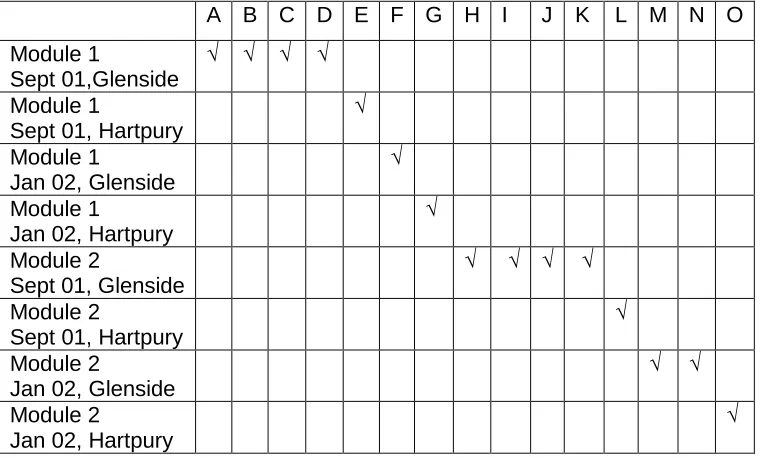
The research team gathered data from 15 face-to-face groups learning together. Seven groups studying module 1 (5 from the September 01 cohort and 2 from January 02 cohort) and 8 groups studying module 2 (5 from September 01 and 3 from January 02) were included in the research. In this report, Module 1 groups are identified by letters A - G, and Module 2 groups by letters H – 0. The 15 research groups include four based at Hartpury (one from each year and from each cohort), and eleven based at Glenside (see Table 1). At Hartpury, all the September 01 module 2 group (L) had been together for the first module (in group E). All the other module 2 groups had members who had been in a module 1 research group as well as members who were new to the research.
A B C D E F G H I J K L M N O Module 1
Sept 01,Glenside Module 1
Sept 01, Hartpury Module 1
Jan 02, Glenside Module 1
Jan 02, Hartpury Module 2
Sept 01, Glenside Module 2
Sept 01, Hartpury Module 2
Jan 02, Glenside Module 2
[image:9.595.66.446.470.699.2]Jan 02, Hartpury
Table 1: Student groups involved in the study of student learning in face-to-face
The research team was led by Dr Brenda Clarke, supported by Kathy Pollard, Dr Margaret Miers and Judith Thomas, who collected data and shared responsibility for data analysis across groups, and by Ros Johnson, Lorna Singer, Mark Dando, Matthew Hughes and Gill Mowforth, who participated in data collection in year 2. All the researchers and all facilitators involved in the study have commented on drafts of this report. Thematic reports on group interaction, interprofessional learning and working, student learning and facilitation have formed the basis of this report. Margaret Miers compiled the report.
The research team sought ethical approval for the study of student learning in face-to-face groups from the Faculty and University ethics committees in September 2001. The recruitment process began with the research team providing facilitators with information about the study and asking facilitators whether they would be willing for their groups to be approached with a view to participating in the research. Students were introduced to the research programme as part of the module induction and then each group involved in the qualitative research of student learning in groups was approached by a researcher during the first session of the interprofessional module. Students and facilitators were given verbal and written information detailing the study and the opportunity to ask questions before deciding whether to consent to participate in the study. All members of the face to face groups had to consent for the group to be included in the research.
Methodology
The overall research programme adopts the principles of realistic evaluation (Pawson and Tilley 1997), an approach which draws on realism’s generative approach to causation. In realism causation is seen as acting internally as well as externally. Interventions (such as interprofessional learning opportunities) have transformative potential within certain contexts (or social structures). The effect of an intervention depends on context and hence the context of an intervention must also be an object of study. Realist explanation, therefore, is based on the proposition that causal outcomes follow from mechanisms acting in contexts. A realist approach to evaluation has to study mechanisms, contexts and outcomes. The realist evaluation cycle involves framing theories which identify and explain regularities, deriving hypotheses concerning what might work for whom in what circumstances, testing these through multi method data collection and analysis, which can then inform further
whom in what circumstances. This report, however, draws from data from all 15 groups to explore the main themes. Not all the groups will be able to be used in a case study analysis as data sets are incomplete. Table 2 indicates the range of data sources available for each group. Case studies will be examined in a later paper. This report draws from all data sources apart from student assignments which have not yet been analysed.
A B C D E F G H I J K L M N 0
Observations - notes
-Student interviews
3 3 4 2 2 3 2 1 notes 3 5 3 2 - 3
Facilitator interview
notes
-Focus group notes Notes notes Questionnaires
Assignments 2 4 2 4 6 1 2 3 6 2 4 4 2 3 3 Module
evaluations
- - -
-Table 2: Range of data sources available for each group
The aim was to collect data as follows:
Observations: Researchers observed each group on two separate occasions
Interviews: Interviews with 1-4 students from each group, 33 student interviewees in total; some students were interviewed about their experiences of research groups in year 1 and in year 2. Some students were interviewed again as a follow-up interview after the module to capture their experiences of placement in years 1 and 2. In addition the researcher’s summary for group I includes short notes from discussions with 3 students. Facilitators were interviewed after the module ended. Most interviews were recorded and transcribed either by the
Focus group with students: A focus group was held in the last session of the module. All focus groups were recorded and most were transcribed in full.
Questionnaire data: The majority of students completed the UWE Interprofessional
Questionnaire (the data collection tool for study 1 in the research programme) during induction week. Group data for each group was available at time of analysis.
In addition, on completion of their professional programme, all students in the two research cohorts were asked if they would be willing to participate in a study of their interprofessional learning through analysing assignments completed for the interprofessional modules. It is the intention of the research team to include analysis of assignments completed by students in the research groups as part of the analysis of case study data.
Analysis
The core group of researchers (BC, JT, KP, MM) developed a framework for analysis after thematic analysis of data collected from the September 01 module 1 groups. Four main themes were identified: group interaction; interprofessional learning and relationships; student learning; and facilitation. A set of sub themes under each broad area were identified and the themes and sub themes provided the framework for analysis of data from later research groups. The researchers worked in pairs and as a group to check data interpretation across themes and sub themes. Subsequently each researcher responsible for data collection for a group prepared a two page summary of the findings which was sent to all participants, inviting comments and offering the opportunity to discuss and review the accuracy and
appropriateness of the summary. In addition the researchers discussed the findings with facilitators in a group meeting. Data from Study 1 (the longitudinal study of student attitudes and assessment of communication skills), analysed after completion of the second year module, sensitised the research team to the possible influence of age and experience on student learning in interprofessional groups. The four main themes were reviewed, discussed and elaborated by the core research group after separately and collectively reviewing the data from all 15 groups. The four themes structure this report.
In the report, students are referred to by their group number and their profession. Abbreviations used for the professions are as follows:
Adult Nursing AN Midwifery MW
Diagnostic Imaging DI Physiotherapy PT Learning Disabilities Nursing LD Radiotherapy RT Mental Health Nursing MH Social Work SW
Where more than one student from the same profession has been interviewed from one group, students are referred to by number, for example, AN1, AN2.
Group interaction
Group composition
The Glenside groups ranged in size from 9-18 students and Hartpury groups from 10-18. Whereas January cohort Hartpury groups are in fact uniprofessional groups (adult nursing) and the September Hartpury groups only include two professional groups (adult and mental health nursing), Glenside groups comprised five or six professions in the September groups and four in the January cohorts. The professional range may not, however, be reflected in attendance or participation, nor, therefore, in individuals’ perception of the group composition. All professional groups were represented in the research groups with the exception of
midwifery students. (Midwifery students are included in the on-line interprofessional module 3 research groups). One module 1 group included Health Science students, but no Health Science students were interviewed.
Most of the groups included a wide age range (18-40+ years). The January 02 Glenside groups included occupational therapy students and social work students studying part-time, and hence included more mature students than most other groups. In one IP2 January group the majority of the students were mature but in other groups there were only one or two students over 30.
Physical and social environment
The potential for the physical environment to affect the groups was illustrated by the fact that one group changed rooms after the first week, as students felt the room was inappropriate for group work. The shape and size of the room could dictate the seating arrangements and the seating layout could influence pairings and formation of sub groups. In one group seating arrangements and room shape appeared to support patterns of dominance. Students spoke about those sitting at the ’top’ or ‘strong’ end of the room. In this group two students told the group they had conducted an experiment on the seating arrangements, by positioning themselves in different places one week and observing the effect on interaction. This revelation was perceived negatively by their colleagues. In many groups, however,
researchers observed students from same profession, older students, students from minority ethnic groups sitting together. The effect of seating arrangements on communication within the groups was only rarely discussed within the groups, or in interviews. Facilitators usually tried to organise a circle of seats, (if they altered the environment). Not all student found this comfortable. One noted in interview
I think the fact that you’re in a circle is terrible. I think it would be much better to be sitting around a table, so that people who might feel exposed feel that they’ve got some sort of psychological protection. You need something there that people can get behind if they want to. (C, AN1, IP1)
Groups that are large appear to struggle to provide a comfortable social environment for participants. In one group of 18 students a student commented the room was too small and the facilitator found the size of the group difficult. In the other group of 18 one student noted
I know two adult nurses that will not say a word in the big group that we’ve been working in. It makes them very nervous, very uncomfortable. (E, AN2, IP1)
A strategy designed to enhance the safety of the social environment is the use of ground rules. Most groups drew up ground rules at the beginning of a module but the ground rules were rarely displayed at student initiative, nor mentioned or applied during the module, even when ground rules were transgressed. The exception was group H, in which the researcher notes group rules were developed and largely appeared to be active and referred to at the
In two groups the provision of facilities for coffee making supported the social environment. In one group it was the students who organised the provisions and the sharing of responsibility enhanced the positive feelings within and about the group. In the other group the facilitator organised the provision of drinks, which was seen as supportive, however the group experienced difficulties in group dynamics and was not necessarily experienced as a ’safe’ environment.
Participation
Not all students attended the module sessions and levels of participation vary. There is no evidence in any of the group data that students were able to challenge those who did not attend. One student explained his own non attendance at some sessions.
Half-eight in the morning maybe was the second reason. The main reason was, I’d be lying in bed at 7.30 thinking that I’d got to go and sit in a room for two hours and talk about something that I hadn’t really understood; and I wasn’t going to get told off if I didn’t go. I think maybe it was just me being new to student-centred learning, the idea behind university. So I just thought if I didn’t go, nothing was going to happen, and I didn’t really look towards my logs, having to write three logs and an essay. (C, DI1, IP1)
Some students participated very little, which caused frustration and some resentment from other students who put a lot of effort into their work for the group. Group C’s focus group explores the complexity of feelings about participation.
Well some people haven’t really researched a great deal and others have come back with a hell of a lot of information and have obviously put more effort into it. Not like saying with animosity or anything, because its down to the individual really, but, I think some people have put a lot more effort in than others and have made the effort to…….. I mean …….some people have made the effort to turn up, like every week, and others have just sort of…. if they felt like it, I don’t know the situations though. (C, focus group, IP1)
That’s really annoying because they used to say things like, ‘we’re not going to try that hard’ if everybody else was doing the same, well you know. (C, focus group, IP1)
Yes because you do feel a bit like if you put a lot of effort into something and you’re working really hard towards something and others are not. (C, focus group, IP1)
Students certainly recognised that patterns of dominance could influence patterns of
students who ‘can’t be bothered to make the effort’ and a quiet student reporting she had tried to join a debate but couldn’t because it was dominated by the 3 most ‘outspoken’ group members. . In group J one student in the focus group volunteered I don’t like talking in a
group, no matter how good the group is. In group F, one student interviewed took a silent role
but reported she felt quite intimidated by dominant students and in addition was too unsure of her skills to take a role in the group such as scribe. She was self conscious and embarrassed about writing things up and worried about getting the spelling right and capturing what others mean.
Both silent and talkative students felt pressurised by the obligation to communicate in the group. During the focus group, one student in group M, in which there was good participation, compared the experience favourably with experience of a level 1 group in which she felt pressurised.
Because there was only a couple of us that ever said anything and everyone else, it was, put pressure on people that did speak whereas I think here everybody has interacted a lot more. (M, focus group, IP2)
In group M one student said very little and the facilitator brought this to the attention of the student and the group. The lack of participation was understood sympathetically.
She’s just a very, very shy person and gets very embarrassed at having to speak to more than maybe just a couple of us. (M, OT1, IP2)
Overall, students were alert to different reasons for non participation. One student in group J noted that some people are scared to look foolish and some didn’t seem to have anything to say.
In group H the facilitator had to work very hard to ensure the group was a positive experience for the participants. The researcher saw the facilitator as compensating for a significant number who had little commitment to the module (including 5 students who were referred in the module) and didn’t want to be there.
facilitated group building exercises in the form of name games and evaluation discussions. (H, IP2, researcher’s notes)
This proactive approach, including encouraging working in small groups had a positive effect on student experience. An interviewee reports
I think it’s boosted everyone's confidence and communication skills working in small groups, getting your confidence in small groups and then you feed back to the large group, it would only work if the actual group dynamic was right if you had to work in small groups the same as the previous module and there was no active listening skills and so I don't think it would have worked but because of the dynamics ……….its sort of giving me confidence, I have certainly grown in confidence. (H, CN1, IP2)
It is worth noting that this group used their ground rules to support cohesion.
Effects of ethnicity, gender, age and experience on group participation
Ethnicity
Overall there were issues of integration and participation in the groups for black and minority ethnic students. However black and minority ethnic students in group H did seem to play an active role in the group and in group B the researcher’s notes suggest support for the sole black student’s integration into the group.
He was quick to choose the topic he chose to work on and ask for help with the
assignment…facilitator encouraged him to work with his partner for the week and seek help from her. (B, IP1, researcher’s notes)
In another group (C) although integration into the group took some time, a male black student was eventually able to play a significant role in the group. The researcher notes
There initially appeared to be some awkwardness with communication between the black male student and other members – in Session 2 he sat alone, and there was virtually no eye contact between him and other group members (this was not a general tendency between other students….
This student played a significant role in the group, helped keep the group focussed and chaired the group with ease when invited to do so (by other male) in second observed session.
In contrast observation notes from other groups record poor integration and a lack of attention to participation issues
At one point there was a sub conversation between two of the quiet members, the white male and Black female but no one made any attempt to draw them into the main discussion. (D, IP1, researcher’s notes)
After the break the first student to present was a mature woman from an ethnic minority background who read her presentation which was probably her written work on empowerment. The group looked bored, quiet and one continued to eat her food. The student was
embarrassed when the chair asked for any questions from the group and nobody responded. As a result the group moved swiftly on to the next presenter. I found this an uncomfortable and extraordinary response particularly in view of previous presentations regarding discriminatory practice and discussions about attitudes towards minority groups in society that the group who had responded to other members with at least one comment chose not to respect or value her contribution. (I, IP2, researcher’s notes)
In group J, the researcher’s observation notes record that one black student
Said very little and when she did contribute something X and Y chatted and laughed together. No one dealt with this. (J, IP2, researcher’s notes)
Language emerged as a communication issue for black and minority ethnic students in relation to technical terms, speaking English and speed of response in a group situation.
Two students take exception to terminology that (black male) uses “mental retardation”; he insists that this is the term he should be using. Fac says that it’s not acceptable in NHS currently. (Student) says that is what is used in USA literature. F1 joins in. Concedes. Not at all clear that he’s convinced, simply bowing to group pressure. (C, IP1, researcher’s notes)
In one group students’ ability to understand each other raised complex issues which
the Irish student who noted that nothing was said openly to the bme students. The facilitator reported
That really knocked her confidence because within the group she had thought she was gaining in confidence and becoming more articulate. (J, IP2, facilitator interview)
In addition the facilitator reported in her interview that the dominant student who had recorded observations on the black students in the log felt she couldn’t give feedback to them because
then she would be criticised as being racist.
Other students showed more sensitivity to the difficulties of participation for some bme
students. In a follow-up interview after ip2 with a student who had been in group D for ip1, the student notes
There were a couple of um, African girls, um…who were, well, English obviously wasn’t their first language, so you could see…I mean they, if you gave them the space and time to say what they wanted to say, it was perfectly valid. But they did need, you know, more time. I think they found it quite difficult ..you know how you sort of chip in and that kind of thing? They didn’t do that, and whether that was because they were reserved, or because they just weren’t quick enough with their, you know, the language, but um, I was quite aware of that. But on occasions when they did choose to speak, they were very good. (D, CN1, IP1, follow-up interview)
A student in group B noted both in interview and in the focus group
I don’t know whether one student needed more support. He seemed alright but I don’t know whether he had enough support, moving from a different country. (B, SW1, IP1)
In the focus group she wondered whether a different scenario might help discussion about equal opportunities issues – which she didn’t think the module (1P1) addressed sufficiently (she was reminded of this by the evaluation form).
He did mention about you know, sort of race and inequalities and I just… I don’t know, I was conscious of him and wanted to include him, but again because its so new, I wasn’t sure how we could or, obviously he was quiet anyway….I think that’s a good example of how you can ask an individual if its similar in your culture or whatever, you know, your background. What would the situation be, actually draw them in while asking them about something they do feel
struggles with finding a place almost. I am sure he feels that we are all so new anyway, that to him is double. (B, focus group, IP1)
Gender
Male students were in the minority in 12 of the groups (ranging from 1-4). Three groups did not include male students. In one of these (J) tensions emerged and one student in an interview commented
I’d quite like to have had a man in there really because it’s a different …it gives a different perspective and it might have changed things. (J, RT2, IP2)
In many groups there did not seem to be any particular issues relating to the men in the group. There were interviews with 4 men. Male students were usually active participants in the
groups. In two groups the researchers noted the particularly positive roles men played through their style of interaction and/or the roles they took on.
It was the male physiotherapist who chaired the second session and both males were active participants but did not dominate or disempower the women students. ‘shall we find out more about the condition?’ ‘what sort of people are out there to help? How do we feel about this? do we want to do this in small groups? Were typical open questions posed by the male chair. The chair had a range of developed competencies which may have developed due to the
programme of study or through past experience (age 30ish) or unknown. (N, IP2, researcher’s notes )
In group B the researcher’s positive impression of the contribution of two male students was supported by the facilitator’s interview. One male mental health nurse took the scribe role, performing it particularly effectively and a young physiotherapist contributed a great deal without dominating. The facilitator noted
In contrast, in group A male students took lead roles but were not so obviously co-operative. Their dominance, however, was controlled by an effective female chair. The researcher’s notes record
A ‘natural’ chair emerged. Whilst overall they appeared to function as a group the group’s discussions were dominated by five younger members. These discussions at times were used to ‘score points off one another,’ in an attempt to illustrate who had the ‘best’ knowledge or the more challenging critical approach. The men in the group in particular appeared to enter into this competitive aspect although the chair was often able to stop this with just one sentence or question - there was no ‘put downs.’ (A, IP1, researcher’s notes)
In interview one male student commented on the female chair but also noted ways in which his own directness and frustration at the level of discussion may have affected the group.
‘the kind of naturally appointed chair was a female….because I suppose the female system, they are quite organised and very logical. Whereas men are quite pragmatic in their approach to things and also quite direct and not terribly subtle….that doesn’t mean that I don’t believe there are any very direct and pragmatic females, but I think that, erm, you’re more likely to experience a well organised female organising the group in a shared capacity than you are for a male….there are certain ways that I’d like to be that would be very…potentially very disruptive to the group. (A, AN1, IP1)
In an interview after the second module he reported his behaviour in a group (not one of the research groups) as disruptive (because of his conflict with the facilitator).
I tried to undermine and destroy it at any opportunity I could because I felt that I was not going to play ball because I didn’t, because of the fact that I felt, that I was viewed badly by the facilitator, for a start I felt that my views were not considered’. (A, AN1, IP1, follow-up interview)
A second male student in group A was interviewed and recognised some issues for the group as a whole arising from the outspokenness of male members. Two of the three men
were the most outspoken in the group, so from that point of view, I know that others in the group felt, not threatened, that’s a bit strong a word, but a bit over-powered …there was a gender issue within our group because it was, say, the other two who spoke up quite a lot. But if it had had an outspoken female in it, I think it would have had the same effect. (A, CN1, IP1)
Not all male students took active roles in groups. The researcher at a Hartpury group noted that it took time for the sole male to integrate but observed active participation after a few weeks. Some male students appeared to hold back from playing a more active role. In one group student interviewees noted the significant role of one male student who may have been
a possible leader but he stopped coming (F, SW2, IP1). In group K a male student described
himself as someone who ‘took a step back’. He reported that conflict in the group in the second week deterred him for full participation, I didn’t go back the following week because I
couldn’t face it (K, AN1, IP2).
One young male diagnostic imaging student acknowledged that he did not feel integrated into the group and attributed this partly to gender.
I just felt like an outcast outside of the group; in the group it wasn’t that bad, because we had the facilitator there. He was taking a back burner, but he made me feel equal, as it were; making eye contact with him was reassuring, whereas making eye contact with them (the female members) made me feel unnerved, I just felt that if I was to say something it would be seen as sexist, and I’d get beaten up – well not beaten up, just jumped on….
….after the session they would talk about, not women’s stuff , but they would talk about what
happened on TV last night and I wouldn’t have watched the same programmes, I’d be out of it. It just felt like being on another planet, it just didn’t feel right me talking to them. Even now, if I see them in the corridor I’ll say hi and they usually blank me. (C, DI1, IP1)
The male student recognised he had contributed to this situation but he was also alert to the influence of others on his role in the group, and to the positive aspects of taking a less active role in some of the sessions. He noted that through taking a devil’s advocate role in the first session he said that nurses
Clean up for a living and I felt that from thereon in, no one really accepted me into the group. I felt that the two adult nurses, the two older people in the group, seemed to get more out of the sessions than I did, I think there was a direct relationship, they controlled the conversation more and got more out of it, whereas I was sitting back a bit and didn’t get much out of it….
…. I think that at some stages I had an opinion and didn’t voice it, and in hindsight I should have voiced it. (C, DI1, IP1)
Just listened, I was one of the people they talked to, rather than talking to the group, they would look at me and chat to me, without chatting to everybody else; so I thought I’m good at
something, they can talk to me. (C, DI1, IP1)
Young male diagnostic radiography students did not necessarily find the groups easy. In group I, a large and not very easy group, the researcher’s observation notes record
A young male radiographer also rarely spoke in the group perhaps because he was more familiar with biology and physics rather than social science….One painfully shy young man spoke for about a minute on the role of the radiographer. Group discussion was a serious problem for this individual. (I, IP2, researcher’s notes)
However, overall, comparatively few men played a quiet role in the groups. It seemed more common for women to be quiet. The facilitator for I, a group in which discussion was difficult saw gender as a factor, noting the silences of women can be powerful.
Age
The research data identifies an overall tendency for mature students (i.e. students over 21) to play a more active role in groups than younger students. This is probably for a range of
reasons to do with experience in practice settings, confidence, experience in higher education. One researcher (also a facilitator) notes in a summary for group J.
In my experience older students are very influential in a group if they are copers they have a very good effect on the group. If they are strugglers they have a negative influence on the group. (J, IP2, researcher’s notes)
Overall data confirm this view, although the range of groups revealed the complexity of the processes involved. Age was a particularly significant factor in group G, in which age related sub groups were noted by the facilitator and researcher and by some, but not all students.
Younger students in the focus group reported dislike of speaking in a group and attributed the active role played by older students to their higher levels of confidence but no younger
students agreed to be interviewed. One older student recognised that the enthusiasm of older students could have inhibited younger ones.
I think we have dominated some of the sessions and I think we actually deprived some of the younger ones from participating more than they would have liked to and I feel a bit responsible for that in some respects, but I can’t help if I’m enthusiastic or I know a topic enough to sort of talk about it, but I do feel that we need to address that sort of imbalance’ (G, focus group, IP1)
Many of the students in group G were also in group O, a module 2 research group. Although the age division was not so marked in the second year, it was still noticed by researcher and facilitator.
The reasons for the influence of mature students may be a) prior experience of independent learning b) prior experience of group work c) prior experience of health and social care.
a) Prior experience of independent learning
Older students who are graduates are likely to have prior experience of independent learning and therefore have less difficulty than other students in adjusting to the learning approach. In several groups graduates’ familiarity with self directed learning made the learning process easier for them and supported their relatively dominant role in a group. The male scribe in group B, for example, was a graduate who played a positive role in group functioning. In group A, where the graduates were males, their prior experience of independent study had a mixed effect on the group (although their role in the group was perceived overall by the group as positive). In this group the facilitator adopted a ‘hands-off’ approach which one graduate interviewed thought the younger students found difficult.
They’re quite used to having a kind of protective mechanism there that you know, if I do everything that sir says then I’ll be alright, and if I don’t that’s to my detriment. I think when you get older and when you’ve learnt to take responsibility for your own learning then I think that you have the confidence to sort of accept that someone’s sitting there and observing. (A, AN1, IP1)
I find the whole thing about teaching yourself nursing very difficult,,,you’re just left to do it yourself. (A, focus group, IP1)
The male graduates were aware that their level of education affected their communication in the group, particularly their approach to, and familiarity with learning through discussion.
The discussion between he and I did tend to go a little bit higher in terms of its complexity than maybe a lot of the other people, But I suppose you’d expect that as a natural sort of
progression, from our educational background. (A, AN1, IP1)
This student justified his vocal and discursive approach in terms of maturity and university level education.
People were saying well you can’t be like that. And I said, well why not? I said we’re adults, we’re in a university education, as long as what you’re saying is respectful, is constructive, then I think there’s no reason why you shouldn’t. But I think a lot of the students had come from colleges, whatever, and take the view that you’re polite and you’re smiley and you sit down and you do this and you leave. Ummm I think it’s only as you get older that you actually learn that the education process is a 2-way thing, where the educators are educated by the students, and the students are educated by the educators. If you don’t have that then things become quite stale. (A, AN1, IP1)
b) Experience of group work
There are many examples of older students in the groups taking responsibility for group discussion and encouraging participation. Researchers’ observation notes record examples:
The mature ethnic women students counteracted this effect and one who was the chair encouraged all students to debate. (H, IP2, researcher’s notes)
Mature students were the first to speak. The two older women from opposite sides of the room helped each other to get the group to get discussion going. (I, IP2, researcher’s notes)
Eventually mature woman took the lead….‘older male students took the lead and fed back to the group first…… The older group members appeared more confident to respond to more complex theoretical material and seemed disappointed when others do not.
The oldest group member, a female social work student regularly took the role of chair
(although others had taken on the role too). In the first obs session I observed her volunteer, in a quiet and not at all dominant way and in the final session I observed her take the chair rapidly and with what I thought was almost too much speed. I later realised the group had fallen into the pattern whereby that was her ‘role’ and all were happy with it…. as chair (she)
demonstrated sensitivity in showing concern for others, inviting contributions, rewarding feedback. In interview she noted that she had not anticipated taking the chair and would not cast herself as a leader in other settings but she felt comfortable in the leadership role. She noted that she had experience and hence ‘could talk’ and was conscious of group dynamics so was aware of others. She noted that no-one dominated. (B, IP1, researcher’s notes)
In group K, older students had a significant effect on the group, convincing the group to change direction in week 3. Researcher’s observations note the way one older student took responsibility for organising the group. This student ‘generally took on job of chair although
was actually scribe. Stood by flipchart, assumed quite commanding position’. In interview this
student reports on the significance of support from a second older student in exerting influence in week 3.
An older nurse picked up on what I was saying about using the trigger, to work the ip into it, and we eventually convinced the group between us. (K, RT1, IP2)
Despite some negative views about the role of older students in the groups, a facilitator volunteered positive views about mature students.
I do think its nice when there’s some old ones…and there were a few that were older, perhaps not lower twenties, late twenties, thirties or something. Yea, I think it definitely helps.
(0, facilitator interview, IP2)
The facilitator of group M thought more mature students were more insightful about group work than recent school leavers who could ‘struggle’ with group responsibilities. In this group, the majority of students were mature and they worked together particularly well, co-operating in identifying scribe and chair and using the roles in a group effectively. One occupational therapy student who played a particularly participative role in the group attributed this to both her profession and her maturity.
One of the perhaps two, or three people that kind of, almost, not just led the group, but sort of
where we are used to working interprofessionally and speaking our minds and all the rest of it…..‘I was quite good at questioning things, and asking questions of people that were presenting. Because I knew that it’s very easy t just present things and for people to not be interested or to switch off or to kind of think because I haven’t read this therefore I am not really trying to create a discussion out of what somebody was presenting. (M, OT1, IP2)
c) Experience of health and social care
But effects of experience were not always positive in a group. Experience could certainly lead to dominance. In group C the more mature female students seemed to take control most of the
time. One student interviewed noted
The two older females used to sit next to each other and chat to each other, and we couldn’t hear them, and then they’d say something out loud. One would say it and the other one would back her up, so we’d feel we’re obviously wrong, and stop there. (C, DI1, IP1)
The effect of this dominance and grouping may have led to over reliance on categories. The same student referred to the mature females as the two old ladies.
In group J there were three older students 40+, two social workers and a radiographer and 2 BME students who were also older. The three white older students were very influential, with the 2 social workers having a complex effect on the group. They had considerable work experience, perceived as relevant to the scenario (and the group adopted more of a problem based learning approach than enquiry based learning), were enthusiastic about the learning process, brought the group considerable resources in terms of information and experience, sat together (with other dominant students) in the ‘strong’ corner. Although the social work
students showed some awareness of their dominance, the effect on the group was
problematic. In the focus group one student noted she didn’t have enough space in the group
to comment. One student interview noted that they were viewed
Almost like teachers in the group because they seemed to know so much more than anyone else about what was going on and I think because of their age as well everyone looked at them to say look, well is this right? (J, PH1, IP2)
In a second group, group F, the most vocal students were older students, particularly social workers with work experience. One young adult nursing student reported she had discussed the group with other students prior to the interview and all felt it was hard being with the social
workers who were very experienced and that none of them had really enjoyed it. The social
overpowering. The differences in age combined with the differences in levels of experience
seemed to have an adverse effect on group dynamics.
Chairing
The module handbook recommends student groups to make use of the roles of chair and scribe to facilitate discussion and co-ordination of work. Groups did not always identify
individuals to act as scribe and if they did the role was enacted in different ways, but there was little discussion about the scribe role in focus groups or interviews. One group decided not to have a scribe, and thought that decision had helped the integration of the group.
We were all more integrated as, as a group and we were able to talk more without having somebody up front who we kept looking at all the time. (M, focus group, IP2 )
Chairing, however, prompted considerable discussion in student interviews, focus groups and researcher’s notes.
Two groups rarely had a chair and the facilitators seemed to lead the group. In one of these groups the facilitator’s active intervention ensured difficult group dynamics resulted in a positive group experience. Another group took a decision in week two that they would do without a chair. One student noted the ‘stiff-collared’ connotations of the term.
People found that quite daunting, as if you were going to be put into an authoritative position, so maybe people should be asked if they’d like to lead the group for that session instead. (C, AN2, IP1)
In contrast, in some groups a ‘natural’ chair emerged and had a positive impact on the group. In group A the observation notes record that the
Style of leadership allowed for negotiation within the group but this individual demonstrated a quiet confidence of the direction the group should take. (A, IP1, researcher’s notes)
In group B the student who took on the role of chair for several weeks described herself as
conscious of group dynamics so aware of others and observations confirmed her place as a
positive role model. A student interview confirmed that everyone was very good at including
However chairing could be problematic and may be seen as linked to difficulties in group functioning. Hartpury groups discussed chairing skills at some length, perhaps because all observed groups had some issues around subdivisions in the groups (between mental health and adult nurses or between older and younger students). In group E students reported finding the election of chair at the beginning of the session very stressful, reporting in the focus group that they
Did not really understand the role, and felt quite intimidated by the thought of having to be chair. (E, focus group, IP1)
I think it stopped us gelling. It’s like you said, you’ve got this awkward 20 minutes at the beginning of every session. (E, focus group, IP1)
I feel very uncomfortable at the beginning of a session when we’re going to elect a chair and a scribe, I feel very overpowered by the whole feeling in the room, it makes me feel quite ill. I don’t mind, I can contribute to a discussion but I don’t feel I want to be put under that sort of pressure at the beginning of a session. (E, focus group, IP1)
In this group the students fell into a pattern whereby the mental health students took on chairing roles and adult nurses reported feeling dominated and intimidated. One adult student saw the election of chair as contributing to this.
They do all the chairmanship, they put themselves forward a bit more aggressively….I talk to other people and they find them a bit intimidating. (E, AN1, IP1).
This concern amongst the group led to discussion about what makes a good chair (as opposed to a bad one).
They were assertive, they spoke well, they didn’t stumble, they said what we needed to do, they actually directed us….
…I wouldn’t mind being the chair but I don’t know what I have to do, and that worries me. I think if someone actually said what the chair had to do, and outlined it, and explained it more, than I’d be able to do it. (E, AN1, IP1)
This discussion continued the following year when many of the students worked together again in group L. The facilitator identified one student who was excellent as a chair looked like
indicated that this daunted the rest of them when they had to follow that. Interestingly, the student chair was thoughtful about the experience in the focus group.
I was actually chairperson myself and from my experience I felt that a lot of things were directed at me. I was looked at, I know that my role was maybe to provide leadership and lead the group through the learning process and all that malarkey, but I think that it would have been better if it had been a shared experience between the group like it was today. I think that it was too much for one person to actually, you know, because I think maybe …… like people looked at me and apologies were made to me, directly to me and it was like, hang on a minute I am not the only person in this room. You know, this is like, everybody is included in this, it’s just not me … …And you’re supposed to know everything like you’re the know it all in the group and you just can’t do that. I kinda think that it took the responsibility away from other group members when it should have been a shared thing. It shouldn’t have just been on one person’s shoulders, and that’s most definitely how I felt when I played role of chair. (L, MH1, IP2)
The focus group conversation continued by discussing the view that the group would have been more equal and participative without a chair. Whereas there was support for this view, students also noticed that strong chairs could draw people in to conversations and the observation notes record a chair being very good at maintaining discussion and probing
questions. In another group, a student reflects on successful chairing strategies in an
interview.
One of the roles I found useful to take was just to use open questions, not even specifically factually based, just opinion questions that anybody can answer, because all it requires is knowledge of yourself, it doesn’t require research. . . . There’ve been times when it’s been really hard to keep, to debate things, because people have one personal viewpoint that they get really defensive about….that was one of the things I found it more difficult to chair. I don’t know how it would work, it’s interesting to think how it would work with other professionals. I’m sure that’s one of the real problems. (G, AN1, IP1)
Students showed considerable insight into the difficulties of the role. One compared her experience with previous chairing roles.
Difficulties identified concerned how to
Interrupt people if they’re talking and if you feel that someone’s not getting to the point you keep hoping that maybe they will…and it’s difficult also, you don’t want to make anybody feel that they’re inadequate, you have to be sensitive to people’s feelings; but sometimes I felt that we didn’t get as much out of the discussions as we could’ve done. (O, AN2, IP2)
Dominant students also posed difficulties for those taking the chairing role. In one group two student interviewees noted how a dominant student took over from the chair and didn’t give
her a chance. The student attempting to act as chair reported her feelings.
it really annoyed me one week as well because I was the chair and I’d never done it before and one of these women was like it was obvious that she didn’t like taking a more submissive role and like she butted in on me and I thought that was really rude for a start and I wouldn’t do it, but it was obvious she liked being in control of things and that really annoyed me actually (J, RT2, IP2)
Some students admitted that paying more attention to guidelines might have improved their experience of chairing.
it wasn’t until the fifth week that I did any research on the role of the chair and the scribe, and I think probably nobody else had done either (O, AN2, IP2)
However it is instructive to hear students’ views about the complexity of the role and the skills involved.
Group task/communication around feedback
Surprisingly, only in one group did students work together across professions when researching topics and giving feedback. In this group the arrangement seemed to have a positive effect on group functioning but most groups reported that they found working with students from other professions too difficult to organise because of different timetables. Groups had different ways of organising themselves to share out their work. Some had a clear structure with chairs facilitating organisation of work for the following week. In others, a
dominant member organised the group. The preferred approach of dominant members could have a significant effect on the group. One student commented
In picking out what topics we were going to discuss and assigning them to people, it was quite noticeable there were some people who were very keen to get things sorted and done and dusted and squared away and parcelled out and what have you; and that was one of the things I thought about people who didn’t get involved too much, and I hope it didn’t end up leaving them no choice. (G, AN1, IP1)
Feedback to the group often relied heavily on reading from notes and on long individual reports, which led to little discussion. One facilitator made a specific attempt to improve the style and standard through a role play exercise in which he played the role of a nurse giving report. Students commented favourably on this. Students with higher education experience raised the analytical nature of feedback and discussion, although other students did not necessarily find it easy to engage with more abstract discussion. The interests of more vocal students inevitably influenced the topics of discussion. One student in a Hartpury group was particularly interested in policy, leading to a greater focus on policy issues in discussion. Student participation increased if individuals could relate to individual topics. It was noticeable, for example, that the younger students in a Hartpury group in which older students tended to dominate became much more involved in a discussion focussed on drugs. Prior personal experience of health and social care as a user or through employment ‘privileged’ some students’ experience, particularly social work and occupational therapy students who had practice based experience of their professional role. Similarly health care assistants entering nurse training had relevant prior experience. This experience did not always have a positive effect on a group if experience contributed to perceived dominance that was viewed
negatively. A facilitator noted, for example,
It is likely that the level and nature of discussion could have a positive effect on the quality of group cohesion, although the perceived ‘safety’ of the group would also influence the nature of the discussion. The relationship between discussion and group safety is noticeable when students share personal experience. The most comfortable groups in which the facilitator did not play an active lead role in ensuring comfort (as in H) were groups B and M. (Group B students who completed the Study 1 baseline questionnaire were all positive about teamwork and communication skills and more positive than others about interprofessional interaction). Group M realised (at facilitator’s prompting) that there were a lot of team players in the group and seemed content with the level of discussion in the group. Group B, however felt the level of discussion could have been deeper, noting that they were very polite to each other, which could have inhibited critical debate. Both groups report that individuals had been able to report personal disclosures in a safe environment. The researcher’s observations record personal disclosures in group M.
One of the child nurses was the first to feedback in an observed session. Overall this was performed badly, the student read from notes with her head down all the time. All of the group appeared to be listening with one student ‘picking up’ one of the issues of empowerment concerning parents of a sick child. This student provided the group with examples of her own personal experience. This led to a wider discussion about the power of doctors, the different roles in paediatrics and the expertise of nurses. . . . Although this discussion was limited to a small number of the group the rest of the students appeared to be listening. The topic was further widened to non accidental injuries and the role/work of the social worker.
(M, IP2, researcher’s notes)
The group appeared to ‘feel comfortable’ with each other and were therefore willing to bring and discuss their own personal experiences. (M, IP2, researcher’s notes)
Conflict and cohesion
Conflict developed in groups through strong personalities arguing against the way the group was going (group K) or through a perception that strong personalities were dominating the group (Group J). In group E the dominance of strong personalities was exacerbated by a MH/AN split. In K the conflict was resolved and the facilitator saw the conflict as healthy. Some students, however, were upset by the experience. In group J the conflict in the group was not really resolved and 2 students were upset by the group’s perception of them as dominant.
student interviewed from group M discussed this at length. ‘We were all being polite, we didn’t
have..nobody was confrontational. Asked about gaining experience in challenging
appropriately, she noted
No certainly not in our group, other people have, I know that’s a huge weakness in me, I’m not one to confront and I need to have that experience to try and deal with that and that came up in my reflections the whole time, I know I’m not good with figures in authority and confrontation so actually to be able to experience in the group would be good but I know others did in their groups they did need to deal with confrontation and that would have been interesting but in our group we were all very nice and trying to be polite and friendly and just get on with it really. (M, OT2, IP2)
Interprofessional issues
Student experience of learning with a range of professions varies. At Hartpury the
September 01 groups included adult and mental health nurses who were together in both module 1 and module 2. The January groups were only adult nurses. At Glenside the 11 groups had between 4 and 6 professions represented in them. Module 1 facilitators were drawn from adult nursing (3 taking 5 groups), social work (1) and physiotherapy (1). Module 2 facilitators were drawn from social work (1), learning disabilities nursing (2), adult nursing (3), physiotherapy (1) and children’s nursing (1). Table 3 shows the professional breakdown of the 33 student interviewees.
Adult nursing 13 Radiotherapy 3 Occupational Therapy 2 Physiotherapy 5 Mental Health Nursing 3 Diagnostic Imaging 1 Social Work 4 Children’s Nursing 2
Table 3 Study 2 student interviewees by professional programme
Students’ opinions of the group mix varied. While some thought that it was good, others thought that there were not enough professions in their group. These conflicting opinions were sometimes held by students in the same group.
What did you think of the interprofessional mix in your group? I felt it was a good mix of professions. (C, DI1, IP1)
There were actually students from 4 professional programmes in this group, so there appears also to have been an issue about students recognising different professions. (One student thought her group included a radiologist).
The desirability of having a greater professional mix was a common theme among the students both at IP1 and IP2.
This group I think's quite good compared to some of the others I've heard of but it would be nice to have, um, a few other professions within the group as well. (F, focus group, IP1)
It'd be nice to have another radiographer in the group, at times there was only one. It was heavy on nurses, even though they were doing adult and child, and then of course the physios. It would've been nice to have a social worker and a midwife, maybe . . . it would've been nice to have a few more professions, to get different points of view. (K, PH1, IP2)
Although many of the students from Hartpury would have preferred to have more professional variety in their groups, this was not always seen as a problem. One student from the
uniprofessional January group commented as follows.
I know there's been some discussion, because our group's adult nurses only, but that doesn't actually bother me particularly. I'm sure there are things that I'm not aware of, that I'm not picking up, not having other professions there, but there's so much that I am learning, so I think personally that it's just as valid. (O, AN1, IP2)
Two students in Hartpury groups, however, considered that the group mix (adult and mental health nursing in one group, adult nursing only in the other) rendered the modules irrelevant.
The profession of the facilitator made some difference to the group; 4 facilitators commented on the potential for influencing the group, and 1 group explicitly wanted the facilitator to contribute as a representative of his profession. Students mentioned the profession of the facilitator both as making the group unfair and more comfortable, depending on the situation.
You also notice that there is bias within the way that the group is run, there is a great degree of empathy between the health care professional, who's facilitating the group, their
What was it like having a physio as a facilitator?
It was nice actually I really liked it . . . I did feel more comfortable.. (J, PH1, IP2)
Experience and skills
A common feeling among ip1 students was that their lack of experience made it difficult for them to appreciate and understand interprofessional issues in relation to health and social care. A number of students commented how much more confident they felt, and how much more they were able to understand and engage with interprofessional issues in ip2, because of the practice experience they had had in their first year of study. This theme was echoed by some students who related their ability to work interprofessionally with previous work
experience in health or social care settings.
Those of us who are going into placement now would find this module a lot easier after our first placement. I mean I've worked in a hospital setting before so some of the
interprofessional work I've done but I can imagine that if you've never worked in that setting before it's, you can't apply it to practice really, you can't think how it fits, you can imagine how it fits in but you can't actually view and see how it fits in until you've actually worked in the, in the area I don't think. (F, focus group, IP1)
We all kind of shared our own thoughts on what we would do in a particular situation, from what area we were coming from. And I think that probably came over better this time because people had got a bit more comfortable with their own profession and learned more since IP1.
(M, OT1, IP2)
As the quote above illustrates, this issue appeared to be linked with the development of students’ own professional identity. Their ability to contribute to the ip groups from their own professional perspective was noticeably increased in ip2. Many commented on how difficult it was to consider interprofessional issues in ip1 when they were still so unsure of their own professional perspective.
I didn't feel I brought anything to the group from what I was learning in physio, or knew about physio; I could have been doing anything else really, and still said the same things, still done the same research. (C, PH1, IP1)
Students appeared to be aware of stereotypes concerning various professions; and some expression of stereotypes was noted, both in the groups and in individual interview,
F6 wondered whether any doctors were involved in any IP groups at UWE, as ‘doctors are like gods’. (E, IP1, researcher’s notes)
Student discussion centred around doctor-nurse conflict. The view of doctors being that they have little understanding of holistic approach or education. One reason was that money influenced doctors more so they were open to inducement from pharmaceutical companies or that they were blinkered. (L, IP2, researcher’s notes)
However, these opinions were not universal, and appeared to depend to some extent on individual students’ experience in placement settings.
Noticeable amount of negative perceptions of medics' lack of communication with other staff and patients; CN1 refuted this, said medics form relationships with long stay patients. Some agreement that it depends on individuals. (E, IP1, researcher’s notes)
Social work was also regarded with some suspicion by some students from other professional groups.
I could never be a social worker, they leave me speechless, they're so open-minded and broad-minded that I don't know - I know that we've got to work alongside them, but I find it quite a frustrating profession to even look at. (E, AN2, IP1)
When considering their own or other students’ pre-existing ability in relation to ip working, students in both modules commented mostly on confidence and communication skills. One student in an ip1 focus group thought the skills needed for effective interprofessional working were merely common sense and manners which she considered she already possessed. Others identified significant learning through participating in the groups.
Very challenging, personally, emotionally; to be analysing yourself all the time, reflecting,
thinking before you speak – most of us don’t do that…awareness of group dynamics, something I’d never looked into before. Looking at my own role and behaviour in the group – it’s not
Knowledge about professions
Both nurses and social workers were considered to suffer from ‘bad press’. The differing status of different professions, and the different role models available to students in this regard, was raised as an issue, in both ip1 and ip2.
The first very session I went to, I said that nurses clean up for a living. (C, DI1, IP1)
AN1 - other profs don't recognise existence of nursing knowledge, think that all they do is 'wipe bottoms'. A few students (AN and RT) said they've always assumed physios to have higher status than nurses; AN1 thought that maybe that was just in nurses' heads. Discussion between physio students, as some had clinical educators who clearly thought some tasks were too menial for them, 'nursing tasks', and others (younger, more recently qualified) who behaved very differently. (K, IP2, researcher’s notes)
Occupational therapy was singled out as being particularly poorly understood, both by occupational therapy students and those from other professions. One adult nursing student referred to it as a ‘newfangled’ profession.
An important learning outcome identified by students was increased knowledge about other professionals’ perspectives, skills and roles.
But I’m saying the issue of respect of somebody’s position. So even we’re unable to respect a position as a Nurse or as an OT. Somebody might have