Verification of model transformations
LANO, K, KOLAHDOUZ-RAHIMI, S and CLARK, Tony
<http://orcid.org/0000-0003-3167-0739>
Available from Sheffield Hallam University Research Archive (SHURA) at:
http://shura.shu.ac.uk/12047/
This document is the author deposited version. You are advised to consult the
publisher's version if you wish to cite from it.
Published version
LANO, K, KOLAHDOUZ-RAHIMI, S and CLARK, Tony (2012). Verification of model
transformations. Other. Dept. of Informatics, King's College London.
Copyright and re-use policy
See http://shura.shu.ac.uk/information.html
Verification of Model Transformations
K. Lano, S. Kolahdouz-Rahimi, T. Clark
Dept. of Informatics, King’s College London
Abstract. Model transformations are a central element of model-driven development (MDD) approaches such as the model-driven architecture (MDA). The correctness of model transformations is critical to their ef-fective use in practical software development, since users must be able to rely upon the transformations correctly preserving the semantics of models. In this paper we define a formal semantics for model transfor-mations, and provide techniques for proving the termination, confluence and correctness of model transformations.
1
Introduction
Model transformations are an essential part of development approaches such as Model-driven Architecture (MDA) [43] and Model-driven Development (MDD). Model-transformations are becoming large and complex and business-critical systems in their own right, and so require systematic development. In particular there is a need to verify the syntactic and semantic correctness of transforma-tions.
At present, a large number of different model transformation approaches ex-ist, such as graph transformations (eg., Viatra [45]), declarative (QVT-Relations [41]), imperative (Kermeta [20]) and hybrid (ATL [19]) languages [7]. These are all primarily based around the concept oftransformation rules, which define one step within a transformation process. The overall effect of a transformation is then derived from the implicit (QVT-Relations, ATL) or explicit (Kermeta, Via-tra) combination of individual rule applications. These descriptions are closer to the level of designs, rather than specifications, and are also specific to particular languages, ie., they are PSMs (platform-specific models) in terms of the MDA.
However for effective verification a higher level of structuring and specifi-cation is required, to define the complete behaviour of a transformation as a process, for example, by pre and postconditions. This level of specification also provides support for the correct external composition of transformations, such as by the sequential chaining of transformations.
detailed techniques and practical tools to carry out transformation verification, however.
In this paper we will describe the following components of a systematic ap-proach for specifying and verifying model transformations, together with tool-supported techniques for specification analysis and verification:
– A formal semantics for UML and transformations (Section 2).
– A constraint-based style of model transformation specification, using specifi-cation patterns and the UML-RSDS approach to model-driven development (Sections 3, 4).
– A formal computational model for transformation execution (Section 5) and correctness conditions for transformation specifications (Section 6).
– Verification techniques for model transformation specifications, using syn-tactic analysis (Section 7) and the B formal method (Section 8).
– Automated design and implementation strategies for these specifications. We give proofs of correctness of these strategies (Section 9).
– Verification techniques for internal and external compositions of transforma-tions (Section 10).
Section 11 evaluates the approach. Section 12 describes related work, and Section 13 summarises the paper.
2
Model transformation semantics
We use the four-level metamodelling framework (MOF) of UML as the context for transformations [44]. This framework consists of levels M0: models which consist of run-time instances of M1 models, which are user models such as class diagrams, which are in turn instances of metamodels M2, such as the definition of the class diagram language itself. Level M3 contains the EMOF and CMOF languages for defining metamodels. Other languages such as EMF Ecore could alternatively be used at level M3 [10].
Most transformations operate upon M1 level models, so we refer to the M2 level as thelanguage level(the models at this level define the languages which the transformation relates) and to the M1 level as themodel level(the models which the transformation operates upon). Transformations themselves are specified by constraints at the M2 level, and they will be implemented by activities and operations at this level also.
It is often the case that a transformation which operates on a class diagram or state machine model will also need to operate on the internal constraints of the model, to re-express them in the target model in a way that correctly captures their original meaning. This is referred to asmodel-level semantic preservation. For each modelM at levels M2 and M3, we can define (i) a first-order logical languageLM that is the formal syntactic representation of the type structure of
M, and (ii) a logical theoryΓM in LM, which defines the semantic meaning of
IfM at level M1 is itself a UML-based model to which a semanticsΓM can be
assigned, then alsoΓM andLM will be defined forM.
LM consists of type symbols for each type defined inM, including primitive
types such as integers, reals, booleans and strings which are normally included in models, and types C for each entity type C defined in M. The boolean operators and,implies, forAll,exists,one of OCL are semantically interpreted by the logical connectives ∧, ⇒, ∀, ∃, ∃1. For each entity C of M there are
logical attribute symbols f(c :C) :Typ′
for each data featuref of typeTyp in the feature set ofC, whereTyp′
is the semantic type corresponding toTyp, and action symbols op(c:C,p:P′
) for each operationop(p :P) in the features of
C.
Attributes and single-valued associationsatt:TypofC are essentially repre-sented as functionsatt:C →Typ′, set-valued associations
f are represented as functions f :C →F(D) where D is the target entity off, and sequence-valued
associationsf are represented as functionsf :C →seq(D) whereD is the target entity off. There are attributesC to denote the set of instances of each entity
C (corresponding toC.allInstances() in OCL). These represent theextensionof
C. The collection and primitive types of the OCL standard library [40] and the operations of these types can be represented inLM.
AstructureforLM is a tuple
(E1, . . . ,En,f1, ...,fm)
of sets Ei interpreting the extension of each entity Ei of LM, and of maps fj :
Ei →Typ representing the values of data features (attributes and associations)
of these entities.
This semantic representation is used as the basis of the translation to B notation.
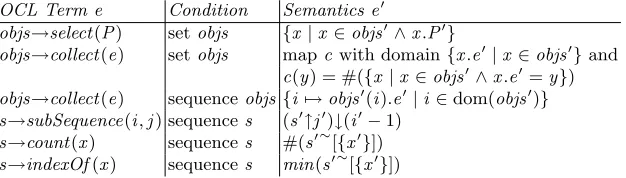
Tables 1 and 2 show some examples of semantic interpretations of OCL col-lection types and operators.
The theoryΓM includes axioms expressing the multiplicities of association
ends, the mutual inverse property of opposite association ends, deletion propa-gation through composite aggrepropa-gations, the existence of generalisation relations, and the logical semantics of any explicit constraints in M. Constraints of M
are expressed as axioms inΓM. Some variation points of UML semantics can be
expressed by the variation of some axioms of ΓM, for example, we assume that
distinct subclasses of a class have disjoint sets of instances, and therefore include the axiom:
B∩C ={}
inΓM ifB andC are distinct direct subclasses of a classA. Likewise for distinct
root classes.
For a sentenceϕinLM, there is the usual notion of logical consequence:
OCL Term e Condition Semantics e′
s→size() set or sequences cardinality #s′
s→size() bags sum ofs′(x) forx ∈dom(s′)
s→includes(x) sets x′∈s′
s→excludes(x) sets x′6∈s′
s→includes(x) sequences x′∈ran(s′)
s→excludes(x) sequences x′6∈ran(s′)
s→includes(x) bags x′∈dom(s′)
s→excludes(x) bags x′6∈dom(s′)
s→asSet() s set s′
s→asSet() s sequence ran(s′)
s→asSet() s bag dom(s′)
s→includesAll(t) setss andt t′⊆s′
s→includesAll(t) sequencess andt ran(t′)⊆ran(s′)
s→excludesAll(t) setss andt s′∩t′={}
s→excludesAll(t) sequencess andt ran(s′)∩ran(t′) ={}
s→sum() sets sum of elements ofs′
[image:5.595.170.443.166.367.2]s→sum() sequences, #s′=n s′(1) +...+s′(n)
Table 1.Semantic mapping for OCL collection operations
OCL Term e Condition Semantics e′
objs→select(P) setobjs {x |x ∈objs′∧x.P′}
objs→collect(e) setobjs mapcwith domain{x.e′|x∈objs′}and
c(y) = #({x |x ∈objs′∧x.e′=y})
objs→collect(e) sequenceobjs {i7→objs′(i).e′|i ∈dom(objs′)}
s→subSequence(i,j) sequences (s′↑j′)↓(i′−1)
s→count(x) sequences #(s′∼[{x′}])
s→indexOf(x) sequences min(s′∼[{x′}])
[image:5.595.152.465.502.591.2]means the sentence is provable from the theory of M, and so holds inM. We may specify inference within a particular languageL by the notation⊢LifL is not clear from the context.
Ifm is at the M1 level and is an instance of a language L at the M2 level, then it satisfies all the properties ofΓL, although these may not be expressible
withinLm itself. We use the notationm |=ϕ to express satisfaction of anLL
sentence ϕin m.
A structure m for language LM is said to be a (semantic) model of M if
m |=ϕfor eachϕ∈ΓM.
A pair (m,n) of models of languagesL1 andL2 can also satisfy predicatesϕ
in the union languageL1∪L2. This is denoted by (m,n)|=ϕ.
The collection of M1 level models of an M2 model L is ModelsL. We may
simply writem :Lto meanm ∈ModelsL.
Models are considered isomorphic if they cannot be distinguished on the basis of feature values. Two modelsm= ((Ei),(fj)) andm′= ((Ei
′ ),(f′
j)) of the
same language L are isomorphic,m ≡m′
, if there is a family hi : Ei →Ei
′ of bijections such that:
1. hi(x) =x′ ⇒ fj(x) =fj′(x
′
) for each attribute featurefj :Typ ofEi,x ∈Ei
2. hi(x) =x′ ⇒ hk(fj(x)) =fj′(x
′) for each single-valued role feature
fj :Ek
ofEi,x ∈Ei
3. hi(x) = x′ ⇒ hk(| fj(x)|) = fj′(x
′) for each set-valued role feature
fj with
element typeEk ofEi,x ∈Ei.
4. hi(x) = x′ ⇒ fj(x); hk = fj′(x
′) for each sequence-valued role feature
fj
with element typeEk ofEi,x ∈Ei.
A model transformationτ from a languageS to a languageT can be char-acterised by a domain of (pairs of) models to which it can be applied:
Domτ⊆ModelsS×ModelsT
and a relation defining which models should correspond under the transforma-tion:
Relτ :ModelsS ↔ModelsT
Acomputationofτ maps a pair (m,n)∈Domτ to a pair (m
′
,n′
)∈Relτ.
Transformations are termedinput-preservingif they do not modify the source model. Such transformations usually have computations of the form
(m,∅)−→τ (m,n)
Transformations that operate on a single model are termedupdate in place
transformations, their computations have the form
m−→τ m
A model transformationτ isinvertible if there is an inverse transformation
τ∼
fromT toS such thatτ followed byτ∼
is effectively the identity relation on
ModelsS.
That is, if there are computations
(m,∅)−→τ (m,n)
of an input-preserving transformationτ and
(n,∅)−→τ∼ (n,m′)
of its inverse, then
m≡m′
(ie.,τ∼
is a right inverse of τ). Operationally, τ∼ takes a model
n of T and an empty model of S, and reconstructs a minimal model m of S that would map ton (or an isomorphic copy ofn) underτ.
This is a desirable property since it provides a means to view a model ofT
as a model ofS, and therefore to check that the semantic meaning of the source model has been preserved by the transformation.
This property is directly related to the existence of aninterpretationχ from
S to T, a mapping of languages which defines a representation χ(E) inT for each entity E ofS, and a representationχ(f) inT for each featuref ofS [35].
3
A model-driven development process for model
transformations
In this section we outline a general model-driven development process for model transformations specified as constraints and operations in UML. We assume that the source and target metamodels of a transformation are specified as MOF class diagrams [44], S and T, respectively, possibly with OCL constraints defining semantic properties of these languages.
For a transformationτ from language S to language T, we can express its requirements in a graphical form such as the SySML requirements diagrams used in [16], or as equivalent structured text.
The formal specification ofτ can be expressed in OCL or a similar first order logic by four separate predicates which characterise the global properties of τ, and which need to be considered in its specification and design [32]:
1. Asm – assumptions, expressed in the union language LS∪T of S and T,
which can be assumed to be true before the transformation is applied. These may be assertions that the source model is syntactically correct, that the target model is empty, or more specialised assumptions necessary forτ to be well-defined.Asm0 denotes the assumptions which refer only toS.Asm
2. Ens– properties, usually expressed inLT, which the transformation should
ensure about the target model at termination of the transformation. These properties usually include the constraints ofT, in order that syntactic cor-rectness holds. For update-in-place transformations Ens may refer to the pre-state versionsE@pre,f@pre of model entitiesE and features f.
Ens is considered separately from Cons because it may contain predicates which cannot be interpreted operationally, but which nonetheless should be established for the target model.
3. Pres– properties, usually expressed inLS, which the transformation should
preserve from the source model to the target model, under a language-level interpretation χ. This could include language-level semantic preservation. Properties at the model level may also be specified for preservation via a model-level interpretationζ.
4. Cons – constraints, expressed in LS∪T, which define the transformation as
a relationship between the elements of the source and target models, which should hold at termination of the transformation. These constraints should have an operational interpretation using thestat() operator (Table 9). Ifτ is input-preserving,Cons is also the relation between the initial state of the source model and the final state of the target model. For update-in-place transformationsCons can refer to the initial state of modified source model features and entities by postfixing such entity and feature names by @pre. Transformations between multiple models can distinguish entities in these models by prefixing them with the model name and $:m1$E,m2$E, etc.
Cons is the syntactic specification of the semantic relationRelτ.
We can express these predicates using OCL notation, this corresponds directly to a fully formal version in the axiomatic UML semantics given above, and also to a formalisation in the B notation.
Together these predicates give a global and declarative definition of the trans-formation and its requirements, so that the correctness of a transtrans-formation may be analysed at the specification level, independently of how it is implemented.
The following two correctness properties should be provable for input-preserving transformations. (I) syntactic correctness:
Asm0,Cons, ΓS ⊢LS∪T Ens
where ΓS is the source language theory. A checking transformation should be
used to verify thatΓS holds for the source model.
Likewise,Cons should prove that Pres is preserved, via a suitable interpre-tationχ from the source language to the target language. (II) semantic preser-vation:
Asm0,Cons,Pres, ΓS ⊢LS∪T χ(Pres)
consistency proof in B, we can establish (I) and (II) for a wide range of possible implementations, in particular for the phased implementations produced by the UML-RSDS synthesis process.
Development of the transformation then involves the construction of a de-sign which ensures that the relationship Cons holds between the source and target models at termination of the transformation. This may involve decom-posing the transformation into phases or sub-transformations, each with their own specifications. Different phases may be implemented using different model transformation languages, appropriate for the particular task of the phase.
By reasoning using the weakest-precondition operator [ ] the composition of phases should be shown to achieveCons. (III) semantic correctness:
ΓS ⊢LS∪T Asm ⇒ [activity]Cons
whereactivity is the algorithm of the transformation design.
3.1 Case studies
We will consider three small running examples of transformations: (1) a version of the UML to relational database transformation [42]; (2) the computation of the non-reflexive transitive closure of an association; (3) computation of the GCD of two integer attributes of a class.
(1) maps attributes to columns, and classes to tables, with all subclasses of a given root class being merged into a single table, which has columns for each attribute of any of the subclasses, together with a primary key for the table (Figure 1).
The requirements are:
1. The objective is to produce a relational data model able to represent the data of the UML class diagram.
(a) The source model should not be modified by the transformation. (b) The result is given by instances ofRDBElement.
(c) Each root class of the source model is represented by a table in the target model, with the same name, and with a primary key column.
(d) Each attribute of a class in the source model is represented by a column with the same name, in the table of the root superclass of the class.
Requirements (c) and (d) are formalised asCons constraints:
∀c:Entity·c.parent ={}implies
∃t :Table; k:Column·t.rdbname=c.name and k.rdbname=c.name+ “ Key”and k :t.column
and
∀c:Entity; a:c.ownedAttribute ·
Fig. 1.UML to relational mapping transformation
The notation E[v] denotes lookup of E elements by their primary key values:
E[v] is theEinstance with primary key valuev, if this is a single value, otherwise it denotes the set ofE instances with primary key values inv.
The assumptionsAsm are that the source model is well-formed (name is a primary key in the model, and association multiplicities are satisfied, also that
parent has no cycles) and that the target model is empty:
RDBElement={}
and that is not used in names:
∀a:NamedElement·“ ”/:a.name
AnEns property is that every table has at least one column:
∀t :Table·t.column.size>0
A possiblePres property is that all attributes have a non-empty name:
∀a:Attribute·a.name.size>0
The interpretationχin this case is only a partial interpretation, sinceownedAttribute
has no interpretation in the target language (information about which attributes belong to which classes has been lost by the transformation, ie., it is an ab-straction in this respect). However, Entity is interpreted byTable,Attribute by
Column, andname byrdbname, soχ(Pres) is:
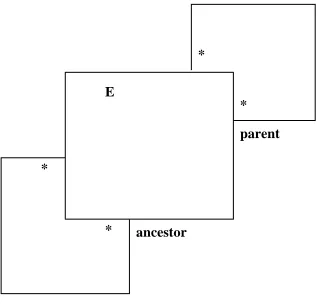
(2) is a generic transformation which computes the transitive closure of a many-many self association parent on an entity E, as a derived many-many associationancestor onE (Figure 2).
E
parent
ancestor * *
*
[image:11.595.230.389.174.326.2]*
Fig. 2.Transitive closure metamodel
The requirements are:
1. The objective is to compute the non-reflexive transitive closure of an asso-ciation.
(a) The original association parent should not be modified by the transfor-mation.
(b) The result is given by a new associationancestorwhich representsparent+
at termination of the transformation.
There are twoCons constraints:
∀s :E·s.parent ⊆s.ancestor
∀s :E·s.parent.ancestor ⊆s.ancestor
Asm asserts thatancestor is initially empty:
∀s :E·s.ancestor ={}
Ens asserts that ancestor is always a subset of the non-reflexive transitive closure:
∀s :E·s.ancestor ⊆s.parent+
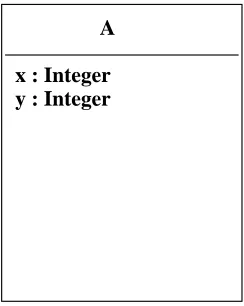
A
[image:12.595.248.370.115.268.2]x : Integer
y : Integer
Fig. 3.GCD metamodel
The assumptionAsm is:
∀a:A·a.x >0 and a.y>0
This is also theEns predicate. TheCons constraints are:
∀a:A·a.x <a.y implies a.y=a.y−a.x
∀a:A·a.y <a.x implies a.x=a.x−a.y
4
Model transformation specification
In this section and the following section we describe how the general development framework described above can be implemented in UML-RSDS. UML-RSDS is a model-driven development approach which has the following general principles:
– Systems are specified using declarative UML models and OCL constraints, at a CIM (computationally independent model) level, where possible.
– Designs and executable implementations are automatically derived by means of verified transformations, so that they are correct-by-construction with respect to the specification.
– Capabilities for formal analysis are provided, for use by specialised users.
As an approach to transformation specification, this means that transformations are specified purely using UML notations, with no additional specialised syntax required.
Cons of postconditions. Logically, the transformation is interpreted as achieving the conjunction of the postconditions, under the assumption that the conjunc-tion of the precondiconjunc-tions holds at its initiaconjunc-tion. Procedurally, the postcondiconjunc-tion constraintsCncan be interpreted as transformation rules or statementsstat(Cn) which establish Cn.
The precondition constraints define checks which should be carried out on the source model, whilst the postconditions also define consistency conditions that should hold between the source and target models as a result of the transforma-tion, and which should be maintained by a change-propagation implementation of the transformation.
The structure and organisation of the constraints will be used to automati-cally derive the design and implementation of the transformation.
There are two primary forms ofConsspecification structure: (i) conjunctive-implicative form, consisting of an ordered seriesC1, ...,Cn of constraints of the
general form
∀s :Si·SCond implies Succ
where the primary quantification is over a source language entity Si. Logically
Cons is the conjunction of theCi.
Recursive form(ii): an ordered disjunction of clauses
∃s :Si·SCond and Succ
In the first case, the ordering of constraints represents an implicit sequential ordering of the transformation implementation, and a potential decomposition of the transformation into sequencedphasesor sub-transformations. In the second case, which is used when the constraints do not have a literal interpretation as postconditions of the transformation, but only as definitions of incremental steps in the transformation, the ordering represents a relative priority in the application of the steps.
For conjunctive-implicative specifications, the constraints define the post-conditions of the entire transformation, ie, what relation it should establish, at its termination, between the source and target model data – independently of any design or implementation strategy to enforce this relation. In this respect the constraints are more abstract and declarative than QVT-Relations or TGG rules.
The constraints have a dual aspect: they express what conditions should be true at the completion of an entire transformation, but they can also be interpreted as the definitions of specific rules executed within the transformation. That is, the individual constraints, and the entire use case, have both a logical and a procedural interpretation. Logically, they can be used as a platform-independent specification to reason about the correctness of the transformation. Procedurally, they can be used to generate a correct-by-construction design and executable implementation of the transformation.
the truth ofCn, given certain assumptionsAsmCn:
AsmCn ⇒ [stat(Cn)]Cn
AsmCnincludes conditionsdef(Cn) to ensure that expression evaluations inCn
are well-defined. Table 9 definesstat(P) for different kinds of predicateP. The ordering of the constraints has no significance to their logical interpreta-tion as a conjuncinterpreta-tion. However, the procedural interpretainterpreta-tion uses this ordering to generate the design as a sequence of phases, and the ordering is also used to establish the design correctness.
In general there may be several related use cases for a given transformation:
– A checking transformation, which checks that the source and target models satisfyAsm.
– The forward transformationτ that establishesCons, assumingAsm.
– A reverse transformation τ∼, derived from τ, which takes a well-formed target language modelMT and generates a source modelMS whichτwould
map toMT.
We recommend a constraint-based specification approach for transformations for several reasons:
1. Constraints have the key advantage that they areunambiguous, with a trans-parent semantics, and they can be understood without knowledge of the execution semantics of a particular tool. In contrast, even the most declara-tive style of transformation rule specification, in QVT-Relations or a graph transformation language, requires knowledge of the particular rule schedul-ing and selection strategies of the language. Simple specifications (such as replacing names of elements) can fail to terminate because of such strategies [37].
2. Constraints are usually more concise than transformation rules or executable versions of a transformation.
3. Constraints can be analysed at the specification level, to identify if the trans-formation implementation synthesised from the constraints is terminating, confluent, complete, etc.
4. Constraints facilitate verification, since they are in a form close to that used by theorem-proving and analysis tools, such as B [24] and OCL checkers such as the Dresden OCL tools [9].
5. The inverse of a transformation can be directly computed from the con-straints in many cases, as can a change-propagation version of the transfor-mation.
5
Computational model for transformations
A transformation implementation typically executes as a collection of individual
rule or constraint, to produce an incrementally modified target and/or source model.
Theapplication conditionsof a conjunctive-implicative constraint
∀s :Si·SCond implies Succ
are the positive application conditionsSCond and the negative application con-ditionsnot(Succ).
A computation of a general transformation τ with assumptions Asm and postconditions Cons maps a pair (m,n) of a source model m and an initial target model n, which satisfyAsm, to a pair (m′,
n′) which satisfies
Cons. We denote this by
(m,n)−→τ (m
′
,n′ )
For each starting pair (m,n) satisfyingAsm, the result (m′
,n′
) is minimal such thatConsholds: no strict subset of the transformation steps of this computation produces a pair (m′′
,n′′
) which satisfyCons.
Such general transformations arise as model migrations where the source and target metamodels are not disjoint (for example, [34]). The definition can be directly generalised to cases of more than 2 involved models.
Many restructuring transformations only modify a single source model, ie., they are update in place. Their computations can be represented as:
m−→τ m
′
wherem′ is the result of a minimal set of transformation steps applied to an
m
which satisfiesAsm, to establishCons form′.
Input-preserving transformations such as refinements, abstractions and mi-grations between disjoint languages usually have an initially empty target model: they map a source modelm and an empty target model∅, satisfyingAsm, to a
pair (m,n) which satisfies the postcondition constraintsCons ofτ. We denote this by
(m,∅)−→τ (m,n)
If the steps ofτonly create target elements and extend target element roles, then the minimality condition can be expressed by saying that no strict submodel of
n satisfiesCons with respect tom.
The minimality can be logically expressed by including Cons∼
in the as-sumptions of obligations of (I) and (II) in Section 3.Cons∼
can also be included as anEns property, for B consistency proof (Section 8).
considered as a complete application of a top-level relation (including all its in-voked non-top-level relations), or at a finer level of granularity, an application of any relation, not including its invoked relations.
Typically, the computations of constraint-based specifications will be divided into computations of individual phases [8]: all the steps for the first phase, ie., for the first constraint, C1, will execute first, then, once C1 is established, the
steps for the second phase will commence, and so forth.
6
Model transformation correctness
By using the above semantics and computational model for transformations, we can precisely define correctness criteria for a model transformation τ from a languageS to a languageT [21].
We will use the concept of atransformation model from [5]: the theory Γτ
formed from the union ofΓS andΓT together with constraints representing the
semantics of the transformation itself. In order to carry out formal verification, this theory will be expressed in the B language as one or more B components.
The following notions of transformation correctness at the level of individual constraints or rules have been defined [52, 5]:
Applicability A constraint Ci is forward applicable if there is a pair (m,n)
of models, wherem ∈ ModelsS and n is a structure for T, such that Ci’s
application condition holds in (m,n).
Failure of this property would indicate an ill-defined rule that can never be applied, perhaps because of an over-restrictive application condition.
Executability A constraint Ci is forward executable if for every model pair
(m,n) withm ∈ModelsS andn a structure forT, such thatCi is applicable
in (m,n), there is an extension n′ of n such that (m,n′) |= Ci and n′ ∈
ModelsT.
Failure of this property indicates that Ci is inconsistent with ΓT, that is,
the effects specified in its postcondition contradict the constraints ofT.
Completeness For individual transformation rules, completeness means that
all elements and settings in the target model intended to be established by the rule are explicitly defined in the rule, unless these can be deduced from the explicit definitions of the rule.
Definedness The expressions within the constraint or rule are well-defined, ie.,
division by zero or other invalid expression evaluations cannot occur.
Determinacy The rule cannot produce more than one possible modified model,
when applied to a particular model and specific elements in that model, so that all its required input values are fixed.
At the level of complete transformationsτ :S →T there are corresponding global properties on implementations1
I of input-preserving transformations,
1 Implementations are defined by activities/algorithms in terms of basic
using (m,n)−→I τ (m
′
,n′
) to denote that there is a completed computation of the implementation I ofτ from (m,n) to (m′
,n′ ):
Syntactic correctness For each model which conforms to (is a model of the
language) S, and to which the transformation implementation can be ap-plied, the transformed model conforms toT:
∀m:S; n·m|=Asm0∧(m,∅)−→Iτ(m,n) ⇒ n:T
IfEns includes ΓT, then this is ensured by property (I) of Section 3.
Semantic correctness Each target model that can be produced by the
trans-formation implementation satisfies the required transtrans-formation postcondi-tionCons:
∀m:S; n·m|=Asm0∧(m,∅)−→Iτ(m,n) ⇒ (m,n)|=Cons
For input-preserving transformations whereAsm requires an initially empty target model, this property is established by property (III) of Section 3.
Semantic preservation At the language level this means that for each
prop-erty of the source model which should be preserved (correctness properties), the target model satisfies the property, under a fixed interpretationχof the source language into the target language.
There may also be model-level properties which should be preserved via a model-level interpretationζ.
1. (Language-level semantic preservation): each language-level propertyϕ: LS satisfied by a source modelmis also satisfied, under an interpretation
χon language-level expressions, in the target modeln:
m |= (Asm0and ϕ) ∧ (m,∅)−→I
τ(m,n) ⇒ n |=χ(ϕ)
This shows thatT is at least as expressive asS, and that users ofn can view it as a model of S, because the entities and features of S can be expressed in terms of those ofT. In particular, no information about m
is lost byτ.
ForϕasPres, this is established by property (II) of Section 3.
χ can be expressed in B by means of B machine invariants and verified by internal consistency proof (Section 8).
2. (Model-level semantic preservation): each model-level propertyϕinLm
of a source modelmis also true, under an interpretationζon model-level expressions, in a target modeln:
m |=Asm0 ∧ Γm ⊢ϕ ∧
(m,∅)−→I
τ(m,n) ⇒ Γn ⊢ζ(ϕ)
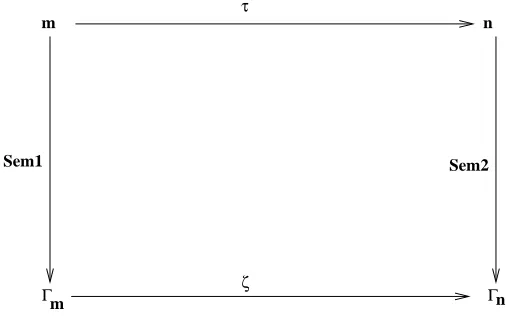
Model-level semantic preservation means that the diagram of Figure 4 com-mutes: each formulaϕ∈Γm has
Γn⊢ζ(ϕ)
whereΓm is the semantics ofmunderSem1, andΓn is the semantics ofnunder
Sem2.
m τ n
ζ
Sem1 Sem2
[image:18.595.182.435.218.380.2]Γm Γn
Fig. 4.Model-level semantic preservation
Notice that if τ and σ are semantically preserving, so is their composition
τ; σ, if the composition of the interpretations is used. More generally, we have the properties:
Uniqueness The transformation implementation should produce a unique
re-sult (up to isomorphism) from a given starting model. This is also termed
confluence: for each pair (m,n) of starting models satisfyingAsm, if (m,n)−→I τ
(m′
,n′
) and (m,n)−→I τ (m
′′
,n′′
) then m′ ≡m′′
and n′ ≡n′′
. In other words, the transformation implementation always produces essentially equiv-alent target models from the same source model.
Implementations of transformationsτ should normally satisfy the stronger condition of beingisomorphism-preserving:
(m,n)−→I τ (p,q)
and
(m′,n′)−→I τ(p
′
,q′)
wherem≡m′ and
n≡n′, should imply that
p≡p′ and
Termination An implementation of transformation τ is terminating if every set of computation steps starting from (m,n) satisfyingAsm, permitted by the implementation, is finite.
Model-level semantic preservation has not been fully addressed by any sup-port tool for model transformations, despite its imsup-portance for ensuring the integrity of a development using transformations. The paper [52] defines a model-checking technique for testing that a transformation preserves selected proper-ties, on a model-per-model basis, but does not provide a means to verify trans-formations on a global basis, for arbitrary models of the source language.
Some transformations may be inherently non-functional, for example, the transformation (translation) between the abstract syntax trees representing texts in different natural languages. However, as [5] points out, non-determinism can also result from specification errors such as under-specification and omission of intended predicates.
7
Verification using syntactic analysis
We can perform some analysis of constraints and use cases using data-dependency analysis. This analysis is used to (i) identify possible flaws in the specification to the developer, and (ii) to determine the choice of design and implementation of the constraints and use case.
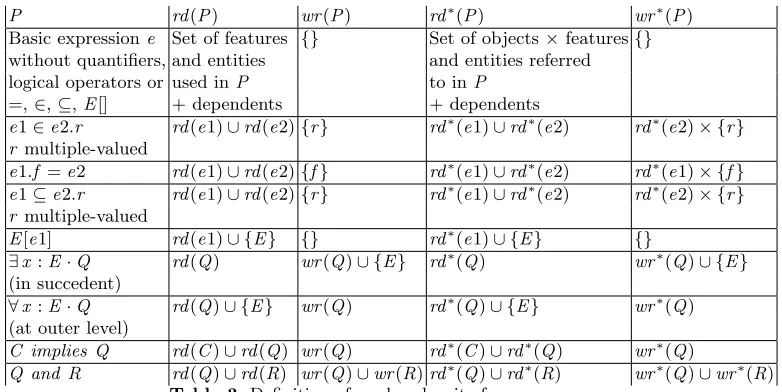
For each predicate P we define thewrite frame wr(P) of P, and the read frame rd(P) (Table 3). These are the sets of entities and features whichstat(P) may update or access, respectively.
Thewrite frame wr(P) of a predicate is the set of features and classes that it modifies, when interpreted as an action (an action stat(P) to establish P). This includes object creation. The read frame rd(P) is the set of classes and features read inP. The read and write frames can help to distinguish different implementation strategies for constraints. In some cases, a more precise analysis is necessary, wherewr∗(
P) andrd∗(
P), which include the sets of objects written and read inP, are used instead.
If an association endrole2 has a named opposite endrole1, then role1 de-pends on role2 and vice-versa. Deleting an instance of classE may affect any superclass ofE and any association end incident withE or with any superclass ofE. The read frame of an operation invocatione.op(pars) is the read frame of
e and pars together with that of the postcondition Postop ofop, excluding the
formal parametersv ofop. Its write frame is that ofPostop, excludingv.wr(G)
of a setG of constraints is the union of the constraint write frames, likewise for
rd(G).
A dependency ordering Cn < Cm is defined between distinct Cons con-straints by
wr(Cn)∩rd(Cm) 6= {}
A use case with postconditionsC1, . . . ,Cn should satisfy thesyntactic
P rd(P) wr(P) rd∗(P) wr∗(P)
Basic expressione Set of features {} Set of objects×features{}
without quantifiers, and entities and entities referred logical operators or used inP to inP
=,∈,⊆,E[] + dependents + dependents
e1∈e2.r rd(e1)∪rd(e2){r} rd∗(e1)∪rd∗(e2) rd∗(e2)× {r}
r multiple-valued
e1.f =e2 rd(e1)∪rd(e2){f} rd∗(e1)∪rd∗(e2) rd∗(e1)× {f}
e1⊆e2.r rd(e1)∪rd(e2){r} rd∗(e1)∪rd∗(e2) rd∗(e2)× {r}
r multiple-valued
E[e1] rd(e1)∪ {E} {} rd∗(e1)∪ {E} {}
∃x :E·Q rd(Q) wr(Q)∪ {E} rd∗(Q) wr∗(Q)∪ {E}
(in succedent)
∀x :E·Q rd(Q)∪ {E} wr(Q) rd∗(Q)∪ {E} wr∗(Q)
(at outer level)
C implies Q rd(C)∪rd(Q) wr(Q) rd∗(C)∪rd∗(Q) wr∗(Q)
[image:20.595.132.523.113.309.2]Q and R rd(Q)∪rd(R) wr(Q)∪wr(R)rd∗(Q)∪rd∗(R) wr∗(Q)∪wr∗(R)
Table 3.Definition of read and write frames
1. If Ci <Cj, then i<j.
2. If i6=j then wr(Ci)∩wr(Cj) = {}.
Together, these conditions ensure that the activitiesstat(Cj) of subsequent
con-straintsCj cannot invalidate earlier constraintsCi, fori<j.
A use case satisfiessemantic non-interferenceif fori<j:
Ci ⇒ [stat(Cj)]Ci
Syntactic non-interference implies semantic non-interference, but not con-versely.
ConstraintsCi may also satisfy the condition
wr(Ci)∩rd(Ci) = {}
We refer to such constraints astype 1constraints. Subject to further restrictions, they have an implementation as bounded iterations over the source model entity
Si of their outermost ∀quantifier.
The general form of a conjunctive-implicative constraint is an implication:
∀s :Si·SCond implies ∃t :Tj·TCond and Post
whereSCond is a predicate over the source model elements only,S1, ...,Sn are
the entities ofS which are relevant to the transformation,Tj is some entity of
T,TCond is a condition inTelements only, eg., to specify explicit values fort’s attributes, andPost refers to botht ands to specifyt’s attributes and possibly linked (dependent) objects in terms of s’s attributes and linked objects. Post
(local versus global relationship betweensandt).TCond does not contain quan-tifiers,Post may contain∃quantifiers to specify creation/lookup of subordinate elements of t. If the t should be unique for a givens, the ∃1 quantifier may be
alternatively used in the succedent of clauses. Additional ∀-quantifiers may be used at the outer level of the constraint, if quantification over multiple source model elements is necessary, instead of over single elements. Each source entity type Si which is ∀-quantified over at the outer level is referred to as a source
domainof the constraint. TheTj aretarget domainsof the constraint.
We can classify transformation constraints into several types, of increasing complexity:
– Type 0 constraints: no quantification over source elements, instead only up-dates to specific objects are specified. For example:
Account[“33665”].balance= 0
to set the balance of a specific identified account.
– Type 1 constraints with 1-1 mapping of identities (structure preserving con-straints): these have disjointwr andrd frames. For example, the first con-straint of the transitive closure computation:
∀s:E·s.parent ⊆s.ancestor
– Type 1 constraints with merging of source entity instances into target in-stances, ie, with a many-1 mapping of identities.
– Type 2 constraints:
wr(Cn)∩(rd(Post)∪rd(TCond))
is non-empty, but
wr(Cn)∩(rd(SCond)∪ {Si}) ={}
These constraints usually need to be implemented by a fixpoint iteration: the basic transformation step stat(Succ) is iterated over applicable source elements until no applicable source element remains.
An example is the second constraint in the transitive closure computation:
∀s:E·s.parent.ancestor⊆s.ancestor
– Type 3 constraints: these have
wr(Cn)∩(rd(SCond)∪ {Si})6={}
– Recursive form constraints: constraints that are not intended to hold literally in the post-state of the transformation, but which describe instead incremen-tal transformation steps. Type 2 or type 3 in terms of data-dependencies, they typically contain a succedent which is false when interpreted as a logical assertion, as in the GCD computation:
∀a:A·a.x <a.y implies a.y =a.y−a.x
Alternatively, the succedent may contradict the antecedent, for example:
∀e:E·SCond implies e→isDeleted()
which removes from the model all instances ofE that satisfySCond.
Some forms of analysis apply regardless of the constraint type. Each con-straint should use correct syntax and should be type-correct in the context of the source and target metamodels.Internal completenesschecks that for each in-stancet of an entityE that is created in the constraint, all defined data features of E are set for t. Syntactic checks can be applied to ensure that constraints are determinate and well-defined (they contain no division by zero, or refer-ence to other undefined expressions, and the succedent of constraints cannot use indeterminate choice: any, or). For each constraint, a definedness condition is produced, this condition is a necessary assumption which should hold before the constraint is applied, in order that its evaluation is well-defined. Likewise with determinacy.
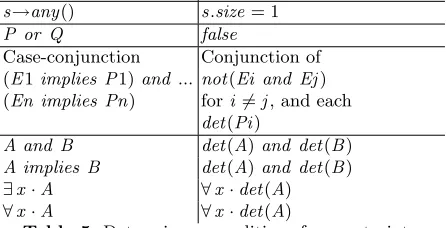
Examples of the clauses for definedness are given in Table 4. Examples of the clauses for determinacy are given in Table 5.
7.1 Analysis of type 1 constraints
For type 1 constraints, many of the verification properties (such as confluence, semantic correctness and termination) can be established by syntactic checks on the constraint to ensure that distinct applications of the constraint cannot semantically interfere.
Given a type 1 constraintCn:
∀s :Si·SCond implies ∃t :Tj·TCond and Post
the following conditions (internal syntactic non-interference) ensure that appli-cations ofCn on distincts1,s2 :Si,s16=s2, cannot interfere with each other’s
effects:
Cn should only read source data navigable from s. There should be no reference to any primary key ofTj in the succedent ofCn, except in an
assignment to it of the primary key value ofs:t.tid =s.sid. Updates in
TCond andPost should be local tot ors: only direct features of t ors
Constraint expression E Definedness condition def(E)
a/b b6= 0
s[ind] ind>0and ind≤s.size sequence, strings
E[v] v ∈E.id
entityE with primary keyid, v single-valued
s→last() s.size>0 s→first()
s→max() s→min() s→any()
v.sqrt v ≥0
v.log v >0
A and B def(A)and def(B) A implies B def(A)and def(B)
∃x ·A ∀x·def(A)
[image:23.595.200.419.161.364.2]∀x ·A ∀x·def(A)
Table 4.Definedness conditions for constraints
Constraint expression E Determinacy condition det(E) s→any() s.size= 1
P or Q false
Case-conjunction Conjunction of (E1implies P1)and... not(Ei and Ej) (En implies Pn) fori6=j, and each
det(Pi)
A and B det(A)and det(B) A implies B det(A)and det(B)
∃x·A ∀x·det(A)
∀x·A ∀x·det(A)
[image:23.595.198.421.485.599.2]f of t are permitted, in additiont can be added to a set or sequence-valued expressione which does not depend ons ort:t :e. Likewise for
s.
These conditions can be generalised slightly to allow 1-1 mappings ofSi
identities toTj identities.
Notice thatSi is not equal to Tj or to any ancestor ofTj, and that no feature
is both read and written in Cn (by the type 1 property).
Taken together, these conditions prevent one application of Cn from over-writing the effect of another application, because the setswr∗of write frames of the two applications are disjoint, except for collection-valued shared data items (such asTj itself), and these are written in a consistent manner (both
applica-tions add elements) by the distinct applicaapplica-tions.
The standard implementation of type 1 constraints is a fixed for-loop iteration over their source domains (Section 9). The execution of the individual constraint applications in any sequential order by this implementation will achieve the required logical condition Cn once all applications have completed. Semantic correctness and termination therefore hold for the standard implementation of internally syntactically non-interfering type 1 constraints.
For confluence of this implementation, we need the further conditions that the Cn are determinate, and that additions of t or s to a sequence are not permitted.
Theorem 1 If a type 1 constraint Cn is syntactically restricted as described above, then its standard implementation is confluent.
Proof By determinacy, each individual application act of Cn has a unique (up to isomorphism) result from a specific starting state.
Two applicationsact1 andact2 ofCn for distincts1,s2 inSi have disjoint
wr∗
frames, except for collection-valued shared data items (such as Tj itself),
because these are based on distinctTj objectst1 andt2 or on the distincts1 and
s2. Hence the effects of act1 andact2 are independent on these write frames. If a set-valued expressioneis written inPostby a formulat :eore→includes(t), thene is not read inCn, so its value cannot affect applications ofCn. The order of addition oft1 andt2 toe does not make any difference to its resulting value, so such updates are order independent. Likewise with additions ofs to a set. ✷
Counter-examples to confluence when the conditions do not hold can easily be constructed. If elements ofSi are simply added to a global sequence:
∀s :Si·s:Root.instance.slist
for a singleton class Root, with an ordered association end slist : seq(Si), then
two different executions of the transformation could produce two different or-derings ofslist.
Likewise, if the mapping of identities is not 1-1, then the sameTj instance
being retained:
∀s :S1· ∃t:T1·t.id =s.id/2and t.y =s.x
where all attributes are integer-valued. This is also a counter-example to seman-tic correctness of the standard implementation.
Update of objects other than t and s can violate confluence and semantic correctness in a similar way, for example:
∀s :S1· ∃t:T1·t.r =T0[“1”]and t.r.att=s.x
Analysis of syntactic correctness and semantic preservation for type 1 con-straints can be achieved by internal consistency proof in B (Section 8).
7.2 Analysis of type 1 entity and instance merging constraints
Instance and entity merging occurs when two or more source objects, possibly of two or more source language entities, are merged into a single object of a target language entity.
The constraints are written in conjunctive-implicative form, but the same target entityTj may appear on the right-hand side of two or more constraints.
In the first constraint to be applied, instances ofTj are created, in subsequent
constraint applications that identify existing Tj instances, these are looked-up
and their data supplemented by the effect of the applications.
An example are the constraints for the UML to relational database transfor-mation, in which the same table object may be written by different constraint applications.
Internal syntactic non-interference needs to be considered carefully for such transformations. In addition to the restrictions on type 1 constraints defined above, we add the following:
Updates to the same target entity instancet :Tj in different constraint
applications must: (i) not change the primary key value of t after its initialisation; (ii) modify disjoint sets of attributes and single-valued as-sociations of t; (iii) modify collection-valued associations r of t in a consistent way, ifr is written by different constraint applications: these updates must all be additions; (iv) mixtures of additions and removals oft to collectionseare forbidden. Only additions are permitted.
For confluence, additions to sequence-valued roles r in case (iii) or sequences
e in case (iv) are forbidden. Individual applications of the constraint must be determinate.
Semantic correctness of the standard implementation follows from the dis-jointness ofwr∗
frames for distinct constraint applications: if the objects being updated are the same, then the features are different, except in the case of non-interfering updates to collection-valued roles.
The UML to relational database example satisfies these conditions, since
t.columnis added to by each distinct constraint application that affectst :Table. A simple counter-example for semantic correctness and confluence in this case is the constraint:
∀s :S1· ∃t:T1·t.id =s.id/2and
(s.x>0 implies t:e)and (s.x ≤0 implies t /:e)
where all attributes are integer-valued, andeis a set-valued collection indepen-dent of s and t. Depending on the order in which S1 elements are processed, a
specifict may or may not be in e at termination.
Type 1 constraints that fail the internal non-interference restrictions can be analysed using the techniques for type 2 and 3 constraints in the following sections.
7.3 Analysis of type 2 and type 3 constraints
A constraint Cn of form
∀s :Si·SCond implies ∃t :Tj·TCond and Post
is termed atype 2constraint if
wr(Cn)∩(rd(Post)∪rd(TCond))
is non-empty, but
wr(Cn)∩(rd(SCond)∪ {Si}) ={}
This means that the order of application of the constraint to instances may be significant, and that a single iteration through the source model elements may be insufficient to establishPost for all elements. A least-fixed point computation may be necessary instead, with iterations repeated until no further change takes place.
A constraint is oftype 3ifSi ∈wr(Cn) orwr(Cn)∩rd(SCond)6={}. Again in
this case a fixpoint computation is necessary, with additional complexity because the set of source objects being considered by the constraint is itself dynamically changing.
A measureQ :ModelsS×ModelsT →Non the source and target model data
is used to establish the termination, confluence and correctness of type 2 and type 3 constraints, and should be defined together with the constraint.Q should have the property that it is decreased by each application of the constraint, and
Q = 0 at termination of the phase for the constraint.
Formally,Q is a variant functionfor applications of the constraint:
∀ν :N·Q(smodel,tmodel) =ν∧s ∈Si ∧SCond ∧ν >0 ⇒
and
Q(smodel,tmodel) = 0 ≡ {s ∈Si |SCond ∧ ¬(Succ)}={}
Succ abbreviates the constraint rhs∃t:Tj ·TCond and Post.
Q will be syntactically defined as an expression in the union languageS∪T. The variant function property of Q establishes termination of the fixpoint implementation of Cn: each application ofCn strictly reduces Q, and Q ≥0, so there can only be finitely many such applications. Semantic correctness also follows, since whenQ = 0, there are no remaining instances of Si which violate
the constraint, ie,Cn holds true.
Confluence requires that theQ = 0 state is unique:
Theorem 2 If for each particular starting state of the source and target models there is a unique (up to isomorphism) possible terminal state of the models (produced by applying the constraint until it cannot be applied further) in which
Q = 0, then the fixpoint implementation of the type 2 or 3 constraint is confluent.
Proof The terminal states of the transformation are characterised by the condi-tion
{s ∈Si |SCond∧ ¬(Succ)}={}
But in such states we also have
Q(smodel,tmodel) = 0
Therefore, there is a unique termination state.✷
In some cases the existence of a Q variant function can be deduced from the form of the constraint. A type 2 constraint Cn with wr(Cn) = {r}, for a many-valued association endr :F(Tj) of entityTi, and that updatesr only by
addition of elements (ie., by formulaee⊆x.r,e:x.r or equivalent forms) must have aQ function bounded above by
Σt:Ti#(Tj −t.r)
since the setsTi andTj are not modified byCn.−denotes set subtraction.
Likewise, for cases where such anr is updated by removal of elements only (formulaex.r→excludesAll(e) and equivalents), we have an upper bound:
Σt:Ti#t.r
For example, aQ measure for the second transitive closure transformation constraint is:
Σs:E#(s.parent+−s.ancestor)
whereparent+
is the non-reflexive transitive closure ofparent.
7.4 Recursive form constraints
These constraints are interpreted as defining clauses of a recursive function
τ:ModelsS×ModelsT →ModelsS×ModelsT
with τ(m,n) =τ(m′,
n′) where (
m′,
n′) are
m and n modified by the updates specified by the constraint.
For example, for the GCD computation, the constraints correspond to the following definition ofτ:
∃ax ∈A·x(ax)<y(ax)∧τ(A,x,y) =τ(A,x,y⊕ {ax 7→y(ax)−x(ax)}) ∨ ∃ax ∈A·y(ax)<x(ax)∧τ(A,x,y) =τ(A,x⊕ {ax 7→x(ax)−y(ax)},y) ∨ ∀ax ∈A·x(ax) =y(ax)∧τ(A,x,y) = (A,x,y)
The definition ofτ therefore is a recursive form transformation, the poststate of the transformation is given byτ(m,n) wherem andn are the initial models.
The treatment of these constraints is similar to type 2 and 3 constraints, with correctness, termination and confluence established by means of suitableQ
variant functions.
7.5 Summary
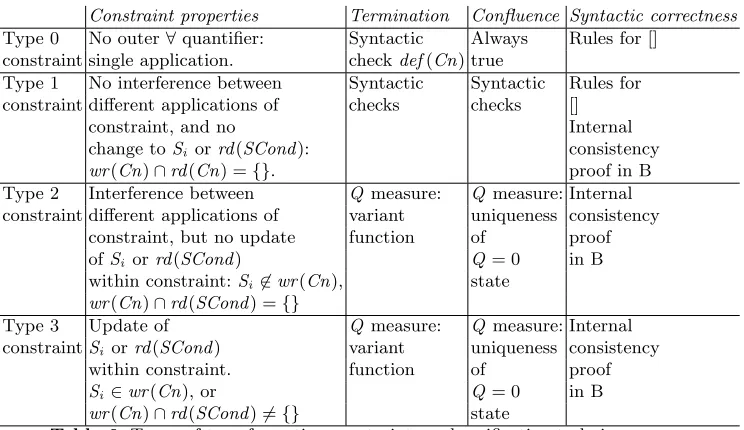
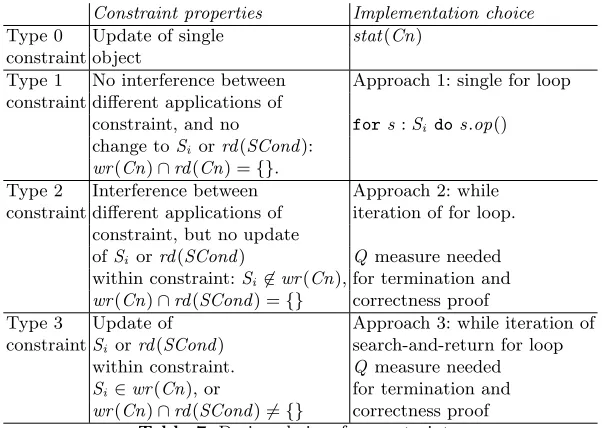
Table 6 summarises the different types of transformation constaint, based on the internal data-dependencies of the constraint, and how different properties of the constraints can be established.
The UML-RSDS tools perform the following analyses on transformation spec-ifications:
– calculation ofrd(Cn) andwr(Cn) for each constraint, and identification of the constraint type (0, 1, 2 or 3 as defined above).
– checks for syntactic non-interference between constraints, and for their cor-rect ordering in Cons. Groups of mutually data-dependent constraints are automatically identified and marked for treatment as a unit for the purposes of design synthesis.
– syntactic checks for termination, semantic correctness and confluence of type 1 constraints.
– automatic derivation of inverse constraints for invertible type 1 constraints.
– checks that constraints are complete (when an object of entityE is created, all its features are set, and that the disjunction ofSCondconditions for each given source entitySi istrue).
Constraint properties Termination Confluence Syntactic correctness Type 0 No outer∀quantifier: Syntactic Always Rules for []
constraint single application. checkdef(Cn) true
Type 1 No interference between Syntactic Syntactic Rules for constraint different applications of checks checks []
constraint, and no Internal
change toSi orrd(SCond): consistency
wr(Cn)∩rd(Cn) ={}. proof in B Type 2 Interference between Q measure: Q measure: Internal constraint different applications of variant uniqueness consistency
constraint, but no update function of proof
ofSi orrd(SCond) Q= 0 in B
within constraint:Si 6∈wr(Cn), state
wr(Cn)∩rd(SCond) ={}
Type 3 Update of Q measure: Q measure: Internal constraintSi orrd(SCond) variant uniqueness consistency
within constraint. function of proof
Si∈wr(Cn), or Q= 0 in B
[image:29.595.135.507.114.329.2]wr(Cn)∩rd(SCond)6={} state
Table 6.Types of transformation constraints and verification techniques
8
Verification using B AMN
B abstract machine notation is an established formal method, with a large num-ber of users and with successful large-scale application to safety-critical systems. Its mathematical foundation is first-order logic and set theory, which makes it a natural formalism for the treatment of UML and OCL, which have the same semantic basis [27, 49].
A B specification consists of a linked collection of modules, termedmachines. Each machine encapsulates data and operations on that data. Entities and meta-models can naturally be represented in machines, using the set-theoretic seman-tics of [27].
The general form of a B machineMτ representing the transformational model
of a transformationτ with source languageS and target languageT is:
MACHINE Mt SEES SystemTypes VARIABLES
/* variables for each entity and feature of S */ /* variables for each entity and feature of T */ INVARIANT
/* type definitions for each entity and feature of S and T */ Asm0 & Pres & Ens & Pres’
INITIALISATION
/* var := {} for each variable */ OPERATIONS
/* update operations for features of S, restricted by Asm, Pres */ /* operations representing transformation steps */
END
wherePres′ isχ(Pres),Asm0 is the sub-part ofAsm which concerns only S. If
Pres andAsm0 are conjunctions of universally quantified formulae∀s :Si ·ψ,
then the appropriate instantiated formulae ψ[sx/s,vx/v] are used as the pre-conditions of operations creating sx : Si (or subclasses of Si) or modifying its
features. All these operations will include preconditions that the target model is empty (for transformations which start with an empty target model).
Pres andPres′
are only included inMτ when proof of correctness property
(II) of Section 3 is being carried out.
As an example, the entity E and its associations in the transitive closure computation transformation can be defined by the following partial machine:
MACHINE E SEES SystemTypes VARIABLES es, parent, ancestor INVARIANT
es <: E_OBJ &
parent : es --> FIN(es) & ancestor : es --> FIN(es) INITIALISATION
es, parent, ancestor := {}, {}, {} END
Using these machines we can verify syntactic correctness and semantic preser-vation properties of a model transformation, by means of internal consistency
proof of a B machine representing the transformation and its metamodels. In-ternal consistency of a B machine consists of the following logical conditions:
– That the state space of the machine is non-empty: ∃v.Inv where v is the tuple of variables of the machine, andInv its invariant.
– That the initialisation establishes the invariant:
[Init]Inv
– That each operation maintains the invariant:
Pre∧Inv ⇒ [Code]Inv
wherePreis the precondition of the operation, andCode its effect.
Therefore, if theEns andχ(Pres) constraints of a transformation τ are in-cluded in the invariant of the machine Mτ which has data representations of
the source and target metamodels, operations to add elements to the source model, and operations for each transformation step of τ, internal consistency proof ofMτ proves thatEnsandχ(Pres) are valid for any (partial or complete)
orf@preinEnsare interpreted by additional variableses pre,f prewhich have the same typing as es and f. They are modified in parallel withes and f by the source model creation and modification operations, and are unchanged by transformation steps.
Mτ expresses the transformation model theoryΓτ in B notation.
The correctness properties (I) and (II) of Section 3 are established for the UML-RSDS implementations of transformations by internal consistency proof in B, because Mτ expressesLS∪T in its data, and ΓS, Asm0 in its invariants.
The phased implementation of τ is expressed by the operation definitions of transformation steps: each step is for a specific constraint Cj of Cons, and its
preconditions include the assumptions that all preceding constraintsCi, i <j
are true.
Internal consistency proof establishes that theEns property holds for each individual target instance of a particular target entity as it is created, so when all applicable steps have been applied,Cons holds and so doesEnsfor all target instances. Likewise forχ(Pres).
For the transitive closure computation, the resulting complete B machine is:
MACHINE E SEES SystemTypes VARIABLES es, parent, ancestor INVARIANT
es <: E_OBJ &
parent : es --> FIN(es) & ancestor : es --> FIN(es) &
/* Ens: */ !ex.(ex : es => ancestor(ex) <: (closure1(rel(parent)))[{ex}]) INITIALISATION
es, parent, ancestor := {}, {}, {} OPERATIONS
create_E() =
PRE es /= E_OBJ & !ex.(ex : es => ancestor(ex) = {}) THEN
ANY ex WHERE ex : E_OBJ - es THEN
es := es \/ { ex } || parent(ex) := {} || ancestor(ex) := {} END
END;
addparent(ex,parentx) =
PRE ex : es & parentx : es & !ex.(ex : es => ancestor(ex) = {}) THEN
parent(ex) := parent(ex) \/ { parentx } END;
uc11(ex) = PRE ex : es THEN
END;
uc12(ex) =
PRE ex : es & not(union(ancestor[parent(ex)]) <: ancestor(ex)) & !ex.( ex : es => parent(ex) <: ancestor(ex) )
THEN
ancestor(ex) := ancestor(ex) \/ union(ancestor[parent(ex)]) END
END
The final invariant expresses theEnsproperty of the transformation,rel(parent) is the relation es ↔ es that corresponds to parent.uc11 defines the transfor-mation step of the first constraint, uc12 defines the transformation step of the second constraint (and assumes that the first constraint has been established). The machine is generated automatically by the UML-RSDS tools from the UML specification of the transformation.
Internal consistency proof then establishes thatEns is a provable invariant, the key deduction is that
!ex.(ex : es => ancestor(ex) <: (closure1(rel(parent)))[{ex}]) & e : es =>
union(ancestor[parent(e)]) <: (closure1(rel(parent)))[{e}]
Using Atelier B version 4.0, 17 proof obligations for internal consistency of the above machine are generated, of which 11 are automatically proved, and the remainder can be interactively proved using the provided proof assistant tool.
Similarly, ifχ(Pres) has a universally quantified form, with these quantifica-tions over target model entities, then internal consistency proof will include the statement thatχ(Pres) holds for each target element produced by applying the transformation constraints.
For the UML to relational database example, the B machine has the form:
MACHINE UMLTORDB SEES SystemTypes, String_TYPE VARIABLES entitys, namedelements, attributes,
name, ownedAttributes, parent,
rdbelements, tables, columns, rdbname, column INVARIANT
namedelements <: NamedElement_OBJ &
attributes <: namedelements & entitys <: namedelements & attributes /\ entitys = {} &
name : namedelements >-> STRING &
ownedAttributes : entitys --> FIN(attributes) & parent : entitys --> FIN(entitys) &
!entityx.(entityx : entities => card(parent(entityx)) <= 1) & rdbelements < RDBElement_OBJ &
tables <: rdbelements & columns <: rdbelements & tables /\ columns = {} &