Texture recognition using force sensitive resistors
SAYED, Muhammad, DIAZ GARCIA,, Jose Carlos and ALBOUL, Lyuba
<http://orcid.org/0000-0001-9605-7228>
Available from Sheffield Hallam University Research Archive (SHURA) at:
http://shura.shu.ac.uk/13128/
This document is the author deposited version. You are advised to consult the
publisher's version if you wish to cite from it.
Published version
SAYED, Muhammad, DIAZ GARCIA,, Jose Carlos and ALBOUL, Lyuba (2016).
Texture recognition using force sensitive resistors. In: ALBOUL, Lyuba, DAMIAN,
Dana and AITKEN, Jonathan M., (eds.) Towards autonomous robotic systems, 17th
Annual Conference, TAROS 2016, Sheffield, UK, June 26--July 1, 2016,
Proceedings. Lecture Notes in Computer Science. Lecture Notes in Artificial
Intelligence (9716). Springer International Publishing, 288-294.
Copyright and re-use policy
See
http://shura.shu.ac.uk/information.html
Texture Recognition Using Force Sensitive
Resistors
Muhammad Sayed, Jose Carlos Diaz Garcia, and Lyuba Alboul
Sheffield Hallam University, Sheffield, UK
Abstract. This paper presents the results of an experiment that inves-tigates the presence of cues in the signal generated by a low-cost force sensitive resistor (FSR) to recognise surface texture. The sensor is moved across the surface and the data is analysed to investigate the presence of any patterns. We show that the signal contain enough information to recognise at least one sample surface.
Keywords: texture recognition, force sensitive resistor, active sensing
1
Introduction
Humans perform a repetitive lateral rubbing motion across a surface to feel its texture, an action known as Lateral Motion Exploratory Procedure [5]. The physiology of the human sense of touch suggests that the information the hu-man brain receives during this motion is coming from force sensory elements embedded in the skin and encoded by frequency modulation [4].
Researchers were able to interface an FSR sensor, installed on a fingertip of a prosthetic hand, with the user’s nerves. The user reported the ability to perceive “texture” of surfaces [8]. This suggests that the single point force data acquired by the FSR hold enough information to perceive surface texture.
We propose that the same ability can be replicated in an artificial system using the same sensor. It would be particularly useful to achieve this ability using FSRs due to their low cost and low thickness that enables superficial installation on robotic hands.
2
Related Work
In [3], researchers constructed a low-profile fabric tactile sensor which was able to differentiate between three surface textures. The sensor was moved across the surface with constant velocity and contact pressure. The data was acquired through a Wheatstone bridge circuit and sampled at 100Hz. The signal process-ing was performed in the time response domain.
signal was samples at 10KHz, the FSR data was only used to estimate surface friction by measuring lateral forces exerted by the operator’s hand and was not in contact with the surface.
Results of two different experiments conducted using a tactile array force sensors attached to a robotic fingertip and moved across the test surfaces in a rubbing motion are presented in [1] and [2]. The signals were processed using Neural-Networks and was able to recognise surface textures.
3
Theory
The human sense of touch is achieved through four nerve channels that connects the brain to four types of sensory elements in the skin known as mechanorecep-tors [4]. The nerve channels are categorised according to receptor receptive field diameter into type I (receptors with a small receptive field) and type II (recep-tors with a large receptive field) and according to temporal response into Slowly Adapting (SA) and Fast Adapting (FA). These channels encode information in terms of nerve “firing” frequency.
Our hypothesis, based on the working principle of the channels, is that the frequency of the signals mediated by one or more of the channels contain enough information to recognise surface texture, and that this ability can be replicated in an artificial system using only force sensors. We propose to use Force Sensitive Resistors (FSR) to investigate this hypothesis due to their low cost and low thickness which enables superficial installation on robotic hands.
4
Experimental setup
[image:3.612.152.456.558.643.2]An FSR acts as a resistor whose resistance changes whenpressureis applied on the sensor’s active area. It is made of two flexible layers joined by an adhesive spacer (Figure 1 Left). One layer contains a printed open circuit, while the other contains a printed semi-conductor layer whose conductivity increases with pres-sure. When pressure is applied, the two layers come in contact thus closing the circuit. The circuit’s resistance is inversely proportional to the applied pressure with a non linear relation (Figure 1 Right).
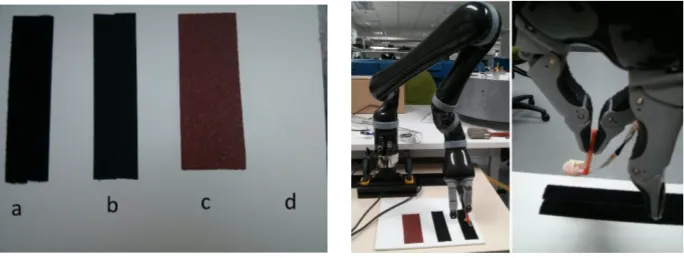
The sensor readings were recorded using an oscilloscope and an operational amplifier circuit. The signals were sampled at 10kHz. Four sample surfaces were selected to have textures that vary from smooth to rough. The selected surfaces are shown in Figure 2: a) Velcro loops, b) Velcro hooks, c) rough sandpaper, and d) smooth plastic-coated cork.
Fig. 2.Surface samples Fig. 3.FSR held by a robotic arm
In the human case, the motion is performed with non-constant speed and contact pressure. Therefore, our experiment investigates the presence of patterns in signals acquired during motion with non-constant speed and contact pressure. For this reason, a set of signals was recorded while performing the motion by holding the sensor and manually moving it across the surfaces. However, for verification purposes, a second set was recorded while the motion is performed using a robotic arm to minimise variation in speed and contact pressure.
5
Results
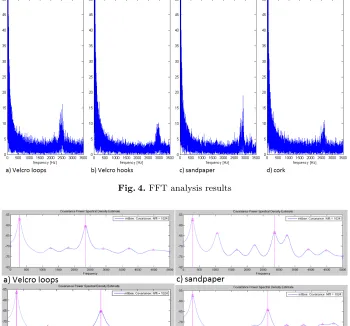
The recorded samples were initially processed using fast Fourier transform (FFT) to look for patterns in the signal frequency response. The data varied between samples of the same surfaces; however, most samples showed a relatively consis-tent pattern of very high magnitude at low frequencies followed by low magnitude at higher frequency with a region of relatively high magnitude at frequencies be-tween 2250 Hz and 3250 Hz (Figure 4). Surprisingly, this pattern only appeared in samples recorded with non-constant motion speed and contact pressure but not in samples recorded with constant speed and pressure.
Fig. 4.FFT analysis results
Fig. 5.Covariance Spectrum Filter analysis results
Spectrum Filter analysis results show the same peaks of activity close to 2500 Hz for smooth surfaces and close to 2800-3000 Hz for rough surfaces.
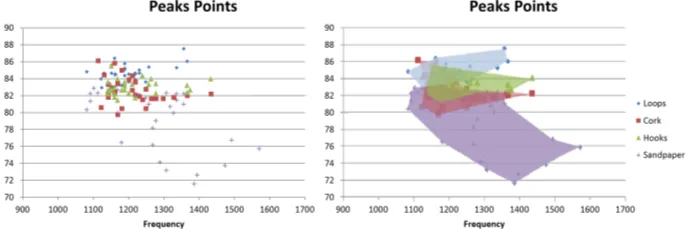
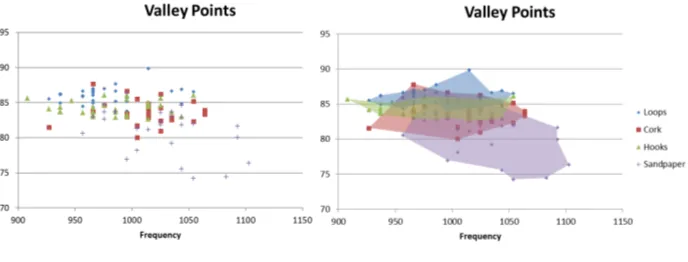
[image:6.612.134.480.283.398.2]The results also suggest another region with potential identifying features within the range of 900-1600 Hz (Figure 6). The peaks and valley points be-tween the two frequencies for 120 samples (30 samples per surface) are plotted in Figures 7 and 8. The plots show that the points are apparently randomly distributed; however, there is a large area (about 50%) that is exclusively oc-cupied by sandpaper points. In case of peaks points, this area contains 18 of the 30 points from sandpaper samples. Also more than 60 points of the other surfaces’ samples lie outside the total sandpaper area. In case of valley points, the exclusive sandpaper area contains only 11 of the 30 sandpaper points, and only 40 of the other surfaces data points lie outside the total sandpaper area.
Fig. 7.Distribution map of peaks points
6
Discussion
The results show that some information do exist in the signal from a single point FSR to differentiate between surfaces with different textures. One particularly interesting observation is that the observed patterns mainly exist in samples recorded with non-constant motion speed and contact pressure.
While the experiment would not completely isolate these features, the ob-tained results clearly show a potential to differentiate between textures, partic-ularly between rough and smooth textures.
Sandpaper in particular showed promising results. The distribution of the peaks points in Figure 7 suggest that sandpaper can be positively detected 60% of the time, while it can be correctly ruled out 67% of the time.
7
Conclusion And Future Work
Fig. 8.Distribution map of valley points
motion across the surface with non-constant speed and contact pressure. This information is not sufficient to quantify the roughness of the surface texture.
In future experiments, we plan to investigate the effect of adding soft textured surfaces on either side of sensor representing the skin and its surface irregularities (fingerprint ridges). We also plan to investigate the effect of using two layers of FSRs, one made of a single large sensor while the other is made of four small sensors, to approximate the differences in receptive field diameters. These experiments will also include low-pass and high-pass filters to imitate the slow and fast adapting behaviour of human receptors and will be analysed using neural networks to investigate possibility of real-time surface recognition.
References
1. Cretu, A.M., De Oliveira, T.E.A., Prado Da Fonseca, V., Tawbe, B., Petriu, E.M., Groza, V.Z.: Computational intelligence and mechatronics solutions for robotic tac-tile object recognition. WISP 2015 - IEEE International Symposium on Intelligent Signal Processing, Proceedings (2) (2015)
2. De Oliveira, T.E.A., Cretu, A.M., Da Fonseca, V.P., Petriu, E.M.: Touch sensing for humanoid robots. IEEE Instrumentation and Measurement Magazine 18(5), 13–19 (2015)
3. Ho, V.A., Araki, T., Makikawa, M., Hirai, S.: Experimental investigation of sur-face identification ability of a low-profile fabric tactile sensor. IEEE International Conference on Intelligent Robots and Systems pp. 4497–4504 (2012)
4. Jones, L.A., Lederman, S.J.: Human Hand Function. Oxford University Press, USA (2006)
5. Lederman, S.J., Klatzky, R.L.: Hand movements: A window into haptic object recog-nition. Cognitive psychology 19(3), 342–368 (1987)
6. Limor Fried: Force Sensitive Resistor Overview (2012), https://learn.adafruit.com/force-sensitive-resistor-fsr
7. Strese, M., Schuwerk, C., Steinbach, E.: Surface classification using acceleration sig-nals recorded during human freehand movement. IEEE World Haptics Conference, WHC 2015 pp. 214–219 (2015)
![Fig. 1. Left) exploded view of the sensor, and Right) resistance-force relation [6]](https://thumb-us.123doks.com/thumbv2/123dok_us/720810.576141/3.612.152.456.558.643/fig-left-exploded-sensor-right-resistance-force-relation.webp)