Aligning the teaching of FCA with Existing Module
Learning Outcomes
ANDREWS, Simon <http://orcid.org/0000-0003-2094-7456>
Available from Sheffield Hallam University Research Archive (SHURA) at:
http://shura.shu.ac.uk/5071/
This document is the author deposited version. You are advised to consult the
publisher's version if you wish to cite from it.
Published version
ANDREWS, Simon (2011). Aligning the teaching of FCA with Existing Module
Learning Outcomes. In: ANDREWS, Simon, POLOVINA, Simon, HILL, Richard and
AKHGAR, Babak, (eds.) Conceptual Structures for Discovering Knowledge : 19th
International Conference on Conceptual Structures, ICCS 2011, Derby, UK, July
25-29, 2011. Proceedings. Lecture notes in computer science (6828). Springer,
394-401.
Copyright and re-use policy
See
http://shura.shu.ac.uk/information.html
Sheffield Hallam University Research Archive
Aligning the Teaching of FCA with Existing
Module Learning Outcomes
Simon Andrews
Conceptual Structures Research Group Communication and Computing Research Centre
Sheffield Hallam University, Sheffield, UK [email protected]
Abstract. Careful design of teaching and assessment activities is re-quired to properly align a topic to the intended learning outcomes of a module. This paper describes and evaluates a four year project to align the teaching of FCA with the learning outcomes of a final-year un-dergraduateSmart Applications module at Sheffield Hallam University. Biggs’ constructive alignment, incorporating an adapted version of Yin’s case study research method, was used in an iterative process to analyse and modify teaching and assessment activities.
1
Introduction
Formal Concept Analysis (FCA) [5] is a valuable subject to study as part of many Degree courses; it has applications in biological sciences, music, linguistics, data mining, semantic searching and in many other area. Its mathematical basis, visualisation and wide scope for software development make it a suitable problem domain in a variety of disciplines.
At Sheffield Hallam University, a project was undertaken to introduce FCA as a topic to an existing undergraduate computing module called Smart Appli-cations. It was felt that that the applications of FCA, particularly in semantic search and knowledge organisation, made it an interesting subject for the mod-ule. To monitor the success of its introduction and make modifications where it was found to be not properly aligned to the existing learning outcomes, an iter-ative approach was taken, applying the constructive alignment model of Biggs [2]
2
Biggs Constructive Alignment
outcomes [3]. The problem with the introduction of a new topic into an existing curriculum is that the intended learning outcomes of the module will probably have been designed without the new topic in mind. A means is required of testing the alignment of the new topic with the existing scheme. Central to Biggs’ is the notion that students construct their own meaning from their learning activities. A means of accessing these constructed meanings could, therefore, be used to ascertain the extent to which particular learning outcomes have been met.
[image:3.612.168.450.295.442.2]The author’s familiarity with research methods led to the idea of using a research method to identify the extent to which existing Smart Applications learning outcomes were being met by FCA. The common practice of using case studies as assignments for the Smart Applications module, combined with the idea that modifications would play a key role in the alignment process, suggested Yin’s case study research method [6].
Fig. 1.Biggs constructive alignment: source HEA academy [4]
3
Yin’s Case Study Research Method
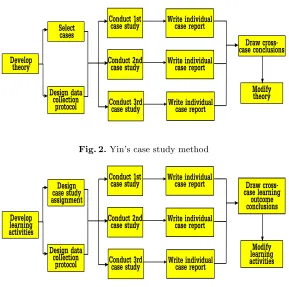
Fig. 2.Yin’s case study method
Fig. 3.Yin’s case study method adapted for Biggs
3.1 Data Collection
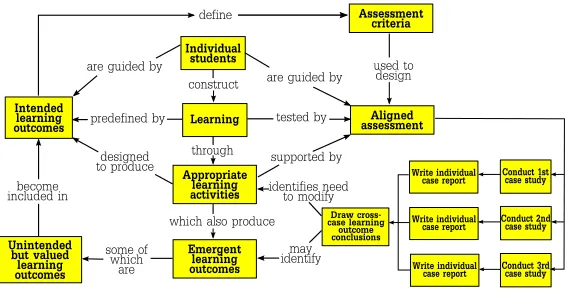
To conduct Yin, a data collection protocol is required that allows the testing of the theory. For the purpose of using Biggs, a data collection protocol was required that would allow cross-case conclusions to be made regarding the outcomes of learning activities; how well have the students achieved the intended learning outcomes of the module? Because students’ construction of their own meaning is so central to Biggs, it seemed sensible to use students’ own conclusions from their case study assignments as the data source. The content of coursework clearly provides qualitative evidence of learning and, by taking only the concluding sections of coursework, appropriate data in a manageable quantity could be procured. Analysis of the students’ conclusions also provided the mechanism in Biggs whereby emergent learning outcomes could be identified.
Fig. 4.Yin’s adapted case study method incorporated into Biggs constructive align-ment
4
Applying the Method: The Four Cycle Smart
Applications Project
Smart Applications is a final year undergraduate computing module taught at Sheffield Hallam University. One of the aims of the module is to introduce stu-dents to frameworks and techniques for representing and reasoning with knowl-edge for smart applications. It was felt that FCA was appropriate to study to achieve this aim. However, it would have to be aligned with the existing in-tended learning outcomes (ILOs). It was decided to use this as an opportunity to develop and test the pedagogical method, described above. The process was carried out in four cycles, over the academic years 2007/8, 2008/9, 2009/10 and 2010/11. The existing ILOs were:
ILO1 Describe the notion of representing and reasoning with knowledge for smart applications.
ILO2 Draw on one or more frameworks and techniques for representing and reasoning with knowledge for smart applications.
ILO3 Critically evaluate the key issues in knowledge representation and knowledge sharing for smart applications.
ILO4 Identify the practical use of software tools for developing smart applications.
4.1 Cycle 1: 2007/8
students were asked to investigate possible solutions and make their own rec-ommendations. The deliverable was a report that considered “How might the implementation of a ‘user profile concept lattice’ be accomplished, that supports the capture and reconfiguration of user profiles?” The following are quotes from the conclusions of the students’ case study reports that gave an indication of the learning outcomes achieved:
1. “FCA lends itself well to mapping user profile details. This is best achieved using a series of different lattices covering the different aspects of user profiles. Trying to capture all of the relevant user information in one lattice would probably be a little ambitious and also result in a complex and impractical lattice.”
2. “Through implementation of web mining techniques of Association rules or Con-ceptual Clustering Mining you can capture User Profiles.”
3. “By utilising BI techniques and FCA modeling, user profiles would be smart as they would show relevant information to users across the company.”
4. “I have found that using FCA for capturing User Profiles makes seeing the re-lationship between objects and attribute a lot easier, which we can then use to see relationships for that particular profile which helps gathering data for use in trends.”
5. “Through user profiling with FCA I found that content and information only rel-evant to that particular individual within the company can be displayed, saving time and improving productivity.”
6. “Although FCA seems to be a good way to analyse and create user profiles it can become slightly difficult if you have a model that constantly changes as it can be difficult to adapt a new role into the model.”
7. “Once a Smart Google system can comprehend the context of a sentence, through the identification of relations between words in a search phrase, it will then deliver the user with answers rather than results. This I would consider as smart.” 8. “Combining FCA and BI with the functions and facilities available in Web DynPro
has the capacity to store a lot of information in a very well organised and formal structure, which can be added to or reduced very easily, with little adaptation of the data structure.”
on the mathematical theory of FCA and more on its practical application; per-haps by implementing FCA-based software, students’ learning outcomes would be better aligned with the intended ones.
4.2 Cycle 2: 2008/9
Modifications were made to the learning activities of the previous cycle to focus less on the theoretical aspects of FCA and more on the engineering of FCA-based software. The themes were Semantic Search: ‘Sleuthing’ with FCA,Data Structures for FCAandFCA-based Smart User Interfaces. The assignment was a modified version of the 2007/8 assignment, with an element of application prototyping replacing the investigation of theory. The following are quotes from the case study reports:
1. “Integrating FCA user profiles into an SUI such as Dynpro comes with issues. Dynpro is not very flexible in terms of changing things by the program. It requires the user profiles to already be configured to support an FCA ontology.”
2. “Concept lattices were used to structure ... an FCA-based user profile. This data was ... integrated into a Smart User Interface (SUI) by being focused on the or-ganising, sorting and searching of data, and finding matching concepts.”
3. “Using the unique way that FCA stores and represents knowledge the Smart User Interface can give the user multiple ways of finding information.”
4. “We defined user sessions as only the URLs that have been requested and visited by the user. This considerably lowered the amount of attributes and data that had to be analysed.”
5. “We have presented how Web Dynpro implements the MVC framework which allows FCA of the data used within it, integrated with BI to support user profiles, customising a user’s interface, manipulating it to suit the aims of enterprise and user. Using FCA to discover patterns and correlations [was a] way of determining relationships and discovering the implicit ones that other methods struggle to uncover.”
6. “It is possible to integrate the FCA user profiles successfully; however, there are several difficulties when implementing them: firstly there’s the issue with accuracy, as the larger the company or department the more complicated it is going to be to implement. There’s also a concern with timing, as it’s a long process computing the profiles.”
7. “The use of FCA based user Profiles as the basis for e-commerce recommender systems does bring benefits, but the same level of functionality can be achieved using [off-the-shelf] alternatives.”
achievement was unsatifactory. Although the quotes give an encouraging picture of the learning that has taken place, the technical aspects were a struggle. The programming skills of the students were not sufficient for developing a useful prototype application. It was therefore decided to modify the learning activities to require less of these technical skills and focus more on the investigation, use and development of existing FCA tools and applications.
4.3 Cycles 3 & 4: 2009/10 & 2010/11
For cycle 3 the learning activities were based on the themes of FCA Tools,
FCA ‘Sleuth’ Applications and Data Mining with FCA. Practical sessions were designed to explore the capabilities and limitations of existing software. The assignment was changed by replacing the prototyping element with one that used existing tools and techniques to carry out FCA on real sets of user profile data. The following are quotes from the case study reports:
1. “FCA raises new questions regarding the actual warranty of ‘hidden’ information. How can we trust that a smart application is actually giving the right results?” 2. “To make this investigation even more interesting, we could use similar FCA
tech-niques on the categorised attributes and incorporate the boolean attributes to discover if the top 4 factors are actually the factors of people from all age groups, for example.”
3. “Filtering the formal concepts generated allowed for visualisation of the large data set and allowed for affective analysis.”
4. “Although there may be some current issues with the interoperability of FCA in existing technologies ... FCA could be integral to the development of semantic knowledge architectures.”
5. “While formal concept analysis and the enabling technologies described are now in a usable state, the applications to use it now have to catch up with them.” 6. “Visualisation techniques are key to enabling Smart Applications. Information that
would be hard to find otherwise was made clear to understand.”
7. “There seems to be a lack of ability to be able to communicate and exchange data between FCA systems and tools with non-FCA applications. Although the data mining is ‘smart’, problems arise when changes are needed to be made to lattices.”
The marks for the assignment had a mean of 67%. The quotes indicate that the ILOs have been met, and to a good extent. Notions of representing and reasoning with knowledge for smart applications (ILO1) and the drawing on FCA as a framework/technique for smart applications (ILO2) are apparent in many of the comments. There is good evidence that an ability to critically evaluate key issues has been demonstrated (ILO3), particularly in quotes 1, 3, 4 and 7. And there is a strong sense that the students can identify the practical use of software tools for developing smart applications (ILO4).
5
Conclusion
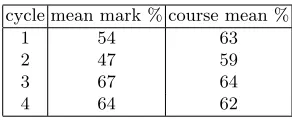
This four-year Smart Applications project shows that FCA can be aligned with the intended learning outcomes of a suitable existing module using sound peda-gogical practice. In Yin’s adapted case-study method, students drew conclusions on the work they had undertaken, then, from these, teachers drew cross-case conclusions regarding the learning outcomes achieved and how far they were aligned with the intended ones. The students’ concluding remarks gave a quali-tative measure of their learning whilst their marks gave a quantiquali-tative measure of the depth of their learning. The results of all four cycles are summarised in Table 1. The mean mark of for the course as a whole is given to corroborate the alignment.
[image:9.612.234.380.330.390.2]An improvement to the method may be found by designing the assessment activities in such a way that the marks can be assigned to ILOs, so that alignment with individual ILOs can be quantified.
Table 1.Summary ofSmart ApplicationsResults
cycle mean mark % course mean %
1 54 63
2 47 59
3 67 64
4 64 62
Acknowledgment This paper is a revised and updated version of one presented at CS-LTA 2010 [1].
References
1. Andrews, S: Aligning the Topic of FCA with Existing Module Learning Outcomes. In Polovina, S.,Et al.(eds.) Artificial Intelligence Workshops: 1st Conceptual Struc-tures - Learning, Teaching and Assessment Workshop at ICCS 2010, Kuching, Malaysia (2010)
2. Biggs, J.: Teaching for Quality Learning at University, SRHE and Open University Press, Buckingham (1999)
3. Biggs, J.: Aligning Teaching and Assessment to Curriculum Objectives, (maginative Curriculum Project, LTSN Generic Centre (2003)
4. HEA Academy, Learning and Teaching Theory Guide:http://www.engsc.ac.uk/ learning-and-teaching-theory-guide/constructive-alignment
5. Wille, R.: Formal Concept Analysis as Mathematical Theory of Concepts and Con-cept Hierarchies. In: Ganter, B., Stumme, G., Wille, R. (eds.),Formal Concept Anal-ysis: Foundations and Applications, pages 1-33. Springer-Verlag, Germany (2005). 6. Yin, R., K.: Case Study Research: Design and Methods (4th Ed.). Applied Social
![Fig. 1. Biggs constructive alignment: source HEA academy [4]](https://thumb-us.123doks.com/thumbv2/123dok_us/748793.580154/3.612.168.450.295.442/fig-biggs-constructive-alignment-source-hea-academy.webp)