ASSESSMENT OF IMPACT OF TEACHING ON KNOWLEDGE AND
AWARENESS AMONG MBBS STUDENTS ABOUT THE DRUG
PACKAGE INSERTS
Smita Y. Wankhede1*, Milind L. Pardeshi2, Vishal V. Ghorpade3 and Balasaheb B.
Ghongane4
1
Junior Resident 3, Department of Pharmacology, B.J. Medical College, Pune, Maharashtra,
India.
2
Associate Professor, Department of Pharmacology, B.J. Medical College, Pune,
Maharashtra, India.
3
Assistant Professor, Department of Pharmacology, B.J. Medical College, Pune, Maharashtra,
India.
4
Professor & Head Department of Pharmacology, B.J. Medical College, Pune, Maharashtra,
India.
ABSTRACT
Background: Patients Package Inserts (PPI’s) are the printed leaflet
that contains information based on regulatory guidelines for the safe
and effective use of a drug. Patients who read the PPI’s are more likely
to follows the instructions, especially if the information in the PPI’s
agrees with instructions of the physician and or pharmacist. Methods:
A questionnaire consisting of questions related to drug package inserts
and its importance, were formulated in the form of pre-test. These
questionnaire were distributed in the students and data was collected.
After that a short lecture was delivered on DPI and same questionnaire
were given again as a post test and the data collected was analysed.
Results: Total 100 second year MBBS students answered the
questionnaires. In the pre-test, 56% were aware of the term drug package inserts and 31%
knew that it is in English language. Only 10% were aware that DPI is the authentic source of
information for new drug. 75% opined, it is mandatory with new drug. Lastly nobody was
knowing about the Rule & Act by which package inserts are governed. After delivering
lecture, in post-test highly significant improvement was observed. All were knowing the term
Volume 6, Issue 3, 670-678. Research Article ISSN 2277– 7105
*Corresponding Author
Dr. Smita Y. Wankhede
Junior Resident 3,
Department of
Pharmacology, B.J. Medical
College, Pune, Maharashtra,
India.
Article Received on 08 Jan. 2017,
Revised on 28 Jan. 2017, Accepted on 18 Feb. 2017
DPI and answered correctly about the language used and DPI as an authentic source of
information. Conclusions: Awareness regarding DPI can be improved by adding a short
lecture to the curriculum of second MBBS.
KEYWORDS Teaching, Awareness, Drug package inserts, Medical students.
INTRODUCTION
The drug package inserts also known as patient package insert (PPI), an information leaflet
included by law in the packaging of prescription drugs. It is approved by the administrative
licensing authority. During the 1970s, the patient package insert (PPI) was widely promoted
as a way to increase patient knowledge and to encourage proper use of medications.[1] The
leaflet is meant to be clear and understandable.[2] A package insert primarily directed at the
prescribers, is intended to provide information for the safe and effective use of the respective
drug.[3] Doctors in developing countries lack easy access to independent medication
information.[4] In India, prescribers are likely dependent on product information provided by
pharmaceutical companies which has been determined to be far from adequate and not
conforming to WHO recommendations.[5] Package inserts by virtue of being amenable to
strict regulations and being readily available with the drug product can serve as reliable and
accurate sources of drug information.[6]
In India the concept of package inserts is governed by Section 6.2 and 6.3 of “Drug and
Cosmetic Act 1940 and Drug and Cosmetic Rules 1945.[7] [8] Latest amendment of the act was
enforced in 2013. The Drugs and Cosmetics Rules do not specify the user of package insert
but it appears to be directed to the healthcare professionals. Also, the text in 'Schedule Y' of
the rules does refer to package inserts as prescribing information.[9] Patients may
independently consult the package leaflets to clarify their doubts, such as information on
medicine administration.[10] The benefits of reading the leaflet include increased knowledge
of the correct method of taking the drug and the possible side effects.[11]
Undergraduate 2nd year MBBS students who are already introduced to the subject of
pharmacology, are well familiar about various drugs and its importance in various diseases.
These students can very well understand the importance of contents of drug package inserts,
provided they are supplied with the necessary information in their curriculum itself. They are
the upcoming prescribers who need to be updated for their knowledge of drug while
2nd year MBBS students about the knowledge of drug package inserts and its importance and
to assess the improvement if any, in their knowledge after a short introductory lecture on drug
package inserts.
MATERIAL AND METHODS
This was a questionnaire based pre- and post-lecture comparative study. It was conducted
among the 2nd year MBBS students of a teaching institute in Maharashtra state in the year
2016. A questionnaire consisting of 20 question with multiple choice options related to drug
package inserts were framed for pre-test. The questionnaire was based on questions regarding
knowledge about the drug package inserts in general and its importance. These questionnaire
was distributed in the form of pre-test in the students and data was collected. After that a
short lecture of about 30 minutes was delivered on the drug package inserts and same
questionnaire was given again as a post test.
The data filled by the students was entered into excel sheet 2013 and was analysed and
compare for the result before and after the test by using paired t test to determine the
significance of training. A p value was calculated and p < 0.05 was considered statistically
significant. Ethical committee approval was taken before starting the study. Informed written
consent was taken before starting the pre-test and Ethical approval was taken from the
institutional ethical committee before starting the study.
RESULTS
Total 100 students participated in this study. Results of pre-test and post-test were analysed
separately and were compared during analysis. In pre-test, 56% of students were knowing the
term drug package inserts and only 45% were knowing the importance of reading the drug
package inserts before taking any new medication. Package inserts are written only in English
language according to drug and cosmetic act and rule was known to 28% of students where as
10 % of them were knowing that it is the authentic source of information for a new drug
Figure 1: Pre-Test results of Term DPI, language used, Importance and source of DPI
Whereas results of post- test showed that all of them answered the questions regarding Drug
package inserts, importance of using them, language in which they are written and
authenticity of DPI. This result of post- test was statistically significant when compared with
pre-test.
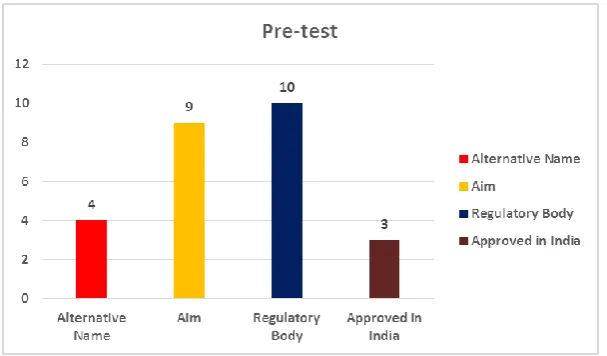
In pre- test, when asked about alternative name for drug package inserts, only 4% were
knowing that it is also called as Patient’s Package Inserts. Only 9% were knowing the aim
behind providing drug package inserts with the medication. When asked regarding regulatory
body for the DPI in India, 10% of them answered correctly whereas 3% students were
knowing that CDSCO approves DPI in India. (Figure2).
Figure 2: Pre-test results of alternative name, aim and regulatory body and DPI
approval in India
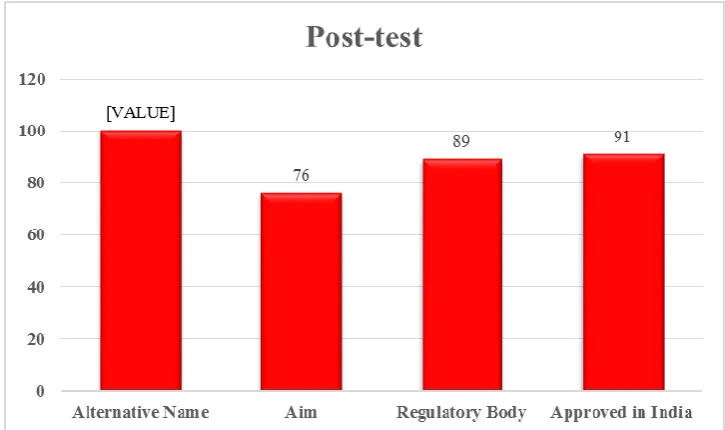
Post –test results were quite satisfactory and statistically significant when compared to
[image:4.595.147.451.490.668.2]answered correctly regarding aim of DPI, 89% were knowing the regulatory body governing
DPI whereas 91% were able to answer correctly that CDSCO approves the DPI in India
[image:5.595.115.478.145.360.2](Figure3).
Figure 3: Post-test results of alternative name, aim, regulatory body and DPI approval
in India
When asked regarding normal font size of drug package inserts, only 6% were knowing the
correct font size of 11-12 recommended by Drugs and Cosmetic Act 1940 and Rule 1945.
While only 2% answered correctly the user of DPI according to Drugs and Cosmetic Rule.
28% of students were of the opinion that package inserts in India needs improvement but
when asked how nobody was able to answer it (Figure 4).
Figure 4: Pre- test result of questions asked on font size, user and improvement
When answers given in post-test were compared with pre-test, 87% were knowing that font
90% of students were in the opinion that package inserts in India needs improvement which
was statistically significant when compared with pre-test.54% of them answered to the
question that DPI needs improvement in terms of font size, simple and regional language
[image:6.595.146.450.167.336.2](Figure5).
Figure 5: Post- test result of questions asked on font size, user and improvement
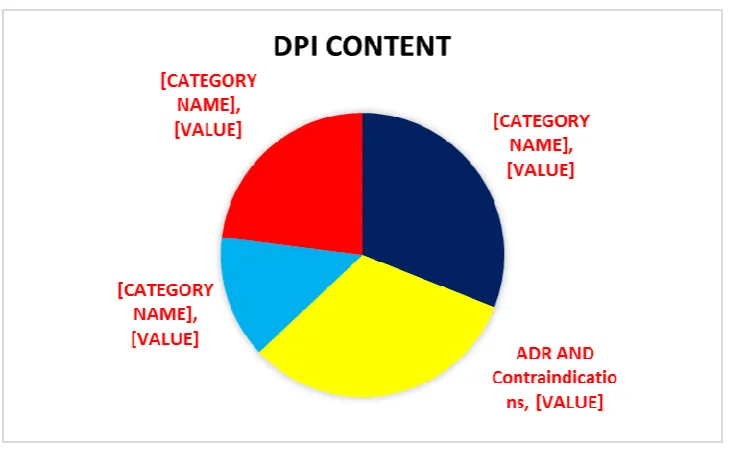
In the pre-test, when asked which information should be present in every package
inserts,31% students answered Adverse drug reactions (ADR),32% answered ADR and
contraindications,14% answered Indications and precautions while 23% answered
contraindication and storage conditions (Figure 6).
Figure 6: Pre- test result of students read DPI for which Headings
When results of post- test were compared with pre-test statistically significant result was
[image:6.595.116.483.471.700.2]adverse drug reactions and storage conditions are equally important and should be present in
every package inserts.
Lastly, in the pre-test results, nobody was knowing about the Rule & Act and its latest
amendment by which package inserts are governed and also about the contents of section 6.2
and section 6.3 in the Drug and cosmetic act 1940 and rule 1945. While in the post-test, all
were knowing the details of drug and cosmetic Act and Rule which was statistically
significant result.
DISCUSSION
No study was found on comparison of pre and post lecture study among medical students.
However, few KAP studies were found. Many studies suggest that patients may retain only
20% of the information given by their doctors. However it has been observed that when
verbal counselling is complemented with visual or written material, patients may remember
up to 50% of the information.[12] Hence package inserts are very important source of
document for increasing knowledge regarding new medications.
The results of the study suggested the limited knowledge among students regarding DPI due
to lack of awareness about its importance. Analysis of KAP pre and post education suggests
that a significant improvement in post KAP scores occurred in the students. In this study,
56% students were aware of the term drug package inserts. In a previous study done in 250
interns, only 30 % were knowing the term drug package inserts.[13] It was observed in a study
done by Gupta V.K. that significantly large number of students (42%) among 100 students do
not even read DPI.[14] Another study suggested that students mostly read DPI for ADR and
contraindications.[15][16] This results matches with the result of our study that maximum
students look for ADR and Contraindications in DPI. Medical Jargon and technical terms
used in classical Package Inserts texts, could also stand as barriers to PIs’ texts
understanding, so they should be written in easy and understandable language which was
suggested by students in post-test.[17] In pre-test only 6% were knowing the normal font size
of package inserts while 87% were able to answer correctly in post-test about font size and
problems in readability due to small font size. Other studies done on package inserts font size
also suggest that most of the package inserts are not according to recommended font
size.[11][12][18] The DPIs and the medical representatives were considered among the most
frequently used sources of medication information by physician and pharmacists.[19] This
CONCLUSION
The package inserts are the good and authentic source of information for doctors as well as
patients. Doctors should go through drug package inserts before prescribing any new drug to
avoid any medical errors. As package inserts are one of the most frequently used sources of
written drug information, approaches to optimize them should be explored as soon as
possible. This especially refers to difficulties in understanding the extensive information
provided, and suggests a more suitable structure of package inserts. Hence there is need to
present the package inserts in accurate information with headings for well understanding of
the user. Lastly it should be easy to read and should also be present in regional language.
This study also suggest there is a need to increase awareness about the importance of drug
package inserts among the upcoming doctors i.e., MBBS students. Regular training sessions
must be carried out for all medical professionals including medical students, doctors and
pharmacists.
ACKNOWLEDGEMENTS
None.
DECLARATIONS
Funding: None
Conflict of interest: None declared
Ethical approval: Taken from the institutional ethical committee before starting study.
REFERENCES
1. De Tullio P. L. et. al., Patient Medication Instruction and Provider Interactions: Effects
on Knowledge and Attitudes. Health education quarterly; 13(1): 51-60.
2. Griffin JP, Griffin JR. Informing the patient. J R Coll Phys, 1996; 30: 102–3.
3. Ved J. Package inserts in India: need for a revision. Int Journal of Pharma Sciences and
Research, 2010; 1(11): 454-456.
4. Miller P, Macmullan J, Upchurch L. Drug, doctors and dinners. How drug companies
influence health in the developing world. London: Consumer International (CI); 2007;
9-29.
5. Shivkar Y.M. Clinical information in drug package inserts in India. J. Postgrad Med
6. Kaikade SB, Jha RK. Assessment of awareness and attitude towards package inserts
amongst rural population. RJPBCS 2011; 2(4): 982-85.
7. Govt. of India, Ministry Of Health and Family Welfare. Drug and Cosmetic Act 1940.
8. Govt. of India, Ministry Of Health and Family Welfare. Drug and Cosmetic Rule 1945,
amendment 2013. Available at http: //cdsco.nic.in/html/Drugs and CosmeticAct.pdf.
Accessed 6th Dec 2015.
9. Kalam A et al., Drug Package Inserts in India: Current Scenario. WJPPS 2014; 3(4):
385-392.
10.Pires C et al. Readability of medicinal package leaflets. Rev Saude Publica, 2015; 49:
1-13.
11.Vinker S et al. The Effect of Drug Information Leaflets on Patient Behavior. IMAJ; 9:
383-386.
12.Adepu R. Assessment of Patient Information Leaflets Usefulness in Selected Chronic
Diseases - A South Indian Based Study. Indian Journal of Pharmacy Practice March
2014; 7(1): 23-28.
13.Wankhede S.Y. Knowledge and awareness about the drug package inserts in medical
interns. IJPR 2016; 6(2): 129-132.
14.Gupta VK, Pathak SS. Assessment of Awareness and Knowledge About Package Inserts
Amongst Medical Students: A Questionnaire Based Study. IOSR Journal of Pharmacy
Mar.-Apr. 2012; 2(2): 215-217.
15.Sharma S, Syed A, Ahmed T. A study of package insert amongst medical, nursing
students: A questionnaire based study. Research journal of Pharmacology and
Pharmacodynamics.2014; 6(4): 181-183.
16.Rai S. et. al., Assessment of awareness regarding package inserts among medical students
of a medical college at Chennai. Int J Pharm Bio Sci 2016 April; 7(2): 843 – 847.
17.Idris KAMA, Yousif MA, Elkhawad AO. Medications package inserts’ usefulness to
doctors and patients: Sudanese doctors perspective. Int J Basic Clin Pharmacol 2014; 3:
718-22.
18.Bernardini C, et al. How to improve readability of the patient package leaflet: A survey
on the use of color print size and layout. Pharmacol Res, 2001; 43(5): 437 – 444.
19.Al-Ramahi R, Zaid AN, Kettana N, Sweileh W, Al-Jabi D. Attitudes of consumers and
healthcare professionals towards the patient package inserts - a study in Palestine.