Table of Contents Index
Full Description Reviews Reader reviews Errata
Java and XML Data Binding
Brett McLaughlin
Publisher: O'Reilly
First Edition May 2002
ISBN: 0-596-00278-5, 214 pages
This new title provides an in-depth technical look at XML Data Binding. The book offers complete documentation of all features in both the Sun Microsystems JAXB API and popular open source alternative
implementations (Enhydra Zeus, Exolabs Castor and Quick). It also gets into significant detail about when data binding is appropriate to use, and provides numerous practical examples of using data binding in
Copyright © 2002 O'Reilly & Associates, Inc. All rights reserved.
Printed in the United States of America.
Published by O'Reilly & Associates, Inc., 1005 Gravenstein Highway North, Sebastopol, CA 95472.
O'Reilly & Associates books may be purchased for educational, business, or sales
promotional use. Online editions are also available for most titles (safari.oreilly.com). For more information contact our corporate/institutional sales department: (800) 998-9938 or [email protected].
Nutshell Handbook, the Nutshell Handbook logo, and the O'Reilly logo are registered trademarks of O'Reilly & Associates, Inc. Many of the designations used by
manufacturers and sellers to distinguish their products are claimed as trademarks. Where those designations appear in this book, and O'Reilly & Associates, Inc. was aware of a trademark claim, the designations have been printed in caps or initial caps. The
association between the image of an osprey and the topic of Java and XML data binding is a trademark of O'Reilly & Associates, Inc.
Table of Content
Table of Content ... 3
Preface... 5
Organization... 6
Conventions Used in This Book ... 8
Comments and Questions ... 8
Acknowledgments... 9
Chapter 1. Introduction ... 10
1.1 Low-Level APIs... 10
1.2 High-Level APIs ... 13
1.3 What Is Data Binding?... 16
1.4 What You'll Need... 18
Chapter 2. Theory and Concepts... 21
2.1 Foundational APIs ... 21
2.2 Dependent APIs ... 26
2.3 Constraint-Modeled Data... 28
2.4 API Transparence... 33
Chapter 3. Generating Classes ... 37
3.1 Process Flow ... 37
3.2 Creating the Constraints... 40
3.3 Binding Schema Basics... 46
3.4 Generating Java Source Files... 50
Chapter 4. Unmarshalling ... 55
4.1 Process Flow ... 55
4.2 Creating the XML... 59
4.3 Converting to Java ... 64
4.4 Using the Results ... 68
Chapter 5. Marshalling... 79
5.1 Process Flow ... 79
5.2 Validating Java Objects ... 81
5.3 Converting to XML... 88
5.4 Process Loops ... 98
Chapter 6. Binding Schemas... 101
6.1 The Basics... 101
6.2 Structure and Global Options... 103
6.3 Elements and Attributes... 105
6.4 And More... 114
Chapter 7. Zeus ... 124
7.1 Process Flow ... 124
7.2 Installation and Setup... 126
7.3 Class Generation ... 127
7.4 Unmarshalling and Marshalling... 131
Chapter 8. Castor ... 143
8.1 Process Flow ... 143
8.2 Installation and Setup... 144
8.3 Class Generation ... 145
8.4 Unmarshalling and Marshalling... 149
8.5 Additional Features... 161
Chapter 9. Quick ... 166
9.1 Process Flow ... 166
9.2 Installation and Setup... 170
9.3 Unmarshalling and Marshalling... 170
9.4 Additional Features... 183
Chapter 10. Looking Forward... 185
10.1 JAXB... 185
10.2 Alternate Implementations... 186
10.3 J2EE ... 188
Appendix A. Tools Reference... 191
A.1 JAXB... 191
A.2 Zeus... 191
A.3 Castor ... 192
A.4 Quick... 193
Appendix B. Quick Source Files ... 196
54237222223154051095082227176186254241250143239137210252117074104060119172099042079097244175
Preface
XML data binding. Yes, it's yet another Java and XML API. Haven't we seen enough of this by now? If you don't like SAX or DOM, you can use JDOM or dom4j. If they don't suit you, SOAP and WSDL provide some neat features. But then there is JAXP, JAXR, and XML-RPC. If you just can't get the swing of those, perhaps RSS, portlets, Cocoon, Barracuda, XMLC, or JSP with XML-based tag libraries is the way to go.
The point of that ridiculous opening is that you, as a developer, should expect some justification for buying yet another XML book, on yet another XML API. The market seems flooded with books like this, and the torrent has yet to slow down. And while I realize that I use circular reasoning when insisting that this API is important (I did write this book on it), that's just what I'm going to do.
XML data binding has taken the XML world by storm. Thousands of programmers simply threw up their hands trying to track SAX, DOM, JDOM, dom4J, JAXP, and the rest. It's become increasingly difficult to parse a silly little XML document, rather than increasingly simple. If it's not namespaces that get you, it's whitespace. Is that carriage return after my element name significant? Well, it depends on whether you specify a DTD; oh, you used an XML Schema? Well, we don't support that yet. I'm sure you know exactly what I'm talking about.
The reason why XML data binding is important, and so remarkably different from other approaches, is because it gets you from XML to business data with no stops in between. You don't have to deal with angle brackets, entity references, or namespaces. A data binding framework converts from XML to data, without your messing around under the hood. For most developers who try to get into XML without spending months doing it, data binding is just the answer you are looking for.
This book covers data binding from front to back, giving you the ins and outs of what may turn out to be the API that makes XML accessible to even the newest programmers. You'll learn how to perform basic conversions from Java to XML, all the way to using various frameworks for advanced transformations and mappings. It's all in this (nicely compact) book, without lots of wasted words and frilly examples. If you want to use data binding, this book is for you. If you don't, well, put it down and go pick up about ten other books so you can manipulate XML some other way. I think the choice is obvious; so get started!
Organization
I begin this book with a brief explanation of what data binding is and what other APIs are in the XML field. From there, I provide an extensive look at Sun's JAXB, that company's data binding framework. You'll learn every option and every switch to use this package. Then, to round out your data binding skills, I examine three other popular open source data binding frameworks, each with its strengths and weaknesses.
Chapter 1
This chapter is a basic introduction to XML data binding and to the general Java and XML landscape that currently exists. It details the basic Java and XML APIs available and organizes them by the general usage situations to which they are applied. It also details setting up for the rest of the book.
Chapter 2
This chapter is the (only) theoretical chapter in the book. It details the difference between data-driven and business-driven APIs and explains when one model is preferable over the other. It then explains how constraint modeling fits into the data binding picture and how data binding makes XML invisible to the
application developer.
Chapter 3
This chapter is the first detailed introduction to data binding. It explains the process of taking a set of XML constraints and converting those constraints into a set of Java source files. It details how this is accomplished using the JAXB API and then explains how the resultant source files can be compiled and used in a Java application.
Chapter 4
This chapter continues the nuts-and-bolts approach to teaching data binding. It covers the process of converting XML documents to Java objects and how the data should be modeled for correct conversion. It also details the use of resultant Java objects.
Chapter 5
Chapter 6
This chapter focuses on binding schemas and how they can customize
transformation from XML to Java. Every option in binding schemas is examined and discussed both technically and practically.
Chapter 7
This chapter begins an exploration of alternate data binding packages with Zeus. The coverage is based on the explored JAXB concepts and compares Zeus operation to the techniques already discussed in previous chapters. Particular attention is paid to Zeus enhancements that are not in the JAXB API.
Chapter 8
This chapter continues exploration of alternate data binding implementations by looking at Castor. This open source alternative was the first major data binding implementation available and offers many features not present in JAXB. These features, as well as process variations, are all covered in this chapter.
Chapter 9
Quick is another open source data binding API, and this chapter details its ins and outs. You'll see that Quick offers ideas and processes that are entirely different from most data binding frameworks and you'll learn how those differences can be put to work in your applications.
Chapter 10
This chapter looks at the future of data binding. It covers the final version of JAXB, as well as expectations for the next JAXB release. It also covers how alternate data binding implementations are likely to change with a JAXB 1.0 release and looks at JAXB in light of the J2EE platform.
Appendix A
This appendix details all the options for the tools provided by various data binding APIs. It can be used as a quick reference for each chapter and for your own programming projects.
Appendix B
Conventions Used in This Book
I use the following font conventions in this book:
Italic is used for:
• Unix pathnames, filenames, and program names • Internet addresses, such as domain names and URLs • New terms where they are defined
Boldface is used for:
• Emphasis in source code (including XML).
Constantwidth is used for:
• Command lines and options that should be typed verbatim
• Names and keywords in Java programs, including method names, variable names, and class names
• XML element names and tags, attribute names, and other XML constructs that appear as they would within an XML document
This symbol indicates a tip.
This symbol indicates a warning.
Comments and Questions
Please address comments and questions concerning this book to the publisher:
O'Reilly & Associates, Inc.
1005 Gravenstein Highway North Sebastopol, CA 95472
(800) 998-9938 (in the United States or Canada) (707) 829-0515 (international/local)
(707) 829-0104 (fax)
There is a web page for this book, which lists errata, examples, or any additional information. You can access this page at:
To comment or ask technical questions about this book, send email to:
For more information about books, conferences, Resource Centers, and the O'Reilly Network, see the O'Reilly web site at:
http://www.oreilly.com
Acknowledgments
At some point, you start writing acknowledgments and taking them for granted. Then, you realize that this is the only section that most of your family will read and understand, and you slow down and get them right.
First, for the technical folks. Mike Loukides and Kyle Hart manage to get me to write these books, and write them fast, without exploding. Thanks guys, but I'm going on vacation now! I had two incredible reviewers on this book, and they really transformed it from OK to great, in my opinion. Thanks to Michael Daudel and Niel Bornstein for persevering under major time constraints and still generating really good comments.
My family is always amazing, and always interested, even though I know they wonder what it is I write about. My parents, Larry and Judy McLaughlin, taught me to read and write and to do them both well. I'm eternally indebted, as are my readers! My aunt, Sarah Jane Burden, is always there to state the obvious in a way that makes me laugh, and my sister has simply grown up as I have written these books. She's now teaching math, probably producing more programmers and writers. I'm proud of you, Sis!
The other side of my family has been there for me since I met them, especially since we live in the same town. Gary and Shirley Greathouse, my father- and mother-in-law, keep me laughing as well, mostly at the strange things they manage to make their computers do ("So, there's this black screen with little rectangles—what do I do now?"). Quinn, Joni, Laura, and Lonnie are all fun to be around, and that's saying a lot. And little Nate, my first-ever nephew, is absolutely the coolest little guy on the planet, at least for a few more months.
My wife, Leigh, has lived with a husband who has written for more hours a day than he spends with her, for nearly three years, and has always loved and supported me. That's saying a lot, because I'm a royal pain most of the time. I love you, honey. And as for that "few more months" comment, I've got a little boy coming in June (2002) who should make life even more exciting. When you read this one day, kiddo, remember that I love you.
Chapter 1. Introduction
With the wealth of interest in XML in the last few years, developers have begun to crave more than the introductory books on XML and Java that are currently available. While a chapter or two on SAX, some basic information on JAXP, and a section on web services was sufficient when these APIs were developed, programmers now want more.
Specifically, there is a huge amount of interest in XML data binding, a new set of APIs that allows XML to be dealt with in Java simply and intuitively, without worrying about brackets and syntactical issues. The result is a need in the developer community for an extensive, technically focused documentation set on using data binding; examples are no longer just helpful, but a critical, required part of this documentation set. This book will provide that technical documentation, ready for immediate use in your application programming.
To fill this need, I want to start off on the right foot and dive into some technical material. This chapter will give you basic information about existing XML APIs and how they relate to XML data binding. From there, I move on to the four basic facets of data binding, which the first half of this book focuses on. Finally, to get you ready for the extensive examples I walk you through, I devote the last portion of this chapter to the APIs, projects, and tools you'll need throughout the rest of the book. From there on, I assault you with examples and technical details, so I hope you're ready.
1.1 Low-Level APIs
By the simple fact that you've picked up this book, I assume that you are interested in working with XML from within your Java programs and applications. However, it's probably not too smart to assume that you're a Java and XML expert (yet—although picking up my Java and XML book could help!), so I want to take you through the application programming interfaces (APIs) available for working with XML from Java. I'll start by detailing what I will henceforth refer to as low-level APIs. These APIs allow you direct access to an XML document's data, as well as its structure.
To illustrate this concept a little more clearly, consider the following simple XML document:
<?xml version="1.0"?>
<songs> <song>
<title>The Finishing Touch</title>
<artist type="Band">Sound Doctrine</artist> </song>
<song>
<title>Change Your World</title>
<artist type="Solo">Babyface</artist> </song>
<song>
<title>The Chasing Song</title>
<artist type="Band">Andy Peterson</artist> </song>
</songs>
An Abridged Dictionary
Before going further, you should know a couple of terms. For those of you familiar with XML, this should be old hat, but for XML newbies, this should prevent future confusion.
Well formed
An XML document that follows all the rules of XML syntax, such as closing every open element in the correct order.
Valid
An XML document that follows the constraints set out for it by a DTD or XML Schema. If the document does not follow these constraints, it is
invalid.
Anything else that confuses you can be found in a quick page, either through O'Reilly's Learning XML, by Erik Ray, or XML in a Nutshell, by Elliotte Rusty Harold and W. Scott Means. I recommend having one or both nearby as you go through this book.
Using a low-level API, you could access the textual content of the second artist
element in the second song. That's the data of the document. In addition, a low-level API lets you change the name of the third song element to folkSong, or move the second song element before the first one. In other words, you have direct access, though methods like setName() and getChild(), to the document itself. These actions don't involve the data in the document, but the structure. Understanding this concept is important because you'll see in a moment that a whole set of APIs don't allow this access and are aimed at a very different set of use cases.
when setting up communication in messaging. When it comes to solving a specific business problem, higher-level APIs (see the next section) are often more appropriate. With that in mind, let me give you the rundown on the major low-level APIs that are currently available.
1.1.1 Streamed Data
The grandfather of all Java-based low-level APIs is the Simple API for XML (SAX). SAX was the first major API released that has any sort of following, and it remains the basic building block of pretty much all other APIs. SAX is based on a streaming input and reads information from an XML input source piece by piece. In other words,
information is sent to the SAX interfaces as the related input stream (or reader) gets it. To use SAX for parsing, you register various handler implementations for handling content, errors, entities, and so forth. Each interface is made up of several callback methods, which receive information about specific data being sent to the parser, such as character data, the start of an element and the end of a prefix mapping. Your SAX-based
application can then use that information to perform business tasks within the callback method implementations.
The advantage to this stream-based approach is raw, blazing speed. SAX easily outstrips any other API in performance (and don't let anyone tell you differently). Because it reads a document piece by piece, making that data available as soon as it is encountered, your applications don't have to wait for the complete document to be parsed to operate upon the data. However, that speed carries a price: complexity. SAX is probably the hardest API for developers to wrap their heads around, and even then, many have trouble writing efficient SAX code. Because data is read in a streaming fashion, your callback methods won't have access to an element's children, its parent, or its siblings. Instead, you have to build up some in-memory stack if you want to keep an idea of tree location. Because of this complexity, it's easy to ignore important data or make mistakes when reading in data. As a result of this complexity, many developers pass up SAX and prefer an API that provides an in-memory model of an XML document. You can learn more about SAX online at http://www.saxproject.org.
1.1.2 Modeled Data
However, these disadvantages are paired with a significantly easier programming model, a means to traverse the content of the DOM tree, and several implementations that offer various options. For example, Apache Xerces offers a "deferred DOM," which makes some trade-offs to reduce the memory overhead when using DOM. For more on DOM, check out http://www.w3.org/DOM.
Recently, developers have moved away from DOM. This is because DOM has some quirks that are not familiar to Java developers; this isn't surprising, considering that DOM is specifically built to work across multiple languages (Java, C, and JavaScript). As a result, some of the choices made, such as the lack of support for Java Collections, don't sit well with Java developers. The result has been two APIs that both are object models aimed squarely at Java and XML developers. The first, JDOM (http://www.jdom.org), is focused on simplicity and avoiding interfaces in programming. The second, dom4j (http://www.dom4j.org), keeps the DOM-style interfaces, but (like JDOM) incorporates Java collections and other Java-style features. I prefer JDOM, but then I cofounded it, so I'm a bit biased! In any case, DOM, JDOM, and dom4j all offer more user-friendly approaches to XML than does SAX, at the expense of memory and performance.
1.1.3 Abstracted Data
Completing the run through low-level APIs, the third model is what I refer to as
abstracted data. This type of API is represented by Sun's Java API for XML Parsing (JAXP). It doesn't offer new functionality over the streamed data (SAX) or modeled data (DOM and company), but abstracts these APIs and makes them vendor-neutral. Because SAX and DOM are based on Java interfaces, different vendors provide implementations of them. These implementations often result in code that relies on a specific vendor parsing class, which ruins any chance of code portability. JAXP offers abstractions of the DOM and SAX APIs, allowing you to easily change parser vendors and API
implementations.
The latest version of JAXP, 1.1, offers this same abstracted data model over XML transformations, but that's a little beyond the scope of this book. In terms of pros and cons in using JAXP, I'd recommend it if you will work with SAX or DOM and can get the latest version of JAXP. It helps you avoid the hard-coded sort of problems that can creep in when working directly with a vendor's implementation classes. In any case, this brief little whirlwind tour should give you at least a basic understanding of the available low-level Java and XML APIs. With these APIs in mind, let me move up the rung a bit to high-level APIs.
1.2 High-Level APIs
So far, the APIs I've discussed have been driven by the data in an XML document. They give you flexibility and power, but also generally require that you write more code to access that power. However, XML has been around long enough that some pretty
<?xml version="1.0"?>
<ejb-jar> <entity>
<description>This is the Account EJB which represents
the information which is kept for each Customer</description>
<display-name>TheAccount</display-name> <ejb-name>TheAccount</ejb-name>
<home>com.sun.j2ee.blueprints.customer.account.ejb.AccountHome</home>
<remote>com.sun.j2ee.blueprints.customer.account.ejb.Account</remote>
<ejb- class>com.sun.j2ee.blueprints.customer.account.ejb.AccountEJB</ejb-class>
<persistence-type>Bean</persistence-type>
<prim-key-class>java.lang.String</prim-key-class> <reentrant>False</reentrant>
<env-entry>
<env-entry-name>ejb/account/AccountDAOClass</env-entry-name> <env-entry-type>java.lang.String</env-entry-type>
<env-entry-value>
com.sun.j2ee.blueprints.customer.account.dao.AccountDAOImpl </env-entry-value>
</env-entry>
<resource-ref>
<res-ref-name>jdbc/EstoreDataSource</res-ref-name> <res-type>javax.sql.DataSource</res-type>
<res-auth>Container</res-auth> </resource-ref>
</entity> </ejb-jar>
In this case, the example is a deployment descriptor from Sun's PetStore J2EE example application. Here, there isn't any data processing that needs to occur; an application that deploys this application wants to know the description, the display name, the home interface, and the remote interface. However, you can see that these are simply the names of the various elements.
Instead of spending time parsing and traversing, it would be much easier to code something like this:
List entities = ejbJar.getEntityList();
for (Iterator i = entities.iterator(); i.hasNext(); ) { Entity entity = (Entity)i.next();
String displayName = entity.getDisplayName(); String homeInterface = entity.getHome(); // etc.
}
Remember, though, that the high-level approach works only in the situation shown here. If you have to perform more complex processing, are filtering data, or have to perform one of a thousand other less-than-routine tasks, these higher-level APIs become less useful. As a result, you'll want to pair the APIs mentioned in this section with the lower-level APIs from the last, thus forming a complete set of tools.
1.2.1 Mapped Data
The most common high-level API, and the one that seems to be gaining the most momentum, is mapping data from an XML document to Java classes. This is the case I just showed you: an XML document is represented by business-driven Java classes, and the data is mapped from the document into the member variables of these Java classes. This mapping of data is generally known as data binding. When working from an XML data store, it is referred to as XML data binding.[1] I won't spend too much time on this
topic here, as you've got the rest of the book to get the nitty-gritty on mapping-based solutions.
[1] Although they won't get much attention in this book, there are also binding packages for converting JDBC rowsets to Java, SQL results to
Java, or LDAP queries to Java—just about anything you can imagine. Future books from O'Reilly will cover many of these emerging technologies.
You should realize that under the hood of these low-level APIs, SAX (and sometimes DOM, JDOM, or dom4j) is used to parse XML data. You still have to have parsing and processing; however, data binding hides these details and delivers data to you in a nice, business-driven package. To fully utilize these sorts of APIs, you'll probably need to at least know basic SAX concepts like entity resolution and validation. As with any other API, the more you know about what occurs beneath the public interface, the better you can use the API and the more performance you can squeeze out.
1.2.2 Messaged Data
I don't want to open too big a can of worms by getting into web services, but you should know about an entirely different type of higher-level API. In a message-based API, XML is used as the interchange medium for data. For example, a Java array that needs to be sent to another application might normally use RMI or something similar. However, if network traffic is prohibited except via HTTP (usually on port 80), or if the data must be sent to a non-Java application, XML can provide a data format for exchanging the contents of that array. For example, here's an XML representation of an array with four elements, all of various types:
<array> <data>
<value><i4>12</i4></value>
<value><string>Egypt</string></value> <value><boolean>0</boolean></value> <value><i4>-31</i4></value>
This data can then be sent as a message, and any application component that is set up to receive XML messages can use this data. If this sort of communication interests you, check out the Simple Object Access Protocol (SOAP) (http://www.w3.org/2000/xp), and XML-RPC (http://www.xml-rpc.com). Both offer XML-based messaging and allow you to interact with XML data at a higher level than SAX or object-based APIs.
If you want to find out more about web services, you can pick up O'Reilly's Java and Web Services, by Tyler Jewell and David Chappell, or Programming Web Services with XML-RPC, by Simon St.Laurent, Joe Johnston, and Edd Dumbill. Additionally, a variety of resources on the Web deal with these technologies. You'll also want to check out Universal Description, Discovery, and Integration (UDDI) registries and the Web Service Description Language (WSDL). I mention these to point out how many XML formats there are; for every format, you'll need an API to access and manipulate the data within differing documents. You'll want to be able to use both low- and high-level APIs to accomplish this. Now that I've run through the basic APIs, let me get to the business of talking about XML data binding.
1.3 What Is Data Binding?
Before starting with the meat of the book, let me give you a basic introduction to data binding and the four concepts that make up a data binding package:
• Source file/class generation • Unmarshalling
• Marshalling • Binding schemas
I'll focus on each of these over the next several chapters, but I wanted to give you a bit of a preview here. You'll want to get an idea of the big picture so you can see how these components fit together.
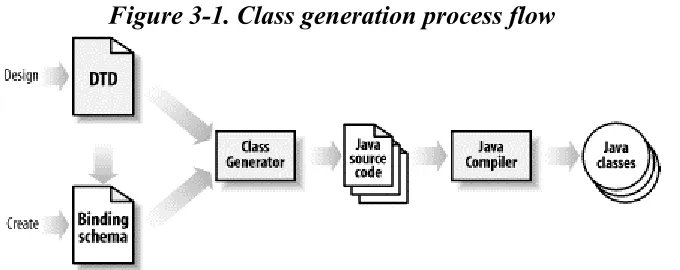
1.3.1 Class Generation
I've already mentioned that the basic idea of data binding is to take an XML document and convert it to an instance of a Java object. Furthermore, that Java class is tailored to a business need and generally matches up with the element and attribute naming in the related XML document. Of course, I conveniently skipped over where that class comes from; this is where class generation comes in. In the most common XML data binding scenario, this class is not hand coded (that's quite a pain, right?). Instead, a data binding tool that will generate this source file (or source files) for you is provided.
and a child element named description, and the resultant Java class (Servlet) has a getId() method as well as a getDescription() method. You get the idea—a mapping is made between the structure laid out by the XML constraint document and a set of Java classes. You can then compile these classes and begin converting between XML and Java.
1.3.2 Unmarshalling
Once you've got your generated classes compiled and on your Java Virtual Machine's (JVM's) classpath, you're ready to convert XML documents to Java classes. This process is called unmarshalling in the data binding world.[2] The process is based on starting with
an XML document. This document should conform to the XML constraints used to generate Java classes, referred to in the class generation section. If it doesn't meet these constraints, you're going to get errors as elements, attributes, and character data in the XML document won't match up with the structure of the generated Java classes. Most data binding packages offer an option to validate an XML document before
unmarshalling it to ensure you don't run into this problem. I'll focus on this and the other details of unmarshalling in Chapter 4.
[2] If you forget which way is marshalling and which is unmarshalling, remember that it's XML data binding. Everything starts and ends with
XML, so converting to XML is the "normal" direction, resulting in simple marshalling. Converting from XML is the reverse direction, so you are unmarshalling. For some reason, thinking of it this way keeps me straight.
Lest you think that all of your existing business objects are wasted, it is possible to unmarshal an XML document into an existing Java class (or classes). This is a common scenario when you already have a Java-based application and want to persist some of your objects to XML (like Enterprise JavaBeans or other data-related objects). You can either structure your XML to match your existing Java object hierarchy or use a binding schema (covered later in this chapter). While not all data binding packages support this handy approach to data binding, I'll spend some time in the later chapters of the book exploring it.
1.3.3 Marshalling
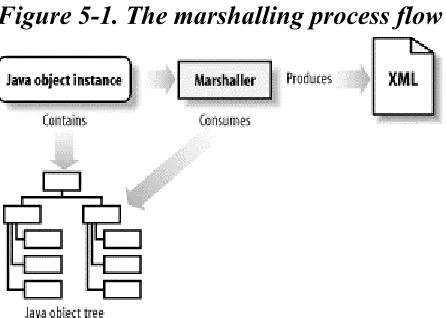
The reverse of the unmarshalling process is marshalling, which converts a Java object into an XML document representation. There's nothing too revolutionary here that you probably haven't already guessed. As with unmarshalling, many frameworks offer a validation option on generated Java classes that allows you to validate the data within your Java classes before trying to write them out to XML. That ensures that the resultant XML documents still match up with the constraints used to generate Java classes in the first place. Some extra data carried around by these generated classes—such as the XML names of the related elements, DTD references, and namespace information—also tends to get marshalled to Java. This ensures that the Java classes marshal to XML documents that they are the same as (or as close as possible) the XML documents they came from.
must follow some rules to be marshalled to XML, such as following the JavaBeans format (each data member has a getXXX() and setXXX() style method). However, if your classes conform to these rules, conversion to XML becomes simple. I'll focus on the nuts and bolts of marshalling in Chapter 5.
1.3.4 Binding Schemas
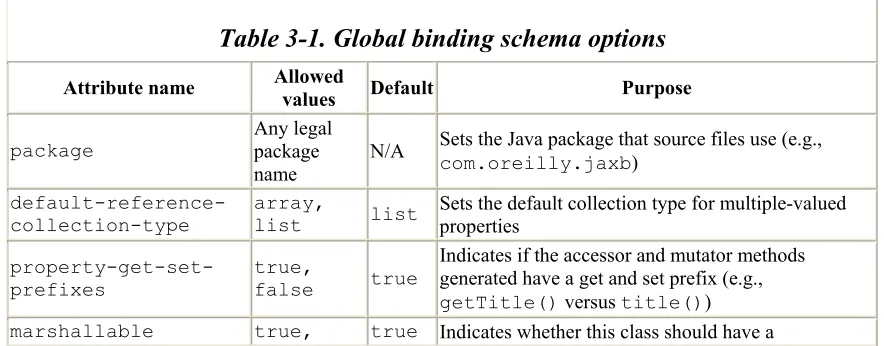
The final component of XML data binding is probably the most complex, but also the most powerful. A binding schema specifies details about how classes are generated from XML constraints. In the general case, an element named ejb-jar becomes an object named EjbJar. Some basic rules are applied to ensure legal Java names, but names are otherwise kept as true to the underlying XML as possible. Additionally, constraints such as those found in DTDs don't have type information applied (everything comes across as PCDATA, which is just character data). However, these basic rules are often not enough to create the Java business objects you want. In these cases, a binding schema can help.
A binding schema allows you to specify type conversions, name transformations, and specification of superclasses for generated objects. It allows the application of a richer set of rules, resulting in objects that more closely model your business needs. I'll spend all of Chapter 6 talking about this, so don't get too caught up in the details just yet. However, these binding schemas can allow you to convert XML to your already-coded Java classes, enforce type-checking even when a DTD doesn't, and a lot more. A binding schema takes data binding tools from trivial utility classes to full-blown persistence packages; all in all, they are the most powerful feature found in data binding packages.
How these schemas actually look and act depends largely (at least at this point in data binding evolution) upon the data binding implementation. Some binding schemas are actual XML Schema-style documents; others look like plain old XML documents. They are almost always represented by a physical XML-style document that is parsed in at the same time as the XML constraint model. It is then up to the data binding package to determine if the binding schema is packaged with generated classes or if the mappings are contained completely within generated source code. All of these details will be covered, for each binding package, in those packages' respective chapters.
1.4 What You'll Need
Finally, I want to let you know what packages, projects, and tools you'll need to work through this book. I'll address the installation and setup details of each in the chapters in which they are used, but you may want to go ahead and download these items before getting started (especially if you're on a slow Internet connection. That way, you're not stuck waiting on a download when you'd rather start a new chapter and example set.
1.4.1 Packages
the standard against which other packages are measured. Because of that, I'll spend the first half of this book discussing the various data binding components in light of their relation to JAXB. You can download the early-access version of JAXB at
http://java.sun.com/xml/jaxb/index.html. The specification, as of this writing, is currently released as Version 0.21, and the implementation is a 1.0 release. I'll cover setting up JAXB for use with the examples in the next chapter.
Additionally, I'll cover three other data binding implementations, all open source projects. I do this for obvious reasons: I'm an open source advocate, it's easy for you to get, and as I've run into occasional bugs in writing this book, I've been able to fix them and save you some headaches. There are several commercial data binding applications, but I've yet to see anything that merits the high price tags they command (you will typically pay a low per-developer price, as well as a much higher one-time deployment fee). The open source packages have matured and serve me well in numerous production applications. You're welcome to use commercial packages, although the examples will have to be tweaked to work within those frameworks.
The first data binding implementation I'll cover is Enhydra Zeus in Chapter 7. I'm partial to this implementation, since I founded the project, but I will cover it and the other implementations as they relate to Sun's JAXB. You can download Zeus from http://zeus.enhydra.org; I'll use the latest CVS code for the examples in this book.
Following Zeus, I'll discuss Castor, a project from Exolab, in Chapter 8. Castor holds the notable honor of being the first major open source project in the data binding space and is fairly mature. Although Castor offers data binding from SQL and LDAP, I'll focus only on the XML portion of its data binding package. You can download Castor from
http://castor.exolab.org; throughout the examples in Chapter 8, I'll use Version 0.9.3.9, which can be downloaded from the web site.
The final open source data binding package I'll cover is Quick, in Chapter 9. This
package is a bit different from the others, as it defines a lot of semantics specific to Quick not found in JAXB, Zeus, or Castor. It also offers a solid environment for marshalling and unmarshalling objects without using class generation. You can download Quick from http://jxquick.sourceforge.net/quick3, and I'll use Version 4.3.0 for the examples in Chapter 9.
1.4.2 Tools
I've found jEdit and some of its plug-ins, as well as XMLSpy (http://www.xmlspy.com), helpful.
Chapter 2. Theory and Concepts
In this chapter, I need to spend a little more time on some basic theory. I know you're ready to get to some code, but reading through this section will prepare you for the terms and concepts that I'll use later in the book and will also allow you to focus on application throughout the rest of the chapters. In the last chapter, you got a very quick rundown of both data-centric and business-centric APIs. In this chapter, I drill down into some of these APIs. However, instead of detailing what the APIs are, or how to use them, I focus on their relation to data binding. For example, most data binding packages allow you to set a SAX entity resolver, so I spend a little time detailing what that is. Since you won't ever need to use a SAX lexical handler, though, I skip right over that. Make sense?
In this chapter, I also explain how XML is modeled with constraints, cover the various constraint models currently available, and then funnel this into discussion of how
constraints are critical to any data binding package. This will set the stage for Chapter 3, for which you need to have a good understanding of XML validation, DTDs, and XML Schema. Additionally, you'll learn about some of the newer constraint models that may affect data binding, like Relax NG.
Finally, I get a bit conceptual (but only briefly) and talk about the relevant factors for a good data binding API. You'll learn about runtime versus compile-time considerations, how versioning is a tricky issue in data binding, and what it takes to interoperate between data binding implementations. In addition to preparing you for a better understanding of the rest of the book, this section will be critical for those of you still deciding on a data binding implementation. Once you make it through this section, though, it's code the rest of the way through—I promise!
2.1 Foundational APIs
As I mentioned in the introductory chapter, data-centric XML APIs provide the lowest levels of interaction available to Java developers. Because of this, they form the
backbone of many higher-level APIs, like data binding. Understanding them is important to effectively use a data binding tool. Not only does a keen understanding of these APIs help interpret error conditions and enhance performance, but it often allows you to set options on the unmarshalling and marshalling process that can drastically change the underlying parser's behavior. In this section, I cover the APIs that are fundamental to data binding and the concepts within these APIs that are critical to using a data binding
framework.
2.1.1 SAX
SAX, the "old faithful" of Java and XML APIs, is critical to any good data binding package. It is most often used as the API that actually handles the process of
of packaging (while some parsers like Apache Xerces are large, the binary distribution of Crimson and other SAX-compliant parsers can manage to stay in the 200-400 KB range), which is great for running data binding in limited-memory environments (think mobile and embedded devices).
Because of this, you will often need to interact with SAX objects and methods, even at the data binding level. For example, SAX provides a means of setting an error handler, defined through the org.xml.sax.ErrorHandler interface. This allows parsing warnings and errors to be dealt with gracefully, rather than bringing a system to a grinding halt. Most data binding projects allow you to set an ErrorHandler
implementation on a class to be unmarshalled (prior to the unmarshalling, of course) so you can customize error handling. In the Lutris Enhydra project, for example, the error handler implementation shown in Example 2-1 demonstrates how errors can be logged before being reported back to the application.
Example 2-1. The EnhydraErrorHandler class
package org.enhydra.util;
// Lutris Logging Package
import com.lutris.logging.LogChannel; import com.lutris.logging.Logger;
// SAX imports
import org.xml.sax.ErrorHandler; import org.xml.sax.SAXException; import org.xml.sax.SAXParseException;
public class EnhydraErrorHandler implements ErrorHandler {
private LogChannel logChannel;
public EnhydraErrorHandler() {
if (Logger.getCentralLogger() != null) { logChannel =
Logger.getCentralLogger().getChannel("Deployment"); }
}
public void warning(SAXParseException e) throws SAXException { log(Logger.WARNING,
new StringBuffer("Parsing Warning: ") .append(e.getMessage())
.toString()); }
public void error(SAXParseException e) throws SAXException { log(Logger.WARNING,
new StringBuffer("Parsing Error: ") .append(e.getMessage())
.toString()); throw e;
public void fatalError(SAXParseException e) throws SAXException { log(Logger.WARNING,
new StringBuffer("Parsing Fatal Error: ") .append(e.getMessage())
.toString()); throw e;
}
private void log(int level, String msg) { if (logChannel != null) {
logChannel.write(level, msg); }
} }
This example logs each error message to a logging facility and then passes on errors and fatal errors to the wrapping application. Here's an example of setting an instance of this error handler up for use—in this case for Zeus unmarshalling:
// Set the ErrorHandler on my unmarshaller class
EjbJarUnmarshaller.setErrorHandler(new EnhydraErrorHandler());
// Unmarshal into an object
EjbJar ejbJar = EjbJarUnmarshaller.unmarshal(myInputStream);
I'll deal with the specifics of this example as it applies to each data binding package in later chapters. For now, you should see that a healthy knowledge of SAX makes this a piece of cake.
Another important topic in data binding specifically related to SAX is entity resolution. When an XML document is read in, it often has a DOCTYPE statement, referring to a DTD.
This statement could be a DTD on the network, as seen here:
<?xml version="1.0"?>
<!DOCTYPE ejb-jar
PUBLIC '-//Sun Microsystems, Inc.//DTD Enterprise JavaBeans 1.1//EN' 'http://java.sun.com/j2ee/dtds/ejb-jar_1_1.dtd'>
<ejb-jar>
<description>
The Account and Order EJBs represent a Customer and a
Customer Order. Because these EJBs are dependent on each other to complete
and manage an order(s) they are bundled together. </description>
<display-name>Customer Component</display-name> <enterprise-beans>
<entity>
<!-- And so on... --> </entity>
This XML file refers to a DTD with a system ID of http://java.sun.com/j2ee/dtds/ejb-jar_1_1.dtd.[1] During production, you would rarely want your well-tested application to
have to access the network every time it unmarshals a file; to avoid this, you need to use an implementation of the SAX org.xml.sax.EntityResolver interface. This interface allows you to match the public and/or system ID of an entity (like that in the preceding XML file) and resolve it in a fashion of your choosing, instead of by the normal means. To give you an idea of how this works, Example 2-2 shows a class that resolves all references to the Sun EJB DTD at the URL shown above to a local copy of that DTD.
[1] If you're lost in the talk of system IDs, entities, and DOCTYPE declarations, I suggest you take a break from this book and pick up your
copy of XML in a Nutshell. It will explain all of these concepts clearly. Then you can come back to this chapter and things will make more sense.
Example 2-2. Using an EntityResolver for Sun EJB DTDs
package javajaxb;
import java.io.File;
import java.io.FileInputStream; import java.io.IOException; import java.io.InputStream;
// SAX imports
import org.xml.sax.EntityResolver; import org.xml.sax.InputSource; import org.xml.sax.SAXException;
public class EjbDtdEntityResolver implements EntityResolver {
private static final String EJB_DTD_SYSTEM_ID = "http://java.sun.com/j2ee/dtds/ejb-jar_1_1.dtd";
private static final String EJB_DTD_LOCAL_ID = "/store/dtd/j2ee/ejb-jar_1_1.dtd";
public InputSource resolveEntity(String publicID, String systemID) throws IOException, SAXException {
if (systemID.equals(EJB_DTD_SYSTEM_ID)) { try {
InputStream in =
new FileInputStream(new File(EJB_DTD_LOCAL_ID)); return new InputSource(in);
} catch (IOException e) { // use normal processing return null;
} }
// Not the DTD we care about, so perform normal processing return null;
} }
resolveEntity("-//Sun Microsystems, Inc.//DTD Enterprise JavaBeans 1.1//EN", "http://java.sun.com/j2ee/dtds/ejb-jar_1_1.dtd");
By packaging a local copy of this DTD with your generated Java classes, you remove the need for a network connection and speed up the unmarshalling process. You would then register this with your unmarshalling code (shown here with the Castor API):
Unmarshaller.setEntityResolver(new EjbDtdEntityResolver()); EjbJar ejbJar = (EjbJar)Unmarshaller.unmarshal(myInputSource);
Again, I'll leave details of various implementations for later chapters, but a working knowledge of SAX can dramatically improve the quality and performance of your data binding code.
SAX is also an option, although not as compelling, for use in class generation. SAX cannot read DTDs, so it is not useful for generating Java classes from an XML DTD; however, it can be used to generate Java classes from XML Schemas or any other constraint model that follows the rules of the XML 1.0 specification. However, the process of building a set of Java classes often relies on hierarchical data (for example, seeing that a book element contains child elements named chapter, which in turn contain elements called section), which SAX isn't very helpful in providing. Because of this, data binding packages often use a modeled data approach, like that provided by DOM, JDOM, or dom4j. Some packages do use SAX, but end up building their own proprietary data structures. In these cases, I'm generally of the opinion that the standard model is better than a custom one. Additionally, the process of class generation is almost always
done at compile time, when speed is less of an issue. This makes the use of a modeled data API even more attractive, as performance becomes less of an issue.
2.1.2 DOM
After you've made it past SAX, the next API to examine is DOM. DOM is not nearly as crucial a portion of most data binding packages, especially in comparison to SAX. However, for class generation, DOM is an attractive option. It offers an XML object model that is well documented and well understood, so it has shown up in many data binding frameworks. However, with the growing popularity of alternative models like JDOM and dom4j, DOM is now just one option among many for that layer of the data binding framework. Additionally, DOM implementations generally use SAX under the hood (as discussed in the last chapter). Because of this, you'll find the SAX concepts covered in this chapter important when dealing with DOM-based class generators.
solution for developers working on class generation and trying to bolster an existing implementation with helper APIs.
[2] This doesn't mean that these implementations don't exist; it just means that they are not as common and generally not as well tested and
documented
2.2 Dependent APIs
When it comes to business-centric APIs, the tables turn a bit. Instead of a data binding package relying on these APIs, higher-level APIs often rely on data binding. This makes sense, as all programming is simply a layering of code that moves from the very specific (shifting bits) to the very general (buying a DVD). I won't spend too much time in this section, as these APIs can change their use of data binding as quickly as I can write about them. I'll touch on only a few items and then move on to XML constraints
2.2.1 SOAP
SOAP is a perfect example of an API that can use data binding very naturally. Consider that the entire purpose of SOAP is to transfer information between systems. This data can be very complex though, and even user-defined.
For example, here's a fairly basic SOAP response:
<SOAP-ENV:Envelope
xmlns:SOAP-ENV="http://schemas.xmlsoap.org/soap/envelope/"
SOAP-ENV:encodingStyle="http://schemas.xmlsoap.org/soap/encoding/"/> <SOAP-ENV:Body>
<resp:stockQuoteResponse xmlns:resp="http://www.stockQuotes.com"> <quote symbol="ALGX" name="Allegiance Telecom">
<volume>2,964,600</volume>
<averageVolume>924,318</averageVolume> <marketCap>411,700,000</marketCap> </quote>
</resp:stockQuoteResponse> </SOAP-ENV:Body>
</SOAP-ENV:Envelope>
Don't get hung up in the envelope and header information; it's the body of the message that is interesting in relation to data binding. Because data has to be transferred via XML, data binding can offer a means of converting that data into XML. You can see that, in this case, the data is a stock quote.
Currently, most SOAP packages pick this data apart piece by piece and convert each to XML. However, consider that this same data could be represented just as well by a Java class like this:
public class Quote {
private float volume;
private float averageVolume; private long marketCap;
public String getSymbol(); public String getName(); public float getVolume();
public float getAverageVolume(); public long getMarketCap();
// Other mutator methods }
Instead of having to work at this data piece by piece, the envelope of the SOAP message could be set as follows:
// Marshal (with data binding) quote object into XML StringWriter stringWriter = new StringWriter(); currentStockQuote.marshal(stringWriter);
// Create the SOAP body Body soapBody = new Body();
Vector bodyEntries = new Vector();
bodyEntries.add(stringWriter.toString()); soapBody.setBodyEntries(bodyEntries);
// Add the SOAP body
soapEnvelope.setBody(soapBody);
Here, rather than working through the Quote object piece by piece, data binding is used to write the object out to XML in a single simple line of code. Obviously, this is a case in which data binding can really shine. Currently, data binding isn't used too much in SOAP implementations, mostly due to the relative immaturity of both SOAP and data binding implementations. However, as both start to shore up and become more stable, and as custom types are used more often, expect data binding to become an alternative to tedious piecemeal data serialization.
2.2.2 UDDI
Another application in which data binding can help is a UDDI registry. In this case, custom data types are not as much of an issue, as the information stored in a UDDI registry is constant. Generally, a universal resource name (URN), category, access point, and possibly a WSDL file reference are stored for each web service registered with UDDI. However, this information is often persisted to an XML document for short-term storage (and later persisted to a database for long-term storage). In these cases, a simple
In any case, with these sorts of objects, and persistence only a simple invocation of the marshal() method, programming tasks become very simple. I'm not going to spend a lot of time listing all the APIs in which data binding could be useful; you probably already have a few in mind that I haven't thought of. However, you should be clear that data binding is both incredibly useful for these higher-level APIs and simple to use. Data binding takes the complexity of reading and writing XML data out of APIs that should be focused on business rather than data tasks.
2.3 Constraint-Modeled Data
Once you've got a handle on the APIs involved with data binding (and those that could depend on it), you need to have a solid understanding of XML constraints. These
constraints are one of the most important aspects of working with class generation (along with the binding schema), and your constraint model will dictate the classes that result. Good constraint modeling will result in efficient, business-oriented classes; however, poor modeling can result in hundreds of classes or convoluted names and methods.
One thing I do want to mention before diving into this section and the rest of the book is that I expect you to know the basics of DTDs and XML Schema. When I cover
alternatives like Relax NG, I'll include some basic explanations related to the examples, but I don't want to spend time covering syntax of DTDs and schemas. There are plenty of available books on the subject, so you may want to have one or more of these handy as you work through the examples. I'm also going to assume that you can pick up some skills by following along with the examples; in other words, I'm not going to spend a lot of time talking about constraint basics, except those that relate specifically to data
binding. Hopefully seeing lots of DTDs and schemas in this book will make you examine how you write your own constraints and pick up some good ideas. That said, let me dive into specific constraint models and what to watch for when writing constraints for use in data binding class generation.
2.3.1 DTDs
Currently, DTDs are the basis of most data binding packages. DTDs were defined in the XML 1.0 specification, and you can learn about their syntax and limitations in O'Reilly's
Learning XML or XML in a Nutshell. DTDs are not as expressive as many other constraint models, like XML Schema or Relax NG, but they remain the core of XML constraints. Tens of thousands, if not hundreds of thousands, of DTDs are used in
production today. Because of this, even if you don't ever plan to write a DTD, you'll need to understand them and how to structure them for efficient data binding use.
First, use clear and concise names for your elements and attributes. This is true for any constraint model. Naming an element cfm for "Container Field Mapping" might seem like a great typing shortcut, until you use the generated classes from that DTD:
Suddenly, that savings in typing doesn't seem like such a good idea. Consider the more verbose, but clearer, name containerFieldMapping:
// The purpose of this class is much clearer
ContainerFieldMapping mapping = new ContainerFieldMapping();
One limitation of DTDs is that they do not support namespaces. Because of this, you may have to think a more about the names of elements that serve different purposes, but might otherwise have the same name. In other words, two elements with the same name cannot have different definitions. Consider the following XML document fragment:
<store>
<inventory>
<item id="lotr-438-1"> <price>39.99</price> </item>
<item id="wot-980-3"> <price>44.99</price> </item>
</inventory>
<equipment>
<item model="cr122-a" quantity="9">Cash Register</item> <item model="as-599" quanity="129">Book shelf</item> </equipment>
</store>
The element name item means different things in these two contexts. You would not want the first item elements to specify a model attribute, but you would also not want the latter item elements to specify an id value. In other words, these two elements, named the same, represent two different data types. Using namespaces, you could distinguish them from each other; however, in a DTD-based environment, this isn't possible. As a result, you'll need to use two different data types and, thus, two different element names. You might use inventoryItem or equipmentItem, or something altogether different, to ensure you don't have name collisions in your DTD.
Finally, I want to make one other general, change-your-life type of suggestion: design your constraints before your documents. I realize that for most of you, the process consists of writing an XML file and then using some tool to generate a DTD from it. When you just need a quick solution, this approach probably works out well. However, for longer-term solutions and situations in which you want to use data binding, writing the document first is a pretty bad idea. You end up forgetting to add an attribute,
Figure 2-1. Developing data before modeling constraints
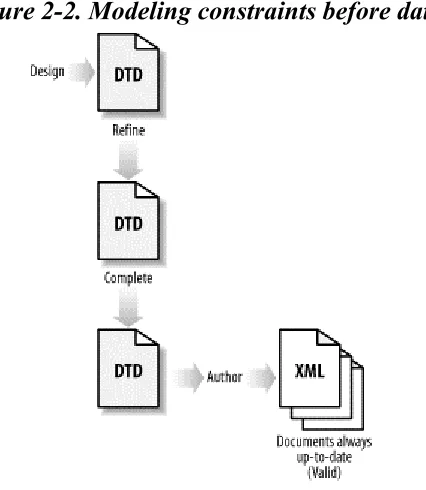
This mess occurs because you write specific data first, and then you write constraints to fit that specific data. You are not thinking about the whole set of data you need to represent and then developing a model. In other words, you want to develop a general solution that your specific data fits, not the other way around. This results in a process flow like that shown in Figure 2-2, which is much different than Figure 2-1.
Figure 2-2. Modeling constraints before data
Even though constraint models like XML Schema offer you richer syntax, namespaces and a wealth of other options, following these simple guidelines will help when dealing with schemas as well.
2.3.2 XML Schema
[image:30.612.205.418.320.565.2]you should start thinking about how you're going to use schemas, as they do offer nice features not found in DTDs.
First, when using XML Schema, you'll want to consider using namespaces. Namespaces can solve the naming collisions mentioned in Section 2.3.1. However, you should spend some time learning how your specific data binding package handles namespaces. Some packages ignore them completely, which doesn't help you out at all. Some assign
different Java packages based on the namespaces, which is helpful, but in some cases not desirable (in other words, it's a good option, but is preferably configurable). Others allow you to map the names or use prefixes—as you can see, there are a lot of different
handling approaches. You'll want to understand this handling thoroughly before using namespaces, or you may end up with results you weren't expecting or desiring.
Another XML Schema feature you'll want to take heavy advantage of is the type safety that schemas provide. In DTDs, you can specify character data only for textual content (PCDATA and CDATA). As a result, you'll need to rely on binding schemas when using DTDs to provide type mappings. However, schemas allow types like integer or string in the constraint model; these types all have analogs in Java and therefore can help ensure that your XML data matches the types you want to use in Java. You'll also want to leave room for growth in these types; I've often seen an integer used without thought when a float was actually required for long-term needs. This leads back to the process shown in Figure 2-1, requiring changes that invalidate earlier versions of generated classes as well as XML documents. As always, spend plenty of time planning your constraints and making sure that they work not only for your current data, but also for future data.
2.3.3 And More ...
Although DTDs and XML Schema hold the majority of developers' attention, I'd be remiss in not mentioning some of the alternatives that are growing in popularity. XML Schema interest is largely driven by the recognition of DTD limitations. However, the XML Schema specification is extremely complex, and many developers are interested in only 15 or 20 percent of the features in the specification. As a result, a lot of weight is carried around by parsers is never used. This has driven several efforts to develop a schema-like constraint language without all the complexity of XML Schema.
What seems to be the best alternative is Relax NG, hosted by OASIS at http://www.oasis-open.org/committees/relax-ng (which is aliased to http://www.relaxng.org). This is the result of two constraint models, Relax and Trex, joining forces and creating a new option for constraint representation. To see what Relax NG looks like, consider the following XML document:
<?xml version="1.0"?>
<addressBook> <card>
<email>[email protected]</email> </card>
<card>
<name>Fred Bloggs</name> <email>[email protected]</email> </card>
</addressBook>
Here's a sample of a Relax NG schema from the Relax NG tutorial:
<?xml version="1.0"?>
<element name="addressBook"
xmlns="http://relaxng.org/ns/structure/0.9"> <zeroOrMore>
<element name="card"> <choice>
<element name="name"> <text/>
</element> <group>
<element name="givenName"> <text/>
</element>
<element name="familyName"> <text/>
</element> </group> </choice>
<element name="email"> <text/>
</element> <optional>
<element name="note"> <text/>
</element> </optional> </element> </zeroOrMore> </element>
Here, I've specified the allowed elements, detailed which ones can have text, and specified which elements are optional. If you've ever looked at an XML Schema, this should look somewhat familiar; however, it's vastly simpler than the same constraints in an XML Schema, which I don't include here because it took more than a hundred lines! In any case, this is a simple, intuitive solution that has a lot of programmers pretty excited.
indicate this could be a very popular feature). I'd keep an eye on this, as it will certainly show up in later versions of data binding frameworks (as well as later editions of this book, I'd bet).
2.4 API Transparence
Before wrapping up on theory and concepts, I wanted to dive into some theoretical issues; don't worry, I'll keep it short and to the point! The issues I want to address relate to API transparence. When using data binding, you actually spend very little time working directly with the data binding API itself; instead, you work with classes generated by the API. Because of that, these generated classes become critical to your applications. However, when an API severs itself from the classes it generates, you can run into all sorts of nasty problems.
Actually, the API only appears to sever itself in many cases. In other words, many frameworks generate classes with methods like this:
public static EjbJar unmarshal(InputStream inputStream) throws IOException {
return (EjbJar)Unmarshaller
.unmarshal(inputStream, EjbJar.class); }
As you can see, the method on the generated class simply hides the details of using the API from your programs. However, from your application's point of view, you aren't interfacing with the data binding API in your code.
2.4.1 Independence
The first thing you'll want to make note of is the level of independence your generated classes offer you. In other words, are you tethered to the data binding API at runtime once classes are generated? Or do your classes run without ever using that API? The latter case is referred to as API independence. Obviously, the fewer dependencies your generated classes have, the easier deployment becomes.
Another question to ask is that of version independence: do your classes have to use a specific version of SAX, a vendor's parser, or your data binding framework? These are all critical questions and can cause bugs that are extremely tricky to track down. Like
2.4.1.1 API independence
First, you need to find out what dependencies your generated classes have at runtime, when the classes are put into action. This will vary from framework to framework, and sometimes with the options you have set in each framework. For example, JAXB requires that the JAXB API (the actual jar archive) be in the classpath at runtime for marshalling and unmarshalling. Castor and Coins are in the same category; however, Zeus generates classes that don't require anything but a SAX XML parser for marshalling and
unmarshalling. Whichever package you choose, you'll want to deploy the correct packages and jars at runtime to avoid ugly ClassNotFoundExceptions.
I recommend considering deploying your data binding API and related classes into your runtime classpath, even if they aren't required. While your generated classes may not need them, you'll often find handy utilities in these frameworks. For example, some basic ErrorHandler or EntityResolver implementations may be included in a data binding framework, as well as parsing tools to make common XML handling tasks easier. That also prevents any errors from occurring, which saves you from remembering which framework produces independent classes and which don't.
2.4.1.2 Version independence
Another issue, and one that is even more important, is versioning. Not specific to data binding, versioning is always a bit of a pain to work with. Your generated classes will almost always outlast a specific version of a framework, and you'll want to try your hardest to always keep up-to-date on API releases. In general, as long as method signatures don't change, things will work out alright. In other words, if your API
developers are doing their jobs, you're going to have code that works with any version of its related data binding API. However, depending on other developers isn't always the best way to guarantee stress-free evenings. To ensure that a new version of an API works with your classes, you should compile your generated classes (or recompile, actually) using the new version of your framework. I highly recommend testing by unmarshalling from XML and then marshalling back to XML, using the most complex XML instance documents you have on hand. If these basic tests pass, you're going to be OK 99 times out of 100.
As for the other one time, it usually crops up when you begin using an XML document that has some piece of data in it that you've never run across before, such as special characters, or contains data that isn't used in your other existing documents. Since this isn't a case you can specifically test for (you're always going to miss something), careful error handling in your application code is your best bet. Getting an odd
2.4.2 Integration
The next subject is API integration. This term refers to integration with your application and other unrelated APIs. In other words, how well does the code generated by a data binding framework work and play with your own code? More often than not, the
generated classes are normal Java classes; however, integration takes things a step further. For example, can you have meaningful error messages reported in a format compatible with the rest of your application? The answer should be "yes." For example, you want to ensure that generated classes are in a format you can live with; this may involve the names of methods, as well as the types used for multiple-valued properties. Some applications may work best with typed arrays (like Person[]), while others may work better with Java collections (Lists and Maps). There isn't a right or wrong solution, as your application will determine your needs at a specific time.
In all of these cases, as you may have guessed, the key is flexibility. Your framework should allow as much flexibility as possible, through binding schemas or any other facility. That could mean you could opt to ignore certain methods, specify packages, generate (or not generate) interfaces versus concrete classes, or use typed arrays versus Java collection classes. What you don't want is an API that gives you one choice for all situations; you'll almost certainly find your application needs a different choice (usually right after you've selected the framework!). In any event, this is a case in which you want a long laundry list of useful features and goodies supported by your data binding
framework of choice.
2.4.3 Interoperation
The final aspect of data binding I want to address is API interoperation. This refers to your data binding framework (Castor, for example) being able to interoperate with another (let's say JAXB). For many developers, the importance of this aspect of APIs is vastly undervalued. The prevailing mentality is "We chose this framework, so who cares if it works with other frameworks." However, that attitude ignores the fact that, more often than not, frameworks, APIs, and vendors change more often than developers' resumes these days. Time and time again, I've seen hundreds, thousands, or millions of lines of code thrown out because management dictates a change in a framework, vendor, or product. In these cases, interoperation becomes a huge factor, and one that can save weeks of work in retooling code.
In the case of data binding frameworks, you shouldn't be concerned with the actual methods used to generate classes; these are fire-and-forget tasks, as once the classes are generated, they're ready for use. The same is true for constraint models; if you use DTDs, they should work with any framework that supports that constraint model. The same goes for XML Schema, Relax NG, or anything else. This does become a factor, though, in two specific areas: the binding schema and in marshalling and unmarshalling.
not going to be compat