Advanced Bash-Scripting Guide
An in-depth exploration of the art of shell scripting
Mendel Cooper
6.3.
30 Apr 2011
Revision History
Revision 6.1
30 Sep 2009
Revised by: mc
'BUFFALOBERRY' release: Minor Update.
Revision 6.2
17 Mar 2010
Revised by: mc
'ROWANBERRY' release
Revision 6.3
27 Apr 2011
Revised by: mc
'SWOZZLEBERRY' release
This tutorial assumes no previous knowledge of scripting or programming, but progresses rapidly toward an
intermediate/advanced level of instruction . . . all the while sneaking in little nuggets of UNIX® wisdom and
lore. It serves as a textbook, a manual for self-study, and a reference and source of knowledge on shell
scripting techniques. The exercises and heavily-commented examples invite active reader participation, under
the premise that
the only way to really learn scripting is to write scripts
.
This book is suitable for classroom use as a general introduction to programming concepts.
Dedication
Table of Contents
Chapter 1. Shell Programming!...1
Chapter 2. Starting Off With a Sha-Bang...3
2.1. Invoking the script...6
2.2. Preliminary Exercises...6
Part 2. Basics...7
Chapter 3. Special Characters...8
Chapter 4. Introduction to Variables and Parameters...29
4.1. Variable Substitution...29
4.2. Variable Assignment...32
4.3. Bash Variables Are Untyped...33
4.4. Special Variable Types...34
Chapter 5. Quoting...40
5.1. Quoting Variables...40
5.2. Escaping...42
Chapter 6. Exit and Exit Status...50
Chapter 7. Tests...53
7.1. Test Constructs...53
7.2. File test operators...60
7.3. Other Comparison Operators...64
7.4. Nested if/then Condition Tests...69
7.5. Testing Your Knowledge of Tests...70
Chapter 8. Operations and Related Topics...71
8.1. Operators...71
8.2. Numerical Constants...77
8.3. The Double-Parentheses Construct...79
8.4. Operator Precedence...80
Part 3. Beyond the Basics...83
Chapter 9. Another Look at Variables...84
9.1. Internal Variables...84
9.2. Typing variables: declare or typeset...103
9.2.1. Another use for declare...105
9.3. $RANDOM: generate random integer...105
Chapter 10. Manipulating Variables...117
10.1. Manipulating Strings...117
10.1.1. Manipulating strings using awk...124
10.1.2. Further Reference...125
Table of Contents
Chapter 11. Loops and Branches...135
11.1. Loops...135
11.2. Nested Loops...148
11.3. Loop Control...149
11.4. Testing and Branching...152
Chapter 12. Command Substitution...161
Chapter 13. Arithmetic Expansion...167
Chapter 14. Recess Time...168
Part 4. Commands...169
Chapter 15. Internal Commands and Builtins...177
15.1. Job Control Commands...206
Chapter 16. External Filters, Programs and Commands...211
16.1. Basic Commands...211
16.2. Complex Commands...216
16.3. Time / Date Commands...227
16.4. Text Processing Commands...231
16.5. File and Archiving Commands...253
16.6. Communications Commands...271
16.7. Terminal Control Commands...285
16.8. Math Commands...287
16.9. Miscellaneous Commands...297
Chapter 17. System and Administrative Commands...312
17.1. Analyzing a System Script...341
Part 5. Advanced Topics...343
Chapter 18. Regular Expressions...345
18.1. A Brief Introduction to Regular Expressions...345
18.2. Globbing...349
Chapter 19. Here Documents...351
19.1. Here Strings...361
Chapter 20. I/O Redirection...365
20.1. Using exec...368
20.2. Redirecting Code Blocks...371
20.3. Applications...376
Table of Contents
Chapter 22. Restricted Shells...383
Chapter 23. Process Substitution...385
Chapter 24. Functions...390
24.1. Complex Functions and Function Complexities...394
24.2. Local Variables...404
24.2.1. Local variables and recursion...406
24.3. Recursion Without Local Variables...408
Chapter 25. Aliases...412
Chapter 26. List Constructs...415
Chapter 27. Arrays...418
Chapter 28. Indirect References...447
Chapter 29. /dev and /proc...451
29.1. /dev...451
29.2. /proc...454
Chapter 30. Network Programming...460
Chapter 31. Of Zeros and Nulls...463
Chapter 32. Debugging...467
Chapter 33. Options...477
Chapter 34. Gotchas...480
Chapter 35. Scripting With Style...489
35.1. Unofficial Shell Scripting Stylesheet...489
Chapter 36. Miscellany...492
36.1. Interactive and non-interactive shells and scripts...492
36.2. Shell Wrappers...493
36.3. Tests and Comparisons: Alternatives...498
36.4. Recursion: a script calling itself...499
36.5. "Colorizing" Scripts...501
36.6. Optimizations...514
36.7. Assorted Tips...515
36.7.1. Ideas for more powerful scripts...515
36.7.2. Widgets...525
36.8. Security Issues...527
36.8.1. Infected Shell Scripts...527
Table of Contents
Chapter 36. Miscellany
36.8.3. Writing Secure Shell Scripts...528
36.9. Portability Issues...528
36.9.1. A Test Suite...529
36.10. Shell Scripting Under Windows...530
Chapter 37. Bash, versions 2, 3, and 4...531
37.1. Bash, version 2...531
37.2. Bash, version 3...535
37.2.1. Bash, version 3.1...538
37.2.2. Bash, version 3.2...538
37.3. Bash, version 4...539
37.3.1. Bash, version 4.1...546
37.3.2. Bash, version 4.2...547
Chapter 38. Endnotes...550
38.1. Author's Note...550
38.2. About the Author...550
38.3. Where to Go For Help...550
38.4. Tools Used to Produce This Book...551
38.4.1. Hardware...551
38.4.2. Software and Printware...551
38.5. Credits...551
38.6. Disclaimer...553
Bibliography...554
Appendix A. Contributed Scripts...562
Appendix B. Reference Cards...761
Appendix C. A Sed and Awk Micro-Primer...766
C.1. Sed...766
C.2. Awk...769
Appendix D. Exit Codes With Special Meanings...772
Appendix E. A Detailed Introduction to I/O and I/O Redirection...773
Appendix F. Command-Line Options...775
F.1. Standard Command-Line Options...775
F.2. Bash Command-Line Options...776
Appendix G. Important Files...778
Table of Contents
Appendix I. An Introduction to Programmable Completion...781
Appendix J. Localization...784
Appendix K. History Commands...788
Appendix L. Sample .bashrc and .bash_profile Files...789
Appendix M. Converting DOS Batch Files to Shell Scripts...804
Appendix N. Exercises...808
N.1. Analyzing Scripts...808
N.2. Writing Scripts...810
Appendix O. Revision History...820
Appendix P. Download and Mirror Sites...823
Appendix Q. To Do List...824
Appendix R. Copyright...825
Appendix S. ASCII Table...827
Index...828
Chapter 1. Shell Programming!
No programming language is perfect. There is
not even a single best language; there are only
languages well suited or perhaps poorly suited
for particular purposes.
--Herbert Mayer
A working knowledge of shell scripting is essential to anyone wishing to become reasonably proficient at
system administration, even if they do not anticipate ever having to actually write a script. Consider that as a
Linux machine boots up, it executes the shell scripts in /etc/rc.d to restore the system configuration and
set up services. A detailed understanding of these startup scripts is important for analyzing the behavior of a
system, and possibly modifying it.
The craft of scripting is not hard to master, since the scripts can be built in bite-sized sections and there is only
a fairly small set of shell-specific operators and options [1] to learn. The syntax is simple and straightforward,
similar to that of invoking and chaining together utilities at the command line, and there are only a few "rules"
governing their use. Most short scripts work right the first time, and debugging even the longer ones is
straightforward.
In the 1970s, the BASIC language enabled anyone reasonably computer proficient
to write programs on an early generation of microcomputers. Decades later, the Bash
scripting language enables anyone with a rudimentary knowledge of Linux or UNIX to do the same
on much more powerful machines.
A shell script is a quick-and-dirty method of prototyping a complex application. Getting even a limited subset
of the functionality to work in a script is often a useful first stage in project development. This way, the
structure of the application can be tested and played with, and the major pitfalls found before proceeding to
the final coding in C, C++, Java, Perl, or Python.
Shell scripting hearkens back to the classic UNIX philosophy of breaking complex projects into simpler
subtasks, of chaining together components and utilities. Many consider this a better, or at least more
esthetically pleasing approach to problem solving than using one of the new generation of high powered
all-in-one languages, such as Perl, which attempt to be all things to all people, but at the cost of forcing you to
alter your thinking processes to fit the tool.
According to Herbert Mayer, "a useful language needs arrays, pointers, and a generic mechanism for building
data structures." By these criteria, shell scripting falls somewhat short of being "useful." Or, perhaps not. . . .
When not to use shell scripts
Resource-intensive tasks, especially where speed is a factor (sorting, hashing, recursion [2] ...)
•
Procedures involving heavy-duty math operations, especially floating point arithmetic, arbitrary
precision calculations, or complex numbers (use C++ or FORTRAN instead)
•
Cross-platform portability required (use C or Java instead)
Complex applications, where structured programming is a necessity (type-checking of variables,
function prototypes, etc.)
•
Mission-critical applications upon which you are betting the future of the company
•
Situations where security is important, where you need to guarantee the integrity of your system and
protect against intrusion, cracking, and vandalism
•
Project consists of subcomponents with interlocking dependencies
•
Extensive file operations required (Bash is limited to serial file access, and that only in a
particularly clumsy and inefficient line-by-line fashion.)
•
Need native support for multi-dimensional arrays
•
Need data structures, such as linked lists or trees
•
Need to generate / manipulate graphics or GUIs
•
Need direct access to system hardware
•
Need port or socket I/O
•
Need to use libraries or interface with legacy code
•
Proprietary, closed-source applications (Shell scripts put the source code right out in the open for all
the world to see.)
•
If any of the above applies, consider a more powerful scripting language -- perhaps Perl, Tcl, Python, Ruby
-- or possibly a compiled language such as C, C++, or Java. Even then, prototyping the application as a
shell script might still be a useful development step.
We will be using Bash, an acronym for "Bourne-Again shell" and a pun on Stephen Bourne's now classic
Bourne shell. Bash has become a de facto standard for shell scripting on most flavors of UNIX. Most of the
principles this book covers apply equally well to scripting with other shells, such as the Korn Shell, from
which Bash derives some of its features, [3] and the C Shell and its variants. (Note that C Shell programming
is not recommended due to certain inherent problems, as pointed out in an October, 1993 Usenet post by Tom
Christiansen.)
What follows is a tutorial on shell scripting. It relies heavily on examples to illustrate various features of the
shell. The example scripts work -- they've been tested, insofar as was possible -- and some of them are even
useful in real life. The reader can play with the actual working code of the examples in the source archive
(scriptname.sh or scriptname.bash), [4] give them execute permission (
chmod u+rx
scriptname
), then run them to see what happens. Should the source archive not be available, then
cut-and-paste from the HTML or pdf rendered versions. Be aware that some of the scripts presented here
introduce features before they are explained, and this may require the reader to temporarily skip ahead for
enlightenment.
Chapter 2. Starting Off With a Sha-Bang
Shell programming is a 1950s juke box . . .
--Larry Wall
In the simplest case, a script is nothing more than a list of system commands stored in a file. At the very least,
this saves the effort of retyping that particular sequence of commands each time it is invoked.
Example 2-1. cleanup: A script to clean up log files in /var/log
# Cleanup
# Run as root, of course.
cd /var/log
cat /dev/null > messages cat /dev/null > wtmp
echo "Log files cleaned up."
There is nothing unusual here, only a set of commands that could just as easily have been invoked one by one
from the command-line on the console or in a terminal window. The advantages of placing the commands in a
script go far beyond not having to retype them time and again. The script becomes a program -- a tool -- and it
can easily be modified or customized for a particular application.
Example 2-2. cleanup: An improved clean-up script
#!/bin/bash
# Proper header for a Bash script.
# Cleanup, version 2
# Run as root, of course.
# Insert code here to print error message and exit if not root.
LOG_DIR=/var/log
# Variables are better than hard-coded values. cd $LOG_DIR
cat /dev/null > messages cat /dev/null > wtmp
echo "Logs cleaned up."
exit # The right and proper method of "exiting" from a script. # A bare "exit" (no parameter) returns the exit status #+ of the preceding command.
Now that's beginning to look like a real script. But we can go even farther . . .
Example 2-3. cleanup: An enhanced and generalized version of above scripts.
#!/bin/bash
# Warning: #
---# This script uses quite a number of features that will be explained #+ later on.
# By the time you've finished the first half of the book, #+ there should be nothing mysterious about it.
LOG_DIR=/var/log
ROOT_UID=0 # Only users with $UID 0 have root privileges. LINES=50 # Default number of lines saved.
E_XCD=86 # Can't change directory? E_NOTROOT=87 # Non-root exit error.
# Run as root, of course. if [ "$UID" -ne "$ROOT_UID" ] then
echo "Must be root to run this script." exit $E_NOTROOT
fi
if [ -n "$1" ]
# Test whether command-line argument is present (non-empty). then
lines=$1 else
lines=$LINES # Default, if not specified on command-line. fi
# Stephane Chazelas suggests the following,
#+ as a better way of checking command-line arguments,
#+ but this is still a bit advanced for this stage of the tutorial. #
# E_WRONGARGS=85 # Non-numerical argument (bad argument format). #
# case "$1" in
# "" ) lines=50;;
# *[!0-9]*) echo "Usage: `basename $0` file-to-cleanup"; exit $E_WRONGARGS;; # * ) lines=$1;;
# esac #
#* Skip ahead to "Loops" chapter to decipher all this.
cd $LOG_DIR
if [ `pwd` != "$LOG_DIR" ] # or if [ "$PWD" != "$LOG_DIR" ] # Not in /var/log?
then
echo "Can't change to $LOG_DIR." exit $E_XCD
fi # Doublecheck if in right directory before messing with log file.
# Far more efficient is: #
# cd /var/log || {
# echo "Cannot change to necessary directory." >&2 # exit $E_XCD;
tail -n $lines messages > mesg.temp # Save last section of message log file. mv mesg.temp messages # Becomes new log directory.
# cat /dev/null > messages
#* No longer needed, as the above method is safer.
cat /dev/null > wtmp # ': > wtmp' and '> wtmp' have the same effect. echo "Log files cleaned up."
# Note that there are other log files in /var/log not affected #+ by this script.
exit 0
# A zero return value from the script upon exit indicates success #+ to the shell.
Since you may not wish to wipe out the entire system log, this version of the script keeps the last section of
the message log intact. You will constantly discover ways of fine-tuning previously written scripts for
increased effectiveness.
* * *
The sha-bang ( #!) [5] at the head of a script tells your system that this file is a set of commands to be fed to
the command interpreter indicated. The #! is actually a two-byte [6] magic number, a special marker that
designates a file type, or in this case an executable shell script (type
man magic
for more details on this
fascinating topic). Immediately following the sha-bang is a path name. This is the path to the program that
interprets the commands in the script, whether it be a shell, a programming language, or a utility. This
command interpreter then executes the commands in the script, starting at the top (the line following the
sha-bang line), and ignoring comments. [7]
#!/bin/sh #!/bin/bash #!/usr/bin/perl #!/usr/bin/tcl #!/bin/sed -f #!/bin/awk -f
Each of the above script header lines calls a different command interpreter, be it /bin/sh, the default shell
(bash in a Linux system) or otherwise. [8] Using
#!/bin/sh
, the default Bourne shell in most commercial
variants of UNIX, makes the script portable to non-Linux machines, though you sacrifice Bash-specific
features. The script will, however, conform to the POSIX [9] sh standard.
Note that the path given at the "sha-bang" must be correct, otherwise an error message -- usually "Command
not found." -- will be the only result of running the script. [10]
#! can be omitted if the script consists only of a set of generic system commands, using no internal shell
directives. The second example, above, requires the initial #!, since the variable assignment line,
lines=50
,
uses a shell-specific construct. [11] Note again that
#!/bin/sh
invokes the default shell interpreter, which
defaults to /bin/bash on a Linux machine.
been invoked with the correct number of parameters.
E_WRONG_ARGS=85
script_parameters="-a -h -m -z"
# -a = all, -h = help, etc.
if [ $# -ne $Number_of_expected_args ] then
echo "Usage: `basename $0` $script_parameters" # `basename $0` is the script's filename. exit $E_WRONG_ARGS
fi
Many times, you will write a script that carries out one particular task. The first script in this chapter is
an example. Later, it might occur to you to generalize the script to do other, similar tasks. Replacing the
literal ("hard-wired") constants by variables is a step in that direction, as is replacing repetitive code
blocks by functions.
2.1. Invoking the script
Having written the script, you can invoke it by
sh scriptname
, [12] or alternatively
bash
scriptname
. (Not recommended is using
sh <scriptname
, since this effectively disables reading from
stdin within the script.) Much more convenient is to make the script itself directly executable with a chmod.
Either:
chmod 555 scriptname
(gives everyone read/execute permission) [13]
or
chmod +rx scriptname
(gives everyone read/execute permission)
chmod u+rx scriptname
(gives only the script owner read/execute permission)
Having made the script executable, you may now test it by
./scriptname
. [14] If it begins with a
"sha-bang" line, invoking the script calls the correct command interpreter to run it.
As a final step, after testing and debugging, you would likely want to move it to /usr/local/bin (as root,
of course), to make the script available to yourself and all other users as a systemwide executable. The script
could then be invoked by simply typing scriptname [ENTER] from the command-line.
2.2. Preliminary Exercises
System administrators often write scripts to automate common tasks. Give several instances where
such scripts would be useful.
1.
Write a script that upon invocation shows the time and date, lists all logged-in users, and gives the
system uptime. The script then saves this information to a logfile.
Part 2. Basics
Table of Contents
3. Special Characters
4. Introduction to Variables and Parameters
4.1. Variable Substitution
4.2. Variable Assignment
4.3. Bash Variables Are Untyped
4.4. Special Variable Types
5. Quoting
5.1. Quoting Variables
5.2. Escaping
6. Exit and Exit Status
7. Tests
7.1. Test Constructs
7.2. File test operators
7.3. Other Comparison Operators
7.4. Nested if/then Condition Tests
7.5. Testing Your Knowledge of Tests
8. Operations and Related Topics
8.1. Operators
8.2. Numerical Constants
Chapter 3. Special Characters
What makes a character special? If it has a meaning beyond its literal meaning, a meta-meaning, then we refer
to it as a special character.
Special Characters Found In Scripts and Elsewhere
#
Comments. Lines beginning with a # (with the exception of #!) are comments and will not be
executed.
# This line is a comment.
Comments may also occur following the end of a command.
echo "A comment will follow." # Comment here.
# ^ Note whitespace before #
Comments may also follow whitespace at the beginning of a line.
# A tab precedes this comment.
Comments may even be embedded within a pipe.
initial=( `cat "$startfile" | sed -e '/#/d' | tr -d '\n' |\ # Delete lines containing '#' comment character.
sed -e 's/\./\. /g' -e 's/_/_ /g'` ) # Excerpted from life.sh script
A command may not follow a comment on the same line. There is no method of
terminating the comment, in order for "live code" to begin on the same line. Use a new
line for the next command.
Of course, a quoted or an escaped # in an echo statement does not begin a comment.
Likewise, a # appears in certain parameter-substitution constructs and in numerical
constant expressions.
echo "The # here does not begin a comment." echo 'The # here does not begin a comment.' echo The \# here does not begin a comment. echo The # here begins a comment.
echo ${PATH#*:} # Parameter substitution, not a comment. echo $(( 2#101011 )) # Base conversion, not a comment.
# Thanks, S.C.
The standard quoting and escape characters (" ' \) escape the #.
Certain pattern matching operations also use the #.
;
Command separator [semicolon]. Permits putting two or more commands on the same line.
echo hello; echo there
#+ ^^
echo "File $filename exists."; cp $filename $filename.bak else # ^^
echo "File $filename not found."; touch $filename fi; echo "File test complete."
Note that the ";" sometimes needs to be escaped.
;;
Terminator in a case option [double semicolon].
case "$variable" in
abc) echo "\$variable = abc" ;; xyz) echo "\$variable = xyz" ;; esac
;;&, ;&
Terminators in a case option (version 4+ of Bash).
.
"dot" command [period]. Equivalent to source (see Example 15-22). This is a bash builtin.
.
"dot", as a component of a filename. When working with filenames, a leading dot is the prefix of a
"hidden" file, a file that an ls will not normally show.
bash$ touch .hidden-file
bash$ ls -l
total 10
-rw-r--r-- 1 bozo 4034 Jul 18 22:04 data1.addressbook -rw-r--r-- 1 bozo 4602 May 25 13:58 data1.addressbook.bak -rw-r--r-- 1 bozo 877 Dec 17 2000 employment.addressbook
bash$ ls -al
total 14
drwxrwxr-x 2 bozo bozo 1024 Aug 29 20:54 ./ drwx--- 52 bozo bozo 3072 Aug 29 20:51 ../
-rw-r--r-- 1 bozo bozo 4034 Jul 18 22:04 data1.addressbook -rw-r--r-- 1 bozo bozo 4602 May 25 13:58 data1.addressbook.bak -rw-r--r-- 1 bozo bozo 877 Dec 17 2000 employment.addressbook -rw-rw-r-- 1 bozo bozo 0 Aug 29 20:54 .hidden-file
When considering directory names, a single dot represents the current working directory, and two dots
denote the parent directory.
bash$ pwd
/home/bozo/projects
bash$ cd .
bash$ pwd
/home/bozo/projects
bash$ cd ..
bash$ pwd
/home/bozo/
bash$ cp /home/bozo/current_work/junk/* .
Copy all the "junk" files to $PWD.
.
"dot" character match. When matching characters, as part of a regular expression, a "dot" matches a
single character.
"
partial quoting [double quote]. "STRING" preserves (from interpretation) most of the special
characters within STRING. See Chapter 5.
'
full quoting [single quote]. 'STRING' preserves all special characters within STRING. This is a
stronger form of quoting than "STRING". See Chapter 5.
,
comma operator. The comma operator [15] links together a series of arithmetic operations. All are
evaluated, but only the last one is returned.
let "t2 = ((a = 9, 15 / 3))" # Set "a = 9" and "t2 = 15 / 3"
The comma operator can also concatenate strings.
for file in /{,usr/}bin/*calc
# ^ Find all executable files ending in "calc" #+ in /bin and /usr/bin directories.
do
if [ -x "$file" ] then
echo $file fi
done
# /bin/ipcalc # /usr/bin/kcalc # /usr/bin/oidcalc # /usr/bin/oocalc
# Thank you, Rory Winston, for pointing this out.
,, ,
Lowercase conversion in parameter substitution (added in version 4 of Bash).
\
escape [backslash]. A quoting mechanism for single characters.
\X
escapes the character X. This has the effect of "quoting" X, equivalent to 'X'. The \ may be used to
quote " and ', so they are expressed literally.
See Chapter 5 for an in-depth explanation of escaped characters.
/
Filename path separator [forward slash]. Separates the components of a filename (as in
/home/bozo/projects/Makefile).
This is also the division arithmetic operator.
`
:
null command [colon]. This is the shell equivalent of a "NOP" (no op, a do-nothing operation). It
may be considered a synonym for the shell builtin true. The ":" command is itself a Bash builtin, and
its exit status is true (0).
:
echo $? # 0
Endless loop:
while : do
operation-1 operation-2 ...
operation-n done
# Same as: # while true # do
# ... # done
Placeholder in if/then test:
if condition
then : # Do nothing and branch ahead else # Or else ...
take-some-action fi
Provide a placeholder where a binary operation is expected, see Example 8-2 and default parameters.
: ${username=`whoami`}
# ${username=`whoami`} Gives an error without the leading :
# unless "username" is a command or builtin...
Provide a placeholder where a command is expected in a here document. See Example 19-10.
Evaluate string of variables using parameter substitution (as in Example 10-7).
: ${HOSTNAME?} ${USER?} ${MAIL?} # Prints error message
#+ if one or more of essential environmental variables not set.
Variable expansion / substring replacement.
In combination with the > redirection operator, truncates a file to zero length, without changing its
permissions. If the file did not previously exist, creates it.
: > data.xxx # File "data.xxx" now empty.
# Same effect as cat /dev/null >data.xxx
# However, this does not fork a new process, since ":" is a builtin.
See also Example 16-15.
This applies to regular files, not pipes, symlinks, and certain special files.
May be used to begin a comment line, although this is not recommended. Using # for a comment
turns off error checking for the remainder of that line, so almost anything may appear in a comment.
However, this is not the case with :.
: This is a comment that generates an error, ( if [ $x -eq 3] ).
The ":" also serves as a field separator, in /etc/passwd, and in the $PATH variable.
bash$ echo $PATH
/usr/local/bin:/bin:/usr/bin:/usr/X11R6/bin:/sbin:/usr/sbin:/usr/games
!
reverse (or negate) the sense of a test or exit status [bang]. The ! operator inverts the exit status of
the command to which it is applied (see Example 6-2). It also inverts the meaning of a test operator.
This can, for example, change the sense of equal ( = ) to not-equal ( != ). The ! operator is a Bash
keyword.
In a different context, the ! also appears in indirect variable references.
In yet another context, from the command line, the ! invokes the Bash history mechanism (see
Appendix K). Note that within a script, the history mechanism is disabled.
*
wild card [asterisk]. The * character serves as a "wild card" for filename expansion in globbing. By
itself, it matches every filename in a given directory.
bash$ echo *
abs-book.sgml add-drive.sh agram.sh alias.sh
The * also represents any number (or zero) characters in a regular expression.
*
arithmetic operator. In the context of arithmetic operations, the * denotes multiplication.
** A double asterisk can represent the exponentiation operator or extended file-match globbing.
?
test operator. Within certain expressions, the ? indicates a test for a condition.
In a double-parentheses construct, the ? can serve as an element of a C-style trinary operator.
condition?result-if-true:result-if-false
(( var0 = var1<98?9:21 )) # ^ ^
# if [ "$var1" -lt 98 ] # then
# var0=9 # else # var0=21 # fi
wild card.
The ? character serves as a single-character "wild card" for filename expansion in
globbing, as well as representing one character in an extended regular expression.
$
Variable substitution (contents of a variable).
var1=5
var2=23skidoo
echo $var1 # 5
echo $var2 # 23skidoo
A $ prefixing a variable name indicates the value the variable holds.
$
end-of-line. In a regular expression, a "$" addresses the end of a line of text.
${}
Parameter substitution.
$' ... '
Quoted string expansion. This construct expands single or multiple escaped octal or hex values into
ASCII [16] or Unicode characters.
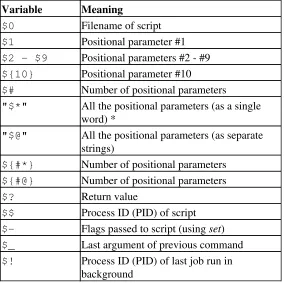
$*, $@
positional parameters.
$?
exit status variable. The $? variable holds the exit status of a command, a function, or of the script
itself.
$$
process ID variable. The $$ variable holds the process ID [17] of the script in which it appears.
()
command group.
(a=hello; echo $a)
A listing of commands within parentheses starts a subshell.
Variables inside parentheses, within the subshell, are not visible to the rest of the
script. The parent process, the script, cannot read variables created in the child
process, the subshell.
a=123
( a=321; )
echo "a = $a" # a = 123
# "a" within parentheses acts like a local variable.
array initialization.
Array=(element1 element2 element3)
{xxx,yyy,zzz,...}
Brace expansion.
echo \"{These,words,are,quoted}\" # " prefix and suffix # "These" "words" "are" "quoted"
# Concatenates the files file1, file2, and file3 into combined_file.
cp file22.{txt,backup}
# Copies "file22.txt" to "file22.backup"
A command may act upon a comma-separated list of file specs within braces. [18] Filename
expansion (globbing) applies to the file specs between the braces.
No spaces allowed within the braces unless the spaces are quoted or escaped.
echo {file1,file2}\ :{\ A," B",' C'}
file1 : A file1 : B file1 : C file2 : A file2 : B file2 :
C
{a..z}
Extended Brace expansion.
echo {a..z} # a b c d e f g h i j k l m n o p q r s t u v w x y z # Echoes characters between a and z.
echo {0..3} # 0 1 2 3
# Echoes characters between 0 and 3.
base64_charset=( {A..Z} {a..z} {0..9} + / = )
# Initializing an array, using extended brace expansion. # From vladz's "base64.sh" example script.
The {a..z} extended brace expansion construction is a feature introduced in version 3 of Bash.
{}
Block of code [curly brackets]. Also referred to as an inline group, this construct, in effect, creates
an anonymous function (a function without a name). However, unlike in a "standard" function, the
variables inside a code block remain visible to the remainder of the script.
bash$ { local a; a=123; }
bash: local: can only be used in a function
a=123 { a=321; }
echo "a = $a" # a = 321 (value inside code block)
# Thanks, S.C.
The code block enclosed in braces may have I/O redirected to and from it.
Example 3-1. Code blocks and I/O redirection
#!/bin/bash
# Reading lines in /etc/fstab.
File=/etc/fstab
read line1 read line2 } < $File
echo "First line in $File is:" echo "$line1"
echo
echo "Second line in $File is:" echo "$line2"
exit 0
# Now, how do you parse the separate fields of each line? # Hint: use awk, or . . .
# . . . Hans-Joerg Diers suggests using the "set" Bash builtin.
Example 3-2. Saving the output of a code block to a file
#!/bin/bash # rpm-check.sh
# Queries an rpm file for description, listing, #+ and whether it can be installed.
# Saves output to a file. #
# This script illustrates using a code block.
SUCCESS=0 E_NOARGS=65
if [ -z "$1" ] then
echo "Usage: `basename $0` rpm-file" exit $E_NOARGS
fi
{ # Begin code block. echo
echo "Archive Description:"
rpm -qpi $1 # Query description. echo
echo "Archive Listing:"
rpm -qpl $1 # Query listing. echo
rpm -i --test $1 # Query whether rpm file can be installed. if [ "$?" -eq $SUCCESS ]
then
echo "$1 can be installed." else
echo "$1 cannot be installed." fi
echo # End code block.
} > "$1.test" # Redirects output of everything in block to file.
echo "Results of rpm test in file $1.test"
# See rpm man page for explanation of options.
Unlike a command group within (parentheses), as above, a code block enclosed by
{braces} will not normally launch a subshell. [19]
{}
placeholder for text. Used after xargs -i (replace strings option). The {} double curly brackets are a
placeholder for output text.
ls . | xargs -i -t cp ./{} $1 # ^^ ^^
# From "ex42.sh" (copydir.sh) example.
{} \;
pathname. Mostly used in find constructs. This is not a shell builtin.
The ";" ends the -exec option of a find command sequence. It needs to be escaped to
protect it from interpretation by the shell.
[ ]
test.
Test expression between [ ]. Note that [ is part of the shell builtin test (and a synonym for it), not a
link to the external command /usr/bin/test.
[[ ]]
test.
Test expression between [[ ]]. More flexible than the single-bracket [ ] test, this is a shell keyword.
See the discussion on the [[ ... ]] construct.
[ ]
array element.
In the context of an array, brackets set off the numbering of each element of that array.
Array[1]=slot_1 echo ${Array[1]}
[ ]
range of characters.
As part of a regular expression, brackets delineate a range of characters to match.
$[ ... ]
integer expansion.
Evaluate integer expression between $[ ].
a=3 b=7
echo $[$a+$b] # 10 echo $[$a*$b] # 21
Note that this usage is deprecated, and has been replaced by the (( ... )) construct.
(( ))
integer expansion.
See the discussion on the (( ... )) construct.
> &> >& >> < <>
redirection.
scriptname >filename
redirects the output of scriptname to file filename. Overwrite
filename if it already exists.
command &>filename
redirects both the stdout and the stderr of command to filename.
This is useful for suppressing output when testing for a condition. For example, let us
test whether a certain command exists.
bash$ type bogus_command &>/dev/null
bash$ echo $?
1
Or in a script:
command_test () { type "$1" &>/dev/null; } # ^
cmd=rmdir # Legitimate command. command_test $cmd; echo $? # 0
cmd=bogus_command # Illegitimate command command_test $cmd; echo $? # 1
command >&2
redirects stdout of command to stderr.
scriptname >>filename
appends the output of scriptname to file filename. If
filename does not already exist, it is created.
[i]<>filename
opens file filename for reading and writing, and assigns file descriptor i to it. If
filename does not exist, it is created.
process substitution.
(command)>
<(command)
In a different context, the "<" and ">" characters act as string comparison operators.
In yet another context, the "<" and ">" characters act as integer comparison operators. See also
Example 16-9.
<<
<<<
redirection used in a here string.
<, >
ASCII comparison.
veg1=carrots veg2=tomatoes
if [[ "$veg1" < "$veg2" ]] then
echo "Although $veg1 precede $veg2 in the dictionary," echo -n "this does not necessarily imply anything " echo "about my culinary preferences."
else
echo "What kind of dictionary are you using, anyhow?" fi
\<, \>
word boundary in a regular expression.
bash$
grep '\<the\>' textfile
|
pipe. Passes the output (stdout of a previous command to the input (stdin) of the next one, or to
the shell. This is a method of chaining commands together.
echo ls -l | sh
# Passes the output of "echo ls -l" to the shell, #+ with the same result as a simple "ls -l".
cat *.lst | sort | uniq
# Merges and sorts all ".lst" files, then deletes duplicate lines.
A pipe, as a classic method of interprocess communication, sends the stdout of one process to the
stdin of another. In a typical case, a command, such as cat or echo, pipes a stream of data to a
filter, a command that transforms its input for processing. [20]
cat $filename1 $filename2 | grep $search_word
For an interesting note on the complexity of using UNIX pipes, see the UNIX FAQ, Part 3.
The output of a command or commands may be piped to a script.
#!/bin/bash
# uppercase.sh : Changes input to uppercase.
tr 'a-z' 'A-Z'
# Letter ranges must be quoted
#+ to prevent filename generation from single-letter filenames.
exit 0
Now, let us pipe the output of ls -l to this script.
bash$ ls -l | ./uppercase.sh
The stdout of each process in a pipe must be read as the stdin of the next. If this
is not the case, the data stream will block, and the pipe will not behave as expected.
cat file1 file2 | ls -l | sort
# The output from "cat file1 file2" disappears.
A pipe runs as a child process, and therefore cannot alter script variables.
variable="initial_value"
echo "new_value" | read variable
echo "variable = $variable" # variable = initial_value
If one of the commands in the pipe aborts, this prematurely terminates execution of the
pipe. Called a broken pipe, this condition sends a SIGPIPE signal.
>|
force redirection (even if the noclobber option is set). This will forcibly overwrite an existing file.
||
OR logical operator. In a test construct, the || operator causes a return of 0 (success) if either of the
linked test conditions is true.
&
Run job in background. A command followed by an & will run in the background.
bash$ sleep 10 &
[1] 850
[1]+ Done sleep 10
Within a script, commands and even loops may run in the background.
Example 3-3. Running a loop in the background
#!/bin/bash
# background-loop.sh
for i in 1 2 3 4 5 6 7 8 9 10 # First loop. do
echo -n "$i "
done & # Run this loop in background.
# Will sometimes execute after second loop.
echo # This 'echo' sometimes will not display.
for i in 11 12 13 14 15 16 17 18 19 20 # Second loop. do
echo -n "$i " done
echo # This 'echo' sometimes will not display.
# ======================================================
# The expected output from the script: # 1 2 3 4 5 6 7 8 9 10
# Sometimes, though, you get: # 11 12 13 14 15 16 17 18 19 20 # 1 2 3 4 5 6 7 8 9 10 bozo $
# (The second 'echo' doesn't execute. Why?)
# Occasionally also:
# 1 2 3 4 5 6 7 8 9 10 11 12 13 14 15 16 17 18 19 20 # (The first 'echo' doesn't execute. Why?)
# Very rarely something like:
# 11 12 13 1 2 3 4 5 6 7 8 9 10 14 15 16 17 18 19 20 # The foreground loop preempts the background one.
exit 0
# Nasimuddin Ansari suggests adding sleep 1 #+ after the echo -n "$i" in lines 6 and 14, #+ for some real fun.
A command run in the background within a script may cause the script to hang,
waiting for a keystroke. Fortunately, there is a remedy for this.
&&
AND logical operator. In a test construct, the && operator causes a return of 0 (success) only if both
the linked test conditions are true.
-option, prefix. Option flag for a command or filter. Prefix for an operator. Prefix for a default
parameter in parameter substitution.
COMMAND -[Option1][Option2][...]
ls -al
sort -dfu $filename
if [ $file1 -ot $file2 ] then # ^
echo "File $file1 is older than $file2." fi
if [ "$a" -eq "$b" ] then # ^
echo "$a is equal to $b." fi
if [ "$c" -eq 24 -a "$d" -eq 47 ] then # ^ ^
echo "$c equals 24 and $d equals 47." fi
param2=${param1:-$DEFAULTVAL} # ^
sort --ignore-leading-blanks
Used with a Bash builtin, it means the end of options to that particular command.
This provides a handy means of removing files whose names begin with a dash.
bash$ ls -l
-rw-r--r-- 1 bozo bozo 0 Nov 25 12:29 -badname
bash$ rm -- -badname
bash$ ls -l
total 0
The double-dash is also used in conjunction with set.
set -- $variable
(as in Example 15-18)
-redirection from/to
stdin
or
stdout
[dash].
bash$ cat -abc
abc
...
Ctl-D
As expected,
cat -
echoes stdin, in this case keyboarded user input, to stdout. But, does I/O
redirection using - have real-world applications?
(cd /source/directory && tar cf - . ) | (cd /dest/directory && tar xpvf -) # Move entire file tree from one directory to another
# [courtesy Alan Cox <[email protected]>, with a minor change]
# 1) cd /source/directory
# Source directory, where the files to be moved are. # 2) &&
# "And-list": if the 'cd' operation successful, # then execute the next command.
# 3) tar cf - .
# The 'c' option 'tar' archiving command creates a new archive, # the 'f' (file) option, followed by '-' designates the target file # as stdout, and do it in current directory tree ('.').
# 4) |
# Piped to ... # 5) ( ... ) # a subshell
# 6) cd /dest/directory
# Change to the destination directory. # 7) &&
# "And-list", as above # 8) tar xpvf
-# Unarchive ('x'), preserve ownership and file permissions ('p'), # and send verbose messages to stdout ('v'),
# reading data from stdin ('f' followed by '-'). #
# Whew!
# More elegant than, but equivalent to: # cd source/directory
# tar cf - . | (cd ../dest/directory; tar xpvf -) #
# Also having same effect:
# cp -a /source/directory/* /dest/directory # Or:
# cp -a /source/directory/* /source/directory/.[^.]* /dest/directory # If there are hidden files in /source/directory.
bunzip2 c linux2.6.16.tar.bz2 | tar xvf
-# --uncompress tar file-- | --then pass it to &-#34;tar&-#34;-- "tar"--# If &"tar"--#34;tar&"tar"--#34; has not been patched to handle &"tar"--#34;bunzip2&"tar"--#34;,
#+ this needs to be done in two discrete steps, using a pipe.
# The purpose of the exercise is to unarchive "bzipped" kernel source.
Note that in this context the "-" is not itself a Bash operator, but rather an option recognized by certain
UNIX utilities that write to stdout, such as tar, cat, etc.
bash$ echo "whatever" | cat
-whatever
Where a filename is expected, - redirects output to stdout (sometimes seen with
tar cf
), or
accepts input from stdin, rather than from a file. This is a method of using a file-oriented utility as
a filter in a pipe.
bash$ file
Usage: file [-bciknvzL] [-f namefile] [-m magicfiles] file...
By itself on the command-line, file fails with an error message.
Add a "-" for a more useful result. This causes the shell to await user input.
bash$ file -abc
standard input: ASCII text
bash$ file -#!/bin/bash
standard input: Bourne-Again shell script text executable
Now the command accepts input from stdin and analyzes it.
The "-" can be used to pipe stdout to other commands. This permits such stunts as prepending lines
to a file.
Using diff to compare a file with a section of another:
grep Linux file1 | diff file2
Example 3-4. Backup of all files changed in last day
#!/bin/bash
# Backs up all files in current directory modified within last 24 hours #+ in a "tarball" (tarred and gzipped file).
BACKUPFILE=backup-$(date +%m-%d-%Y)
# Embeds date in backup filename. # Thanks, Joshua Tschida, for the idea. archive=${1:-$BACKUPFILE}
# If no backup-archive filename specified on command-line, #+ it will default to "backup-MM-DD-YYYY.tar.gz."
tar cvf - `find . -mtime -1 -type f -print` > $archive.tar gzip $archive.tar
echo "Directory $PWD backed up in archive file \"$archive.tar.gz\"."
# Stephane Chazelas points out that the above code will fail #+ if there are too many files found
#+ or if any filenames contain blank characters.
# He suggests the following alternatives:
# ---# find . -mtime -1 -type f -print0 | xargs -0 tar rvf &---#34;$archive.tar&---#34; # using the GNU version of "find".
# find . -mtime -1 -type f -exec tar rvf "$archive.tar" '{}' \; # portable to other UNIX flavors, but much slower.
#
---exit 0
Filenames beginning with "-" may cause problems when coupled with the "-"
redirection operator. A script should check for this and add an appropriate prefix to
such filenames, for example ./-FILENAME, $PWD/-FILENAME, or
$PATHNAME/-FILENAME.
If the value of a variable begins with a -, this may likewise create problems.
var="-n"
echo $var
# Has the effect of "echo -n", and outputs nothing.
-previous working directory. A cd - command changes to the -previous working directory. This uses
the $OLDPWD environmental variable.
Do not confuse the "-" used in this sense with the "-" redirection operator just
discussed. The interpretation of the "-" depends on the context in which it appears.
-Minus. Minus sign in an arithmetic operation.
=
a=28
echo $a # 28
In a different context, the "=" is a string comparison operator.
+
Plus. Addition arithmetic operator.
In a different context, the + is a Regular Expression operator.
+
Option. Option flag for a command or filter.
Certain commands and builtins use the + to enable certain options and the - to disable them. In
parameter substitution, the + prefixes an alternate value that a variable expands to.
%
modulo. Modulo (remainder of a division) arithmetic operation.
let "z = 5 % 3" echo $z # 2
In a different context, the % is a pattern matching operator.
~
home directory [tilde]. This corresponds to the $HOME internal variable. ~bozo is bozo's home
directory, and ls ~bozo lists the contents of it. ~/ is the current user's home directory, and ls ~/ lists the
contents of it.
bash$ echo ~bozo
/home/bozo
bash$ echo ~
/home/bozo
bash$ echo ~/
/home/bozo/
bash$ echo ~:
/home/bozo:
bash$ echo ~nonexistent-user
~nonexistent-user
~+
current working directory. This corresponds to the $PWD internal variable.
~-previous working directory. This corresponds to the $OLDPWD internal variable.
=~
regular expression match. This operator was introduced with version 3 of Bash.
^
beginning-of-line. In a regular expression, a "^" addresses the beginning of a line of text.
^, ^^
Uppercase conversion in parameter substitution (added in version 4 of Bash).
Control Characters
change the behavior of the terminal or text display. A control character is a CONTROL + key
combination (pressed simultaneously). A control character may also be written in octal or
hexadecimal notation, following an escape.
Ctl-A
Moves cursor to beginning of line of text (on the command-line).
◊
Ctl-B
Backspace
(nondestructive).
◊
Ctl-C
Break
. Terminate a foreground job.
◊
Ctl-D
Log out from a shell (similar to exit).
EOF
(end-of-file). This also terminates input from stdin.
When typing text on the console or in an xterm window,
Ctl-D
erases the character under
the cursor. When there are no characters present,
Ctl-D
logs out of the session, as expected.
In an xterm window, this has the effect of closing the window.
◊
Ctl-E
Moves cursor to end of line of text (on the command-line).
◊
Ctl-F
Moves cursor forward one character position (on the command-line).
◊
Ctl-G
BEL
. On some old-time teletype terminals, this would actually ring a bell. In an xterm it
might beep.
◊
Ctl-H
Rubout
(destructive backspace). Erases characters the cursor backs over while backspacing.
#!/bin/bash
# Embedding Ctl-H in a string.
a="^H^H" # Two Ctl-H's -- backspaces # ctl-V ctl-H, using vi/vim echo "abcdef" # abcdef
echo
echo -n "abcdef$a " # abcd f
# Space at end ^ ^ Backspaces twice. echo
echo -n "abcdef$a" # abcdef
# No space at end ^ Doesn't backspace (why?). # Results may not be quite as expected. echo; echo
# Constantin Hagemeier suggests trying: # a=$'\010\010'
# a=$'\b\b'
# a=$'\x08\x08'
# But, this does not change the results.
Ctl-I
Horizontal tab
.
◊
Ctl-J
Newline
(line feed). In a script, may also be expressed in octal notation -- '\012' or in
hexadecimal -- '\x0a'.
◊
Ctl-K
Vertical tab
.
When typing text on the console or in an xterm window,
Ctl-K
erases from the character
under the cursor to end of line. Within a script,
Ctl-K
may behave differently, as in Lee Lee
Maschmeyer's example, below.
◊
Ctl-L
Formfeed
(clear the terminal screen). In a terminal, this has the same effect as the clear
command. When sent to a printer, a
Ctl-L
causes an advance to end of the paper sheet.
◊
Ctl-M
Carriage return
.
#!/bin/bash
# Thank you, Lee Maschmeyer, for this example.
read -n 1 -s -p \
$'Control-M leaves cursor at beginning of this line. Press Enter. \x0d' # Of course, '0d' is the hex equivalent of Control-M.
echo >&2 # The '-s' makes anything typed silent,
#+ so it is necessary to go to new line explicitly.
read -n 1 -s -p $'Control-J leaves cursor on next line. \x0a' # '0a' is the hex equivalent of Control-J, linefeed. echo >&2
###
read -n 1 -s -p $'And Control-K\x0bgoes straight down.' echo >&2 # Control-K is vertical tab.
# A better example of the effect of a vertical tab is:
var=$'\x0aThis is the bottom line\x0bThis is the top line\x0a' echo "$var"
# This works the same way as the above example. However: echo "$var" | col
# This causes the right end of the line to be higher than the left end. # It also explains why we started and ended with a line feed
--#+ to avoid a garbled screen.
# As Lee Maschmeyer explains: #
# In the [first vertical tab example] . . . the vertical tab #+ makes the printing go straight down without a carriage return. # This is true only on devices, such as the Linux console, #+ that can't go "backward."
# The real purpose of VT is to go straight UP, not down. # It can be used to print superscripts on a printer.
# The col utility can be used to emulate the proper behavior of VT.
exit 0
Ctl-N
Erases a line of text recalled from history buffer [21] (on the command-line).
◊
Ctl-O
Issues a newline (on the command-line).
◊
Ctl-P
Recalls last command from history buffer (on the command-line).
◊
Ctl-Q
Resume (
XON
).
This resumes stdin in a terminal.
◊
Ctl-R
Backwards search for text in history buffer (on the command-line).
◊
Ctl-S
Suspend (
XOFF
).
This freezes stdin in a terminal. (Use Ctl-Q to restore input.)
◊
Ctl-T
Reverses the position of the character the cursor is on with the previous character (on the
command-line).
◊
Ctl-U
Erase a line of input, from the cursor backward to beginning of line. In some settings,
Ctl-U
erases the entire line of input, regardless of cursor position.
◊
Ctl-V
When inputting text,
Ctl-V
permits inserting control characters. For example, the following
two are equivalent:
echo -e '\x0a' echo <Ctl-V><Ctl-J>
Ctl-V
is primarily useful from within a text editor.
◊
Ctl-W
When typing text on the console or in an xterm window,
Ctl-W
erases from the character
under the cursor backwards to the first instance of whitespace. In some settings,
Ctl-W
erases backwards to first non-alphanumeric character.
Ctl-X
In certain word processing programs, Cuts highlighted text and copies to clipboard.
◊
Ctl-Y
Pastes back text previously erased (with
Ctl-U
or
Ctl-W
).
◊
Ctl-Z
Pauses a foreground job.
Substitute operation in certain word processing applications.
EOF
(end-of-file) character in the MSDOS filesystem.
◊
Whitespace
functions as a separator between commands and/or variables. Whitespace consists of either
spaces, tabs, blank lines, or any combination thereof. [22] In some contexts, such as variable
assignment, whitespace is not permitted, and results in a syntax error.
Blank lines have no effect on the action of a script, and are therefore useful for visually separating
functional sections.
$IFS, the special variable separating fields of input to certain commands. It defaults to whitespace.
Definition:
A field is a discrete chunk of data expressed as a string of consecutive characters.
Separating each field from adjacent fields is either whitespace or some other designated character
(often determined by the $IFS). In some contexts, a field may be called a record.
To preserve whitespace within a string or in a variable, use quoting.
Chapter 4. Introduction to Variables and
Parameters
Variables are how programming and scripting languages represent data. A variable is nothing more than a
label, a name assigned to a location or set of locations in computer memory holding an item of data.
Variables appear in arithmetic operations and manipulation of quantities, and in string parsing.
4.1. Variable Substitution
The name of a variable is a placeholder for its value, the data it holds. Referencing (retrieving) its value is
called variable substitution.
$
Let us carefully distinguish between the name of a variable and its value. If
variable1
is the name
of a variable, then
$variable1
is a reference to its value, the data item it contains. [23]
bash$ variable1=23
bash$ echo variable1
variable1
bash$ echo $variable1
23
The only times a variable appears "naked" -- without the $ prefix -- is when declared or assigned,
when unset, when exported, in an arithmetic expression within double parentheses (( ... )), or in the
special case of a variable representing a signal (see Example 32-5). Assignment may be with an = (as
in var1=27), in a read statement, and at the head of a loop (for var2 in 1 2 3).
Enclosing a referenced value in double quotes (" ... ") does not interfere with variable substitution.
This is called partial quoting, sometimes referred to as "weak quoting." Using single quotes (' ... ')
causes the variable name to be used literally, and no substitution will take place. This is full quoting,
sometimes referred to as 'strong quoting.' See Chapter 5 for a detailed discussion.
Note that
$variable
is actually a simplified form of
${variable}
. In contexts where the
$variable
syntax causes an error, the longer form may work (see Section 10.2, below).
Example 4-1. Variable assignment and substitution
#!/bin/bash # ex9.sh
# Variables: assignment and substitution
#---# No space permitted on either side of = sign when initializing variables. # What happens if there is a space?
# "VARIABLE =value" # ^
#% Script tries to run "VARIABLE" command with one argument, "=value".
# "VARIABLE= value" # ^
#% Script tries to run "value" command with
#+ the environmental variable "VARIABLE" set to "".
#---echo hello # hello
# Not a variable reference, just the string "hello" . . .
echo $hello # 375
# ^ This *is* a variable reference. echo ${hello} # 375
# Also a variable reference, as above.
# Quoting . . .
echo "$hello" # 375 echo "${hello}" # 375
echo
hello="A B C D" echo $hello # A B C D echo "$hello" # A B C D
# As you see, echo $hello and echo "$hello" give different results. # Why?
# ======================================= # Quoting a variable preserves whitespace. # =======================================
echo
echo '$hello' # $hello # ^ ^
# Variable referencing disabled (escaped) by single quotes, #+ which causes the "$" to be interpreted literally.
# Notice the effect of different types of quoting.
hello= # Setting it to a null value. echo "\$hello (null value) = $hello"
# Note that setting a variable to a null value is not the same as #+ unsetting it, although the end result is the same (see below).
#
---# It is permissible to set multiple variables on the same line, #+ if separated by white space.
# Caution, this may reduce legibility, and may not be portable.
var1=21 var2=22 var3=$V3 echo
# May cause problems with older versions of "sh" . . .
#
---echo; echo
numbers="one two three" # ^ ^ other_numbers="1 2 3" # ^ ^
# If there is whitespace embedded within a variable, #+ then quotes are necessary.
# other_numbers=1 2 3 # Gives an error message. echo "numbers = $numbers"
echo "other_numbers = $other_numbers" # other_numbers = 1 2 3 # Escaping the whitespace also works.
mixed_bag=2\ ---\ Whatever
# ^ ^ Space after escape (\).
echo "$mixed_bag" # 2 --- Whatever
echo; echo
echo "uninitialized_variable = $uninitialized_variable" # Uninitialized variable has null value (no value at all!).
uninitialized_variable= # Declaring, but not initializing it
#+ same as setting it to a null value, as above. echo "uninitialized_variable = $uninitialized_variable"
# It still has a null value.
uninitialized_variable=23 # Set it. unset uninitialized_variable # Unset it.
echo "uninitialized_variable = $uninitialized_variable" # It still has a null value. echo
exit 0
An uninitialized variable has a "null" value -- no assigned value at all (not zero!).
if [ -z "$unassigned" ] then
echo "\$unassigned is NULL." fi # $unassigned is NULL.
Using a variable before assigning a value to it may cause problems. It is nevertheless
possible to perform arithmetic operations on an uninitialized variable.
echo "$uninitialized" # (blank line) let "uninitialized += 5" # Add 5 to it. echo "$uninitialized" # 5
# Conclusion:
# An uninitialized variable has no value,
#+ however it evaluates as 0 in an arithmetic operation.
4.2. Variable Assignment
=
the assignment operator (no space before and after)
Do not confuse this with = and -eq, which test, rather than assign!
Note that = can be either an assignment or a test operator, depending on context.
Example 4-2. Plain Variable Assignment
#!/bin/bash # Naked variables
echo
# When is a variable "naked", i.e., lacking the '$' in front? # When it is being assigned, rather than referenced.
# Assignment a=879
echo "The value of \"a\" is $a."
# Assignment using 'let' let a=16+5
echo "The value of \"a\" is now $a."
echo
# In a 'for' loop (really, a type of disguised assignment): echo -n "Values of \"a\" in the loop are: "
for a in 7 8 9 11 do
echo -n "$a " done
echo echo
# In a 'read' statement (also a type of assignment): echo -n "Enter \"a\" "
read a
echo "The value of \"a\" is now $a."
echo
exit 0
Example 4-3. Variable Assignment, plain and fancy
#!/bin/bash
a=23 # Simple case echo $a
echo $b
# Now, getting a little bit fancier (command substitution).
a=`echo Hello!` # Assigns result of 'echo' command to 'a' ... echo $a
# Note that including an exclamation mark (!) within a
#+ command substitution construct will not work from the command-line, #+ since this triggers the Bash "history mechanism."
# Inside a script, however, the history functions are disabled.
a=`ls -l` # Assigns result of 'ls -l' command to 'a'
echo $a # Unquoted, however, it removes tabs and newlines. echo
echo "$a" # The quoted variable preserves whitespace. # (See the chapter on "Quoting.")
exit 0
Variable assignment using the $(...) mechanism (a newer method than backquotes). This is likewise a
form of command substitution.
# From /etc/rc.d/rc.local R=$(cat /etc/redhat-release) arch=$(uname -m)
4.3. Bash Variables Are Untyped
Unlike many other programming languages, Bash does not segregate its variables by "type." Essentially, Bash
variables are character strings, but, depending on context, Bash permits arithmetic operations and
comparisons on variables. The determining factor is whether the value of a variable contains only digits.
Example 4-4. Integer or string?
#!/bin/bash
# int-or-string.sh
a=2334 # Integer. let "a += 1"
echo "a = $a " # a = 2335
echo # Integer, still.
b=${a/23/BB} # Substitute "BB" for "23".
# This transforms $b into a string. echo "b = $b" # b = BB35
declare -i b # Declaring it an integer doesn't help. echo "b = $b" # b = BB35
let "b += 1" # BB35 + 1 echo "b = $b" # b = 1
echo # Bash sets the "integer value" of a string to 0.
c=BB34
d=${c/BB/23} # Substitute "23" for "BB". # This makes $d an integer. echo "d = $d" # d = 2334
let "d += 1" # 2334 + 1 echo "d = $d" # d = 2335 echo
# What about null variables?
e='' # ... Or e="" ... Or e= echo "e = $e" # e =
let "e += 1" # Arithmetic operations allowed on a null variable? echo "e = $e" # e = 1
echo # Null variable transformed into an integer.
# What about undeclared variables? echo "f = $f" # f =
let "f += 1" # Arithmetic operations allowed? echo "f = $f" # f = 1
echo # Undeclared variable transformed into an integer. #
# However ...
let "f /= $undecl_var" # Divide by zero?
# let: f /= : syntax error: operand expected (error token is " ") # Syntax error! Variable $undecl_var is not set to zero here! #
# But still ... let "f /= 0"
# let: f /= 0: division by 0 (error token is "0") # Expected behavior.
# Bash (usually) sets the "integer value" of null to zero #+ when performing an arithmetic operation.
# But, don't try this at home, folks!
# It's undocumented and probably non-portable behavior.
# Conclusion: Variables in Bash are untyped, #+ with all attendant consequences.
exit $?
Untyped variables are both a blessing and a curse. They permit more flexibility in scripting and make it easier
to grind out lines of code (and give you enough rope to hang yourself!). However, they likewise permit subtle
errors to creep in and encourage sloppy programming habits.
To lighten the burden of keeping track of variable types in a script, Bash does permit declaring variables.
4.4. Special Variable Types
Local variables
Variables visible only within a code block or function (see also local variables in functions)
Environmental variables
Variables that affect the behavior of the shell and user interface
process.
Every time a shell starts, it creates shell variables that correspond to its own
environmental variables. Updating or adding new environmenta