Implementing Adobe Captivate in Designing
E-Learning’s Digital Content
Paula Dewanti
Information System
Institut Teknologi dan Bisnis STIKOM Bali, Indonesia
Muhammad Rusli
Information System
Institut Teknologi dan Bisnis STIKOM Bali, Indonesia
ABSTRACT
Technology has been taking a part in advancing education and be an instrument of the learning experiences. E-Learning is considered as a bridge over the boundaries in the conventional knowledge transfer. In addition to that, it is crucial to focus on the learning media used to perform the process itself. This preliminary study aims to explore how Adobe Captive, as learning medium, can help to create interactive digital E-Learning content. Using ADDIE, as instructional systems design, the three initial phases were performed, namely Analysis, Design, and Develop. Meanwhile, further two remaining stages, Implement and Evaluate, are carried over on extended research. The computer-based media in learning can provide a variety of material, in the form of data, with software as the processor, so that the learning atmosphere becomes interactive in multiple directions to maximize the potential learning experience.
General Terms
Digital Content Design, E-Learning, Computer Assisted Instruction, ADDIE Model.
Keywords
Adobe Captivate, E-Learning, Digital Content.
1.
INTRODUCTION
The learning paradigm has changed from teacher-centered learning to student-centered learning. The need for change in teaching, learning, assessment and work to be effective participants in the 21st-century conditions that are driven by information and technology (Kivunja, 2015).
In today’s age, all data and information are spread all over the world through the internet/web, so that everyone can easily access all the desired data and information. Digital learning content or material available on the internet can be text, pictures, videos or multimedia (Clark, 2016). Multimedia learning is a form of learning application that can answer the paradigms that occur in the current digital era (Clark, 2016) (Clark, 2016).
Technology is developing rapidly and taking part in education as a tool for teaching and learning (Lautala, 2015). In addition to E-Learning which bridges boundaries in the delivery of direct learning, learning media is also needed to facilitate the learning process itself. Packaging material using attractive learning media can improve learning effectiveness and creating the learning experiences (Clark, 2016). The purpose of this study is to explore how Adobe Captive can assist with creating an interactive E-Learning's digital content.
2.
LITERATURE REVIEW
2.1
Computer Assisted Instruction
Computer Assisted Instruction (CAI) is a learning model that utilizes computers as instructors or learning media for students. Some classroom research suggests computers can offer highly individualized instruction, and allow students to learn at their own pace (Barrow, 2009).
Instructional design involves identifying, consolidating, and selecting the learning experiences necessary to educate learner on knowledge. Good instructional design is self-contained of the technology or personnel used to create those learning experiences (Horton, 2011).
Adobe Captivate can be used in the process of teaching, and learning activities, especially those that are assisted by computers (Allen, 2016).
2.2
E-Learning
Some experts framed the E-Learning as a type of learning that allows the delivery of teaching materials to students by using the internet, intranet, and other computer network media (Harley, 2011). ‘E-Learning is any learning that involves the use electronic circuits (LAN, WAN or Internet), content of learning, interaction and guidance’ (Dazki, 2015). Others said that E-learning is the use of information and computer technologies, to enhance learning experiences (Horton, 2011). It can be summarized that E-Learning is learning itself, thus learning process which utilizes electronic information packages for learning and education purposes, accessed by learners, anytime and anywhere based on ICT. Other researchers discovered that computers extend customized individualized instruction, enable learners to study at their own pace (Barrow, 2009).
The implementation of E-Learning may vary depending on the class’s needs. Furthermore, Horton divides E-Learning forms into the following (Horton, 2011):
Self-minded-learning with no interaction with either the mentor or other students.
An online class that identically designed according to a classroom’s course.
Gaining knowledge by carrying out simulated activities that require exploration and lead to findings.
An Embedded E-Learning where the E-learning is part of another system.
goal.
A Mobile Learning. Learning that, aided by mobile devices while learner keeps moving from one place to another.
A Knowledge Management, as it uses extensive e-learning, online documents, and conventional media to educate entire populations and organizations rather than just individuals.
2.3
Adobe Captivate
Adobe Captivate is one of the audiovisual media. Created by Adobe System Incorporated, it is one of the Industrials scale software for building e-Learning content or digital learning (Allen, 2016). Based on the Adobe Flash platform, Adobe Captivate produces an interactive content which compatible
with Flash Player and easily distributed, thus accessed, online. It has various automatic features, enable users to easily create complex branching scenarios with feedback options and insert various multimedia files (Siegel, 2015). Adobe Captivate allows anyone to make a quick and effective simulation that is powerful and guaranteed, scenario-based training and testing without the need for programming, or multimedia skills (Jaisingh, 2017).
[image:2.595.105.493.255.479.2]Adobe Captivate is a stand-alone E-Learning application for creating complex interactive material. Adobe Captivate is a multi-purpose tool such as training, tutorials, quizzes, assessments, and even simple slide shows (Huettner, 2008). The availability of tools to build the multimedia content, such as video, audio, text, color, color gradation, object shape, object motion effects, and animation effects can be seen in Figure 1.
Fig 1: Features on the Adobe Captivate New Project
Picture 2 shows one of automated features, for example, uploading automated content to YouTube. There were other features, namely Quiz, Audio, Video, and many more.
[image:2.595.351.505.497.674.2]Fig 2: Content Publish Function to Youtube.com
Fig 3: Other Features of Adobe Captivate
3.
RESEARCH METHODS
[image:2.595.88.248.534.712.2]The Analyze’ stage is the core of the instructional design process. At this stage, the learning designer analyzes and identifies what kind of learning is needed, who are the subjects, what material will be delivered in the learning program that concluded on learning plan. The analysis includes feasibility studies, and needs’ analysis, which was done through a direct observation and an interview.
In the Design stage, specified learning objectives strategies are considered, such as the selection of learning material, the media to be used, the time or duration of learning, and how to assess the material.
From there, Develop’ phase will be executed. This phase aims to arrange and integrate the materials that will be used in the learning. At this stage, the designer will develop all aspects related to learning activities, for example: learning materials, videos, participant workbooks, and others.
As for the other two remain stages, Implement and Evaluate, are carried over into the next study. Implement stage is the stage of learning activities where it previously designed. Learning activities can be in the form of face-to-face or online (E-Learning). The function of this stage is the delivery of learning effectively and efficiently to achieve learning objectives (De Witte, 2015). It will then follow with Evaluate stage to evaluate the effectiveness and the efficiency of learning that has been done.
4.
RESULTS AND DISCUSSION
4.1
Analyzing the Needs
Millennial shows that they’re more of technologically advanced (Smith, 2015). They carry their own generation characteristics and transform previously conventional learning through the use of information technology such as computers, Internet and mobile apps in learning process. Multimedia learning is a short of learning application that may answer the paradigms that occur within the current digital era (Allen, 2016). Required media to be able to visualize learning material, and it is crucial to determine the most suitable media that fit into the student. The Higher Education continues to
improve the quality of learning through computer-based learning media where it can be used as learning enhancement in facilitating the learning process (Barrow, 2009). Adobe Captivate, as a learning media, can fill in the needs (Jaisingh,
2017). There was a necessity for creating the learning material and quiz based on the Learning Guideline Plan (RPS) of the subject matter.
4.2
Concept Designing
In this study, Tri Hita Karana-based Tourism learning module, which was one of the topics discussions about the Balinese local wisdom, part of the e-Tourism subject matter, were built.
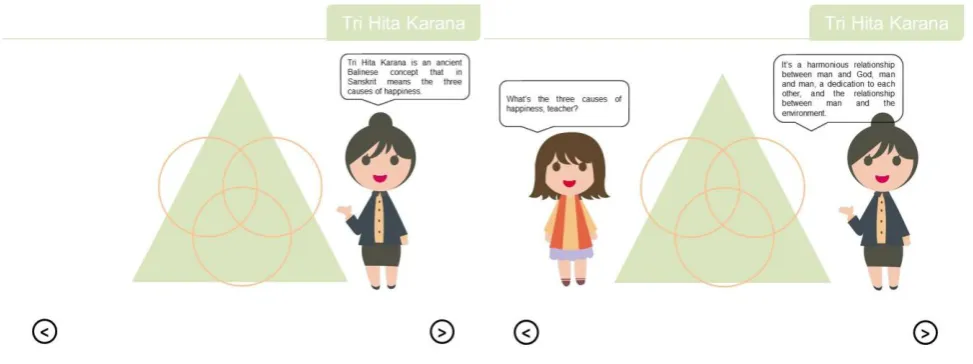
[image:3.595.56.543.496.678.2]Tri Hita Karana is an ancient Balinese concept that in Sanskrit means the three causes of happiness. Consists of three words, that broken down into the following meaning: Tri which means three, Hita means happiness, and Karana means causes (Roth, 2015). Essentially, Tri Hita Karana is a philosophy that focuses on the importance of maintaining a harmonious relationship between man and God, man and man, a dedication to each other, then the relationship between man and the environment.
Fig 5: Creating Characters
Fig 6: Material Draft
4.3
Developing Content
Essentially, Adobe Captivate is importing PowerPoint slides. It allows us to add, modify text captions, and provide audios (voice-overs, background music, and sound effects), videos, animations, images, hyperlinks, to projects that have been
created (Khademi, 2011).
1. Creating A Learning Module
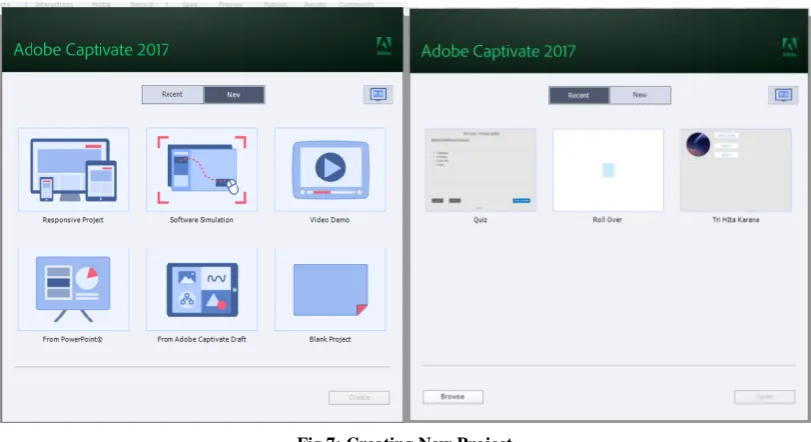
Fig 7: Creating New Project
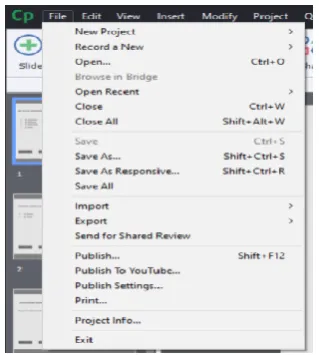
If the presentation file is available in PowerPoint format, they will be able to import it to Adobe Captivate. Select 'File' in the Adobe Captivate menu, then 'Import' and select 'PowerPoint'. The 'Open' dialog box will be then displayed. Select the PowerPoint file that needs to be imported, then click 'Open' or double-click on the relevant PowerPoint file.
[image:4.595.91.244.417.596.2]The text, narration, an audio, another slide, music background and more, were also adding into the slide. To conclude with, the presentation can be previewed, before it is being published. Figure 8 shows the options.
Fig 8: Adding More Slides
2. Creating the Quiz
Adobe Captivate is equipped with a quiz making features. There are several types of questions, namely True/False, Multiple Choice, Fill-in-the-Blank, and Matching questions. The types of question can be tailored to the needs of each class. The teacher needs to have question’s bank where
contain of their selected questions relating to the topics.
The steps for creating the quiz were further stepping from creating the Blank Project. On the Menu select Quiz, then Question Slide. The Question Types dialog box will appear, and then select the Multiple-Choice option. The grade can also be determined by clicking Graded Question.
The Multiple-Choice Question’ dialog box will appear. Then, in the Name Box, type the type of your question, continued with typing the question in the Question Box.
Stay still in the Multiple-Choice Question’ dialog box, click the Add menu, then the answer choice ‘A’ will appear. The next answer choices ‘B’ will appear by clicking the ‘Add’ over, and repeat the same action with the rest of the answer choice, finished by clicking ‘OK’. Repeat the previous steps to add next questions or quiz.
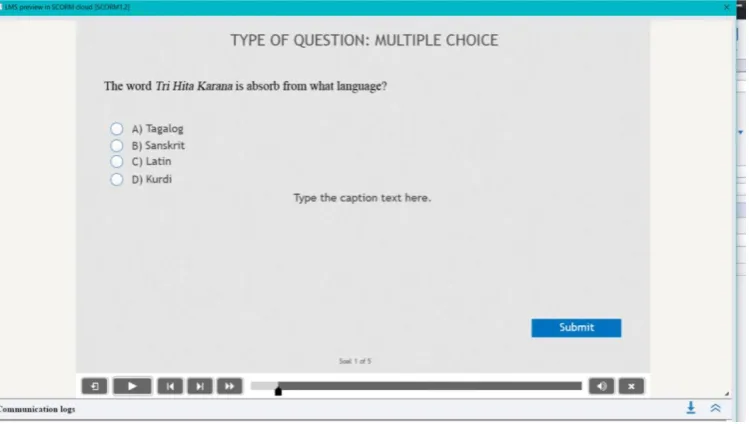
[image:4.595.329.529.498.663.2]Table 1 consists of few questions’ sample and type.
Table 1: Creating Question and Answer
No. Question Type
1 The word Tri Hita Karana is absorbed from what
language?
Multiple Choice
2 Match the words with its meaning.
Matching Question
3 Tri Hita Karana is an ancient Balinese concept that
in Sanskrit means the three causes of happiness.
Fig 9: Creating Question and Answer
Once the quiz has created, it can be published by selecting the
Publish’s menu and selecting how you would like it to be published. Figure 10 shows publishing made for LMS
Fig 10: Publishing the Quiz
5.
CONCLUSIONS
Learning media were one of the components used in the learning process. The use of Adobe Captivate as a learning media, means using media for delivering knowledge, itself. By doing so, the development of interactive learning modules can motivate students in learning. It is expected to be a hasp of learners’ interest.
In conjunction with this study, the authors will move forward with two other stages of the ADDIE Model; Implement and Evaluate. Both of these stages are carried out to evaluate the effectiveness and efficiency of the learning process that has been carried out using the learning modules designed in this study.
6.
ACKNOWLEDGMENTS
This research was supported by Institute of Technology and Business (ITB) Stikom Bali under the 2019 Internal Research Program. The author thanks her advisor, Muhammad Rusli,
for his expertise discussion on this study. The author would also like to thank the visual creative talent, AsahinaChan, from Indonesian Institute of the Art (ISI) Denpasar, for her original character design.
7.
REFERENCES
[1] Kivunja, C. (2015). Teaching students to learn and to work well with 21st century skills: Unpacking the career and life skills domain of the new learning paradigm. International Journal of Higher Education, 4(1), 1-11.
[2] Clark, R.C. and Mayer, R.E., 2016. E-learning and the science of instruction: Proven guidelines for consumers and designers of multimedia learning. John Wiley & Sons.
[image:5.595.113.488.339.551.2]Education. International Journal of Transportation Science and Technology, 4(2), pp.179-196.
[4] Dazki, E. (2015). Aptikom Open Education Architectural Framework A Strategic Platform to Implement Online Learning in Higher Education Environment. IJNS-Indonesian Journal on Networking and Security, 5(2). [5] Harley, Z., & Harley, E. (2011). E-learning and
e-assessment for a computer programming course. EDULEARN11 Proceedings, 2074-2080.
[6] Barrow, L., Markman, L. and Rouse, C.E., 2009. Technology's edge: The educational benefits of computer-aided instruction. American Economic Journal: Economic Policy, 1(1), pp.52-74.
[7] Horton, W. (2011). E-learning by design. John Wiley & Sons.
[8] Allen, M. W. (2016). Michael Allen's guide to e-learning: Building interactive, fun, and effective learning programs for any company. John Wiley & Sons.
[9] Siegel, K. (2015). Adobe Captivate 9: The Essentials. IconLogic.
[10]Huettner, B. (2008). Adobe Captivate 3: The Definitive Guide. Jones & Bartlett Learning.
[11]Jaisingh, P., & Bruyndonckx, D. (2017). Mastering Adobe Captivate 2017: create professional SCORM-compliant eLearning content with Adobe Captivate. Packt Publishing Ltd.
[12]De Witte, K., Haelermans, C. and Rogge, N., 2015. The effectiveness of a computer‐ assisted math learning program. Journal of Computer Assisted Learning, 31(4), pp.314-329.
[13]Smith, T. J., & Nichols, T. (2015). Understanding the millennial generation. The Journal of Business Diversity, 15(1), 39.
[14]Roth, D., & Sedana, G. (2015). Reframing Tri Hita Karana: From ‘Balinese Culture’to Politics. The Asia Pacific Journal of Anthropology, 16(2), 157-175. [15]Khademi, M., Haghshenas, M., & Kabir, H. (2011,
September). A review on authoring tools. In Proceedings of the 5th International Conference on Distance Learning and Education, IPCSIT (Vol. 12, pp. 40-44). [16]Deacon, M., Han, A., Thorn, M. and Yates, S., 2016.