http://www.scirp.org/journal/ojn ISSN Online: 2162-5344
ISSN Print: 2162-5336
DOI: 10.4236/ojn.2018.83019 Mar. 29, 2018 221 Open Journal of Nursing
Problems and Instruction Needed in Relation
to Nursing Students’ Handling of Patient
Information—From a Survey of Nurses
Coordinating Clinical Practicums in Japan
Mikiko Natsume
Department of Nursing College of Life and Health Sciences, Chubu University, Kasugai, Japan
Abstract
The purpose of this study was to clarify and consider the instruction that is needed in relation to nursing students’ handling of patient information, as felt by the people in charge of student clinical practicums in hospitals. Semi-structured interviews were conducted with 7 people in charge of orga-nizing practicums at hospitals where they are carried out. These subjects were asked about problems they had experienced in relation to nursing students’ handling of patient information and the instruction that is needed so that problems related to nursing students’ handling of information do not occur. Various problems were shown to occur in relation to nursing students’ han-dling of patient information, such as hanhan-dling the information outside of the practicum setting. Many students receive no instruction with regard to the ethics of handling patient information in their classroom work, and their awareness regarding information is cannot be considered high, indicating the need for more consistent and reliable education in this area. The findings also suggest that instruction is needed with regard to the handling of sensitive in-formation in accordance with the circumstances of individual patients.
Keywords
Nursing Student, Information Privacy, Clinical Practicum
1. Introduction
In providing medical care, medical personnel gather, record, and share informa-tion about individual patients. Nurses in particular handle much informainforma-tion on the physical, social, and psychological aspects of patients, and not uncommonly How to cite this paper: Natsume, M.
(2018) Problems and Instruction Needed in Relation to Nursing Students’ Handling of Patient Information—From a Survey of Nurses Coordinating Clinical Practicums in Japan. Open Journal of Nursing, 8, 221-233. https://doi.org/10.4236/ojn.2018.83019
Received: January 6, 2018 Accepted: March 26, 2018 Published: March 29, 2018
Copyright © 2018 by author and Scientific Research Publishing Inc. This work is licensed under the Creative Commons Attribution International License (CC BY 4.0).
http://creativecommons.org/licenses/by/4.0/
DOI: 10.4236/ojn.2018.83019 222 Open Journal of Nursing that includes information that is deeply personal. Most countries have estab-lished their own legal regulations based on the 8 principles of the OECD guide-lines related to the handling of patient information, examples of which are the Health Insurance Portability and Accountability Act of 1996 (HIPAA) in the USA and the Law on the Handling of Personal Information in Japan. These reg-ulations are meant to ensure the ethical handling of information and protect the privacy of patients. Today, with the digitization of information in electronic medical records and other formats and the need to share information with other medical institutions due to shorter hospital stays and transfers, nurses’ informa-tion ethics in handling patient informainforma-tion are becoming increasingly impor-tant. In the USA, the Technology Informatics Guiding Education Reform (TIGER) Initiative, a professional organization for nursing informatics, includes an informatics competencies team that presents information literacy competen-cy, information ethics, and information management as competencies related to information necessary to nursing, to help nurses develop abilities related to in-formation ethics.
In the educational process, nursing students gather patient information and provide nursing care under the instruction of faculty members and hospital staff in nursing practicums. These practicums are structured so that students care for specific patients. Although these students are in a position that is not legally subject to confidentiality requirements, they record various patient information in their practicum record and memos, and share information with other stu-dents in conferences and other settings. At the time of graduation from basic nursing education, student nurses need to understand the concepts of “confi-dentiality obligation” and “protection of personal information,” and to have ac-quired a level of awareness that allows them act based on those concepts [1].
Considering the position of nurses in handling patient information, basic nursing education courses need to be enhanced to produce nurses with solid knowledge and competencies in information ethics for the proper handling of patients’ personal information.
DOI: 10.4236/ojn.2018.83019 223 Open Journal of Nursing of opinions on the instruction that is needed, which includes the opinions of pa-tients and the people in charge at hospitals, seems necessary. The aim of this study was to clarify the type of instruction that is needed for students in basic nursing education courses so that they can handle patient information appro-priately with a basis in information ethics. The purpose of this study was to cla-rify teaching instruction related to nursing students’ handling of patient infor-mation that is felt to be needed by hospital personnel in charge of coordinating nursing practicums at hospitals where they are held, and to investigate what in-struction is necessary.
2. Methods
2.1. Subjects
The subjects were nurses in charge of coordinating nursing practicums at the hospitals that agreed to them (nurses in charge of education, etc.). The reason for selecting these subjects was that they are the ones who oversee the clinical practicums of students and are thought to be very knowledgeable about the cur-rent situation with regard to accepting students and the desires of patients. In order to elicit the wishes of the hospital overall with regard to the current situa-tion and educasitua-tional institusitua-tion instrucsitua-tion, the specialty of the hospital depart-ment where the subjects worked was not asked. To limit the study to the situa-tion at hospitals, community or home care practicum facilities were not in-cluded.
2.2. Selection of Participants
There are 71 hospitals with 300 beds or more in the prefecture where the study took place. Of them, about 30 hospitals that were geographically practicable to visit for interviews were selected, and requests were made to the head of the nursing department. If the head of the nursing department agreed, a letter of request including the study content and purpose was sent to the person in charge of coordinating nursing practicums to ask for their cooperation. Included with the letter were a consent form and a form with contact information to ar-range an interview time. Return of the consent form was taken to be consent for the study. A date and time and the individual interview was set and the interview was conducted.
2.3. Survey Method and Content
Semi-structured interviews based on an interview guide were conducted. Ques-tions on the following were asked during the interview.
1) Subject attributes including professional position, sex, and number of years’ experience as a nurse.
2) Thoughts on being asked by patients about nursing students’ handling of patient information.
informa-DOI: 10.4236/ojn.2018.83019 224 Open Journal of Nursing tion by nursing students.
4) Instructions or considerations felt to be needed so that problems related to the handling of patient information do not occur.
“Consideration” in this study includes matters that should be kept in mind when giving instruction.
5) Other opinions regarding the handling of patient information by nursing students.
The surveys were conducted between September 2015 and January 2016.
2.4. Analysis
The interviews were recorded with the subjects’ consent using an IC recorder. Transcriptions were prepared, and semantic content was classified according to the following procedures based on the similarity of the semantic content. The transcripts of the recorded interview content were read repeatedly, and remarks consistent in meaning were abstracted. The notes made by the researcher during the interview were summarized for clarification without changing the meaning. The summarized statements were grouped according to similarity of meaning and content, and subcategories expressing common meanings were identified. Further grouping was done based on the similarity of semantic content in the subcategories, and categories that express further common meanings were iden-tified. In the analysis process, the results were reviewed several times with a nursing researcher experienced in content analysis with the aim of ensuring va-lidity.
2.5. Ethical Considerations
When requesting cooperation with this survey, a written explanation was sent to the head of each hospital’s nursing department with regard to the protection of privacy and ethical considerations. The subject of the research was explained in writing and orally, and the survey was conducted with ethical considerations for the subjects. The explanation included that the interviews would be held in a place where privacy was maintained and the anonymity of the interview content was ensured; that the collected data would be confidential and the data and con-tact information would not be used for any purpose other than this study; that subjects could withdraw from the study even after giving consent; and that the individual would suffer no disadvantage by not consenting to participant. Final confirmation was made orally at the start of the survey. Consent from the ethics committee of the author’s affiliated institution was obtained for all of the proce-dures in this study (approval number 270039).
3. Results
DOI: 10.4236/ojn.2018.83019 225 Open Journal of Nursing
Table 1. Subject attributes, n = 7.
Position
Education head nurse 4
Education chief nurse 1
Ward head nurse 2
Age 50 s 4
40 s 3
Sex Female 7
were female. The interview times were 31 - 49 minutes, with a mean time of 40.5 ± 10.5 minutes. In the following, quotation marks are used for the specific statements in the interviews, italics are used for subcategories, and bold letters are used for categories.
3.1. Problems Felt in the Handling of Patient Information by
Nursing Students
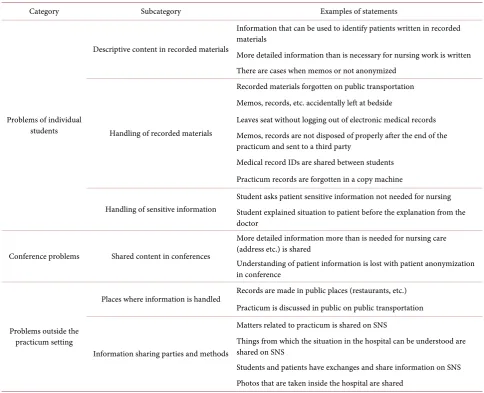
Fifty-eight descriptive statements were abstracted for problems felt in relation to nursing students’ handling of patient information. They were arranged into 3 categories consisting of 6 subcategories (Table 2).
The 3 categories were Problems of individual students, consisting of the subcategories Descriptive content in recorded materials, Handling of recorded materials, and Handling of sensitive information; Conference problems, with the subcategory of Shared content in conferences; and Problems outside the practicum setting, consisting of Places where information is handled and In-formation sharing parties and methods.
3.2. Necessary Instruction and Considerations Associated with
Students’ Handling of Patient Information
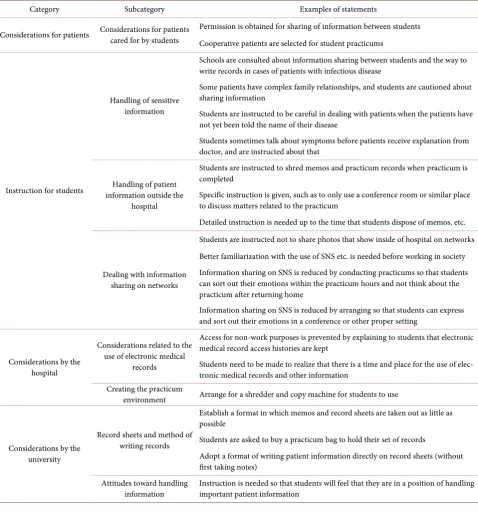
Seventy-six descriptive statements were extracted for instruction and considera-tions needed in conducting practicums. They were arranged into 4 categories consisting of 8 subcategories (Table 3). Each of the categories is described be-low.
1) Instruction for students
In the category of Instructions for students, the subcategory of Handling of sensitive information was derived from statements such as “When students are caring for patients with infectious disease, a university faculty member is con-sulted with regard to the sharing of information between students and the way to write records,” and “Some patients have complex family relationships, and stu-dents are sometimes cautioned about sharing information.” The subcategory of
DOI: 10.4236/ojn.2018.83019 226 Open Journal of Nursing
Table 2. Problems in students’ handling of patient information.
Category Subcategory Examples of statements
Problems of individual students
Descriptive content in recorded materials
Information that can be used to identify patients written in recorded materials
More detailed information than is necessary for nursing work is written There are cases when memos or not anonymized
Handling of recorded materials
Recorded materials forgotten on public transportation Memos, records, etc. accidentally left at bedside
Leaves seat without logging out of electronic medical records Memos, records are not disposed of properly after the end of the practicum and sent to a third party
Medical record IDs are shared between students Practicum records are forgotten in a copy machine
Handling of sensitive information
Student asks patient sensitive information not needed for nursing Student explained situation to patient before the explanation from the doctor
Conference problems Shared content in conferences
More detailed information more than is needed for nursing care (address etc.) is shared
Understanding of patient information is lost with patient anonymization in conference
Problems outside the practicum setting
Places where information is handled Records are made in public places (restaurants, etc.) Practicum is discussed in public on public transportation
Information sharing parties and methods
Matters related to practicum is shared on SNS
Things from which the situation in the hospital can be understood are shared on SNS
Students and patients have exchanges and share information on SNS Photos that are taken inside the hospital are shared
statements such as “Guidance is needed for a better familiarization with the use of things such as social networking services (SNS) before working in society,” “Information sharing on SNS is reduced by conducting practicums so that stu-dents can sort out their emotions within the practicum hours, and do not need to think about the practicum after returning home,” and “Information sharing on SNS is reduced by arranging so that students can express and sort out their emotions in a conference or other proper setting.” These 3 subcategories were adopted as instruction for students.
2) Considerations for patients
The category Considerations for patients was adopted with the subcategory
Considerations for patients cared for by students, derived from statements such as “Permission is obtained for the sharing of information between students” and “Cooperative patients are selected for student practicums.”
3) Considerations by the hospital
DOI: 10.4236/ojn.2018.83019 227 Open Journal of Nursing
Table 3. Necessary instruction, considerations, and points bear in mind associated with students’ handling of patient information.
Category Subcategory Examples of statements
Considerations for patients Considerations for patients cared for by students Permission is obtained for sharing of information between students Cooperative patients are selected for student practicums
Instruction for students
Handling of sensitive information
Schools are consulted about information sharing between students and the way to write records in cases of patients with infectious disease
Some patients have complex family relationships, and students are cautioned about sharing information
Students are instructed to be careful in dealing with patients when the patients have not yet been told the name of their disease
Students sometimes talk about symptoms before patients receive explanation from doctor, and are instructed about that
Handling of patient information outside the
hospital
Students are instructed to shred memos and practicum records when practicum is completed
Specific instruction is given, such as to only use a conference room or similar place to discuss matters related to the practicum
Detailed instruction is needed up to the time that students dispose of memos, etc.
Dealing with information sharing on networks
Students are instructed not to share photos that show inside of hospital on networks Better familiarization with the use of SNS etc. is needed before working in society Information sharing on SNS is reduced by conducting practicums so that students can sort out their emotions within the practicum hours and not think about the practicum after returning home
Information sharing on SNS is reduced by arranging so that students can express and sort out their emotions in a conference or other proper setting
Considerations by the hospital
Considerations related to the use of electronic medical
records
Access for non-work purposes is prevented by explaining to students that electronic medical record access histories are kept
Students need to be made to realize that there is a time and place for the use of elec-tronic medical records and other information
Creating the practicum
environment Arrange for a shredder and copy machine for students to use
Considerations by the university
Record sheets and method of writing records
Establish a format in which memos and record sheets are taken out as little as possible
Students are asked to buy a practicum bag to hold their set of records
Adopt a format of writing patient information directly on record sheets (without first taking notes)
Attitudes toward handling
information Instruction is needed so that students will feel that they are in a position of handling important patient information
statements such as “Access for other than the intended purpose is prevented by explaining to students that electronic medical record access histories are kept” and “Students need to be made to realize that there is a time and place for the use of electronic medical records and other information,” and Creating the prac-ticum environment derived from statements such as “Arrange for a shredder and copy machine for students to use.”
4) Considerations by the university
DOI: 10.4236/ojn.2018.83019 228 Open Journal of Nursing Record sheets and method of writing records, derived from statements such as “Establish a format in which memos and record sheets are taken out as little as possible” and “Adopt a format of writing patient information directly on record sheets (without first taking notes),” and Attitudes toward handling information, which requires instruction so that students will recognize that they are in a posi-tion of handling important patient informaposi-tion.
3.3. Other Things Felt with Regard to Students’ Handling of
Patient Information
Other things given as being felt with regard to the handling of patient informa-tion are shown in Table 4.
One category was Information sharing on SNS, derived from comments such as “It is easy for people to understand that information which can be used to identify a patient must not be posted on SNS, but decisions about information that can or should not be written on SNS regarding the situation in the hospital varies depending on individual values, making instruction difficult.”
The other category was Considerations for patients being cared for by nursing students, derived from statements such as “Permission is obtained from patients for information sharing between students,” “Actual permission is not obtained, but there is an understanding that permission for students to share information is obtained at the moment a patient consents to the practicum,” and “If a detailed explanation including the details on purpose of the practicum and the handling of information is given, patients may refuse to be cared for by nursing students.”
4. Discussion
DOI: 10.4236/ojn.2018.83019 229 Open Journal of Nursing
Table 4. Feelings and opinions on students’ handling of patient information.
Category Examples of statements
Information sharing on SNS
It is easy for people to understand that information that can be used to identify a patient must not be posted on SNS, but decisions about information that can or should not be written on SNS regarding the situation in the hospital varies depending on individual values, making instruction difficult
There are problems not only with students but with working nurses in how they express themselves on SNS
If problems in nursing students’ handling of patient information on SNS are surfaced, we may lose patients willing to cooperate with the next practicum
Considerations for patients being cared for
by nursing students
Permission is obtained from patients for information sharing between students
There is an understanding that permission for students to share information is obtained when a patient consents to the practicum (actual permission is not obtained)
If detailed explanations including the particulars on the purpose of the practicum and handling of information, patients may refuse care by nursing students
4.1. Considerations for Patients
None of the subjects in this study had heard the opinions or wishes of patients. The reason for this is that we were told patients who were cooperative with stu-dent practicums were selected from among all patients, and that subjects asked patients to accept care from a nursing student. This suggested that student prac-ticums proceed more smoothly with considerations for patient selection and full explanations to patients from instructors.
DOI: 10.4236/ojn.2018.83019 230 Open Journal of Nursing
4.2. Instruction for Students
1) Instruction and considerations related to information sharing on networks
The sharing of information on SNS, in the category Information sharing parties and methods, was given as a problem in the handling of patient infor-mation. Problems that were indicated included not only the sharing of informa-tion that can be used to directly identify patients, but also the sharing among students of photos showing records even though patient information has been anonymized, sharing information on the situation within a hospital on SNS, and sharing of photos that show the inside of hospitals. There are many media re-ports in Japan on problems related to information shared on SNS, including in the fields of nursing and medicine, and this has become a major social problem in recent years. It was shown that in the current situation similar problems are likely to occur among nursing students as well.
Many necessary instructions were given with regard to the sharing of infor-mation on SNS. They included not only teaching about things that must not be shared and things to be careful about, but also comments such as “Unless prac-ticums are made so that students do not have to think about the practicum after they go home, they may end up sharing information on SNS,” and “Students need to be given an opportunity to express their opinions in conference set-tings.” This suggests that students need not only instruction related to nursing care, but also help dealing with their emotions. In today’s society the use of SNS is thought to be essential in forming and maintaining groups and in strengthen-ing cohesion among those groups [10]. Limitstrengthen-ing the use of SNS among students of the young generation is predicted to be difficult. Faculty and instructor in-volvement will be necessary so that students can sort out their emotions in the practicum setting, without relying only on SNS.
Information sent out on SNS may include problems in ethical terms even if it does not include patient information, and there are no clear criteria for deter-mining what is good and what is not. This suggests the need to provide instruc-tion so that each individual can make ethical judgments, even though such in-struction is said to be difficult.
2) Problems associated with the handling of sensitive information and rele-vant guidance
DOI: 10.4236/ojn.2018.83019 231 Open Journal of Nursing is difficult to give appropriate instruction in classroom settings only in basic education courses. To make it more likely that sensitive information is handled in ways that are suitable for each patient, hospital instructors need to grasp a range of information and provide instruction with coordination between faculty members and hospital instructors.
4.3. Considerations by Universities
The findings suggest university teaching needs to include instructions and con-siderations to decrease the likelihood of problems, based on the formats and management of recorded materials.
Among things felt to be problems, it was shown that problems of individual students occur not only through inattention, such as loss of recorded materials by accident, but also insufficient awareness by students regarding patient infor-mation, such as failure to anonymize recorded material or inappropriate dispos-al methods for practicum records that contain patient information. In addition, with regard to school instruction on the handling of patient information by nursing students, the need was indicated for instruction that will help students realize that they are in a position of handling important patient information. Accordingly, there is a need to measure the establishment of knowledge in coursework and other learning on the ethics of handling information.
With regard to the present status of conceptual learning of information ethics, only 25.0% of universities have special classes to teach information ethics asso-ciated with the handling of written patient information, as described in the Act on the Protection of Personal Information and privacy laws, and about half of these classes are electives. This indicates the possibility that many students are not educated on information ethics in their coursework [12]. In the tight curri-culum of basic nursing education, teaching about the handling of information is assumed to be difficult in the regular coursework. Instead, it is thought to be taught in settings such as clinical practicums where patients are actually treated. The possibility that students do not learn the concept of protecting personal in-formation in coursework or elsewhere suggests that instruction related to prac-ticums needs to include not only instruction at the level of specific actions but also education on privacy concepts.
4.4. Considerations by Hospitals
DOI: 10.4236/ojn.2018.83019 232 Open Journal of Nursing The findings indicate that hospitals need to give instruction on the appropri-ate handling of electronic medical records, including informing students that electronic medical record access history will remain in the computer system. Media reports on medical record access for purposes other than the intended use are also seen in the case of working nurses. Measures to prevent this were shown to be needed for nursing students as well.
5. Conclusions
This study has shown the following.
It was shown that various problems occur in relation to the handling of pa-tient information by nursing students, such as Problems of individual stu-dents and Handling of information outside the practicum setting. Among them are problems that are thought to occur from a lack of student aware-ness about patient information. It was shown that many students are not educated on the ethics of handling patient information in coursework, sug-gesting that more consistent and reliable education is needed.
The need was felt to create conditions that make problems less likely to oc-cur, by giving specific instruction on the handling of information outside the hospital, developing the practicum environment on the hospital side, and teaching methods of making records on the university side. It is also thought that instruction for students is needed on the handling of sensitive informa-tion, suggesting the need for individual instruction on the handling of patient information in accordance with the circumstances of individual patients.
Limitations
This study showed the educational content related to information ethics in uni-versity undergraduate programs, problems that occur in the handling of patient information in clinical practicums, and the type of instruction that is needed. However, the number of subjects in the survey was limited, and the findings cannot be generalized. In the future it will be necessary to identify issues that are applicable to current educational content and problems by increasing the num-ber of subjects for the problems that occur and instruction given, and surveying faculty members on the educational content that is actually implemented.
References
[1] Ito, C. (2011) Educational Items in Nursing Ethics and Their Level of Attainment in Basic Nursing Education in Japan: A Delphi Study. Nursing Ethics, 18, 441-454.
https://doi.org/10.1177/0969733010385530
[2] (2016) Nurse Disciplined for Accessing Medical Records for Non-Work-Related Purposes Kahoku Shinpo. (In Japanese) https://this.kiji.is/146428121753667064
[3] USB Drive with Patient Info Missing from IU Health Hospital (2016) Indianapolis Business Journal.
DOI: 10.4236/ojn.2018.83019 233 Open Journal of Nursing
[4] Shinagawa, Y. and Hashimoto, H. (2014) Current Status Data of Breaches Involving Patients Personal Information at Medical Facilities: An Analysis of Cases Involving Electronic Media. Journal of Medical Informatics, 33, 311-319.
[5] Pessalacia, J.D.R., Tavares, B.M., Faria, F.C., Oliveira, S. and Souza, C.C. (2013) Perception of Nursing Students about Behaviors and Ethical Aspects Involved Inpa-tient data Collection. Investigación y Educación en Enfermería, 31, 210-217. [6] Japan Academy of Nursing Science Nursing Ethics Review Committee (2006)
Sur-vey on Implementation of the “Act on the Protection of Personal Information.”
Journal of Japan Academy of Nursing Science, 26, 77-82. (In Japanese)
[7] Ministry of Health, Labor and Welfare (2003) Investigative Report on Approaches to Skills Education in Basic Nursing Education. (In Japanese)
http://www.mhlw.go.jp/shingi/2003/03/s0317-4b.html
[8] Natsume, M. and Ota, K. (2013) Problems and Instruction Methods in the Handling of Patient Information by Students in Clinical Practicums. Japanese Journal of Nursing and Health Sciences, 11, 1-9. (In Japanese)
[9] Ota, K., Aoki, T., Yahiro, M. and Mayumi, N. (2001) Investigation of Differences in Extent of Information Sharing Depending on Job Type—How Do Patients Under-stand the Differences by Job Type? Japan Journal of Medical Informatics, 21, 715-716. (In Japanese)
[10] Kayamura, T. Mental Health of Youth in an Information Society: Thoughts from Groups and Self-Esteem. Mukugawa Joshi Daigaku Joho Kyoiku Kenkyu Senta Kiyo, 22, 22-24. (In Japanese)
[11] Natsume, M. and Ota, K. (2013) Problems in Nursing Students’ Handling of Patient Information in Clinical Practicums, and Instruction Methods to Prevent Them.
Japanese Journal of Nursing and Health Sciences, 11, 1-11. (In Japanese)
[12] Natsume, M. and Ota, K. (2010) Current Status of Education on Information Pri-vacy in Basic Nursing Education. Journal of Japan Academy of Nursing Education, 20, 211. (In Japanese)
[13] Tenpaku, N., Hachisuka, M. and Niimi, Y. (2007) Protection and Anonymization of Patient Information Recorded by Students in Clinical Practicums. Nihon Kango Gakkai Ronbunshu Kango Kanri, 38, 407-409. (In Japanese)