Research on Module Selection Method Based on the
Integration of Kano Module with QFD Method
Hang Liu
School of Management Science and Engineering, Zhengzhou Institute of Aeronautical Industry Management, Zhengzhou, China. Email: [email protected]
Received August 24th,2011; revised September 23rd, 2011; accepted September 30th, 2011
ABSTRACT
To solve the challenge of deciding which modules should be chosen when developing new products, a new methodol-ogy has been proposes. This module selection method combines Kano model into a QFD framework to get the final importance of modules. The QFD approach is first applied to get initial importance ratio. Then, the application of the Kano model adjusts the importance ratio with a consideration of overall satisfaction. Thereafter, the final relative im-portance can be determined by using QFD function. A process model is given to apply the method successfully and unambiguously. Finally, the feasibility and efficiency of this method is demonstrated by a case study.
Keywords: Module Selection; QFD; Kano Module
1. Introduction
With the intensive competition among manufacturing in- dustry, customer satisfaction has been a matter of con-cern to most of the manufacturers. Customer satisfaction is the eventual objective of every business, which drives customers to do business [1]. Identifying customer needs and transforming it into innovative features are very im-portant for manufacturing enterprises to remain competi-tive advantages. Due to shorter product life cycles, manu- facturers are looking for the ways to reduce product de-velopment time when providing more customized prod-ucts according to customers demand. The challenge of building customized production rapidly while at the same time acquiring the same profit as mass production has been well recognized in academia and industry corre-spondingly [2]. Modularization is a high effective tech-nique to solve the conflict between flexibility and pro-ductivity. With the modular design approach, common modules can be shared by different products, so the time and cost of design and manufacturing can then be re-duced significantly.
At the first stage of new product development, the in-novation features will be recognized based on customer requirements. Afterwards, relative functional modules can be identified. These modules can be divided into two types: one is the improved modules from current prod-ucts and the other is the new modules that do not exist in the enterprise’s current manufacturing system. However, it happens all the time that not all improvement of
inno-vation of modules can be realised in the real manufac-turing process because of the resource shortage or tech-nology limitation. Therefore, the manufacturers have to make the decision on which modules should be kept to next step from all possible options. Once the selection is wrong, the whole product development project could fail as the new product may not be able to satisfy customers. Hence, there is a need to study and develop a method that can help manufacturers to make a quick and reliable de-cision on choosing the proper modules to achieve the maximum customer satisfaction.
2. Basic Theory of QFD and Kano Model
2.1. Quality Function Deployment (QFD)
Quality function deployment (QFD) is a customer-ori- ented approach which helps companies to identify cus-tomer requirements, and translates these requirements into design and production specifications so that the prod- uct can satisfy customers’ needs [3].
calculated by using Function (1).
0
IR TCS CCS (1) where TCS is target customer satisfaction and CCS is currentcustomer satisfaction the final relative weight of requirements will also be affected by the customer-stated importance (CR) that is given by the customer to each requirement. So the final relative importance of the re-quirements can be obtained through Function (2) [4]:
Relative importance = IR0CR (2) Thereafter, a set of modules that could fulfil the cus-tomer requirements is determined correspondingly. The module that corresponds to the most important require-ment should have the highest priority in implerequire-mentation. Through this way, the voice of the customer is translating into product specifications.
2.2. Kano Model
The existence and performance of some product features can bring more customer satisfaction than others because they meet certain customer needs. In other words, some requirements bring more customer satisfaction than oth-ers. Therefore, it is important to determine those require- ments. As customers usually cannot express the desired product attributes accurately, it is necessary to use some approach to identify the relevant customer requirements. The Kano model is one effective method to categorize customer requirements.
The Kano model introduces the theory of attractive quality, which proposes several perceived quality attrib-utes on the basis of the relationship between the degree of fulfilment of a quality attribute and customer satisfac-tion with the quality attribute. Four core dimensions of quality that will be used in this paper are described as follows [4-6]:
Must-be requirements (M): Must-be requirements are the crucial requirements which must be fulfilled. Without fulfilling the must-be requirements, the cus-tomer will be extremely dissatisfied and will have no interest in the product at all. However, the fulfilment of the must-be requirements cannot increase customer satisfaction level significantly because the customers usually take them for granted
One-dimensional requirements (O): One-dimensional requirements are usually explicitly claimed by the customers. Customer satisfaction is proportional to the level of fulfilment of this category of require-ments.
Attractive requirements (A): Attractive requirements refer the potential demands that have the greatest in-fluence on customer satisfaction but customers them-selves are not aware of it. However, ignoring these requirements will not lead to dissatisfaction.
Indifferent requirements (I): This category of require- ments is those that customers have less interests in. That means they usually do not care whether it is pre-sent or not.
3. Necessity Analysis of Integrating Kano
Model with QFD
As a traditional importance adjustment technique, QFD is assumed that the improvement in product features will increase customer satisfaction in a constant proportion. However, in real world, some of the attribute needs more attention than others. The linear relationship between customer satisfaction improvement and requirement im-portance ratio may not be true for every attribute [6]. Besides, another problem existing in traditional QFD method is that it is difficult to achieve the maximum overall customer satisfaction. In traditional QFD method, the relative data are obtained from the customers through certain surveys and are used directly. However, in the real situation, customers usually give more weight to “must be” requirements and neglect the innovative and attractive attributes if they are asked directly.
Kano model helps to identify different categories of requirements and determine the importance value of customer requirements with considering overall customer satisfaction.
Therefore, the integration of Kano model and QFD method presents a two-dimensional requirements recog-nition approach instead of traditional one-dimensional method. By integrating the Kano model into the QFD framework, customer requirements can be identified more specifically and the importance rating and priori-tizing customer requirements can be decided more accu-rately. This integration can let manufacturers to under-stand the need of customers in a better way and can prop- erly focus on it [4-7]. As a result, customers will be satis-fied more prominently and at the same time a competi-tive product can be made to the market.
Based on above analysis, integrating Kano model into QFD is most suitable decision-making technique for mod- ule selection process in terms of maximum customer satisfaction. Hence, a new module selection approach is proposed in this paper and described below.
4. Proposed Approach Based on the
Integration of Kano Model into QFD
4.1. Theory of Customer Satisfaction Coefficient
improvement ratio IR* can be obtain through Function (5) below:
Customer satisfaction coefficient, proposed by Ber-geretal, is used to evaluate the quantitative values of cus- tomer satisfaction and dissatisfaction which acquires from fulfilling or non-fulfilling a requirement [8]. This ratio indicates how strongly a product feature may influence customer satisfaction or customer dissatisfaction in a non- fulfilment situation. Customer satisfaction coefficient can be calculated by Functions (3) and (4):
n0
IR* 1 M IR (5)
Satisfaction index (SI) =
A+O
M+O+A+I (3)
Dissatisfaction index (DI) =
M+O
M+O+A+I
(4)
where Mmax
SI ,DI
and n is the value of differ-ent Kano category. The value of n is 0, 0.5, 1 and1.5 for indifferent, must-be, one-dimensional and attractive re-quirements, respectively [7]. In previous literatures, Kano parameter for indifferent requirements is often ignored. However, Kano [10] has pointed out that indifferent re-quirements can turn into attractive rere-quirements in a life cycle so they cannot be totally neglected. Because mod-ern customer’s demand is emphasis on innovation, must- be requirements alone cannot make a competitively bet-ter product. Thus, attractive requirements are given more weight.The value of satisfaction indexes varies between 0 and 1. The closer the value is to 1, the higher the influence on customer satisfaction if the specific product feature is fulfilled. Likewise, the negative customer satisfaction co- efficient (dissatisfaction index) is valued from –1 to 0. The closer the value is to –1, the stronger the influence on customer dissatisfaction if this feature is not fulfilled [9].
Similar as the traditional final relative weight (Func-tion (2)), the final relative importance is the multiplica-tion of adjusted improvement ratio (IR*) with the cus-tomer-stated importance (CR).
4.2. The Model of Kano-QFD Module Selection Approach
The important parameters of different Kano category are utilized to adjust the traditional improvement ratio IR0 that is used in traditional QFD method. This adjusted
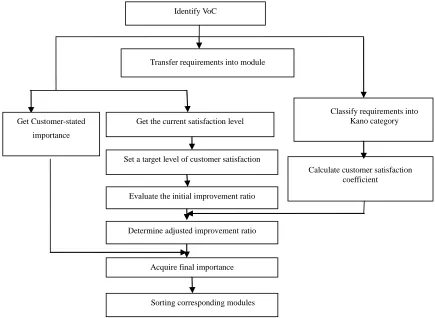
The model of proposed module selection approach is described in Figure 1.
Identify VoC
Set a target level of customer satisfaction
Evaluate the initial improvement ratio
Classify requirements into Kano category
Calculate customer satisfaction coefficient
Get Customer-stated
importance
Determine adjusted improvement ratio
Acquire final importance
Sorting corresponding modules Get the current satisfaction level
[image:3.595.80.515.403.721.2]Transfer requirements into module
Derived from customer investigation, the Voice of Customer obtained. In accordance with the acquired cus-tomer needs, the modules (M1, M2, ··· , Mi , ··· , Mn) can
be select primarily to accomplish all possible customer demands. Afterwards, a second investigation will be im-plemented to get the current customer satisfaction level of each requirement, the initial data of importance of each requirement (customer-stated importance) and gather customer response on a modified Kano questionnaire. The requirements are classified into different Kano cate-gories.
Based on competitive analysis, the manufacturer will set a target level of customer satisfaction of each re-quirement and the initial improvement ration can then be calculated. Thereafter, the final importance of each re-quirement is determined after getting adjusted improve-ment ration. Then, the modules are sequenced in accor-dance with the importance of corresponding require-ments. Therefore, the numbers of modules should be chosen into real manufacturing process according to pri-ority.
5. Case Study
A case example is presented here to illustrate how the Kano model can be integrated into QFD to select the most proper modules by using proposed approach. The method is applied for developing an improvement of one SUV in an automobile manufacturer.
[image:4.595.303.537.521.734.2]After careful information gathering and suggestions from current customers, 11 requirements are decided for “a good SUV”. Then, the relative modules that should be added, improved or innovated to fulfil corresponding requirements are determined and illustrated in Table 1.
Table 1. Customer requirements and corresponding mod-ules.
Code Customer requirements Corresponding modules
1 Fuel consumption M1
2 Ease for use M2
3 Using import parts M3
4 Riding comfort M4
5 Maximum speed M5
6 Braking effectiveness
and stability M6
7 Car insurance M7
8 Safety M8
9 Body design M9
10 acceleration M10
11 Slop climbing ability M11
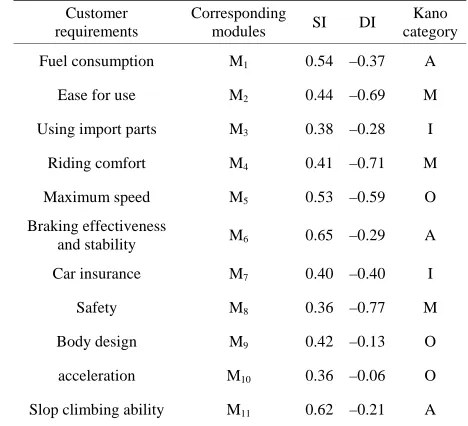
[image:4.595.60.310.522.737.2]A modified questionnaire for each requirement is asked to customers [9]. After accessing the result of questionnaires by using the evaluation table of Lee and Newcomb [11], frequency of different categories for each requirement is found and customer satisfaction coeffi-cient SI and DI are calculated by using Functions (3) and (4). Kano categories are then decided according to SI, DI value of each requirement and the results are shown in
Table 2.
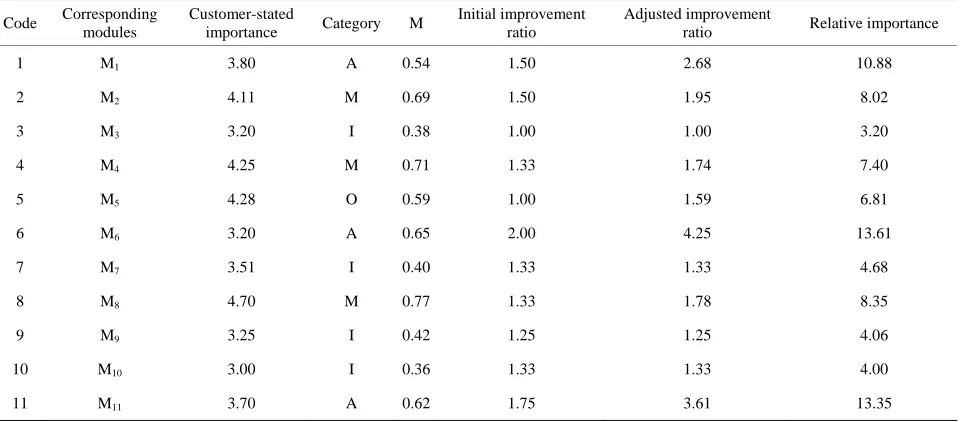
Customers are asked to rate the importance of particu-lar to give requirement customer-stated importance. The rating is on a 1-5 scale where 1 is for minimum impor-tance and 5 for maximum imporimpor-tance. The final cus-tomer-stated importance value for each requirement is the average of all customer ratings. Afterwards, a quanti-tative research is conducted to evaluate the competitive position of the product in terms of customer satisfaction. Based on the competitive analysis, the current customer satisfaction level and the target customer satisfaction level are set for each requirement. This value is also rat-ing from 1 to 5. Accordrat-ing to Function (1), the initial improvement ratio for each requirement is evaluated by traditional QFD method and given in Table 3. In the proposed approach, after considering the value of differ-ent Kano category and satisfaction and dissatisfaction index values, the initial improvement ratio is adjusted with Function (5). Then, the final relative importance can be calculated by using Function (2) in QFD method. Ta-ble 3 shows adjusted improvement ratio and final impor-tance of requirement. In Table 3 the code is used to re-place the full name of customer requirements for the reason of space of a whole page.
From Table 3, it is clearly that the modules must-be requirements have higher customer-stated importance
Table 2. SI, DI and Kano category of requirements.
Customer requirements
Corresponding
modules SI DI
Kano category
Fuel consumption M1 0.54 –0.37 A
Ease for use M2 0.44 –0.69 M
Using import parts M3 0.38 –0.28 I
Riding comfort M4 0.41 –0.71 M
Maximum speed M5 0.53 –0.59 O
Braking effectiveness
and stability M6 0.65 –0.29 A
Car insurance M7 0.40 –0.40 I
Safety M8 0.36 –0.77 M
Body design M9 0.42 –0.13 O
acceleration M10 0.36 –0.06 O
Slop climbing ability M11 0.62 –0.21 A
Table 3. Relative importance result with proposed method.
Code Corresponding modules
Customer-stated
importance Category M
Initial improvement ratio
Adjusted improvement
ratio Relative importance
1 M1 3.80 A 0.54 1.50 2.68 10.88
2 M2 4.11 M 0.69 1.50 1.95 8.02
3 M3 3.20 I 0.38 1.00 1.00 3.20
4 M4 4.25 M 0.71 1.33 1.74 7.40
5 M5 4.28 O 0.59 1.00 1.59 6.81
6 M6 3.20 A 0.65 2.00 4.25 13.61
7 M7 3.51 I 0.40 1.33 1.33 4.68
8 M8 4.70 M 0.77 1.33 1.78 8.35
9 M9 3.25 I 0.42 1.25 1.25 4.06
10 M10 3.00 I 0.36 1.33 1.33 4.00
11 M11 3.70 A 0.62 1.75 3.61 13.35
than any others, which depicts that customers give higher weight to them if asked directly as they usually express must-be requirements strongly. It can also be seen clearly that even when using the proposed method, the customer- stated importance for must-be requirements has signifi-cantly less final importance.
Meanwhile, from the result of Table 3, it is easy to make the decision on which modules should be chosen to the following design and manufacturing process with the maximum customer satisfaction. The choosing sequence is M6-M11-M1-M8-M2-M4-M5-M7-M9-M10-M3. Consistent
with the cost limitation, the manufacturer choose to im-prove and innovate the modules M6, M11 and M1 for the
new product.
6. Conclusion
The module selection is the first and crucial step for us-ing modular technology. The approach presented in this paper provides a new methodology for solving module selection problem in manufacturing industry. The pro-posed integration method of the Kano model with QFD provides a method for organizations to choose the most proper modules in product development process. This new method successfully prioritizes the module impor-tance to help product designers to decide the particular modules that should be chosen to be implemented in the design process. The major limitation of this study is that it may not be able to apply this approach on a totally new product which has never been introduced in the market. In such conditions, customers will be unaware with dif-ferent aspects of product and survey results will be ir-relevant. Besides, product and development costs of each module are not considered in this research. The cost may greatly affect the overall satisfaction of customers. A cost
model may be involved in further research.
7. Acknowledgements
Supported by 2012 Soft Science Project of Henan Pro-vincial Science & Technology Department (Project Num- ber: 122400450223):
REFERENCES
[1] A. S. Yigit and A. Allahverdi, “Optimal Selection of Module Instance for Modular Products in Reconfigurable Manufacturing System,” International Journal of Pro- duction Research, Vol. 41, No. 17, 2003, pp. 4063-4074. doi:10.1080/0020754031000149220
[2] M. M. Tseng and J. Jiao, “Mass Customization, Hand Book of Industrial Engineering,” 3rd Edition, Wiley, New York, 2001.
[3] L. P. Sullivan, “Quality Function Development,” Quality Program, Vol. 34, No. 6, 1986, pp. 39-50.
[4] G. Tontini, “Integrating the Kano Model and QFD for Designing New Products,” Total Quality Management & Business Excellence, Vol. 18, No. 6, 2007, pp. 599-612. doi:10.1080/14783360701349351
[5] K. Matzler and H. H. Hinterhuber, “How to Make Prod-uct Development Projects More Successful by Integrating Kano’s Model of Customer Satisfaction into Quality Function Development,” Technovation, Vol. 18, No. 1, 1998, pp. 25-38. doi:10.1016/S0166-4972(97)00072-2 [6] K. C. Tan and X. X. Shen, “Integrating Kano’s Model in
the Planning Matrix of Quality Function Deployment,”
Total Quality Management, Vol. 11, No. 8, 2000, pp. 1141-1151. doi:10.1080/095441200440395
[7] G. Tontini, “Develop of Customer Needs in the QFD Using a Modified Kano Model,” Journal of the Academy of Business and Economics, 2003.
W. DuMouchel, F. Pouliot, R. Richter, A. Rubinoff, D. Shen and M. Timko, “Walden Kano’s Methods for Un- derstanding Customer-Defined Quality,” Quality Man- agement Journal, Vol. 2, No. 4, 1993, pp. 2-36.
[9] E. Sauerwein, F. Bailom, K. Matzler and H. H. Hinter- huber, “The Kano Model: How to Delight Your Custom- ers,” International Working Seminar on Production Eco- nomics, Innsbruck, 19-23 February 1996, pp. 313-327.
[10] N. Kano, “Life Cycle and Creation of Attractive Quality,”
Proceeding of the 4th International QMOD Conference Quality Management and Organizational Development, Linköping, 12-14 September 2001.