ISSN Online: 2164-5558 ISSN Print: 2164-5531
DOI: 10.4236/ojanes.2018.87021 Jul. 25, 2018 205 Open Journal of Anesthesiology
An Easy Way for Percutaneous
Nephrolithotomy Using Mixed Sedative Agents
Amr M. Hilal Abdou
*, Walid Y. Kamel, Eman K. Abo-Seif
Department of Anesthesia, Intensive Care, and Pain Management, Ain Shams University, Cairo, Egypt
Abstract
Objective: We recorded the data of patients performing Percutaneous Neph-rolithotomy (PCNL) under combined spinal anesthesia with sedative mixtures of Ketamine-Propofol (KP) or Fentanyl-Propofol (FP). Background: The PCNL is usually done under General anesthesia (GA); combining spinal anesthesia with a mixture of sedative drugs has shown to provide an optimum intra and post-operative analgesic and sedative response without side effects. Patients and Methods: 100 healthy patients were enrolled for PCNL, after stabilization of the sensory block of spinal anesthesia patients were rando-mized into two groups; Group KP received 1 mg/Kg Ketamine and 1 mg/Kg Propofol diluted in 20 ml syringe given over 30 seconds and Group FP re-ceived 1 mic/Kg Fentanyl and 1 mg/Kg Propofol diluted in 20 ml syringe over 30 seconds; both groups will receive increment doses if the patient suffers from anxiety, pain or discomfort. Perioperative Hemodynamic data (HR, SBP, DBP, RR, and SpO2) were recorded; PACU stay time and post operative analgesia time were analyzed. Results: Sedative mixtures of FP and KP pro-vided remarkably deep sedation levels for PCNL procedures under spinal anesthesia. Respiratory depression, hypotension and bradycardia were the major side effects reported in FP group which had mean decrease in RR of 4.63 breath/min (27.49%) with mean 3.77% drop in SpO2 levels. KP group produced significant increase in HR about 7 beats/min without reported side effects. Conclusion: Various sedation techniques may be applicable for PCNL procedures with routine premedication, mixtures of fentanyl-Propofol or Ke-tamine-Propofol could be used, and KP has advantages of stable hemody-namics, prolonged analgesic response intra and post-operatively with no ap-preciable side effects and more effective method of sedative mixture.
Keywords
Nephrolithotomy, Percutaneous, Sedation, Propofol, Ketamine How to cite this paper: Abdou, A.M.H.,
Kamel, W.Y. and Abo-Seif, E.K. (2018) An Easy Way for Percutaneous Nephrolithot-omy Using Mixed Sedative Agents. Open Journal of Anesthesiology, 8, 205-213. https://doi.org/10.4236/ojanes.2018.87021
Received: April 27, 2018 Accepted: July 22, 2018 Published: July 25, 2018
Copyright © 2018 by authors and Scientific Research Publishing Inc. This work is licensed under the Creative Commons Attribution International License (CC BY 4.0).
DOI: 10.4236/ojanes.2018.87021 206 Open Journal of Anesthesiology
1. Introduction
Midazo-DOI: 10.4236/ojanes.2018.87021 207 Open Journal of Anesthesiology lam, Propofol and also opioids have been used in a variety of combination, par-ticularly during Total intravenous anesthesia (TIVA). Ketamine in relatively low doses is arguably the safest agent currently available for the induction of anes-thesia but it has been undervalued due to dysphoric phenomena during recovery and its relatively prolonged duration of action when used as sole agent. The aim of this study is to find and evaluate a unique sedation regimen for PCNL proce-dures using a combination of either Ketamine-Propofol (KT-PROP) or Fen-tanyl-Propofol (FT-PROP) mixtures as an adjuvant to spinal anesthesia for these procedures.
2. Sample Size
Using PASS program, setting alpha error at 5% and power 80%. Result from previous study [13] Based on this the needed sample we recruited 100 cases for the study.
3. Methodology
DOI: 10.4236/ojanes.2018.87021 208 Open Journal of Anesthesiology the procedure we assessed the hemodynamic parameters (HR, SBP, DPB, RR, SpO2) recorded every 1 minute for the first 10 minutes then every 10 minutes. Any hemodynamic instability will be dealt via atropine or ephedrine and fluids. In the PACU; vital data were recorded every 15 minutes in addition to the time of PACU stay. Postoperative pain was assessed for the first six hours using the VAS at the following times 0 h, 1 h, 3 h and 6 h.
4. Statistical Analysis
The study was double-blinded with three different anesthesiologists involved. The drugs were prepared by an anesthesia resident not involved in the study and were blinded to the study groups. The anesthesiologist who pretreated the pa-tients was blinded to each patient’s allocation. The study drug solutions were identical in appearance. Data were analyzed using Chi-square test for categorical data. Student’s t-test for quantitative variables for comparison between the two groups. For intra group comparison, paired t-test was used. Results were ex-pressed as mean ± SD. Probability value less than 0.05 was considered signifi-cant.
5. Results
DOI: 10.4236/ojanes.2018.87021 209 Open Journal of Anesthesiology Table 1. Demographic data.
Parameter Group I (KP) n = 50 Group II (FP) n = 50 Statistical Test P value
Age 33.87 ± 14.80 37.25 ± 15.32 1.12 0.26
Sex (M:F) ratio 26:24 (54%) 28:22 (62%) 0.161 (chi) 0.68
[image:5.595.210.539.205.289.2]Weight 92.43 ± 5.32 94.32 ± 5.94 1.68 0.09
Table 2. Mean Pulse difference in both groups.
Parameter KP FP
Pulse Mean SD Mean SD T value P value
Pre-operative 77.11 8.23 75.62 6.73 0.99 0.324
[image:5.595.211.539.320.404.2]Intra-operative 84.38 7.96 66.27 7.21 11.92 0.001 Post-operative 82.86 8.01 67.45 7.14 10.15 0.001
Table 3. Mean respiratory difference in both groups.
Parameter KP FP
RR Mean SD Mean SD T value P value
Pre-operative 16.67 1.17 16.84 1.00 0.78 0.437
Intra-operative 16.12 1.02 8.21 1.32 16.57 0.000
[image:5.595.211.539.438.705.2]Post-operative 16.53 1.19 16.54 0.96 0.89 0.534
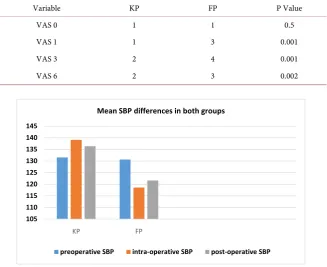
Table 4. Postoperative analgesia.
Variable KP FP P Value
VAS 0 1 1 0.5
VAS 1 1 3 0.001
VAS 3 2 4 0.001
VAS 6 2 3 0.002
Figure 1. Mean SBP differences in both groups. Y Axis: Mean SBP in mmHg. 105
110 115 120 125 130 135 140 145
KP FP
Mean SBP differences in both groups
DOI: 10.4236/ojanes.2018.87021 210 Open Journal of Anesthesiology Figure 2. Mean DBP difference in both groups. Y Axis: Mean DBP in mmHg.
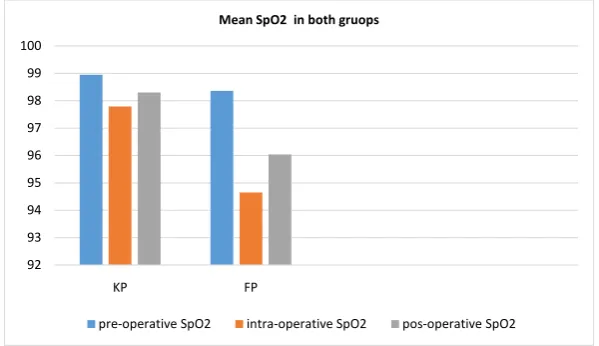
Figure 3. Mean SpO2 in both groups. Y Axis: Mean SpO2 %.
6. Discussion
This study was conducted on 100 patients who were scheduled for elective PCNL under spinal anesthesia, patients were randomized in two groups KP group and FP group, Propofol lack analgesic properties and if used alone for anesthesia, the dose required will be large enough to cause cardio respiratory compromise, this necessitates concurrent administration of intravenous opioids and Paraceta-mol/NSAIDS as apart of multimodal balanced analgesia. Fentanyl is a commonly used opioid that provide rapid onset, short duration potent analgesia, useful during anesthetic induction. Using Ketamine and Propofol in combination al-lows sedation to be achieved at lower total doses of each drug [5], using a com-bination of Ketamine and Propofol with several ration of 2:1, 1:1 or 1:5 has been reported in several studies [14] [15], Fentanyl and PROP has been efficiently used in separate syringes by Bajwa and his colleagues [16] another study re-ported their mixing in the same syringe [17] in several procedures. In our study, we used a simple and easy method to maintain the level of sedation by adding
70 75 80 85 90 95
KP FP
Mean DBP difference in both groups.
pre-operative DBP intra-operative DBP post-operative DBP
92 93 94 95 96 97 98 99 100
KP FP
Mean SpO2 in both gruops
[image:6.595.223.523.290.463.2]DOI: 10.4236/ojanes.2018.87021 211 Open Journal of Anesthesiology increments of bolus doses were used to maintain a steady state level of sedation. This method is safe and applicable in our country due to the presence of several financial constraints limiting the presence of expensive monitors and dispo-sables like bispectral index or electroencephalogram. Ketamine and Propofol in a ratio of 1:1 provided hemodynamic stability and are supported by the studies of Feky and colleagues [18]. Who compared the addition of PROP and Ketamine with PROP and fentanyl in pediatric patients who underwent upper gastrointes-tinal endoscopy, they concluded that the PK combination resulted in stable he-modynamics. There was pronounced bradycardia and hypotension in FP group. Our observations are supported by Khutia et al., who compared the infusion of both KP with FP in pediatric patients undergoing emergency short surgical pro-cedures and found that HR and MAP were significantly decreased in the fen-tanyl group [14]. Bajwa et al. found slight respiratory depression in patients who received FP as compared to those who received KP [16]; this was due to the cen-tral depressant effect of fentanyl that may alter the respiratory rate and alveolar ventilation associated with narcotic analgesia that last longer than the analgesic effect. The peak respiratory depressant effect of a single intravenous dose of fen-tanyl is noted 5 to 15 minutes following injection. Fenfen-tanyl frequently slows the respiratory rate, but this effect is seldom noted for longer than 30 minutes re-gardless of the dose administered. Respiratory depression was not found in pa-tients of KP group in our study. Our observations are supported by study of Na-lini et al. who reported that none of the patients who received KP did not have any episodes of oxygen desaturation, airway obstruction or apnea, in contrast to patients who received FP, significant number had oxygen desaturation caused by airway obstruction [19]. The addition of low dose Ketamine to PROP improves ventilation and reduces the risk of respiratory depression. This may be due to effect of Ketamine induced sympathoadrenal activation [14]. To prevent Keta-mine induced emergence reactions, pretreatment with benzodiazepines is com-monly used. Likewise, the incidence of psychotomimetic responses was small when Ketamine was combined with PROP for general anesthesia or sedation
DOI: 10.4236/ojanes.2018.87021 212 Open Journal of Anesthesiology anesthesia.
There is a limitation in our work, the personal variability between patients sa-tisfaction and their confidence with the efficacy of sedative techniques in such procedures, in addition to limitations towards the surgical techniques and dif-ferences between surgeons.
7. Conclusion
From this study we concluded that various sedation techniques may be applica-ble for PCNL procedures with routine premedication, mixtures of fen-tanyl-Propofol or Ketamine-Propofol could be used, and KP has advantages of stable hemodynamics, prolonged analgesic response intra and post-operatively with no appreciable side effects and more effective method of sedative mixture.
Conflict of Interest
Nothing to disclose.
Author’s Contribution
We hereby declare that the article has not been published or submitted to or ac-cepted for publication in any form in any other journal. I vouch that the au-thorship of this manuscript will not be contested by anyone whose names are not listed. On acceptance the article will become the copyright of Journal. The manuscript has been read and approved by all the authors.
References
[1] Ramakumar, S. and Segura, J.W. (2000) Renal Calculi. Percutaneous Management. Urologic Clinics of North America, 27, 617-622.
https://doi.org/10.1016/S0094-0143(05)70111-7
[2] Marcovich, R. and Smith, A.D. (2005) Percutaneous Renal Access: Tips and Tricks. BJU International, 95, 78-84. https://doi.org/10.1111/j.1464-410X.2005.05205.x
[3] Macario, A., Weinger, M., Carney, S. and Kim, A. (1999) Which Clinical Anaes-Thesia Outcomes Are Important to Avoid? The Perspective of Patients. Anesthesia & Analgesia, 89, 652-658.
[4] Smith, I., Monk, T.G., White, P.F. and Ding, Y. (1994) Propofol Infusion during Regional Anaesthesia: Sedative, Amnestic, and Anxiolytic Proper-Ties. Anesthesia & Analgesia, 79, 313-319. https://doi.org/10.1213/00000539-199408000-00020
[5] Willman, E.V. and Andolfatto, G. (2007) A Prospective Evaluation of “Ketofol” (Ketamine/Propofol Combination) for Procedural Sedation and Analgesia in the Emergency Department. Annals of Emergency Medicine, 49, 23-30.
https://doi.org/10.1016/j.annemergmed.2006.08.002
[6] Doufas, A.G., Wadhwa, A., Shah, Y.M., Lin, C.M., Haugh, G.S. and Sessler, D.I. (2004) Block-Dependent Sedation during Epidural Anaesthesia Is Associated with Delayed Brainstem Conduction. British Journal of Anaesthesia, 93, 228-234.
https://doi.org/10.1093/bja/aeh192
DOI: 10.4236/ojanes.2018.87021 213 Open Journal of Anesthesiology 368-372. https://doi.org/10.1213/00000539-199408000-00030
[8] Schulz-Stubner, S. (2002) Clinical Hypnosis Instead of Drug-Based Sedation for Procedures under Regional Anesthesia. Regional Anesthesia and Pain Medicine, 27, 622-623. https://doi.org/10.1097/00115550-200211000-00018
[9] Kenny, G.N. (1996) Patient Sedation: Technical Problems and Developments. Eu-ropean Journal of Anaesthesiology, 13, 18-21.
https://doi.org/10.1097/00003643-199607001-00005
[10] Taylor, E., Ghouri, A.F. and White, P.F. (1992) Midazolam in Combination with Propofol for Sedation during Local Anaesthesia.Journal of Clinical Anesthesia, 4, 213-216. https://doi.org/10.1016/0952-8180(92)90068-C
[11] Nakagawa, M., Mammoto, T., Sakai, T., Kishi, Y. and Mashimo, T. (2001) Preme-dication Modifies the Quality of Sedation with Propofol during Regional Anaesthe-sia. Canadian Journal of Anesthesia, 48, 284-287.
https://doi.org/10.1007/BF03019760
[12] Corssen, G., Guttierrez, J., Reves, J.G. and Huber, F.C. (1972) Ketamine in Anes-thetic Management of Asthmatic Patients. Anesthesia & Analgesia, 51, 588-596.
https://doi.org/10.1213/00000539-197207000-00027
[13] Ahmed, D.G., Hetta, D.F. and Abdelraouf, A.M.S. (2017) Percutaneous Nephroli-thotomy under Thoracic Paravertebral Block: A Preliminary Report. Journal of Anesthesia and Clinical Research, 8, 720.
https://doi.org/10.4172/2155-6148.1000720
[14] Khutia, S.K., Mandal, M.C., Das, S. and Basu, S.R. (2012) Intravenous Infusion of Ketamine-Propofol Can Be an Alternative to Intravenous Infusion of Fen-tanyl-Propofol for Deep Sedation and Analgesia in Paediatric Patients Undergoing Emergency Short Surgical Procedures. Indian Journal of Anaesthesia, 56, 145-150.
https://doi.org/10.4103/0019-5049.96313
[15] Frizelle, H.P., Duranteau, J. and Samii, K. (1997) A Comparison of Propofol with Propofol Ketamine Combination for Sedation during Spinal Anaesthesia. Anesthe-sia & AnalgeAnesthe-sia, 84, 1313-1322. https://doi.org/10.1213/00000539-199706000-00026
[16] Bajwa, S.S., Bajwa, S.K. and Kaur, J. (2010) Comparison of Two Drug Combinations in Total Intravenous Anaesthesia: Propofolketamine and Propofol-Fentanyl. Saudi Journal of Anaesthesia, 4, 72-79.https://doi.org/10.4103/1658-354X.65132
[17] Singh, R., Ghazanwy, M. and Vajifdar, H. (2013) A Randomized Controlled Trial to Compare Fentanyl-Propofol and Ketamine-Propofol Combination for Procedural Sedation and Analgesia in Laparoscopic Tubal Ligation. Saudi Journal of Anaesthe-sia,7, 24-28.https://doi.org/10.4103/1658-354X.109801
[18] Feky, E.M. and Koptan, H.M. (2015) Midazolam, Ketamine, or Fentanyl Added to Propofol as Total Intravenous Anaesthesia in Skin Grafting after Burn in Paedia-trics: A Comparative Study. Ain-Shams Journal of Anaesthesiology, 8, 160-165.
https://doi.org/10.4103/1687-7934.156664
[19] Nalini, K.B., Cherian, A., Balachander, H. and Kumar, C.Y. (2014) Comparison of Propofol and Ketamine versus Propofol and Fentanyl for Puerperal Sterilization, a Randomized Clinical Trial. Journal of Clinical and Diagnostic Research, 8, GC01-04.
[20] Badrinath, S., Avramov, M.N., Shadrick, M., Witt, T.R. and Ivankovich, A.D. (2000) The Use of a Ketamine-Propofol Combination during Monitored Anesthesia Care. Anesthesia & Analgesia, 90, 858-862.