RESEARCH ARTICLE
THE GREAT RECESSION, THE US FED, AND THE LESSONS LEARNED
¹Zeina Al-Ahmad and *²Behrouz Tabrizi
¹
Tishreen University, Department of Banking and Finance, Syria/Lattakia
²St. Francis College, Department of Economics, New York, U.S.A.
ARTICLE INFO ABSTRACT
This paper is an endeavor to outline the Federal Reserve System’s theoretical perspective of the financial market during the last three decades. It is a glimpse into the policies of regulatory authorities at the Fed whose designed path of financial growth led the US economy to its worst crisis in 2008 since the Great Depression.The Reagan era marked the beginning of the end of the post Great Depression financial regulations. This paper is also to briefly appreciate the Fed’s realization of the importance of financial regulation and supervisionto the US economic recovery.
Copyright © Behrouz Tabrizi and Zeina Al-Ahmad. This is an open access article distributed under the Creative Commons Attribution License, which permits unrestricted use, distribution, and reproduction in any medium, provided the original work is properly cited.
INTRODUCTION
The 2007-09 recession was not only the deepest, but also the longest
recession in US history since the Great Depression of 1930 (Figure 1). The recession hit the entire economy, households as well
as the large and small businesses, in ways that were not anticipated by the responsible authorities in government.
Source: Commerce Department; NBER
Fig. 1. Comparing Recessions
The Great Recession of 2007-09 has a three-decade historical background of its own. It began when the declining rate of profit hit its lowest rates at the onset of the 1980s (Shaikh, 2010). The turn to the right with the new administration in the US government did, however, reverse this trend in support of capital gains toward the era prior to the Great Depression. Historical data show that the profit share of GDP was at its peak just before the sudden downturn of the economy in 1929; but the recovery that began with the New Deal and
*Corresponding author:Behrouz Tabrizi,
St. Francis College, Department of Economics, New York, U.S.A.
continued up until late 1970s set the stage for a period in which
productivity gains were shared proportionally between wages and
profit. A glimpse of the decades between the Great Depression and 1979 shows a promising harmony between productivity growth and the share of its gains in terms of wages and overall compensation for production and nonsupervisory workers. For example, based on the historical data for the period between 1947 and 1979 as productivity increased by 119%, the average hourly compensation also kept pace and changed by 100% (Reich, 2011). But, the prosperous US economy during these three decades of Great Prosperity, as it is now known for, had cost the capitalist class a falling rate of profit over the time. Thus, the 1980s saw the beginning of actions by the US government to pursue policies aimed at increasing financial profits.
New Administration and New Policies
The regulated economy of the post Great Depression took a reversing course at the beginning of 1980s in terms of both fiscal and monetary policies. The leaders of the new administration, the new regulators, waged an unprecedented campaign against the existing regulations and carefully planned for its deregulation and privatization. In this process, for example, the new government began to cut spending on infrastructure, reduce the top income tax rate, shift much of the costs of public higher education to families, not to mention simultaneously tearing down their safety nets by allowing companies to bust unions and threaten employees if they tried to organize (Reich, 2011). And above all, the administration let Wall Street gradually deregulate the financial market which resulted in soaring financial profits (Figure 2).
Deregulating Wall Street
The systematic deregulation process of financial institutions began in 1980, and reached its peak in 1999. It was in 1980 that the Depository Institutions Deregulation and Monetary Control Act became law and
ISSN: 0975-833X
Available online at http://www.journalcra.com
International Journal of Current Research
Vol. 5, Issue, 09, pp.2657-2661, September,2013
INTERNATIONAL JOURNAL
OF CURRENT RESEARCH
Article History:
Received 03rd June, 2013 Received in revised form 22nd July, 2013
Accepted 05th August, 2013
Published online 14th September, 2013
Key words:
Great Recession, Deregulation, Reregulation, Quantitative Easing
Source: http://www.economist.com/node/10881318
Fig. 2.Finance industry profits as % of US Corporate total
brought the first major financial reform to the US financial system since the Great Depression. Among other things, the Act lowered the required reserve ratio for banks, allowed banks to merge, raised the deposit insurance of US banks and credit unions from $40,000 to $100,000, and weakened the Glass-Steagall Act by allowing institutions to charge any interest rates they choose. In 1982, another Act of Congress deregulated savings and loan associations by allowing banks to provide “adjustable-rate mortgage loans” (one of the contributing factors to the housing crisis which led to the economic crisis of 2007-09), and above all, raised the ceiling on direct investment by savings institutions in nonresidential real estate from 20% to 40% of assets. The deregulation process had already been in the fast lane of progress during the first years of the 1980s, and even though faced with fewer challenges, then Chairman of the Federal Reserve System, Paul Volcker, had to be removed from his
position for his regulatory beliefs. So, he was in fact fired by
President Reagan in 1987 “because the Reagan administration didn't believe he was an adequate de-regulator” (Stiglitz, 2008). The replacing Chairman, Alan Greenspan, was, on contrary, a firm
believer in deregulation, and turned out to be a charming
philosophizer of his deregulatory ideas. In most of his speeches before the recent economic downturn, Greenspan proved to be intellectually the best fit to the financial environment nationally as well as globally in the age of globalization around the world. “Having been a bank regulator for ten years, I need something to remind me that the world operates just fine with a minimum of us. Fortunately, I have never lost sight of the fact that government regulation can undermine the effectiveness of private market regulation and can itself be ineffective in protecting the public interest. It is critically important to recognize that no market is ever truly unregulated in that the self-interest of market participants generates private market regulation” (Greenspan, 1997). Greenspan stood firmly against the regulation of derivatives in particular the OTC (Over-the-Counter) and CDS (Credit Default Swap). Consequently, the financial products that were supposed to act as a cushion against the higher risks in the protection of investors turned into toxic assets empty of any value to do so. Although Greenspan admitted that the derivatives markets should have been “restrained,” his admission came only after the collapse of the financial market, when the soaring credit default insurance market had reached $45.5 trillion by 2007. In a report by Andrews (2008) in the New York Times, Greenspan had to agree that “the multitrillion-dollar market for credit default swaps, instruments originally created to insure bond investors against the risk of default, needed to be restrained.” Greenspan was one of the main voices for the repeal of Glass-Steagall Act to such an extent he practically disregarded the Act before the Congress repealed it. At the time that
the legislation was still pending, and the Glass-Steagall Act effectively separated investment banking from commercial banks, he audaciously ignored the Act and agreed with the illegal merger of the three of the largest different financial institutions. Travelers, one of the largest insurance companies, Salomon Smith Barney, one of the largest investment banks, and Citibank, the largest commercial bank merged in 1998 while the Glass-Steagall Act was still in effect. Congress passed the repeal bill of the Glass-Steagall Act only a year after in 1999 by signing in the Gramm-Leach-Bliley Act. The rush of Greenspan to repeal the Glass-Steagall contributed to and hastened the onset of the financial meltdown of 2008 and the ensuing economic crisis, the longest since the Great Depression. For one reason, among others, the “repeal” extensively encouraged moral hazard in the financial markets by removing the conflict of interest on behalf of investment bankers. It was then that the law allowed the investment bankers to also serve as the officers of commercial banks. In addition, Greenspan resisted the routine examination of non-bank subsidiaries which were, according to the Financial Crisis Inquiry Committee (2011.a), carrying out the lion’s share of subprime lending (the main contributor to the housing crisis). Although Greenspan argued he did not possess the required resources to examine the non-bank subsidiaries, the Financial Crisis Inquiry Commission (2011.b)
reported a different view. “Yet we do not accept the view that
regulators lacked the power to protect the financial system. They had
ample power in many arenas and they chose not to use it.”
The Low Interest Rates of the Fed
Greenspan kept the interest rate too low in response to the dotcom crisis of 2000 and the 9/11 tragedy. Although it is a standard policy of any central bank to bring down the key interest rate at critical times, consistently lowering it for too long may even deepen rather than help cure the sick economy. The Fed sharply decreased the federal funds rates target after the dotcom market crush until it hit its lowest at 1 percent in June 2003. Then the worst happened when the Fed steadily kept on increasing it to a peak rate of 5.25 percent by 2006 (Figure 3). Such monetary maneuvering nourished the already sowed seed of housing bubble by the sub-prime mortgages and related derivatives, a bubble which finally burst and resulted in the default of millions of mortgages, particularly the adjustable-rate mortgages (ARM), due to a drastic increase in mortgage payments.
Source: Federal Reserve Board
Fig. 3. Intended Federal Funds Rate (Historical Review)
The bear stock market of 2001 on the one hand, and the simultaneous rise of derivatives markets with the lowering interest rates in the real estate on the other hand, led the financial markets to concentrate intensively on real estate investment. Thus, in the absence of supervision by the Fed over the financial institutes involved in this,
sub-prime mortgage lending soared and so did fraud. The result, what
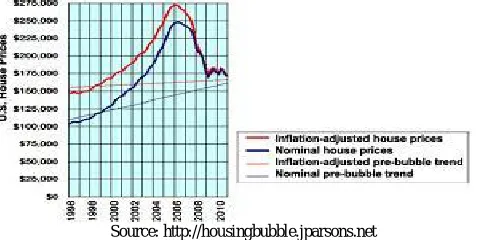
[image:2.595.315.549.484.661.2]Advisers, was the formation of a housing bubble beneath the unprecedented growth of the real estate industry. In his speech on economic flexibility before the National Italian American foundation in Washington, D.C., Greenspan (2005) said: “These increasingly complex financial instruments have contributed, especially over the recent stressful period, to the development of a far more flexible, efficient, and hence resilient financial system than existed just a quarter-century ago.” Also, in the October of the same year Bernanke (2005.a), then the Chairman of President’s Economic Advisors, said in a testimony before the Joint Economic Advisors: “House prices have risen by nearly 25 percent over the past two years. Although speculative activity has increased in some areas, at a national level these price increases largely reflect strong economic fundamentals.” And a month later, in his Confirmation Hearing before Senate Banking Committee, Bernanke reaffirmed his economic outlook. This happened when Senator Sarbanes, one of the members of the Hearing Committee, brought up his serious concern about the existing economy of derivatives with a reference to Warren Buffet who had called derivatives “time bombs.” In response to this concern Bernanke (2005.b) replied: “I am more sanguine about derivatives than the position you have just suggested. I think, generally speaking, they are very valuable. They provide methods by which risks can be shared, sliced, and diced, and given to those most willing to bear them. They add, I believe, to the flexibility of the financial system in many different ways. With respect to their safety, derivatives, for the most part, are traded among very sophisticated financial institutions and individuals who have considerable incentive to understand them and to use them properly.” But, it didn’t even take a year for Bernanke and, of course, Greenspan to see how wrong they were in their understanding of the state of economy, in general, and the derivatives markets of mortgage-related-backed securities, in particular. The bursting of the housing bubble (Figure 4) was followed by the meltdown of the three dominant derivative securities, namely, mortgage-backed securities (MBS), credit default swap (CDS), and collateralized debt obligation (CDO) which then paralyzed the very “flexible” and “resilient” financial market with its spillover into the entire economy.
[image:3.595.41.280.449.569.2]Source: http://housingbubble.jparsons.net
Fig. 4. Bursting of the US Housing Bubble
The Fed and the Lame Excuses
It is true that “deregulation” can create, as it did, a set of new opportunities for financial innovation. However, it is also true that “deregulation” can, as it did, create equally if not even more a range of new opportunities for fraud, and in the best cases for much riskier financial investments. So, in a sense, “deregulation” implies an
underlying tradeoff between the rise of financial growth for Wall
Street and the fall of the economy for the Main Street down the road.
It brings record profits and bonuses for the very top, but joblessness and poverty for millions of the innocent Americans, not to mention that the Fed itself made $45 billion in the troubled year of 2009 (Irwin, 2010).
Greenspan, the “Maestro” of Crisis
Alan Greenspan as the chairman of the most powerful US financial regulatory institution, the Federal Reserve System, never truly
believed in regulation during his 18-year tenure at the Fed. The depth of this disbelief comes up most vividly when he comments on the financial crisis. For example, in response to the question of whether the dotcom-bubble burst of 2000 could have been prevented, he said: “. …we could not prevent the bubbles that emerged while I was at the Fed….we tightened the economy quite significantly at various times during the 1990s. And what we found was that instead of defusing or incrementally declining the bubble, we enhanced it” (Greenspan, 2007). It is obvious that such rationalization of crisis is based on the
establishment of a false equation between the failures of the means
(i.e., monetary tools) with the validity of the ends (i.e., regulatory
policies). In other words, such rationalization of the crisis means nothing more than to let the deregulated financial markets, with their hidden chaos, erupt into another crisis which became more severe in the following years. Greenspan’s ideology meant that he would settle for nothing less than a deregulated financial market. In his mindset,
regulation even enhances bubbles, so he let the free market take care
of it. “You can only break a bubble if you break the underlying basis of the economy.” Basically, it’s not possible to defuse a bubble before its time has come” (Greenspan, 2007). And with this conclusion, Greenspan actually took on the role of being a mess cleaner rather than a mess preventer in the financial market. The mess which is created by the deregulation of financial markets in the age of the supremacy of finance is not easy to clean either. For it comes from a
long process of the financialization of capital. The deregulation of
financial markets not only set the stage for the revival of financial investment in the 1980s, but also led the industry into a spiraling growth through financial innovations (Figure 5). Consequently,
finance was able to gain enough power to master the real economy
instead of remaining at its service. Thus, the real economy which was not at the mercy of financial markets turned into an economic sector directly vulnerable to the wide range of fraud, greed, and high risk derivative investments caused by the dominating financial sector. So, unlike the past, in the age of financialization the economic mess is not easy to clean by any standard.
[image:3.595.314.548.451.589.2]Source: Bureau of Economic Analysis
Fig. 5. Compensation in Financial and Nonfinancial Sectors
Greenspan before the Congress
Greenspan sat before the Congress in October 2008, when the economy was in the grip of a deep recession; and the main question was how he failed to see its emergence, or if he saw, why then he didn’t prevent it from spreading into the entire economy. The reality of time in terms of the state of economy as well as the people to whom Greenspan had to answer put him, however, in a much less defensive position for the first time. The sinking economy, actually, did not leave him enough room to go around as in the past and to maneuver using ideological reasoning in defense of his deregulatory decisions as the chairman of the Federal Reserve System.
Unlike the mild recession of 2000, the severity of the recent recession was indeed a wake-up call for Greenspan. That is why he had finally to admit that he have been putting “too much faith in the self-correcting power of free markets.” When Greenspan was asked by Representative Mr. Waxman of California if it was his ideology that pushed him to make decisions that he would now wish had not make, the answer was: “Yes, I’ve found a flaw” (Andrews, 2008). But, this “flaw” was not simply an ignorable flaw; it led Greenspan decisively stand against regulating the OTC market until 2008 , which, in turn, let the OTC market grow sevenfold, and credit default swaps, one of the key factors behind the financial crisis, grow one-hundred fold between 2000 and 2008. (Financial Crisis Inquiry Commission, 2011.c). It is quite enlightening to quote another part of the report of the Financial Crisis Inquiry Commission (2011.d), where by the committee believed that the “widespread failures in financial regulation and supervision proved devastating to the stability of the nation’s financial markets.” In addition, the committee stressed that “more than 30 years of deregulation and reliance on self-regulation by financial institutions, championed by former Federal Reserve chairman Alan Greenspan and others, supported by successive administrations and Congresses, andactively pushed by the powerful financial industry at every turn, had stripped awaykey safeguards, which could have helped avoid catastrophe.”
Ben Bernanke as Chairman of the Fed
If Alan Greenspan’s laissez-faire monetary policy boosted a bubble-led economy, his successor, Ben Bernanke, faibubble-led in his turn to detect its last undergoing bubble before the current financial crisis, namely the housing bubble. He continually denied the growth of such a bubble in the economy, and thus in this respect he ignored the serious concerns of many economists in the field, particularly the well-known scholar Robert J. Shiller of Yale University. On the threshold of the mortgage crisis, throughout the summer of 2007, Chairman Ben Bernanke assured the public that problems in the subprime mortgage markets were contained. Even when Bear Stearns’s hedge funds, which were heavily invested in mortgage-related securities, imploded in June 2007, the Federal Reserve considered the case to be “relatively unique.” But, this particular event soon proved to be only a tip of iceberg. As the Financial Crisis Inquiry Commission (2011.d) pointed out, Chairman Ben Bernanke ignored “the fact that so many other funds were exposed to the same risks” as those of the hedge funds of the collapsed Bear Stearns. Chairman Ben Bernanke now reaps what had been sown by the Fed leaders including himself. The fact that the current recessionary crisis is so deep seated and has continued for so long has led him to adopt an unconventional monetary policy known as “quantitative easing” (QE) to stimulate the economy. But as long as the Fed remains caught in the liquidity trap, the success of any monetary package will largely depend on a coordinated fiscal policy. This is vividly reflected in the following comment of Bernanke (2011): “Most of the economic policies that support robust economic growth in the long run are outside the province of the central bank.”
The post-crisis Fed
In the post crisis era Chairman Ben Bernanke has recognized that in order to avoid a future destructive crisis, one must learn all he can from the current one. In hindsight, Bernanke realized that the major contributors to the crisis were the weaknesses in the risk management practices of financial firms for having had insufficient buffers against their capital and liquidity adventures. This was neither noticed nor addressed by regulators and supervisors in an efficient time frame to avoid such a crisis (Bernanke, 2009). Facing the great recession, thus the Federal Reserve Bank officials finally realized the importance of financial regulation and supervision in the financial markets. The post-crisis recovery period should therefore be marked by the Fed’s engagement in setting new rules and regulations to uphold the recovery process.
On a regulatory level, the Federal Reserve moved on to focus its efforts toward strengthening regulatory standards for risk taking and maintenance of capital and liquidity buffers within the financial institutions. Through the adoption of more than 30 regulations, the Federal Reserve began to strengthen the financial standards that would, amongst others, govern bank capital, liquidity, risk management, incentive compensation, and consumer protection. On a supervisory level, the Federal Reserve has stressed the importance of consolidated supervision for financial holding companies, in particular, the largest, most complex, and systemically critical firms including those that do not own a bank, but pose risks to the overall financial system. The Fed also highlighted the importance of adopting a more macro-prudential approach to the supervision of these systemically critical firms. For this would help the Fed foresee the potential problems that might affect the market due to the failure of such firms. The better supervision could be achieved, according to the
Fed, through “adopting new supervisory tools-including
comprehensive horizontal reviews, off-site quantitative evaluations, and more extensive information gathering” (Bernanke, 2009). Alongside the Federal Reserve’s progressive actions to secure the economic recovery, legislative action from congress is necessary to ensure the proper oversight of financial markets. “Regulators and supervisors can do a great deal, but comprehensive financial reform requires action by the Congress” (Bernanke, 2009). In light of the financial crisis, Congress under the Obama administration passed the Dodd-Frank Wall Street Reform and Consumer Protection Act of 2010. Under which the Financial Stability Oversight Council (FSOC) was created. As a member of the FSOC, the supervisory and regulatory capacities of the Fed were enhanced by the allowance to systematically overlook the financial system as a whole rather than at individual components. This gave them the framework needed to stabilize the economy and the tools needed to prevent and or deal with future repercussions (Bernanke, 2011). On September 20, 2010 the National Bureau of Economic Research (NBER, 2010) based on the revised data of the National Income and Product Account (released on July 30 and August 27, 2010) concluded that the US recession has ended in June 2009. This never meant the return of normalcy in the US economy; it was only an indication that the Fed was taking right decisions, although not aggressive enough to push up the economic activities to the pre-crisis level. With the 0 to 0.25% target rate range, the Fed was practically in a liquidity trap since December 2008. However, the Fed’s decision in adopting aggressively the unconventional measures such as quantitative easing and operation twist to overcome its awkward “trapped” situation, led the economy to finally bypass the danger of facing a double-dip recession and gradually move forward.
Conclusion
natural outcome of market failure and crafted within the capitalist system, the Fed’s role in shaping the current crisis was so profound that the Financial Crisis Inquiry Commission (2011.e) had to make a
striking conclusion in their two-page Press Release: “This Crisis was
Avoidable,” and it was the “Result of Human Actions, Inactions and
Misjudgments.”The crisis revealed many supervisory weaknesses and
regulatory gaps. The Fed, however, realized the past shortcomings fairly well, andthrough a new market attitude under the leadership of Chairman Bernanke took new supervisory and regulatory steps to rectify them. Although the Fed’s financial reforms may appear to be stringent to some, they are essential in restoring financial stability of a market which has so harmfully been deregulated for more than three decades. The Fed’s denial of “wrongdoing” in the past is now history. It seems that the Fed has already learned the lessons needed to pass the US economy through the complications of its financial recovery.
REFERENCES
Andrews, E. (2008). Greenspan Concedes Error on Regulation.The
New York Times, October 24. Retrieved September 13, 2011,
from http://www.nytimes.com/2008/10/24/business/economy/
24panel.html
Bernanke, B. (2011). Aftermath of the Crisis, Lecture 4.The Federal
Reserve and the Financial Crisis. Retrieved Sunday November 11,
2012 from http://www.federalreserve.gov/mediacenter/files/
chairman-bernanke-lecture4-20120329.pdf
Bernanke, B. (2005.a). The Economic Outlook. Retrieved September
17, 2011, from http://georgewbush-whitehouse.archives.gov/cea/ econ-outlook20051020.html
Bernanke, B. (2005.b). Nomination of Ben S. Bernanke: Hearing
before the Committee on Banking, Housing, and Urban Affairs,
United States Senate. Retrieved September 17, 2011, from
http://frwebgate.access.gpo.gov/cgibin/getdoc.cgi?dbname=109_s enate_hearings&docid=f:26610.wais
Bernanke, B. (2009). Speech at the Federal Reserve Bank of Boston 54th Economic Conference, Chatham, Massachusetts entitled, Financial Regulation and Supervision after the Crisis: The Role
of the Federal Reserve, Retrieved March, 27, 2012, from http://
www.federalreserve.gov/newsevents/speech/bernanke20091023a. htm
Bernanke, B. (2011). Bernanke Suggests Fiscal Process Is Broken in
U.S. The New York Times, August 27, p. A3.
Federal Reserve Board (2011).Press Release. Retrieved February 27,
2012, from http://www.federalreserve.gov/newsevents/press/
bcreg/20111223a.htm
Financial Crisis Inquiry Commision (2011.a).The Financial Crisis
Inquiry Report .p. 107. Retrieved September 20, 2011, from
http://fcic.law.stanford.edu/
Financial Crisis Inquiry Commision (2011.b).The Financial Crisis
Inquiry Report.p.18. Retrieved September 20, 2011, from
http://fcic.law.stanford.edu/
______________________________________ (2011.c). The
Financial Crisis Inquiry Repot.pp.76-77. Retrieved September
20, 2011, from http://fcic.law.stanford.edu/
_______________________________________ (2011.d). The
Financial Crisis Inquiry Report.p. 21. Retrieved September 20,
2011, from http://fcic.law.stanford.edu/
_______________________________________ (2011.e).FCIC
Releases Report on the Causes of the Financial Crisis. p.1.
Retrieved September 21, 2011, from http://fcic.law.stanford.edu/
Greenspan, A. (1997). The Evolution of Banking in a Market
Economy. Retrieved September 13, 2011, from
http://www.federalreserve.gov/boarddocs/speeches/1997/1997041 2.htm
Greenspan, A. (2005). Remarks by Chairman Alan Greenspan:
Economic Flexibility. Retrieved September 17, 2011, fromhttp://
www.federalreserve.gov/boarddocs/speeches/2005/20051012/def ault.htm
Greenspan, A. (2007). The Oracle Reveals All. Newsweek, September
24, pp. 32-33.
Irwin, N. (2010). Federal Reserve earned $45 billion in 2009. The
Washington Post, January 12. Retrieved September 14, 2011,
from http://www. washingtonpost.com/ wpdyn/content/article /2010/01/11/AR2010011103892.html
Reich, R. (2011). The Limping Middle Class.The New York Times,
September 4, pp. 6-7.
Shaikh, A. (2010). The First Great Depression of the 21st Century. In
Panitch, L., Albo, G., Chibber, V. (eds.) The Crisis This Time:
Socialist Register. Merlin Press, p. 50.
Stiglitz, J. (2008). An interview with Nathan Gardels, The Huffington
Post, September 16. Retrieved September 27, 2011, from Stiglitz:
The Fall of Wall Street Is to Market Fundamentalism What the Fall of the Berlin Wall Was to Communism.