© 2019, IRJET | Impact Factor value: 7.211 | ISO 9001:2008 Certified Journal
| Page 2543
Analysis of Connecting Rod and Designed Spring of Raisin Sorting
Machine
Prashant U. Hingalaje
1, Dr.Vinayak R. Naik
21,2
Department of Mechanical Engineering, D.K.T.E. Textile and Engineering Institute, Ichalkaranji-416116,
Maharashtra, India
---***---Abstract -India is one of leading grapes producing countriesin world and produces nearly 1.2 million tonnes per year. Out of which, about 17-20% of grapes are dried for raisins. Recent years, the price of the raisins is not stable and due to poor quality of raisins, the price further goes down and false to attract and catch global market. This forces the producers to improve the quality of raisin in order to promote export of raisin in world market and earn foreign exchange. Cleaning and sorting of raisins is one of the critical tasks and the present work has made an attempt to focuses on the same problem. In this view, in this paper, a new design is proposed in order to overcome the present limitations of the raisin grading machine such as less capacity i.e.2 tonnes/hr, Improper cleaning of the raisin, failure of the connecting rod due to fluctuating loads, damage of raisins due to excess vibration.
Key Words: new design for raisin production, processing
of raisin, production of raisin and quality of raisin
1. INTRODUCTION
The world production of grapes is presently 65,486,235 tons per year. India produces 1.2 million tonnes grapes per year which is 1.83% of the world’s grapes production and 3% of the total fruit production in the country. Presently, in India about 17-20% of grapes are dried for raisins. USA, Turkey, India, South Africa, Australia, Greece, Russia, Iran, Afghanistan and China are the leading raisin producing countries in the world. India has achieved the raisin production level in the range of 55,000 to 65,000 tons per year which stands third at world level after USA and Turkey [1]. In India, raisins are mostly produced in Single, Nasik and Solapur districts of Maharashtra and Vijayapur district in Karnataka. In last two years there is no price stability for raisins. In India, efforts have been initiated for improving quality of raisin in order to promote export of raisin in world market. Cleaning and sorting of raisins is one of the main tasks during the processing of raisins.
1.1 Present Raisin Grading Machine
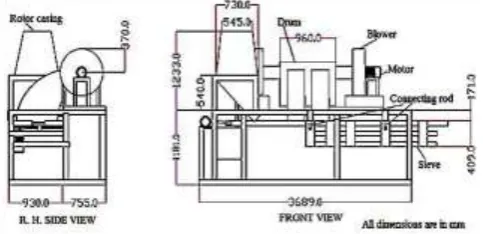
Figure 1 shows two-dimensional drawing of a typical raisin grading machine. In this machine, the raisins are fed into the machine through a feeder, which has a rotor with a rubber pad. A 2 HP motor drives the mechanism. The rubber pad hammers the raisins to remove the twigs of raisins. These raisins are then passed through the blower, which blows the dust and twigs and cleans the raisins with the help of a
high-pressure airflow. Two blowers are used in this machine and each blower utilizes the power of a 3 HP motor. The raisins are further graded according to size with the help of vibratory sieves with different wire mesh (9 mm, 7 mm and 5 mm). A 2 HP motor drives the vibrating sieve. Motion to vibratory sieve is given by connecting rod which is eccentrically connected to the motor shaft. Vibrating motion of sieve is guided by the connecting rod which is hinged to the foundation as shown in Figure 2. Total four connecting rods are used for guiding vibratory motion of the sieve. The raisins separated and graded over each sieve are collected in a different chamber. Total 10 HP power supply is needed for this raisin grading machine and all three phase induction motors are used. A photocopy of an existing raisin sorting and grading machine is shown in Figure 3.
Fig.1 A typical raisin grading machine
[image:1.595.314.556.398.515.2] [image:1.595.316.549.542.676.2]© 2019, IRJET | Impact Factor value: 7.211 | ISO 9001:2008 Certified Journal
| Page 2544
Fig.3 Existing raisin sorting and cleaning machine and its problems
2. Literature Survey
In this section, a literature presenting various developments in the raisin cleaning and grading machine has been presented.
Sharma and Adsule [1] have explained production of raisin all over the world. The numbers regarding the raisin production in India is also presented. The world production of grapes is presently 65,486,235 Tonnes per year. India produces 1.2 million tonnes grapes per year which is 1.83% of world’s grapes production. In Indian grapes production is 3% of the total fruit production of the country. The paper also explains whole process of preparing raisins from the grapes.
Utpat [2] has given definition, quality criteria and types of defects in raisin. If raisin contains piece of stem, cap-stem, immature or undeveloped raisins, damaged raisins then it is considered as low-quality raisins. Raisins affected by sunburn, scars, mechanical injury, or other similar means which seriously affect the appearance is considered as a defective raisin.
Rao et. al. [3] have explained the design and working of vibrating feeders. Vibrating feeders are used in many applications such as metering and transferring of material from bins, hoppers, silos and storage piles to crusher, screens and belt conveyors. The material from storage tankers, hoppers, Lorries etc. is dropped onto the feeder prior to the crusher. The feeder has given vibrating motion by vibrating motors that rotates with same speed but in opposite direction. Vibrating motor contains unbalance weight attached to the shaft, so that while rotating the shaft unbalance force is created and that will give vibrating force to the feeder. Vibrating motor power calculation, unbalance force calculation, throw angle calculation, average transport velocity of particles over feeder and spring design is explained in the paper.
Sullivan et. al. [4] have described the application of vibrating conveyors to the handling of ash from mass-burn incinerators. Different types of conveyors, different ways to give vibrating motion to the conveyor are discussed in the
paper. Different number of factors that should be considered while selecting and specifying a conveyor design is explained in the paper.
Ray [5] has explained design procedure of vibratory conveyor. A vibratory conveyor consists of an open or closed trough, horizontal or inclined and which is supported by springs. The trough has oscillatory motion of high frequency and small amplitude by an appropriated drive mechanism.
Bidkar [6] has given the automatic sorting system has been reported to be complex and a global problem. This is because of the inability of sorting machines to incorporate flexibility in their design concept. Automation is a preferred for faster and precise operations as compare to manual operation. This paper provides a mean of simple yet effective fixed type of automation for sorting the products. Two products identical in shape and size are sorted out automatically on the basis of drilled or undrilled product. LED and photo transistor arrangement is used for hole detection. Vertical zigzag conveyor is employed instead of usual flat belt conveyor in order to utilise gravitational force as a driving force for feeding the products. 8051 Microcontroller is used for controlling the sorting mechanism by using program or coding.
Normanyo and Ayim [7] have explained about the hitherto manual sorting of 1,200 letters per hour in the post offices is laborious, labour-intensive and time consuming. This paper seeks to design a letter sorting machine (LSM) based on the conveyor belt transportation and letter sorting principle to replace the manual method of sorting letters. This machine is designed to make sorting of letters very effective and efficient thus, minimizing sorting into wrong destination bins and increasing the number of well-sorted letters per hour to over 30,000. A programmable logic controller (PLC) installed in-between the sensors and actuators effects programming flexibility by way of the control program in its memory. Optical character recognition (OCR) technology and barcode sorter (BCS) systems are employed to read handwritten and printed addresses as well as barcodes. Coding of the regions and a proposed addressing format is resolved thereby enhancing compatibility with the postal optical character reading system. This paper therefore seeks to design a letter sorting machine for the regional post offices in Ghana to increase effectiveness and efficiency of letter delivery.
Fluke [8] the thesis will concentrate on designing and implementing a realistic simulation for an automated method of sorting bags of product coming from the distribution side of manufacturing plant located in Atlanta, Georgia, USA. The goal is to develop a technique using mechatronics technologies, to automate the sorting.
© 2019, IRJET | Impact Factor value: 7.211 | ISO 9001:2008 Certified Journal
| Page 2545
provision to reduce the manual effort and hence humanerror by replacing the conventional methods of sorting in areas involving hectic sorting. The system comes into play in airports and other industrial distribution centres where the products or commodities have to be sorted into batches in order to take them to their respective destination. The products are put on a conveyer system where they are scanned for the particular barcode provided on them. Depending on the barcode, they are placed on the respective carriers automatically where these carriers dispatch them to the corresponding destinations.
2.1 Literature Summery
From present study, it is seen that Indian raisin samples conform to all the parameters specified under the Codex standard. However, some cap stems and stem pieces are remains there in the raisin even after cleaning is done. Some of the practical problems are i) raisin cleaning is not properly done, ii) blower picks some raisins along with the debris, iii) connecting rod which is eccentrically connected to the motor shaft gets failed frequently due to fluctuating loads, iv) less capacity (only 2 tones/hour) and v) while grading, some raisins gets damaged due to excess vibration.
This shows that cleaning of raisins in India is not efficient to comply with the Codex standard and therefore, improvement has to be made with respect to cleaning of raisins, preferably by adopting mechanical means. Furthermore, there is very little work has been reported on raisin grading. The detailed drawings and design of present raisin sorting machine is available in the literature. Therefore, it is decided to develop solution of above problems by contacting to experts from raisin/ raisin manufacturers, suppliers and doing some practical experiments. Some of the objectives are as given below:
1. To modify/replace connecting rod of the vibratory mechanism.
2. To select vibratory motor and design unbalanced weight for best vibration results for grading system,
3. To analyse critical components such as connecting rod, spring using FEA software,
4. To reduce noise and unwanted vibrations,
5. To design of new raisin grading machine in order to have better performance,
6. Validation of new raisin grading machine with performance parameters on field as per codex standard such as capacity analysis, quality of the raisin produced , quantity of good raisin produced, power supply .
Section two gives the review of literature regarding the raisin and raisin grading machines. Design of components of
new machine by analyzing performance of existing and modified machine is presented in section three.
3. Analysis of existing connecting rod
Connecting rod is an intermediate link which connects the piston and the crankshaft in an internal combustion engine, the main work of connecting rod is to convert the linear motion of the piston (thrust force) into rotary motion of the crankshaft. Same mechanism is used in the raisin sorting machine. In this study, an attempt has been made to analyse and understand the connecting rod structure using Finite Element Analysis method. The static structural analysis is carried out by using ANSYS14.5 simulation tool.
The existing connecting rod having dimension as shown in fig 4. It is failed frequently due to fluctuating loads. Also the vibratory effect is only in one direction which was affected on the quality of the produced raisin. Also the detailed failure analysis of the connecting rod is shown in below.
Fig.4 CAD model of connecting rod
Fig.5 CATIA model of Connecting Rod
© 2019, IRJET | Impact Factor value: 7.211 | ISO 9001:2008 Certified Journal
| Page 2546
Loading & Boundary condition is as shown in fig 7. The axialforce is applied in X direction only.
Fig.7 Loading & Boundary condition of Connecting Rod
Total Deformation in the rod is as shown in fig 8a & 8b
Fig.8a Total Deformation of connecting rod
Fig.8b Total Deformation with undeformed part of connecting rod
The stress analysis of the rod is as shown in fig 9.
Fig.9 Von Masses (Stress Analysis) Analysis of connecting rod
From above analysis it is concluded that the connecting rod is sustained the load of 44 KN till yielding which is very less than required. Also the amplitude of the vibration is below 1 mm which affects the quality of produced raisin. So to avoid this, new vibratory system is developed which is explained in the next chapter
4. Design and Analysis of spring
4.1
Design of springAmplitude of sieve in the direction of force = 2.9 mm
Stroke of sieve in the direction of force = 2 × 2.9 = 5.8 mm
Therefore, Stroke of sieve in the horizontal direction = 5.8 cos25 = 5.26 mm
Stroke of sieve in the vertical direction = 5.8 sin25 = 2.45 mm
So, static deflection of spring should be greater than 2.45 mm so that spring will vibrate in compression region
Component of unbalance force in vertical direction = 12075 sin 25 = 5103 N
© 2019, IRJET | Impact Factor value: 7.211 | ISO 9001:2008 Certified Journal
| Page 2547
Now, dynamic force on each spring in vertical direction= 5103 /8 = 637.8N
Static force on each spring =
183 x9.81
= 213.3 N 8
Total force on each spring (P) = 637.8 + 213.3 = 851.1 N
Now,
P = 851 N, δ = 90 mm (assume)
Sut = 1090 N/mm2, G = 81370 N/mm2 for high carbon steel
Step 1 - Wire diameter (d)
The permissible shear stress is given by
= 0.5 x 1090 / 1.5
= 363.33 N/mm2
Spring index (C) = 9 (assumed)
Wahl factor (K),
d = 7.89 or 8 mm
Step 2: Mean coil diameter (D)
D = C × d = 9 × 8 = 72 mm
Step 3: Number of active coils (N)
N = 9.18 or 10
Step 4 : Total number of coils (Nt)
Spring with square and ground ends is selected. Therefore,
Nt = 10 +2 =12
Step 5 : Free length of spring
The actual deflection of spring is given by,
It is assumed that there will be 6 mm gap between consecutive coils when spring subjected to maximum force
Total number of coils = 12
Total axial gap = (12-1) × 6 = 66 mm
Free length = Solid Length + total axial gap +actual deflection
= 96 +66 + 76
= 238 mm
[image:5.595.33.564.208.800.2]Step 6: Pitch of coil
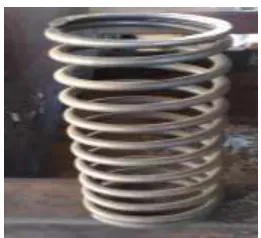
Figure 10 shows the spring that is manufactured with the specifications calculated as above.
Fig.10 Spring
4.2Analysis of Designed Spring
[image:5.595.368.499.475.594.2]© 2019, IRJET | Impact Factor value: 7.211 | ISO 9001:2008 Certified Journal
| Page 2548
Fig.12 Stress Analysis of the springFig.13 Defection analysis of the spring
The spring is analyzed by using CATIA V5 R20. The maximum stress at the end is 1.04×10³ N/m2 as shown in
figure 12. Also the maximum deflection at the end is 90 mm as shown in figure 13. Hence the designed spring is safe
and suitable for this application.
5. New Raisin Grading Machine Assembly
2-D view of new raisin grading machine is shown in figure 14. Shape and size of this machine is almost same as that of existing machine. The helical compression spring is used in this new design. Reason behind using compression spring is that it gives the better spring stiffness and vibratory effect. Therefore it is possible to achieve only forward movement of the raisin on the sieve. So that the compression spring is used in new raisin grading machine.
Fig.14 Schematic Diagram of New Raisin Grading Machine
6. RESULT
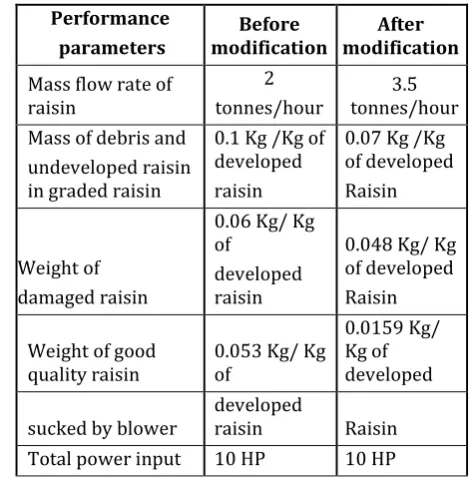
Comparison of Performance of Machine before and after Modification
The test is carried out on field after modification in the machine, the performance parameters are compared with existing and modified which shows that after modification performance of machine is improved. The table III shows the comparison of various parameters before and after modification
Table 1 Comparison of performance parameters before and After modification
From above table,
The grading
capacity of the m/c =
=75 %increased Performance
parameters modification Before modification After Mass flow rate of
raisin
2
tonnes/hour tonnes/hour 3.5 Mass of debris and
undeveloped raisin in graded raisin
0.1 Kg /Kg of developed raisin
0.07 Kg /Kg of developed Raisin
Weight of damaged raisin
0.06 Kg/ Kg of
developed raisin
0.048 Kg/ Kg of developed Raisin
Weight of good
quality raisin 0.053 Kg/ Kg of
0.0159 Kg/ Kg of developed
sucked by blower developed raisin Raisin Total power input 10 HP 10 HP
Mass of debris and undeveloped raisin in graded raisin after modification
[image:6.595.37.295.217.346.2] [image:6.595.326.561.259.499.2] [image:6.595.41.282.562.732.2]© 2019, IRJET | Impact Factor value: 7.211 | ISO 9001:2008 Certified Journal
| Page 2549
Percentage of removal of
debris
And low quality raisins=
=30 % increased
Damaging to the raisins =
= 80% i.e. 20% reduced
7. CONCLUSIONS
This paper presents the design of a new
mechanism and design of a raisin grading machine. By comparing performance parameters of raisin grading machine before and after modification the following observations were recorded:
Grading capacity of machine was increased by 75%,
Percentage of removal of debris and low quality raisins was increased by 30 %,
Damaging to the raisins was reduced by 20 %,
Structure with eccentrically connected Connecting rod was eliminated with the new vibratory mechanism and helical compression spring,
The leaf spring is replaced by helical compression spring for its improved performance.
REFERENCES
[1] Sharma A. K. and Adsule P. G, “Raisin Production in India”, Journal of food processing technology, ISSN: 9749-7597, Vol 85, Issue 4, 2008, pp. 210-214. [2] Utpat S. S, “Fate of agrochemicals during processing of
grapes to raisins”, Journal of food processing technology, ISSN: 9560-5161, Vol 3, Issue 2, 2008, pp. 226-240. [3] Rao, A. V. R., Prakash, C. H. B., and Raju, G. H. T,
“Selection of vibratory motors for vibrating feeder by analytical approach for material handling plants”,
International journal of manufacturing research, ISSN:2231-5381,Vol 10,Issue 14,2005, pp. 652-657. [4] Sullivan, J. F., Mayo, W. M., and Sullivan, J. W, “The
vibrating conveyor for incinerator ash handling systems”, Australian journal of mechanical engineering, ISSN: 2068-2239, Vol 4, Issue 3, 2010, pp. 151-161. [5] Bidkar M. S, “Design of Automatic Sorting Machine”,
ISSN: 2454-132X, Vol 4, Issue 1, 2018, pp. 422-424. [6] Normanyo E, “Designing of a letter sorting machine for
the regional post offices in Ghana”, ISSN: 1819-6608, Vol 4, Issue 6, 2009, pp. 3-5.
[7] Fluke J. T, “Implementing an Automated Sorting System”, ISSN: 2021-2505, Vol 5, Issue 2, 2015, pp. 5-43. [8] Kottalil A. M, “Automatic sorting machine”, ISSN:
2395-7549, Vol 2, Issue 4, 2016, pp. 66-70.
[9] Pawar S.P, “Cost Effective Grading Process for Grape Raisins based on HSI and Fuzzy Logic Algorithms”, Vol 62, Issue 22, 2013, pp. 18.
[10]Kunar V, “Raisin Grade Detection Using Image Processing Technology”, ISSN: 2319-7064, Vol. 6, Issue 5, 2017, pp. 1773-1776.
[11]Narendra V.G, “Quality Inspection and Grading of Agricultural and Food Products by Computer Vision- A Review”, ISSN: 0975-8887, Vol 2, Issue 1, 2010, pp. 43-78.
[12]George M, “Multiple Fruit and Vegetable Sorting System Using Machine Vision”, ISSN: 0976-4860, Vol 6, Issue 1, 2015, pp. 1-4.
[13]Ray, “Mechanical handling of materials”, 2nd edition, Asian books pvt. Ltd, New Delhi, ISBN 8186299475, Vol 1, 2005, pp. 35-80.
[14]Timoshenko, “Element of Strength of material”, D. Van Nostrand, ISBN 13:9780442085476, Vol 5, 1968, pp. 90-150.
[15]Bhandari ,“Element of Machine Design”, Tata McGraw Hill Education pvt.ltd.,ISBN:978-0-07-339814-3,Vol 5,2013,pp. 235-290
[16]Singh, “Mechanical Vibration”, Dhanpat Rai Co.pvt ltd., ISBN 13:5551234002564, Vol 1, 2016, pp. 200-240. Weight of good quality
raisin after modification
Weight of good quality raisin before
modification
Weight of damaged raisin after modification