http://dx.doi.org/10.4236/mps.2012.23013 Published Online July 2012 (http://www.SciRP.org/journal/mps)
Reconstruction of Partial Auricular Defects by
Polypropylene Mesh Helix Framework
Ayman F. Mehanna
General Surgery Department, Division of Plastic Surgery, Faculty of Medicine, Zagazig University Hospitals, Zagazig, Egypt. Email: [email protected]
Received April 4th,2012; revised May 1st, 2012; accepted June 4th, 2012
ABSTRACT
Background: Current techniques in partial auricular reconstruction can utilize an autologous or alloplastic framework covered by a variety of soft tissue envelopes. Objective: Is to evaluate the benefit of using polypropylene mesh to re-construct helix framework in partial auricular defects covered with local postauricular skin flap. Method: Eleven pa-tients with partial auricular defect were treated by using polypropylene mesh helix framework which is covered with post auricular flap in a two stage repair; clinical results of the procedure were evaluated. Results: This technique achieved satisfactory results in 9 (81.8%) cases. Early Post operative complications: Hematoma formation in one case, mild infection in two cases, edema in two cases, and Partial overlying skin breakdown in one case with failure of tech-nique. Late Post operative complications: Hypertrophic scar in one case, narrow retroauricular sulcus in one case, hair bearing skin over the auricle in one case. Conclusion: It is a simple technique, with satisfactory clinical results, easily done, even under local anesthesia, with no donor site morbidity of autogenous cartilage harvesting, not costly as other alloplastic substitutes, large series and longer follow up period are needed for better evaluation of this technique.
Keywords: Partial Auricular Defects; Polypropylene Mesh; Helix Framework Reconstruction
1. Introduction
Reconstruction of partial auricular defects represents a unique and complex challenge to the plastic surgeon, due to delicate and complex architecture of the structure of the auricle [1]. Apart from functional importance, the auricle also has a great aesthetic value, because it frames the face and provides symmetry [2]. The helical rim is aesthetically critical because it forms the contours of the ear [3].
A common defect taking place in the ear is marginal loss of the ear frame involving a variable segment of the helix with or without a cartilage defect [2,4]. These de- fects could be the result of traumatic laceration or avul- sion injuries, animal or human bites, traffic injuries, burns, and others, may require plastic surgical reconstruction [3,4]. The ear is a frequent site of skin tumors, especially those predisposed by sun exposure. Basal cell carcino- mas are the most frequent type, then squamous cell car- cinomas, melanomas and other tumors [3].
Patients often let their tumors go untreated for a con- siderable time, so that the primary defects get larger than in other, more eye-catching, areas of the face [3].
The chief problem in ear reconstruction has been to obtain an appropriate substitute for the fibrocartilaginous framework of the normal ear [5]. The auricular defect
reconstruction can be done either by autogenous material like costal cartilage or by alloplastic material [6]. Over the years, numerous alloplastic materials have been used to create a framework for use in ear reconstruction [7].
The advantage of using alloplastic material is that it avoids overall the procedure of harvesting costal carti-lage. Therefore there is less morbidity of the patient, avoidance of additional scar and the technical difficulties of carving the costal cartilage [8].
The technique presented is the use of polypropylene mesh in partial ear reconstruction; it is a two stage repair with 6 - 8 weeks interval.
2. Patient and Method
Between October 2009 and February 2011, 11 patients were underwent partial auricular defect reconstruction by Polypropylene mesh helix frame covered by postauricu-lar skin flap in two stage repair; the included patients were 9 men and 2 women (Table 1), their age was rang-ing from 16 to 62 years old (Table 2).
There were 6 cases post traumatic injury all in male, and 4 cases post tumor excision (2 females and 2 males), and 1 case with congenital partial helix defect (Table 3).
Table 1. Age characteristics.
Std. Deviation Mean
Max. Min.
N. Age
19.3663 34.3636
Valid N
(Listwise) 11 16.00 65.00
Table 2. Sex characteristics.
Valid Percent (%) Percent (%)
Frequency Sex
81.8 81.8
9 Male
18.2 18.2
2 Female
100.0 100.0
[image:2.595.57.290.252.324.2]11 Total
Table 3. Aetiopathogenesis.
Valid Percent (%) Percent (%)
Frequency Ateiology
9.1 9.1
1 Congenital defect
54.5 54.5
6 Post traumatic
36.4 36.4
4 Post tumor
100.0 100.0
11 Total
case in the middle third of the auricle, 8 patients were done under local infiltration anesthesia and 3 patients under general anesthesia. Patients were followed up from 2 months to 12 months.
2.1. Preoperative Planning
The size and shape of the auricle ear to be reconstructed is planned with the use of a template drown on a sheet of transparent material (e.g., radiographic film) traced from the opposite normal ear.
2.2. Surgical Procedure
2.2.1. The 1st Stage
After surgical resection of a tumor with adequate safety margin and frozen section histopathology is done, or re- freshing of the auricular stump of the ear in case of old or recent trauma is done.
1-Construction of poly propylene helix framework by rolling the mesh on it self to obtain the appropriate girth, then multiple 4 - 0 or 5 - 0 non-absorbable sutures are used to maintain the frame.
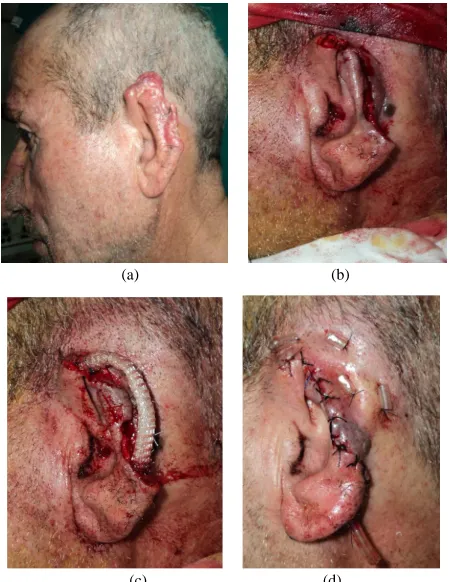
2-A subcutaneous pocket is prepared in the normal post auricular skin at the edge of auricular stump, ex- tending 1 - 1.5 cm beyond the outlined ear margins. This additional dissection is done to ensure tension free clo- sure and help proper coaptation of skin on the helix framework, then homeostasis is ensured well and the helix framework is sutured to the edges of remaining helix by 4 - 0 or 5 - 0 non-absorbable sutures, and the poly propylene helix framework is fixed to the underling fascial layer to keep the frame in its place and preserve the shape of the frame, the overlying skin is tucked by
tension sutures to fascial layer around the frame, finally a suction drain is used to help skin coaptation of the framework Figure 1. In case of middle third defect a U shaped post auricular flap is raised and sutured to skin of the stump then coapted well to the framework Figure 2.
2.2.2. The 2nd Stage
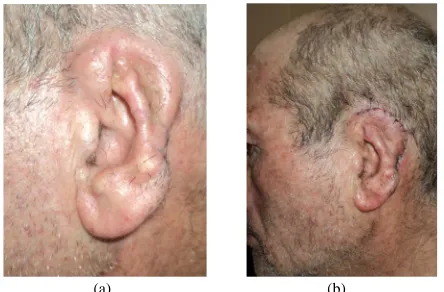
The 2nd stage was done 6 - 8 weeks after the 1st stage, a skin incision is made 1 - 1.5 cm behind the posterior margin of the frame, then the dissection was performed beneath the frame work taking care to preserve a enough connective tissue layer on the frame, until the sufficient amount of projection and creation of retroauricular sulcus
(a) (b)
(c) (d)
Figure 1. (a)-(d) First stage of the procedure. (a) Tumor is involving the upper and middle thirds of auricle; (b) Tumor excision with safety margin; (c) Fabricated mesh fixed in its place; (d) Coapted skin over the mesh.
(a) (b)
[image:2.595.311.536.253.544.2] [image:2.595.312.535.606.709.2]is obtained, the skin of the scalp and mastoid skin is ad-vanced to reduce the defect and fixed in its place, resid-ual defect in the retro auricular plane is covered with a full thickness skin graft Figures 3 and 4.
3. Results
Reconstructed auricles were evaluated in comparison to the normal side according to the following criteria: size, position, shape and contour, and long term stability. The results were satisfactory in 9 (81.8%) cases.
There were early post-operative complications: He- matoma formation occurred in one case, mild infection in two cases and were treated with i.v. antibiotic, edema occurred in two cases, and Partial overlying skin break- down in one case that ends with failure of reconstruction (Table 4).
Late Postoperative complications were hypertrophic scar in one case, narrow retroauricular sulcus in one case, and hair bearing skin over the auricle in one case (Table 5).
4. Discussion
Accurate reconstruction of the external ear after trauma,
[image:3.595.305.539.101.195.2]
(a) (b)
Figure 3. Second stage of the procedure. (a) 6 weeks after the first stage; (b) Post auricular skin incision and final result.
[image:3.595.309.538.222.293.2]
(a) (b)
Figure 4. Second stage of the procedure. (a) Two months after the 2nd stage; (b) Wide retroauricular sulcus.
Table 4. Early post op. complications.
Early complications Frequency Percent (%)
Edema 2 18.2
Haematoma 1 9.1
Infection 2 18.2
Skin breakdown 1 9.1
Total 11 100.0
Table 5. Late post op. complications.
Late complications Frequency Percent (%)
Hair bearing skin 1 9.1
Hypertrophic scar 1 9.1
Narrow retroauricular sulcus 1 9.1
Total 11 100.0
burn or local excision of tumors is demanding and diffi- cult due to the complex tissue structure of the auricle and also has been a common challenge in plastic surgery [2,9]. The helical rim, the anti-helix fold with its crura, and the concha are structures with highly-elastic stability that prevent collapse of the auricle [3].
Framework fabrication is one of the important steps in ear reconstruction [10]. The use of autogenous rib carti- lage framework was first proposed by Tanzer in 1959 [9], then Brent improved techniques and combined the use of expanded postauricular flap with autogenous rib cartilage framework [11].
Over the years, numerous alloplastic materials have been used to create a framework for use in ear recon- struction [7]. Success has likely relates to the surface biocompatibility of the alloplastic material, its pliability, durability, and tendency for tissue adherence [7]. The alloplastic implant has to be easy to shape, strong yet somewhat flexible and is remarkably stable; and it exhi- bits tissue ingrowth into its pores. It should be highly inert material [12]. Silicone rubber was commonly used throughout the 1960s and 1970s for ear and nasal recon-struction, exhibited a high extrusion rate likely due to its lack of porosity and tissue adherence [13].
Porous polyethylene implant was first described by Berghaus in 1982 [14]. Polyethylene is porous material promotes tissue ingrowth of fibrovascular tissue and ad- herence, and has proved quite advantageous as a scaffold for ear reconstruction. [15,16], in the current series the polypropylene mesh shows the knitted nature which helps fibrovascular ingrowth.
[image:3.595.62.284.383.529.2] [image:3.595.56.286.580.710.2]of ear reconstruction cases were performed by using po- rous polyethylene implants [18]. Zhao et al. 2009 achieved excellent results in 301 patients (84.8%) from 355 patients reconstructed by porous polyethylene [9]. In this article we achieve satisfactory results in 9 (81.8%) from 11 cases.
The Infection of the rib cartilage framework is a severe complication, it difficult to cure with antibiotics [9]. The homogenous costal cartilages and fibrocartilage frame- work, have mainly failed as a result of infection and ab- sorption [5]. Sengezer et al. 1996 reported one infected case from ten implants was salvaged by irrigation with antibiotics [18]. Zhao et al. 2009 mentioned that the in- fection was in 8 cases (0.5%) from 1485 cases underwent autogenous graft framework while was 1 case (0.2%) in 355 MEDPOR® alloplastic frame cases [9]. While Wel- lisz, 1993 reported no cases of infection occurred in 41 patients with porous polyethylene Implants were placed as an ear framework reconstructions [12]. In this article two cases with mild infection were easily treated, the two cases were post traumatic.
JAIN et al., 2002 concluded that, the allopathic sub- stitutes had failed as a result of exposure and extrusion [5]. While Piero et al., 2000 mentioned that MEDPOR® is a porous alloplastic material and rarely become in-fected, when exposed will not be absorbed like cartilage [15]. Wellisz, 1993 reported five implant exposures, these were managed without removal of the implant, and all went on to heal uneventfully [12]. Sengezer et al., 1996 mentioned three exposures in 10 ear reconstruction cases which were managed without implant removal [18]. Reinisch et al. 2009 reported 7% exposure rate in ear re- construction using Porous polyethylene framework was performed on 786 cars over an 18-year period [19]. Zhao
et al. 2009 reported that exposure of frame were 15 (1.07%) in 1485 autogenous graft cases autogenous graft while occurred in 48 (13.5%) cases MEDPOR® alloplas- tic frame [9]. In this article there was one case of early exposure and the mesh was removed, we avoid exposure of the mesh by wide enough pocket (tension free closure) in the 1st stage and deeper dissection for projection in the 2nd stage.
Donor site morbidity related to harvest of the rib carti- lage includes the risk of pneumothorax, significant initial postoperative pain, resulting thorax scarring and a visible chest wall deformity in most patients [20], all these com- plications were avoided by use of alloplastic frame.
Hospitalization time is significantly shorter. There is less surgical intervention and the patient is spared the additional procedure needed for harvesting and carving the rib cartilage [14].
Some absorption of the rib cartilage may occur [9], so when used cartilage framework, it is made thicker than normal ear cartilage in order to hold its shape, projection
and details beneath the overlying skin [21]. While the long-term follow-ups showed that the porous polyethy- lene framework had no deformation. The contour of auri- cular prosthesis was vivid and stable [22].
It is basically important the quality and quantity of the skin available for framework coverage [10]. The post auricular skin may be considered a flap bank for recon- struction; it has great vascularity, and has similar skin texture and color [23].
When alloplastic materials are used subcutaneously, there is definite risk of skin breakdown, contamination and eventually the loss of entire reconstructive procedure [8]. The reconstruction must start by placing the frame- work in an ideal position under unscarred skin [11]. Wel- lisz, 1993 said that no complications were associated with any of the implants placed in deep tissue pockets in 41 cases of ear reconstruction [12].
When the postauricular skin is scarred due to trauma or infection there is no sufficient skin available to cover the framework [9]. In this article that was the cause of failure in one case due to traumatized postauricular skin.
The age of he patient should be considered, costal car-tilage will calcify as age advances, it will certainly cal-cify at age of 30 years, calcification of costal cartilage make carving more difficult and fractures more common [9]. The alloplastic implant does not grow with body and their use is restricted to adults [9]. In addition, this agrees also with the Polypropylene mesh.
5. Conclusion
Finally the polypropylene mesh framework is a simple technique, with satisfactory clinical results, easily done, even under local anesthesia, with no donor site morbidity of autogenous cartilage harvesting, not costly as other alloplastic substitutes, large series and longer follow up period are needed for better evaluation of this technique.
REFERENCES
[1] B. Brent, “The Acquired Auricular Deformity, a Systemic Approach to Its Analysis and Reconstruction,” Plastic and Reconstructive Surgery, Vol. 59, No. 4, 1977, pp. 475-485. doi:10.1097/00006534-197704000-00001 [2] E. Anesti, R. Karoo and A. Phipps, “Auricular
Recon-struction with the Use of a Modified Rhomboid Flaps,”
European Journal of Plastic Surgery, Vol. 33, No. 5, 2010, pp. 311-313. doi:10.1007/s00238-010-0501-x [3] R. Bernd, “Reconstruction of the External Ear after
Trauma or Tumor Surgery, Master Class in Plastic Sur-gery,” European Journal of Plastic Surgery, Vol. 28, No. 1, 2005, pp. 7-16.
doi:10.1016/S0007-1226(03)00222-4
[5] S. Jain, P. Kumar and L. M. Bariar, “Total Auricular Re-construction with Autogenous Costal Cartilage Frame-work for Congenital Microtia (Grade-III),” Indian Jour-nal of Otolaryngology and Head and Neck Surgery, Vol. 54, 2002, p. 3.
[6] G. Osorno, “A 20-Year Experience with the Brent Tech-nique of Auricular Reconstruction: Pearls and Pitfalls,”
Plastic and Reconstructive Surgery, Vol. 119, No. 5, 2007, pp. 1447-1463.
doi:10.1097/01.prs.0000258572.57161.d8
[7] R. L. Walton and E. K. Beahm, “Auricular Reconstruc-tion for Microtia,” In: M. Z. Siemionow and M. Eisen-mann-Klein, Eds., Plastic and Reconstructive Surgery, Springer-Verlag, London, 2010.
[8] H. Fischer, W. Gubisch and V. Sinha, “Auricular Recon-struction—Our Experience at Marine Hospital Stuttgart, Germany, Original Article,” Indian Journal of Otolaryn-gology and Head & Neck Surgery, Vol. 62, No. 2, 2010, pp. 162-167.
[9] Y. Zhao, Y. Wang, H. Zhuang, et al., “Clinical Evalua-tion of Three Total Ear ReconstrucEvalua-tion Methods,” Journal of Plastic, Reconstructive & Aesthetic Surgery, Vol. 62, No. 12, 2009, pp. 1550-1554.
doi:10.1016/j.bjps.2008.07.009
[10] P. S. Bhandari, “Total Ear Reconstruction in Post Burn Deformity,” Burns, Vol. 24, No. 7, 1998, pp. 661-670. doi:10.1016/S0305-4179(98)00093-X
[11] B. Brent, “Auricular Repair with Autogenous Rib Carti-lage: Two Decades Experience with 600 Cases,” Plastic and Reconstructive Surgery, Vol. 90, No. 3, 1992, pp. 355-373. doi:10.1097/00006534-199209000-00001 [12] T. Wellisz, “Clinical Experience with the Medpor Porous
Polyethylene Implant Aesth,” Aesthetic Plastic Surgery, Vol. 17, No. 43, 1993, pp. 339-344.
doi:10.1007/BF00437109
[13] S. Ohmori, “Reconstruction of Microtia Using the Silastic Frame,” Clinics in Plastic Surgery, Vol. 5, No. 3, 1978, pp. 379-387.
[14] A. Berghaus, et al., “Ear reconstruction with porous
poly-ethylene implants,” Adv Otorhinolaryngol, Vol. 68, 2010, pp. 53-64. doi:10.1159/000314562
[15] J. L. Piero Ibanez, et al., “Auricular Alloplastic Recon-struction with Osteointegrated Implants, a New Therapy Option in Microtia,” Cir Pediatr Journal, Vol. 13, 2000, pp. 25-29.
[16] T. Romo, M. S. Fozo and A. P. Sclafani, “Microtia Re-construction Using a Porous Polyethylene Framework,”
Facial Plastic Surgery, Vol. 16, No. 1, 2000, pp. 15-22. doi:10.1055/s-2000-7322
[17] T. Wellisz, “The Reconstruction of the Burned External Ear Using a MEDPOR Porous Polyethylene Pivoting He-lix Framework,” Plastic and Reconstructive Surgery, Vol. 91, No. 5, 1993, pp. 811-818.
doi:10.1097/00006534-199304001-00009
[18] M. Sengezer, M. Turegun, S. Isik and M. Sezgin, “Re-construction of the Microtic External Ear in Adults Using Porous Polyethylene Implant,” European Journal of Plas-tic Surgery, Vol. 19, No. 6, 1996, pp. 314-317.
doi:10.1007/BF00180325
[19] J. F. Reinisch and S. Lewin, “Ear Reconstruction Using a Porous Polyethylene Framework and Temporoparietal Fascia Flap,” Facial Plastic Surgery, Vol. 25, No. 3, 2009, pp. 181-189. doi:10.1055/s-0029-1239448
[20] S. A. Zim, “Microtia Reconstruction: An Update,” Cur-rent Opinion in Otolaryngology & Head and Neck Sur-gery, Vol. 11, No. 4, 2003, pp. 275-281.
doi:10.1097/00020840-200308000-00011
[21] S. Nasser, “Improvement of the Aesthetic Outcome and Reduction of the Donor Site Morbidity in Autogenous Microtia Reconstruction, Egypt,” Plastic and Reconstruc-tive Surgery, Vol. 33, No. 2, 2009, pp. 245-251.
[22] H. Y. Jiang, et al., “Surgical Treatment of Acquired Ear Defect Chinese Article,” Zhonghua Zheng Xing Wai Ke Za Zhi, Vol. 23, No. 2, 2007, pp. 106-108.