Submitted to: MeTRiD 2018
c
A. Gouglidis, C. Grompanopoulos, & A. Mavridou This work is licensed under the
Creative Commons Attribution License.
Antonios Gouglidis
School of Computing and Communications Lancaster University
Lancaster, United Kingdom [email protected]
Christos Grompanopoulos
Department of Mechanical Engineering University of Western Macedonia
Kozani, Greece [email protected]
Anastasia Mavridou
Institute for Software Integrated Systems Vanderbilt University
Nashville, TN, USA
Usage control models provide an integration of access control, digital rights, and trust management. To achieve this integration, usage control models support additional concepts such as attribute mu-tability and continuity of decision. However, these concepts may introduce an additional level of complexity to the underlying model, rendering its definition a cumbersome and prone to errors pro-cess. Applying a formal verification technique allows for a rigorous analysis of the interactions amongst the components, and thus for formal guarantees in respect of the correctness of a model. In this paper, we elaborate on a case study, where we express the high-level functional model of the UseCON usage control model in the TLA+ formal specification language, and verify its correctness for≤12 uses in both of its supporting authorisation models.
1
Introduction
Access control systems offer the mechanisms to control and limit the actions or operations that are performed by a user or process – referred to assubjects– on a set of systemobjects. Specifically, an authorisation process is required to take a decision for granting or denying asubjectto access anobject of the system, based on a set of existing policy rules. Thus, access control systems are considered to be amongst the most critical of security components. Their importance is recently highlighted in NIST’s special publication [4], where verification approaches for various access control models are examined.
Temporal logic is applied to provide unambiguous semantics to functions supported by usage models, such as attribute mutability and continuity of decision [6]. Usage control systems are concurrent and characterised by non-determinism due to the potential of asubjectto arbitrarily request or terminate using
anobjectduring the operation of a system. As discussed in [10], a number of usage control formal models
are limited to the specification of a single use, which is isolated and has no interference with other uses. UseCON [3] is a usage model that provides enhanced expressiveness compared to existing access/usage control models and applicable in new computing paradigms [3]. This is achieved by introducing a new entity entitleduse, which enables the use of historical information in usage control decision. To ensure the correctness of the UseCON model, we used an existing formal language to verify the correctness of its supportedusemanagement procedures. For example, ensure out of bound values are not assigned to attribute values, and that authorisation states of the usage model always comply with certain behaviours and follow predefined authorisation transitions (e.g., an authorisation must always be requested before changing into another state). The enhanced version of Temporal Logic of Actions (TLA+) [5] is selected for the formal specification of UseCON – TLA+ has been selected also in formal definitions of other usage models (e.g., UCON [11]). In this paper, we anticipate that the formal specification and verification of UseCON using an automated and error-free model checking technique will provide a comprehensive and unambiguous understanding of the concepts introduced in UseCON and ensure its correctness for a number of uses, depending on the authorisation model (pre-authorisation and ongoing-authorisation).
The remainder of this paper is organised as follows: Section 2 provides a specification of UseCON’s high-level requirements in TLA+, and the verification of its system model is described in Section 3. A performance evaluation of the TLC model checker to verify deadlock, safety and liveness properties is given in Section 4. Concluding remarks and future work are provided in Section 5. Although not a prerequisite, we provide a brief overview of UseCON and TLA+ specifications in Appendix A and B, respectively.
2
Specification of UseCON in TLA+
UseCON is a usage control model that is characterised by extended expressiveness when compared with existing usage-based models (e.g., UCON [11]). Specifically, it may support authorisations that have logical relations between entities (seedirectandindirectentities in Appendix A and [3]), as well as his-torical information, and can express complicated requests betweensubjectsandobjectsthrough simple policies (see automated management of use entities in [3]). In the following, we provide a formal speci-fication of the UseCON model in TLA+ (see Appendix B). This includes the specispeci-fication of UseCON’s main elements, decision making rules, and procedures for managing use elements. Furthermore, we describe two transition systems (T S) of UseCON, i.e., oneT Sfor the preand one T Sfor the ongoing authorisation model, which are used for supporting concurrent operations amongst uses in UseCON.
2.1 Main Elements
Ausein UseCON represents a request to execute anaction (a)from asubject (s)on anobject (o). All
subjects,objectsandactionsused in the usage control system define the sets ofsubjects (S),objects (O),
andactions (A), respectively. The set ofsubjects S,objects O, andactions Aare defined, as follows:
The set of entities E is defined as the union ofS,OandAsets, as follows:
E,S∪O∪A
The characteristics of an entity are represented through its attribute values. An attribute is a function whose domain is a particular set (SorOorA) and its range is composed of specific attribute values, as follows:
atti:X7→RangeAtti
whereX =S, orX =O, orX =A. For every system’s entity, an identification attribute id is defined for assigning a unique value to the entity. Theidvalue remains the same throughout the life-time of the usage control system. Thus, the following invariant is valid for all the behaviours of the usage control system:
∀e1,e2∈E:id[e1] =id[e2]⇒e1=e2
In UseCON, the operation of the usage control system does not modify automatically the attribute values of system entities. Thus, attribute values of system entities are proposed to be updated manually by the usage control administration model. Consequently, a system entity is represented with a constant record having as fields the entity’s attribute values, as follows:
e,[id(e) =k,att1(e) =l1,att2(e) =l2, . . . ,attn(e) =ln]
wheree∈Eis a system entity andatti(e), withi∈1, . . . ,n, represents the valueliof one of its attributes. The first record field of each entity is anidattribute.
Auserequest in UseCON results into the creation of ause. Auseis an entity instantiated by UseCON and describes all the usage requests in a system and it is described with attributes. More specifically, everyusemust contain auseid attribute having a tuple composed of the attribute valuessid,oid,aidthat describe the identities of thesubject,object, andactionparticipating in the instantiateduse. A special attributestis associated to everyuseinstance representing the status of theuse. Its value may be one of the following:’requested’,’activated’,’denied’,’stopped’, and’completed’.
Ause uthat instantiates a specificuserequest from subjectsto objectofor actionais represented in the specification of the model with a variable record, having as fields its attribute values as follows: u,[sid(u) =s.id,oid(u) =o.id,aid(u) =a.id,st(u) =state,att1(u) =v1,att2(u) =v2, . . . ,attn(u) =vn]
where s.id, o.id and a.id are the identity values of the subject, the object, and the action, respectively. The state attributestgets a valuestatewhich belongs to the following set: state∈ {’requested’, ’activated’, ’denied’, ’completed’, ’stopped’}andatti(u),i=1,2, . . . ,nareuseattribute values. The set of all system uses isU. During the operation of the usage control system,U is populated due to the userequests. Moreover, as these use requests are served by the usage control system, the use attribute values are modified. Specifically, theU is altered when a newuseis requested or change its progress status (e.g.,
from’activated’to’stopped’). Consequently, the only variable utilised in the specification isU, which
In the beginning of a TLA+ specification, several modules may be included for supporting different operators. Our specification includesIntegersandFiniteSetsmodules, which encompass arithmetic and set-related operators, likeCardinality. This is declared as follows:
EX T ENDS Integers,FiniteSets
2.2 Decision Making in UseCON
Policy rules in UseCON provide an enhanced utilisation of information from entity anduse attribute values. More precisely, the general form of a UseCON policy rule that governs the allowance of ause request from a subject s on an object o with an action a, is a boolean valued expression defined as follows:
Policy Rule(s,o,a,S,O,A),expression(e1, . . . ,en)
wheres,o,aare the particulardirectentities of theuse. In addition, two or more UseCON policy rules can be combined together with logical operators as follows:
p=p1⊗p2⊗. . .⊗pn
where⊗is a logical operator (e.g., AND, OR), and piis a policy rule, wherei=1, . . . ,n.
The parametersei: i∈1, . . . ,nof a policy rule that are utilised for the evaluation of theexpression may have various origins, and thus lead to the creation of the following categories of policy rules:
• Direct Policy Rules: The parameters ei in the expression of a direct policy rule are values only
from attributes ofdirectentities or constant values. Specifically, all parametersei, are defined by the following formula:
ei∈ {s,o,a}or ei,l
wherelis a constant value.
• Indirect Policy Rules: The expression of anindirectpolicy rule consists of attribute values
stem-ming not only fromdirect, but also fromindirect entities. In this case a logical relation exists between the two types of entities, which can be retrieved by aselectexpression. The definition of such an expression is as follows:
ei,CHOOSE x ∈ E:select(x,s,o,a,l)
An example of an indirect policy rule could be an expression that evaluates into true or false, if the father of a child has a premium membership. In this example, the child is adirectentity, while the father is anindirect. Theselectexpression should take into account the fact that there is a’father’ attribute in the child entity having the attribute value of her father’s identity.
• Complex Indirect Policy RulesNew computing paradigms introduce complex access control
ei,aggregation({e∈E:select(e)})
An example of a complex indirect policy rule is one that confirms that the balance sum of all the accounts of a bank customer is over a specific amount. Information that is related with a set of bank accounts, those belonging to the corresponding user, is required for the evaluation of the aforementioned policy rule. Consequently, theselectionexpression defines the subset of the bank accounts that belongs to the specific customer.
2.3 Use Attribute Update Procedures
Attribute values are utilised by UseCON policy rules through the usage decision making process. Con-sequently, the implementation of a high level policy should also cope with the definition ofuseattribute value update procedures because these values determine the outcome of the policy rule. In UseCON the mutation of attribute values only records security related information that are related with theuse. Moreover, a categorisation of the use attributes according to the nature of information they record is as follows:
• Induced Attributes: Information that can be inferred from entities involved in a use(i.e.,subject,
object, andaction) that a specific use instantiates.An example of aninduceduse attribute could be
the price of an offered service.
• Observed Attributes: Information recorded during the exercise of a use. Such info cannot be
derived directly from the entities involved in theuse. Examples ofobserveduse attributes are the duration of ause, etc.
Update procedures forinducedattributes can be specified during the definition of the implementation of a high level policy by the policy administrator. However, update procedures forobserved attributes require the existence of a system function that returns the required value. For example, the specification of a policy, which requires recording the system time whenever auseis permitted, is as follows:
preU pdate,[u EXCEPT !.st=“activated”, !.allowedtime=SystemTime()]
whereSystemTime()is an internal function provided by the system framework that provides the current time. In TLA+,EXCEPT is a special purpose operator representing the modification of a function from a state to the next. In that next state all function values are left unchanged unless stated otherwise1.
Attribute update procedures in UseCON are performed whenever ausechanges its state (e.g., from
‘requested’to‘activated’). Therefore, during the execution of ause, the times of use attribute update in
UseCON are represented in Figure 1.
2.4 Transition Systems
Actions in the UseCON model are categorised to those triggered by asubject’srequest and those operated automatically by the usage control system. More specifically, for every use supervised by the usage control system the following actions can be triggered by asubject.
• Request: This action performs the transition from the‘init’state of theuseto‘requested’.
More-over,requestcreates a particular use instance that instantiates the requesteduseand also assigns values to theidattribute of theuse.
Figure 1: Use attributes updates during the exercise of ausein UseCON
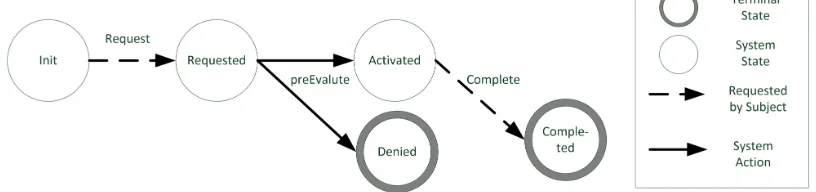
Figure 2: Transition system of a singleusepre-authorisation UseCON model
• Complete: This action changes the state of theusefrom’activated’to’completed’.
The actions performed automatically by the usage control system, follows:
• preEvaluate: This action is performed by the usage control system only when the allowance of
theuseis governed by a pre-authorisation rule. This action changes the state of theuseto either
’activated’or’denied’, depending on the outcome of the examined policy rule.
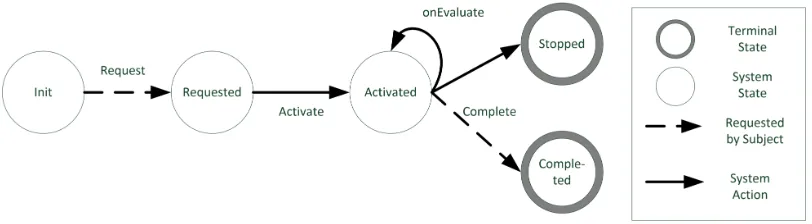
• onEvaluate: In case the allowance of a use is governed by an ongoing authorisation rule, the
onEvaluateaction is performed by the usage control system. If the particular policy rule is satisfied
then the state of theusedoes not change. In case the policy rule is not satisfied, the state of theuse is changed to’stopped’.
• Activate: This action is performed only when the allowance of theuseis governed by an ongoing
authorization rule. It follows the execution of theRequestaction and changes the state of theuse
from‘requested’to‘activated’.
Any of the previous actions, apart from modifying thestattribute value, may also update otheruse attribute values. Such modifications in the use attribute values are considered to be implementation specific, as already described in Section 2.3. Moreover, despite the existence of a great number of updates on attribute values, the execution of any of the previous actions is considered to be atomic2, i.e., a single behavioural step. The transition system for a singleuseUseCON system controlled by a pre and an ongoing authorisation policy rule is depicted in Figures 2 and 3, respectively.
In its initial state, nousesare exercised in the system, and thus the first state of every behaviour must satisfy the TLA+ predicateinit, which defines that the set-variableU is an empty set:
Init,U={ }
[image:6.612.102.510.193.289.2]Figure 3: Transition system of a singleuseongoing authorisation UseCON model
Moreover, according to the time period that auserequest evaluation is performed, a pre-authorisation and ongoing-authorisation transition systems is created.
2.4.1 Pre-authorisation
The possible actions that can be performed on a pre-authorisation UseCON system are theuserequest for a newuse, the evaluation of an already requesteduse, or the termination of ausethat is already executed. Therefore, the next action, that describes all the possible next states could be a request, evaluate, or
completeaction, described as follows:
Next, Request∨preEvaluate∨Complete
More specifically, theRequest action selects non-deterministically3 a newuse x. This is verified by searching the set of usesU, and returning one that has not already been requested by the subjects or processed by the usage control system. Consequently, in case that this particular xexists, the request action creates the corresponding use instance that instantiates use x and inserts it to the set U. The definition of theRequestaction is as follows:
Request, ∃u∈(S×A×O):(
∧ ∀x∈U:(x.sid=6 u[1].id∨x.aid6=u[2].id∨x.oid6=u[3].id) ∧U0=U∪ {createU se(u)})
The preEvaluateaction examines if there are anyuses that have been requested but have not been
processed by the usage control system. More specifically, preEvaluate examines if there is any use instance with state attribute value equals to‘requested’. Consequently, the action evaluates the policy rule that governs the allowance of theusethat the specific use instance instantiates. Based on the outcome of that policy rule the action modifies the state of the use either to‘activated’or to‘denied’withpreUpdate
anddenUpdateuse attribute update procedures respectively as follows:
preEvaluate,∃u∈U:(∧u.state=“requested”
∧IF(PolicyRule)T HEN
U0= (U\ {u})∪ {preU pdate(u)}
ELSE
U0= (U\ {u})∪ {denU pdate(u)})
TheCompleteaction simulates asubject’srequest to terminate the execution of a currently activeuse.
If such a use exists, its state attribute value should be equal to’activated’. Consequently, thecompleted action modifies the state attribute value from’activated’to’completed’with thecomUpdateuse attribute update procedure. TheCompleteaction is defined as follows:
Complete,∃u∈U:(∧u.state=“activated”
∧U0= (U\ {u})∪ {comU pdate(u)})
CreateUseis the procedure that creates a use instance that has the identities of thedirect subject,object,
action. The definition of thecreateUseprocedure follows:
createU se(x),[sid(x) =x[1].id,aid(x) =x[2].id,oid(x) =x[3].id, state(x) =requested,att(x) =k]
All the other use attribute update procedures perform a dual role. Firstly, they alter the stateuse attribute to the desired value (e.g.,preUpdateto‘activated’ orcomUpdate to‘completed’). Secondly, the use attribute update procedures modify the values of other use attributes according to the requirements of the usage control system that they are called to describe. For example, a possiblepreUpdateprocedure can be the following:
preU pdate,[u EXCEPT !.st=“activated”,!.att=value]
The same definitions apply to thedenUpdate, comUpdateprocedures.
2.4.2 Ongoing-authorisation
The transition system of the ongoing-authorisation UseCON model is differentiated from the pre-authorisation model in a number of ways. Firstly, in an ongoing model, ausethat is requested is permitted to be acti-vated without the evaluation of any policy rule. Secondly, at a given time interval4, an ongoing action is executedonEvaluate. Thus, the specification of theNextaction on an ongoing authorisation model has the following definitions:
Next, Request∨Activate∨onEvaluate∨Complete
TheActivateaction searches for the existence of a use with state attribute value equal to’requested’ and consequently updates it to‘activated’by executing thepreUpdateprocedure.
Activate,∃u∈U:(∧u.state=“requested”
∧U0= ({U\ {u})∪ {preU pdate(u)})
WhereasonEvaluateaction evaluates an ongoing policy rule, based on this result it either leaves use
to‘activate’state, but it can possibly update the rest use attribute values withonUpdateprocedure, or
modify its state attribute value to‘stopped’withtermUpdateuse attribute update procedure as follows:
onEvaluate, ∃u∈U:(∧u.state=“activated”
∧IF(PolicyRule)T HEN
U0= ({U\ {u})∪ {onU pdate(u)}
ELSE
U0= ({U\ {u})∪ {stopU pdate(u)})
Moreover, in the case where there is no need for an ongoing use attribute update procedure, the onUp-dateprocedure can be substituted with theUNCHANGED UTLA+ operator that leaves the variableU unmodified. Here, the semantics of‘request’and‘complete’actions are considered to be the same with the pre-authorisation model.
3
Model Checking with TLC
Toolboxis an Integrated Development Environment (IDE), which is designed for the definition and
veri-fication of TLA+ speciveri-fications [1]. Specifically, thetoolboxeditor provides functionality for the defini-tion and alteradefini-tion of TLA+ specificadefini-tions, and supports syntax highlighting. Addidefini-tionally, an automatic parser checks the defined specifications for syntax errors and presents them accordingly by marking them in the used modules.
Table 1: Safety and liveness properties in UseCON
Safety Liveness
Former state Latter state Former state Latter state
Pre
Completed Any other state Requested Activated or Denied Activated Requested or Denied Requested Completed or Denied Denied Any other state Activated Completed
Ongoing
Completed Any other state Requested Activated
Activated Requested Requested Completed or Stopped Stopped Any other state Activated Completed or Stopped
3.1 Use management
One of the fundamental properties that can be verified in a system is that of type correctness. Specifically, type correctness is considered to be an invariant which determines that all the variables of the system are assigned with values originating only from a specific set of values. The UseCON specification uses a single variableU which corresponds to the set of system uses. Theinvariantproperty that defines type correctness in the UseCON model, is defined as follows:
TypeCorrectness,U⊆U ses
whereUsesis the set of all records that have the following form (i.e., all the record fields are assigned with values originating from their domains):
[s.id:Sub jectIDS,o.id:Ob jectIDS,a.id:ActionIDS,st:U STAT E,att:AT T DOMAIN]
Moreover, the definition of the domainsSubjectIDS, ObjectIDs, ActionIDsandUSTATEis:
Sub jectIDs,{s.id:s∈S},Ob jectIDs,{o.id:o∈O},ActionIDs,{a.id:a∈A}
where
U STAT E,{requested, activated, denied, stopped, completed}
Auseis capable of recording detailed historical information about the operation ofusesin the sys-tem. Consequently, a valid implementation of the UseCON model, where multipleuse processes are operating concurrently, depends on a proper management of theuseinstances that represent theseuses. Specifically, alluseinstances must adhere only to the state transitions depicted in Figures 2 and 3 for the pre-authorisation and ongoing-authorisation models, respectively. Based on that, a number ofsafety
andlivenessproperties can be defined. For example, asafetyproperty (a faulty state cannot be reached)
states that auseinstance cannot be evaluated as’requested’in itsstattribute, if it has previously been evaluated as’completed’. The semantics, expressed in TLA+, which verify the previous property for all the uses of a system are defined by the following temporal formula:
Figure 4: Violation of safety properties
Similarsafetyproperties can be defined for all the possible prohibited state transitions. The complete set of prohibited state transitions is depicted in Table 1 under the header‘safety’. Moreover, two examples that illustrate the violation ofsafetyproperties are depicted in Figure 4. Specifically, the transition of the useinstanceu1 from‘completed’into‘requested’results in a violation of asafetyproperty. A similar violation is considered during the transition of theuseinstanceu2 if the state transits from’activated’
to‘requested’. In addition, the definition oflivenessproperties in the UseCON model determine all the
valid state transitions regarding any use instance. For example, Figure 2 presents that auseinstance that has at any given state anstattribute value that is evaluated to‘activated’, then its attributed value must be eventually evaluated as’completed’. All the possible state transitions that are eligible to be performed are depicted in Table 1 under the header’liveness’. This property is defined in TLA+ as follows:
Liveness,∀u∈U:u.st=“activated” u.st=“completed”
4
Performance Evaluation
The verification of the examined model was performed on a MacBook Pro (Mid 2014) using TLA+ Tool version 1.5.6 and running TLC version 2.12. The system operates on OS X El Capitan and its hardware specifications are: 2.5GHz Intel Core i7 with 16GB 1600 MHz DDR3.
consid-Table 2: Performance evaluation
Authorisation Uses Diameter States Distinct Deadlock Safety and Liveness
model found states (seconds) (seconds)
Pre
2 6 21 12 1 3
8 23 277969 16832 2 5
12 31 45533665 560128 53 138
Ongoing
2 7 33 16 1 3
8 25 367873 23808 2 7
12 37 79112449 1224704 118 241
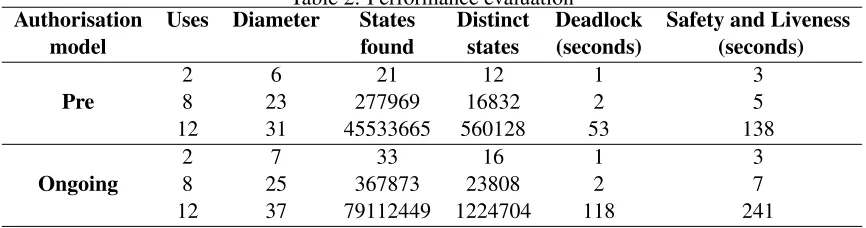
ered, the verification process had to be interrupted due to the excessive amount of time required for its completion given the number ofuses. The collected verification results (see Table 2) requires a better understanding of the internal procedures TLC is applying to compute the behaviours of the model (i.e., generation of the transition system). Initially, TLC computes the states that verify theInitpredicate and inserts them into a setG. For every state s∈G, TLC computes all the possible statestthats7→tcan be a step in a behaviour. Specifically, TLC substitutes the values assigned to variables by statesfor the unprimed variables of theNextaction, and then it computes all the possible assignment of values to the primed variables that makes theNextaction true. For every statet found by the former procedure it is added to setGif it does not already exists. The previous two actions are repeated until no new states can be added inG. Therefore, the verification results produced by TLC, are:Diameterexpresses the number of states in the longest path ofGin which no state appears twice;States foundexpresses the number of examined states; Distinct Statesexpresses the number of examined distinct states. The verification re-sults produced by TLC for thepreandongoingUseCON models are presented in Table 2. An additional column presents the actual running time of the TLC model checker in seconds.
5
Conclusion and Future Work
The application of model checking as a technique resulted in formally verifying the use management functions of UseCON. The trace of the deadlock errors verifies that the defined specifications of the system operate correctly. An advantage of using model checking techniques for the verification of usage control models is the provision of formal guarantees with regards to the correctness of the model, without requiring an implementation of it. Nevertheless, known issues of model checking, i.e., state explosion problem, prevented the timely verification of uses when these increase in number. This resulted in providing formal guarantees for the correctness of UseCON for≤12 uses for both the pre-authorisation and ongoing-authorisation models, as depicted in Table 2.
[image:12.612.90.523.86.200.2]References
[1] Microsoft Corporation: TLA+ Tools. Available at http://research.microsoft.com/en-us/um/
people/lamport/tla/tools.html. (visited on February 2018).
[2] Antonios Gouglidis, Ioannis Mavridis & Vincent C Hu (2014):Security policy verification for multi-domains in cloud systems.International Journal of Information Security13(2), pp. 97–111.
[3] Christos Grompanopoulos, Antonios Gouglidis & Ioannis Mavridis (2012): A use-based approach for en-hancing UCON. In:International Workshop on Security and Trust Management, Springer, pp. 81–96.
[4] Vincent C Hu, Rick Kuhn & Dylan Yaga (2017): Verification and Test Methods for Access Control Poli-cies/Models.NIST Special Publication800, p. 192.
[5] Leslie Lamport (2002): Specifying Systems: The TLA+ Language and Tools for Hardware and Software Engineers, 1st edition. Addison-Wesley Professional.
[6] Aliaksandr Lazouski, Fabio Martinelli & Paolo Mori (2010):Usage control in computer security: A survey.
Computer Science Review4(2), pp. 81–99.
[7] Anastasia Mavridou, Emmanouela Stachtiari, Simon Bliudze, Anton Ivanov, Panagiotis Katsaros & Joseph Sifakis (2016):Architecture-based design: A satellite on-board software case study. In: International
Con-ference on Formal Aspects of Component Software, Springer, pp. 260–279.
[8] Jaehong Park & Ravi Sandhu (2004):The UCON ABC usage control model.ACM Trans. Inf. Syst. Secur.7, pp. 128–174.
[9] Najah Ben Said, Takoua Abdellatif, Saddek Bensalem & Marius Bozga (2014): Model-driven information flow security for component-based systems. In: From Programs to Systems. The Systems perspective in Computing, Springer, pp. 1–20.
[10] Xinwen Zhang, Masayuki Nakae, Michael J Covington & Ravi Sandhu (2008):Toward a usage-based secu-rity framework for collaborative computing systems.ACM Transactions on Information and System Security (TISSEC)11(1), p. 3.
[11] Xinwen Zhang, Jaehong Park, Francesco Parisi-Presicce & Ravi Sandhu (2004): A logical specification for usage control. In: Proceedings of the ninth ACM symposium on Access control models and technologies, SACMAT ’04, ACM, New York, NY, USA, pp. 1–10.
A
An Overview of UseCON
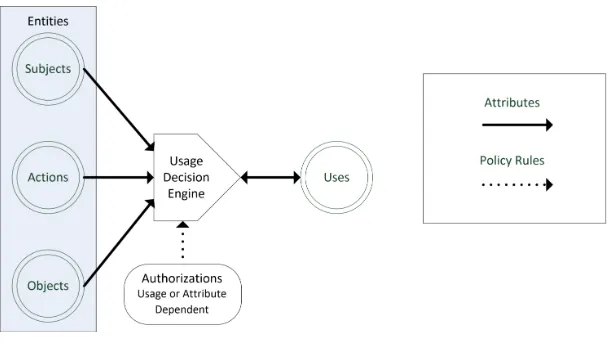
The UseCON model is composed by three entities, namelysubjects, objects, andactions. These three entities, together withuses, are the core components of UseCON. Decision factors in UseCON are the attribute dependent authorisations and the usage dependent authorisations.
Subjectsandobjectsare fundamental concepts, proposed already by access control models.
Specifi-cally, asubjectis an entity that requests the execution of an operation onobjectentities. Anactionentity represents the novel and complicated operations imposed by new computing paradigms. All the secu-rity relevant characteristics, including related contextual information ofsubjects,objects, andactionsare described through their attributes. An example of anactionentity is a money transfer operation from a bank account, where the attributes describe the amount being transferred, the date of the transaction, the currency, etc. A core component of the UseCON model is theusecomponent that represents the secu-rity related semantics of ause. Ause, is created when asubjectrequests the execution of anactionon
anobject. Auseis described through attributes that record the detailed security-relevant characteristics
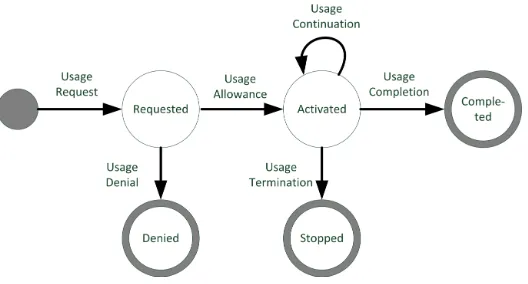
Figure 5: Accomplishment status of a singleuse
• Requested: Upon request for ause, the appropriate attributes are associated with theuseand proper values are assigned to them. The pre-authorisation policy rules, which govern the requesteduse, has not been evaluated yet.
• Activated: The requestedusehas been allowed, as a result of successfully fulfilled pre-authorisation policy rules, and is being executed.
• Denied: The requestedusehas been denied, because it failed to satisfy the pre-authorisation rules.
• Stopped: The allowed/ongoing usehas been terminated by the system due to a violation of an ongoing authorisation rule.
• Completed: Theusethat has been completed due to a subjects intervention.
An authorisation is the only decision factor in UseCON. However, for the creation of a usage deci-sion, the UseCON model utilises three criteria viz. the (properties) of the entities, contextual information, and historical information aboutuses. Therefore, authorisations are categorised into Attribute dependent Authorisations (AdAs) and Usage dependent Authorisations (UdAs) as follows:
• Contextual information andpropertiesthat describes an entity are associated with the correspond-ing entity’s attributes. The values of these attributes in turn are utilised by AdAs policy rules for the creation of ausedecision.
• Historical information ofusesis utilised by UdAs. Specifically, in UseCON,usescan record all the information regarding the previous or concurrentusesexercised in the system. Consequently, an UdA policy rule utilises the historical information contained into the use attribute values to allow or deny auserequest.
Integrating authorisations with continuity of decision results into two UseCON sub-models. These are the pre-authorisations and the ongoing-authorisations sub-models. The UseCON elements and the relations between them are depicted in Figure 6.
Figure 6: UseCON usage control system
inherently supports the utilisation of historical information ofuses. Consequently, there is a strict dis-tinction between the functional components of the internal usage control model (e.g., creation and state transition actions of use entities) and the components that define the specific policy implementations of the model (e.g., the creation of the usage decision policy rules).
B
Specifications in TLA+
A system’s specification in TLA+ follows the Standard Model, which is the description of a set of behaviours each representing a possible execution of the system. Every TLA+ specification is composed
ofpredicates,actionsandtemporal formulas.
Specifically, a predicate is a boolean-valued expression built fromvariables andconstants and is evaluated on a state. The evaluation of apredicatein astateis performed by calculating thepredicate expression with the assignedvaluesof the includedvariablesin thisstate. A formal definition follows:
s[[p]] =p(∀’u’:s[[u]]/u)
where p(∀’u’:s[[u]]/u)denotes the evaluation of predicate pby substituting every variableuwith the assigned value in state s (s[[u]]). If apredicate pis evaluated astrueinstate sit denotes thatpredicate p satisfies state s.
Anactiondenotes a relation between pairs of states of the system (denoted as systemsteps).
More-over, anactionis a boolean-valued expression built from constants andprimedandunprimedvariables.
Primedvariables refer to new states while unprimedrefer to old states. A formal definition of actions
follows:
s[[a]]t=a(∀’u’: s[[u]]/u,t[[u]]/u0)
We say that action a satisfies states s,t, or that s,t is an a-stepif the evaluation of the action, with unprimed variables assigned value from state s and primed variables assigned value from state t, is true.
Apredicatecan be considered as a specialactionthat is evaluated only on the first state of a step.
Atemporal formulain TLA+ is a boolean valued expression that is evaluated on behaviours. More
tem-poral operators. Anaction/predicatecan be considered as a specialtemporal formulathat is evaluated on the firststep/stateof the behaviour. Some of the fundamental temporal operators in TLA+ follow:
• Always. The formulaFmust satisfy every suffix of the behaviour. The semantics of thealways
temporal operator follows:
<s0,s1, . . . >[[F]],∀n≥0 : <sn,sn+1, . . . >[[F]]
where the, operator utilised in an expression id,exp defines id to be synonymous with the expressionexp. Replacingidbyexpdoes not change the meaning of the specification.
• Eventually♦. The formulaFmust satisfy some states of the behaviour. The semantics or
eventu-allycan be defined by utilizing thealwaystemporal operator as follows:
♦F,¬¬F
• Leads to . The formulaF Gasserts that wheneverFis true,Gis eventually true. That isGis
true at the same time withF or some time later. Theleads tooperator can be defined utilizing the previous temporal operators as:
F G, (F =⇒ ♦G)
Consequently, all the accepted behaviours of a system can be specified in TLA+ with a temporal formula calledspecificationof the following form:
Spec,Init∧Next
where Init is a predicate and Next is an action. A behaviour satisfies Spec if the first state of the behaviour satisfies Init and every consequent step satisfies Next. However, a well-defined specification should allowstutteringsteps (steps that leave the system variables unchanged). Thus, the specification has the following form:
Spec,Init∧[Next]<v1,...,vn> (1)
where[Next]<v1,...,vn>is defined as:
[Next]<v1,...,vn>,Next∨((v 0
1=v1)∧. . .∧(v0n=vn))
Formula (1) demands that the transition from one state to another is either a Next-step or a stuttering step that leaves the system variables unchanged.
However, the TLA+ specification expressed in (1), also describes behaviours that may stop at any point, including a behaviour that starts in a valid initial state and takes no step. Weak fairnessproperty of the action Next (W Fvars(Next)) asserts that behaviours are not allowed to stop in a state in which Next action is enabled (Action A is enabled in a state s if there exists a state t such that s→t is an Next-step). Therefore, the specification of a system that permits stuttering steps and supports the weak fairness property for action Next has the following form:
A property in TLA+ is described together with a system’s specification and has the form of an
invari-antor atemporal formula. Aninvariantis a predicate that is evaluated on a system state. Consequently,
aninvariantholds on a system specification, if and only if, every state of all the behaviours of a system
satisfy that predicate. Moreover, atemporal formulais evaluated on a system behaviour. Consequently, a