ISSN Online: 2327-5227 ISSN Print: 2327-5219
DOI: 10.4236/jcc.2018.65005 May 24, 2018 55 Journal of Computer and Communications
A Method for Calculating the Association
Degrees between Concepts of Concept
Networks
Shi-Jay Chen
Department of Information Management, National United University, Miaoli, China
Abstract
Depicting the associating degrees between two concepts and their relation-ships are major works for constructing a multi-relationship fuzzy concept network. This paper indicates some drawbacks of the existing methods of calculating associating degrees between concepts, and proposes a new method for overcoming these drawbacks. We also use some examples to compare the proposed method with the existing methods for calculating the associating degrees between two concepts in a multi-relationship fuzzy concept networks.
Keywords
Document Retrieval, Fuzzy Query Processing, Geometric-Mean Averaging Operators, Fuzzy Concept Networks
1. Introduction
Salton and Mcgill proposed information retrieval system based on the Boolean logic model [1]. Moreover, documents are retrieved only when they contain the index terms specified in the user’s queries. However, this method may be neglect some relevant documents that do not contain the index terms specified in user’s queries. Therefore, many researchers proposed intelligent information retrieval systems to retrieval documents intelligently by incorporating knowledge bases into the systems [2]-[13]. In [13], Lucarella et al. presented the fuzzy concept networks for information retrieval based on fuzzy set theory [14]. The concept network can depict the relationships between concepts which are defined as in-dex terms [15] or classes of documents [11] in a specific domain.
In [9], Horng et al. proposed the method to automatically construct ti-relationship fuzzy concept networks for fuzzy information retrieval. In mul-How to cite this paper: Chen, S.-J. (2018)
A Method for Calculating the Association Degrees between Concepts of Concept Net-works. Journal of Computer and Commu-nications, 6, 55-65.
https://doi.org/10.4236/jcc.2018.65005
Received: March 26, 2018 Accepted: May 21, 2018 Published: May 24, 2018
Copyright © 2018 by author and Scientific Research Publishing Inc. This work is licensed under the Creative Commons Attribution International License (CC BY 4.0).
DOI: 10.4236/jcc.2018.65005 56 Journal of Computer and Communications ti-relationship, there are four kinds of relationship to describe possible semantic relationships between concepts, such as fuzzy positive association relationship, fuzzy negative associating relationship, fuzzy generalization relationship and fuzzy specialization relationship [10]. The users of the fuzzy information retriev-al system based on multi-relationship concept networks can submit a fuzzy query in which a search context is involved to provide the user’s perspective on the fuzzy relationships between concepts. Documents are retrieved if they tain concepts that have a specified fuzzy relationship with the concepts con-tained in the user’s query when concerning the search context. Thus, depicting the associating degrees between two concepts and their relationships are impor-tant for constructing a multi-relationship fuzzy concept network.
The rest of this study is organized as follows. Section 2 briefly reviews the concept of geometric mean, the fuzzy concept network [13] and the mu-ti-relationship fuzzy concept network [10]. Section 3 reviews the existing me-thods of associating degrees between concepts for automatically constructing multi-relationship associating fuzzy concept networks, and indicates some drawbacks of existing methods for calculating associating degrees between con-cepts. Section 4 presents a new method for calculating associating degrees be-tween concepts, and uses some examples to compare the proposed method with the existing methods. Conclusions are finally drawn in Section 5.
2. Preliminary
In [9], the geometric mean of positive number a a1, , ,2 an is defined as
1 2
1 n
n n
i n
i=a = a a× × ×a
∏
, (1) where 1≤ ≤i n. The geometric mean is well defined for sets of positive num-bers, and is useful to deal with fuzzy aggregating problem and fuzzy deci-sion-making problem.2.1. Fuzzy Concept Networks
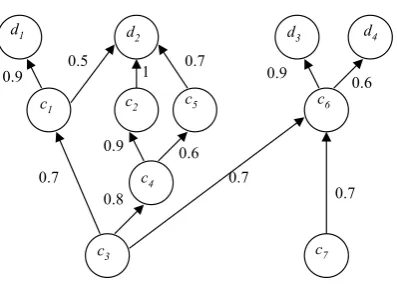
Lucarella et al. have proposed the fuzzy concept networks for fuzzy information retrieval [13]. A fuzzy concept network includes nodes and directed links. Each node represents a concept or document. Each directed link connects two con-cepts or directs from one concept cito one document di, and each directed link is associated with a degree μ, where µ∈
[ ]
0,1 , indicating the degree of strength of the relationship between two concepts or the degree of strength that a document contains a concept. Figure 1 shows a fuzzy concept network, where c c1, ,2 and c7 are concepts, and d1, d2, d3 and d4 are documents. A link in the fuzzy con-cept network is defined as:
( )
{
, , , | and}
l= c r u c r c C∈ r C∈ ,
where C represents the set of concepts, u is the membership function,
[ ]
: 0,1
DOI: 10.4236/jcc.2018.65005 57 Journal of Computer and Communications
Figure 1. A fuzzy concept network.
by the link l, and their relevant is u(c, r), where u c r
( )
, ∈[ ]
0,1 .In the relevant value between concept c and concept r is u(c, r), and the rele-vant value between concept r and concept s is u(r, s). Then based on the transi-tivity of link relationship, we can obtain the relevant value between concept c
and concept s by the following expression:
( )
, min(
( ) ( )
, , ,)
u c s = u c r u c s .
Similarly, if u c c u c c
(
1, 2) (
, 2, 3)
, , u c c(
n−1, n)
are known, then based on the transitivity of relationship, we can obtain the relevant value between concept c1 and concept cn by the following expression:(
1, n)
min(
(
1, 2) (
, 2, 3)
, ,(
n1, n)
)
u c c = u c c u c c u c c− .
2.2. Multi-Relationship Fuzzy Concept Networks
Kracker proposed the multi-relationship fuzzy concept network [10]. The con-cepts of multi-relationship fuzzy concon-cepts are similar to the concon-cepts of semantic networks [9] for expressing different types of relationship between keywords. Four types of relationship can be described the possible relationship between concepts in a multi-relationship fuzzy concept network as follows:
1) Positive association: It relates concepts with a fuzzy similar meaning (e.g. person—individual) in some contexts.
2) Negative association: It relates concepts with fuzzy complementary rela-tionship (e.g. male—female), fuzzy incompatible relarela-tionship (e.g. unem-ployed—freelance) or fuzzy antonymous relationship (e.g. small—large) in some contexts.
3) Generalization: A concept regarded as a fuzzy generalization of another concept if it includes that concept in an analytic or partitive sense (e.g. per-son—student).
4) Specialization: It is the inverse of fuzzy generalization.
Let C be a set of concepts in a multi-relationship fuzzy concept network. The fuzzy relationships between concepts are defined as follows [10].
1) Fuzzy positive associating P is a fuzzy relation, P C C: × →
[ ]
0,1 , which is reflexive, symmetric, and max-*-transitive.0.7
0.9 0.5 1
0.9 0.7
0.6
0.8
d1 d2 d3 d4
c1 c2 c5 c6
c4
c3 c7
0.9 0.6
DOI: 10.4236/jcc.2018.65005 58 Journal of Computer and Communications 2) Fuzzy negative association N is a fuzzy relation, N C C: × →
[ ]
0,1 , which isanti-reflexive, symmetric, and max-*-nontransitive.
3) Fuzzy generalization G is a fuzzy relation, G C C: × →
[ ]
0,1 , which is an-ti-reflexive, anti-symmetric, and max-*-transitive.4) Fuzzy specialization S is a fuzzy relation, S C C: × →
[ ]
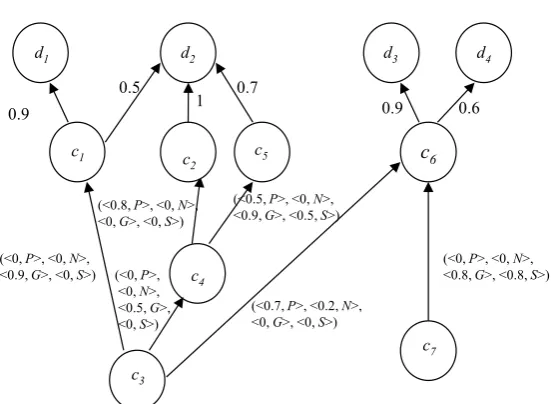
0,1 , which is an-ti-reflexive, anti-symmetric, and max-*-transitive.A multi-relationship fuzzy concept network is denoted as MRFCN (E, L), where E is a set of nodes, and where represents a concept or a document as in Figure 2. L is a set of directed edges between nodes. If l L∈ , then the directed
edge l has following two formats: 1) ( P, ,P N, ,N G, ,G S,S)
i j
c µ µ µ µ →c , means that the directed edge l connect ci to cj with a four-tuple
(
µ
P, ,Pµ
N,N ,µ
G, ,Gµ
S,S)
, where µP∈[ ]
0,1 ,[ ]
0,1N
µ ∈ , µG∈
[ ]
0,1 and µS∈[ ]
0,1 .2) ci→µ dj, means that document dj has concept ci with the degree of strength, where µ∈
[ ]
0,1 .Figure 2 shows a multi-relationship fuzzy concept network, where c c1, , ,2 c7
are concepts; d1, d2, d3 and d4 are documents.
Furthermore, Horng et al. proposed an algorithm with eight steps to construct multi-relationship fuzzy concept networks automatically [9].
3. Analysis of the Existing Methods for Calculating the
Relationships and the Associating Degrees between
Concepts
In [9], Horng et al. pointed out that calculating the relationships and the asso-ciating degrees between concepts is an important part of constructing a mul-ti-relationship fuzzy concept network. They decided fuzzy relationship between two concepts by following six cases. Assume the concept ci and the concept cj be any two arbitrary concepts in the concept set C, the discussions of the six cases are shown as follows.
Case 1: If concept ci and concept cj contain different words, then they are not related.
Case 2: If concept ci and concept cj contain almost the same words, but the weighs of the words in concept ci are larger than those in concept cj, then con-cept ci is said to dominate concept cj and should be more general than concept cj. Case 3: If concept ci and concept cj contain almost the same words, but the weights of the words in concept ci are smaller than those in concept cj, then con-cept ci is said to be dominated by con concept cj and should be more specific than concept cj.
DOI: 10.4236/jcc.2018.65005 59 Journal of Computer and Communications
Figure 2. A multi-relationship fuzzy concept network.
Case 5: If most words contained in concept ci are also contained in concept cj, but many words contained in concept cj are not contained ci, then concept ci concerns fewer aspect than concept cj and should be more specific than concept
cj.
Case 6: If concept ci and concept cj contain almost the same words, and the weight of the words are similar in both concepts, then these two concepts should be similar to each other and have a fuzzy positive associating relationship.
Young proposed a method for calculating the associating degree between concepts [16]. The proposed method uses a mapping function M to represent each concept by showing its corresponding fuzzy subset in the word set WS. The mapping function M shown as follows:
( )
i i1 1 i2 2 ih hM c =w t w t+ ++w t , (2)
where M C: →
[ ]
0,1W, wi1 is the weight of word tj in concept ci, and h is the number of words in the word set WS. Then, calculating the associating degree between concepts denoted G(ci, cj) and equal to the degree of subsethood of M(ci) in M(cj). A method to calculate G(ci, cj) is shown as follows:(
)
( )
( )
( )
(
)
( )
( )
11
min ,
, if ,
1, if
h
ki kj
i i k
j h
i j i k ki
i w w
M c M c
M c
G c c M c w
M c
φ
φ
=
=
= ≠
=
≠
∑
∑
(3)
where wki is the weight of word tk in concept ci, wki is the weight of word tk in concept cj, WC(ci) is the number of words contained on concept ci, WC(cj) is the number of words contained in concepts cj, and h is the number of words in the word set WS. According to Subsection 2.2, we can understand that fuzzy specia-lization relationship is the inverse of the fuzzy generaspecia-lization relationship. Thus
(
i, j) (
i, j)
S c c =G c c . (4) 0.7
0.9
0.5 1
(<0, P>, <0, N>, <0.9, G>, <0, S>)
d1 d2 d3 d4
0.9
c1 c2 c5 c6
c4
c3
c7
0.9 0.6
(<0, P>, <0, N>, <0.5, G>, <0, S>) (<0.8, P>, <0, N>, <0, G>, <0, S>)
(<0.7, P>, <0.2, N>, <0, G>, <0, S>) (<0.5, P>, <0, N>, <0.9, G>, <0.5, S>)
DOI: 10.4236/jcc.2018.65005 60 Journal of Computer and Communications Moreover, based on Subsection 2.1, the degree of fuzzy positive association relationship between concept ci and concept cj, denoted as P(ci, cj), is calculated as follows:
(
i, j)
min(
(
i, j) (
, i, j)
)
P c c = G c c S c c . (5)
However, Horng et al.[9] founded that Young’s method cannot effectively re-veal the generality of concept cj over concept ci, such as the following example [9].
Example 3.1: Assume that there are five words t1, t2, …, and t5 in the word set
WS and assume that the corresponding fuzzy subset M(ci) and M(cj) of concept
ci and concept cj in the word set WS are shown as follows:
( )
i 0.3 1 0.3 2 0.4 3 0.4 4 0.3 5M c = t + t + t + t + t ,
( )
j 0.8 2 0.9 3M c = t + t .
According to Case 4 of the above six cases for deciding fuzzy relationship be-tween concepts, concept ci should be more general than the concept cj because concept ci contains all the words contained in concept cj (i.e., the words t2, t3). However, Young’s method yield the same associating degrees G(ci, cj) and G(cj,
ci) as follows:
(
,)
0.3 0.4 0.410.3 0.3 0.4 0.4 0.3
i j
G c c = + =
+ + + + ,
(
,)
0.3 0.4 0.41 3.8 0.9j i
G c c = + =
+ .
According to the above results, we cann’t know which concept is more general than the other one.
Therefore, Horng et al.[9] proposed the formula (6) to overcome this draw-back.
(
)
(
)
( ) ( ) ( )
(
)
( )
( )
max ,
1
1
min ,
, if ,
1, if
i
i j
WC c
h WC c WC c
ki kj k
j h
i j
ki k
i w w
M c G c c
w
M c
φ
φ
=
=
≠
=
≠
∑
∑
(6)where wki is the weight of word tk in concept ci, wkj is the weight of word tk in concept cj, WC(ci) is the number of words contained on concept ci, WC(cj) is the number of words contained in concepts cj, and h is the number of words in the word set WS. The proposed method can overcome the drawback of Young’s method.
However, we also found the formula (6) proposed by Horng et al. still has some drawbacks for dealing with associating degrees between concepts (i.e., the result is not fitting for one of the above six cases). In the following, we use some examples to illustrate these drawbacks.
DOI: 10.4236/jcc.2018.65005 61 Journal of Computer and Communications and concept cj in the word set WS are shown as follows:
( )
i 0.3 1 0.1 2 0.2 3 0.8 4M c = t + t + t + t ,
( )
j 0.4 1 0.3 2 0.8 3M c = t + t + t .
According to Case 2 of the above six cases for deciding fuzzy relationship be-tween concepts, concept cj should be more general than concept ci because con-cept ci and concept cj contained almost the same words (i.e., the words t1, t2, and
t3), but all the weights of the words in concept cj also contained in concept ci are larger than concept ci. Based on Horng et al.’s method, we calculate the G(ci, cj) and G(cj, ci), respectively, as follows:
(
)
0.3 0.1 0.2 44, 0.42
0.3 0.1 0.2 0.8
i j
G c c = + + =
+ + +
,
(
)
0.3 0.1 0.2 34, 0.5
0.4 0.3 0.8
j i
G c c = + + =
+ +
.
Since G(cj, ci) is larger than G(ci, cj), we can see that concept ci is more general than concept cj. However, the relationship between the two concepts ci and cj does not coincide with human intuition for violating Case 2.
Example 3.3: Assume that there are six words t t1 2, , , t6 in the word set WS,
and assume that the corresponding fuzzy subset M(ci) and M(cj) of concept ci and concept cj in the word set WS are shown as follows:
( )
i 0.6 1 0.3 2 0.4 3 0.7 4 0.6 5 1 6M c = t + t + t + t + t + t ,
( )
j 0.8 1 0.5 2 0.7 3 1 4 0.8 5M c = t + t + t + t + t .
According to Case 3 of the above six cases for deciding fuzzy relationship be-tween concepts, concept cj is general than ci because the two concepts ci and cj contained almost the same words (i.e., the word t1, t2, t3, t4 and t5), but all the weights of the words in concept cj also contained in concept ci are larger than concept ci. Based on Horng et al.’s method, we calculate the G(ci, cj) and G(cj, ci), respectively, as follows:
(
)
0.6 0.3 0.4 0.7 0.6 66, 0.6767
0.6 0.3 0.4 0.7 0.6 1
i j
G c c = + + + + =
+ + + + +
,
(
)
0.6 0.3 0.4 0.7 0.6 56, 0.6842
0.8 0.5 0.7 1 0.8
j i
G c c = + + + + =
+ + + +
.
Since G(cj, ci) is larger than G(ci, cj), we can see that concept ci is more general than concept cj. However, the relationship between the two concepts ci and cj is not fitting for human intuition because of violating Case 3.
Example 3.4: Assume that there are seven words t t1 2, , , t7 in the word set
WS, and assume that the corresponding fuzzy subset M(ci) and M(cj) of concept
ci and concept cj in the word set WS are shown as follows:
( )
i 1 1 0.8 2 0.9 3DOI: 10.4236/jcc.2018.65005 62 Journal of Computer and Communications
( )
j 0.2 1 0.1 2 0.2 3 0.1 4 0.2 5 0.1 6 0.1 7M c = t + t + t + t + t + t + t .
According to Case 4 of the above six cases for deciding fuzzy relationship be-tween concepts, concept cj should be more general than the concept ci because concept cj contains all the words contained in concept ci, (i.e., the words t1, t2 and t3), but the words t4, t5, t6 and t7 contained in concept cj are not contained in concept ci. Based on Horng et al.’s method, we calculate the G(ci, cj) and G(cj, ci), respectively, as follows:
(
)
0.2 0.1 0.2 73, 0.485
1 0.8 0.9
i j
G c c = + + =
+ +
,
(
)
0.2 0.1 0.2 44, 0.5
0.2 0.1 0.2 0.1 0.2 0.1 0.1
j i
G c c = + + =
+ + + + + +
.
Since G(ci, cj) is larger than G(cj, ci), we can see that concept ci is more general than concept cj. However, the relationship between the two concepts ci and cj does not coincide with human intuition because of violating Case 4.
According to the above discussion, we found that formula (5) proposed by Horng et al. has some drawbacks for calculating the degrees between concepts. In order to obtain more accurate associating degrees between concepts for au-tomatically constructing multi-relationship fuzzy concept networks, to develop a new method for calculating associating degrees between concepts is necessary.
4. A New Method for Calculating Associating Degrees
between Two Concepts
In this section, we present a new method for calculating associating degrees be-tween concepts based on geometric mean operator. The new method for calcu-lating associating degrees between concepts shown as follows:
(
)
( )
( )
( ) ( )
(
)
( )
( )
1 2 ROUND1
max ,
1
0.5 , if
, 2
1, if
i
i j
h WC c
ki kj k
WC c WC c j
k
i j k ki
i
w w
M c
G c c w
M c
φ
φ
+ ×
=
=
×
+ ≠
= ×
≠
∑
∑
(7)DOI: 10.4236/jcc.2018.65005 63 Journal of Computer and Communications max operators have the “single operand dependent” property, which decrease retrieval effectiveness [15]. Thus, our method is based on geometric mean for calculating the associating degrees between concepts.
In the following, we use the examples discussed in Section 3 to compare the proposed method with existing methods.
1) If we use formula (7) to deal with Example 3.1, we can calculate the two asso-ciating degrees G(ci, cj) and G(cj, ci), respectively, as follows:
(
)
(
) ( )
1 2 ROUND55
0.3 0.8 0.4 0.9
, 0.5 0.44556
2 0.3 0.3 0.4 0.4 0.3
i j
G c c = × + × + + × =
× + + + +
(
)
(
)
( )
1 2 ROUND 25
0.3 0.8 0.4 0.9
, 0.5 0.82056
2 0.8 0.9
j i
G c c = × + × + + × =
× + .
Since G(cj, ci) is larger than G(ci, cj), we can see that concept ci is more general than concept cj, and it coincides with the intuition of the human being.
2) If we use formula (7) to deal with Example 3.2, we can calculate the two asso-ciating degrees G(ci, cj) and G(cj, ci), respectively, as follows:
(
)
(
)
( )
1 2 ROUND44
0.3 0.4 0.1 0.3 0.2 0.8
, 0.5 0.45343
2 0.3 0.1 0.2 0.8
i j
G c c = × + × × × + + × =
× + + + ,
(
)
(
)
( )
1 2 ROUND 34
0.3 0.4 0.1 0.3 0.2 0.8
, 0.5 0.43154
2 0.4 0.3 0.8
j i
G c c = × + × × × + + × =
× + + .
Since G(cj, ci) is larger than G(ci, cj), we can see that concept ci is more general than concept cj, and it coincides with the intuition of the human being for observ-ing Case 2.
3) If we use formula (7) to deal with Example 3.3, we can calculate the two asso-ciating degrees G(ci, cj) and G(cj, ci), respectively, as follows:
(
)
(
)
( )
1 2 ROUND 6 60.6 0.8 0.3 0.5 0.4 0.7 0.7 0.1 0.6 0.8 ,
2 0.6 0.3 0.4 0.7 0.6 1
0.5 0.5609
i j G c c
+ × × + × + × + × + × = × + + + + + + = ,
(
)
(
)
( )
1 2 ROUND 5 60.6 0.8 0.3 0.5 0.4 0.7 0.7 1 0.6 0.8 ,
2 0.8 0.5 0.7 1 0.8
0.5 0.5380
j i G c c
+ × × + × + × + × + × = × + + + + + = .
Since G(ci, cj) is larger than G(cj, ci), we can see that concept cj is more general than concept ci, and it coincides with the intuition of the human being for observ-ing Case 3.
4) If we use formula (7) to deal with Example 3.4, we can calculate the two asso-ciating degrees G(ci, cj) and G(cj, ci), respectively, as follows:
(
)
(
)
( )
1 2 ROUND37
0.1 0.2 0.8 0.1 0.9 0.2
, 0.5 0.71376
2 0.1 0.8 0.9
i j
G c c = × + × × × + + × =
DOI: 10.4236/jcc.2018.65005 64 Journal of Computer and Communications
(
)
(
) ( )
1 2 ROUND 77 0.3 0.4 0.1 0.3 0.2 0.8
, 0.5 2 0.2 0.1 0.2 0.1 0.2 0.1 0.1 0.70216
j i
G c c = × + × × × + + ×
× + + + + + +
=
.
Since G(ci, cj) is larger than G(cj, ci), we can see that concept cj is more general than concept ci, and it coincides with the intuition of the human being for ob-serving Case 4.
From the previous discussions, we can obtain the proposed method is useful than the two existing methods proposed by Young and Horng et al. respectively for calculating the associating degrees between two concepts for deciding their relationship in a multi-relationship fuzzy concept network.
5. Conclusion
In this paper, we firstly pointed out some drawbacks of the existing methods for calculating the associating degree between two concepts, and presented a me-thod based on geometric mean operator for overcoming these drawbacks. We used some examples to compare the proposed method with the existing me-thods. The proposed method is more useful than the existing methods to calcu-late the associating degrees between two concepts for constructing their rela-tionship in a multi-relarela-tionship fuzzy concept networks for document retrieval.
Acknowledgements
This work was supported in part by the Ministry of Science and Technology, Republic of China, under Grant 104-2410-H-239-007.
References
[1] Salton, G. and Mcgill, M.J. (1983) Introduction to Modern Information Retrieval. McGraw-Hill Education, New York.
[2] Bezdek, J.C., Biswas, G. and Huang, L.Y. (1986) Transitive Closures of Fuzzy The-sauri for Information-Retrieval System. International Journal of Man-Machine Stu-dies, 25, 343-356.https://doi.org/10.1016/S0020-7373(86)80065-7
[3] Bhatia, S.K. and Deogun, J.S. (1998) Conceptual Clustering on Information Retriev-al. IEEE Transactions on Systems, Man, and Cybernetics—Part B, Cybernetics, 28, 427-435.https://doi.org/10.1109/3477.678640
[4] Chang, C.S. and Chen, A.L.P. (1998) Supporting Conceptual and Neighborhood Quiries on the World Wide Web. IEEE Transactions on Systems, Man, and Cyber-netics—Part B, Cybernetics, 28, 300-308.https://doi.org/10.1109/5326.669578 [5] Chen, C.L.P. and Lu, Y. (1997) FUZZY: A Fuzzy-Based Concept Information
Sys-tem That Integrates Human Categorization and Numerical Clustering. IEEE Trans-actions on Systems, Man, and Cybernetics—Part B, Cybernetics, 27, 79-94.
https://doi.org/10.1109/3477.552187
[6] Chen, S.M. and Horng, Y.J. (1999) Fuzzy Query Processing for Document Retrieval Based on Extended Fuzzy Concept Networks. IEEE Transactions on Systems, Man,
and Cybernetics—Part B, Cybernetics,29, 96-104.
In-DOI: 10.4236/jcc.2018.65005 65 Journal of Computer and Communications ternational Computer Symposium: Workshop on Artificial Intelligence, Chiayi, 6-8 December 2000, 79-86.
[8] Chen, S.M., and Wang, J.Y. (1995) Document Retrieval Using Knowledge-Based Fuzzy Information Retrieval Techniques. IEEE Transactions on Systems, Man, and Cybernetics, 25, 793-803.
[9] Horng, Y.J., Chen, S.M. and Lee, C.H. (2003) Automatically Constructing Mul-ti-Relationship Fuzzy Concept Networks for Document Retrieval. Applied Artificial Intelligence, 17, 303-328. https://doi.org/10.1080/713827141
[10] Kracker, M. (1992) A Fuzzy Concept Network Model and Its Applications. Pro-ceedings of the First IEEE International Conference on Fuzzy Systems,San Diego, 8-12 March 1992, 761-768.https://doi.org/10.1109/FUZZY.1992.258752
[11] Liang, T. and Chang, C.C., (1999) Chinese Textual Retrieval Based on Fuzzy Con-cept Networks. Proceedings of National Computer Symposium, Tamsui, 20-22 De-cember1999, 61-67.
[12] Lin, C.C., Tseng, S.Y. and Chen, P.M (1999) A Fuzzy Document Retrieval System Based on Concept Networks and Cluster Analysis. Soochow Journal of Economics and Business, 25, 39-60.
[13] Lucarella, D. and Morara, R. (1991) FIRST: Fuzzy Information Retrieval System.
Journal of Information Science, 17, 81-91.
https://doi.org/10.1177/016555159101700202
[14] Zadeh, L.A. (1965) Fuzzy Sets. Information and Control, 8, 338-353.
https://doi.org/10.1016/S0019-9958(65)90241-X
[15] Kim, K.J. and Cho, S.B. (2001) A Personalized Web Search Engine Using Fuzzy Concept Network with Link Structure. Proceedings of the Joint 9th IFSA Congress and 20th NAFIPS International Conference, Vancouver, 25-28 July 2001, 81-86. [16] Young, V.R. (1996) Fuzzy Subsethood. Fuzzy Sets and Systems, 77, 371-384.