RESEARCH ARTICLE
A NEW GENETIC ALGORITHM BASED POLYTECHNIC COLLEGE COURSE TIMETABLING
Dhanabalan, K
1,*., Dr. S. Nagarajan
2and Dr. S. Sakthivel
31Head of Computer Science Department, SRNM College, Sattur-626203,Tamilnadu,India
2 Prof. Department of B.Tech. (IT), Hindustan Institute of Science and Technology, Chennai, India.
3 Principal, PSNA College of Engineering and Technology, Dindugal, Tamilnadu, India.
ARTICLE INFO ABSTRACT
The course timetabling problem is a special version of the optimization problem and it is computationally NP-hard. In this paper two methods one using binary weight and another one using normal weight instead of binary weight to teachers have been presented. Genetic algorithm in which selective two point multiple years crossover and mutation cum sequential evaluation (SMCMSE) algorithm is introduced in both the methods and test results have been compared. Both of them are proved to be useful in solving College Department as well as entire Institution Timetabling problem.
©Copy Right, IJCR, 2011, Academic Journals. All rights reserved
INTRODUCTION
The timetabling problem is a scheduling problem where a teacher is assigned under a timeslot in a class room of suitable capacity. This assignment depends on three different types of constraints called Physical constraints, Preference constraints and Specification constraints. These constraints depend on the nature of the Institution and its priorities. Physical constraints tells that no student or teacher can attend two different classes at the same time. Preference constraints and specification constraints says that a particular class must be held in some specified time, where specification constraints are mandatory and preference constraints are optional. Since the constraints are specific to individual problems, the development of a general technique is difficult. Among the high number of possible solutions for a scheduling problem only some of them are acceptable. The majority of the problem in scheduling is caused due to the large size and complexity of the search space. Therefore instead of using exact methods heuristic algorithms can be used to obtain near optimal solution to these kind of problems. The time tabling problem is modeled as a bi-objective problem [1] used as a basis to construct feasible assignment of teachers to classes. A binary integer programming model [2] is applied to solve school timetabling problem. The timetable problem is represented as a linear 0,1 integer programming problem [10] and the solution technique based on simplex method is used to obtain the solution. Universal method for solving large highly constrained timetabling problems from different domains is solved based on evolutionary algorithm [3] framework and operates on two
*Corresponding author: [email protected]
levels. Tabu search algorithm [7,8] to solve class/teacher timetabling problem is also presented. Two automatic timetabling systems based on evolutionary algorithms [9] are described. Genetic algorithm based approaches [4, 5, 6, 11, 13, 14, 15, 16, 17, 18] were used to obtain optimal solution for the timetabling problem. A solution method [12] consists of two phases for solving the timetabling problem using local search methods and equipped with an interactive user–intervention facility is presented.
In this paper use of genetic algorithm for developing a common time table for a Polytechnic College is considered. The teachers are represented by binary 2i where i is the number of the teacher. If there are n teachers the teachers are represented as 21, 22, 23 ……2n. The solution found at each stage will be a feasible solution. The paper is organized as follows. In Section 2 timetabling problem representations along with the terminology and the set of constraints used are given. In section 3 the proposed methods are explained in detail. Section 4 is devoted to discuss the experimental results obtained using the proposed method.
The Timetabling Problem
The terminology and definition of the timetabling problem are described in this section.
Terminology
Student Group
Group of students admitted in a particular major during the same academic year
ISSN: 0975-833X
Available online at http://www.journalcra.com
International Journal of Current Research Vol. 3, Issue, 8, pp.218-224, August, 2011
INTERNATIONAL JOURNAL OF CURRENT RESEARCH
Article History:
Received 18th
April, 2011 Received in revised form
26th
May, 2011
Accepted 5th
June, 2011
Published online 25th
August, 2011
Key words:
Timeslot
The time allotment between the particular teacher and the student group for a meeting.
Class
Denotes the meeting in a particular timeslot between the student group and teacher.
Major Class
Each student belongs to a particular major like Civil Engineering, Mechanical Engineering, and Automobile Engineering etc. Each Major is considered as a Department or Discipline.
Period
Represents a particular timeslot
Meeting Conflict
Same Student group or same teacher allotted more than once at the same time.
Course
Represents a major or discipline.
Time Interval
The group of meetings which are held during the particular time period in a day.
The Set of Constraints
The set of Constraints in a timetabling problem can be stated as follows:
1. Some meetings must not be assigned to some specific timeslots.
2. Some meetings must be assigned to some specific timeslots.
3. In the timetable of each teacher, there should be idle timeslot between two meetings.
4. Required number of specific rooms are available for all meetings.
5. At any time interval more than one meeting must not be assigned to any student/teacher.
6. Saturday shall be used only after other scheduling possibilities are exhausted.
7. Some Meetings such as laboratory class may be held outside the regular timeslots if all scheduling possibilities are exhausted.
8. Any particular timeslot can be freed
9. All teachers must fulfill their weekly workload.
Here 5, 9 are physical constraints. 1, 2, 4, 8 are specification constraints. 3, 6, 7 are preference constraints.
The Problem Representation
The timetabling of an individual department of a college or for the entire college/institution can be represented as a constraint
satisfaction problem (CSP). A CSP is a pair of (X,T,C) where X is a two dimensional array where row denotes the number of group of students in a department/in the entire college/institution (n) and column denotes the total number of timeslots in a week (m) for a group. T is a finite set of teachers {t1, t2, ……….. tn} represented by their weight. The teachers are represented by binary 2n where n is the number of the teacher. If there are n teachers the teachers are represented as 21, 22, 23 ……2n. The problem is to assign to each element of X by a value from T subject to the set of constraints C. The assignment has to satisfy all physical and specification constraints in C and minimize the number of preference constraint violations. The main objective is to minimize preference constraint violations (i.e. the number of meetings which are handled by the same teacher continuously should be minimized).If the value of a timeslot is already allotted (such as Laboratory) and if next timeslot is also allotted with the same value then that is not considered as a violation.
Proposed methods
Two different methods
1. Physical Weight Method
2. Binary Weight Method are proposed.
The steps involved in the proposed methods are explained below.
Physical Weight Method
1. Assign binary Weight to each teacher based on the number of teachers. (For ith teacher it will be 2i). 2. Create a two dimensional array X. Based on the number
of student groups in a department/institution calculate the number of rows(n) and depending on the number of timeslots per day and the number of working days per week calculate the total number of timeslots in each column (m). Here each row represents a particular time interval. In a Polytechnic College there are 7 timeslots per day and 5 working days per week.
3. Fix the group and the maximum number of periods or lessons each teacher has to handle per week for each student group.
4. Generate binary weight randomly that many times equivalent to the number of periods to be handled by the teacher and fit this in a two dimensional array X.
5. Rearrange the values in the array in such a way that the physical and specification constraints mentioned earlier are met.
6. Repeat step 4 and 5 that many times equivalent to the number of populations. Let it be named as P1, P2, P3, ……….Pr.
7. Choose any two populations randomly (Let it be Pi,, Pj where i ≠ j and i, j ≤ r). Population selected in the previous selections should not be considered again. 8. Do the two point multiple years crossover with the
selected populations (Pi, Pj).
a) Choose the beginning student group randomly. b) Choose the ending student group randomly.
c) Interchange the elements of the selected student groups between both the populations. After cross over process let us assume Pi, Pj are converted as O1, O2.
9. In each time interval there may be a possibility that same teacher weight placed more than once in O1, O2. This may be corrected by applying mutation.
a) Take the ith time interval and check for the existence of duplicates. If exist for each timeslot k1 (excluding fixed slots) in the i
th
time interval go to step b else go to step c.
b) Check whether the same teacher is placed in the ith time interval more than once.
[image:3.792.58.741.120.263.2]If so interchange the particular teacher with the jth time interval teacher of the same group (where j = 1, 2,…..m, j ≠ i, m = total number of time intervals) in such a way that the interchange will not cause placing of same teacher more than once in both i and jth time intervals.
Table 1 : Science / English Department Work Allotment (Code 2)
INITIAL MA MB MC PA PB PC CA CB CC EA EB
WEIGHT 4 8 16 32 64 128 256 512 1024 2048 4096
I MECH 7 0 0 4 Fixed
(Computer lab)
2 Fixed (Physics lab)
3 0 2 Fixed (Chemistry
lab)
3 4 0
I AUTO 0 7 0 0 2 Fixed (Physics
lab)
3 4 Fixed (Computer
lab)
2 Fixed (Chemistry lab)
3 4 0
I CIVIL 7 0 0 2 Fixed (Physics
lab)
3 0 2 Fixed (Chemistry
lab)
3 4 Fixed (Computer
lab)
4 0
I CSC 0 7 0 2 Fixed (Physics
lab)
3 4 Fixed (Computer
lab)
2 Fixed (Chemistry lab)
3 0 0 4
I EEE 0 0 7 3 0 2 Fixed (Physics
lab)
3 4 Fixed (Computer
lab)
2 Fixed (Chemistry lab)
0 4
I ECE 0 0 7 3 4 Fixed (Computer
lab)
2 Fixed (Physics lab)
3 0 2 Fixed (Chemistry
lab)
0 4
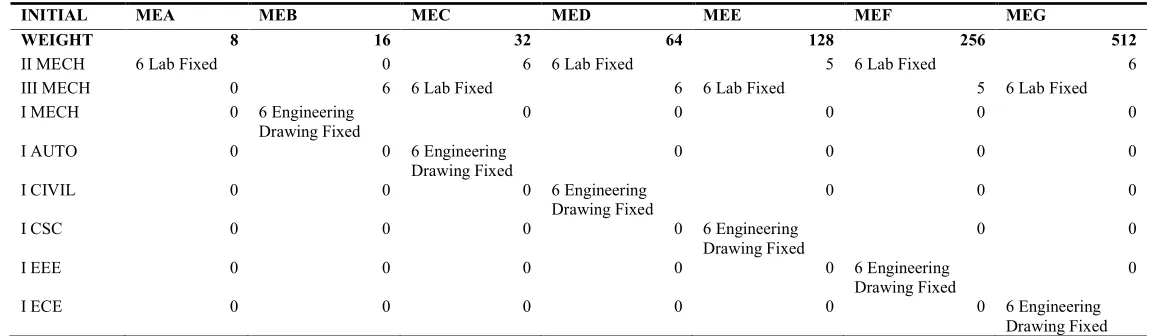
Table 2 : Mechanical Engineering Department Work Allotment (Code 4)
INITIAL MEA MEB MEC MED MEE MEF MEG
WEIGHT 8 16 32 64 128 256 512
II MECH 6 Lab Fixed 0 6 6 Lab Fixed 5 6 Lab Fixed 6
III MECH 0 6 6 Lab Fixed 6 6 Lab Fixed 5 6 Lab Fixed
I MECH 0 6 Engineering
Drawing Fixed
0 0 0 0 0
I AUTO 0 0 6 Engineering
Drawing Fixed
0 0 0 0
I CIVIL 0 0 0 6 Engineering
Drawing Fixed
0 0 0
I CSC 0 0 0 0 6 Engineering
Drawing Fixed
0 0
I EEE 0 0 0 0 0 6 Engineering
Drawing Fixed
0
I ECE 0 0 0 0 0 0 6 Engineering
Drawing Fixed
[image:3.792.109.685.294.462.2]Table 3: Automobile Engineering Department Work Allotment (Code 8)
INITIAL EA EB EC ED EE EF EG
WEIGHT 16 32 64 128 256 512 1024
II AUTO 6 Lab Fixed 0 6 6 Lab Fixed 5 6 Lab Fixed 6
III AUTO 0 6 6 Lab Fixed 6 6 Lab Fixed 5 6 Lab Fixed
I MECH 0 4 Work Shop Fixed 0 0 0 0 0
I AUTO 0 0 4 Work Shop Fixed 0 0 0 0
I CIVIL 0 0 0 4 Work Shop Fixed 0 0 0
I CSC 0 0 0 0 4 Work Shop Fixed 0 0
I EEE 0 0 0 0 0 4 Work Shop Fixed 0
I ECE 0 0 0 0 0 0 4 Work Shop Fixed
Table 4 : Civil Engineering Department Work Allotment (Code 16)
INITIAL CA CB CC CD CE CF
WEIGHT 32 64 128 256 512 1024
II CIVIL 5 6 + 3 Lab Fixed 6 Lab Fixed 6 6 Lab Fixed 3 Lab Fixed
[image:4.792.128.685.317.367.2]III CIVIL 6 Lab Fixed 6 + 3 Lab Fixed 6 Lab Fixed 5 6 + 3 Lab Fixed
Table 5 : Computer Science Engineering Department Work Allotment (Code 32)
INITIAL CSCA CSCB CSCC CSCD CSCE CSCF
WEIGHT 64 128 256 512 1024 2048
II CSC 5 6 + (3 Lab Fixed) 6 Lab Fixed 6 6 Lab Fixed 3 Lab Fixed
III CSC 6 Lab Fixed 6 + (3 Lab Fixed) 0 5 6 + (3 Lab Fixed)
III EEE 6 Lab Fixed
Table 6 : Electrical and Electronics Engineering Department Work Allotment (Code 64)
INITIAL EEEA EEEB EEEC EEED EEEE EEEF
WEIGHT 128 256 512 1024 2048 4096
II EEE 5 6 + (3 Lab Fixed) 0 6 6 Lab Fixed 3 Lab Fixed
III EEE 6 Lab Fixed 6 + (3 Lab Fixed) 0 5 6 + (3 Lab Fixed)
III CSC 6 Lab Fixed
[image:4.792.171.636.489.541.2]II ECE 6 Lab Fixed
Table 7 : Electronics and Communication Engineering Department Work Allotment (Code 128)
INITIAL ECEA ECEB ECEC ECED ECEE ECEF
WEIGHT 256 512 1024 2048 4096 8192
II ECE 5 6 + (3 Lab Fixed) 0 6 6 Lab Fixed 3 Lab Fixed
III ECE 6 Lab Fixed 6 + (3 Lab Fixed) 6 Lab Fixed 5 6 + (3 Lab Fixed)
II EEE 6 Lab Fixed
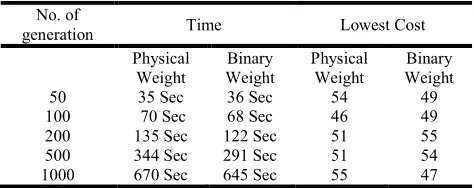
Table 8 : Comparison of Time and Cost
No. of
generation Time Lowest Cost
Physical Weight
Binary Weight
Physical Weight
Binary Weight
50 35 Sec 36 Sec 54 49
100 70 Sec 68 Sec 46 49
200 135 Sec 122 Sec 51 55
500 344 Sec 291 Sec 51 54
1000 670 Sec 645 Sec 55 47
If interchange causes placing of same teacher more than once in any one of the i and jth time interval then increment j by 1 and if j < m go to step c else the solution is infeasible and go to step 8.
c) Increment i by 1 and if i ≤ m go to step 9(a) .
10. Repeat steps 7 to 9 till all the populations are considered. 11. If a teacher is assigned two classes consecutively then penalty cost value of 1 is added. Using this approach total penalty cost value is calculated for each population. 12. Choose the best based on the penalty value among the
generated populations of O1,O2,O3…On and replace the high penalty value population with the low penalty value population.
13. Store the population and the penalty value of the best population as the pth element in an array called leastcost.
14. Increment the number of generations by 1 and increment p by 1.
15. Repeat steps from 7 to 11 until the required number of generations are generated.
16. Choose the best population among the stored populations in leastcost array.
Binary Weight Method
While doing steps 9a and 9b in physical weight method there will be more number of physical comparisons has to be carried out .
1. to find whether a particular element is present in the given set of elements
2. and to find the existence of duplicate element in the given set of elements.
In Binary weight method the following two different approaches are handled while doing steps 9a and 9b. Suppose if there are set of elements S1, S2, S3 ….. Sn and to search for any particular element say Sx in the above set a maximum of n comparisons are to be made. If all the elements are binary weighted, bitwise arithmetic OR operation can be performed on elements of the set and a value Q1 can be obtained. To this Q1, bitwise arithmetic OR operation can be done with Sx and store it as Q2. If both Q1 and Q2 are equal then search element is present otherwise search element is not present. To find if any of the element is duplicated in a set of elements S1, S2, S3 ….. Sn, if all the elements are binary weighted then
a) Find the sum of the decimal values of the (S1 + S2 + S3 + …….. Sn) and store in Q3
b) Perform arithmetic bitwise OR operator on (S1, S2, S3 ….. Sn)and store the decimal value of the result in Q4
If Q3 and Q4 are not equal then some of the elements are duplicated otherwise no element is duplicated.
EXPERIMENTAL RESULTS
Tests were done on the real life data of a Polytechnic College. Our main intention is assignment of classes for the entire college. Since we are giving binary weight to teachers there is a limitation in generation of binary weight based on the system configuration. Initially one department is processed as given in the example, then while processing next department already allotted meetings of previous department teachers considered as fixed and one similar weight is given to all processed teachers belong to the same department so that the already assigned weights can be reused for next group. In this manner all departments are processed sequentially one by one. The work allotment and the weight allotment of each department and the respective student group is tabulated below. If there are any Lab hours those are treated as Fixed and allotment carried out accordingly. HCL machine having P IV Intel processor with 1GB main memory and Microsoft visual studio version 2005 Vb.net is used to run all tests. It is found that if number of duplicates are less then binary weight method is faster than physical weight method. Constraint violations need to be reduced further.
Conclusions
In this we have proposed two different methods one using binary weight and another one using ordinary weight. A new kind of sequential evaluation process including selective two point multiple years crossover and mutation is introduced. Both the methods proved to useful in course timetabling
problem of entire institution or group of departments. Currently working on another mutation process which is reducing the penalty cost and handling multiple objective functions and also working on Engineering College Timetabling and also working on exam timetabling using this similar approach. Also working on processing all groups in parallel and running all at the same time without grouping.
REFERENCES
1. Geraldo Ribeiro Filho and Luiz Antonio Nogueira Lorena A Constructive Evolutionary Approach to School Timetabling, in Application of Evolutionary Computing, Lecture Notes in Computer Science, vol. 2037, Springer – Verlag, 2001, page 130 – 139. 2. M. Akif Bakir and Cihan Aksop, A 0 – 1 Integer
Programming Approach to a University Timetabling Problem, Hacettepe Journal of Mathematics and Statistics Volume 37 (1) (2008), 41 – 55.
3. Maciej Norberciak, Universal Method for Timetable Construction based on Evolutionary Approach, International Journal of Applied Mathematics and Computer Sciences Volume 3 Number 3, 2006. 4. Burke E.K., Elliman D.G. and Weare R.F. (1994) “A
Genetic Algorithm Based University Timetabling System”, AISB Workshop on Evolutionary Computing. 5. Supachate Innet, Nawat Nuntasen, University
Timetabling Using Evolutionary Computation, Wseas Transactions on Advances in Engineering Education Manuscript received Oct 18, 2007, revised Dec. 28, 2007.
6. Malek Rahoual, Rachid Saad, Solving Timetabling Problems by Hybridizing Genetic Algorithms and Tabu Search,PATAT 2006, pp. 467–472. ISBN 80-210- 3726-1).
7. Cagdas Hakan Aladag and Gulsum Hocaoglu, A Tabu search Algorithm to solve a course Timetabling Problem, Hacettepe Journal of
Mathematics
and Statistics Volume 36 (1) (2007), 53 – 648. Haroldo G. Santos , Luiz S. Ochi , Marcone J.F. Souza, A Tabu search heuristic with efficient diversification strategies for the class/teacher timetabling problem, Journal of Experimental Algorithmics (JEA), 10, 2005. 9. Pawel Myszkowski, Maciej Norberciak, Evolutionary
algorithms for timetable problems, Annales UMCS
Information AI 1 (2003) 115 – 125,
http://www.annales.umcs.lublin.pl/.
10. Christelle Guéret, Christian Prins, Marc Sevaux: Applications of optimization with Xpress-MP c 2000 Editions Eyrolles, Paris, France.Translated and revised by Susanne Heipcke.]
11. S. Gyori, Z. Petres, A. R. Varkonyi – Koczy, Genetic Algorithms in Timetabling. A New Approach, 2001, http://www.mft.hu/hallg/200107.pdf.
12. Duong Tuan Anh, Vo Hoang Tam, and Nguyen Quoc Viet Hung, Combines Interactive and Automatic Course Timetabling, Citeseer - 2008.
13. A Framework for School Timetabling Problem Kimmo Nurmi, Jari Kyngäs, MISTA 2007.
14. Aldy Gunawan, K.M. Ng, H.L.Ong, A Genetic Algorithm for the Teacher Assignment Problem for a University in Indonesia, Information and Management Sciences, Volume 19, Number 1, pp. 1 – 16, 2008.
15. Rhydian Lewis and Ben Paechter, An Emprical Analysis of the Grouping Genetic Algorithm: the Timetabling Case, The 2005 IEEE Congress.
16. A Parallel Genetic Algorithm for solving the School timetabling problem by D. Abramson J. Abela, High Performance Computation Project Appeared in 15 Australian Computer Science Conference, Hobart, Feb 1992, pp 1-11.
17. A genetic algorithm solving a weekly course-timetabling problem Wilhelm Erben and Jürgen Keppler,1995.
18. An Application of Genetic Algorithms to Course Scheduling at the United States Army War College by M A J James J. Donlon, pringer Berlin/Heidelberg,2001
224 International Journal of Current Research, Vol. 3, Issue, 9, pp.218-224, August, 2011