Workability and Strength Properties of SCC made with Processed RCA
Praveen Kumar. T
1, Sharmila Devi. K
2, Umanambi.J
31
P.G Student, Department of Civil Engineering, Paavai Engineering College,
2
Assistant Professor, Department of Civil Engineering, Paavai Engineering College, Tamil Nadu, India.
3Head of Department, Department of Civil Engineering, Paavai Engineering College, Tamil Nadu, India.
---***---Abstract –Concrete is the most commonly used material incivil engineering and the main component of most infrastructures. For the foreseeable future, there seems to be no alternative to concrete and building materials. Although the strength of the concrete is the most important factor, it is also necessary that the concrete be strong, good life and durable. In this paper, the mechanical properties of self-compacting fly ash concrete with recycled aggregates (RCA) were investigated. The RCA comes from local construction and demolition waste. The natural substitution of coarse aggregates by recycled coarse aggregates varies in self-compacting concrete between 0 to 50% at 10% interval. This study uses a commonly available class F fly ash as viscosity modifying agents. In this study the influence of the treated RCA on the SCC of grades M30 and M40 was measured.
Key Words: Self Compacting Concrete, Recycled Concrete
Aggregate, Strength Properties
1. INTRODUCTION
According to the World Commission on Environment and Development, sustainability means "meeting the needs of the present without compromising the ability of future generations to meet their own needs." Sustainability is an idea that aims to preserve the health of our planet and to continue to grow and human development.
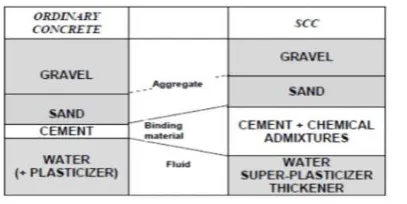
[image:1.595.312.558.309.430.2]SCC settles due to its own weight and is almost completely deaerated when filling the formwork. In SCC, No additional internal or external vibration is required for compaction. Even with components with heavily congested reinforcements, all voids and spaces are completely filled. SCC flows like a "honey" and has a near horizontal concrete height after laying (less screed). In terms of composition, SCC consists of the same constituents as conventional normal vibrated concrete, namely cement, aggregates, water and admixtures. A comparison of a typical SCC and conventional concrete mix composition is shown in Figure 1.
Fig -1: Comparison of Conventional and SCC
[image:1.595.64.268.661.763.2]Fresh and hardened properties of SCC directly depends on the mix design, should not be different from normal concrete, the only exception is its consistency. However, the high level of super-plasticizers to lower the liquid limit and improve the workability, the high powder content as a "lubricant" for coarse aggregates and the use of viscosity agents to increase the viscosity of the concrete were taken into account.
Fig -2: Basic Principles of SCC
1.1 Advantages of SCC
It has been proved economically beneficial because of a number of factors as noted below (ENFARC, 2002):
Faster construction & Easier placing,
Reduction in site manpower
Uniform and complete consolidation,
Better surface finishes,
Improved durability,
Increased bond strength,
Greater freedom in design,
Reduced noise levels, due to absence of vibration
Safe working environment.
1.2 Disadvantages of SCC
o There is no globally accepted test standard to undergo SCC mix design
o The cost of construction is costlier than the conventional concrete construction
o The use of designed mix will require more trial batches and lab tests
1.3 Characteristics of SCC
According to the British Standard, SCC is defined as that concrete that has the capability of flowing and compacting under its self-weight and filling the forms with reinforcement, ducts, boxouts etc., by not compromising the homogeneity. Khayat (2000) has defined SCC in terms of flow ability, passing ability and segregation resistance.
i) Flowability: Capacity to flow under its self-weight and thereby filling the form work uniformly without the application of external vibration.
ii) Passing ability: Ability to enter and pass through closely spaced reinforcement.
iii)Segregation resistance: Maintaining homogeneity without segregation of constituent materials.
1.4 RECYCLED CONCRETE AGGREGATE (RCA)
RCA is a relatively new building material that is obtained by breaking old concrete and replacing it with new aggregate. On the other hand, this concrete, as it ages and needs to be demolished, will regenerate other concrete waste that could possibly be reused in the same way. Therefore, recycled coarse aggregate concrete is a completely new eco friendly product that requires extensive experimental research to make a step towards a more sustainable world.
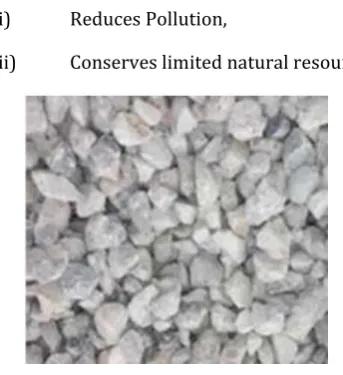
RCA in concrete are made by sequentially crushing used concrete products. Use in the construction industry will help reduce two major environmental issues.
i) Reduces Pollution,
[image:2.595.73.245.455.643.2]ii) Conserves limited natural resources.
Fig -3: Recycled Aggregate
2. REVIEW OF LITERATURES
Detailed investigations are done on the previous literatures and various parameters on utilizing SCC and RCA are described in this section.
Dhir (1999) investigates the ability of recycled aggregates (ACR) to be used in BS 5328 mixtures. Results on aggregate properties have shown that smooth concrete and reinforced concrete residues can be milled with existing equipment. To
provide RCA with physical properties that meet the current requirements of BS882. The density of the fine and coarse ACR was lower than that of the natural aggregate (NA) and water absorption was three to six times higher.
Boozoubaa.N et al. (2001) reported that high volume of class F fly ash based self compacting concrete properties like slump flow, segregation index, and bleed water test satisfied the SCC properties. Compressive strength was tested after 7 and 28 days that increased the strength compared to normal concrete. Hardened concrete properties were satisfied up to 50% replacement fly ash by cement.
Ding & Li (2002) investigated and compared effects of MK (5, 10 and 15%) and SF (5, 10 and 15%) with a W/B ratio of 0.35 on various properties of concrete. They found that MK-modified concrete showed a better workability and strength than silica fume-modified concrete. Further they observed that both mineral admixtures reduced free drying shrinkage, chloride diffusivity and restrained the shrinkage cracking width.
Malhotra et al., (2002) predicted that the global impact of OPC production on greenhouse gas emissions would be around 1.35 billion tonnes per year. Greenhouse lies in the environment of the Earth. Cement is the most energy exhaustive building material after aluminium and steel.
Davidovits (2015) have reported the wrong values on CO2 emission for GPC available in Scientific Papers. This was for reiterating his earlier investigation on CO2 saving in GPC. He has highlighted the improper method of calculating CO2 emission in geopolymer cement by his contemporaries and reiterated the high savings of CO2 when compared to OPC.
Meyer (2009) summarized the recent developments in the utilization of recycled materials in concrete industry. He concluded that, the important tool to meet the environmental challenges is the utilization of supplementary cementitious material such as GGBFS, FA etc. and RA in concrete industry
Hassan et al. (2012) investigated the effect of SF and MK as a cement replacement by on the durability of self-consolidating concrete. They evaluated the durability of SCC based on the results of drying shrinkage, freezing and thawing, salt scaling and RCPT. They found that the addition of MK to SCC mixes improved the resistance to freezing and thawing, scaling resistance and decreases the drying shrinkage and chloride permeability of SCC than the SF. Their results indicated that highly durable concrete SCC mixes can be produced using MK with an optimum percentage of around 20%.
granite stone aggregate concrete was 5.39% lesser than the natural aggregate concrete.
Thomas et al. (2013) undertook tests on the durability of concrete made with recycled aggregates. They have found that the durability of the concrete made with recycled aggregate is less due to the porosity of the recycled aggregate. They also found that the durability increases with low water / cement ratio. The strength of the concrete with recycled aggregate decreases with higher water / cement ratios was considerably higher than conventional mix.
Shah. U et al. (2014) concluded that slump flow values increases when the percentage of fly ash replacement increases. They also reported that L - box ratio increases as the fly ash increases in the mix as a replacement of the cement. Addition of fly ash in self compacting concrete increases the workability of concrete.
Aijaz Ahmad Zende et al. (2014) reported that the importance and benefits of self compacting concrete in construction industry. Role of VMA were studied and applications of super plasticizers in self compacting concrete were also reported. Fresh and hardened concrete properties were clearly discussed. No standard codes are available for mix design of self compacting concrete apart from EFNARC guidelines.
Prashant. O et al (2014) reported that a significant potential for growth of recycled aggregate as an appropriate and green solution for sustainable development in construction industry, the strength investigation showed that in all the mixes, compressive and tensile strength has inverse relationship with percentage of recycled coarse aggregate. This is a consequence of adhered mortar attached to recycle aggregate contributing for weaker interfacial transition zone. All the mixes having recycled aggregates have higher permeability values, which is a consequence of high initial water absorption of RCA. Concrete mixes up to 40% RCA showed good resistance to acid attack and chloride penetration.
Zekong Chen (2015) studied the process and application of self-compacting concrete and focused on the quality control of self-compacting concrete. Self-compacting concrete differed from the composition of normal concrete and its material requirements. The resistance of the concrete to the environment was therefore important, such as the resistance to carbonation, the shrinking performance, which leads to a durable concrete.
3. MATERIAL PROPERTIES
The following are the materials were utilized in this study.
• Cement
• Fine aggregate
• Coarse aggregate
• Recycled Concrete Aggregate
• Water
• Viscosity Modifying Agents (Fly Ash)
• Super Plasticizers
3.1 Cement (C)
Ordinary Portland cement of 53 Grade was used in this experimentation conforming to IS 12269: 2013.
Table -1: Physical Properties of Cement
Parameter Results As 12269 per IS Specific Gravity 3.11 3.1 - 3.15
Fineness (m2/kg) 325 ≥ 225
Setting time
(Minutes) Initial 48 Final 480 ≥ 30 < 600
Consistency (%) 31.5 30 - 35
3.2 Viscosity Modifying Agents (Fly Ash)
Fly Ash has the specific quality that its spherical shape of particles improves fluidity and reduces the water requirements in SCC. So siliceous fly ash was utilized as a Viscosity Modifying Agent (VMA) throughout the investigation. Class F Fly ash obtained from Mettur Thermal Power Plant confirming to IS 3812(Part 1):2013 was used and the tests are conducted with the available facilities in the laboratory under room temperature.
Table -2: Physical Properties of Fly Ash
Parameter Results As per IS 3812
Color Dark grey -
Specific Gravity 2.12 - Fineness (m2/kg) 455 ≥ 320 Bulk density (kg/m3) 1137 - Fineness modulus 17.7 -
TABLE -3: Chemical Properties of OPC 53 and Fly Ash
Component OPC 53 Fly ash
SiO2 24.51 54.01
Al2O3 6.86 26.8
Fe2O3 3.49 7.36
CaO 63.11 3.23
SO3 1.41 0.22
MgO 2.15 1.73
Na2O 0.44 0.42
3.3 Fine aggregate (FA)
Natural river sand is used as fine aggregate which consumes maximum volume of content in concrete. Locally available clean and dry sand was used in this study. The results obtained from the sieve analysis results indicate that the fine aggregate conforms to Zone II of IS 383:2016.
Table -4: Properties of Fine Aggregate
Parameter Results As per IS 3812
Grade II I - IV
Specific Gravity 2.58 ≥ 2.60 Fineness modulus 2.66 2.30 – 3.10 Bulk density (kg/m3) 1795 -
Water absorption 1.5 -
3.4 Coarse aggregates (CA)
Locally available, crushed granite stones were used as coarse aggregate which are passing through 20mm sieve and retained on 12.5mm and confirms to the specifications mentioned in IS 383:2016.
Table -5: Properties of Coarse Aggregate
Parameter Results As per IS 3812 Specific Gravity 2.85 ≥ 2.60
Fineness modulus 7.15 6.50 – 8.00 Bulk density (kg/m3) 1685 -
Water absorption 1.2 ≤ 3.00
3.5 Processed Recycled Concrete Aggregate (RCA)
[image:4.595.303.565.114.207.2]Concrete aggregate was acquired from the demolished construction waste and concrete cubes which are more angular and higher absorption capacity. Recycled aggregates were processed before added to the concrete mix which will help in reducing the percentage of porosity in aggregate.
Table -6: Properties of RCA
Parameter Results As per IS 3812 Specific Gravity 2.74 ≥ 2.60
Fineness modulus 6.9 6.50 – 8.00 Bulk density (kg/m3) 1280 -
Water absorption 3.25 ≤ 3.00
4. MIX DESIGN
Mix design for Self compacting concrete has been adopted as per the guidelines given in IS 10262:2009 and EFNARC Specifications.
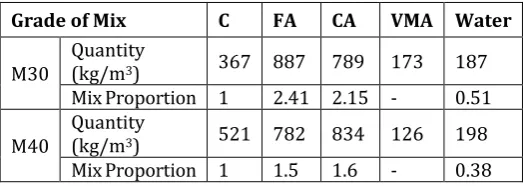
Mix design for M30 and M40 grade concrete with partial of replacement of natural coarse aggregate by processed recycled concrete aggregate in the proportion intervals of 10% from 0% to 50%. Detailed mix proportioning details are tabulated in the table as described below.
Table -7: Mix Proportioning
Grade of Mix C FA CA VMA Water
M30 Quantity (kg/m3) 367 887 789 173 187 Mix Proportion 1 2.41 2.15 - 0.51
M40 Quantity (kg/m3) 521 782 834 126 198 Mix Proportion 1 1.5 1.6 - 0.38
5. EXPERIMENTAL INVESTIGATION
As per the EFNARC guidelines, a self compacting concrete was tested to measure its workability. There are various parameters were investigated in order to check the workability of SCC (see Table 4.8). Workability parameters such as flowability, passing ability and segregation resistance are determined from various investigations on SCC at fresh state.
At hardened state, the mechanical strength properties are determined such as compressive, split tensile and flexural strength tests.
Table -8: Acceptance Criteria for SCC
Method Unit Typical range Min. Max Slump flow test (Filling ability) mm 650 800 T50cm slump flow (Filling ability) sec 2 5 V-funnel test (Filling ability) sec 6 12 J-ring (Passing ability) mm 0 10 L-Box (Passing ability) - 0.8 1.0 V-T50 (Segregation Resistance) sec 8 15
5.1 Workability Properties
The self-compacting concrete grades M30 and M40 were manufactured by partially replacing natural aggregates with recycled aggregates. The concrete has been freshly examined and hardened. SCC is characterized by resistance to flow, passage and separation. The concrete mix has recently been tested in accordance with EFNARC recommendations.
Table -9: Fresh Properties of SCC
Concrete
Grade Test Method RCA Replacement % 0 10 20 30 40 50
M30
Slump flow
(mm) 797 782 786 779 763 746
T50cm Slump
(Sec) 2.6 2.7 2.9 2.9 3 3.1
V-Funnel
(Sec) 7.6 7.9 8 8.1 8.4 8.7
L-Box
(H1/H2) 0.9 0.91 0.93 0.94 0.94 0.95
J-Ring
M40
Slump flow
(mm) 732 714 695 673 659 647
T50cm Slump
(Sec) 2.3 2.4 2.5 2.5 2.6 2.7
V-Funnel
(Sec) 6.6 6.8 6.9 7 7.3 7.5
L-Box
(H1/H2) 0.86 0.87 0.89 0.91 0.92 0.93
J-Ring
(H1-H2) 3.8 4.3 5.7 6.2 6.7 7.6
5.2 Hardened Properties
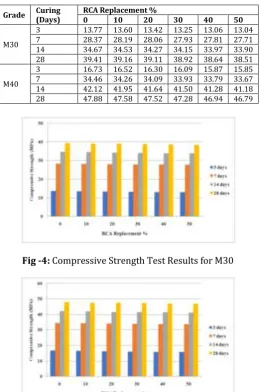
In order to determine the bending or mechanical behavior of SCC manufactured with RCA, tests on hardened concrete such as compressive strength, tensile strength and flexural strength were performed at 3 days, 7 days, 14 days and 28 days apart.
Table -10: Compressive Strength Test Results
Grade Curing (Days) RCA Replacement %0 10 20 30 40 50
M30
3 13.77 13.60 13.42 13.25 13.06 13.04
7 28.37 28.19 28.06 27.93 27.81 27.71
14 34.67 34.53 34.27 34.15 33.97 33.90
28 39.41 39.16 39.11 38.92 38.64 38.51
M40
3 16.73 16.52 16.30 16.09 15.87 15.85
7 34.46 34.26 34.09 33.93 33.79 33.67
14 42.12 41.95 41.64 41.50 41.28 41.18
[image:5.595.306.562.270.397.2]28 47.88 47.58 47.52 47.28 46.94 46.79
Fig -4: Compressive Strength Test Results for M30
Fig -5: Compressive Strength Test Results for M40
Table -11: Split Tensile Strength Test Results
Grade Curing (Days) RCA Replacement %
0 10 20 30 40 50
M30
3 2.08 2.07 2.05 2.04 2.02 2.02 7 2.98 2.97 2.97 2.96 2.95 2.95 14 3.30 3.29 3.28 3.27 3.26 3.26 28 3.52 3.50 3.50 3.49 3.48 3.48
M40
3 2.29 2.28 2.26 2.25 2.23 2.23 7 3.29 3.28 3.27 3.26 3.26 3.25 14 3.63 3.63 3.61 3.61 3.60 3.59 28 3.87 3.86 3.86 3.85 3.84 3.83
Table -12: Flexural Strength Test Results
Grade Curing (Days) RCA Replacement %0 10 20 30 40 50
M30
3 2.60 2.58 2.56 2.55 2.53 2.53 7 3.73 3.72 3.71 3.70 3.69 3.68 14 4.12 4.11 4.10 4.09 4.08 4.08 28 4.39 4.38 4.38 4.37 4.35 4.34
M40
3 2.86 2.85 2.83 2.81 2.79 2.79 7 4.11 4.10 4.09 4.08 4.07 4.06 14 4.54 4.53 4.52 4.51 4.50 4.49 28 4.84 4.83 4.83 4.81 4.80 4.79
6. CONCLUSIONS
This paper presents a preliminary study on the impact of recycled coarse aggregates on the mechanical properties of self-compacting concrete with fly ash. The mechanical properties are measured after 3, 7, 14 and 28 days. On the basis of the results obtained, the following conclusions were drawn:
1. It can be seen that the current sustainable concrete contains a RCA that perfectly replaces the natural coarse aggregate.
2. The inclusion of coarsely recycled aggregates (RCAs) as a partial replacement for coarse natural aggregates in SCC has a negative impact on the compressive strength of all aging hardeners. The mechanical properties of self-compacting concrete from recycled aggregates decrease with increasing RCA content.
3. Self-compacting concrete made with RCA has almost reached the target strength in all compounds and complies with the guidelines given in the EFNARC specifications.
4. An optimal replacement percentage of 40% of the RCA as a partial replacement of the natural coarse aggregate.
[image:5.595.33.294.342.735.2]REFERENCES
[1] Abid A Shah & Ribakov, Y 2011, “Recent trends in steel fevered high strength concrete”, Materials and Design, vol. 32, pp. 4122–4151.
[2] Aijaz, P, Zende, A &Khadirnaikar, RB 2014, 'An Overview of the Properties of Self Compacting Concrete', Journal of Mechanical and Civil Engineering (IOSR-JMCE), vol. 2014, pp. 35-43.
[3] Ali A Abbas, Sharifah M Syed Mohsin & Demetrios M Cotsovos, 2014, ‗Seismic response of steel fiber reinforced concrete beam – column joints‘, Engineering Structures, vol. 59, pp. 261-283.
[4] Aloia Schwartzentruber L.D, Le Roy R. and Cordin J, (2006) ‘Rheological behaviour of fresh cement pastes formulated from a Self Compacting Concrete (SCC)’, Cement and Concrete Composites , Vol. 36, pp. 1203-1213.
[5] E. Anastasiou, K. Georgiadis Filikas, M. Stefanidou., (2014). “Utilization of fine recycled aggregates in concrete with fly ash and steel slag”, Construction and Building Materials, 50: 154–161.
[6] Annie Peter J., Lakshmanan N., Devadas Manoharan P., Rajamane N.P., and Gopalakrishnan S. J. (2004). ”Flexural behaviour of RC beams using self-compacting concrete” The Indian concrete journal, June-2004, pp. 66-72.
[7] Antonio, F., Barbosa, and Gabriel, O., Ribeiro, “Analysis of reinforced concrete structures using ANSYS nonlinear concrete model”, Computational mechanics, New trends and applications, Vol. 09, 1998, pp. 454-460.
[8] R. Anuradha, v. sreevidya, r. venktasubramani and B. V Rangan (2012) “Modified guidelines for geopolymer concrete mix design using Indian Standards” Asian Journal of Civil Engineering, Vol 13 No 3, page 353-364.
[9] T.V. Arul Prakash, Dr. M. Natarajan, Dr. T. Senthil Vadivel, K. Vivek “Performance of Recycled Concrete Aggregate in Self Compacting Concrete (RCASCC)”, International Journal of Engineering and Technology, ISSN: 2227-5248, Vol 7 (3.35) (2018) 1-4.
[10] Aydin, AC 2007, 'Self compactability of high volume hybrid fiber reinforced concrete', Construction and Building Materials, vol. 21, no. 6, pp. 1149-1154.
[11] Bakharev, T, Sanjayan, JG & Cheng, YB 1999, ‘Effect of elevated temperature curing on properties of alkali-activated slag concrete’, Science Direct, vol.29, issue.10, pp.1619-1625
[12] Bhattacharyya S K, Minocha Mridul Garg A K, Jaswinder Singh, Neeraj Jain S Maiti & S K Singh, GAP0072 (DST Project), Demolition Wastes as Raw Materials for sustainable Construction Products, CSIR – CBRI, Vol., 33, No-2, pp.1-2, 2013.
[13] Crow, J. M. 2008. “The concrete conundrum”. Chemistry World, 5, 62-66.
[14] Dhir, R.K., Limbachya, M.C., and Leelawat, T., (1999), “Suitability ofrecycled Concrete Aggregates in concrete”, Magazine of Concrete Research,Vol. 52, No. 4, pp. 235 – 242.
[15] Dimitri Feys, Ronny Verhoeven and Geert De Schutter (2008). “Fresh self-compacting concrete, a shear thickening material”, Journal of cement and concrete research, Elsevier Ltd., 38(2008), pp.922 - 929.
[16] Ding, J-T & Li, Z 2002, 'Effects of metakaolin and silica fume on properties of concrete', ACI Materials Journal, vol. 99, no. 4, pp. 393-398.
[17] EFNARC 2002. Specification and guidelines for self-compacting concrete. European Federation of Producers and Applicators of Specialist Products for Structures.
[18] Fisher, C.; Werge, M. EU as a Recycling Society; ETC/SCP Working Paper 2/2009; Available online: http://scp.eionet.europa.eu.int (accessed on 14 August 2009).
[19] Gritsada Sua-iam, Natt Makul., (2013). Use of recycled alumina as fine aggregate replacement in Self-Compacting concrete, Construction and Building Materials, 47: 701–710.
[20] Hui Zhaoa, Wei Sun , Xiaoming Wub and Bo Gao., (2015). The properties of the Self-Compacting concrete with fly ash and ground granulated blast furnace slag mineral admixtures, Journal of Cleaner Production, 1:25-34.
[21] Karthik V, G.Baskar., “Investigation on strength properties of self compacting concrete with copper slag as fine aggregate”, International Journal of Civil Engineering Research and Development (IJCERD), ISSN 2248- 9428, Volume 5, Number 1, January - April (2015) Volume 10, pg: 18-25
[22] V.Karthik, G. Baskar., “Study on durability properties of self-compacting concrete with copper slag partially replaced for fine aggregate”, International Journal of Civil Engineering and Technology (IJCIET), ISSN 0976-6308 and 0976-6316 Volume 6, Issue 9, Sep 2015, pp. 20-30.
[24] Malhotra V,M., Introduction: Sustainable development and concrete technology, ACI Concrete International, 24(7), 2002
[25] C. Marthong and T. P. Agrawal (2012), “Effect of Fly Ash Additive on Concrete Properties”, International Journal of Engineering Research and Applications (IJERA)”, ISSN: 2248-9622, Volume 2, Issue 4, pp. 1986-1991.
[26] Mucteba Uysal, Mansur Sumer., (2011). Performance of self - compacting concrete containing different mineral admixtures, Construction and Building Materials, 25 (11): 4112–4120.
[27] Nagataki, S, Gokce, A, Saeki, T & Hisada, M 2004, 'Assessment of recycling process induced damage sensitivity of recycled concrete aggregates', vol. 34, pp. 965-971
[28] Neeta.A, Subha.B, Karthik.V., “A Mix Design of Self Compacting Concrete with Copper slag as Fine aggregate and Silica fume as Mineral Admixture”, International Journal of Scientific & Engineering Research, Volume 7, Issue 4, April-2016 ISSN 2229-5518.
[29] Okamura H Ozawa 1994, “Self compactable concrete in Japan”, SP-169, American Concrete Institute, Detroit, pp. 31-44.
[30] Paratibha Aggarwal., (2008). Self Compacting Concrete – Procedure for Mix Design., Leonardo Electronic Journal of Practices and Technologies, 12:15-24.
[31] B.H.V. Pai., (2014). Experimental Study on Self Compacting Concrete Containing Industrial By products, European Scientific Journal, 10(12):292-300.
[32] Pereira, P & Deoliya, R 2014 “S. Recycled aggregate from C&D waste & its use in concrete – A Breakthrough towards sustainability in the construction sector: A review”, Construction and Building Materials, vol. 68, pp. 501-516.
[33] Prakash, K.B., and Manjunath, M. (2006), “Effect of replacement of natural aggregates by recycled aggregates on properties of concrete”, Materials and structures, Vol. 82, No. 7, pp 320 – 330.
[34] Prakash Nanthagopalan & Manu Santhanam, 2011, ‘Fresh and hardened properties of Self-Compacting Concrete produced with manufactured sand’, Science Direct, vol.33, issue.3, pp.353-358.
[35] Ravindrarajah, M., (1987), “Suitability of recycled concrete aggregates for use in concrete”, Journal of the Institution of Engineers (India), Vol. 14, pp. 34 –40.
[36] Salem, R.M., Burdette, E.G., and Jackson, N.M. (2003). “Resistance to Freezing and Thawing of Recycled
Aggregate Concrete,” ACI Materials Journal, V. 100, No. 3, May-June 2003, pp. 216-221.
[37] S. Sathyan, R. Sundararajan, K. Vivek, “Structural Strengthening of Composite Beams Made with SCC and Cold Formed Steel Members”, International Journal of Recent Technology and Engineering (IJRTE), ISSN: 2277-3878, Volume-7, Issue-6S5, April 2019.
[38] Subramanian.S & Chattopadhayay. D “Experiments for Mix Proportioning of Self-Compacting Concrete”, The Indian Concrete Journal, Jan. 2002, pp13-20.
[39] Thomas, C, Setien, J, Polanco, JA, Alaejos, P & Sanchez de Juan, M 2013, ‘Durability of recycled aggregate concrete’, Science Direct, vol.40, pp.1054-1065.
[40] Uysal, M, Yilmaz, K & Ipek, M 2012, 'The effect of mineral admixtures on mechanical properties, chloride ion permeability and impermeability of self-compacting concrete', Construction and Building Materials, vol. 27, no. 1, pp. 263-270.
[41] Zoran., (2008). Properties of Self Compacting Concrete Different Types of Additives, Architecture and Civil Engineering, 6(2):173-177.
BIOGRAPHIES