Nonparametric Bayesian Models for Spoken Language Understanding
Kei Wakabayashi Tsukuba University, 1-2 Kasuga, Tsukuba, Ibaraki 305-8550, Japan [email protected]
Johane Takeuchi, Kotaro Funakoshi andMikio Nakano
Honda Research Institute Japan Co., Ltd. 8-1 Honcho, Wako, Saitama 351-0188, Japan
{johane.takeuchi,funakoshi,nakano} @jp.honda-ri.com
Abstract
In this paper, we propose a new generative ap-proach for semantic slot filling task in spoken language understanding using a nonparamet-ric Bayesian formalism. Slot filling is typi-cally formulated as a sequential labeling prob-lem, which does not directly deal with the pos-terior distribution of possible slot values. We present a nonparametric Bayesian model in-volving the generation of arbitrary natural lan-guage phrases, which allows an explicit cal-culation of the distribution over an infinite set of slot values. We demonstrate that this ap-proach significantly improves slot estimation accuracy compared to the existing sequential labeling algorithm.
1 Introduction
Spoken language understanding (SLU) refers to the challenge of recognizing a speaker’s intent from a natural language utterance, which is typically de-fined as a slot filling task. For example, in the ut-terance “Remind me to call John at 9am tomorrow”, the specified information {“time”: “9am
tomor-row”} and{“subject”: “to call John”} should be
extracted. The termslotrefers to a variable such as thetimeorsubjectthat is expected to be filled with a value provided through the user’s utterance.
The slot filling task is typically formulated as a sequential labeling problem as shown in Figure 1. This labeling scheme naturally represents the recog-nition of arbitrary phrases that appear in the tran-scription of an utterance. Formally speaking, when we assume a given set of slots{s1, ..., sM}and de-note the corresponding slot values by{vs1, ..., vsM}
wherevsi ∈Vsi, the domain of each slot valueVsiis an infinite set of word sequences. In this paper, we use the termarbitrary slot filling taskto refer to this implicit problem statement, which inherently under-lies the sequential labeling formulation.
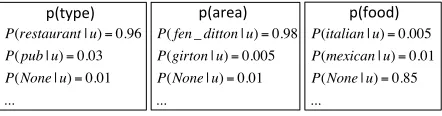
In contrast, a different line of work has explored the case whereVsiis provided as a finite set of possi-ble values that can be handled by a backend system (Henderson, 2015). We refer to this type of task as a categorical slot filling task. In this case, the slot filling task is regarded as a classification problem that explicitly considers a value-based prediction, as shown in Figure 2. From this point of view, we can say that a distribution of slot values is actually con-centrated in a small set of typical phrases, even in the arbitrary slot filling task, because users basically know what kind of function is offered by the system. To reflect this observation, in this paper we ex-plore the value-based formulation approach for arbi-trary slot filling tasks. Unlike the sequential labeling formulation, which is basically position-based label prediction, our method directly estimates the poste-rior distribution over an infinite set of possible val-ues for each slotVsi. The distribution is represented by using a Dirichlet process (Gershman and Blei, 2012), which is a nonparametric Bayesian formal-ism that generates a categorical distribution for any space. We demonstrate that this approach improves estimation accuracy in the arbitrary slot filling task compared with conventional sequential labeling ap-proach.
The rest of this paper is organized as follows. In Section 2, we review the existing approaches for categorical and arbitrary slot filling tasks and
!! !! !! !! "#$%&'! !! !! "#()'(!*#()'(! !!
[image:2.612.76.297.141.199.2]+,-!.//0+12!3/)!(! )'4$(5)(1$!+1!$6'! 3'1! 7+8/1!()'(!
Figure 1:sequential labeling formulation for slot filling tasks.
!"#!$%%&!'(!)%*!+!*,-.+/*+'.!!'!.0,!),'!1!2%'!+*,+!
P(restaurant|u)=0.96
P(pub|u)=0.03
P(None|u)=0.01 ...
P(fen_ditton|u)=0.98 P(girton|u)=0.005 P(None|u)=0.01 ...
P(italian|u)=0.005
P(mexican|u)=0.01
P(None|u)=0.85 ...
!"#"!
34.53,6! 34+*,+6! 34)%%16!
Figure 2:Value-based formulation. The posterior probabilities of values for each slot are explicitly computed.
duce related work. In Section 3, we present our nonparametric Bayesian formulation, the hierarchi-cal Dirichlet process slot model (HDPSM), which directly models an infinite set of slot values. On the basis of the HDPSM, we develop a generative utter-ance model that allows us to compute the posterior probability of slot values in Section 4. In Section 5, we introduce a two-stage slot filling algorithm that consists of a candidate generation step and a candi-date ranking step using the proposed model. In Sec-tion 6, we show the experimental results for multiple datasets in different domains to demonstrate that the proposed algorithm performs better than the base-line sequential labeling method. We conclude in Section 7 with a brief summary.
2 Related Work
The difference between the categorical and arbitrary slot filling approaches has not been explicitly dis-cussed in a comparative manner to date. In this sec-tion, we review existing work for both approaches.
For the categorical slot filling approach, various algorithms that directly model the distribution of slot values have been proposed, including generative models (Williams, 2010), maximum entropy linear classifiers (Metallinou et al., 2013), and neural net-works (Ren et al., 2014). However, none of these models are applicable for predicting a variable that ranges over an infinite set, and it is not straightfor-ward to extend them suitably. In particular, a dis-criminative approach is not applicable for arbitrary slot filling tasks because it requires a fixed finite set of slot values to take statistics.
The arbitrary slot filling approach is a natural application of shallow semantic parsing (Gildea, 2002), which is naturally formulated as a sequen-tial labeling problem. Various sequensequen-tial labeling algorithms have been applied to this task, including support vector machines, conditional random fields (CRF) (Lafferty et al., 2001; Hahn et al., 2011), and deep neural networks (Mesnil et al., 2015; Xu and Sarikaya, 2013). Vukotic et al. (2015) reported that the CRF is still the most accurate, rapid, and stable method among them. Because the focus of this pa-per is arbitrary slot filling tasks, we use CRFs as our baseline method.
In this paper, we apply nonparametric Bayesian models (Gershman and Blei, 2012) to represent the distribution over arbitrary phrases for each slot. The effectiveness of this phrase modeling approach has been examined in various applications including morphological analysis (Goldwater et al., 2011) and infinite vocabulary topic models (Zhai and Boyd-graber, 2013). Our method can be regarded as an application of this idea, although it is not straight-forward to integrate it with the utterance generation process, as we explain later.
Consequently, our proposed method is catego-rized as a generative approach. There are many ad-vantages inherent in generative approaches that have been examined, including unsupervised SLU (Chen et al., 2015), automatic feature extraction (Tur et al., 2013), and integration with syntactic modeling (Lorenzo et al., 2013). Another convenient prop-erty of generative models is that prior knowledge can be integrated in an intuitive way (Raymond et al., 2006). This often leads to better performance with less training data compared with discriminative models trained completely from scratch (Komatani et al., 2010).
3 Hierarchical Dirichlet Process Slot Model
In this section, we present a nonparametric Bayesian formulation that directly models the distribution over an infinite set of possible values for each slot.
Let S = {s1, ..., sMS} be a given set of slots and
letter sequencesV, which is represented as follows:
V ={b1, ..., bL|bι ∈C, L≥0}
where C is a set of characters including the blank character and any other character that potentially ap-pears in the transcription of an utterance. Conse-quently, we regard the set of slotsS as also being a random variable that ranges overVMS. The objec-tive of this section is to develop the formulation of the probabilistic distributionp(S).
3.1 Dirichlet Process
We apply the Dirichlet process (DP) to model both the distribution for an individual slotpi(si)and the joint distributionp(S). In this subsection, we review
the definition and key properties of DP with general notation for the target distribution G over the do-main X. In the DP for the prior of pi(si) that is described in Section 3.2, the domainX corresponds
to a set of slot values V, e.g., “fen ditton”, “new chesterton”, and None. In the DP forp(S)presented
in Section 3.3,Xindicates a set of tuples of slot
val-uesVMS, e.g., (“restaurant”, “new chesterton”, “fast food”) and (“restaurant”, “fen ditton”, None).
The DP is a probabilistic distribution over the dis-tribution G. DP is parameterized by α0 and G0, whereα0 > 0is a concentration parameter andG0
is a base distribution over X. IfG is drawn from DP(α0, G0)(i.e.,G ∼DP(α0, G0)), then the
fol-lowing Dirichlet distributed property holds for any partition ofX denoted by{A1, ..., AL}:
(G(A1), ..., G(AL))∼Dir(α(A1), ..., α(AL))
where α(A) = α0G0(A), which is known as the
base measure of DP.
Ferguson (1973) proved an important property of a posterior distribution of repeated i.i.d.
sam-ples x1:N = {x1, ..., xN} drawn from G ∼
DP(α0, G0). Consider a countably infinite set of
atoms φ = {φ1, φ2, ...} that are independently
drawn fromG0. Letc
i ∈Nbe theassignmentof an atom for samplexi, which is generated by a sequen-tial draw with the following conditional probability:
p(cN+1=k|c1:N) = ( nk
N+α0 k≤K α0
N+α0 k=K+ 1
wherenk is the number of times that thekth atom appears in c1:N and K is the number of different atoms inc1:N. Given the assignment c1:N, the pre-dictive distribution ofxN+1 ∈ X is represented in
the following form:
P(xN+1 =θ|c1:N,φ1:K, α0, G0)
=
K X
k=1
nk
N+α0δ(φk, θ) +
α0
N +α0G
0(θ)
The base distribution possibly generates an iden-tical value for different atoms, such as (φ1 =“fen
ditton”,φ2 =“new chesterton”,φ3 =“fen ditton”).
The assignment ci is an auxiliary variable to indi-cate which of these atoms is assigned to theith data pointxi; whenxi =“fen ditton”,ci can be 1 or 3. The posterior distribution above depends on the fre-quency of atomnk, not on the frequency ofθitself. The atoms φand the assignment c are latent vari-ables that should be determined at runtime.
3.2 Individual Slot Model
First we formulate the distribution for an individ-ual slot as pi(si) ∼ DP(α0i, G0i) where G0i is a base distribution over the set of phrasesV. 1 We define G0i as a generative model that consists of two-step generation: generation of the phrase length
0≤Li ≤Lmaxusing a categorical distribution and generation of a letter sequences1:i Lusing an n-gram model, as follows:
Li ∼Categorical(λi)
siι ∼p(sιi|siι−n+1:ι−1,ηi)
whereλi andηi are parameters for the categorical distribution and the n-gram model for slotsi, respec-tively. This explicit modeling of the length helps avoid the bias toward shorter phrases and leads to a better distribution, as reported by Zhai and Boyd-graber (2013). We defineG0
i as a joint distribution of these models:
G0i(s1:i Li) =p(Li|λi) Li Y
ι=1
p(sιi|siι−n+1:ι−1,ηi) (1)
G0i potentially generates an empty phrase ofLi= 0 to express the case that the slot value vsi is not 1Note that the subscriptifors,p,α0andG0indicates the
provided by an utterance. Therefore, the distribu-tionpi(si)can naturally represent the probability of None, which is shown in Figure 2.
We consider prior distributions of the parame-tersλi andηi to treat the n-gram characteristics of each slot in a fully Bayesian manner. p(λ)is given
as a Lmax-dimensional symmetric Dirichlet distri-bution with parameter a. We also define the |C| -dimensional symmetric Dirichlet distributions with parameterbfor each n-gram context, since given the contextp(sι
i|sιi−n+1:ι−1,ηi)is just a categorical dis-tribution that ranges over C. Consider we observe N phrases si for sloti. Let nLiι be the number of phrases that have length ι and nγih be the number of times that letter sι = h appears after context sι−n+1:ι−1 = γ. The predictive probability of a phrase is represented as follows:
G0i(s1:i Li|si) =
nLiι+b
N +bC
Li Y
ι=1
nγisι i +a P
cn γ ic+a
PLmax l=1 nLil
3.3 Generative Model for a Set of Slot Values
A naive definition of the joint distribution p(S) is
a product of all slot probabilities QMS
i=1pi(si) for
making an independence assumption. However, the slot values are generally correlated with each other (Chen et al., 2015). To obtain more accurate dis-tribution, we formulatep(S)using another DP that
recognizes a frequent combination of slot values, as p(S) ∼ DP(α1, G2) whereG2 is a base
distribu-tion over VMS. We apply the naive independence assumption toG2 as follows:
G2(S) =
MS Y
i=1
pi(si)
The whole generation process of S involves two-layered DPs that share atoms among them. In this sense, this generative model is regarded as a hierar-chical Dirichlet process (Teh et al., 2005).
LetG1i(si) =pi(si)andG3(S) =p(S)for con-sistent notations. In summary, we define the hierar-chical Dirichlet process slot model (HDPSM) as a generative model that has the following generation process.
G1i ∼DP(α0i, G0i)
G3 ∼DP(α1, G2)
S ∼G3
3.4 Inference of HDPSM
In a slot filling task, observations of S1:T =
{S1, ..., ST} are available as training data. The in-ference of HDPSM refers to the estimation ofλ, η and the atom assignments for each DP.
We formulate the HDPSM in a form of the Chi-nese restaurant franchise process, which is one of the explicit representations of hierarchical DPs obtained by marginalizing out the base distributions. Teh et al. (2005) presents a Gibbs sampler for this repre-sentation, which involves a repetitive resampling of atoms and assignment. In our method, we prefer to adopt a single pass inference, which samples the as-signment for each observation only once. Our pre-liminary experiments showed that the quality of in-ference is not affected becauseSis observed unlike the settings in Teh et al. (2005).
We denote the atoms and the atom assignment in the first level DPDP(α1, G2) byφ1 andc11:N, re-spectively. The posterior probability of atom assign-ment for a new observationSN+1 is represented as
follows:
p(c1N+1=k|c11:N,φ1, SN+1)
∝
( n1
kδ(φ1k, SN+1) k≤K
α1G2(SN+1) k=K+ 1
wheren1k is the number of times that thekth atom appears in c11:N and K is the number of different atoms inc1
1:N.
φ0i andc0i1:Kdenote the atoms and the assignment in the second level DPs DP(α0i, G0i). The second
level DPs assign atoms to each first level atomφ1
k, i.e. the second level atomφ0itis generated only when a new atom is assigned for SN+1 at the first level.
The posterior probability of atom assignment at the second level is:
p(c0iK+1=t|ci01:K,φ0i, sN+1i)
∝
(
n0itδ(φ0it, SN+1) t≤Ti α0iG0(SN+1) t=Ti+ 1
wheren0it is the number of times that the tth atom appears inc0
i1:K and Ti is the number of different atoms inc0
i1:K.
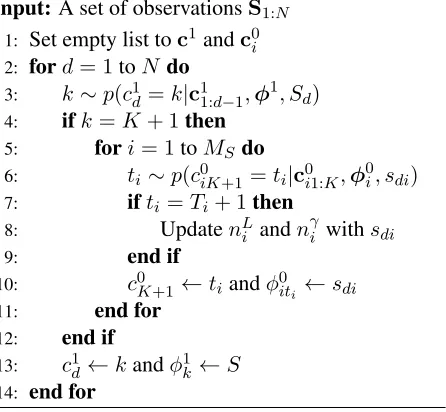
Algorithm 1Single pass inference of HDPSM
Input:A set of observationsS1:N 1: Set empty list toc1andc0i
2: ford= 1toN do
3: k∼p(c1d=k|c11:d−1,φ1, Sd) 4: ifk=K+ 1then
5: fori= 1toMSdo
6: ti ∼p(c0iK+1=ti|c0i1:K,φ0i, sdi) 7: ifti =Ti+ 1then
8: UpdatenL
i andn γ
i withsdi
9: end if
10: c0K+1 ←ti andφ0iti ←sdi
11: end for
12: end if
13: c1d←kandφ1k←S 14: end for
{sN+11, ..., sN+1MS}is calculated as follows:
P(SN+1|c,φ) =
K X
k=1
n1
k N +α1δ(φ
1
k, SN+1) (2)
+ α
1
N +α1
MS Y
i=1
P(sN+1i|c0i,φ0i)
P(sN+1i|c0i,φ0i) = Ti X
t=1
n0it K+α0iδ(φ
0
it, sN+1i)
+ α
0
i
K+α0
i
G0i(sN+1i|φ0i)
4 Generative Model for an Utterance
We present a generative utterance model to derive a slot estimation algorithm given utteranceu. Figure 3 presents the basic concept of our generative model. In the proposed model, we formulate the distribution of slot values as well as the distribution of non-slot parts. In Figure 3, the phrases “hi we’re in um” and “and we need a” should be removed to identify the slot information. We call these non-slot phrases as
functional fillers because they more or less have a function to convey information. Identifying the set of non-slot phrases is equivalent to identifying the set of slot phrases. Therefore, we define a generative model of functional fillers in the same way as the slot values.
!"#$%&'%#"(#)*#+%(#,"-.(#/(,#$%#(%%,#/#'%01/)'/(1! !"#$2#'%01/)'/(1#
%&$%2#+%(#,"-.(# '(()2#!"#$%
3-%'/(4%2!
5.(1%(1#67.12!
*$+,--,-+2#!"#$%&'%#"(#)*# .,))/$2#/(,#$%#(%%,#/# $-),-+2#!"#$!
[image:5.612.76.299.75.281.2]8)(49.(/7#8"77%'2!
Figure 3: The proposed generative utterance model. We at-tempt to find the best combination of the slot parts and the non-slot parts (i.e., functional filler parts) by using this model.
4.1 Functional Filler
We assume an utteranceuis a concatenation of slot valuesS and functional fillersF. A functional filler is represented as a phrase that ranges over V. To derive the utterance model, we first formulate a gen-erative model for functional fillers.
In our observation, the distribution of the func-tional filler depends on its position in an utterance. For example, utterances often begin with typical phrases such as “Hello I’m looking for ...” or “Hi please find ...”, which can hardly ever appear at other positions. To reflect this observation, we introduce afiller slotto separately model the functional fillers based on a position feature. Specifically, we define three filler slots:beginning fillerf1, which precedes
any slot value,ending fillerf3, which appears at the
end of an utterance, and middle filler f2, which is
inserted between slot values. We use the term con-tent slotto refer to S when we intend to explicitly distinguish it from a filler slot.
Let F = {f1, f2, f3}be a set of filler slots and
MF = 3be the number of filler slots. Each slotfi is a random variable ranging overV andF is a ran-dom variable overVMF. These notations for filler slots indicate compatibility to a content slot, which suggests that we can formulate F using HDPSMs, as follows:
Hi1 ∼DP(βi0, Hi0)
H3 ∼DP(β1, H2)
F ∼H3
where Hi0 is an n-gram-based distribution over V that is defined in an identical way to (1) and
H2(F) =QMF
G0 G1 S
u
H0 H1 F
M
S
M
F G3
H3
[image:6.612.88.283.58.138.2]D
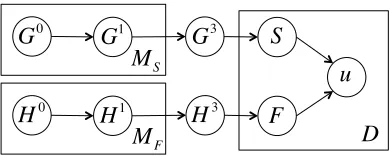
Figure 4:Graphical model of the utterance model.
4.2 Utterance Model
Figure 4 presents the graphical model of our utter-ance model. We assume that an utterutter-anceuis built with phrases provided byS andF. Therefore, the conditional distributionp(u|S, F)basically involves
a distribution over the permutation of these slot val-ues with two constraints: f1 is placed first andf3
has to be placed last. In our formulation, we simply adopt a uniform distribution over all possible permu-tations.
For training the utterance model, we assume that a set of annotated utterances is available. Each train-ing instance consists of utterance u and annotated slot valuesS. Given u andS, we assume that the functional fillersF can be uniquely identified. For the example in Figure 3, we can identify the sub-sequence inuthat corresponds to each content slot value of “restaurant” and “fen ditton”. This match-ing result leads to the identification of filler slot val-ues. Consequently, a triple(u, S, F) is regarded as
an observation. Because the HDPSMs of the content slot and of the filler slot are conditionally indepen-dent givenS andF, we can separately apply Algo-rithm 1 to train each HDPSM.
For slot filling, we examine the posterior proba-bility of content slot valuesSgivenu, which can be reformed as follows:
P(S|u)∝X
F
P(u|S, F)P(S)P(F)
In this equation, we can remove the summation ofF because filler slot values F are uniquely identified regardinguandS in our assumption. Additionally, we approximately regardP(u|S, F)as a constant if
ucan be built withSandF. By using these assump-tions, the posterior probability is reduced to the fol-lowing formula:
P(S|u)∝P(S)P(F) (3)
!"# ! ! ! "#$%&$ '#$%&$ '#$%&$ ! ! ! ! "#()*&
$%& ! ! ! ! "#$%&$ '#$%&$ ! ! ! ! "#()*&
'(& ! ! ! ! "#$%&$ '#$%&$ ! ! "#+,,- '#+,,- ! ./ 0&1%& /2 34 +&2 -/((,2 $2- 0& 2&&- $ %&5($3%$2(
!"#
$%&$ 346+&26-/((,2 ()*& %&5($3%$2(
+7 ./60&1%&6/2 +8 $2-60&62&&-6$
$%&
$%&$ +&26-/((,2 ()*& %&5($3%$2( +7 ./60&1%&6/2634 +8 $2-60&62&&-6$
'(&
$%&$ +&26-/((,2 +,,- 2&&-6$
+7 ./60&1%&6/2634 +8 $2-60& +9 %&5($3%$2(
Figure 5:Candidate generation using sequential labeling algo-rithm. The figure shows the case ofN= 3.
whereF in this formula is fillers identified given u andS. Consequently, the proposed method attempts to find the most likely combination of the slot val-ues and the non-slot phrases, since all words in an utterance have to belong to either of them. By using trained HDPSM (i.e., the posterior given all training data),P(S)andP(F)can be computed by (2).
5 Candidate Generation
For estimating slot values givenu, we adopt a can-didate generation approach (Williams, 2014) that leverages another slot filling algorithm to enumer-ate likely candidenumer-ates. 2 Specifically, we assume a candidate generation functiong(u)that generatesN candidates {S1, ..., SN} regarding u. Our slot fill-ing algorithm computes the posterior probability by (3) for each candidate slot Sj and takes the candi-date that has the highest posterior probability. In this estimation process, our utterance model works as a secondary filter that covers the error of the primary analysis.
Figure 5 provides an example of candidate gener-ation by using a sequential labeling algorithm with IOB tags. The subsequences to which the O tag is assigned can be regarded as functional fillers. The values for each filler slot are identified depending on the position of the subsequence, as the figure shows.
6 Experiments
We evaluate the performance of the proposed gener-ative model with an experiment using the algorithm
[image:6.612.317.542.60.166.2]name #utterances #slots max. diversity
DSTC 1,441 6 55
Weather 1,442 3 191
Table 1: Datasets in the experiment. Max. diversity refers to the maximum number of value types that are taken by a slot.
described in Section 5. We adopt a conditional ran-dom field (CRF) as a candidate generation algorithm that generatesN-best estimation as candidates. For the CRF, we apply commonly used features includ-ing unigram and bigram of the surface form and part of speech of the word. We used CRF++3as the CRF implementation.
6.1 Dataset
The performance of our method is evaluated using two datasets from different languages, as summa-rized in Table 1. The first dataset is provided by the third Dialog State Tracking Challenge (Hender-son, 2015), hereafter referred to as the DSTC corpus. The DSTC corpus consists of dialogs in the tourist information domain. In our experiment, we use the user’s first utterance in each dialog, which typically describes the user’s query to the system. Utterances without any slot information are excluded. We man-ually modified the annotated slot values into “as-is form” to allow a sequential labeling method to extract the ground-truth values. This identification process can be done in a semi-automatic manner that involves no expert knowledge. We apply the part of speech tagger in NLTK4for the CRF application.
The second dataset is a weather corpus consisting of user utterances in an in-house corpus of human-machine dialogues in the weather domain. It con-tains 1,442 questions spoken in Japanese. In this corpus, the number of value types for each slot is higher than DSTC, which indicates a more challeng-ing task. We applied the Japanese morphological analyzer MeCab (Kudo et al., 2004) to segment the Japanese text into words before applying CRF.
For both datasets, we examine the effect of the amount of available annotated utterances by varying the number of training data in
25,50,75,100,200,400,800, all.
3https://taku910.github.io/crfpp/ 4http://www.nltk.org/
#train CRF best HDPN = 5 HDPN = 300
25 0.560 0.706* 0.684*
50 0.709 0.791* 0.765*
75 0.748 0.824* 0.817*
100 0.791 0.845* 0.837*
200 0.839 0.901* 0.876*
400 0.904 0.938* 0.936*
800 0.926 0.953* 0.947*
[image:7.612.314.548.233.357.2]1296 0.938 0.960* 0.951
Table 2: Slot estimation accuracy for the DSTC corpus. The asterisk (*) indicates that the accuracy is statistically significant compared against CRF best (p <0.005).
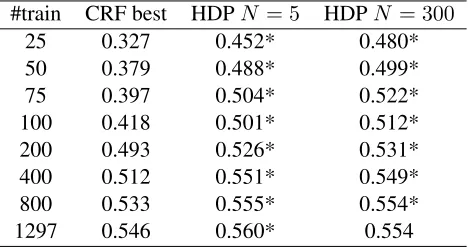
#train CRF best HDPN = 5 HDPN = 300
25 0.327 0.452* 0.480*
50 0.379 0.488* 0.499*
75 0.397 0.504* 0.522*
100 0.418 0.501* 0.512*
200 0.493 0.526* 0.531*
400 0.512 0.551* 0.549*
800 0.533 0.555* 0.554*
1297 0.546 0.560* 0.554
Table 3:Slot estimation accuracy for the Japanese weather cor-pus. An asterisk (*) indicates statistical significance against CRF best (p <0.01).
6.2 Evaluation Metrics
The methods are compared in terms of slot estima-tion accuracy. Let nc be the number of utterances for which the estimated slotSand the ground-truth slotSˆare perfectly matched, and letnebe the
num-ber of the utterances including an estimation error. The slot estimation accuracy is simply calculated as
nc
nc+ne. All evaluation scores are calculated as the average of 10-fold cross validation. We also conduct a binomial test to examine the statistical significance of the improvement in the proposed algorithm com-pared to the CRF baseline.
6.3 Results
Tables 2 and 3 present the slot estimation accu-racy for the DSTC corpus and the Japanese weather corpus, respectively. The baseline (CRF best) is a method that takes only one best output of CRF for slot estimation. HDP withN = 5 andN = 300
genera-utterance estimation by CRF best estimation by HDPN = 5
im looking for a restaurant that type:restaurant (*) type:restaurant,food:fast food serves fast food
i want a moderate restaurant in area:new chesterton, area:new chesterton, the new chesterton area type:restaurant, type:restaurant,
food:moderate (*) pricerange:moderate
im looking for a cheap chine pricerange:cheap,type:restaurant, pricerange:cheap,type:restaurant, chinese takeaway restaurant food:chinese takeaway food:chine chinese takeaway (*)
Table 4:Examples of estimated slot values for the condition of #train is 800. An asterisk (*) indicates misrecognition.
tor. The asterisks (*) beside the HDP accuracy in-dicate the statistical significance against CRF best, which is tested using the binomial test.
Results show that our proposed method performs significantly better than CRF. Especially when the amount of training data is limited, the proposed method outperforms the baseline. This property is attractive for practical speech recognition systems that offer many different functions. Accurate recog-nition at an early stage of development allows a practitioner to launch a service that results in quickly collecting hundreds of speech examples.
Since we use the CRF as a candidate generator, we expect that the CRF N-best can rank the correct answer higher in the candidate list. In fact, the top five candidates cover almost all of the correct an-swers. Therefore, the result in the comparison of
N = 5 andN = 300suggests the stability of the
proposed method against the mostly noisy 295 can-didates. Because the proposed algorithm makes no use of the original ranking order, N = 300 is a
harder condition in which to identify the correct an-swer. Nevertheless, the result shows that the drop in the performance is limited; the accuracy is still sig-nificantly better than the baseline. This result sug-gests that the proposed method is less dependent on the performance of the candidate generator.
Table 4 presents some examples of the slot val-ues estimated by CRF best and HDP withN = 5
for the condition where the number of training utter-ances is 800. The first two are samples where CRF best failed to predict the correct values. These er-rors are attributed to infrequent sequential patterns caused by the less trained expressions “that serves fast food” and “moderate restaurant” because CRF is a position-based classifier. The value-based for-mulation allows the model to learn that the phrase
“fast food” is more likely to be a food name than to be a functional filler and to reject the candidate.
The third example in Table 4 shows an error using HDP, which extracted “chine chinese take-away” which includes a reparandum of disfluency (Georgila et al., 2010). This error can be attributed to the fact that this kind of disfluency resembles the true slot value, which leads to a higher probability of “chine” in the food slot model compared to in the functional filler model. Regarding this type of error, preliminary application of a disfluency detec-tion method (Zayats et al., 2016) is promising for improving accuracy.
The execution time for training the proposed HDP utterance model with 1297 training data in the Japanese weather corpus was about 0.3 seconds. This is a good performance since the CRF training takes about 5.5 seconds. Moreover, the training of the proposed HDP model is scalable and works in an online manner because it is a single pass algorithm. When we have a very large number of training ex-amples, the bottleneck is the CRF training, which requires scanning the whole dataset repeatedly.
7 Conclusion
References
Yun-Nung Chen, William Yang Wang, Anatole Gersh-man, and Alexander Rudnicky. 2015. Matrix Fac-torization with Knowledge Graph Propagation for
Un-supervised Spoken Language Understanding. InProc.
Annual Meeting of the Association for Computational Linguistics.
Thomas S. Ferguson. 1973. A Bayesian Analysis of
Some Nonparametric Problems. The Annual of
Statis-tics, 1(2):209–230.
Kallirroi Georgila, Ning Wang, and Jonathan Gratch. 2010. Cross-Domain Speech Disfluency Detection. In
Proc. Annual SIGDIAL Meeting on Discourse and Di-alogue.
Samuel J. Gershman and David M. Blei. 2012. A
tu-torial on Bayesian nonparametric models. Journal of
Mathematical Psychology, 56(1):1–12.
Daniel Gildea. 2002. Automatic labeling of semantic
roles. Computational Linguistics, 28(3):245–288.
Sharon Goldwater, Thomas L. Griffiths, and Mark
John-son. 2011. Producing Power-Law Distributions
and Damping Word Frequencies with Two-Stage
Lan-guage Models. Journal of Machine Learning
Re-search, 12:2335–2382.
Stefan Hahn, Marco Dinarelli, Christian Raymond, Fabrice Lefevre, Patrick Lehnen, Renato De Mori, Alessandro Moschitti, Hermann Ney, and Giuseppe Riccardi. 2011. Comparing stochastic approaches to spoken language understanding in multiple languages.
IEEE Transactions on Audio, Speech and Language Processing, 19(6):1569–1583.
Matthew Henderson. 2015. Machine Learning for
Dia-log State Tracking: A Review. InProc. Workshop on
Machine Learning in Spoken Language Processing. Kazunori Komatani, Masaki Katsumaru, Mikio Nakano,
Kotaro Funakoshi, Tetsuya Ogata, and Hiroshi G. Okuno. 2010. Automatic Allocation of Training Data
for Rapid Prototyping. InProc. International
Confer-ence on Computational Linguistics.
Taku Kudo, Kaoru Yamamoto, and Yuji Matsumoto.
2004. Applying Conditional Random Fields to
Japanese Morphological Analysis. InProc. Empirical
Methods in Natural Language Processing.
John Lafferty, Andrew McCallum, and Fernando C N Pereira. 2001. Conditional random fields: Probabilis-tic models for segmenting and labeling sequence data. InProc. International Conference on Machine Learn-ing.
Alejandra Lorenzo, Lina M Rojas-barahona, and Christophe Cerisara. 2013. Unsupervised structured semantic inference for spoken dialog reservation tasks. In Proc. Annual SIGDIAL Meeting on Discourse and Dialogue.
Gregoire Mesnil, Yann Dauphin, Kaisheng Yao, Yoshua Bengio, Li Deng, Dilek Hakkani-Tur, Xiaodong He, Larry Heck, Gokhan Tur, Dong Yu, and Geoffrey Zweig. 2015. Using Recurrent Neural Networks for Slot Filling in Spoken Language Understanding.
IEEE/ACM Transactions on Audio, Speech, and Lan-guage Processing, 23(3):530–539.
Angeliki Metallinou, Dan Bohus, and Jason Williams. 2013. Discriminative state tracking for spoken dialog
systems. Proc. Annual Meeting of the Association for
Computational Linguistics.
Christian Raymond, Fr´ed´eric B´echet, Renato De Mori, and G´eraldine Damnati. 2006. On the use of finite
state transducers for semantic interpretation. Speech
Communication, 48(3-4):288–304.
Hang Ren, Weiqun Xu, and Yonghong Yan. 2014.
Markovian discriminative modeling for dialog state
tracking. InProc. Annual SIGDIAL Meeting on
Dis-course and Dialogue.
Yee W. Teh, Michael I. Jordan, Matthew J. Beal, and David M. Blei. 2005. Hierarchical Dirichlet
Pro-cesses. Journal of the American Statistical
Associa-tion, 101:1566–1581.
Gokhan Tur, Asli Celikyilmaz, and Dilek Hakkani-Tur. 2013. Latent Semantic Modeling for Slot Filling in
Conversational Understanding. InProc. International
Conference on Acoustics, Speech and Signal Process-ing.
Vedran Vukotic, Christian Raymond, and Guillaume Gravier. 2015. Is it Time to Switch to Word Em-bedding and Recurrent Neural Networks for Spoken
Language Understanding? InProc. Interspeech.
Jason D. Williams. 2010. Incremental partition re-combination for efficient tracking of multiple dialog
states. In Proc. International Conference on
Acous-tics, Speech and Signal Processing.
Jason D Williams. 2014. Web-style ranking and SLU
combination for dialog state tracking. InProc. Annual
SIGDIAL Meeting on Discourse and Dialogue. Puyang Xu and Ruhi Sarikaya. 2013. Convolutional
neu-ral network based triangular CRF for joint intent
de-tection and slot filling. In Proc. IEEE Workshop on
Automatic Speech Recognition and Understanding. Vicky Zayats, Mari Ostendorf, and Hannaneh Hajishirzi.
2016. Disfluency Detection using a Bidirectional
LSTM. arXiv preprint arXiv:1604.03209.
Ke Zhai and Jordan Boyd-graber. 2013. Online Latent
Dirichlet Allocation with Infinite Vocabulary. InProc.