Proceedings of the 9th Conference on Computational Natural Language Learning (CoNLL),
A Statistical Semantic Parser that Integrates Syntax and Semantics
Ruifang Ge Raymond J. Mooney
Department of Computer Sciences University of Texas, Austin
TX 78712, USA
fgrf,[email protected]
Abstract
We introduce a learning semantic parser, SCISSOR, that maps natural-language sen-tences to a detailed, formal,
meaning-representation language. It first uses
an integrated statistical parser to pro-duce a semantically augmented parse tree, in which each non-terminal node has both a syntactic and a semantic label. A compositional-semantics procedure is then used to map the augmented parse tree into a final meaning representation. We evaluate the system in two domains, a natural-language database interface and an interpreter for coaching instructions in robotic soccer. We present experimental
results demonstrating that SCISSOR
pro-duces more accurate semantic representa-tions than several previous approaches.
1 Introduction
Most recent work in learning for semantic parsing has focused on “shallow” analysis such as
seman-tic role labeling (Gildea and Jurafsky, 2002). In this
paper, we address the more ambitious task of learn-ing to map sentences to a complete formal meanlearn-ing-
meaning-representation language (MRL). We consider two
MRL’s that can be directly used to perform useful, complex tasks. The first is a Prolog-based language used in a previously-developed corpus of queries to a database on U.S. geography (Zelle and Mooney, 1996). The second MRL is a coaching language for
robotic soccer developed for the RoboCup Coach Competition, in which AI researchers compete to provide effective instructions to a coachable team of agents in a simulated soccer domain (et al., 2003).
We present an approach based on a statisti-cal parser that generates a semantistatisti-cally augmented
parse tree (SAPT), in which each internal node
in-cludes both a syntactic and semantic label. We aug-ment Collins’ head-driven model 2 (Collins, 1997) to incorporate a semantic label on each internal node. By integrating syntactic and semantic inter-pretation into a single statistical model and finding the globally most likely parse, an accurate combined syntactic/semantic analysis can be obtained. Once a SAPT is generated, an additional step is required to translate it into a final formal meaning
representa-tion (MR).
Our approach is implemented in a system called SCISSOR (Semantic Composition that Integrates Syntax and Semantics to get Optimal Representa-tions). Training the system requires sentences an-notated with both gold-standard SAPT’s and MR’s. We present experimental results on corpora for both geography-database querying and Robocup
coach-ing demonstratcoach-ing that SCISSOR produces more
ac-curate semantic representations than several previ-ous approaches based on symbolic learning (Tang and Mooney, 2001; Kate et al., 2005).
2 Target MRL’s
We used two MRLs in our experiments: CLANGand
GEOQUERY. They capture the meaning of linguistic utterances in their domain in a formal language.
2.1 CLANG: the RoboCup Coach Language
RoboCup (www.robocup.org) is an
interna-tional AI research initiative using robotic soccer as its primary domain. In the Coach Competition, teams of agents compete on a simulated soccer field and receive advice from a team coach in a formal
language called CLANG. In CLANG, tactics and
behaviors are expressed in terms of if-then rules. As described in (et al., 2003), its grammar consists of 37 non-terminal symbols and 133 productions. Below is a sample rule with its English gloss:
((bpos (penalty-area our)) (do (player-except our {4})
(pos (half our))))
“If the ball is in our penalty area, all our players except player 4 should stay in our half.”
2.2 GEOQUERY: a DB Query Language
GEOQUERY is a logical query language for a small
database of U.S. geography containing about 800 facts. This domain was originally chosen to test corpus-based semantic parsing due to the avail-ability of a hand-built natural-language interface, GEOBASE, supplied with Turbo Prolog 2.0 (Borland
International, 1988). The GEOQUERY language
consists of Prolog queries augmented with several meta-predicates (Zelle and Mooney, 1996). Below is a sample query with its English gloss:
answer(A,count(B,(city(B),loc(B,C), const(C,countryid(usa))),A))
“How many cities are there in the US?”
3 Semantic Parsing Framework
This section describes our basic framework for se-mantic parsing, which is based on a fairly stan-dard approach to compositional semantics
(Juraf-sky and Martin, 2000). First, a statistical parser
is used to construct a SAPT that captures the se-mantic interpretation of individual words and the basic predicate-argument structure of the sentence. Next, a recursive procedure is used to composition-ally construct an MR for each node in the SAPT from the semantic label of the node and the MR’s
has 2
VP−bowner
player the ball
NN−player CD−unum NP−null
NN−null VB−bowner
S−bowner
NP−player
DT−null PRP$−team
[image:2.612.313.551.57.301.2] [image:2.612.316.541.57.171.2]our
Figure 1: An SAPT for a simple CLANGsentence.
Function:BUILDMR(N;K)
Input: The root nodeNof a SAPT;
predicate-argument knowledge,K, for the MRL.
Notation:XMRis the MR of nodeX.
Output:NM R
Ci:=theith child node ofN;1in Ch=GETSEMANTICHEAD(N) // see Section 3 Ch
MR
=BUILDMR(Ch;K)
for each other childCiwherei6=h Ci
MR
=BUILDMR(Ci;K) COMPOSEMR(C
h MR
,C i
MR
;K) // see Section 3 N
MR =C
h MR
Figure 2: Computing an MR from a SAPT.
of its children. Syntactic structure provides infor-mation of how the parts should be composed. Am-biguities arise in both syntactic structure and the se-mantic interpretation of words and phrases. By in-tegrating syntax and semantics in a single statistical parser that produces an SAPT, we can use both se-mantic information to resolve syntactic ambiguities and syntactic information to resolve semantic ambi-guities.
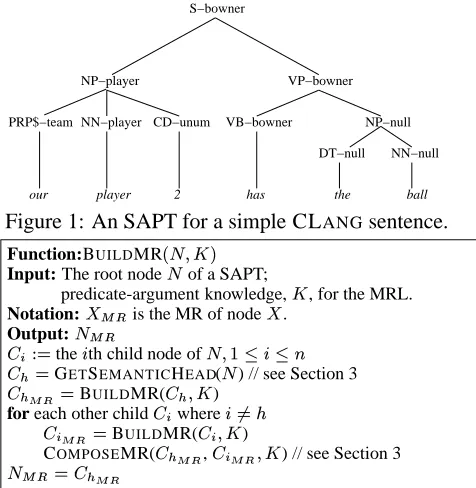
In a SAPT, each internal node in the parse tree is annotated with a semantic label. Figure 1 shows
the SAPT for a simple sentence in the CLANG
do-main. The semantic labels which are shown after dashes are concepts in the domain. Some type
con-cepts do not take arguments, like team and unum
(uniform number). Some concepts, which we refer to as predicates, take an ordered list of arguments, like player and bowner (ball owner). The
predicate-argument knowledge, K, specifies, for each
predi-cate, the semantic constraints on its arguments. Con-straints are specified in terms of the concepts that can fill each argument, such as player(team, unum)
and bowner(player). A special semantic labelnull
is used for nodes that do not correspond to any con-cept in the domain.
player the ball
N3−bowner(_) N7−player(our,2)
N2−null
null null
N4−player(_,_) N5−team
our
N6−unum
2
N1−bowner(_)
has
[image:3.612.81.290.57.160.2]N8−bowner(player(our,2))
Figure 3: MR’s constructed for each SAPT Node.
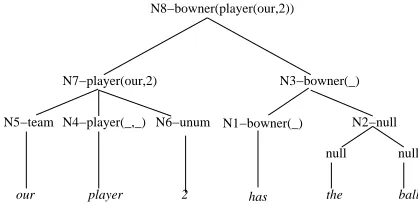
construction of the MR for the SAPT in Figure 1. Nodes are numbered in the order in which the
con-struction of their MR’s are completed. The first
step, GETSEMANTICHEAD, determines which of a
node’s children is its semantic head based on hav-ing a matchhav-ing semantic label. In the example, node N3 is determined to be the semantic head of the sentence, since its semantic label, bowner, matches N8’s semantic label. Next, the MR of the seman-tic head is constructed recursively. The semanseman-tic head of N3 is clearly N1. Since N1 is a part-of-speech (POS) node, its semantic label directly de-termines its MR, which becomes bowner( ). Once the MR for the head is constructed, the MR of all other (non-head) children are computed recursively,
and COMPOSEMR assigns their MR’s to fill the
ar-guments in the head’s MR to construct the com-plete MR for the node. Argument constraints are used to determine the appropriate filler for each ar-gument. Since, N2 has a null label, the MR of N3 also becomes bowner( ). When computing the MR for N7, N4 is determined to be the head with the
MR: player( , ). COMPOSEMR then assigns N5’s
MR to fill the team argument and N6’s MR to fill the unum argument to construct N7’s complete MR:
player(our, 2). This MR in turn is composed with
the MR for N3 to yield the final MR for the sen-tence: bowner(player(our,2)).
For MRL’s, such as CLANG, whose syntax does
not strictly follow a nested set of predicates and ar-guments, some final minor syntactic adjustment of the final MR may be needed. In the example, the
final MR is (bowner (player our f2g)). In the
fol-lowing discussion, we ignore the difference between these two.
There are a few complications left which re-quire special handling when generating MR’s, like coordination, anaphora resolution and
non-compositionality exceptions. Due to space limita-tions, we do not present the straightforward tech-niques we used to handle them.
4 Corpus Annotation
This section discusses how sentences for training SCISSOR were manually annotated with SAPT’s. Sentences were parsed by Collins’ head-driven model 2 (Bikel, 2004) (trained on sections 02-21 of the WSJ Penn Treebank) to generate an initial syntactic parse tree. The trees were then manually corrected and each node augmented with a semantic label.
First, semantic labels for individual words, called
semantic tags, are added to the POS nodes in the
tree. The tag null is used for words that have no cor-responding concept. Some concepts are conveyed by phrases, like “has the ball” for bowner in the pre-vious example. Only one word is labeled with the concept; the syntactic head word (Collins, 1997) is preferred. During parsing, the other words in the phrase will provide context for determining the se-mantic label of the head word.
Labels are added to the remaining nodes in a bottom-up manner. For each node, one of its chil-dren is chosen as the semantic head, from which it will inherit its label. The semantic head is chosen as the child whose semantic label can take the MR’s of the other children as arguments. This step was done mostly automatically, but required some man-ual corrections to account for unusman-ual cases.
In order for COMPOSEMR to be able to construct
the MR for a node, the argument constraints for its semantic head must identify a unique concept to fill each argument. However, some predicates take multiple arguments of the same type, such as
point.num(num,num), which is a kind of point that
represents a field coordinate in CLANG.
In this case, extra nodes are inserted in the tree with new type concepts that are unique for each ar-gument. An example is shown in Figure 4 in which the additional type concepts num1 and num2 are in-troduced. Again, during parsing, context will be used to determine the correct type for a given word. The point label of the root node of Figure 4 is the
concept that includes all kinds of points in CLANG.
,
0.5 , −RRB−
−RRB−−null
−LRB− 0.1
CD−num CD−num −LRB−−point.num
PRN−point
[image:4.612.78.296.57.145.2]CD−num1 CD−num2
Figure 4: Adding new types to disambiguate argu-ments.
use the most general CLANG label for its concept
(e.g. point instead of point.num). This generality avoids sparse data problems during training.
5 Integrated Parsing Model
5.1 Collins Head-Driven Model 2
Collins’ head-driven model 2 is a generative, lexi-calized model of statistical parsing. In the following section, we follow the notation in (Collins, 1997).
Each non-terminalXin the tree is a syntactic label,
which is lexicalized by annotating it with a word,
w, and a POS tag, t
syn. Thus, we write a
non-terminal as X(x), where X is a syntactic label and
x = hw;t syn
i. X(x) is then what is generated by
the generative model.
Each production LHS ) R HS in the PCFG is
in the form:
P(h)!L n
(l n
):::L 1
(l 1
)H(h)R 1
(r 1
):::R m
(r m
)
whereH is the head-child of the phrase, which
in-herits the head-word h from its parentP. L
1 :::L
n
andR
1 :::R
mare left and right modifiers of
H.
Sparse data makes the direct estimation of
P(R HSjLHS) infeasible. Therefore, it is
decom-posed into several steps – first generating the head, then the right modifiers from the head outward, then the left modifiers in the same way. Syntactic subcategorization frames, LC and RC, for the left and right modifiers respectively, are generated be-fore the generation of the modifiers. Subcat frames represent knowledge about subcategorization prefer-ences. The final probability of a production is com-posed from the following probabilities:
1. The probability of choosing a head constituent
label H:P
h
(HjP;h).
2. The probabilities of choosing the left and right
subcat frames LC and RC: P
l
(LCjP;H;h)
andP
r
(R CjP;H;h).
has 2
our player the
PRP$−team NN−player CD−unum
NN−null DT−null
NP−player(player) VP−bowner(has)
NP−null(ball)
ball
S−bowner(has)
[image:4.612.317.542.58.302.2]VB−bowner
Figure 5: A lexicalized SAPT.
3. The probabilities of
generat-ing the left and right modifiers:
Q
i=1::m+1 P
r (R
i (r
i
)jH;P;h; i 1
;R C)
Q
i=1::n+1 P
l (L
i (l
i
)jH;P;h; i 1
;LC).
Where is the measure of the distance from
the head word to the edge of the constituent,
andL
n+1 (l
n+1
)andR m+1
(r m+1
)areSTOP.
The model stops generating more modifiers
whenSTOP is generated.
5.2 Integrating Semantics into the Model
We extend Collins’ model to include the genera-tion of semantic labels in the derivagenera-tion tree. Un-less otherwise stated, notation has the same
mean-ing as in Section 5.1. The subscript syn refers to
the syntactic part, and sem refers to the semantic
part. We redefine X and x to include semantics,
each non-terminalXis now a pair of a syntactic
la-bel X
syn and a semantic label
X
sem. Besides
be-ing annotated with the word, w, and the POS tag,
t syn,
X is also annotated with the semantic tag,
t
sem, of the head child. Thus,
X(x)now consists of
X = hX
syn ;X
sem
i, andx = hw;t
syn ;t
sem i.
Fig-ure 5 shows a lexicalized SAPT (but omittingt
syn
andt
sem).
Similar to the syntactic subcat frames, we also condition the generation of modifiers on semantic
subcat frames. Semantic subcat frames give
se-mantic subcategorization preferences; for example,
player takes a team and a unum. ThusLCand R C
are now: hLC
syn ;LC
sem
i and hR C syn
;R C sem
i.
X(x)is generated as in Section 5.1, but using the
new definitions ofX(x), LC and R C. The
imple-mentation of semantic subcat frames is similar to syntactic subcat frames. They are multisets speci-fying the semantic labels which the head requires in its left or right modifiers.
As an example, the probability of generating the
PRP$-[team](our) NN-[player](player) CD-[unum](2) is (omitting only the distance measure):
P h
(NN-[player]jNP-[player],player)
P l
(hfg,fteamgijNP-[player],player)
Pr(hfg,funumgijNP-[player],player)
P l
(PRP$-[team](our)jNP-[player],player,hfg,fteamgi)
Pr(CD-[unum](2)jNP-[player],player,hfg,funumgi)
P l
(STOPjNP-[player],player,hfg,fgi )
P r
(STOPjNP-[player],player,hfg,fgi)
5.3 Smoothing
Since the left and right modifiers are independently generated in the same way, we only discuss smooth-ing for the left side. Each probability estimation in the above generation steps is called a parameter. To reduce the risk of sparse data problems, the parame-ters are decomposed as follows:
P h
(HjC) = P
h syn
(H syn
jC)
P h
sem (H
sem jC ;H
syn )
P l
(LCjC) = P
l syn (LC
syn jC)
P l sem
(LC sem
jC ;LC syn
)
P l
(L i
(l i
)jC) = P
lsyn (L
isyn (lt
isyn ;lw
i )jC)
P lsem
(L isem
(lt isem
;lw i
)jC ;L isyn
(lt isyn
))
For brevity,C is used to represent the context on
which each parameter is conditioned;lw
i, lt
isyn, and
lt i
sem are the word, POS tag and semantic tag
gener-ated for the non-terminalL
i. The word is generated
separately in the syntactic and semantic outputs. We make the independence assumption that the syntactic output is only conditioned on syntactic fea-tures, and semantic output on semantic ones. Note that the syntactic and semantic parameters are still integrated in the model to find the globally most likely parse. The syntactic parameters are the same as in Section 5.1 and are smoothed as in (Collins, 1997). We’ve also tried different ways of condition-ing syntactic output on semantic features and vice versa, but they didn’t help. Our explanation is the integrated syntactic and semantic parameters have already captured the benefit of this integrated ap-proach in our experimental domains.
Since the semantic parameters do not depend on
any syntactic features, we omit the semsubscripts
in the following discussion. As in (Collins, 1997),
the parameter P
l (L
i (lt
i ;lw
i
)jP;H;w;t;;LC) is
further smoothed as follows:
P l 1
(L i
jP;H;w;t;;LC)
P l 2
(lt i
jP;H;w;t;;LC ;L i
)
P l 3
(lw i
jP;H;w;t;;LC ;L i
(lt i
))
Note this smoothing is different from the syntactic counterpart. This is due to the difference between POS tags and semantic tags; namely, semantic tags are generally more specific.
Table 1 shows the various levels of back-off for
each semantic parameter. The probabilities from
these back-off levels are interpolated using the tech-niques in (Collins, 1997). All words occurring less than 3 times in the training data, and words in test data that were not seen in training, are unknown words and are replaced with the ”UNKNOWN” to-ken. Note this threshold is smaller than the one used in (Collins, 1997) since the corpora used in our ex-periments are smaller.
5.4 POS Tagging and Semantic Tagging
For unknown words, the POS tags allowed are lim-ited to those seen with any unknown words during training. Otherwise they are generated along with the words using the same approach as in (Collins, 1997). When parsing, semantic tags for each known word are limited to those seen with that word dur-ing traindur-ing data. The semantic tags allowed for an unknown word are limited to those seen with its as-sociated POS tags during training.
6 Experimental Evaluation
6.1 Methodology
Two corpora of NL sentences paired with MR’s
were used to evaluate SCISSOR. For CLANG, 300
pieces of coaching advice were randomly selected from the log files of the 2003 RoboCup Coach
Com-petition. Each formal instruction was translated
into English by one of four annotators (Kate et al., 2005). The average length of an NL sentence in
this corpus is 22.52 words. For GEOQUERY, 250
questions were collected by asking undergraduate students to generate English queries for the given
BACK-OFFLEVEL P h
(Hj:::) P LC
(LCj:::) P
L1 (L
i
j:::) P
L2 (lt
i
j:::) P
L3 (lw
i j:::)
1 P,w,t P,H,w,t P,H,w,t,,LC P,H,w,t,,LC, L
i P,H,
w,t,,LC,L i,
lt i
2 P,t P,H,t P,H,t,,LC P,H,t,,LC,L
i P,H,
t,,LC,L i,
lt i
3 P P,H P,H,,LC P,H,,LC,L
i
L i,
lt i
4 – – – L
i
lt i
Table 1: Conditioning variables for each back-off level for semantic parameters (semsubscripts omitted).
into logical form (Zelle and Mooney, 1996). The average length of an NL sentence in this corpus is 6.87 words. The queries in this corpus are more complex than those in the ATIS database-query cor-pus used in the speech community (Zue and Glass,
2000) which makes the GEOQUERYproblem harder,
as also shown by the results in (Popescu et al., 2004). The average number of possible semantic tags for
each word which can represent meanings in CLANG
is 1.59 and that in GEOQUERYis 1.46.
SCISSOR was evaluated using standard 10-fold cross validation. NL test sentences are first parsed to generate their SAPT’s, then their MR’s were built from the trees. We measured the number of test sen-tences that produced complete MR’s, and the
num-ber of these MR’s that were correct. For CLANG,
an MR is correct if it exactly matches the correct representation, up to reordering of the arguments of
commutative operators likeand. For GEOQUERY,
an MR is correct if the resulting query retrieved the same answer as the correct representation when submitted to the database. The performance of the parser was then measured in terms of precision (the percentage of completed MR’s that were correct) and recall (the percentage of all sentences whose MR’s were correctly generated).
We compared SCISSOR’s performance to several
previous systems that learn semantic parsers that can
map sentences into formal MRL’s. CHILL(Zelle and
Mooney, 1996) is a system based on Inductive Logic Programming (ILP). We compare to the version
of CHILL presented in (Tang and Mooney, 2001),
which uses the improved COCKTAILILP system and
produces more accurate parsers than the original
ver-sion presented in (Zelle and Mooney, 1996). SILTis
a system that learns symbolic, pattern-based, trans-formation rules for mapping NL sentences to formal languages (Kate et al., 2005). It comes in two
ver-sions, SILT-string, which maps NL strings directly
to an MRL, and SILT-tree, which maps syntactic
0 10 20 30 40 50 60 70 80 90 100
0 50 100 150 200 250
Precision (%)
Training sentences
SCISSOR SILT-string SILT-tree CHILL GEOBASE
Figure 6: Precision learning curves for GEOQUERY.
0 10 20 30 40 50 60 70 80
0 50 100 150 200 250
Recall (%)
Training sentences
[image:6.612.315.536.165.491.2]SCISSOR SILT-string SILT-tree CHILL GEOBASE
Figure 7: Recall learning curves for GEOQUERY.
parse trees (generated by the Collins parser) to an
MRL. In the GEOQUERYdomain, we also compare
to the original hand-built parser GEOBASE.
6.2 Results
Figures 6 and 7 show the precision and recall
learn-ing curves for GEOQUERY, and Figures 8 and 9 for
CLANG. Since CHILL is very memory intensive,
it could not be run with larger training sets of the
CLANGcorpus.
Overall, SCISSOR gives the best precision and
re-call results in both domains. The only exception
is with recall for GEOQUERY, for which CHILL is
slightly higher. However, SCISSORhas significantly
0 10 20 30 40 50 60 70 80 90 100
0 50 100 150 200 250 300
Precision (%)
Training sentences
[image:7.612.76.291.59.379.2]SCISSOR SILT-string SILT-tree CHILL
Figure 8: Precision learning curves for CLANG.
0 10 20 30 40 50 60 70 80
0 50 100 150 200 250 300
Recall (%)
Training sentences
SCISSOR SILT-string SILT-tree CHILL
Figure 9: Recall learning curves for CLANG.
Results on a larger GEOQUERY corpus with 880
queries have been reported for PRECISE(Popescu et
al., 2003): 100% precision and 77.5% recall. On
the same corpus, SCISSOR obtains 91.5% precision
and 72.3% recall. However, the figures are not
com-parable. PRECISE can return multiple distinct SQL
queries when it judges a question to be ambigu-ous and it is considered correct when any of these SQL queries is correct. Our measure only considers the top result. Due to space limitations, we do not present complete learning curves for this corpus.
7 Related Work
We first discuss the systems introduced in Section
6. CHILLuses computationally-complex ILP
meth-ods, which are slow and memory intensive. The
string-based version of SILT uses no syntactic
in-formation while the tree-based version generates a syntactic parse first and then transforms it into an
MR. In contrast, SCISSOR integrates syntactic and
semantic processing, allowing each to constrain and inform the other. It uses a successful approach to
sta-tistical parsing that attempts to find the SAPT with maximum likelihood, which improves robustness compared to purely rule-based approaches. How-ever, SCISSORrequires an extra training input, gold-standard SAPT’s, not required by these other sys-tems. Further automating the construction of train-ing SAPT’s from sentences paired with MR’s is a subject of on-going research.
PRECISE is designed to work only for the spe-cific task of NL database interfaces. By comparison, SCISSOR is more general and can work with other
MRL’s as well (e.g. CLANG). Also, PRECISEis not
a learning system and can fail to parse a query it con-siders ambiguous, even though it may not be consid-ered ambiguous by a human and could potentially be resolved by learning regularities in the training data. In (Lev et al., 2004), a syntax-driven approach is used to map logic puzzles described in NL to an MRL. The syntactic structures are paired with hand-written rules. A statistical parser is used to generate syntactic parse trees, and then MR’s are built using compositional semantics. The meaning of open-category words (with only a few exceptions) is considered irrelevant to solving the puzzle and their meanings are not resolved. Further steps would be needed to generate MR’s in other domains like
CLANGand GEOQUERY. No empirical results are
reported for their approach.
Several machine translation systems also attempt to generate MR’s for sentences. In (et al., 2002), an English-Chinese speech translation system for limited domains is described. They train a statisti-cal parser on trees with only semantic labels on the nodes; however, they do not integrate syntactic and semantic parsing.
History-based models of parsing were first
in-troduced in (Black et al., 1993). Their original
model also included semantic labels on parse-tree nodes, but they were not used to generate a formal MR. Also, their parsing model is impoverished com-pared to the history included in Collins’ more recent
model. SCISSOR explores incorporating semantic
labels into Collins’ model in order to produce a com-plete SAPT which is then used to generate a formal MR.
pro-duce a much simpler MR, i.e., a single semantic
frame. A sample frame is AIRTRANSPORTATION
which has three slots – the arrival time, origin and destination. Only one frame needs to be extracted from each sentence, which is an easier task than our problem in which multiple nested frames (pred-icates) must be extracted. The syntactic model in (Miller et al., 2000) is similar to Collins’, but does not use features like subcat frames and distance
mea-sures. Also, the non-terminal labelX is not further
decomposed into separately-generated semantic and syntactic components. Since it used much more spe-cific labels (the cross-product of the syntactic and semantic labels), its parameter estimates are poten-tially subject to much greater sparse-data problems.
8 Conclusion
SCISSORlearns statistical parsers that integrate
syn-tax and semantics in order to produce a semanti-cally augmented parse tree that is then used to com-positionally generate a formal meaning representa-tion. Experimental results in two domains, a natural-language database interface and an interpreter for coaching instructions in robotic soccer, have
demon-strated that SCISSORgenerally produces more
accu-rate semantic representations than several previous approaches. By augmenting a state-of-the-art statis-tical parsing model to include semantic information, it is able to integrate syntactic and semantic clues to produce a robust interpretation that supports the generation of complete formal meaning representa-tions.
9 Acknowledgements
We would like to thank Rohit J. Kate , Yuk Wah Wong and Gregory Kuhlmann for their help in
an-notating the CLANGcorpus and providing the
eval-uation tools. This research was supported by De-fense Advanced Research Projects Agency under grant HR0011-04-1-0007.
References
Daniel M. Bikel. 2004. Intricacies of Collins’ parsing model.
Computational Linguistics, 30(4):479–511.
Ezra Black, Frederick Jelineck, John Lafferty, David M. Mager-man, Robert L. Mercer, and Salim Roukos. 1993. Towards
history-based grammars: Using richer models for probabilis-tic parsing. In Proc. of ACL-93, pages 31–37, Columbus, Ohio.
Borland International. 1988. Turbo Prolog 2.0 Reference Guide. Borland International, Scotts Valley, CA.
Mao Chen et al. 2003. Users manual: RoboCup soccer server manual for soccer server version 7.07 and later. Available athttp://sourceforge.net/ projects/sserver/.
Michael J. Collins. 1997. Three generative, lexicalised mod-els for statistical parsing. In Proc. of ACL-97, pages 16–23, Madrid, Spain.
Yuqing Gao et al. 2002. Mars: A statistical semantic parsing and generation-based multilingual automatic translation sys-tem. Machine Translation, 17:185–212.
Daniel Gildea and Daniel Jurafsky. 2002. Automated labeling of semantic roles. Computational Linguistics, 28(3):245– 288.
Daniel Jurafsky and James H. Martin. 2000. Speech and
Lan-guage Processing: An Introduction to Natural LanLan-guage Processing, Computational Linguistics, and Speech Recog-nition. Prentice Hall, Upper Saddle River, NJ.
Rohit J. Kate, Yuk Wah Wong, and Raymond J. Mooney. 2005. Learning to transform natural to formal languages. To ap-pear in Proc. of AAAI-05, Pittsburgh, PA.
Iddo Lev, Bill MacCartney, Christopher D. Manning, and Roger Levy. 2004. Solving logic puzzles: From robust process-ing to precise semantics. In Proc. of 2nd Workshop on Text
Meaning and Interpretation, ACL-04, Barcelona, Spain.
Scott Miller, David Stallard, Robert Bobrow, and Richard Schwartz. 1996. A fully statistical approach to natural lan-guage interfaces. In ACL-96, pages 55–61, Santa Cruz, CA. Scott Miller, Heidi Fox, Lance A. Ramshaw, and Ralph M. Weischedel. 2000. A novel use of statistical parsing to ex-tract information from text. In Proc. of NAACL-00, pages 226–233, Seattle, Washington.
Ana-Maria Popescu, Oren Etzioni, and Henry Kautz. 2003. To-wards a theory of natural language interfaces to databases. In
Proc. of IUI-2003, pages 149–157, Miami, FL. ACM.
Ana-Maria Popescu, Alex Armanasu, Oren Etzioni, David Ko, and Alexander Yates. 2004. Modern natural language in-terfaces to databases: Composing statistical parsing with se-mantic tractability. In COLING-04, Geneva, Switzerland. Lappoon R. Tang and Raymond J. Mooney. 2001. Using
multi-ple clause constructors in inductive logic programming for semantic parsing. In Proc. of ECML-01, pages 466–477, Freiburg, Germany.
John M. Zelle and Raymond J. Mooney. 1996. Learning to parse database queries using inductive logic programming. In Proc. of AAAI-96, pages 1050–1055, Portland, OR. Victor W. Zue and James R. Glass. 2000. Conversational