A Multilingual Dependency Analysis System using Online
Passive-Aggressive Learning
Le-Minh Nguyen, Akira Shimazu, and Phuong-Thai Nguyen Japan Advanced Institute of Science and Technology (JAIST)
Asahidai 1-1, Nomi, Ishikawa, 923-1292 Japan {nguyenml,shimazu,thai}@jaist.ac.jp
Xuan-Hieu Phan Tohoku University
Aobayama 6-3-09, Sendai, 980-8579, Japan [email protected]
Abstract
This paper presents an online algorithm for dependency parsing problems. We propose an adaptation of the passive and aggressive online learning algorithm to the dependency parsing domain. We evaluate the proposed algorithms on the 2007 CONLL Shared Task, and report errors analysis. Experimen-tal results show that the system score is bet-ter than the average score among the partici-pating systems.
1 Introduction
Research on dependency parsing is mainly based on machine learning methods, which can be called history-based (Yamada and Matsumoto, 2003; Nivre et al., 2006) and discriminative learning methods (McDonald et al., 2005a; Corston-Oliver et al., 2006). The learning methods using in discrimina-tive parsing are Perceptron (Collins, 2002) and on-line large-margin learning (MIRA) (Crammer and Singer, 2003).
The difference of MIRA-based parsing in com-parison with history-based methods is that the MIRA-based parser were trained to maximize the accuracy of the overall tree. The MIRA based parsing is close to maximum-margin parsing as in Taskar et al. (2004) and Tsochantaridis et al. (2005) for parsing. However, unlike maximum-margin parsing, it is not limited to parsing sentences of 15 words or less due to computation time. The perfor-mance of MIRA based parsing achieves the state-of-the-art performance in English data (McDonald et al., 2005a; McDonald et al., 2006).
In this paper, we propose a new adaptation of on-line larger-margin learning to the problem of depen-dency parsing. Unlike the MIRA parser, our method does not need an optimization procedure in each learning update, but users only an update equation. This might lead to faster training time and easier im-plementation.
The contributions of this paper are two-fold: First, we present a training algorithm called PA learning for dependency parsing, which is as easy to im-plement as Perceptron, yet competitive with large margin methods. This algorithm has implications for anyone interested in implementing discrimina-tive training methods for any application. Second, we evaluate the proposed algorithm on the multilin-gual data task as well as the domain adaptation task (Nivre et al., 2007).
The remaining parts of the paper are organized as follows: Section 2 proposes our dependency pars-ing with Passive-Aggressive learnpars-ing. Section 3 discusses some experimental results and Section 4 gives conclusions and plans for future work.
2 Dependency Parsing with Passive-Aggressive Learning
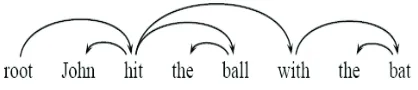
This section presents the modification of Passive-Aggressive Learning (PA) (Crammer et al., 2006) for dependency parsing. We modify the PA algo-rithm to deal with structured prediction, in which our problem is to learn a discriminant function that maps an input sentence x to a dependency tree y. Figure 1 shows an example of dependency parsing which depicts the relation of each word to another word within a sentence. There are some algorithms
Figure 1: This is an example of dependency tree
to determine these relations of each word to another words, for instance, the modified CKY algorithm (Eisner, 1996) is used to define these relations for a given sentence.
2.1 Parsing Algorithm
Dependency-tree parsing as the search for the maxi-mum spanning tree (MST) in a graph was proposed by McDonald et al. (2005b). In this subsection, we briefly describe the parsing algorithms based on the first-order MST parsing. Due to the limitation of participation time, we only applied the first-order decoding parsing algorithm in CONLL-2007. How-ever, our algorithm can be used for the second order parsing.
Let the generic sentence be denoted by x ; the
ith word of x is denoted by wi. The generic
de-pendency tree is denoted byy. Ifyis a dependency tree for sentencex, we write(i, j) ∈ y to indicate that there is a directed edge from wordxwi to word xwj in the tree, that is, xwi is the parent of xwj .
T ={(xt, yt)}nt=1denotes the training data. We
fol-low the edge based factorization method of Eisner (Eisner, 1996) and define the score of a dependency tree as the sum of the score of all edges in the tree,
s(x, y) = X
(i,j)∈y
s(i, j) = X
(i,j)∈y
w·Φ(i, j) (1)
where Φ(i, j) is a high-dimensional binary fea-ture representation of the edge from xwi to xwj .
For example in Figure 1, we can present an example
Φ(i, j)as follows;
Φ(i, j) = (
1 ifxwi =0 hit0and xwj =0ball0
0 otherwise
The basic question must be answered for models of this form: how to find the dependency treeywith
the highest score for sentencex? The two algorithms we employed in our dependency parsing model are the Eisner parsing (Eisner, 1996) and Chu-Liu’s al-gorithm (Chu and Liu, 1965). The alal-gorithms are commonly used in other online-learning dependency parsing, such as in (McDonald et al., 2005a).
In the next subsection we will address the problem of how to estimate the weightwi associated with a
feature Φi in the training data using an online PA learning algorithm.
2.2 Online PA Learning
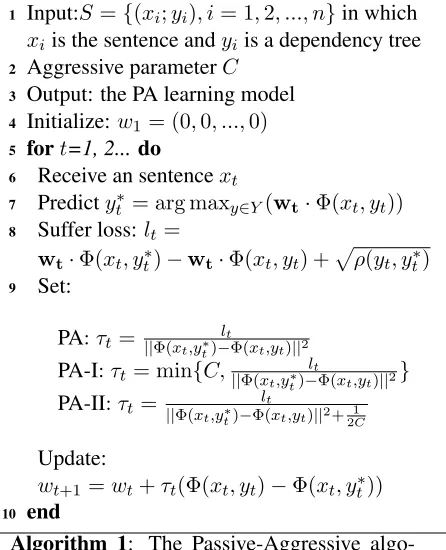
This section presents a modification of PA algo-rithm for structured prediction, and its use in de-pendency parsing. The Perceptron style for natural language processing problems as initially proposed by (Collins, 2002) can provide state of the art re-sults on various domains including text chunking, syntactic parsing, etc. The main drawback of the Perceptron style algorithm is that it does not have a mechanism for attaining the maximize margin of the training data. It may be difficult to obtain high accu-racy in dealing with hard learning data. The struc-tured support vector machine (Tsochantaridis et al., 2005) and the maximize margin model (Taskar et al., 2004) can gain a maximize margin value for given training data by solving an optimization problem (i.e quadratic programming). It is obvious that using such an optimization algorithm requires much com-putational time. For dependency parsing domain, McDonald et al (2005a) modified the MIRA learn-ing algorithm (McDonald et al., 2005a) for struc-tured domains in which the optimization problem can be solved by using Hidreth’s algorithm (Censor and Zenios, 1997), which is faster than the quadratic programming technique. In contrast to the previous method, this paper presents an online algorithm for dependency parsing in which we can attain the max-imize margin of the training data without using opti-mization techniques. It is thus much faster and eas-ier to implement. The details of PA algorithm for dependency parsing are presented below.
Assume that we are given a set of sentences xi
and their dependency treesyiwherei= 1, ..., n. Let
the feature mapping between a sentencexand a tree
y be: Φ(x, y) = Φ1(x, y),Φ2(x, y), ...,Φd(x, y)
where each feature mappingΦjmaps(x, y)to a real
asso-ciated with a weight value. The goal of PA learning for dependency parsing is to obtain a parameter w
that minimizes the hinge-loss function and the mar-gin of learning data.
Input:S={(xi;yi), i= 1,2, ..., n}in which
1
xiis the sentence andyiis a dependency tree
Aggressive parameterC 2
Output: the PA learning model
3
Initialize:w1 = (0,0, ...,0) 4
fort=1, 2...do
5
Receive an sentencext
6
Predicty∗
t = arg maxy∈Y(wt·Φ(xt, yt))
7
Suffer loss:lt=
8
wt·Φ(xt, y∗t)−wt·Φ(xt, yt) +
p
ρ(yt, yt∗)
Set:
9
PA:τt= lt
||Φ(xt,y∗t)−Φ(xt,yt)||2
PA-I:τt= min{C,||Φ(xt,y∗ lt
t)−Φ(xt,yt)||2}
PA-II:τt= ||Φ(xt,y∗ lt
t)−Φ(xt,yt)||2+21C
Update:
wt+1 =wt+τt(Φ(xt, yt)−Φ(xt, y∗t))
end
10
Algorithm 1: The Passive-Aggressive algo-rithm for dependency parsing.
Algorithm 1 shows the PA learning algorithm for dependency parsing in which its three variants are different only in the update formulas. In Algorithm 1, we employ two kinds of argmax algorithms: The first is the decoding algorithm for projective lan-guage data and the second one is for non-projective language data. Algorithm 1 shows (line 8)p(y, yt)
is a real-valued loss for the tree yt relative to the
correct tree y. We define the loss of a dependency tree as the number of words which have an incorrect parent. Thus, the largest loss a dependency tree can have is the length of the sentence. The similar loss function is designed for the dependency tree with la-beled. Algorithm 1 returns an averaged weight vec-tor: an auxiliary weight vectorv is maintained that accumulates the values ofwafter each iteration, and the returned weight vector is the average of all the weight vectors throughout training. Averaging has been shown to help reduce overfitting (McDonald et al., 2005a; Collins, 2002). It is easy to see that the
main difference between the PA algorithms and the Perceptron algorithm (PC) (Collins, 2002) as well as the MIRA algorithm (McDonald et al., 2005a) is in line 9. As we can see in the PC algorithm, we do not need the valueτtand in the MIRA algorithm we
need an optimization algorithm to computeτt. We
also have three updated formulations for obtaining
τt in Line 9. In the scope of this paper, we only
focus on using the second update formulation (PA-I method) for training dependency parsing data.
2.3 Feature Set
We denote p-word: word of parent node in depen-dency tree. c-word: word of child node. p-pos: POS of parent node. c-pos: POS of child node. p-pos+1: POS to the right of parent in sentence. p-pos-1: POS to the left of parent. c-pos+1: POS to the right of child. c-pos-1: POS to the left of child. b-pos: POS of a word in between parent and child nodes. The
p-word,p-pos p-word p-pos
[image:3.612.75.298.134.409.2]c-word, c-pos c-word c-pos
Table 1: Feature Set 1: Basic Unit-gram features p-word, p-pos, c-word, c-pos
p-pos, c-word, c-pos p-word, c-word, c-pos p-word, p-pos, c-pos p-word, p-pos, c-word p-word, c-word p-pos, c-pos
Table 2: Feature Set 2: Basic bi-gram features p-pos, b-pos, c-pos
p-pos, p-pos+1, c-pos-1, c-pos p-pos-1, p-pos, c-pos-1, c-pos p-pos, p-pos+1, c-pos, c-pos+1 p-pos-1, p-pos, c-pos, c-pos+1
Table 3: Feature Set 3: In Between POS Features and Surrounding Word POS Features
features used in our system are described below.
features are added for entire words as well as for the 5-gram prefix if the word is longer than 5 characters.
• In addition to these features shown in Table 1, the morphological information for each pair of words p-word and c-word are represented. In addition, we also add the conjunction morpho-logical information of p-word and c-word. We do not use the LEMMA and CPOSTAG infor-mation in our set features. The morphological information are obtained from FEAT informa-tion.
• Table 3 shows our Feature set 3 which take the form of a POS trigram: the POS of the par-ent, of the child, and of a word in between, for all words linearly between the parent and the child. This feature was particularly helpful for nouns identifying their parent (McDonald et al., 2005a).
• Table 3 also depicts these features taken the form of a POS 4-gram: The POS of the par-ent, child, word before/after parent and word before/after child. The system also used back-off features with various trigrams where one of the local context POS tags was removed.
• All features are also conjoined with the direc-tion of attachment, as well as the distance be-tween the two words being attached.
3 Experimental Results and Discussion
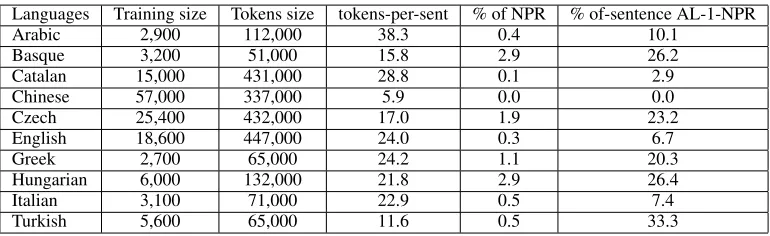
We test our parsing models on the CONLL-2007 (Hajiˇc et al., 2004; Aduriz et al., 2003; Mart´ı et al., 2007; Chen et al., 2003; B¨ohmov´a et al., 2003; Marcus et al., 1993; Johansson and Nugues, 2007; Prokopidis et al., 2005; Csendes et al., 2005; Mon-temagni et al., 2003; Oflazer et al., 2003) data set on various languages including Arabic, Basque, Cata-lan, Chinese, English, Italian, Hungarian, and Turk-ish. Each word is attached by POS tags for each sen-tence in both the training and the testing data. Table 4 shows the number of training and testing sentences for these languages. The table shows that the sen-tence length in Arabic data is largest and its size of training data is smallest. These factors might be
af-fected to the accuracy of our proposed algorithm as we will discuss later.
The training and testing were conducted on a pen-tium IV at 4.3 GHz. The detailed information about the data are shown in the CONLL-2007 shared task. We applied non-projective and projective parsing along with PA learning for the data in CONLL-2007. Table 5 reports experimental results by using the first order decoding method in which an MST pars-ing algorithm (McDonald et al., 2005b) is applied for non-projective parsing and the Eisner’s method is used for projective language data. In fact, in our method we applied non-projective parsing for the Italian data, the Turkish data, and the Greek data. This was because we did not have enough time to train all training data using both projective and non-projective parsing. This is the problem of discrimi-native learning methods when performing on a large set of training data. In addition, to save time in train-ing we set the number of best treesk to 1 and the parameterCis set to 0.05.
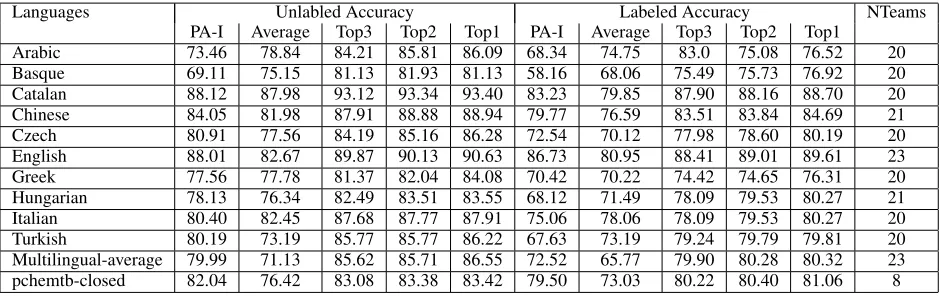
Table 5 shows the comparison of the proposed method with the average, and three top systems on the CONLL-2007. As a result, our method yields results above the average score on the CONLL-2007 shared task (Nivre et al., 2007).
Table 5 also indicates that the Basque results ob-tained a lower score than other data. We obob-tained 69.11 UA score and 58.16 LA score, respectively. These are far from the results of the Top3 scores (81.13 and 75.49). We checked the outputs of the Basque data to understand the main reason for the errors. We see that the errors in our methods are usually mismatched with the gold data at the labels ”ncmod” and ”ncsubj”. The main reason might be that the application of projective parsing for this data in both training and testing is not suitable. This was because the number of sentences with at least 1 non projective relation in the data is large (26.1).
Languages Training size Tokens size tokens-per-sent % of NPR % of-sentence AL-1-NPR
Arabic 2,900 112,000 38.3 0.4 10.1
Basque 3,200 51,000 15.8 2.9 26.2
Catalan 15,000 431,000 28.8 0.1 2.9
Chinese 57,000 337,000 5.9 0.0 0.0
Czech 25,400 432,000 17.0 1.9 23.2
English 18,600 447,000 24.0 0.3 6.7
Greek 2,700 65,000 24.2 1.1 20.3
Hungarian 6,000 132,000 21.8 2.9 26.4
Italian 3,100 71,000 22.9 0.5 7.4
[image:5.612.114.499.59.177.2]Turkish 5,600 65,000 11.6 0.5 33.3
Table 4: The data used in the multilingual track (Nivre et al., 2007). NPR means non-projective-relations. AL-1-NPR means at-least-least 1 non-projective relation.
problem in our method. Table 5 also shows the com-parison of our system to the average score and the Top3 scores. It depicts that our system is accurate in English data, while it has low accuracy in Basque and Arabic data.
We also evaluate our models in the domain adap-tation tasks. This task is to adapt our model trained on PennBank data to the test data in the Biomedical domain. The pchemtb-closed shared task (Marcus et al., 1993; Johansson and Nugues, 2007; Kulick et al., 2004) is used to illustrate our models. We do not use any additional unlabeled data in the Biomed-ical domain. Only the training data in the PennBank is used to train our model. Afterward, we selected carefully a suitable parameter using the development test set. We set the parameter C to 0.01 and se-lect the non projective parsing for testing to obtain the highest result in the development data after per-forming several experiments. After that, the trained model was used to test the data in Biomedical do-main. The score (UA=82.04; LA=79.50) shows that our method yields results above the average score (UA=76.42; LA=73.03). In addition, it is officially coming in 4th place out of 12 teams and within 1.5% of the top systems.
The good result of performing our model in an-other domain suggested that the PA learning seems sensitive to noise. We hope that this problem is solved in future work.
4 Conclusions
This paper presents an online algorithm for depen-dency parsing problem which have tested on various language data in CONLL-2007 shared task. The per-formance in English data is close to the Top3 score.
We also perform our algorithm on the domain adap-tation task, in which we only focus on the training of the source data and select a suitable parameter using the development set. The result is very good as it is close to the Top3 score of participating systems. Future work will also be focused on extending our method to a version of using semi-supervised learn-ing that can efficiently be learnt by uslearn-ing labeled and unlabeled data. We hope that the application of the PA algorithm to other NLP problems such as seman-tic parsing will be explored in future work.
Acknowledgments
We would like to thank D. Yuret for his helps in checking errors of my parser’s outputs. We would like to thank Vinh-Van Nguyen his helps during the revision process and Mary Ann Mooradian for cor-recting the paper.
We would like to thank to anonymous review-ers for helpful discussions and comments on the manuscript. Thank also to Sebastian Riedel for checking the issues raised in the reviews.
The work on this paper was supported by a Mon-bukagakusho 21st COE Program.
References
A. Abeill´e, editor. 2003.Treebanks: Building and Using Parsed Corpora. Kluwer.
Languages Unlabled Accuracy Labeled Accuracy NTeams PA-I Average Top3 Top2 Top1 PA-I Average Top3 Top2 Top1
Arabic 73.46 78.84 84.21 85.81 86.09 68.34 74.75 83.0 75.08 76.52 20
Basque 69.11 75.15 81.13 81.93 81.13 58.16 68.06 75.49 75.73 76.92 20 Catalan 88.12 87.98 93.12 93.34 93.40 83.23 79.85 87.90 88.16 88.70 20 Chinese 84.05 81.98 87.91 88.88 88.94 79.77 76.59 83.51 83.84 84.69 21
Czech 80.91 77.56 84.19 85.16 86.28 72.54 70.12 77.98 78.60 80.19 20
English 88.01 82.67 89.87 90.13 90.63 86.73 80.95 88.41 89.01 89.61 23
Greek 77.56 77.78 81.37 82.04 84.08 70.42 70.22 74.42 74.65 76.31 20
[image:6.612.72.542.61.209.2]Hungarian 78.13 76.34 82.49 83.51 83.55 68.12 71.49 78.09 79.53 80.27 21 Italian 80.40 82.45 87.68 87.77 87.91 75.06 78.06 78.09 79.53 80.27 20 Turkish 80.19 73.19 85.77 85.77 86.22 67.63 73.19 79.24 79.79 79.81 20 Multilingual-average 79.99 71.13 85.62 85.71 86.55 72.52 65.77 79.90 80.28 80.32 23 pchemtb-closed 82.04 76.42 83.08 83.38 83.42 79.50 73.03 80.22 80.40 81.06 8
Table 5: Dependency accuracy in the CONLL-2007 shared task.
A. B¨ohmov´a, J. Hajiˇc, E. Hajiˇcov´a, and B. Hladk´a. 2003. The PDT: a 3-level annotation scenario. In Abeill´e (Abeill´e, 2003), chapter 7, pages 103–127.
Y. Censor and S.A. Zenios. 1997. Parallel optimization: theory, algorithms, and applications. In Oxford Uni-versity Press.
K. Chen, C. Luo, M. Chang, F. Chen, C. Chen, C. Huang, and Z. Gao. 2003. Sinica treebank: Design criteria, representational issues and implementation. In Abeill´e (Abeill´e, 2003), chapter 13, pages 231–248.
Y.J. Chu and T.H. Liu. 1965. On the shortest arbores-cence of a directed graph. InScience Sinica.
M. Collins. 2002. Discriminative training methods for hidden markov models: Theory and experiments with perceptron algorithms. InProceedings of EMNLP.
S. Corston-Oliver, A. Aue, K. Duh, , and E. Ringger. 2006. Multilingual dependency parsing using bayes point machines. InProceedings of HLT/NAACL.
K. Crammer and Y. Singer. 2003. Ultraconservative on-line algorithms for multiclass problems. Journal of Machine Learning Research, 3:951–991.
K. Crammer, O. Dekel, J. Keshet, S.Shalev-Shwartz, and Y. Singer. 2006. Online passive-aggressive al-gorithms. Journal of Machine Learning Research, 7:581–585.
D. Csendes, J. Csirik, T. Gyim´othy, and A. Kocsor. 2005.
The Szeged Treebank. Springer.
J. Eisner. 1996. Three new probabilistic models for de-pendency parsing: An exploration. InProceedings of COLING 1996, pages 340–345.
J. Hajiˇc, O. Smrˇz, P. Zem´anek, J. ˇSnaidauf, and E. Beˇska. 2004. Prague Arabic dependency treebank: Develop-ment in data and tools. InProc. of the NEMLAR In-tern. Conf. on Arabic Language Resources and Tools, pages 110–117.
R. Johansson and P. Nugues. 2007. Extended constituent-to-dependency conversion for English. In
Proc. of the 16th Nordic Conference on Computational Linguistics (NODALIDA).
S. Kulick, A. Bies, M. Liberman, M. Mandel, R. Mc-Donald, M. Palmer, A. Schein, and L. Ungar. 2004. Integrated annotation for biomedical information ex-traction. In Proc. of the Human Language Technol-ogy Conference and the Annual Meeting of the North American Chapter of the Association for Computa-tional Linguistics (HLT/NAACL).
M. Marcus, B. Santorini, and M. Marcinkiewicz. 1993. Building a large annotated corpus of English: the Penn Treebank. Computational Linguistics, 19(2):313–330.
M. A. Mart´ı, M. Taul´e, L. M`arquez, and M. Bertran. 2007. CESS-ECE: A multilingual and multilevel annotated corpus. Available for download from: http://www.lsi.upc.edu/∼mbertran/cess-ece/.
R. McDonald, K. Cramer, and F. Pereira. 2005a. On-line large-margin training of dependency parsers. In
Proceedings of ACL.
R. McDonald, F. Pereira, K. Ribarov, and J. Hajiˇc. 2005b. Non-projective dependency parsing using spanning tree algorithms. In Proc. of the Human Language Technology Conf. and the Conf. on Empirical Meth-ods in Natural Language Processing (HLT/EMNLP), pages 523–530.
R. McDonald, K. Crammer, and F. Pereira. 2006. Multi-lingual dependency parsing with a two-stage discrim-inative parser. In Conference on Natural Language Learning.
R. Delmonte. 2003. Building the Italian Syntactic-Semantic Treebank. In Abeill´e (Abeill´e, 2003), chap-ter 11, pages 189–210.
J. Nivre, J. Hall, J. Nilsson, G. Eryi˘git, and S. Marinov. 2006. Labeled pseudo-projective dependency parsing with support vector machines. InProc. of the Tenth Conf. on Computational Natural Language Learning (CoNLL), pages 221–225.
J. Nivre, J. Hall, S. K¨ubler, R. McDonald, J. Nils-son, S. Riedel, and D. Yuret. 2007. The CoNLL 2007 shared task on dependency parsing. In Proc. of the CoNLL 2007 Shared Task. Joint Conf. on Em-pirical Methods in Natural Language Processing and Computational Natural Language Learning (EMNLP-CoNLL).
K. Oflazer, B. Say, D. Zeynep Hakkani-T¨ur, and G. T¨ur. 2003. Building a Turkish treebank. In Abeill´e (Abeill´e, 2003), chapter 15, pages 261–277.
P. Prokopidis, E. Desypri, M. Koutsombogera, H. Papa-georgiou, and S. Piperidis. 2005. Theoretical and practical issues in the construction of a Greek depen-dency treebank. InProc. of the 4th Workshop on Tree-banks and Linguistic Theories (TLT), pages 149–160.
B. Taskar, D. Klein, M. Collins, D. Koller, and C.D. Man-ning. 2004. Max-margin parsing. Inproceedings of EMNLP.
I. Tsochantaridis, T. Hofmann, T. Joachims, and Y. Altun. 2005. Support vector machine learning for interde-pendent and structured output spaces. Inproceedings ICML 2004.