Animacy Detection with Voting Models
Joshua L. Moore∗
Dept. Computer Science Cornell University
Ithaca, NY 14853 [email protected]
Christopher J.C. Burges Erin Renshaw Wen-tau Yih
Microsoft Research One Microsoft Way Redmond, WA 98052
{cburges, erinren, scottyih} @microsoft.com
Abstract
Animacy detection is a problem whose solu-tion has been shown to be beneficial for a number of syntactic and semantic tasks. We present a state-of-the-art system for this task which uses a number of simple classifiers with heterogeneous data sources in a voting scheme. We show how this framework can give us direct insight into the behavior of the system, allowing us to more easily diagnose sources of error.
1 Introduction
Animacy detection has proven useful for a va-riety of syntactic and semantic tasks, such as anaphora and coreference resolution (Orˇasan and Evans, 2007; Lee et al., 2013), verb argument dis-ambiguation (Dell’Orletta et al., 2005) and depen-dency parsing (Øvrelid and Nivre, 2007). Existing approaches for animacy detection typically rely on two types of information: linguistic databases, and syntactic cues observed from the corpus. They usu-ally combine two types of approaches: rule based systems, and machine learning techniques. In this paper we explore a slightly different angle: we wish to design an animacy detector whose decisions are
interpretable and correctable, so that downstream
semantic modeling systems can revisit those deci-sions as needed. Thus here, we avoid defining a large number of features and then using a ma-chine learning method such as boosted trees, since such methods, although powerful, result in hard-to-interpret systems. Instead, we explore combining interpretable voting models using machine learning
∗
Work performed while visiting Microsoft Research.
only to reweight their votes. We show that such an approach can indeed result in a high perform-ing system, with animacy detection accuracies in the mid 90% range, which compares well with other re-ported rates. Ensemble methods are well known (see for example, Dietterich (2000)) but our focus here is on using them for interpretability while still main-taining accuracy.
2 Previous Work
2.1 Definitions of Animacy
Previous work uses several different definitions of animacy. Orˇasan and Evans (2007) define animacy in the service of anaphora resolution: an NP is con-sidered animate “if its referent can also be referred to using one of the pronouns he, she, him, her, his, hers, himself, herself, or a combination of such pro-nouns (e.g. his/her )”. Although useful for the task at hand, this has counterintuitive consequences: for example,babymay be considered animate or inan-imate, and ant is considered inanimate (Ibid., Fig-ure 1). Others have argued that animacy should be captured by a hierarchy or by categories (Aissen, 2003; Silverstein, 1986). For instance, Zaenen et al. (2004) propose three levels of animacy (human,
other animateandinanimate), which cover ten
cat-egories of noun phrases, with catcat-egories like ORG (organization), ANIM (animal) and MAC (intelli-gent machines such as robots) categorised asother
animate. Bowman and Chopra (2012) report results
for animacy defined both this way and with the cat-egories collapsed to a binary (animate, inanimate) definition.
2.2 Methods for Animacy Detection
Evans and Orˇasan (2000) propose a rule-based sys-tem based on the WordNet taxonomy (Fellbaum, 1998). Each synset is ascribed a binary animacy label based on its unique beginner. A given noun is then associated with the fraction of its animate synsets (where all synsets are taken to be animate or inanimate) and one minus that fraction, similarly for a given verb. Animacy is then ascribed by ap-plying a series of rules imposing thresholds on those fractions, together with rules (and a gazetteer) to de-tect names and acronyms, and a rule triggered by the occurrence ofwho, or reflexives, in the NP. In later work, Orˇasan and Evans (2007) extend the algorithm by propagating animacy labels in the WordNet graph using a chi-squared test, and then apply ak-nearest neighbor classifier based on four lexical features. In their work, the only context used was the animacy of the verb in the NP, for heads of subject NPs (e.g., the subject ofeatis typically animate). Øvrelid (2009) and Bowman and Chopra (2012) extend this idea by using dependency relations to generate features for their classifier, enabled by corpora created by Zae-nen et al. (2004). In another approach, Ji and Lin (2009) apply a simple “relative-pronoun” pattern to the Googlen-gram corpus (Brants and Franz, 2006) to assign animacy (see the List model in Section 5 for details). Although the animacy decision is again context-independent, such a list provides a strong baseline and thus benefit applications like anaphora resolution (Lee et al., 2013).
3 The Task
We adopt a definition of animacy closest to the bi-nary version in Bowman and Chopra (2012): we define an entity to be animate if it is alive and has the ability to move under its own will. We adopt this simple definition because it fits well with the common meaning and is therefore less error prone, both in terms of incorporation into higher level mod-els, and for labeling (Orˇasan and Evans (2007) re-port that the labeling of animacy tuned for anaphora proved challenging for the judges). We also ap-ply the label to single noun tokens where possible: the only exceptions are compound names (“Sarah
Jones”) which are treated as single units. Thus,
for example, “puppy food” is treated as two words,
with puppy animate and food inanimate. A more
complete definition would extend this to all noun phrases, so thatpuppy foodas a unit would be inan-imate, a notion we plan to revisit in future work. Note that even this simple definition presents chal-lenges, so that a binary label must be applied de-pending on the predominant meaning. In “A plate of chicken,” chickenis treated as inanimate since it refers to food. In “Caruso (1873-1921) is consid-ered one of the world’s best opera singers. He...,” although at the time of writing clearlyCaruso was not alive, the token is still treated as animate here because the subsequent writing refers to a live per-son.
4 The Data
We used the MC160 dataset, which is a subset of the MCTest dataset and which is composed of 160 grade level reading comprehension stories generated using crowd sourcing (Richardson et al., 2013). Workers were asked to write a short story (typically less than 300 words) with a target audience of 5 to 7 year olds. The available vocabulary was limited to ap-proximately 8000 words, to model the reading abil-ity of a first or second grader. We labeled this data for animacy using the definition given above. The first 100 of the 160 stories were used as the training set, and the remaining 60 were used for the test set. These animacy labels will be made available on the web site for MCTest (Richardson et al., 2013).
5 The Models
Since one of our key goals is interpretability we chose to use an ensemble of simple voting models. Each model is able to vote for the categories Ani-mal, Person,Inanimate, or to abstain. The distinc-tion betweenAnimalandPersonis only used when we combine votes, whereAnimal andPersonvotes appear as distinct inputs for the final voting combi-nation model. Some voters do not distinguish be-tweenPersonandAnimal, and vote for Animateor
Inanimate. Our models are:
in the list is classified asInanimate. This voter ab-stains when the noun is not present in the list.
Anaphora Design: The WordNet-based approach of Evans and Orˇasan (2000).
WordNet: A simple approach using WordNet. This voter choosesAnimal or Personif the unique beginner of the first synset of the noun is either of these, andInanimateotherwise.
WordSim: This voter uses the contextual vector space model of Yih and Qazvinian (2012) computed using Wikipedia and LA Times data. It uses short lists of hand-chosen signal words for the categories
Animal, Person, and Inanimate to produce a
“re-sponse” of the word to each category. This response is equal to the maximum cosine similarity in the vec-tor space of the query word to any signal word in the category. The final vote goes to the category with the highest response.
Name: We used an in-house named entity tagger. This voter can recognize some inanimate entities such as cities, but does not distinguish between peo-ple and animals, and so can only voteAnimate, Inan-imateorAbstain.
Dictionaries: We use three different dictionary sources (Simple English Wiktionary, Full English Wiktionary, and the definitions found in Word-Net) with a recursive dictionary crawling algorithm. First, we fetch the first definition of the query and use a dependency tree and simple heuristics to find the head noun of the definition, ignoring qualifica-tion NPs like “piece” or “member.” If this noun belongs to a list of per-category signal words, the voter stops and votes for that category. Otherwise, the voter recursively runs on the found head noun. To prevent cycling, if no prediction is made after 10 recursive lookups, the voter abstains.
Transfer: For each story, we first process each sentence and detect instances of the patterns x
am/is/was/are/were y and y named x. In each of
these cases, we use majority vote of the remaining voters to predict the animacy of y and transfer its vote to x, applying this label (as a vote) to all instances ofxin the text.
The WordSim andDictionariesvoters share lists
of signal words, which were chosen early in the ex-perimental process using the training set. The sig-nal words for theAnimalcategory wereanimaland
mammal1. Personcontainspersonandpeople.
Fi-nally, Inanimate uses thing, object, space, place,
symbol,food,structure,sound,measure, andunit. We considered two methods for combining vot-ers: majority voting (where the reliableNamevoter overrides the others if it does not abstain) and a lin-ear reweighting of votes. In the reweighting method, a feature vector is formed from the votes. Except
for WordSim, this vector is an indicator vector of
the vote – either Animal, Person, Animate (if the voter doesn’t distinguish between animals and peo-ple),Inanimate, orAbstain.
For Dictionaries, the vector’s non-zero
compo-nent is multiplied by the number of remaining al-lowed recursive calls that can be performed, plus one (so that a success on the final lookup gives a 1). For example, if the third lookup finds a signal word and choosesAnimal, then the component corresponding toAnimalwill have a value of 9.
For WordSim, instead of an indicator vector, the
responses to each category are used, or an indica-tor for abstain if the model does not contain the word. If the word is in the model, a second vec-tor is appended containing the ratio of the maximum response to the second-largest response in the com-ponent for the maximum response category. These per-voter feature vectors are concatenated to form a 35 dimensional vector, and a linear SVM is trained to obtain the weights for combining the votes.
6 Results
We used the POS tagger in MSR SPLAT (Quirk et al., 2012) to extract nouns from the stories in the MC160 dataset and used these as labeled examples for the SVM. This resulted in 5,120 extracted nouns in the 100 training stories and 3,009 in the 60 test stories. We use five-fold cross-validation on the training set to select the SVM parameters. 57.2% of the training examples were inanimate, as were 58.1% of the test examples.
Table 1 gives the test accuracy of each voter. List
1This was found to work well given typical dictionary
List Anaphora WNet WSim Dict Name 84.6 77.1 78.8 57.6 74.3 16.0
Table 1: Accuracy of various individual voters on the test set. Abstentions are counted as errors. Note thatTransfer
depends on a secondary source for classification, and is therefore not listed here.
Majority SVM N+WN+D+WS+AD+L 87.7 95.0
N+WN+WS 80.1 95.0
N+WN+D+WS+AD+L+T 87.4 95.0
N+WN+D+WS 86.4 94.8
N+WN+WS+AD+L 86.5 94.7 N+WN+D+WS+T 86.8 94.0
N+WN+D 86.1 93.7
N+WN 89.3 93.0
N+D 82.6 93.0
N+AD 87.6 89.4
N+L 85.4 88.9
Table 2: Accuracy of various combinations of voters among Name (N), Anaphora Design (AD), List (L), WordNet (WN), WordSim (WS), Dictionary (D), and Transfer (T) under majority voting and SVM schemes. Bold indicates a statistically significant difference over the next lower bolded entry withp <0.01, for the SVM.
comes out on top when taken alone, but we see in later results that it is less critical when used with other voters. Nameperforms poorly on its own, but later we will see that it is a very accurate voter which frequently abstains.
Table 2 gives the test performance of various com-binations of voters, both under majority vote and reweighting. Statistical significance was tested us-ing a paired t-test, and bold indicates a method was significant over the next lower bold line with
p value p < 0.01. We see a very large gain from the SVM reweighting: 14.9 points in the case of
Name+WordNet+WordSim.
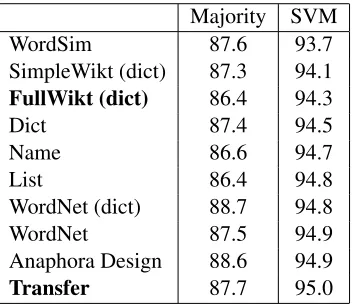
In Table 3, we show the results of ablation exper-iments on the voters. We see that the most valuable sources of information areWordSimand Dictionar-ies.
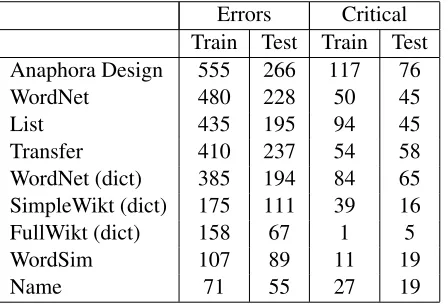
Finally, in Table 4, we show a breakdown of which voters cause the most errors, for the majority vote system. In this table, we considered only “fi-nal errors,” i.e. errors that the entire system makes. Over all such errors, we counted the number of times
Majority SVM WordSim 87.6 93.7 SimpleWikt (dict) 87.3 94.1
FullWikt (dict) 86.4 94.3
Dict 87.4 94.5
Name 86.6 94.7
List 86.4 94.8
WordNet (dict) 88.7 94.8 WordNet 87.5 94.9 Anaphora Design 88.6 94.9
[image:4.612.80.296.148.312.2]Transfer 87.7 95.0
Table 3: Test accuracy when leaving out various voters, using both majority vote and and reweighting. Bold indi-cates statistical significance over the next lower bold line withp <0.01.
each voter chose incorrectly, giving a count of how many times each voter contributed to a final error. We see that the Anaphora Design system has the largest number of errors on both train and test sets. After this,WordNet,List, andWordNet (dict)are also large sources of error. On the other hand,Nameand
WordSim have very few errors, indicating high
re-liability. The table also gives the number of criti-cal errors, where the voter selected the wrong cate-goryandwas a deciding vote (that is, when chang-ing its vote would have resulted in a correct overall classification). We see a similar pattern here, with
Anaphora Designcausing the most errors and
Word-SimandNameamong the most reliable. We included
Anaphora Designeven though it uses a different def-inition of animacy, to determine if its vote was nev-ertheless valuable.
Error tables such as these show how voting mod-els are more interpretableand therefore correctable
compared to more complex learned models. The ta-bles indicate the largest sources of error and sug-gest changes that could be made to increase accu-racy. For example, we could make significant gains by improving WordNet, WordNet (dictionary), or
List, whereas there is relatively little reason to
ad-justWordSimorName.
7 Conclusions
Errors Critical Train Test Train Test Anaphora Design 555 266 117 76 WordNet 480 228 50 45
List 435 195 94 45
Transfer 410 237 54 58 WordNet (dict) 385 194 84 65 SimpleWikt (dict) 175 111 39 16 FullWikt (dict) 158 67 1 5 WordSim 107 89 11 19
[image:5.612.76.300.60.212.2]Name 71 55 27 19
Table 4: Errorscolumn: number of errors on train and test where a source voted incorrectly, and was thus at least in part responsible for an error of the overall sys-tem. Criticalcolumn: number of errors on train and test where a source voted incorrectly, and in addition cast a deciding vote. Results are for majority vote.
by using the n-gram method of (Ji and Lin, 2009), which is used as an animacy detection component in other systems. In this sense the work presented here improves upon the state of the art, but there are caveats, since other workers define animacy differ-ently and so a direct comparison with their work is not possible. Our method has the added advantage of interpretability, which we believe will be useful when using it as a component in a larger system.
Acknowledgments
We wish to thank Andrzej Pastusiak for his help with the labeling tool.
References
Judith Aissen. 2003. Differential object marking: Iconicity vs. economy. Natural Language & Linguis-tic Theory, 21(3):435–483.
Samuel Bowman and Harshit Chopra. 2012. Automatic animacy classification. InProceedings of the NAACL-HLT 2012 Student Research Workshop.
Thorsten Brants and Alex Franz. 2006. Web 1T 5-gram Version 1. Linguistic Data Consortium.
Felice Dell’Orletta, Alessandro Lenci, Simonetta Monte-magni, and Vito Pirrelli. 2005. Climbing the path to grammar: a maximum entropy model of subject/object learning. In Proceedings of the Workshop on Psy-chocomputational Models of Human Language Acqui-sition, PMHLA ’05, pages 72–81, Stroudsburg, PA, USA. Association for Computational Linguistics.
Thomas G. Dietterich. 2000. Ensemble methods in ma-chine learning. InMultiple Classifier Systems, pages 1–15.
Richard Evans and Constantin Orˇasan. 2000. Improv-ing anaphora resolution by identifyImprov-ing animate entities in texts. In Proceedings of the Discourse Anaphora and Reference Resolution Conference (DAARC2000), pages 154–162.
Christiane Fellbaum. 1998. WordNet: An Electronic Lexical Database. The MIT Press.
Heng Ji and Dekang Lin. 2009. Gender and animacy knowledge discovery from Web-scalen-grams for un-supervised person mention detection. InProceedings of the 23rd Pacific Asia Conference on Language, In-formation and Computation, pages 220–229, Hong Kong, December. City University of Hong Kong. Heeyoung Lee, Angel Chang, Yves Peirsman, Nathanael
Chambers, Mihai Surdeanu, and Dan Jurafsky. 2013. Deterministic coreference resolution based on entity-centric, precision-ranked rules. Computational Lin-guistics, 39(4).
Constantin Orˇasan and Richard J. Evans. 2007. NP an-imacy identification for anaphora resolution. Journal of Artificial Intelligence Research (JAIR), 29:79–103. Lilja Øvrelid and Joakim Nivre. 2007. When word
or-der and part-of-speech tags are not enough – Swedish dependency parsing with rich linguistic features. In
Proceedings of the International Conference on Recent Advances in Natural Language Processing (RANLP), pages 447–451.
Lilja Øvrelid. 2009. Empirical evaluations of animacy annotation. InProceedings of the 12th Conference of the European Chapter of the Association for Compu-tational Linguistics (EACL).
Chris Quirk, Pallavi Choudhury, Jianfeng Gao, Hisami Suzuki, Kristina Toutanova, Michael Gamon, Wen-tau Yih, Colin Cherry, and Lucy Vanderwende. 2012. MSR SPLAT, a language analysis toolkit. In Proceed-ings of the Demonstration Session at the Conference of the North American Chapter of the Association for Computational Linguistics: Human Language Tech-nologies, pages 21–24, Montr´eal, Canada, June. As-sociation for Computational Linguistics.
Matthew Richardson, Chris Burges, and Erin Renshaw. 2013. MCTest: A challenge dataset for the open-domain machine comprehension of text. In Confer-ence on Empirical Methods in Natural Language Pro-cessing (EMNLP).
Michael Silverstein. 1986. Hierarchy of features and ergativity. In P. Muysken and H. van Riemsdijk, ed-itors,Features and Projections, pages 163–232. Foris Publications Holland.
models. In Proceedings of NAACL-HLT, pages 616– 620, Montr´eal, Canada, June.